
SOC 2 Certification in Pennsylvania
SOC 2 Certification in Pennsylvania is issued by a Licensed CPA Firm following an independent examination conducted under AICPA AT-C Section 205 standards. The examination evaluates whether an organization’s controls meet the applicable Trust Services Criteria — Security, Availability, Confidentiality, Processing Integrity, and Privacy — across a defined service or system scope. The SOC 2 certification decision is independent, evidence-based, and governed by AICPA standards, not by management representation or self-assessment.
OUR CLIENTS










Independent SOC 2 Certification by a Licensed CPA Firm in Pennsylvania
SOC 2 Certification in Pennsylvania is governed exclusively by the American Institute of Certified Public Accountants (AICPA) and is issued only by a Licensed CPA Firm authorized to perform attestation engagements. Unlike self-assessment frameworks or vendor-administered certifications, SOC 2 attestation requires an independent third-party examination conducted under formally defined professional standards.
The SOC 2 examination evaluates whether an organization’s internal controls are suitably designed and, in the case of Type 2 reports, operating effectively over a defined review period. This independence is foundational to the credibility of the SOC 2 attestation report and cannot be achieved through self-certification or internal assessment alone.
Pennsylvania’s technology and services economy encompasses a broad range of organizations that handle sensitive customer data — including healthcare systems, financial services institutions, life sciences firms, SaaS providers, cloud infrastructure companies, and enterprise software developers. Each of these sectors operates under heightened cybersecurity governance expectations from enterprise clients, regulators, and procurement teams.
SOC 2 Certification in Pennsylvania has become the recognized standard for demonstrating independent verification of security controls. Enterprise buyers, healthcare partners, and regulated-sector customers increasingly require formal third-party assurance before onboarding service providers, making SOC 2 attestation a baseline requirement in many procurement processes.
The SOC 2 examination is performed without advisory, consulting, or implementation involvement by the certifying Licensed CPA Firm. This separation preserves the independence required for an objective attestation outcome under AICPA standards. The Licensed CPA Firm’s role is strictly evaluative — reviewing evidence, testing controls, identifying exceptions, and issuing a formal opinion on whether the organization’s controls meet the applicable Trust Services Criteria within the defined scope.
Pennsylvania organizations that engage a Licensed CPA Firm for SOC 2 attestation receive a formal report that can be shared with customers, partners, and regulators as evidence of independent control verification.
AICPA Standards Governing SOC 2 Examinations
SOC 2 examinations are performed under AICPA AT-C Section 205, which establishes the standards for examination engagements. This framework requires the Licensed CPA Firm to obtain sufficient, appropriate evidence to support the opinion expressed in the SOC 2 attestation report. The examination standards define the nature, timing, and extent of procedures the auditor must perform — including inquiry, observation, inspection of documentation, and re-performance of controls.
These professional standards are mandatory for all Licensed CPA Firms issuing SOC 2 attestation reports and apply uniformly regardless of organization size, industry sector, or the specific Trust Services Criteria being evaluated.
The AICPA Trust Services Criteria (TSC) provide the measurement framework against which controls are evaluated during a SOC 2 examination. The Security criterion — also known as the Common Criteria — is mandatory for all SOC 2 engagements. Organizations in Pennsylvania may additionally select Availability, Confidentiality, Processing Integrity, and Privacy criteria based on their service commitments, contractual obligations, and customer requirements.
Each additional criterion adds specific control requirements that the Licensed CPA Firm must evaluate, expanding both the scope of evidence collection and the depth of control testing required during the SOC 2 audit.
Pennsylvania Regulatory Context and Cross-Sector Demand
Pennsylvania’s regulatory environment encompasses several overlapping frameworks that drive demand for independent security assurance. Healthcare organizations in the Commonwealth are subject to HIPAA Security Rule requirements, and many enterprise healthcare buyers require SOC 2 attestation as evidence that service providers maintain appropriate administrative, physical, and technical safeguards.
Financial services organizations in Philadelphia and Pittsburgh operate under state banking regulations, federal oversight from the Office of the Comptroller of the Currency (OCC), and customer-driven vendor risk management programs that specify SOC 2 compliance as a procurement requirement. Life sciences firms, university-affiliated research organizations, and government contractors also face sector-specific data protection mandates that align with SOC 2 compliance standards.
Pennsylvania’s position as a major U.S. technology hub — with significant concentrations of enterprise software companies in the Philadelphia metropolitan area and growing technology corridors in Pittsburgh, Harrisburg, and the broader mid-Atlantic region — creates sustained enterprise demand for SOC 2 attestation. Pennsylvania-based SaaS providers seeking to expand into regulated industries, serve federal agencies, or penetrate enterprise markets routinely encounter SOC 2 certification requirements embedded in vendor qualification questionnaires, master service agreements, and security addenda.
The SOC 2 examination Pennsylvania organizations undergo positions them to meet these procurement requirements with a formally issued attestation report from a Licensed CPA Firm.
Type 1 and Type 2 SOC 2 Reports: Key Distinctions
SOC 2 examinations produce one of two report types, each serving distinct assurance purposes. A SOC 2 Type 1 report reflects an examination of control design as of a specific point in time — typically the date on which the examination concludes. The Licensed CPA Firm evaluates whether the described controls are suitably designed to meet the selected Trust Services Criteria at that moment.
A SOC 2 Type 2 report, by contrast, covers an extended review period — commonly six to twelve months — during which the Licensed CPA Firm tests whether controls operated effectively and consistently throughout the period. Enterprise customers, financial institutions, and regulated-sector buyers in Pennsylvania and nationally generally prefer Type 2 reports because operating effectiveness over time provides stronger assurance than design assessment alone.
| Report Type | Examination Focus | Review Period | Typical Use Case |
|---|---|---|---|
| SOC 2 Type 1 | Control design suitability | Point in time | Initial vendor qualification or first-time SOC 2 certification |
| SOC 2 Type 2 | Control design and operating effectiveness | 6–12 months | Ongoing enterprise procurement and regulatory assurance |
| SOC 3 | High-level public summary | Based on Type 2 period | Public-facing trust signaling and marketing |
What Is SOC 2 Certification?
SOC 2 Certification is a formal attestation issued by a Licensed CPA Firm confirming that an organization’s information security controls are suitably designed and, for Type 2 engagements, operating effectively over a defined period. The term ‘SOC 2 certified’ means that independent auditors examined the organization’s control environment, tested controls against the AICPA Trust Services Criteria, and issued a formal opinion in an attestation report.
SOC 2 certification is not self-declared, not issued by a commercial accreditation body, and not achieved through questionnaire completion. It requires a formal SOC 2 examination conducted by a Licensed CPA Firm under AICPA professional standards.
The distinction between SOC 2 compliance and SOC 2 certification is important for Pennsylvania organizations to understand. SOC 2 compliance refers to an organization’s internal state of having implemented controls aligned with the Trust Services Criteria. SOC 2 certification — more precisely, SOC 2 attestation — means a Licensed CPA Firm has independently verified and formally attested to that control state through a structured SOC 2 examination.
Compliance without independent examination cannot produce a SOC 2 attestation report. Pennsylvania organizations that represent themselves as ‘SOC 2 compliant’ without a formal examination and attestation report from a Licensed CPA Firm are not certified in the defined professional sense of the term.
Trust Services Criteria: The Evaluation Framework
The AICPA Trust Services Criteria (TSC) define the control objectives and requirements against which organizations are evaluated during a SOC 2 examination. The five criteria categories are Security (Common Criteria), Availability, Confidentiality, Processing Integrity, and Privacy. The Security criterion is mandatory in all SOC 2 engagements and covers logical and physical access controls, system operations, change management, risk mitigation, and monitoring activities.
The Common Criteria are organized into seventeen control categories that collectively address how an organization structures, operates, monitors, and communicates its information security environment — forming the foundation of every SOC 2 audit.
The Availability criterion applies to organizations whose service commitments include system uptime, performance benchmarks, or business continuity obligations. Cloud service providers, SaaS platforms, and data hosting organizations in Pennsylvania commonly include Availability because their customer contracts specify system performance and uptime guarantees.
The Confidentiality criterion addresses how organizations protect information designated as confidential — including customer data, proprietary business information, and regulated data categories. The Processing Integrity criterion is particularly relevant to financial processing organizations, payroll service providers, and transaction processing platforms where accuracy, completeness, and timeliness of processing are core service commitments. The Privacy criterion evaluates the collection, use, retention, disclosure, and disposal of personal information in alignment with the organization’s privacy notice and applicable privacy frameworks.
Scope Definition in a SOC 2 Examination
The scope of a SOC 2 examination is defined by the service or system under review and the boundaries within which the Licensed CPA Firm evaluates controls. Scope definition is a critical step that determines which systems, infrastructure components, business processes, personnel, and third-party service providers fall within the examination.
Pennsylvania organizations must document their system description — a formal narrative that identifies the types of services provided, the infrastructure used, the software and data involved, the people responsible for control operation, and the procedures that govern system operation. The system description becomes part of the final SOC 2 attestation report and must accurately reflect the environment examined.
Scope decisions have direct implications for the depth and duration of the SOC 2 examination. A narrowly scoped engagement covering a single product or service line will involve fewer systems, controls, and evidence requirements than a broad engagement covering an entire organization’s technology environment. Pennsylvania organizations that provide multiple distinct services may choose to scope their SOC 2 examination to a specific product line or customer segment to produce a focused attestation report.
The Licensed CPA Firm does not define the scope on behalf of the organization — scope is management’s responsibility, and the Licensed CPA Firm evaluates whether the defined scope is reasonable and accurately described in the system description.
SOC 2 vs. Other Security Frameworks
SOC 2 certification differs from other information security frameworks in several important ways. Unlike ISO 27001 — a management system standard certified by accredited certification bodies — SOC 2 is an attestation engagement performed exclusively by Licensed CPA Firms under AICPA standards. ISO 27001 certification evaluates whether an Information Security Management System (ISMS) conforms to the standard’s requirements; SOC 2 examines whether specific controls meet the Trust Services Criteria within a defined service scope.
SOC 2 is primarily recognized in U.S. markets and among U.S.-based enterprise buyers, while ISO 27001 carries broader international recognition. Pennsylvania organizations targeting U.S. enterprise customers — particularly in technology, healthcare, and financial services — typically prioritize SOC 2 attestation because their customers’ vendor risk management programs specifically reference SOC 2 reporting.
| Framework | Issuing Body | Primary Market | Report Type | Key Focus |
|---|---|---|---|---|
| SOC 2 | Licensed CPA Firm (AICPA) | United States | Attestation Report | Trust Services Criteria — security controls |
| ISO 27001 | Accredited Certification Body | Global | Certificate | Information Security Management System |
| PCI DSS | Qualified Security Assessor | Global (payment card) | Report on Compliance | Payment card data security |
SOC 2 Certification Audit Process in Pennsylvania
The SOC 2 audit process in Pennsylvania follows a structured sequence of stages defined by AICPA professional standards and executed exclusively by the Licensed CPA Firm. Each stage serves a distinct evaluative purpose, and the progression from scope definition to final attestation report issuance is governed by professional obligations that require independence, objectivity, and evidence sufficiency.
Pennsylvania organizations undergoing a SOC 2 examination should understand that the audit process is not advisory — it is an independent assessment in which the Licensed CPA Firm collects and evaluates evidence against the Trust Services Criteria without providing implementation guidance or consulting services.
The SOC 2 examination begins with engagement scoping, during which the Licensed CPA Firm reviews the organization’s system description and determines the applicable Trust Services Criteria. At this stage, the auditor reviews the organization’s documented description of its services, infrastructure, software, personnel, procedures, and data categories to establish examination boundaries. The audit program — the specific set of procedures, evidence requests, and testing activities the Licensed CPA Firm will perform — is determined based on the selected criteria, the complexity of the control environment, and the type of report being issued (Type 1 or Type 2).
During audit program determination, the Licensed CPA Firm identifies the controls the organization has placed in operation and maps those controls to the applicable Trust Services Criteria. This mapping drives the evidence collection strategy — the auditor determines which control activities require inspection of documentation, which require observation, which require inquiry of responsible personnel, and which require re-performance to confirm operating effectiveness.
For Type 2 SOC 2 examinations in Pennsylvania, the audit program must account for the full review period. This requires the Licensed CPA Firm to select evidence samples across the entire period rather than testing only at a single point in time.
Evidence collection and control testing constitute the substantive phase of the SOC 2 examination. The Licensed CPA Firm requests documentation, system configurations, access logs, policy documents, vendor agreements, incident records, change management records, and other artifacts that demonstrate how controls were designed and operated during the review period.
Evidence is evaluated for sufficiency — the quantity of evidence — and appropriateness — the quality and relevance of evidence to the control being tested. For each control in the audit program, the Licensed CPA Firm must obtain enough evidence to form a supportable conclusion about whether the control meets the applicable Trust Services Criteria.
Control testing during a SOC 2 examination in Pennsylvania involves multiple evidence types. Logical access control testing requires review of user access provisioning records, access removal documentation, privileged access management logs, and multi-factor authentication configurations. Change management control testing involves inspection of change request records, approval workflows, testing documentation, and deployment logs.
Monitoring control testing requires review of security event logs, intrusion detection system alerts, vulnerability scan results, and incident response records. The Licensed CPA Firm evaluates not only whether these controls exist in documented form but whether they were consistently applied throughout the SOC 2 review period.
When the Licensed CPA Firm identifies exceptions — instances where controls did not operate as described or did not meet the applicable Trust Services Criteria — these are documented as exceptions or deviations in the audit findings. Exceptions are reported to management and included in the final SOC 2 attestation report as noted items within the description of tests and results.
Management has the opportunity to review draft findings and provide factual responses or corrections to the system description; however, factual corrections must be supported by evidence reviewed by the Licensed CPA Firm. Management responses do not eliminate documented exceptions — they provide context that report users can evaluate when assessing the significance of noted deviations.
The SOC 2 attestation report is the formal output of the examination and contains four primary components: the Licensed CPA Firm’s opinion, management’s assertion, the system description, and the description of tests and results (for Type 2 reports). The opinion section states whether the auditor found, in all material respects, that controls were suitably designed (Type 1) or suitably designed and operating effectively (Type 2) to meet the applicable Trust Services Criteria.
The opinion may be unqualified — meaning no material exceptions were found — or qualified/adverse if material exceptions were identified. Pennsylvania organizations typically distribute their SOC 2 attestation report under non-disclosure agreements to enterprise customers, procurement teams, and regulated-sector partners who require formal third-party assurance.
| Audit Stage | Key Activities | Output |
|---|---|---|
| Engagement Scoping | System description review, criteria selection, audit program determination | Defined scope and audit program |
| Evidence Collection | Document requests, system configuration review, personnel inquiry, observation | Evidence file supporting control testing |
| Control Testing | Re-performance, inspection, sampling across review period | Test results mapped to Trust Services Criteria |
| Nonconformity Review | Exception identification, documentation, management response review | Documented deviations and management context |
| Attestation Issuance | Opinion drafting, system description finalization, report issuance | Signed SOC 2 attestation report |
SOC 2 attestation reports do not carry indefinite validity. Enterprise customers and regulated-sector buyers in Pennsylvania typically require current SOC 2 Type 2 reports covering review periods that ended within the preceding twelve months. Organizations that allow their SOC 2 coverage period to lapse risk disqualification from enterprise procurement processes and vendor qualification programs.
Annual SOC 2 examinations are standard practice for organizations serving enterprise markets, with the subsequent examination typically beginning before the prior review period expires to maintain continuous coverage. The Licensed CPA Firm conducts each annual examination as a new engagement, evaluating the current control environment and testing controls across the new review period.
- ✓Stage 1: Engagement Scoping and Audit Program Determination
- ✓Stage 2: Evidence Collection and Control Testing
- ✓Stage 3: Nonconformity Review and Management Response
- ✓Stage 4: Attestation Report Issuance and Opinion
- ✓Surveillance and Recertification Cycles
SOC 2 Certification Requirements and Evaluation Criteria
SOC 2 Certification in Pennsylvania requires organizations to demonstrate that their control environment is structured, documented, and operated in a manner consistent with the applicable Trust Services Criteria. The requirements for a successful SOC 2 examination are evidence-based — meaning the Licensed CPA Firm must be able to review documentary and observable evidence of control operation, not merely rely on management representations.
Pennsylvania organizations preparing for a SOC 2 audit must have operational controls in place that can be tested across the review period, comprehensive system documentation that accurately describes the service and control environment, and organized evidence that supports each control’s design and operation.
Documentation is the foundation of a SOC 2 examination. Pennsylvania organizations must maintain comprehensive written policies and procedures governing each control activity within scope. Core documentation requirements include an information security policy, access control policy and procedures, change management procedures, incident response plan and records, vendor management policy and third-party agreements, business continuity and disaster recovery plans, risk assessment documentation, and encryption and data protection standards.
Each policy must be formally approved by authorized management, maintained as a current document reflecting actual organizational practices, and supported by procedural documentation describing how policy requirements are implemented in day-to-day operations.
Beyond formal policy documentation, the SOC 2 examination requires evidence of policy execution — records demonstrating that documented procedures were followed consistently during the review period. Evidence of execution includes access provisioning tickets, access review records, change request approvals, security training completion logs, vulnerability scan reports, penetration test reports, incident tickets, vendor risk assessment records, and system configuration baselines.
The Licensed CPA Firm samples these records across the SOC 2 review period to determine whether controls operated consistently, not merely at the time of the examination. Pennsylvania organizations that have implemented controls but lack systematic evidence collection practices will encounter significant challenges during evidence collection phases of the SOC 2 audit.
Technical controls are evaluated in detail during the SOC 2 examination and must demonstrate both design suitability and, for Type 2 reports, operating effectiveness. Core technical control requirements include multi-factor authentication for privileged access and remote access, role-based access control with documented provisioning and deprovisioning procedures, encryption of data in transit and at rest using current cryptographic standards, intrusion detection and security information and event management (SIEM) logging, vulnerability management with documented remediation tracking, patch management with defined timelines, and network segmentation between production and non-production environments.
Each of these technical controls must be documented in system configuration baselines and supported by evidence that configurations were maintained throughout the SOC 2 review period.
- ✓Multi-factor authentication for privileged and remote access systems
- ✓Role-based access control with documented provisioning and deprovisioning records
- ✓Encryption of data in transit using TLS 1.2 or higher and encryption of data at rest
- ✓Security information and event management (SIEM) logging and monitoring
- ✓Vulnerability scanning with documented remediation tracking and timelines
- ✓Patch management program with defined patching cycles and exception processes
- ✓Intrusion detection or prevention systems with alert response procedures
- ✓Network segmentation between production, development, and corporate environments
- ✓Incident response plan with documented incident records and post-incident reviews
- ✓Annual security awareness training with completion tracking
Organizational controls evaluated during a SOC 2 examination address how the organization structures accountability for information security governance, communicates security requirements to personnel, and manages human risk. Control of Commitment and Communication (CC1 and CC2 under the AICPA Common Criteria) requires that management establish a tone of commitment to security objectives communicated across the organization through policies, procedures, and training programs.
Personnel controls include background screening for roles with access to sensitive systems, security awareness training delivered at hiring and annually thereafter, role-specific security training for personnel with elevated access, and documented acknowledgment of security policy requirements by all employees.
Pennsylvania organizations that rely on third-party service providers — including cloud infrastructure vendors, payment processors, identity providers, and data center operators — must address vendor risk management controls in their SOC 2 examination. The Licensed CPA Firm evaluates whether the organization maintains a vendor inventory, conducts risk-based due diligence on vendors with access to in-scope systems or data, reviews vendor security attestations (such as their own SOC 2 reports), and has contractual security requirements in vendor agreements.
Vendors classified as subservice organizations — those whose services are part of the in-scope system — may be addressed in the SOC 2 report using either the inclusive method (bringing them within scope) or the carve-out method (referencing their separate attestation). Pennsylvania cloud-native organizations commonly rely on major cloud providers whose SOC 2 reports are referenced in the carve-out method.
- ✓Documentation Requirements for SOC 2 Examination
- ✓Technical Control Requirements
- ✓Organizational and Personnel Control Requirements
- ✓Third-Party and Subservice Organization Requirements
Business Sectors in Pennsylvania Seeking SOC 2 Certification
SOC 2 Certification in Pennsylvania is pursued across a diverse range of industries driven by enterprise customer requirements, regulatory compliance expectations, and competitive positioning in technology-intensive markets. Pennsylvania’s economy includes major concentrations of financial services, healthcare, life sciences, higher education, government contracting, manufacturing, and technology sectors — each generating distinct demand profiles for SOC 2 attestation.
Understanding the drivers within each sector clarifies why the SOC 2 examination Pennsylvania organizations undergo is structured around specific Trust Services Criteria selections and scoping decisions that reflect their operational environments.
Financial Services and Fintech Organizations
SOC 2 certification for Pennsylvania financial services firms addresses the security and operational integrity expectations of institutional clients, bank regulators, and enterprise technology buyers. Philadelphia hosts a significant concentration of financial institutions, wealth management firms, payment processors, and fintech startups that collectively generate substantial demand for SOC 2 attestation. Pennsylvania banks and credit unions that use third-party technology vendors are required under federal banking guidance — including OCC Bulletins on third-party risk management — to obtain and review vendor SOC 2 reports as part of their vendor due diligence programs.
Fintech companies serving Pennsylvania’s banking sector must therefore maintain current SOC 2 Type 2 reports to remain eligible for bank vendor qualification programs.
SOC 2 compliance Pennsylvania fintech organizations demonstrate through annual Type 2 reports addresses several specific concerns of financial institution buyers: the security of financial data processing, the availability and reliability of payment processing systems, and the integrity of transaction processing. Fintech organizations in Pennsylvania that process payments, provide core banking platforms, or manage investment data commonly select Security, Availability, and Processing Integrity as their Trust Services Criteria.
The SOC 2 attestation report produced by the Licensed CPA Firm provides bank compliance teams with the structured evidence they require to document vendor due diligence and satisfy regulatory examination expectations.
Healthcare and Life Sciences Organizations
Pennsylvania is home to major academic medical centers, integrated health systems, specialty care networks, and a robust life sciences industry concentrated in the Philadelphia suburbs. Healthcare organizations and their technology vendors face overlapping compliance requirements under HIPAA, state health data privacy laws, and enterprise procurement standards that increasingly reference SOC 2 attestation. Health information technology vendors serving Pennsylvania hospital systems are routinely required to provide current SOC 2 Type 2 reports as part of vendor credentialing processes.
Electronic health record vendors, health data analytics platforms, medical device software companies, and clinical research organizations in Pennsylvania commonly pursue SOC 2 Certification in Pennsylvania to satisfy these requirements.
SaaS Providers and Cloud Service Organizations
Pennsylvania’s SaaS and cloud services ecosystem has expanded significantly, with technology corridors in Philadelphia, Pittsburgh, and the Route 202 technology corridor hosting hundreds of software companies serving enterprise, government, and regulated-sector customers. SaaS providers encounter SOC 2 certification requirements at the enterprise procurement stage — customers embed SOC 2 attestation requirements in security questionnaires, data processing agreements, and vendor qualification criteria.
A Pennsylvania SaaS company that cannot provide a current SOC 2 Type 2 report from a Licensed CPA Firm may be excluded from procurement consideration by enterprise buyers, regardless of the strength of its underlying security controls. SOC 2 attestation therefore functions as a market access requirement in enterprise SaaS sales cycles.
Cloud service providers operating data centers or managed services in Pennsylvania are similarly subject to SOC 2 examination requirements from enterprise customers. Data hosting organizations, managed security service providers, managed detection and response firms, and cloud-native infrastructure platforms all encounter customer-driven requirements for SOC 2 attestation reports. For these organizations, the Availability criterion is frequently selected alongside Security because system uptime and resilience are core service commitments.
Pennsylvania managed service providers serving regulated industries — including healthcare IT, financial technology, and government contracting — often include Confidentiality as an additional criterion to address the sensitivity of customer data processed on their infrastructure.
Higher Education and Government-Adjacent Organizations
Pennsylvania’s extensive higher education sector — anchored by the University of Pennsylvania, Carnegie Mellon University, Penn State University, Temple University, and dozens of other institutions — generates demand for SOC 2 attestation among technology vendors providing services to universities and research organizations. EdTech vendors, research computing platforms, student information system providers, and identity management organizations serving Pennsylvania universities encounter SOC 2 certification requirements from university procurement and information security teams.
Government contractors operating in Pennsylvania that handle federal data subject to Federal Risk and Authorization Management Program (FedRAMP) requirements, or that serve state agencies under Pennsylvania’s procurement security standards, similarly encounter SOC 2 examination requirements as part of their vendor qualification processes.
Benefits of SOC 2 Certification for Pennsylvania-Based Organizations
SOC 2 Certification in Pennsylvania provides organizations with independently verified evidence of control effectiveness that serves multiple operational, commercial, and regulatory purposes. The benefits of SOC 2 attestation extend beyond the formal report itself — the examination process reveals the actual state of an organization’s control environment as assessed by an independent Licensed CPA Firm, providing management with objective findings that internal assessments cannot produce.
Pennsylvania organizations that maintain current SOC 2 Type 2 reports position themselves to satisfy enterprise procurement requirements, reduce vendor risk questionnaire burdens, and demonstrate credible information security governance to customers, partners, and regulators.
The most immediate operational benefit of SOC 2 attestation for Pennsylvania organizations is the ability to satisfy enterprise customer security requirements without conducting lengthy individual security assessments for each prospective client. Enterprise buyers — particularly in financial services, healthcare, and technology — maintain vendor risk management programs that require third-party security assessments before onboarding service providers.
A current SOC 2 Type 2 report from a Licensed CPA Firm provides procurement teams with the structured, independent evidence they need to complete vendor qualification. This eliminates the need for service providers to complete multiple customer-specific security questionnaires or submit to individual customer security audits, directly accelerating sales cycles for Pennsylvania technology companies.
Consider a Pennsylvania-based SaaS company pursuing a contract with a major Philadelphia bank. The bank’s vendor management program requires prospective vendors to provide a current SOC 2 Type 2 report covering Security and Availability criteria, with a review period ending within the preceding twelve months, issued by a Licensed CPA Firm. Without a current SOC 2 attestation report, the vendor would be required to complete a detailed security questionnaire and potentially submit to an on-site security assessment — a process that can take months and may ultimately result in disqualification.
A current SOC 2 Type 2 report replaces this process with a formally attested document that the bank’s vendor management team can review, evaluate, and file as due diligence documentation — demonstrating why SOC 2 compliance is a practical business necessity, not just a regulatory checkbox.
SOC 2 attestation provides management with objective, independent verification of whether controls are operating as intended — a perspective that internal assessments, self-certifications, and management representations cannot provide. The Licensed CPA Firm’s examination surfaces control gaps, inconsistencies in control operation, and deviations between documented procedures and actual practices that management may not identify through internal review.
This independent perspective is valuable not only for satisfying external requirements but for improving the actual security posture of the organization. Pennsylvania organizations that undergo annual SOC 2 Type 2 examinations develop increasingly mature control environments as each examination cycle identifies and addresses control weaknesses through the discipline of annual independent assessment.
SOC 2 attestation provides Pennsylvania organizations with documented evidence of information security due diligence that can be material in regulatory examinations, legal proceedings, and contractual compliance disputes. In the event of a security incident, an organization that can demonstrate it maintained a current SOC 2 Type 2 report — meaning an independent Licensed CPA Firm examined and attested to its security controls — is in a substantially stronger position than an organization that relied solely on management assertion.
Pennsylvania healthcare organizations subject to HIPAA enforcement, financial services firms subject to OCC or state banking examinations, and government contractors subject to federal cybersecurity requirements all benefit from the evidentiary weight that an independent SOC 2 attestation report carries in regulatory contexts.
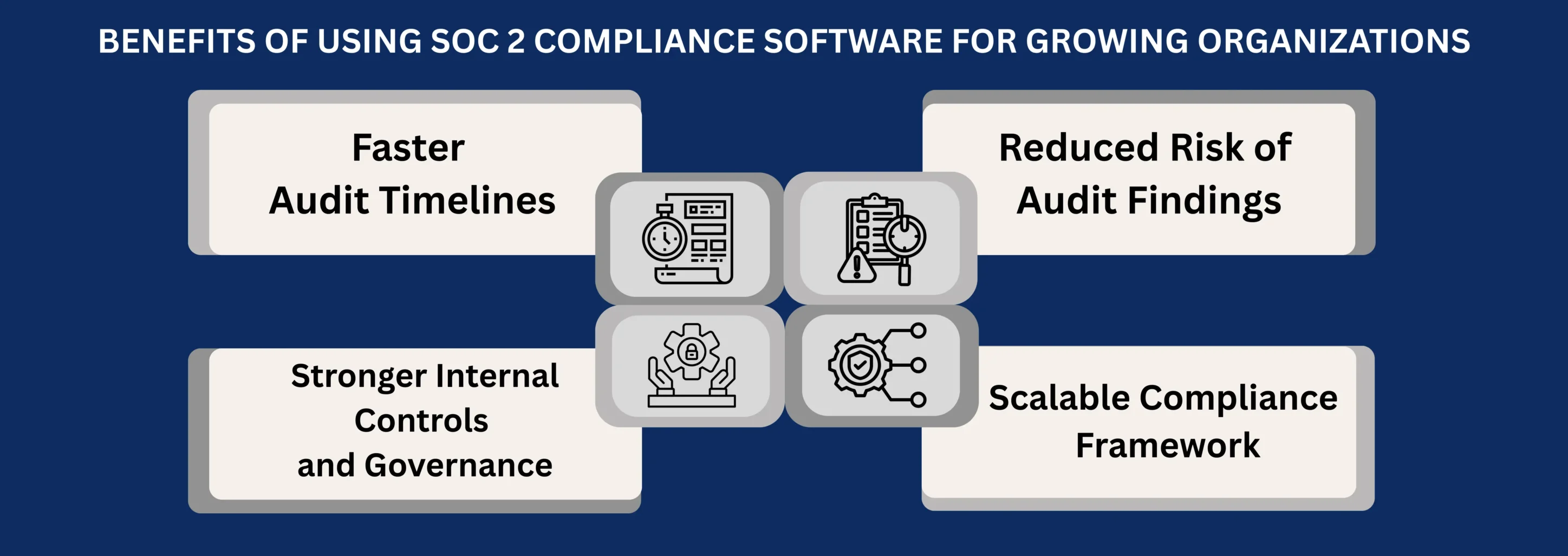
- ✓Independent verification of control design and operating effectiveness by a Licensed CPA Firm
- ✓Acceleration of enterprise procurement cycles through pre-attested vendor qualification documentation
- ✓Reduction of security questionnaire burden for repeated customer assessments
- ✓Objective identification of control gaps and deviations through annual SOC 2 examination cycles
- ✓Demonstration of information security maturity to enterprise customers in regulated industries
- ✓Evidentiary documentation of security due diligence for regulatory examinations and legal proceedings
- ✓Market access qualification for enterprise, healthcare, and financial sector customer segments
- ✓Customer confidence in the security and availability of services through formal third-party SOC 2 attestation
- ✓Annual control environment improvement driven by independent Licensed CPA Firm examination findings
- ✓Recognition in international expansion scenarios where U.S. SOC 2 attestation satisfies partner requirements
- ✓Enterprise Procurement and Vendor Qualification
- ✓Independent Verification of Control Effectiveness
- ✓Regulatory and Legal Risk Reduction
SOC 2 Compliance in Pennsylvania: Ongoing Maintenance Requirements
SOC 2 compliance in Pennsylvania is not a one-time achievement but a continuous operational discipline. Organizations that obtain a SOC 2 Type 2 attestation report must maintain the control environment examined, address exceptions identified in prior reports, and sustain the evidence collection practices required for annual re-examination. The Licensed CPA Firm conducting each annual SOC 2 examination evaluates the current state of controls — not the historical state documented in a prior report.
Pennsylvania organizations that allow controls to degrade, evidence collection to lapse, or policy documentation to become outdated between examination cycles will encounter findings in subsequent examinations that reflect those degradations.
SOC 2 audit practitioners in Pennsylvania consistently observe that organizations face the greatest examination challenges not in control design but in evidence collection. Controls may be well-designed and consistently operated, yet if the operational records demonstrating that operation were not systematically collected and retained, the Licensed CPA Firm cannot obtain sufficient evidence to support an unqualified opinion.
Pennsylvania organizations that automate evidence collection through security information and event management platforms, identity governance tools, and compliance management systems significantly reduce the operational burden of the annual SOC 2 examination. Automated evidence collection also reduces the risk of sampling gaps — periods within the review window where no evidence exists to demonstrate control operation.
Critical evidence categories that must be continuously collected and retained throughout the SOC 2 review period include: user access provisioning and deprovisioning records for all in-scope systems; access review records demonstrating periodic review and recertification of user access rights; change management approvals for all in-scope system changes; security event log data from production systems; vulnerability scan reports with documented remediation tracking; security awareness training completion records; vendor risk assessment records and annual reviews; incident response records for all security events identified during the period; and encryption key management records.
Pennsylvania organizations operating cloud-native environments should ensure that automated evidence sources are configured to retain logs for the full SOC 2 review period before the examination begins.
Organizations undergoing annual SOC 2 examinations frequently implement significant technology, organizational, or process changes between examination cycles — cloud migrations, product acquisitions, workforce changes, system re-architectures, and vendor transitions that affect the control environment described in the prior year’s system description. Pennsylvania organizations must ensure that material changes to the in-scope environment are documented and reflected in the system description reviewed by the Licensed CPA Firm for the current examination.
Changes that introduce new systems or processes into scope may require the auditor to extend control testing to cover those new elements, which can affect the duration and complexity of the SOC 2 examination. Changes that remove systems from scope must be evaluated to confirm they were properly decommissioned and access deprovisioned.
- ✓Continuous Evidence Collection Practices
- ✓Managing Control Changes Between Examination Cycles
SOC 2 Type 1 and Type 2 Reports: Choosing the Right Examination for Pennsylvania Organizations
Selecting between a SOC 2 Type 1 and Type 2 examination depends on the organization’s current state of control maturity, customer requirements, and strategic timeline. Both examination types are performed by a Licensed CPA Firm under AICPA standards, but they serve different assurance purposes and carry different weight in enterprise procurement processes.
Pennsylvania organizations should evaluate customer requirements, competitive positioning, and control environment readiness when determining which report type to pursue for their initial SOC 2 examination engagement.
When SOC 2 Type 1 Is Appropriate
A SOC 2 Type 1 examination is appropriate when an organization needs to demonstrate that controls have been designed and implemented to meet the applicable Trust Services Criteria, but does not yet have a sufficient operating history to support a Type 2 examination covering a meaningful review period. Organizations that recently implemented new security controls — such as a startup that completed its initial security program build-out — may pursue a Type 1 report as an initial attestation while accumulating the operating history required for a Type 2 examination.
Pennsylvania technology companies entering regulated markets for the first time often use a SOC 2 Type 1 report to satisfy initial vendor qualification requirements while completing their first full-year Type 2 review period.
Type 1 reports are also used by organizations that have undergone significant control environment changes — such as a cloud migration or major system re-architecture — that reset the operating history clock for the affected controls. When a Pennsylvania SaaS company migrates its production environment from an on-premises data center to a cloud platform, the controls governing the new cloud environment may have only a limited operating history at the time of the next examination.
A SOC 2 Type 1 report can document the design suitability of the new cloud environment while the organization builds the operational record required for a subsequent Type 2 examination covering the cloud infrastructure.
Why Enterprise Buyers Prefer SOC 2 Type 2
Enterprise customers — particularly financial institutions, healthcare organizations, and government agencies — consistently prefer SOC 2 Type 2 reports over Type 1 reports because Type 2 examinations evaluate operating effectiveness over time, not merely control design at a single point. A control can be well-designed on the day it is evaluated but consistently fail to operate as intended during actual business operations.
Type 2 reports address this gap by requiring the Licensed CPA Firm to test control operation across a review period — demonstrating that controls were applied consistently, exceptions were identified and addressed, and the overall control environment functioned as described throughout the period under review. For Pennsylvania financial services organizations subject to OCC or Federal Reserve vendor risk management programs, SOC 2 Type 2 reports are often specified in third-party risk policy as the required form of assurance.
SOC 2 Attestation Pennsylvania: Report Distribution and Usage
The SOC 2 attestation report issued by a Licensed CPA Firm is a restricted-use document intended for specified parties — typically the management of the service organization, existing and prospective customers, and regulators or business partners with a need to understand the organization’s control environment. Unlike ISO 27001 certificates, which can be publicly displayed, SOC 2 attestation reports contain detailed descriptions of control tests, results, and exceptions that would be sensitive if broadly distributed.
Pennsylvania organizations typically distribute their SOC 2 attestation reports under non-disclosure agreements to customers who formally request them during procurement, contract renewal, or ongoing vendor oversight processes.
SOC 3 Reports as Public-Facing Complements
Organizations that want to publicly communicate their SOC 2 attestation status without distributing the detailed restricted-use SOC 2 report may have their Licensed CPA Firm issue a SOC 3 report. SOC 3 is a public-use report that summarizes the Licensed CPA Firm’s opinion on whether controls met the applicable Trust Services Criteria, without including the detailed description of tests and results contained in the full SOC 2 attestation report.
Pennsylvania technology companies that operate consumer-facing platforms or want to signal their security attestation status on their websites commonly publish their SOC 3 report or display the AICPA SOC for Service Organizations seal as a trust indicator. SOC 3 is always based on a completed Type 2 examination — an organization cannot obtain a SOC 3 report based solely on a Type 1 examination.
Report Validity and Currency Requirements
SOC 2 attestation reports do not expire on a fixed schedule, but enterprise customers and regulated-sector buyers apply practical currency standards when evaluating reports. The standard market expectation is that a SOC 2 Type 2 report covers a review period that ended within the preceding twelve months. A report covering a period that ended more than twelve months before a vendor qualification review is typically considered stale and may not satisfy enterprise procurement requirements.
Pennsylvania organizations must plan their SOC 2 examination timelines to ensure that a current report — with a period-end date within the preceding year — is available throughout their active sales and contract renewal cycles. Gaps in SOC 2 coverage can disqualify organizations from active procurement processes and should be avoided through proactive scheduling.
SOC 2 Audit Firms in Pennsylvania: Selecting a Licensed CPA Firm
SOC 2 audit firms Pennsylvania organizations engage must be Licensed CPA Firms authorized to perform attestation engagements under AICPA standards. The selection of a Licensed CPA Firm for a SOC 2 examination is a material decision — the firm’s independence, technical knowledge of the Trust Services Criteria, experience with information technology controls, and professional quality control practices directly affect the quality and credibility of the attestation report issued.
Pennsylvania organizations evaluating SOC 2 audit firms should confirm that the firm is licensed to perform attestation engagements, that its personnel have demonstrated experience in SOC 2 examinations, and that the firm has established quality control procedures consistent with AICPA quality management standards.
Independence Requirements for SOC 2 Auditors
Independence is the foundational requirement for a SOC 2 examination. The Licensed CPA Firm conducting the SOC 2 audit must be independent of the organization being examined — meaning the firm must have no financial interest in the organization, no management relationships, and no advisory or consulting engagements that would impair the auditor’s objectivity. Under AICPA independence standards, a firm that provided implementation services, policy writing, or security consulting to an organization during the period under review cannot independently attest to the effectiveness of controls it helped implement.
Pennsylvania organizations that have engaged consultants or technology service providers to build their security programs must ensure that the Licensed CPA Firm selected for the SOC 2 examination has no impairment to its independence relative to those services.
AICPA peer review requirements additionally mandate that Licensed CPA Firms performing SOC 2 examinations submit their attestation practice to periodic peer review to verify that engagement quality standards are maintained. Pennsylvania organizations reviewing prospective SOC 2 audit firms should confirm that the firm participates in the AICPA peer review program and that its most recent peer review was conducted without significant findings related to attestation engagement quality.
The AICPA publishes peer review reports in its public database, allowing organizations to independently verify a firm’s peer review status before engaging it for a SOC 2 examination.
FAQ
▶
What is SOC 2 Certification in Pennsylvania and who issues it?
▶
What is the difference between a SOC 2 Type 1 and Type 2 report?
▶
How long does a SOC 2 examination take in Pennsylvania?
▶
Which Trust Services Criteria should Pennsylvania organizations select?
▶
What is the difference between SOC 2 compliance and SOC 2 certification?
▶
How often must SOC 2 examinations be renewed in Pennsylvania?
▶
What industries in Pennsylvania most commonly require SOC 2 attestation?
▶
Can a SOC 2 attestation report be shared publicly?

SOC 1 VS SOC 2: WHICH REPORT YOUR CUSTOMERS ACTUALLY ASK FOR
If you sell SaaS or provide outsourced services, you have likely been asked for a SOC report. However, the follow-up question is rarely easy to answer…

AICPA Issues New Guidance for Peer Reviewers Evaluating SOC 2 Engagements
AICPA SOC 2 guidance has been issued to help peer reviewers identify quality risks associated with SOC 2 engagements as the use of compliance automati…
SOC 2 Certified: What Does It Mean for Your Business
For companies that handle sensitive data or run cloud-based services, the question “Can you provide your SOC 2 report?” carries enormous weight. Yet, …
Get In Touch
have a question? let us get back to you.