
SOC 2 Certification in Portland
SOC 2 Certification in Portland delivers independently verified documentation of control effectiveness, recognized in enterprise vendor security review programs, financial sector procurement processes, regulated industry supply chain requirements, and international customer due diligence frameworks. The structured benefits below reflect the direct outcomes of a completed SOC 2 examination for Portland-based technology, financial, and operational organizations.
OUR CLIENTS










SOC 2 Certification for Portland-Based Technology and Financial Organizations
SOC 2 Certification in Portland is conducted by a Licensed CPA Firm as an independent third-party examination under AICPA attestation standards. The examination evaluates whether an organization’s controls are suitably designed and operating effectively against the applicable Trust Services Criteria. Portland’s technology and financial ecosystem — spanning SaaS providers, cloud platforms, fintech companies, healthcare technology organizations, semiconductor and hardware firms, AI startups, cybersecurity businesses, e-commerce companies, clean technology firms, manufacturing and industrial technology businesses, and logistics providers across Portland, Beaverton, Hillsboro, Lake Oswego, and the broader Oregon technology corridor — drives sustained demand for SOC 2 attestation. This independently verified mechanism is widely recognized in enterprise procurement and vendor assurance processes throughout the region and nationally.
Portland’s Technology and Business Ecosystem Driving SOC 2 Demand
Portland occupies a distinct position within the Pacific Northwest technology economy. The Hillsboro and Beaverton corridors host significant semiconductor and hardware manufacturing operations. Meanwhile, downtown Portland and the Pearl District have developed a dense concentration of SaaS providers, cloud service platforms, AI startups, and fintech businesses. Healthcare technology organizations serving Oregon Health & Science University affiliates, regional hospital networks, and digital health platforms have also expanded significantly across the metropolitan area.
Each of these sectors manages sensitive customer data, financial records, protected health information, intellectual property, or proprietary operational data — categories that trigger enterprise procurement requirements for independently verified security assurance. SOC 2 Certification in Portland has emerged as the primary mechanism through which Oregon-based technology organizations demonstrate control effectiveness to enterprise buyers, regulated customers, and third-party risk management programs operating across the United States and internationally.
Clean technology companies, logistics providers, and manufacturing and industrial technology businesses operating across the Portland metropolitan area increasingly face vendor security questionnaires and contractual attestation requirements embedded in enterprise and government procurement processes. The Oregon Consumer Privacy Act (OCPA) and Oregon’s data breach notification requirements have further elevated awareness of formal data security obligations among Oregon-based organizations.
While SOC 2 attestation does not automatically establish compliance with the OCPA or other Oregon, U.S., or industry-specific laws and regulations, the SOC 2 examination provides independently verified documentation of control design and operating effectiveness. This documentation supports broader information governance and third-party risk management expectations relevant to organizations operating in Portland and across Oregon.
Licensed CPA Firm as Independent Certification Body
SOC 2 Certification is not issued by a general consulting firm, software vendor, or industry association. Under AICPA attestation standards — specifically AT-C Section 205 — only a Licensed CPA Firm is authorized to conduct a SOC 2 examination and issue a SOC 2 attestation report. The Licensed CPA Firm operates as an independent third party, applying professional skepticism, evidence-based testing procedures, and structured audit methodology to evaluate whether an organization’s controls meet the applicable Trust Services Criteria.
The resulting SOC 2 attestation report carries the Licensed CPA Firm’s opinion. This is what distinguishes it from self-assessed security questionnaires, vendor-completed compliance declarations, or automated scan outputs. For Portland organizations seeking to satisfy enterprise vendor security reviews, financial sector procurement requirements, or international customer due diligence processes, the Licensed CPA Firm’s independent opinion is the authoritative output that procurement teams and regulators recognize.
SOC 2 Attestation vs. Self-Assessed Security Claims
SOC 2 attestation is structurally distinct from self-assessed security claims, internal compliance declarations, or automated compliance platform outputs. A SOC 2 examination requires a Licensed CPA Firm to independently gather and evaluate evidence, test control operation across a defined observation period, assess control design against the applicable Trust Services Criteria, and issue a formal opinion. Self-assessments, by contrast, reflect management’s own representations without independent corroboration.
Enterprise buyers, regulated financial institutions, healthcare organizations, and government procurement programs in Portland and nationally distinguish between independently attested controls and self-reported compliance. SOC 2 attestation satisfies the former standard. Organizations that rely solely on self-assessment responses to vendor security questionnaires increasingly face scrutiny from procurement teams that require third-party attestation as a condition of contract award or vendor approval.
ENQUIRE NOW
What Is SOC 2 Certification?
SOC 2 Certification refers to the process by which a Licensed CPA Firm examines an organization’s controls relevant to security, availability, processing integrity, confidentiality, and privacy — the five Trust Services Criteria established by the American Institute of Certified Public Accountants (AICPA) — and issues a formal attestation report on the design and operating effectiveness of those controls. SOC 2 compliance is established through this independent examination, not through internal declaration or automated tooling. The SOC 2 examination evaluates the organization’s control environment against the specific Trust Services Criteria selected as in-scope, based on the nature of the services provided and the commitments made to customers.
Trust Services Criteria: The Foundation of SOC 2 Compliance
The AICPA Trust Services Criteria provide the evaluative framework against which SOC 2 compliance is assessed. The Security criterion — also referred to as the Common Criteria — is mandatory in every SOC 2 examination. It addresses logical and physical access controls, system operations, change management, and risk mitigation. The remaining four criteria — Availability, Processing Integrity, Confidentiality, and Privacy — are included based on the scope of services and customer commitments applicable to the organization under examination.
For Portland SaaS providers and cloud platforms, Security and Availability are the most frequently included criteria. Healthcare technology organizations and those handling protected health information commonly include the Privacy criterion. Fintech businesses and organizations managing confidential financial data frequently include the Confidentiality criterion. The scope determination is documented in the description of the system and reflected in the boundaries of the SOC 2 examination.
| Trust Services Criterion | Scope Focus | Typical Portland Sectors |
|---|---|---|
| Security (Common Criteria) | Access controls, system operations, change management, risk mitigation | All sectors — mandatory in every SOC 2 examination |
| Availability | System uptime, performance monitoring, disaster recovery | SaaS providers, cloud platforms, logistics technology |
| Processing Integrity | Complete, valid, accurate, timely processing | Fintech, payment processing, e-commerce |
| Confidentiality | Protection of confidential information throughout its lifecycle | Fintech, AI platforms, semiconductor and hardware firms |
| Privacy | Collection, use, retention, and disposal of personal information | Healthcare technology, e-commerce, digital health platforms |
SOC 2 Type 1 vs. SOC 2 Type 2 Reports
SOC 2 Certification produces one of two report types: a Type 1 report or a Type 2 report. A SOC 2 Type 1 report reflects the Licensed CPA Firm’s opinion on whether controls are suitably designed to meet the applicable Trust Services Criteria as of a specific point in time. A SOC 2 Type 2 report reflects the Licensed CPA Firm’s opinion on both the suitability of control design and the operating effectiveness of controls over a defined observation period — typically a minimum of six months, though twelve-month observation periods are standard in most enterprise procurement contexts.
The SOC 2 Type 2 report is more widely required by enterprise buyers and regulated institutions because it demonstrates that controls operated consistently over time, not merely that they were designed correctly at a single date. Portland organizations seeking SOC 2 audit attestation for enterprise or government customer requirements typically pursue the Type 2 report as the primary deliverable.
System Description and Management’s Assertion
Every SOC 2 examination includes a description of the system prepared by management. This document defines the boundaries of the services under examination, the infrastructure components, the software and applications in scope, the personnel responsible for controls, the data processed, and the relevant Trust Services Criteria. Management also provides a written assertion confirming that the description is fairly presented and that the controls stated therein are suitably designed — and, for Type 2 reports, operated effectively during the observation period.
The Licensed CPA Firm’s examination independently evaluates whether management’s assertion is supported by evidence. Inaccuracies in the system description, gaps between described controls and actual practice, or evidence of control failures during the observation period are documented as findings and reflected in the Licensed CPA Firm’s opinion. For Portland organizations undergoing a SOC 2 audit, the system description represents a foundational document that frames the entire examination scope.
SOC 2 Certification Audit Process for Organizations in Portland
The SOC 2 audit process follows a structured sequence of stages defined by AICPA attestation standards and the Licensed CPA Firm’s audit methodology. Each stage is distinct and produces defined outputs that inform the subsequent stage. Portland organizations pursuing SOC 2 Certification in Portland — whether SaaS providers in the Pearl District, semiconductor firms in Hillsboro, or fintech businesses across the metropolitan area — move through the same structured examination process regardless of industry sector. The specific controls tested and evidence evaluated, however, vary based on the in-scope Trust Services Criteria and the nature of the system under examination.
| Audit Stage | Key Activities | Output |
|---|---|---|
| Scope Definition | Identify in-scope services, infrastructure, Trust Services Criteria, and examination period | Defined examination boundary and report type determination |
| Audit Program Determination | Develop testing procedures tailored to in-scope Trust Services Criteria and system characteristics | Structured audit program with evidence requirements |
| Stage 1 — Documentation Review | Review system description, policies, procedures, and control documentation for completeness | Documentation assessment and identification of areas requiring clarification |
| Stage 2 — Control Testing | Test control design and, for Type 2, operating effectiveness through inquiry, observation, inspection, and re-performance | Control test results and identified exceptions or nonconformities |
| Nonconformity Review | Evaluate exceptions, assess materiality, obtain management responses | Nonconformity determination and management representation |
| Certification Decision | Licensed CPA Firm forms opinion based on evidence and issues SOC 2 attestation report | Issued SOC 2 Type 1 or Type 2 attestation report |
The SOC 2 examination begins with scope definition, during which the Licensed CPA Firm and the organization’s management establish the boundaries of the system under examination. Scope definition addresses which services are included, which infrastructure components and applications are in scope, which Trust Services Criteria apply, and — for Type 2 examinations — the observation period start and end dates.
For Portland technology organizations, scope definition typically involves mapping customer-facing services, identifying data flows involving sensitive customer information, and determining which Trust Services Criteria reflect the nature of service commitments and contractual obligations. Following scope agreement, the Licensed CPA Firm develops an audit program that specifies the testing procedures, evidence types, and sampling methodologies to be applied across each in-scope criterion. The audit program is tailored to the system’s characteristics and the complexity of the control environment.
Stage 1 of the SOC 2 audit involves a structured review of documentation relevant to the system under examination. The Licensed CPA Firm reviews the system description prepared by management, evaluates policies and procedures governing the in-scope control domains, and assesses whether documented controls are logically designed to address the applicable Trust Services Criteria. Documentation gaps, inconsistencies between described controls and supporting policies, or unclear system boundaries identified during Stage 1 are communicated to management prior to Stage 2 fieldwork.
Stage 2 is the principal testing phase. During this stage, the Licensed CPA Firm applies audit procedures — including inquiry of responsible personnel, observation of control operation, inspection of evidence samples, and re-performance of control activities — to evaluate whether controls operated as described throughout the observation period. For SOC 2 Type 2 examinations, evidence must span the full observation period, demonstrating consistent control operation rather than point-in-time compliance.
The observation period for a SOC 2 Type 2 examination defines the timeframe over which control operating effectiveness is evaluated. Standard observation periods range from six to twelve months. Evidence collected during this period includes access control logs, security monitoring outputs, change management records, vulnerability scan results, incident response documentation, backup verification records, vendor management documentation, and personnel training completion records — among other evidence types specific to the in-scope Trust Services Criteria.
The Licensed CPA Firm applies sampling methodologies consistent with AICPA attestation standards to assess whether controls operated without material exception throughout the observation period. Upon completion of testing and nonconformity review, the Licensed CPA Firm issues the SOC 2 attestation report. This report includes the system description, management’s assertion, and the Licensed CPA Firm’s independent opinion — the primary deliverable that Portland organizations present to enterprise customers, procurement teams, and regulatory contacts.
- ✓Scope Definition and Audit Program Determination
- ✓Stage 1 Documentation Review and Stage 2 Control Testing
- ✓Observation Period, Evidence Collection, and Report Issuance
Why Organizations in Portland Pursue SOC 2 Certification
Portland organizations pursue SOC 2 Certification in Portland in response to direct commercial requirements, enterprise vendor security review programs, financial sector procurement expectations, and the expanding scope of third-party risk management frameworks applied by regulated institutions and large enterprise buyers. SOC 2 compliance has become a de facto prerequisite in many technology vendor procurement contexts — particularly for organizations providing cloud-based services, SaaS platforms, data processing functions, or technology infrastructure to regulated industries including financial services, healthcare, and government.
The demand drivers are both external — driven by customer requirements — and internal. Organizations increasingly recognize that an independent SOC 2 examination produces defensible documentation of control effectiveness that self-assessment simply cannot replicate.
Enterprise Vendor Security Reviews and Procurement Requirements
Enterprise organizations across industries — particularly financial institutions, healthcare systems, insurance companies, and large technology platforms — have embedded SOC 2 attestation requirements into vendor security review and procurement approval processes. A Portland SaaS provider seeking to enter a contract with a national bank, a regional health system, or a Fortune 500 technology company will routinely encounter a vendor security questionnaire that includes a specific requirement to provide a current SOC 2 Type 2 report issued by a Licensed CPA Firm.
In many cases, the enterprise buyer’s third-party risk management program will not approve a vendor relationship without a current, unqualified SOC 2 attestation report. For Portland technology companies targeting enterprise customers in financial services, healthcare, or regulated government sectors, SOC 2 Certification in Portland is a direct enabler of customer acquisition and contract execution — not a discretionary activity.
Fintech, Healthcare Technology, and Regulated Sector Requirements
SOC 2 compliance is particularly prominent among Portland fintech organizations, given the concentration of financial technology firms across the metropolitan area and the regulatory oversight applied to their financial services customers. Fintech companies providing payment processing, lending technology, banking-as-a-service infrastructure, or financial data aggregation to regulated financial institutions frequently receive direct requirements from their bank or credit union customers to maintain current SOC 2 Type 2 attestation.
Similarly, healthcare technology organizations — including electronic health record platforms, digital health applications, telehealth providers, and health information exchange operators — face SOC 2 attestation requirements from health system customers and their compliance programs. SOC 2 Certification in Portland for organizations in these regulated sectors directly supports vendor approval, contract renewal, and customer due diligence processes that would otherwise create commercial barriers to market access.
International SaaS Expansion and Cross-Border Vendor Assurance
Portland-based SaaS providers and cloud platforms seeking to expand into international markets — including the European Union, United Kingdom, Canada, Australia, and Asia-Pacific regions — encounter vendor assurance requirements from international enterprise buyers and regulated institutions that recognize SOC 2 attestation as a credible, independent security evaluation. While international buyers may also require ISO 27001 certification or local equivalents, SOC 2 attestation is frequently accepted alongside or in lieu of other frameworks by U.S.-headquartered multinational enterprises and international technology companies familiar with AICPA attestation standards.
SOC 2 Certification in Portland for SaaS organizations seeking international enterprise customer relationships positions the attestation report as a cross-border vendor assurance document — one that supports procurement approval without requiring jurisdiction-specific regulatory filings. Organizations serving both domestic and international enterprise customers often maintain SOC 2 alongside ISO 27001 for comprehensive coverage across procurement frameworks.
SOC 2 Certification Requirements and Evaluation Criteria
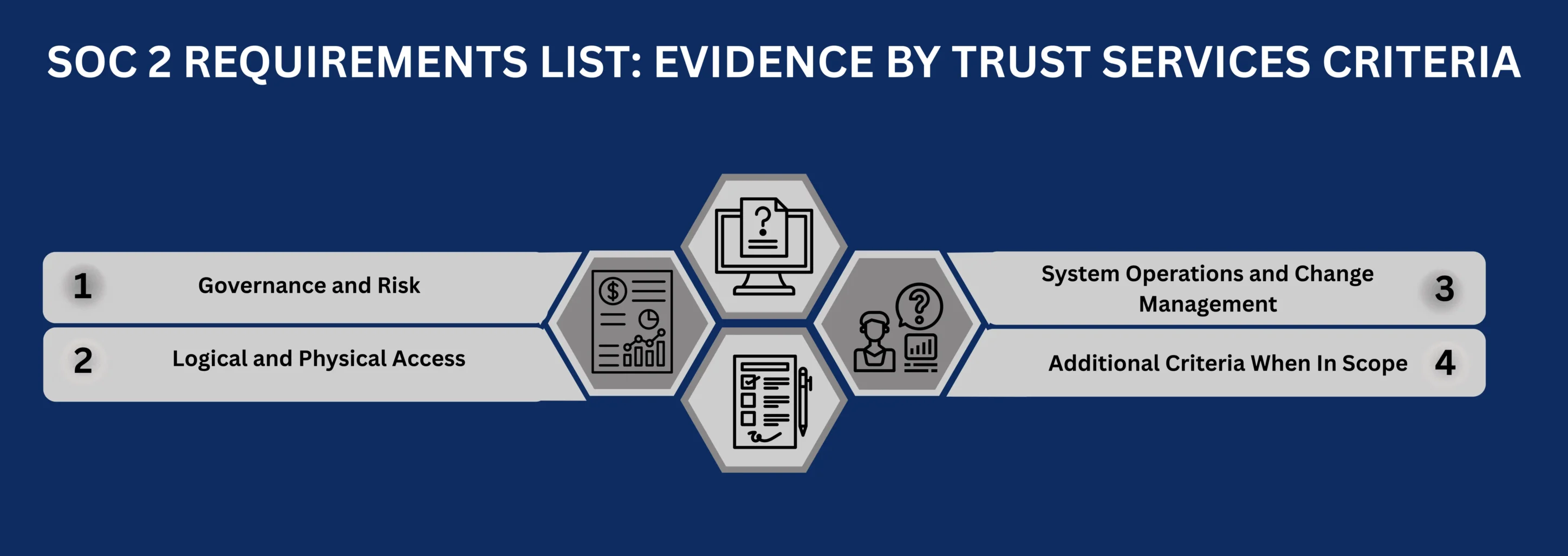
SOC 2 Certification requirements are defined by the AICPA Trust Services Criteria and the specific control domains applicable to the organization’s in-scope services. The SOC 2 examination evaluates controls across multiple domains — including logical and physical access, system operations, change management, risk assessment, vendor management, incident response, and system monitoring — against the criteria applicable to the selected Trust Services Criteria. Evidence-based assessment is the governing methodology: controls must be supported by documentary evidence demonstrating their design and, for Type 2 examinations, their consistent operation throughout the observation period.
The Security criterion’s Common Criteria — mandatory in every SOC 2 examination — define requirements across the organization’s control environment, risk assessment processes, control activities, logical and physical access controls, system operations, change management, and risk mitigation activities. Common Criteria requirements include the establishment of organizational policies and procedures governing information security, the definition of roles and responsibilities, the implementation of access control mechanisms aligned with least-privilege principles, and the operation of system monitoring and logging capabilities.
They also encompass the management of third-party vendor relationships affecting in-scope systems and the execution of incident identification and response procedures. For Portland technology organizations, Common Criteria control requirements typically span identity and access management systems, cloud infrastructure configuration management, endpoint security controls, network segmentation and monitoring, and personnel security practices including background verification and security awareness activities.
SOC 2 examination evidence requirements span documentary, system-generated, and observation-based evidence across each in-scope control domain. Documentary evidence includes information security policies, access control procedures, change management records, risk assessment documentation, vendor contract terms and security review records, incident response logs, and training completion records. System-generated evidence includes access provisioning and de-provisioning records, multi-factor authentication enforcement logs, vulnerability scan results, penetration test reports, system configuration baselines, backup completion and restoration verification records, and security monitoring alert and response logs.
The Licensed CPA Firm applies sampling procedures to system-generated evidence covering the full observation period, assessing whether controls operated without material exception. Organizations that maintain incomplete or inconsistent evidence records across the observation period risk qualified opinions or identified exceptions in the SOC 2 attestation report — outcomes that require management response and may affect the report’s commercial utility.
When the Licensed CPA Firm identifies exceptions during control testing — instances where a control did not operate as described or where evidence does not support the control’s effectiveness — those exceptions are evaluated for materiality and reflected in the SOC 2 attestation report. The Licensed CPA Firm’s opinion on the SOC 2 examination may be unqualified (controls are suitably designed and operating effectively without material exception), qualified (certain controls have identified exceptions of sufficient materiality to affect the opinion), or adverse (controls are not suitably designed or are not operating effectively).
Management provides written responses to identified exceptions within the report, explaining compensating controls or remediation actions. The SOC 2 attestation report’s opinion — issued by the Licensed CPA Firm — is the authoritative output reviewed by enterprise procurement teams, third-party risk managers, and regulated customers evaluating Portland organizations’ vendor security posture.
- ✓Control Environment and Common Criteria Requirements
- ✓Evidence Requirements and Documentation Standards
- ✓Nonconformity Review and Certification Decision Framework
Benefits of SOC 2 Certification for Portland-Based Organizations
SOC 2 Certification in Portland delivers independently verified documentation of control effectiveness, recognized in enterprise vendor security review programs, financial sector procurement processes, regulated industry supply chain requirements, and international customer due diligence frameworks. The structured benefits below reflect the direct outcomes of a completed SOC 2 examination for Portland-based technology, financial, and operational organizations.
- ✓Independent verification of control design and operating effectiveness by a Licensed CPA Firm under AICPA attestation standards
- ✓SOC 2 attestation report recognized in enterprise procurement, financial sector vendor approval, and regulated industry supply chain programs
- ✓Structured evidence of SOC 2 compliance across Security, Availability, Processing Integrity, Confidentiality, and Privacy criteria
- ✓Clear differentiation from competitors relying solely on self-assessed security questionnaires or automated compliance platform outputs
- ✓Support for Oregon Consumer Privacy Act (OCPA) and data breach notification governance through documented control frameworks
- ✓Enablement of international SaaS and cloud platform expansion into markets requiring independent security attestation
- ✓Ongoing surveillance and annual recertification cycles providing continuous independent oversight of control effectiveness
- ✓Reduction in customer-driven security questionnaire burden through availability of a current, independently issued SOC 2 Type 2 report
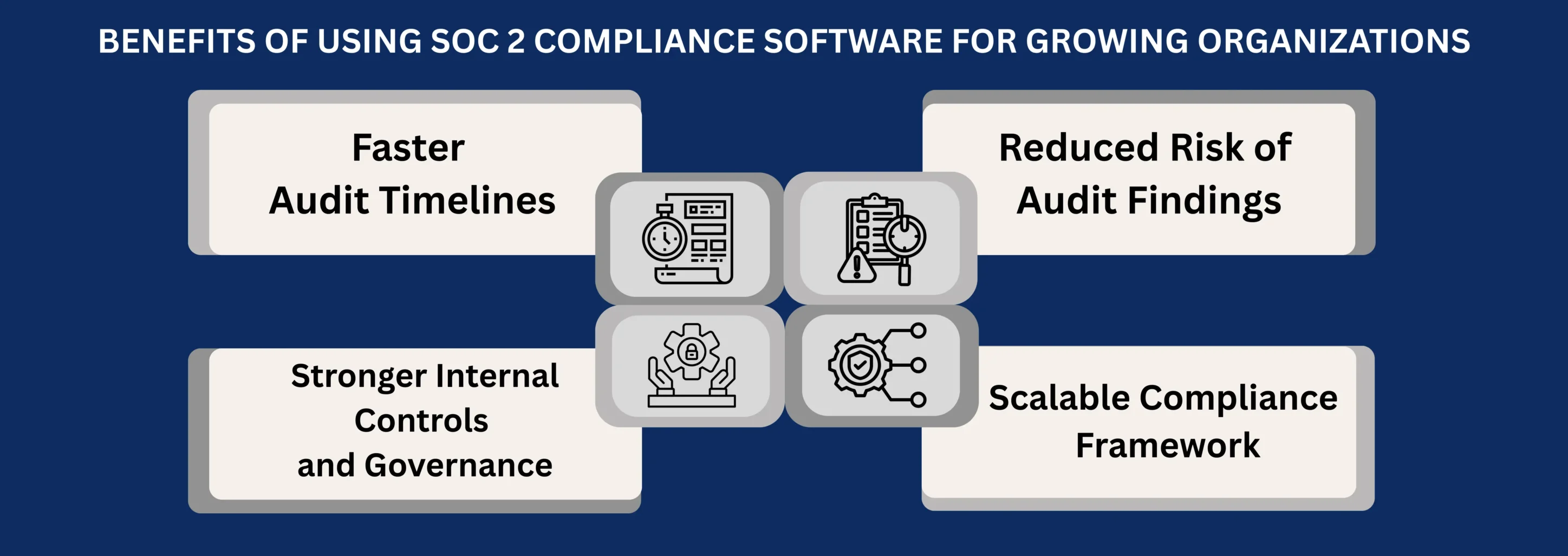
A current SOC 2 Type 2 attestation report directly supports commercial outcomes for Portland-based organizations by satisfying the third-party risk management requirements embedded in enterprise and regulated industry procurement processes. Portland SaaS providers presenting a current, unqualified SOC 2 Type 2 report to enterprise procurement teams eliminate a common barrier in vendor approval workflows — the absence of independent security attestation that would otherwise require extended questionnaire processes, additional site reviews, or conditional contract structures.
Financial sector customers — including regional banks, credit unions, investment managers, and insurance carriers operating across the Pacific Northwest — apply vendor security review standards that recognize SOC 2 attestation as a primary assurance mechanism. For Portland technology companies seeking to scale enterprise customer relationships in regulated sectors, SOC 2 audit attestation functions as a commercial prerequisite, not merely a differentiator.
The SOC 2 examination process produces a structured mapping of the organization’s control environment against the applicable Trust Services Criteria. This gives management documented visibility into control design, evidence requirements, and testing outcomes. Annual SOC 2 Type 2 examination cycles — the standard for maintaining current attestation status acceptable to enterprise customers — create a recurring independent review of control operating effectiveness, supporting management’s ongoing oversight of the information security control environment.
For Portland organizations operating in sectors subject to regulatory oversight — such as healthcare technology organizations subject to HIPAA and fintech businesses subject to state and federal financial services requirements — annual SOC 2 audit cycles provide structured, recurring documentation of control operation. This supports broader compliance governance without constituting legal compliance certification under those regulatory frameworks.
- ✓Commercial and Procurement Outcomes
- ✓Internal Control Visibility and Ongoing Monitoring
SOC 2 Certification Across Portland’s Key Industry Sectors
SOC 2 audit demand spans multiple industry verticals within the Portland metropolitan area, each with distinct control environment characteristics, Trust Services Criteria selections, and customer-driven attestation requirements. Understanding sector-specific SOC 2 examination considerations enables organizations to align scope definition, evidence collection, and observation period planning with the attestation requirements most relevant to their customer base and competitive market.
SaaS Providers, Cloud Platforms, and AI Startups
Portland’s SaaS and cloud platform ecosystem — concentrated in downtown Portland, the Pearl District, and the broader inner eastside technology corridor — represents the largest segment of SOC 2 Certification in Portland demand. SaaS providers typically include Security and Availability as in-scope Trust Services Criteria, reflecting customer expectations around both information security control and service uptime. AI startups and machine learning platforms handling proprietary customer data or processing sensitive inputs frequently add Confidentiality and, where personal data is involved, Privacy criteria.
Organizations in this space often pursue an initial SOC 2 Type 1 report during early commercial scaling to demonstrate control design to early enterprise customers, followed by Type 2 attestation as customer requirements formalize. Cloud-native architecture introduces specific evidence requirements around infrastructure configuration management, container security, identity and access management in cloud environments, and shared responsibility boundary documentation.
Semiconductor, Hardware, and Manufacturing Technology Firms
The Hillsboro and Beaverton technology corridors host significant semiconductor manufacturing operations, hardware design firms, and manufacturing and industrial technology businesses for which technology supply-chain security and intellectual property protection are primary SOC 2 examination drivers. These organizations frequently include Security and Confidentiality as in-scope Trust Services Criteria, reflecting the sensitivity of engineering data, product specifications, fabrication process information, and customer intellectual property managed within their systems.
SOC 2 attestation for semiconductor and hardware organizations supports vendor approval processes within global technology supply chains, where original equipment manufacturers and system integrators apply third-party risk management standards requiring independent security attestation from component and IP suppliers. The SOC 2 examination in this sector typically addresses access controls governing engineering systems, change management processes for design and fabrication workflows, and vendor and contractor access management across complex multi-site operational environments.
Cybersecurity Firms, E-Commerce, and Logistics Technology
Cybersecurity businesses operating from Portland — including managed security service providers, threat intelligence platforms, and security operations technology vendors — encounter a distinctive SOC 2 attestation context: their customers are security-aware organizations that apply particularly detailed vendor security review standards. SOC 2 Certification for Portland cybersecurity firms demonstrates that the organization’s own control environment meets independently verified standards — a credibility signal that is especially meaningful to technically sophisticated buyers.
E-commerce organizations and logistics technology providers operating across the Portland area, including those serving regional retail networks and supply chain operators, frequently include Processing Integrity and Availability criteria to address customer expectations around transaction accuracy, order processing reliability, and platform uptime. Clean technology firms managing energy data, grid management systems, or environmental monitoring platforms increasingly encounter SOC 2 attestation requirements from utility customers and infrastructure operators subject to NERC CIP or equivalent regulatory frameworks.
SOC 2 Report Validity, Maintenance, and Recertification
SOC 2 attestation reports are point-in-time or period-specific documents that reflect the Licensed CPA Firm’s opinion as of the examination date or the end of the observation period. Enterprise customers and third-party risk management programs apply currency standards to SOC 2 reports — typically requiring that the report cover an observation period ending within the past twelve months. Organizations that allow their SOC 2 attestation to lapse — by failing to initiate a new examination before the prior report’s observation period falls outside that twelve-month window — risk losing approved vendor status with enterprise customers or triggering remediation requirements in existing vendor agreements.
Annual Examination Cycles and Report Currency
Maintaining current SOC 2 attestation requires organizations to complete annual examination cycles, with each successive Type 2 report covering a twelve-month observation period that begins at or before the end date of the prior report’s observation period. Annual examination cycles ensure continuity of independently verified attestation — which enterprise procurement programs and financial sector customers interpret as evidence of sustained control operation rather than historical compliance that may have lapsed.
Portland organizations maintaining SOC 2 Certification in Portland across annual cycles accumulate a longitudinal record of independently attested control effectiveness. This record supports vendor relationship continuity, contract renewal processes, and enterprise account retention. Organizations that undergo material changes to their system — such as significant infrastructure migrations, acquisitions, or service scope expansions — should evaluate whether a supplemental examination or scope update is warranted to maintain the accuracy and representativeness of the current attestation report.
Management Responsibilities During and After the SOC 2 Examination
Management’s responsibilities in the SOC 2 examination extend throughout the observation period and continue after report issuance. During the observation period, management is responsible for ensuring that controls described in the system description are operating as documented, that evidence of control operation is captured and retained in accessible form, and that exceptions or control failures are identified, addressed, and appropriately documented within the organization’s incident and exception management processes.
After report issuance, management is responsible for distributing the SOC 2 attestation report to customers and prospective customers under appropriate confidentiality terms, responding to customer inquiries about the report’s findings, and addressing any exceptions documented in the report through ongoing remediation activities. Management is also responsible for retaining evidence of control operation throughout the subsequent observation period to support the next annual examination cycle. These ongoing responsibilities reflect the continuous nature of SOC 2 compliance rather than a one-time certification event.
SOC 2 Examination Portland: Scope, Independence, and Report Distribution
The SOC 2 examination in a Portland context involves specific considerations around examination scope definition, Licensed CPA Firm independence standards, and the controlled distribution of the resulting attestation report. SOC 2 attestation reports issued to Portland organizations are restricted-use documents — unlike general-purpose financial audit reports, SOC 2 reports are issued for the benefit of specified parties, typically the service organization’s existing and prospective customers and their auditors. Understanding these parameters is relevant for Portland organizations structuring their SOC 2 attestation program and managing customer expectations around report access and distribution.
Licensed CPA Firm Independence and AICPA Standards
The Licensed CPA Firm conducting the SOC 2 examination must maintain independence from the organization under examination, as required by AICPA independence standards applicable to attestation engagements. Independence requirements prohibit the Licensed CPA Firm from having financial interests in the organization, providing certain non-attest services that would impair objectivity, or maintaining relationships that compromise the firm’s ability to apply professional skepticism. These independence standards are what distinguish the SOC 2 examination from vendor self-assessment or internal audit review — they ensure that the Licensed CPA Firm’s opinion is issued by a party with no stake in the outcome.
For Portland organizations evaluating potential Licensed CPA Firm engagements for a SOC 2 audit, confirming the firm’s independence, AICPA membership, and experience with SOC 2 examinations across relevant technology sectors is an appropriate due diligence step. Firms that also provide consulting, implementation, or advisory services to the same organization cannot serve as the independent Licensed CPA Firm for the SOC 2 examination without impairing independence.
Report Distribution and Confidentiality Considerations
SOC 2 attestation reports are restricted-use documents distributed under confidentiality terms to specified parties — primarily the service organization’s existing and prospective customers and their independent auditors. The restricted-use nature of the report reflects the sensitivity of the control information disclosed within the system description and testing sections. These sections include details of control design, infrastructure components, and exception findings that represent commercially sensitive information.
Portland organizations distributing their SOC 2 attestation report to customers and prospective customers typically do so under non-disclosure agreements or platform-based report sharing mechanisms. Regulatory bodies, enterprise procurement teams, and financial institution vendor management programs that request SOC 2 reports as part of vendor approval processes are considered appropriate recipients within the restricted-use framework. The Licensed CPA Firm’s opinion within the report remains the authoritative attestation, and the report must not be altered or excerpted in ways that misrepresent its scope or findings.
FAQ
▶
What is SOC 2 Certification and who issues it?
▶
What is the difference between SOC 2 Type 1 and SOC 2 Type 2?
▶
How long does a SOC 2 Type 2 examination take for Portland organizations?
▶
Which Trust Services Criteria should Portland technology companies include in scope?
▶
Is SOC 2 attestation the same as SOC 2 compliance?
▶
Does SOC 2 attestation establish compliance with Oregon’s Consumer Privacy Act (OCPA)?
▶
How often must Portland organizations renew their SOC 2 attestation?
▶
What sectors in Portland most commonly require SOC 2 certification from vendors?
SOC 1 VS SOC 2: WHICH REPORT YOUR CUSTOMERS ACTUALLY ASK FOR
If you sell SaaS or provide outsourced services, you have likely been asked for a SOC report. However, the follow-up question is rarely easy to answer…

AICPA Issues New Guidance for Peer Reviewers Evaluating SOC 2 Engagements
AICPA SOC 2 guidance has been issued to help peer reviewers identify quality risks associated with SOC 2 engagements as the use of compliance automati…
SOC 2 Certified: What Does It Mean for Your Business
For companies that handle sensitive data or run cloud-based services, the question “Can you provide your SOC 2 report?” carries enormous weight. Yet, …
Get In Touch
have a question? let us get back to you.