
SOC 2 Certification in Rotterdam
The SOC 2 audit process in Rotterdam follows a structured sequence of stages governed by AICPA attestation standards. Each stage produces defined outputs that collectively form the basis for the attestation report issued by the Licensed CPA Firm. The process applies uniformly across all organization types — SaaS providers, maritime technology firms, fintech companies, healthcare platforms, and logistics technology operators — with scope and criteria selection tailored to the nature of each organization’s services and client commitments.
OUR CLIENTS










SOC 2 Certification for Rotterdam-Based Financial and Technology Organizations
SOC 2 Certification in Rotterdam is a formal attestation issued by a Licensed CPA Firm confirming that an organization’s security controls have been independently tested and verified against the AICPA Trust Services Criteria. For Rotterdam-based service organizations — including SaaS providers, fintech companies, logistics technology firms, maritime businesses, cloud service providers, and healthcare organizations — this attestation represents independently verified evidence that controls functioned as designed over a defined period, not simply that policies exist on paper.
Enterprise clients, financial institutions, and regulatory stakeholders operating across the Netherlands and European Union require this level of documented assurance before engaging third-party service providers with access to sensitive data or critical infrastructure. SOC 2 Certification delivers that assurance through a rigorous, independently conducted examination process.
Rotterdam is one of Europe’s most significant technology and logistics hubs. The Port of Rotterdam — the largest port in Europe — generates extensive demand for digital operations, supply-chain technology platforms, and data-driven infrastructure management. Organizations operating in this ecosystem routinely process sensitive commercial, operational, and personal data on behalf of their clients.
As data volumes grow and third-party risk management requirements tighten across the EU, Rotterdam organizations face increasing scrutiny from enterprise procurement teams, financial regulators, and institutional clients. These stakeholders require independently audited control documentation before establishing or continuing vendor relationships — making SOC 2 Certification in Rotterdam an essential business credential.
SOC 2 compliance in Rotterdam represents more than a vendor checkbox. The SOC 2 examination, conducted under AICPA AT-C Section 205 attestation standards, evaluates whether an organization’s controls over security, availability, processing integrity, confidentiality, and privacy meet the defined Trust Services Criteria. A SOC 2 Type II report covers a minimum observation period — typically six to twelve months — providing evidence of sustained control operation rather than a point-in-time snapshot.
Rotterdam organizations pursuing SOC 2 attestation demonstrate to the market that their control environment is subject to independent verification, not self-assessment. This distinction matters significantly to enterprise buyers and institutional counterparties evaluating vendor risk.
The Dutch regulatory environment amplifies the value of SOC 2 Certification in Rotterdam. Organizations operating under the EU General Data Protection Regulation (GDPR), the Dutch GDPR Implementation Act (Uitvoeringswet AVG), the NIS2 Directive, and the Digital Operational Resilience Act (DORA) face overlapping obligations regarding information security, operational resilience, and third-party risk.
While SOC 2 attestation does not automatically establish compliance with these frameworks, the control documentation and independent audit evidence produced through the SOC 2 examination process provides meaningful support for organizations managing Dutch and European regulatory obligations. Rotterdam’s growing fintech sector, its concentration of cloud service providers, and its expanding AI and cybersecurity companies make SOC 2 Certification an increasingly standard expectation in enterprise and institutional sales contexts.
CertPro CPA LLC operates as a Licensed CPA Firm conducting independent SOC 2 audit and attestation engagements for organizations across Rotterdam, The Hague, Delft, Schiedam, Capelle aan den IJssel, and the broader Rotterdam-Rijnmond region. The firm’s scope is strictly limited to independent examination, testing, and attestation activities under the AICPA Trust Services Criteria and applicable attestation standards.
CertPro does not provide consulting, implementation, or advisory services. This structural separation preserves auditor independence and ensures that attestation reports reflect objective, third-party evaluation of an organization’s control environment — a critical requirement for credible SOC 2 Certification.

What Is SOC 2 Certification?
SOC 2 Certification is the outcome of a formal SOC 2 examination conducted by a Licensed CPA Firm under the American Institute of Certified Public Accountants (AICPA) attestation standards, specifically AT-C Section 205. The examination evaluates whether a service organization’s controls relevant to the Trust Services Criteria — Security, Availability, Processing Integrity, Confidentiality, and Privacy — are suitably designed and operating effectively.
SOC 2 Certification is not a self-declaration or a self-assessment framework. It requires independent third-party testing, evidence evaluation, and formal issuance of an attestation report by a qualified CPA firm. The Security criterion is mandatory for all SOC 2 engagements; additional criteria are selected based on the nature of the services provided and the commitments made to user entities.
Trust Services Criteria for SOC 2 Certification
The AICPA Trust Services Criteria form the evaluative framework for every SOC 2 examination. The Security criterion — also referred to as the Common Criteria — is required in all SOC 2 engagements and covers logical and physical access controls, system operations, change management, and risk mitigation. Availability addresses system uptime and operational performance commitments. Processing Integrity evaluates whether system processing is complete, valid, accurate, timely, and authorized.
Confidentiality covers controls over information designated as confidential. Privacy addresses the collection, use, retention, disclosure, and disposal of personal information consistent with the organization’s privacy notice and applicable privacy principles. For Rotterdam organizations processing personal data under GDPR, the Privacy criterion is frequently included to align SOC 2 attestation with existing data protection obligations.
| Trust Services Criterion | Scope of Evaluation | Typical Applicability |
|---|---|---|
| Security (Common Criteria) | Logical and physical access controls, change management, risk mitigation | Mandatory for all SOC 2 engagements |
| Availability | System uptime, performance commitments, operational continuity | SaaS platforms, cloud infrastructure, logistics systems |
| Processing Integrity | Complete, accurate, timely, and authorized data processing | Fintech, payment processing, and data processing firms |
| Confidentiality | Protection of information contractually designated as confidential | B2B service providers and financial institutions |
| Privacy | Collection, use, retention, and disclosure of personal data | Healthcare, HR platforms, and GDPR-scoped organizations |
SOC 2 Type I vs. SOC 2 Type II Reports
SOC 2 attestation is issued in two distinct report formats, each serving different evidentiary purposes. A SOC 2 Type I report evaluates the suitability of control design at a specific point in time. It confirms that controls were designed appropriately to meet the relevant Trust Services Criteria as of the report date, but does not test whether those controls operated effectively over a period.
A SOC 2 Type II report — the more widely required format in enterprise and institutional procurement contexts — evaluates both the suitability of control design and the operating effectiveness of controls over a defined observation period, typically six to twelve months. For Rotterdam organizations in financial services, logistics technology, and cloud services, SOC 2 Type II Certification is the standard expectation from enterprise clients and institutional counterparties.
The distinction between Type I and Type II has material implications for report recipients. A Type I report provides limited assurance — it demonstrates that controls were present and designed appropriately at a moment in time. A Type II report provides substantially greater assurance by demonstrating that controls functioned as designed across the entire observation period, including during system changes, personnel transitions, and operational events.
User entities relying on service organizations for critical data processing or infrastructure management typically require Type II reports to satisfy their own audit obligations and risk management frameworks. SOC 2 Type I reports in Rotterdam are often used as an interim step when an organization is completing its first full SOC 2 audit cycle.
SOC 2 Certification Audit Process in Rotterdam
The SOC 2 audit process in Rotterdam follows a structured sequence of stages governed by AICPA attestation standards. Each stage produces defined outputs that collectively form the basis for the attestation report issued by the Licensed CPA Firm. The process applies uniformly across all organization types — SaaS providers, maritime technology firms, fintech companies, healthcare platforms, and logistics technology operators — with scope and criteria selection tailored to the nature of each organization’s services and client commitments.
- Scope Definition: The Licensed CPA Firm and the service organization determine the systems, services, and Trust Services Criteria in scope for the SOC 2 examination.
- Audit Program Determination: The auditor develops an examination program specifying the control areas to be tested, evidence requirements, and testing procedures.
- Stage 1 Audit (Design Evaluation): Controls are evaluated for suitability of design against the applicable Trust Services Criteria.
- Type I or Type II Assessment: The engagement is confirmed as a point-in-time Type I or a period-of-time Type II examination based on client requirements and organizational readiness.
- Control Testing (Operating Effectiveness): For Type II engagements, the auditor tests controls across the full observation period using inquiry, observation, inspection, and re-performance procedures.
- Evidence Collection and Evaluation: Documentary evidence — system logs, access control records, change management records, incident logs — is reviewed and assessed.
- Nonconformity Review: Identified control deficiencies, exceptions, or deviations are documented and evaluated for materiality and impact on the attestation opinion.
- Certification Decision: The Licensed CPA Firm issues an attestation opinion — unqualified, qualified, adverse, or disclaimer of opinion — based on examination findings.
- Issuance of Attestation Report: The formal SOC 2 attestation report is issued, including the auditor’s opinion, description of the system, and results of control testing.
The observation period for a SOC 2 Type II examination is a critical parameter that determines the scope and depth of control testing. The AICPA requires a minimum observation period of six months for Type II reports, though twelve-month periods are common for organizations seeking to provide maximum assurance to enterprise clients. During the observation period, the auditor collects evidence demonstrating that each in-scope control operated continuously and effectively.
Evidence types include system-generated logs, automated monitoring outputs, access review records, change management approvals, incident response documentation, and vendor management records. For Rotterdam organizations with complex IT environments — particularly those operating distributed cloud infrastructure or multi-system logistics platforms — evidence collection requires structured coordination between the SOC 2 audit firm and the organization’s technical teams.
Evidence collection strategy directly affects audit efficiency. Organizations that implement continuous log aggregation, automated configuration management, and structured access review workflows produce audit-ready evidence throughout the observation period rather than reconstructing documentation at audit time.
The SOC 2 audit firm engages in systematic evidence review using defined sampling methodologies for each control category. Sampling sizes are determined by the frequency of control operation — daily controls require larger samples than annual controls. The auditor documents all evidence evaluated, exceptions identified, and compensating controls considered, producing a traceable audit trail that supports the SOC 2 attestation opinion.
- ✓Audit Stages: From Scope Definition to Report Issuance
- ✓Observation Period and Evidence Requirements
Security Controls and Compliance Assurance for Rotterdam Service Organizations
SOC 2 compliance for Rotterdam service organizations is built on the design, implementation, and sustained operation of controls across the Common Criteria and any additional Trust Services Criteria included in scope. The Common Criteria — organized under the COSO Internal Control framework — cover nine categories: control environment, communication and information, risk assessment, monitoring, logical and physical access controls, system operations, change management, and risk mitigation.
Each category contains specific control requirements that the auditor tests using defined procedures. Rotterdam organizations operating in regulated sectors — financial services, healthcare, energy technology — frequently find that SOC 2 control requirements align substantially with existing internal control obligations, reducing duplication of effort across compliance programs.
Logical and Physical Access Controls
Logical access controls are among the most heavily tested areas in every SOC 2 examination. The auditor evaluates whether access to systems, applications, and data is granted based on the principle of least privilege, whether access provisioning and de-provisioning processes are formalized and consistently executed, and whether privileged access is subject to enhanced controls and periodic review.
Multi-factor authentication, role-based access control, and periodic user access reviews are standard control requirements tested in SOC 2 audits in Rotterdam. Physical access controls — covering data centers, server rooms, and network infrastructure — are evaluated for adequacy of physical barriers, visitor management procedures, and environmental controls. Rotterdam organizations using co-location facilities or third-party cloud providers must demonstrate that subservice organization controls are considered in their overall control environment.
Risk Assessment and Change Management Controls
Risk assessment is a foundational control area under the SOC 2 Common Criteria. The auditor evaluates whether the organization has a formalized risk assessment process that identifies threats to achieving its service commitments, assesses the likelihood and impact of those threats, and implements controls to mitigate risks to acceptable levels. Risk assessments must be documented, reviewed at defined intervals, and updated when significant changes occur to the organization’s environment.
For Rotterdam organizations experiencing rapid growth — particularly SaaS and fintech companies scaling across EU markets — annual risk assessments may be insufficient. The auditor will test whether risk assessment frequency aligns with the pace of organizational and environmental change. Change management controls — covering software releases, infrastructure changes, and configuration modifications — are tested for authorization, testing, and documentation requirements throughout the SOC 2 compliance process.
SOC 2 Attestation and Reporting Framework
The SOC 2 attestation report is the formal output of the SOC 2 examination. Issued by the Licensed CPA Firm under AICPA AT-C Section 205, the report contains five primary components: the auditor’s opinion letter, management’s assertion, a description of the service organization’s system, a description of the Trust Services Criteria and related controls, and — for Type II reports — the results of control testing including any identified exceptions.
The attestation opinion is the most consequential component for report recipients, as it communicates the auditor’s professional judgment regarding whether controls met the applicable Trust Services Criteria throughout the examination period. SOC 2 attestation reports in Rotterdam are structured to be shared with existing and prospective clients under non-disclosure agreements as part of vendor security review processes.
Management’s Assertion and System Description
Management’s assertion is a required component of the SOC 2 attestation report in which the service organization’s management formally states that the description of the system is accurate and complete, that controls were suitably designed and operating effectively, and that the criteria used are the applicable Trust Services Criteria. The assertion carries legal significance — management accepts responsibility for the accuracy of the system description and the design and operation of controls.
The system description itself must accurately represent the services provided, the components of the system (infrastructure, software, people, procedures, and data), and the boundaries of the system in scope for the examination. Inaccurate system descriptions are a common source of qualified opinions in SOC 2 audits and represent a reputational risk for organizations sharing attestation reports with enterprise clients.
Report Validity and Distribution Controls
SOC 2 attestation reports are valid for the period covered by the examination — typically twelve months from the end of the observation period. After this period, the report is considered stale and no longer provides current assurance to report recipients. Enterprise clients and institutional counterparties typically require current SOC 2 reports — issued within the past twelve months — as a condition of vendor onboarding and annual vendor review processes.
SOC 2 reports are restricted-use documents under AICPA standards and are intended for distribution only to the service organization, its management, and specified user entities. Distribution to unrestricted parties requires a SOC 3 report, which contains the auditor’s opinion without the detailed control testing results. Rotterdam organizations managing report distribution should maintain formal procedures for tracking report recipients and ensuring appropriate confidentiality protections.
Ongoing SOC 2 Compliance Monitoring and Re-Attestation
SOC 2 Certification is not a permanent status. Organizations must complete annual audit cycles to maintain current certified status and meet customer expectations for up-to-date assurance. Ongoing SOC 2 compliance monitoring between attestation cycles is a management responsibility — not an auditor function — and requires that organizations maintain the controls tested during the prior examination period.
Control failures identified after issuance of the attestation report do not retroactively invalidate the report, but they may affect the scope and findings of the subsequent SOC 2 examination. Rotterdam organizations that allow control environments to degrade between audit cycles risk receiving qualified opinions in subsequent examinations, which can trigger client escalations and procurement holds.
Continuous Control Monitoring Between Audit Cycles
Effective continuous control monitoring requires that organizations maintain the same evidentiary disciplines during non-audit periods that they apply during the formal SOC 2 examination. This includes maintaining system access logs, executing periodic access reviews, documenting change management approvals, tracking incident response activities, and reviewing vendor management records on defined schedules.
Organizations that implement automated monitoring tools — log aggregation platforms, configuration management systems, and security information and event management (SIEM) solutions — can generate audit-ready evidence continuously, reducing the effort required to produce examination evidence during subsequent SOC 2 audit cycles. For Rotterdam fintech and cloud service organizations operating under DORA and NIS2 obligations, continuous monitoring infrastructure that satisfies SOC 2 evidence requirements frequently provides simultaneous support for regulatory reporting obligations.
Re-Attestation Cycles and Scope Updates
Re-attestation engagements follow the same structured audit process as initial SOC 2 examinations but benefit from the established system description and prior audit documentation. Organizations that have undergone material changes during the prior period — new product launches, infrastructure migrations, acquisitions, personnel changes, or changes to subservice organizations — must update their system description and control documentation to reflect the current state of the environment.
The auditor evaluates whether changes to the control environment are appropriately reflected in the updated system description and whether new or modified controls have been designed and operating effectively for a sufficient portion of the examination period. Rotterdam organizations planning significant system changes should coordinate timing with their Licensed CPA Firm to minimize the impact on SOC 2 examination scope and findings.
Why Rotterdam Organizations Pursue SOC 2 Certification
SOC 2 Certification in Rotterdam is pursued for a range of commercial, regulatory, and operational reasons. The most immediate driver for most organizations is enterprise client demand — procurement teams at large corporations, financial institutions, and government entities require independently audited security control documentation as a condition of vendor selection and contract renewal.
Rotterdam’s position as a gateway to European and global markets means that local technology companies frequently pursue SOC 2 Certification to satisfy requirements from US-headquartered clients and multinational organizations that apply AICPA-standard vendor assurance requirements globally.
Vendor Assurance and Procurement Requirements
Enterprise vendor security reviews increasingly require SOC 2 Type II reports as a baseline condition for third-party engagement. Organizations that cannot produce a current SOC 2 attestation report face extended procurement timelines, security questionnaire obligations that require extensive manual documentation, and — in some cases — disqualification from competitive processes where competing vendors hold current attestation reports.
For Rotterdam-based SaaS providers, cloud service organizations, and financial technology firms serving multinational clients, SOC 2 Certification in Rotterdam eliminates a significant procurement friction point and demonstrates control maturity at the institutional level required by enterprise buyers. The SOC 2 attestation report provides a structured, auditor-verified response to the majority of questions included in standard vendor security questionnaires.
Competitive Differentiation in Technology Markets
SOC 2 Certification distinguishes Rotterdam technology organizations in competitive markets where multiple vendors offer comparable technical capabilities. When enterprise procurement decisions reach the security evaluation stage, organizations holding current SOC 2 Type II attestation reports demonstrate a documented, independently verified control environment that self-attesting competitors cannot match.
Rotterdam’s fintech ecosystem — anchored by financial services firms, payment processors, and regulatory technology providers — operates in markets where SOC 2 Certification is an expectation rather than a differentiator. For organizations in emerging categories — AI platforms, energy technology, maritime data analytics — SOC 2 Certification signals institutional-grade security maturity that accelerates enterprise sales cycles and reduces due diligence burdens on both parties.
Rotterdam Regulatory Alignment and GDPR Considerations
Rotterdam organizations operating under Dutch and European regulatory frameworks face information security and data protection obligations that intersect with SOC 2 control requirements across multiple dimensions. The EU General Data Protection Regulation (GDPR) requires organizations processing personal data to implement appropriate technical and organizational measures to protect that data. The Dutch GDPR Implementation Act (Uitvoeringswet AVG) establishes specific national requirements within the GDPR framework applicable to organizations operating in the Netherlands.
The NIS2 Directive imposes security requirements on operators of essential and important services across the EU, including risk management measures, incident reporting obligations, and supply chain security requirements. The Digital Operational Resilience Act (DORA) establishes ICT risk management and third-party risk requirements for financial entities operating in the EU. SOC 2 compliance in Rotterdam provides control documentation that supports engagement with each of these regulatory frameworks.
SOC 2 and GDPR Control Alignment
SOC 2 attestation does not establish GDPR compliance and should not be represented as doing so. However, the control categories evaluated under the SOC 2 Privacy criterion — collection limitation, use and retention, access, disclosure, security for privacy, quality, and monitoring — align substantively with GDPR Article 5 data processing principles and Article 32 security obligations.
Rotterdam organizations that include the Privacy criterion in their SOC 2 scope produce auditor-tested documentation of privacy-relevant controls that provides meaningful support for demonstrating compliance with GDPR accountability obligations under Article 5(2). This intersection is particularly relevant for Rotterdam healthcare organizations, HR technology platforms, and financial services firms that process significant volumes of personal data and face regulatory inquiries from the Dutch Data Protection Authority (Autoriteit Persoonsgegevens).
NIS2 and DORA Contextual Alignment
The NIS2 Directive requires operators of essential and important services — including digital infrastructure providers, cloud computing services, and managed service providers — to implement risk-based security measures and report significant incidents to national authorities. SOC 2 compliance in Rotterdam, particularly the Security and Availability criteria, evaluates control categories that correspond to NIS2 security requirements: access control, system security, incident handling, and supply chain security.
Similarly, DORA requires financial entities to implement ICT risk management frameworks and assess third-party ICT service provider risks. Rotterdam financial institutions and fintech organizations that require their service providers to hold SOC 2 attestation are exercising third-party risk management practices consistent with DORA’s vendor assurance expectations. SOC 2 attestation reports produced through a rigorous SOC 2 audit provide structured third-party ICT risk evidence that supports financial entity obligations under DORA Article 28.
Benefits of SOC 2 Certification for Rotterdam-Based Organizations
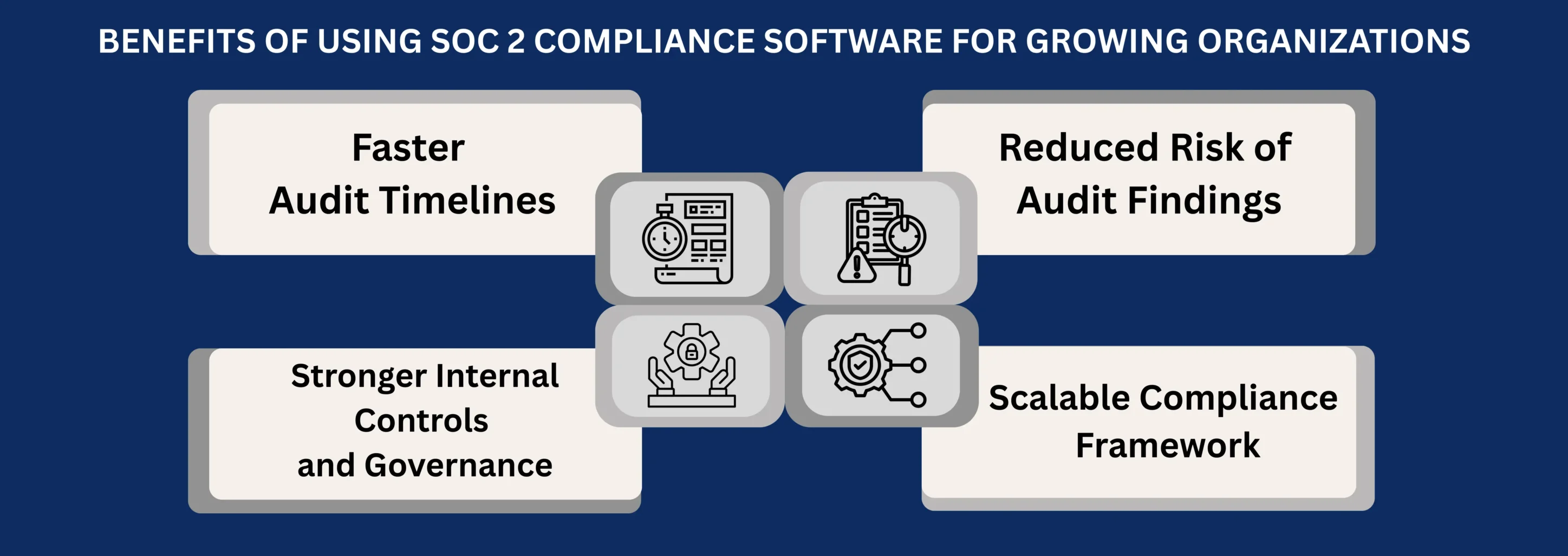
The benefits of SOC 2 Certification in Rotterdam extend across commercial, operational, and risk management dimensions. Organizations that complete the SOC 2 examination process gain independently verified documentation of their control environment, a structured basis for communicating security posture to clients and stakeholders, and a repeatable annual process for evaluating and improving internal controls. The following benefits are consistently cited by Rotterdam organizations that have completed SOC 2 Certification.
- ✓Independently verified SOC 2 attestation report accepted by enterprise clients, financial institutions, and institutional counterparties as evidence of control effectiveness
- ✓Reduced vendor security questionnaire burden — SOC 2 attestation reports address the majority of standard security questionnaire items with auditor-verified responses
- ✓Accelerated enterprise sales cycles by eliminating extended security review timelines for clients who accept SOC 2 reports in lieu of bespoke assessments
- ✓Documented control environment that supports internal risk management, board-level reporting, and regulatory engagement
- ✓Structured evidence of GDPR-aligned privacy controls when the Privacy Trust Services Criterion is included in SOC 2 examination scope
- ✓Annual re-attestation process that functions as a systematic internal control review, identifying control weaknesses before they result in incidents or regulatory findings
- ✓Competitive positioning in markets where SOC 2 Certification in Rotterdam’s financial services and technology sectors is treated as a baseline vendor requirement
- ✓Third-party risk management evidence for Rotterdam financial entities managing DORA compliance obligations regarding ICT service provider assurance
CertPro SOC 2 Audit Services in Rotterdam
CertPro CPA LLC is a Licensed CPA Firm conducting independent SOC 2 examination and attestation engagements for organizations across Rotterdam and the broader Rotterdam-Rijnmond region. The firm’s practice covers SOC 2 Type I and Type II examinations for all applicable Trust Services Criteria, serving technology companies, financial services firms, logistics and supply-chain technology providers, healthcare organizations, maritime businesses, cloud service providers, and enterprises across the Netherlands.
CertPro’s scope is limited strictly to independent SOC 2 audit, examination, testing, and attestation activities under AICPA attestation standards. The firm does not provide consulting, implementation, policy development, or control design services — preserving the auditor independence required for credible SOC 2 Certification in Rotterdam.
Examination Methodology and Auditor Independence
CertPro conducts SOC 2 examinations using a structured audit methodology aligned with AICPA AT-C Section 205 and the Trust Services Criteria. The examination process follows defined stages — scope determination, audit program development, design evaluation, operating effectiveness testing, evidence review, nonconformity assessment, and report issuance — with each stage producing documented outputs that support the attestation opinion.
Auditor independence is maintained through strict separation from any consulting or advisory engagement with the subject organization. CertPro does not participate in the design, implementation, or remediation of controls that are subsequently subject to examination. This ensures that every SOC 2 audit in Rotterdam reflects objective third-party evaluation rather than validation of the auditor’s own work — a cornerstone of credible SOC 2 Certification.
Industries and Organization Types Served in Rotterdam
CertPro conducts SOC 2 examination engagements for a range of organization types operating across Rotterdam and the Netherlands. Fintech companies and payment technology firms pursuing SOC 2 Certification in Rotterdam use Type II reports to satisfy financial institution vendor requirements. SaaS platforms and cloud service providers use SOC 2 attestation to demonstrate control effectiveness to enterprise clients across the EU and United States.
Logistics and supply-chain technology companies serving the Port of Rotterdam ecosystem use SOC 2 compliance documentation to evidence controls over commercial and operational data processed on behalf of shipping, freight, and port operations clients. Healthcare organizations, AI platforms, cybersecurity firms, and energy technology companies across the Rotterdam-Rijnmond region also pursue SOC 2 Certification to satisfy procurement requirements from institutional clients and to support their own regulatory compliance documentation.
FAQ
▶
What is SOC 2 Certification?
▶
What is SOC 2 Certification and who issues it?
▶
How long does the SOC 2 audit process take for a Rotterdam organization?
▶
What is the difference between SOC 2 Type I and Type II for Rotterdam organizations?
▶
Does SOC 2 attestation establish GDPR compliance for Rotterdam organizations?
▶
Which Trust Services Criteria should Rotterdam organizations include in their SOC 2 scope?
▶
How long is a SOC 2 attestation report valid?
▶
What evidence is required for a SOC 2 Type II examination?
SOC 1 VS SOC 2: WHICH REPORT YOUR CUSTOMERS ACTUALLY ASK FOR
If you sell SaaS or provide outsourced services, you have likely been asked for a SOC report. However, the follow-up question is rarely easy to answer…

AICPA Issues New Guidance for Peer Reviewers Evaluating SOC 2 Engagements
AICPA SOC 2 guidance has been issued to help peer reviewers identify quality risks associated with SOC 2 engagements as the use of compliance automati…
SOC 2 Certified: What Does It Mean for Your Business
For companies that handle sensitive data or run cloud-based services, the question “Can you provide your SOC 2 report?” carries enormous weight. Yet, …
Get In Touch
have a question? let us get back to you.