
SOC 2 Certification in San Jose
The scope of a SOC 2 examination determines which systems, processes, controls, and Trust Services Criteria categories are subject to the auditor’s evaluation. Scope definition is a critical early step in any SOC 2 audit in San Jose and directly affects the relevance and utility of the resulting report. An appropriately scoped SOC 2 examination addresses the systems and controls most material to customer commitments and most relevant to the information security risks presented by the organization’s service delivery environment.
OUR CLIENTS










SOC 2 Certification for San Jose Technology and Financial Organizations
SOC 2 Certification in San Jose is issued exclusively by a Licensed CPA Firm following an independent examination conducted under the American Institute of Certified Public Accountants (AICPA) attestation standards, specifically AT-C Section 205. The examination evaluates whether an organization’s controls are suitably designed and, in the case of a Type 2 report, operating effectively over a defined observation period. The resulting SOC 2 report provides independent, third-party validation of control effectiveness against the AICPA Trust Services Criteria — making it the authoritative standard for service organization assurance in the Silicon Valley market.
San Jose, as the operational center of Silicon Valley, hosts one of the highest concentrations of SaaS providers, cloud service organizations, AI startups, cybersecurity companies, semiconductor manufacturers, enterprise software vendors, fintech firms, e-commerce businesses, and telecommunications providers in the United States. Organizations across San Jose and the broader Santa Clara County technology corridor — including Sunnyvale, Cupertino, Mountain View, and Santa Clara — routinely engage enterprise customers and regulated institutions that require documented evidence of control effectiveness. SOC 2 attestation, issued by a Licensed CPA Firm, delivers that independent, third-party validation of control design and operating effectiveness that these customers demand.
The AICPA’s Trust Services Criteria establish five categories against which SOC 2 examinations are conducted: Security (Common Criteria), Availability, Processing Integrity, Confidentiality, and Privacy. All SOC 2 examinations must address the Security category as a baseline. Additional Trust Services Criteria categories are included based on the nature of services provided and the commitments made to customers. For a SaaS provider in San Jose storing customer financial data, the Confidentiality category may be relevant. For a cloud infrastructure organization in Santa Clara with contractual uptime obligations, the Availability criteria may also apply. The scope of applicable criteria is determined prior to the examination and documented in the system description.
SOC 2 compliance in San Jose is particularly relevant given California’s regulatory environment. The California Consumer Privacy Act (CCPA) and the California Privacy Rights Act (CPRA) impose significant obligations on organizations that collect, process, or share personal information of California residents. While SOC 2 attestation does not automatically establish compliance with the CCPA, CPRA, or other California or federal statutes, the control evidence gathered during a SOC 2 examination — particularly under the Privacy Trust Services Criteria — can support an organization’s broader privacy governance documentation. Enterprise customers in regulated industries frequently use a SOC 2 report as a primary instrument in their vendor due diligence and third-party risk management programs.
CertPro operates exclusively as an independent audit and attestation body, not as a consulting or advisory firm. The SOC 2 examination is conducted by CertPro’s Licensed CPA professionals under AICPA attestation standards. CertPro does not provide consulting, readiness assessments, control design, policy development, or remediation services. This independence is fundamental to the integrity of SOC 2 attestation and ensures that the resulting report reflects an objective, evidence-based evaluation — rather than an assessment influenced by any prior advisory engagement with the subject organization.

What Is SOC 2 Certification?
SOC 2 Certification is a formal attestation issued by a Licensed CPA Firm following a SOC 2 examination conducted under AICPA AT-C Section 205 standards. The term “SOC 2” stands for System and Organization Controls 2. The AICPA developed this certification framework specifically for service organizations that store, process, or transmit customer data. The SOC 2 examination evaluates both the design and operating effectiveness of internal controls relevant to the Trust Services Criteria selected for the engagement. The output is a formal SOC 2 report that includes the auditor’s opinion on control effectiveness and a detailed description of the service organization’s system — providing enterprise customers with the independent assurance they require.
SOC 2 Type 1 vs. SOC 2 Type 2 Reports
SOC 2 reports are issued in two distinct forms: Type 1 and Type 2. A SOC 2 Type 1 report — formally referred to as a Type I certification — assesses whether the controls described in the system description are suitably designed as of a specific point in time. A SOC 2 Type 2 report — formally referred to as a Type II certification — assesses both the suitability of control design and the operating effectiveness of those controls over a defined observation period, which typically spans a minimum of six months. Enterprise customers and regulated institutions generally prefer SOC 2 Type 2 reports because they provide evidence of sustained control operation rather than a single point-in-time snapshot.
For San Jose organizations pursuing SOC 2 Type I certification, the examination process is less time-intensive than a Type 2 engagement because no observation period is required. However, a Type 1 report carries more limited utility in enterprise vendor assessments, where procurement teams and third-party risk management programs in regulated industries expect Type 2 evidence. Many organizations in the Silicon Valley technology corridor pursue a Type I report first to establish a formal baseline, then proceed to a SOC 2 Type II audit in San Jose covering the subsequent operating period. The choice between Type 1 and Type 2 is determined by customer requirements, contractual obligations, and the organization’s current control maturity.
| Feature | SOC 2 Type 1 | SOC 2 Type 2 |
|---|---|---|
| Assessment Scope | Control design suitability at a specific point in time | Control design suitability and operating effectiveness over a defined period |
| Observation Period | Not required | Minimum 6 months (typically 6–12 months) |
| Evidence Requirement | Design-focused documentation | Design documentation plus operational evidence collected throughout the period |
| Enterprise Demand | Baseline or initial attestation | Preferred by regulated institutions and enterprise procurement programs |
| Report Output | Point-in-time auditor opinion | Period-covering auditor opinion with detailed control testing results |
Trust Services Criteria: The Evaluation Framework
The AICPA Trust Services Criteria (TSC) serve as the evaluative framework for all SOC 2 examinations. The five TSC categories are: Security (also called the Common Criteria, applicable to all engagements), Availability (system availability per contractual commitments), Processing Integrity (system processing completeness, validity, accuracy, and authorization), Confidentiality (protection of information designated as confidential), and Privacy (personal information collection, use, retention, and disposal). Each category contains specific criteria — numbered as CC, A, PI, C, and P series respectively — that describe control requirements. During a SOC 2 audit, the Licensed CPA Firm evaluates the organization’s controls mapped against each applicable criterion and assesses whether those controls adequately address the risks identified in the system description.
SOC 2 Certification Audit Process in San Jose
The SOC 2 audit process in San Jose follows a defined sequence of stages established under AICPA attestation standards. Each stage produces specific outputs that feed into the subsequent phase and ultimately culminate in the issuance of the SOC 2 attestation report. The process is conducted exclusively by a Licensed CPA Firm and is governed by professional standards requiring independence, objectivity, and evidence-based conclusions. The stages below describe the SOC 2 examination methodology as applied to organizations in San Jose and the broader Silicon Valley technology corridor.
| Audit Stage | Key Activities | Output |
|---|---|---|
| Scope Definition | Identify applicable Trust Services Criteria, define system boundaries, confirm report type (Type 1 or Type 2) | Agreed scope document and system description framework |
| Audit Program Determination | Develop control testing procedures tailored to the organization’s environment and selected TSC categories | Audit program with testing objectives and evidence requirements |
| Stage 1 — Documentation Review | Review system description, control documentation, policies, and risk assessment records for completeness and suitability | Stage 1 findings and documentation assessment results |
| Stage 2 — Control Testing | Test control design effectiveness (Type 1) and operating effectiveness over the observation period (Type 2) | Control testing workpapers and preliminary findings |
| Nonconformity Review & Report Issuance | Evaluate exceptions identified during testing, assess materiality, finalize auditor opinion, issue SOC 2 report | Issued SOC 2 Type 1 or Type 2 attestation report |
The first stage of a SOC 2 audit in San Jose involves defining the scope of the examination and preparing the system description. The system description is a management-prepared document that outlines the nature of services provided, the infrastructure, software, people, procedures, and data components that make up the service system, and the control objectives relevant to the Trust Services Criteria in scope. For a SaaS organization in San Jose, this description would typically reference cloud infrastructure providers, data processing workflows, access control mechanisms, and any subservice organizations such as third-party hosting providers. The system description forms the foundation of the auditor’s evaluation and must be both complete and accurate to support a valid SOC 2 examination.
During the control testing phase of a SOC 2 Type II audit in San Jose, the Licensed CPA Firm applies testing procedures — including inquiry, observation, inspection, and re-performance — to evaluate whether controls operated effectively throughout the observation period. Evidence collection is central to this phase. For a San Jose cybersecurity company, evidence might include access logs demonstrating periodic user access reviews, vulnerability scan reports, incident response records, and change management tickets. For a fintech organization, evidence might include encryption key management records, audit trails of financial data processing, and penetration testing reports. The auditor documents the results of each test, identifies any deviations or exceptions, and assesses whether those deviations are individually or collectively material to the auditor’s opinion.
Following the completion of control testing, the Licensed CPA Firm conducts a nonconformity review to assess any exceptions identified during the audit. Nonconformities are documented in the SOC 2 report, which includes a description of each test performed, the result observed, and any deviations noted. Management is given the opportunity to provide responses to noted exceptions, which are included in the final report. The certification committee then reviews the aggregate findings, evaluates materiality, and determines the appropriate auditor opinion — unqualified, qualified, or adverse — based solely on the evidence gathered. The issued SOC 2 attestation report is then made available to the organization for distribution to customers and stakeholders under appropriate confidentiality arrangements.
- ✓Scope Definition and System Description
- ✓Control Testing and Evidence Collection
- ✓Nonconformity Review and Report Issuance
Why Organizations in San Jose Pursue SOC 2 Certification
SOC 2 compliance in San Jose is driven by a distinct set of demand factors rooted in the city’s position as the operational heart of Silicon Valley. Enterprise procurement processes, financial sector vendor assessments, regulated institution requirements, and international SaaS market expansion collectively generate high demand for SOC 2 attestation among San Jose organizations. The following subsections describe the primary demand drivers that make SOC 2 certification a recurring business requirement — rather than an optional assurance activity — for San Jose SaaS companies, cloud providers, and technology organizations.
Enterprise Vendor Security Reviews and Procurement Requirements
Enterprise organizations operating in San Jose and across Silicon Valley routinely require third-party service providers to produce current SOC 2 reports as part of their vendor onboarding and annual third-party risk management review processes. A typical procurement scenario involves a large enterprise software organization in San Jose evaluating a SaaS vendor: the procurement team requests the vendor’s most recent SOC 2 Type 2 report, reviews the system description and auditor’s testing results, and assesses whether the vendor’s control environment meets the enterprise’s minimum security requirements. Without a current SOC 2 attestation, vendors frequently cannot advance past initial procurement stages. This dynamic is particularly pronounced in financial services, healthcare technology, and enterprise software — sectors where regulated end-customers impose strict vendor assurance standards.
Financial Services and Fintech Sector Expectations
San Jose hosts a significant concentration of fintech organizations, payment processors, digital banking platforms, and financial technology infrastructure providers. These organizations frequently serve regulated financial institutions — including banks, credit unions, broker-dealers, and investment advisors — that are subject to examination by regulatory bodies such as the OCC, FDIC, Federal Reserve, and FINRA. Regulated financial institutions are required to conduct formal due diligence on their technology service providers and often rely on SOC 2 Type 2 reports as primary evidence in vendor risk assessments. For fintech organizations in San Jose pursuing contracts with regulated financial institutions, SOC 2 attestation is frequently a contractual prerequisite rather than a discretionary credential. The absence of a current SOC 2 report can disqualify a vendor entirely in competitive financial services procurement processes.
International SaaS Expansion and Cross-Border Assurance
Many SaaS organizations based in San Jose and the broader Silicon Valley corridor pursue international enterprise customers in Europe, Asia-Pacific, and other markets where SOC 2 attestation is recognized as a credible third-party assurance mechanism. While SOC 2 is an AICPA-governed attestation standard developed in the United States, international enterprise customers — particularly in regulated sectors — accept SOC 2 Type 2 reports as evidence of control effectiveness in their vendor due diligence programs. For San Jose organizations expanding into markets where local regulatory requirements demand documented evidence of security and data protection controls, SOC 2 certification provides an internationally recognized baseline. Organizations should note that SOC 2 attestation does not automatically satisfy requirements under frameworks such as the EU General Data Protection Regulation (GDPR) or other jurisdiction-specific regulations, but it can support documentation of control effectiveness within a broader compliance program.
SOC 2 Certification Scope and Independent Decision Framework
The scope of a SOC 2 examination determines which systems, processes, controls, and Trust Services Criteria categories are subject to the auditor’s evaluation. Scope definition is a critical early step in any SOC 2 audit in San Jose and directly affects the relevance and utility of the resulting report. An appropriately scoped SOC 2 examination addresses the systems and controls most material to customer commitments and most relevant to the information security risks presented by the organization’s service delivery environment.
Defining System Boundaries and Applicable Trust Services Criteria
System boundaries define which components of the organization’s technology and operational environment are included in the SOC 2 examination. For a cloud service provider in San Jose, system boundaries would typically include the production infrastructure environment, application layer, data management systems, network architecture, and the operational procedures governing those components. Subservice organizations — third-party providers whose services are part of the system being described — may be included in scope using the inclusive method or excluded using the carve-out method, with the chosen approach disclosed in the system description. Applicable Trust Services Criteria categories are selected based on the nature of services provided, the types of data processed, and the commitments made to customers in service agreements. The Licensed CPA Firm reviews the proposed scope for completeness and appropriateness before the SOC 2 examination commences.
Independence, Objectivity, and the Certification Decision
The independence of the Licensed CPA Firm conducting the SOC 2 examination is a foundational requirement under AICPA attestation standards. The firm must be independent of the subject organization — meaning it has no financial interest in, employment relationship with, or advisory engagement with the organization that would impair its objectivity. This independence requirement is precisely what distinguishes a SOC 2 attestation from an internal audit or self-assessment. Following the completion of testing and the nonconformity review, an independent certification committee evaluates the aggregate findings and determines the appropriate auditor opinion. The certification decision is based exclusively on evidence gathered during the SOC 2 examination and is not influenced by commercial or relationship considerations — which is the basis on which enterprise customers and regulated institutions place reliance on SOC 2 reports.
Report Validity, Maintenance, and Recertification
A SOC 2 report does not carry an indefinite validity period. SOC 2 Type 2 reports cover a specific observation period and are considered current for the period they cover, typically 12 months. Enterprise customers and third-party risk management programs generally expect organizations to produce SOC 2 reports issued within the prior 12 months. Once a Type 2 report’s observation period expires without a subsequent report being issued, the organization may be considered to have a lapse in SOC 2 compliance documentation — which can affect vendor status with enterprise customers. Organizations that have obtained SOC 2 Certification in San Jose are expected to undergo annual audit cycles to maintain a continuous and current attestation record. Recertification involves a new SOC 2 examination covering the subsequent period, conducted by a Licensed CPA Firm under the same AICPA attestation standards.
SOC 2 Certification Requirements for San Jose Organizations
Meeting the requirements for SOC 2 Certification in San Jose involves establishing, documenting, and operating a control environment that addresses the applicable Trust Services Criteria. The specific requirements vary depending on the Trust Services Criteria categories in scope and the nature of the organization’s service delivery. The following requirements are characteristic of organizations undergoing a SOC 2 examination across key Trust Services Criteria domains.
The SOC 2 examination requires organizations to produce documented evidence of the controls described in their system description. Documentation requirements include information security policies, risk assessment records, access control procedures, change management processes, incident response plans, and vendor management documentation. For each Trust Services Criterion addressed in the examination, the organization must demonstrate that relevant controls exist, are formally documented, have been communicated to responsible personnel, and — in the case of a Type 2 engagement — have been consistently operated throughout the observation period. Gaps between documented procedures and actual operational practice represent a common source of exceptions identified during SOC 2 Type II audit engagements in San Jose. Evidence must be collected concurrently with control operation, rather than retrospectively assembled after the observation period concludes.
Technical controls form a substantial portion of the control environment evaluated during a SOC 2 audit. Under the Security Common Criteria, organizations are required to demonstrate controls addressing logical access restrictions, network security, encryption of data at rest and in transit, vulnerability management, monitoring and logging, and configuration management. For cloud-native organizations in San Jose — which represent a significant portion of the local technology ecosystem — technical controls are often implemented through cloud infrastructure platforms such as AWS, Google Cloud Platform, and Microsoft Azure. The SOC 2 examination evaluates the configuration and operation of these controls within the organization’s specific environment. Centralized logging and monitoring systems play a particularly important role in supporting evidence collection during a Type 2 observation period, providing the audit trails that the Licensed CPA Firm reviews during control testing.
- ✓Formal information security policy documented and communicated to all relevant personnel
- ✓Risk assessment process identifying threats and vulnerabilities relevant to the in-scope system
- ✓Logical access controls restricting system access to authorized personnel only
- ✓Encryption of sensitive data at rest and in transit using industry-standard protocols
- ✓Vulnerability management program with periodic scanning and remediation tracking
- ✓Centralized logging and monitoring with defined alert and response procedures
- ✓Change management process governing infrastructure and application modifications
- ✓Incident response plan with defined detection, response, and notification procedures
- ✓Vendor and subservice organization management program with periodic performance reviews
- ✓Documentation and Control Environment Requirements
- ✓Technical Control Requirements
Benefits of SOC 2 Certification for San Jose-Based Organizations
SOC 2 Certification in San Jose delivers a defined set of organizational outcomes directly tied to the attestation process itself. These outcomes result from the independent examination conducted by a Licensed CPA Firm and the formal SOC 2 report that documents the auditor’s findings. The benefits described below reflect the direct value of holding a current SOC 2 attestation — not claims of organizational improvement or assurance of future outcomes.
SOC 2 attestation provides independent, third-party verification that an organization’s controls addressing the applicable Trust Services Criteria are suitably designed and — in the case of a Type 2 report — have operated effectively over the observation period. This independent verification, conducted by a Licensed CPA Firm under AICPA attestation standards, carries a level of credibility that self-assessments and internal audit reports cannot replicate. For enterprise customers evaluating vendors in the San Jose technology ecosystem, a SOC 2 report issued by an independent Licensed CPA Firm represents authoritative evidence of control effectiveness — evidence that can be relied upon in formal vendor risk assessments and procurement decision-making processes.
SOC 2 certification for San Jose companies creates formal recognition in enterprise procurement processes, where vendor security questionnaires, risk assessments, and contract due diligence cycles are standard requirements. Organizations holding a current SOC 2 Type 2 report can satisfy security questionnaire requirements by referencing the report rather than completing each questionnaire individually. This recognition extends across multiple industry verticals represented in the San Jose market: technology, financial services, healthcare IT, defense contracting, education technology, and telecommunications. In competitive vendor selection processes, the presence of a current SOC 2 report signals to enterprise procurement teams that the vendor has undergone an independent evaluation of its control environment — a signal that organizations without SOC 2 attestation simply cannot provide through alternative means.
The annual SOC 2 examination cycle introduces a structured, recurring audit methodology that requires organizations to maintain continuous control operation and evidence collection throughout the observation period. This recurring structure — defined by the observation period requirements of a SOC 2 Type 2 engagement — creates an ongoing control monitoring discipline within the organization. For San Jose technology organizations with rapid growth trajectories, the annual SOC 2 examination cycle provides a mechanism for independent assessment of whether the control environment has kept pace with organizational growth, system changes, and evolving risk exposures. The structured audit methodology also produces documentation — testing workpapers, control descriptions, and management responses — that organizations can reference in their own risk management and governance programs.
- ✓Independent third-party validation of control design and operating effectiveness
- ✓Recognition in enterprise and regulated institution vendor due diligence programs
- ✓Formal SOC 2 report available for distribution to customers and key stakeholders
- ✓Annual audit cycle supporting ongoing control monitoring and evidence discipline
- ✓Reduced vendor security questionnaire burden through standardized report sharing
- ✓Documented evidence of Trust Services Criteria compliance for customer contracts
- ✓Support for California privacy law documentation requirements under CCPA and CPRA
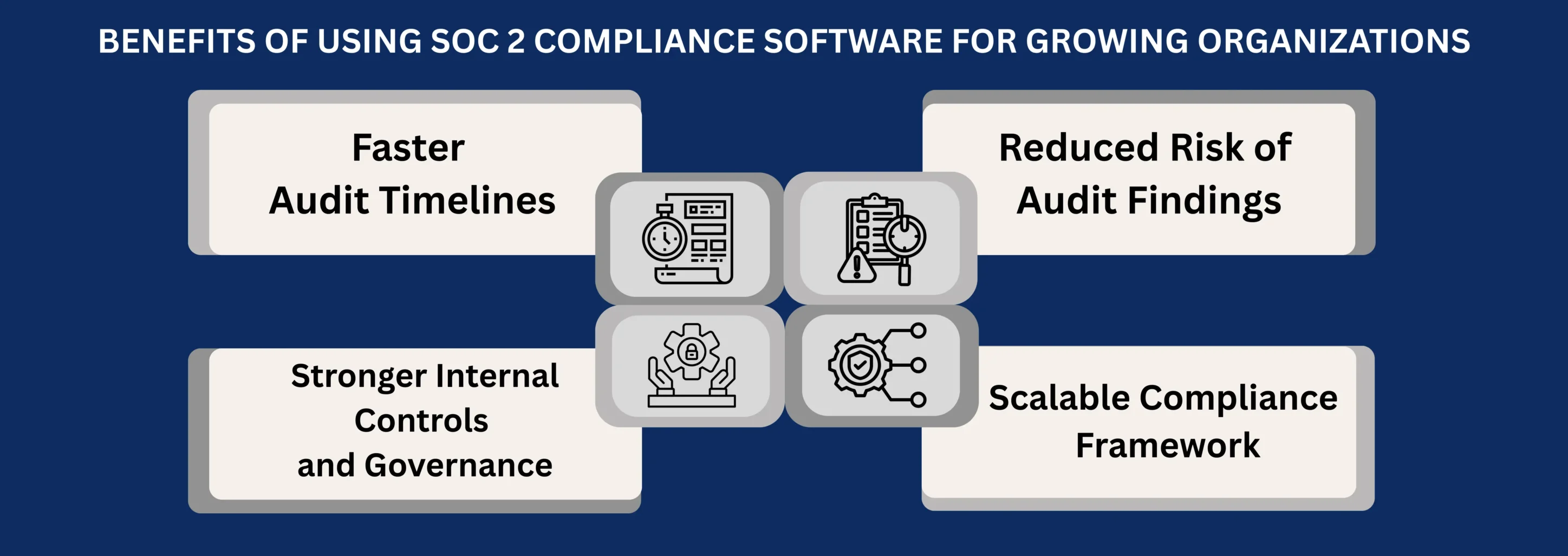
- ✓Independent Verification of Control Effectiveness
- ✓Recognition in Enterprise Procurement and Vendor Assessments
- ✓Structured Audit Methodology and Ongoing Control Oversight
San Jose Technology Sectors Pursuing SOC 2 Certification
SOC 2 compliance in San Jose spans a broad and diverse range of industry sectors, reflecting the city’s position as one of the most concentrated technology markets in the world. The following sectors represent the primary organizational categories in San Jose and the Santa Clara County technology corridor where SOC 2 attestation is pursued as a routine business requirement.
SaaS, Cloud, and Enterprise Software Providers
Software-as-a-Service organizations and cloud service providers in San Jose represent the largest single category of SOC 2 examination engagements in the Silicon Valley technology corridor. These organizations process, store, and transmit customer data on behalf of enterprise clients and are routinely required to produce SOC 2 Type 2 reports as part of their commercial contracts. Enterprise software vendors serving sectors such as human resources, financial management, customer relationship management, and supply chain management frequently encounter SOC 2 attestation requirements throughout their sales cycles. SOC 2 certification for San Jose SaaS companies allows these organizations to provide a single, standardized assurance artifact to multiple enterprise customers simultaneously — replacing ad hoc security questionnaire processes with a formal, auditor-issued report.
AI Startups, Cybersecurity, and Semiconductor Organizations
Artificial intelligence startups, cybersecurity companies, and semiconductor manufacturers in San Jose and the surrounding technology corridor increasingly pursue SOC 2 attestation to address the security and confidentiality expectations of enterprise customers and investors. AI organizations that process large volumes of customer data — including proprietary datasets, training data, and model outputs — face particular scrutiny regarding data handling practices and access controls. Cybersecurity companies may pursue SOC 2 Certification in San Jose to demonstrate that their own security practices meet the standards they deliver to clients. Semiconductor and hardware technology companies with software-enabled services, intellectual property management systems, or supply chain platforms also engage in SOC 2 examinations to address the control assurance requirements of enterprise and government customers in their markets.
Fintech, E-Commerce, and Telecommunications Providers
Fintech organizations in San Jose processing payments, managing digital assets, or providing financial infrastructure services face SOC 2 attestation requirements from regulated financial institution customers and payment card industry participants. E-commerce businesses operating platforms that process consumer financial data and personal information routinely encounter SOC 2 requirements in enterprise retail and marketplace vendor agreements. Telecommunications providers and managed service organizations serving enterprise and government customers in the Silicon Valley corridor face SOC 2 compliance requirements driven by customer security programs and government contractor obligations. For each of these sectors, SOC 2 attestation provides a standardized, auditor-issued report that addresses the control assurance expectations of diverse customer bases — without requiring sector-specific attestation formats for each individual customer relationship.
SOC 2 Examination: Management Responsibilities and Evidence Requirements
The SOC 2 examination under AICPA AT-C Section 205 places specific responsibilities on management of the subject organization. These responsibilities are distinct from those of the Licensed CPA Firm conducting the examination and are a formal condition of the attestation engagement. Understanding management’s role in the SOC 2 examination process is essential for organizations in San Jose preparing to engage in a SOC 2 audit for the first time or on an ongoing annual basis.
Management of the subject organization is required to prepare and sign a formal assertion that accompanies the SOC 2 report. This assertion states that the system description presents the organization’s system fairly and that the controls described are suitably designed to meet the applicable Trust Services Criteria. In the case of a Type 2 engagement, the assertion also states that the controls described operated effectively throughout the specified period. Management’s assertion is a formal representation made under AICPA attestation standards and carries professional and legal implications. The system description itself — including the identification of applicable Trust Services Criteria, the description of controls, and disclosure of complementary user entity controls — is management’s responsibility, not the auditor’s. The Licensed CPA Firm evaluates the system description for completeness and accuracy but does not prepare it.
During a SOC 2 Type 2 observation period — typically spanning 6 to 12 months — management is responsible for ensuring that controls operate as described in the system description and that evidence of control operation is collected and retained contemporaneously. Evidence requirements for a SOC 2 Type II audit in San Jose include access review records, change management approvals, vulnerability scan results, security incident logs, backup and recovery test results, vendor assessment records, and training completion records, among others. The Licensed CPA Firm will request samples of this evidence during the testing phase and will assess whether it demonstrates consistent control operation throughout the observation period. Organizations that fail to maintain contemporaneous evidence records frequently encounter exceptions during control testing — exceptions that may result in a qualified auditor opinion or management responses that reduce the report’s utility for enterprise customers.
- ✓Management’s Assertion and System Description Responsibilities
- ✓Evidence Collection and Control Documentation During the Observation Period
FAQ
▶
What is SOC 2 Certification and why do San Jose technology organizations pursue it?
▶
What is the difference between SOC 2 Type 1 and SOC 2 Type 2?
▶
How long does a SOC 2 Type 2 audit take for a San Jose organization?
▶
Which Trust Services Criteria categories are most commonly included in SOC 2 audits for San Jose SaaS companies?
▶
Does SOC 2 attestation establish compliance with California privacy laws such as CCPA or CPRA?
▶
How long is a SOC 2 report valid and how often must San Jose organizations renew their attestation?
▶
What is the difference between SOC 2 compliance and SOC 2 certification?
▶
Can a SOC 2 examination include subservice organizations used by a San Jose company?
SOC 1 VS SOC 2: WHICH REPORT YOUR CUSTOMERS ACTUALLY ASK FOR
If you sell SaaS or provide outsourced services, you have likely been asked for a SOC report. However, the follow-up question is rarely easy to answer…

AICPA Issues New Guidance for Peer Reviewers Evaluating SOC 2 Engagements
AICPA SOC 2 guidance has been issued to help peer reviewers identify quality risks associated with SOC 2 engagements as the use of compliance automati…
SOC 2 Certified: What Does It Mean for Your Business
For companies that handle sensitive data or run cloud-based services, the question “Can you provide your SOC 2 report?” carries enormous weight. Yet, …
Get In Touch
have a question? let us get back to you.