
SOC 2 Certification in St. Louis
The SOC 2 audit process follows a structured sequence of stages governed by AICPA attestation standards. Each stage produces defined outputs that collectively form the basis for the independently issued SOC 2 attestation report. For organizations pursuing SOC 2 Certification in St. Louis, the process begins with a scope determination that identifies the systems, services, and Trust Services Criteria categories subject to examination.
OUR CLIENTS










SOC 2 Certification for St. Louis-Based Financial and Technology Organizations
SOC 2 Certification in St. Louis is conducted by CertPro CPA LLC, a Licensed CPA Firm operating as an independent third-party examination body under the American Institute of Certified Public Accountants (AICPA) attestation standards. The SOC 2 examination evaluates an organization’s internal controls against the AICPA Trust Services Criteria (TSC), producing an independently issued attestation report that documents control design and operating effectiveness. CertPro does not provide consulting, advisory, or implementation services — the firm functions exclusively as an independent SOC 2 certification and attestation body.
St. Louis operates as a recognized financial, technology, and healthcare hub within the Midwest. The Greater St. Louis metropolitan area supports a concentrated ecosystem of SaaS providers, fintech companies, regional financial institutions, health technology organizations, biotechnology and life sciences firms, logistics and supply-chain businesses, manufacturing and industrial technology companies, cybersecurity firms, AI companies, e-commerce businesses, and cloud service providers. Organizations operating across St. Louis, Clayton, Chesterfield, Creve Coeur, St. Charles, and the broader Missouri business corridor increasingly pursue SOC 2 Certification in St. Louis as a condition of enterprise vendor onboarding, regulated industry procurement, and international SaaS expansion.
The Trust Services Criteria established by the AICPA define the framework against which SOC 2 audits are conducted. The five TSC categories are Security (Common Criteria), Availability, Processing Integrity, Confidentiality, and Privacy. Security is mandatory in every SOC 2 engagement. Organizations select additional criteria categories based on the nature of services delivered and customer contractual obligations. Each selected criterion is evaluated through the review of documented policies, system configurations, logical access controls, monitoring procedures, change management activities, risk assessment processes, and operating evidence collected across a defined observation period.
SOC 2 Certification differs from self-declared SOC 2 compliance in one fundamental respect: compliance refers to an organization’s internal assertion that controls exist, while SOC 2 attestation is an independently verified determination issued by a Licensed CPA Firm following a structured examination. Enterprise customers, regulated financial institutions, healthcare organizations, and government contractors operating in and around St. Louis routinely require SOC 2 attestation reports as part of third-party risk management programs and vendor security reviews. The attestation report issued following a SOC 2 examination provides customers with documented, independently verified evidence of control effectiveness — not a self-assessed declaration.
St. Louis organizations subject to the Missouri Data Breach Notification Law, HIPAA, GLBA, PCI DSS, or contractual data protection requirements frequently pursue SOC 2 Certification in St. Louis to demonstrate structured control environments to regulators, customers, and business partners. SOC 2 attestation does not automatically establish compliance with Missouri statutes or federal regulations. However, the documented control evidence produced during a SOC 2 audit is directly relevant to demonstrating information security program maturity across multiple regulatory frameworks. The independently issued SOC 2 report is recognized across enterprise procurement processes, financial sector due diligence reviews, healthcare technology vendor assessments, and international SaaS contract negotiations.

What Is SOC 2 Certification?
Definition and Governing Standards
SOC 2 Certification is a formal third-party attestation issued by a Licensed CPA Firm following an independent examination of an organization’s internal controls relevant to security, availability, processing integrity, confidentiality, and privacy. The SOC 2 examination is governed by the AICPA’s Statement on Standards for Attestation Engagements No. 18 (SSAE 18) and evaluated against the AICPA Trust Services Criteria. Unlike regulatory compliance frameworks that impose prescriptive control requirements, the Trust Services Criteria define objectives — organizations design and implement controls appropriate to their service environment, and the Licensed CPA Firm independently evaluates whether those controls are suitably designed and operating effectively.
SOC 2 is not a product certification or a regulatory license. It is an independent attestation of control effectiveness issued following a structured SOC 2 audit. Organizations in St. Louis that store, process, or transmit customer data across cloud environments, SaaS platforms, or managed service infrastructures are the primary candidates for SOC 2 Certification in St. Louis.
SOC 2 Type I and SOC 2 Type II Reports
SOC 2 produces two distinct report types that serve different purposes within enterprise vendor assurance programs. A SOC 2 Type I report evaluates the design of controls at a specific point in time — answering the question: Are the controls that management has described suitably designed to meet the applicable Trust Services Criteria as of the report date?
A SOC 2 Type II report evaluates both control design and operating effectiveness across a defined observation period, typically six to twelve months. It answers the question: Did the controls operate effectively throughout the observation period? Type II reports carry significantly greater evidentiary weight in enterprise procurement, financial sector vendor reviews, and regulated industry assessments because they demonstrate sustained control performance — not merely control existence at a single date. Most St. Louis organizations pursuing SOC 2 attestation for enterprise customer requirements will ultimately need a Type II report, although Type I reports serve as a structured starting point in initial audit cycles.
| Report Type | Evaluation Focus | Time Dimension | Primary Use Case |
|---|---|---|---|
| SOC 2 Type I | Control design suitability | Point in time | Initial vendor qualification, early-stage SOC 2 attestation |
| SOC 2 Type II | Control design and operating effectiveness | Observation period (6–12 months) | Enterprise procurement, regulated industry vendor reviews |
| SOC 2 + Privacy | Security and Privacy TSC | Observation period | Healthcare technology, fintech, consumer data platforms |
| SOC 2 + Availability | Security and Availability TSC | Observation period | Cloud service providers, SaaS uptime commitments |
Trust Services Criteria Categories
The AICPA Trust Services Criteria are organized into five categories, each addressing a distinct dimension of organizational control. Security — the Common Criteria — is mandatory in every SOC 2 examination and covers logical and physical access controls, risk assessment, change management, monitoring, and incident response. Availability addresses system uptime, performance monitoring, and disaster recovery controls relevant to service commitments. Processing Integrity evaluates whether system processing is complete, accurate, timely, and authorized. Confidentiality addresses controls governing the protection of information designated as confidential by agreement or policy. Privacy evaluates controls governing the collection, use, retention, disclosure, and disposal of personal information consistent with the organization’s privacy notice and applicable privacy frameworks.
St. Louis organizations in healthcare technology, fintech, cloud services, and data processing frequently include Availability, Confidentiality, and Privacy criteria in their SOC 2 examination scope — reflecting customer contractual requirements and the sensitivity of information handled within their service environments.
SOC 2 Certification Audit Process for Organizations in St. Louis
The SOC 2 audit process follows a structured sequence of stages governed by AICPA attestation standards. Each stage produces defined outputs that collectively form the basis for the independently issued SOC 2 attestation report. For organizations pursuing SOC 2 Certification in St. Louis, the process begins with a scope determination that identifies the systems, services, and Trust Services Criteria categories subject to examination.
Scope determination is the foundational stage of the SOC 2 audit process. The Licensed CPA Firm reviews the organization’s system description, service commitments, and the nature of information processed within the in-scope environment. This review identifies which Trust Services Criteria categories apply, which systems and infrastructure components fall within the audit boundary, and what evidence collection activities will be required during the SOC 2 examination.
The audit program is then developed to specify the procedures the Licensed CPA Firm will perform to evaluate control design and operating effectiveness. For St. Louis organizations operating multi-tenant SaaS platforms, cloud-hosted environments, or financial data processing systems, scope determination frequently encompasses application-layer controls, infrastructure security configurations, third-party subservice organization relationships, and complementary user entity controls that affect the overall control environment.
The Stage 1 audit is a structured review of the organization’s documented control environment. The Licensed CPA Firm examines system descriptions, information security policies, risk assessment documentation, control inventories, and evidence of control ownership and accountability. Stage 1 identifies whether the documented control framework is structured to address the applicable Trust Services Criteria and whether the organization’s evidence collection and documentation practices are sufficient to support the Stage 2 SOC 2 examination.
Observations identified during Stage 1 are communicated to the organization prior to the commencement of detailed control testing. Stage 1 does not produce the final attestation report — it functions as the structured review that establishes the basis for Stage 2 audit procedures and confirms that the observation period and evidence collection are appropriately positioned for the full SOC 2 audit.
The Stage 2 audit constitutes the core examination phase of the SOC 2 compliance process. The Licensed CPA Firm performs detailed control testing procedures, including inspection of policy documents and system configurations, observation of control activities, inquiry of personnel responsible for control operation, and re-performance of selected control procedures to confirm operating effectiveness.
For SOC 2 Type II reports, control testing is performed across the full observation period — typically six to twelve months — evaluating whether controls operated consistently and effectively throughout that period. Evidence reviewed during Stage 2 includes access provisioning and deprovisioning records, change management tickets and approvals, security monitoring logs, vulnerability assessment results, incident response records, vendor management documentation, and business continuity and disaster recovery test results. The Stage 2 audit produces the findings that inform the nonconformity review and certification committee decision.
| Audit Stage | Key Activities | Output |
|---|---|---|
| Scope Determination | System description review, criteria selection, audit boundary identification | Audit program and scope confirmation |
| Stage 1 Audit | Documentation review, policy examination, control inventory assessment | Stage 1 observations communicated to organization |
| Stage 2 Audit | Control testing, evidence collection, operating effectiveness evaluation | SOC 2 audit findings and nonconformity identification |
| Nonconformity Review | Review of identified exceptions, management response evaluation | Nonconformity classification and resolution assessment |
| Attestation Issuance | Certification committee review, SOC 2 report finalization | Independently issued SOC 2 attestation report |
Following Stage 2 control testing, the Licensed CPA Firm conducts a nonconformity review to evaluate exceptions identified during the SOC 2 examination. Nonconformities are documented in the audit findings and assessed in the context of the overall control environment and the applicable Trust Services Criteria. The certification committee then reviews the complete examination findings, the organization’s system description, and the auditor’s conclusions before issuing the final attestation determination.
The SOC 2 attestation report — either Type I or Type II — is issued as an independently produced document reflecting the Licensed CPA Firm’s examination conclusions. The report includes the independent auditor’s opinion, the organization’s system description, the applicable Trust Services Criteria, and the auditor’s findings regarding control design and operating effectiveness. SOC 2 attestation reports are typically valid for twelve months from the report date, after which organizations pursue renewal through a subsequent SOC 2 audit cycle.
- ✓Scope Determination and Audit Program Development
- ✓Stage 1 Audit: Documentation and Readiness Review
- ✓Stage 2 Audit: Control Testing and Evidence Evaluation
- ✓Nonconformity Review and Attestation Issuance
Why Organizations in St. Louis Pursue SOC 2 Certification
SOC 2 Certification in St. Louis is driven by a combination of enterprise customer procurement requirements, regulated industry vendor assessment standards, financial sector due diligence expectations, and international SaaS expansion criteria. The demand for SOC 2 attestation among St. Louis organizations reflects the city’s position as a growing technology and financial services hub — one where vendor security reviews have become standard practice across both public and private sector procurement processes.
Enterprise Vendor Security Reviews and Financial Sector Procurement
Enterprise organizations headquartered or operating across St. Louis, Clayton, and Chesterfield routinely require SOC 2 attestation reports from technology vendors as a condition of vendor onboarding and contract execution. Regional financial institutions, insurance carriers, and investment management firms in St. Louis’s financial corridor require SOC 2 Type II reports from SaaS vendors, cloud service providers, and fintech platforms that process financial data, customer account information, or payment transactions.
SOC 2 Certification in St. Louis financial services contexts extends to managed service providers, data analytics firms, and software vendors supplying systems to regulated financial entities. A St. Louis-based fintech company seeking to onboard a major regional bank as a customer, for example, will typically be required to provide a current SOC 2 Type II report as part of the bank’s third-party risk management and vendor due diligence process before contract execution proceeds.
Healthcare Technology and Life Sciences Vendor Assessment
St. Louis is home to a significant concentration of healthcare technology organizations, biotechnology and life sciences firms, and health information management companies whose services touch protected health information (PHI) and sensitive clinical and research data. Healthcare systems, academic medical centers, and managed care organizations in the Greater St. Louis area evaluate technology vendors against SOC 2 attestation standards as part of HIPAA-aligned vendor assessment programs.
SOC 2 compliance demonstrated by St. Louis health technology vendors through an independently issued attestation report provides healthcare customers with structured, evidence-based documentation of security and availability controls. This documentation informs HIPAA Business Associate Agreement (BAA) due diligence without constituting HIPAA compliance certification in itself. Life sciences organizations handling clinical trial data, genomic information, and proprietary research data similarly face SOC 2 attestation requirements from pharmaceutical partners, research institutions, and regulatory technology platforms operating within their vendor ecosystems.
International SaaS Expansion and Cloud Service Provider Requirements
St. Louis-based SaaS companies and cloud service providers pursuing enterprise customers in regulated industries across North America, Europe, and the Asia-Pacific region face SOC 2 attestation requirements as a standard condition of enterprise contract negotiation. International enterprise customers and procurement teams recognize SOC 2 attestation as the primary U.S.-issued third-party assurance standard for cloud-hosted and SaaS environments.
SOC 2 examination completed by St. Louis technology companies through CertPro produces an independently issued report structured for international enterprise recognition alongside ISO 27001 certification in combined vendor assessment frameworks. Cybersecurity firms, AI companies, and e-commerce platforms operating from St. Louis that serve customers across multiple jurisdictions increasingly maintain current SOC 2 attestation reports as a baseline requirement for enterprise sales cycles and international procurement qualification.
SOC 2 Certification Requirements and Evaluation Criteria
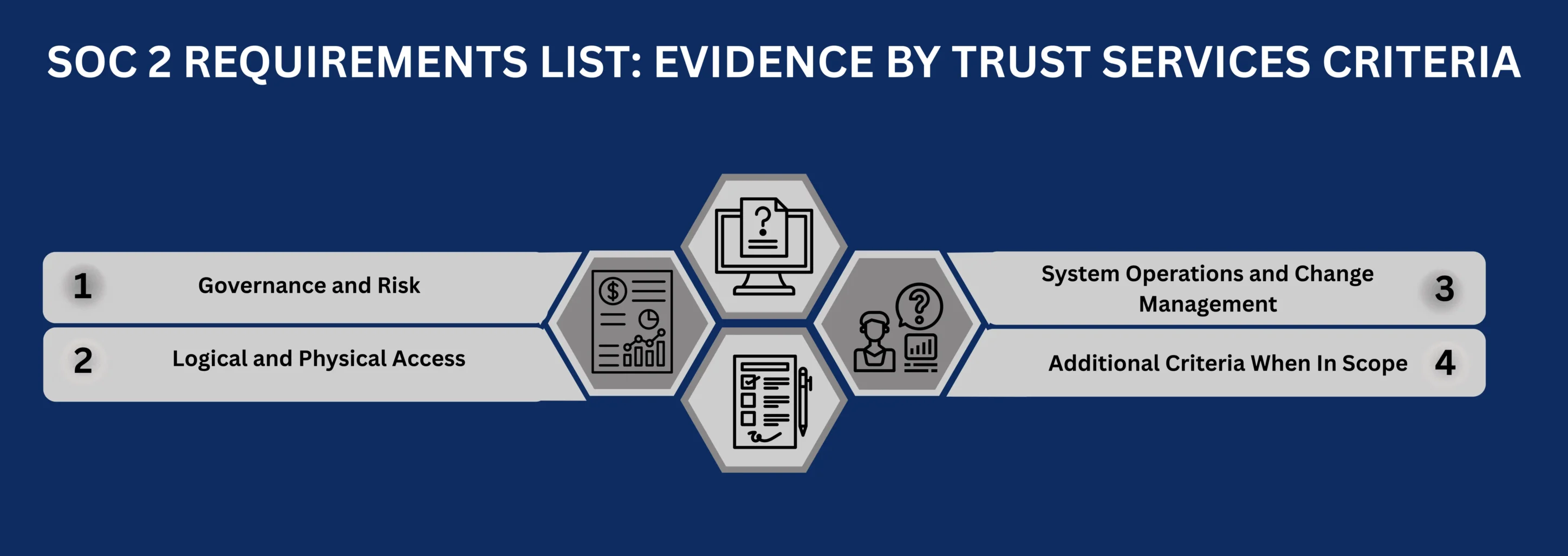
SOC 2 Certification requirements are defined by the AICPA Trust Services Criteria, which establish the control objectives against which the Licensed CPA Firm conducts its independent examination. Organizations seeking SOC 2 Certification in St. Louis must maintain a documented control environment that addresses each applicable Trust Services Criterion within the defined audit scope. The evaluation criteria are evidence-based: the Licensed CPA Firm assesses whether controls are suitably designed and, for Type II reports, whether they operated effectively across the observation period.
SOC 2 audit documentation requirements encompass the system description, information security policies, risk assessment and risk treatment documentation, control activity records, and evidence of management review and monitoring activities. The system description is a formal document that management prepares to describe the services provided, the system components that deliver those services, and the controls in place to meet the applicable Trust Services Criteria.
Risk assessment documentation must demonstrate that the organization has identified information security risks relevant to its service environment and has implemented controls to address those risks. Control activity evidence — including records of access reviews, change management approvals, security configurations, incident response activities, vendor assessments, and business continuity testing — is reviewed by the Licensed CPA Firm during the SOC 2 audit. All documentation must be organized, retrievable, and consistent with the control descriptions provided in the system description.
Technical control requirements for SOC 2 compliance address the logical and physical security measures that protect in-scope systems and data. The Licensed CPA Firm evaluates controls governing logical access management — including user provisioning, access reviews, multi-factor authentication, and privileged access restrictions. Infrastructure security controls covering network segmentation, vulnerability management, patch management, and endpoint protection are assessed against the Security Trust Services Criteria.
Change management controls must demonstrate that changes to in-scope systems are authorized, tested, and documented prior to implementation. Monitoring and alerting controls are evaluated to determine whether the organization detects and responds to security events and performance anomalies in a timely manner. For St. Louis organizations operating cloud-hosted environments, the SOC 2 audit also evaluates controls relevant to cloud configuration management, data encryption in transit and at rest, and the management of subservice organizations such as IaaS and PaaS providers whose services are part of the in-scope system.
Management of the organization seeking SOC 2 attestation is responsible for the accuracy and completeness of the system description, the design and implementation of controls, the collection and retention of evidence supporting control operation, and the ongoing monitoring of control effectiveness across the observation period. The Licensed CPA Firm evaluates whether management has established oversight mechanisms — including internal audit activities, security committee governance, and periodic control performance reviews — that demonstrate active management of the control environment rather than passive documentation of control existence.
Management is also responsible for identifying, documenting, and addressing control deficiencies identified through internal monitoring before or during the SOC 2 examination. Ongoing control monitoring is a critical element of the SOC 2 compliance framework. Because the Type II report evaluates control performance across an extended observation period, control failures that occur and are not addressed will be reflected in the auditor’s findings and the issued attestation report.
- ✓Documentation Requirements for SOC 2 Examination
- ✓Technical and Operational Control Requirements
- ✓Management Responsibilities and Control Monitoring
Business Sectors in St. Louis Seeking SOC 2 Certification
SOC 2 certification for St. Louis companies spans a diverse range of industries concentrated across the Greater St. Louis metropolitan area. The city’s established financial services infrastructure, expanding technology sector, significant healthcare and life sciences presence, and growing logistics and manufacturing technology base collectively generate substantial demand for SOC 2 attestation across multiple industry verticals.
Financial Services, Fintech, and Insurance
SOC 2 compliance for St. Louis fintech organizations, regional banks, credit unions, insurance carriers, investment management firms, and payment processors represents one of the most active demand segments for SOC 2 attestation in the metropolitan area. Financial institutions subject to GLBA, state banking regulations, and OCC examination expectations require technology vendors to demonstrate independent control validation through SOC 2 audit reports.
Fintech companies operating payment platforms, lending technology systems, wealth management applications, and insurance technology (insurtech) platforms serving Missouri’s regulated financial sector face SOC 2 attestation requirements as a standard condition of financial institution vendor programs. The Missouri Division of Finance and the Missouri Department of Insurance, Financial Institutions and Professional Registration (DIFP) both oversee regulated entities that maintain vendor management programs requiring evidence of third-party control assurance — contexts in which a current SOC 2 Type II report provides structured, independently verified documentation.
Healthcare Technology, Life Sciences, and Logistics
Healthcare technology companies, electronic health record (EHR) platforms, health information exchanges, telehealth providers, and medical device software organizations operating in St. Louis and the surrounding Missouri healthcare corridor pursue SOC 2 Certification to satisfy vendor security requirements imposed by hospital systems, health plans, and integrated delivery networks. Biotechnology and life sciences firms handling clinical research data, genomic databases, and proprietary scientific information similarly require SOC 2 attestation as a condition of collaboration with academic medical institutions and commercial pharmaceutical partners.
Logistics and supply-chain technology organizations — a significant sector in the St. Louis economy given the city’s position as a major transportation and distribution hub — pursue SOC 2 certification for St. Louis companies operating transportation management systems, warehouse management platforms, and supply-chain visibility applications that process sensitive shipment, inventory, and customer data for enterprise retail, manufacturing, and government clients.
SaaS Providers, Cloud Services, Cybersecurity, and AI Companies
St. Louis has developed a growing technology corridor spanning Midtown, Cortex Innovation Community, and suburban technology campuses in Chesterfield and Creve Coeur. This corridor supports a significant concentration of SaaS providers, cybersecurity firms, AI companies, and cloud service organizations — many of whom serve enterprise customers across regulated industries and face SOC 2 attestation requirements as a standard feature of enterprise sales cycles and vendor security review programs.
Cybersecurity firms providing managed detection and response (MDR), security operations center (SOC) services, and identity management platforms face heightened scrutiny from enterprise customers who require evidence that the organizations entrusted with security oversight maintain independently verified control environments. AI companies operating machine learning platforms, data annotation services, and predictive analytics tools that process customer or enterprise proprietary data similarly face SOC 2 audit requirements from enterprise customers seeking evidence of security and confidentiality controls governing AI model training environments and data handling practices.
Benefits of SOC 2 Certification for St. Louis-Based Organizations
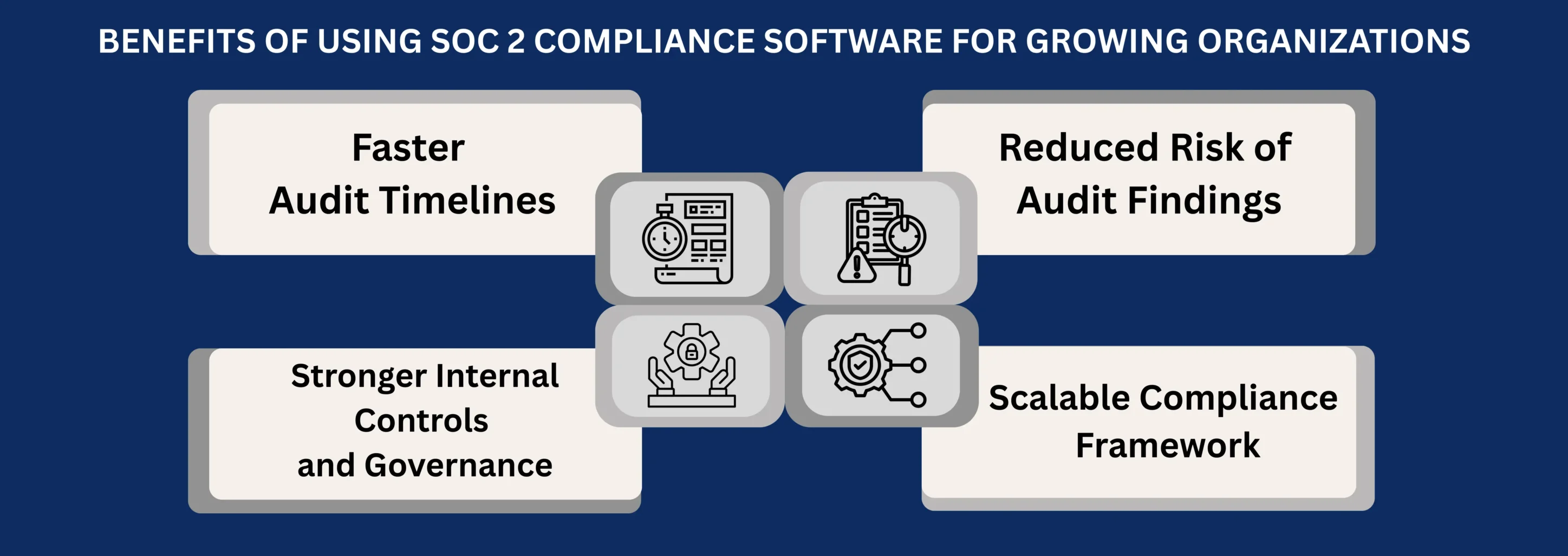
SOC 2 Certification in St. Louis delivers independently verified documentation of control effectiveness recognized across enterprise vendor security review programs, regulated industry procurement processes, and international SaaS contract negotiations. The independently issued SOC 2 attestation report provides objective evidence that an organization’s internal controls are suitably designed and, in the case of a Type II report, have operated effectively over a sustained observation period.
- ✓Independent verification of control design and operating effectiveness against AICPA Trust Services Criteria, issued by a Licensed CPA Firm following a structured SOC 2 examination
- ✓Recognition in enterprise procurement programs, vendor security questionnaire processes, and regulated industry vendor onboarding reviews across financial services, healthcare, and government sectors
- ✓Structured SOC 2 audit methodology that evaluates evidence-based control performance across a defined observation period, producing a documented and reproducible assessment record
- ✓Demonstrated alignment with information security risk management expectations relevant to the Missouri Data Breach Notification Law and federal regulatory frameworks including HIPAA and GLBA
- ✓Competitive differentiation in St. Louis enterprise technology markets where SOC 2 attestation is a standard requirement for SaaS, cloud, and managed service vendor qualification
- ✓Third-party validated documentation that supports international SaaS contract negotiations and cross-border enterprise customer due diligence reviews
- ✓Ongoing surveillance and recertification audit cycles that maintain current SOC 2 attestation status and demonstrate sustained control effectiveness to enterprise customers
- ✓Reduction of the volume and frequency of customer security questionnaires through provision of a current SOC 2 Type II report as standardized vendor assurance documentation
The SOC 2 examination produces independently verified documentation of control effectiveness that organizations can present to enterprise customers, regulatory bodies, and business partners as structured assurance evidence. Unlike internally produced security certifications or self-assessed compliance declarations, a SOC 2 attestation report issued by a Licensed CPA Firm carries the independent authority of a professional attestation engagement conducted under AICPA standards.
For St. Louis organizations operating in competitive enterprise technology markets — particularly in financial services, healthcare technology, and cloud infrastructure — the independently issued SOC 2 attestation report functions as a structured differentiator in vendor qualification processes. The annual SOC 2 audit cycle required to maintain current attestation status establishes an ongoing oversight mechanism that drives continuous evaluation of control performance, evidence quality, and risk management effectiveness across the organization’s control environment.
A current SOC 2 Type II report is recognized in enterprise procurement programs across North America and internationally as the primary U.S.-origin independent assurance standard for cloud-hosted and SaaS service organizations. St. Louis technology companies pursuing enterprise contracts with Fortune 500 organizations, regulated financial institutions, healthcare systems, and government agencies in Missouri and beyond will routinely encounter SOC 2 attestation as a vendor qualification requirement in request-for-proposal (RFP) processes, master service agreement negotiations, and third-party risk management program onboarding.
SOC 2 attestation obtained by St. Louis organizations through an independently conducted examination positions those organizations to respond to vendor security review requests with structured, independently verified documentation — materially accelerating enterprise procurement timelines and reducing the burden of repetitive security documentation requests from multiple enterprise customers simultaneously.
- ✓Control Effectiveness Verification and Ongoing Oversight
- ✓Enterprise Procurement Recognition and International Expansion
SOC 2 Attestation, Report Validity, and Recertification
The SOC 2 attestation report issued following completion of the SOC 2 examination is a formal professional document that reflects the Licensed CPA Firm’s independent conclusions regarding the organization’s control environment — as of the report date for Type I, or across the observation period for Type II. Understanding report validity, maintenance requirements, and recertification obligations is essential for St. Louis organizations managing vendor assurance programs and enterprise customer commitments.
Report Validity Period and Annual Audit Cycles
SOC 2 attestation reports are generally considered current for twelve months from the report period end date. Enterprise customers and regulated industry procurement programs typically require organizations to provide a SOC 2 report issued within the preceding twelve months to satisfy active vendor assurance requirements. Organizations that allow their SOC 2 attestation to lapse — by failing to initiate a new audit cycle before the previous report period expires — may face vendor disqualification, contract renegotiation delays, or temporary suspension from approved vendor lists maintained by enterprise customers.
To maintain continuous SOC 2 attestation status, St. Louis organizations should initiate their annual SOC 2 audit cycle sufficiently in advance of the prior report period end date to ensure the new report is issued without a gap in attestation coverage. The SOC 2 audit firm that St. Louis organizations engage should structure the audit cycle to align observation periods and reporting timelines with customer contract renewal dates and enterprise vendor review schedules.
Scope Changes, System Changes, and Attestation Maintenance
Material changes to an organization’s system, service environment, or control framework between SOC 2 audit cycles may require the organization to notify the Licensed CPA Firm and assess whether a supplemental examination or scope adjustment is warranted. Significant changes that may affect attestation maintenance include the addition of new cloud service platforms within the in-scope system, material changes to subservice organization relationships, the acquisition of new business units whose systems are incorporated into in-scope services, changes to privacy practices affecting the Privacy Trust Services Criteria, or significant restructuring of logical access management controls.
The SOC 2 attestation report issued by CertPro reflects the control environment as examined during the audit period. Changes occurring after the report period are the responsibility of management to document, assess, and address in the context of the next SOC 2 audit cycle. Completing a SOC 2 examination annually produces an updated attestation report that reflects the current control environment and resets the twelve-month validity period for St. Louis organizations maintaining continuous attestation coverage.
SOC 2 vs. Other Information Security Standards
St. Louis organizations evaluating information security assurance frameworks frequently assess SOC 2 Certification alongside ISO 27001, HITRUST, PCI DSS, and FedRAMP to determine which standard best addresses their customer requirements and target market. Each framework serves distinct purposes and carries different recognition characteristics across enterprise procurement programs.
SOC 2 and ISO 27001: Complementary Frameworks
SOC 2 and ISO 27001 are complementary frameworks that address information security assurance from different perspectives and serve different market segments. SOC 2 attestation is the dominant vendor assurance standard in U.S. enterprise technology markets — particularly for SaaS providers, cloud service organizations, and fintech platforms serving U.S.-based financial institutions and healthcare organizations. ISO 27001 carries broader international recognition and is frequently required by European enterprise customers, global enterprise procurement programs, and organizations operating across multiple regulatory jurisdictions.
Organizations pursuing SOC 2 Certification in St. Louis that also serve international enterprise customers may find that maintaining both SOC 2 attestation and ISO 27001 certification provides the most comprehensive coverage across their enterprise vendor qualification requirements. The two frameworks share significant control overlap — particularly in security management, risk assessment, access control, and incident response — and organizations that maintain documented control environments meeting Trust Services Criteria typically find meaningful alignment with ISO 27001 Annex A control requirements.
SOC 2 and HITRUST, PCI DSS, and FedRAMP
HITRUST CSF certification is a healthcare-sector-specific framework adopted by many large health systems and health plans as a vendor assurance standard. It incorporates SOC 2, HIPAA, NIST, and other regulatory requirements into a unified control framework. St. Louis healthcare technology vendors may encounter requirements for both SOC 2 attestation and HITRUST certification from different healthcare system customers, as the two standards serve overlapping but distinct assurance purposes.
PCI DSS applies specifically to organizations that store, process, or transmit payment card data and is governed by the Payment Card Industry Security Standards Council — organizations subject to PCI DSS may also pursue SOC 2 attestation to address broader information security assurance requirements beyond the payment card data scope. FedRAMP authorization is the relevant federal cloud security standard for organizations seeking to provide cloud services to U.S. federal government agencies. St. Louis technology organizations pursuing federal contracts should assess FedRAMP requirements alongside SOC 2 compliance and St. Louis enterprise market requirements based on their specific customer target segments.
FAQ
▶
What is SOC 2 Certification and which St. Louis organizations need it?
▶
What is the difference between SOC 2 Type I and SOC 2 Type II?
▶
How long does the SOC 2 audit observation period last?
▶
What Trust Services Criteria are included in a SOC 2 audit?
▶
Does SOC 2 attestation confirm compliance with Missouri state law or HIPAA?
▶
How long is a SOC 2 attestation report valid?
▶
What is the difference between SOC 2 certified and SOC 2 compliant?
▶
Which St. Louis industries most commonly require SOC 2 certification?
SOC 1 VS SOC 2: WHICH REPORT YOUR CUSTOMERS ACTUALLY ASK FOR
If you sell SaaS or provide outsourced services, you have likely been asked for a SOC report. However, the follow-up question is rarely easy to answer…

AICPA Issues New Guidance for Peer Reviewers Evaluating SOC 2 Engagements
AICPA SOC 2 guidance has been issued to help peer reviewers identify quality risks associated with SOC 2 engagements as the use of compliance automati…
SOC 2 Certified: What Does It Mean for Your Business
For companies that handle sensitive data or run cloud-based services, the question “Can you provide your SOC 2 report?” carries enormous weight. Yet, …
Get In Touch
have a question? let us get back to you.