
SOC 2 Certification in Wilmington
SOC 2 Certification in Wilmington is issued exclusively by a Licensed CPA Firm following an independent examination conducted under AICPA AT-C Section 205 attestation standards. CertPro performs SOC 2 examinations in Wilmington, Delaware, evaluating organizational controls against the AICPA Trust Services Criteria (TSC). SOC 2 Type 1 and Type 2 attestation reports serve corporate, financial services, SaaS, healthcare, pharmaceutical, and technology organizations operating throughout Wilmington.
OUR CLIENTS










What Is SOC 2 Certification?
SOC 2 Certification is a formal attestation issued by a Licensed CPA Firm confirming that a service organization’s controls meet the AICPA Trust Services Criteria (TSC) across one or more of five principal categories: Security, Availability, Processing Integrity, Confidentiality, and Privacy. Governed by AICPA AT-C Section 205, this attestation is not issued by a standards body. Instead, it represents an independent auditor’s opinion delivered through a SOC 2 report following a structured examination engagement. SOC 2 Certification in Wilmington is increasingly required by enterprises, financial institutions, and government-affiliated organizations seeking verified assurance over third-party service providers’ internal control environments.
Definition and Authoritative Framework
SOC 2 stands for System and Organization Controls 2, a framework developed by the American Institute of Certified Public Accountants (AICPA). The framework defines how CPA firms examine and report on a service organization’s controls relevant to security, availability, processing integrity, confidentiality, and privacy. The SOC 2 examination is governed by AICPA AT-C Section 205 (Examination Engagements) and SSAE 18 (Statements on Standards for Attestation Engagements No. 18), establishing professional standards for evidence gathering, risk assessment, control testing, and attestation reporting.
The Trust Services Criteria (TSC) underpinning SOC 2 examinations are organized into 17 points of focus under the CC (Common Criteria) series, supplemented by additional criteria specific to Availability (A), Processing Integrity (PI), Confidentiality (C), and Privacy (P) categories. Each criterion specifies control objectives and related points of focus that the examining CPA firm uses to evaluate whether management’s description of the system is fairly presented, whether controls are suitably designed, and whether they operated effectively over the examination period. The Security criterion—also referred to as the Common Criteria—is mandatory in all SOC 2 engagements. The remaining four criteria are included based on the service organization’s system scope and customer commitments.
SOC 2 Type 1 vs. Type 2 Reports
SOC 2 examinations produce two distinct report types, each serving different assurance purposes. A SOC 2 Type 1 report evaluates the fairness of a service organization’s system description and the suitability of control design as of a specific point in time—but does not include testing of control operating effectiveness. By contrast, a SOC 2 Type 2 report covers both the suitability of control design and the operating effectiveness of those controls over a defined observation period. This period is typically a minimum of six months, though twelve-month periods are standard for mature programs. Type 2 attestation provides a higher level of assurance and is generally required by enterprise customers, financial institutions, and regulated industries operating in Wilmington and across Delaware.
Organizations pursuing SOC 2 Certification in Wilmington for the first time frequently begin with a Type 1 report to establish a baseline of control design before proceeding to Type 2 attestation. The Type 1 report demonstrates to prospective customers that controls are suitably designed before the observation period required for Type 2 begins. Once a Type 2 examination cycle is underway, controls must operate continuously throughout the observation period—they cannot be suspended, altered, or reactivated immediately before the audit window closes. The examining CPA firm will assess whether evidence of control operation exists throughout the stated period and will note any gaps, exceptions, or deviations observed during testing.
| Report Type | Assessment Focus | Time Frame | Primary Use Case |
|---|---|---|---|
| SOC 2 Type 1 | Design of controls at a point in time | Single date | Initial assurance, early-stage programs |
| SOC 2 Type 2 | Design and operating effectiveness of controls | Minimum 6 months (12 months typical) | Enterprise procurement, regulated sectors |
| SOC 2 + Privacy | All TSC including Privacy (P) criteria | 12 months standard | Healthcare, financial services, data processors |
Trust Services Criteria: The Five Categories
The five Trust Services Criteria categories define the scope boundaries of every SOC 2 examination. The Security criterion (CC series) governs logical and physical access controls, system operations, change management, risk mitigation, and monitoring—it is the foundational criterion present in all SOC 2 reports. Availability criteria (A series) apply to organizations where system uptime and performance commitments are material to service delivery, such as SaaS platforms, cloud infrastructure providers, and managed service organizations. Processing Integrity criteria (PI series) address whether system processing is complete, accurate, timely, and authorized—directly relevant to payment processors, financial data platforms, and transactional service providers in Wilmington’s fintech sector.
Confidentiality criteria (C series) apply when organizations must protect specific categories of information designated as confidential, such as proprietary business data, trade secrets, or non-public financial information. The Privacy criterion (P series) is the most extensive supplemental category, derived from the AICPA Privacy Management Framework. It addresses notice, choice and consent, collection, use and retention, access, disclosure, security for privacy, quality, and monitoring. Organizations in Wilmington’s pharmaceutical, healthcare, and insurance sectors frequently include Privacy criteria in their SOC 2 examinations to address HIPAA-adjacent data handling commitments. However, SOC 2 Privacy attestation and HIPAA compliance remain legally distinct obligations. The examining CPA firm determines which criteria apply based on the service organization’s system description and service commitments.

ENQUIRE NOW
Related Resources
Related Services in Wilmington
SOC 2 Certification Audit Process in Wilmington
The SOC 2 audit process in Wilmington follows a structured, multi-stage examination methodology governed by AICPA attestation standards. Each stage involves defined activities performed by the Licensed CPA Firm’s examination team, producing documented evidence that supports the auditor’s opinion. SOC 2 audit Wilmington engagements conducted by CertPro follow this established sequence, ensuring examination integrity, audit independence, and report quality consistent with AICPA professional standards and peer review requirements.
Scope definition is the foundational stage of every SOC 2 examination. During this stage, the examining CPA firm reviews the service organization’s description of its system—a document that specifies the services provided, infrastructure components, software applications, people, procedures, and data included within the examination boundary. The system description must meet the AICPA’s description criteria, which require clearly identified system boundaries, service commitments, and system requirements used by management to govern the system, along with principal service commitments relevant to each Trust Services Criterion in scope.
Scope definition directly determines the depth and breadth of the SOC 2 audit. For Wilmington-based organizations, the scope may encompass on-premises data centers, co-location facilities, cloud service environments (AWS, Azure, GCP), third-party subservice organizations, and personnel across multiple Delaware locations. The examining CPA firm evaluates whether subservice organizations are addressed using the carve-out method (excluded from testing) or the inclusive method (included within scope), and whether complementary user entity controls (CUECs) are appropriately described. Scope definition errors—such as excluding critical infrastructure components or omitting relevant Trust Services Criteria—are among the most common causes of report qualifications and reissuance in SOC 2 engagements.
Following scope definition, the examining CPA firm develops an audit program tailored to the specific controls, systems, and Trust Services Criteria in scope. The audit program specifies the nature, timing, and extent of procedures to be performed—including inquiry, observation, inspection of evidence, and re-performance of controls. Risk assessment at this stage evaluates the likelihood that material misstatements exist in the service organization’s system description or that controls are not suitably designed or operating effectively. Higher-risk areas—such as privileged access management, vendor management, and incident response—receive more extensive testing procedures.
For SOC 2 Type 2 examinations, the audit program includes population-based sampling strategies for each key control. The examining CPA firm selects samples from the full observation period to confirm that controls operated consistently throughout—not merely at the start or end of the period. Sampling methodology follows AICPA guidance, with sample sizes determined by population size, control frequency (daily, weekly, monthly, or annually), and assessed risk levels. Controls with higher operational risk—such as security event monitoring, access provisioning and deprovisioning, and backup verification—typically require larger sample sizes and more extensive evidence review during SOC 2 audit Wilmington, Delaware engagements.
Evidence collection is the most time-intensive phase of the SOC 2 examination. The examining CPA firm gathers documentary evidence supporting each control assertion made in the system description. Evidence types include configuration screenshots, access review logs, change management tickets, security event logs, vendor contracts, training completion records, penetration test reports, business continuity test results, and board or management meeting minutes demonstrating oversight. For each tested control, the auditor documents the evidence reviewed, the procedure performed, and the conclusion reached regarding operating effectiveness.
Control testing procedures in the SOC 2 examination involve inquiry of responsible personnel, direct observation of control execution, inspection of policy documentation and system-generated reports, and re-performance where technically feasible. The examining CPA firm does not simply accept management’s representations without corroborating evidence. Where evidence is unavailable, incomplete, or inconsistent with control assertions, the auditor identifies an exception. Exceptions are evaluated for materiality and systemic nature. Isolated exceptions may result in explanatory language within the report, while pervasive or material control failures may result in a qualified or adverse opinion on the SOC 2 attestation.
Upon completing control testing, the examining CPA firm compiles findings and conducts a nonconformity review to classify each identified exception by severity, frequency, and impact on the relevant Trust Services Criterion. Management is provided an opportunity to review draft findings and submit formal responses where applicable. The examining CPA firm then issues the final SOC 2 report, which includes the auditor’s opinion, management’s assertion, the system description, the description of tests of controls and results, and—for Type 2 reports—the period covered by the examination. This report constitutes the SOC 2 attestation that Wilmington-based service organizations provide to customers, business partners, and regulators as evidence of their control environment.
- Scope definition and system description review
- Trust Services Criteria selection and boundary determination
- Audit program development and risk assessment
- Observation period commencement (Type 2 only, minimum 6 months)
- Evidence collection and documentation review
- Control testing via inquiry, observation, inspection, and re-performance
- Exception identification and nonconformity review
- Management assertion review and draft report circulation
- Final SOC 2 report issuance and attestation delivery
- Annual recertification planning and continuous control monitoring
- ✓Stage 1: Scope Definition and System Description Review
- ✓Stage 2: Audit Program Determination and Risk Assessment
- ✓Stage 3: Evidence Collection and Control Testing
- ✓Stage 4: Nonconformity Review, Report Issuance, and Attestation
Benefits of SOC 2 Certification for Wilmington-Based Organizations
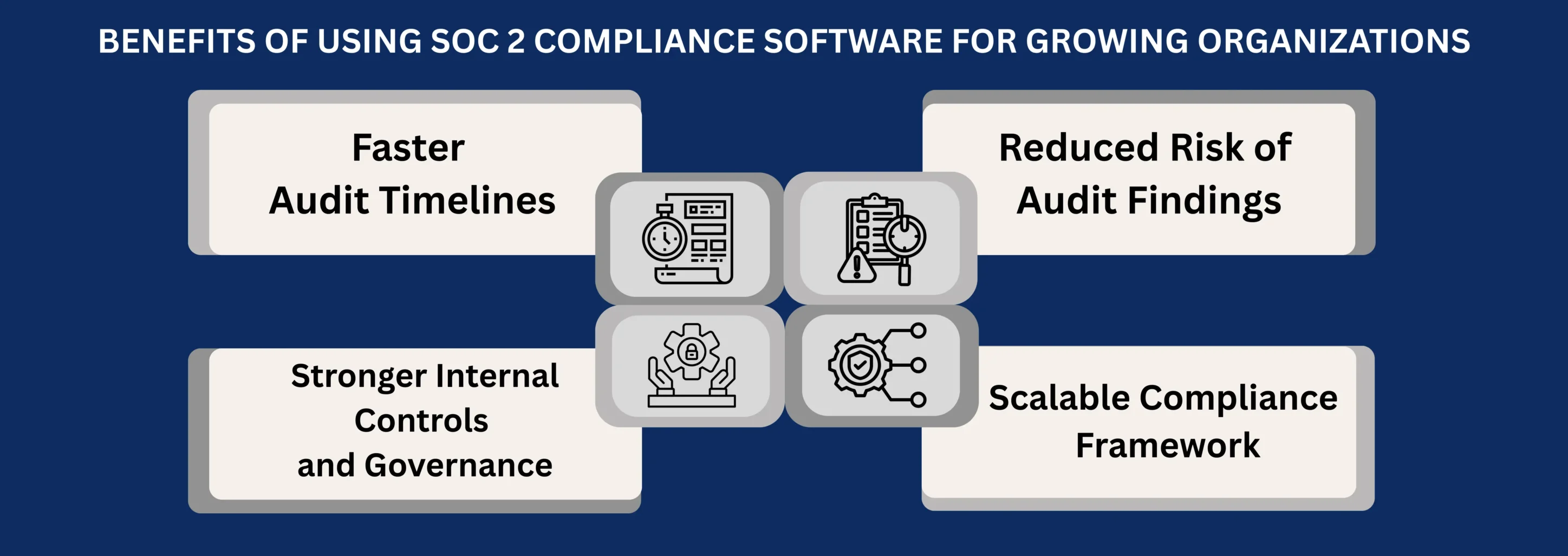
SOC 2 Certification for Wilmington companies delivers measurable operational, commercial, and regulatory advantages. As Delaware’s corporate capital and a major U.S. financial services and technology hub, Wilmington’s business environment demands high-assurance third-party validation of data security and control integrity. Achieving SOC 2 attestation positions Wilmington service organizations as demonstrably trustworthy vendors—capable of meeting enterprise procurement requirements, satisfying regulatory scrutiny, and substantiating their security posture with independent, auditor-issued evidence rather than self-assessed claims.
Enterprise organizations in Wilmington’s banking, insurance, pharmaceutical, and technology sectors routinely mandate SOC 2 Type 2 reports as a vendor qualification requirement during procurement. Without a current SOC 2 Type 2 attestation, Wilmington-based service providers may be disqualified from vendor shortlists before commercial negotiations even begin. A SOC 2 report replaces multiple customer-specific security questionnaires with a single authoritative document, reducing the administrative burden on both the vendor’s security team and the customer’s procurement and risk management functions. Organizations that complete SOC 2 Certification in Wilmington consistently report accelerated sales cycles, reduced procurement friction, and expanded access to enterprise-tier accounts previously inaccessible without third-party attestation.
The commercial value of SOC 2 attestation extends beyond initial vendor qualification. Enterprise contract renewals increasingly require confirmation that the SOC 2 report remains current and that no material control failures have been identified since the last examination period. Organizations that allow their SOC 2 reports to lapse—typically after twelve months—risk vendor disqualification during contract renewal reviews. For Wilmington fintech companies and SaaS providers serving financial institution clients, the absence of a current SOC 2 Type 2 report may trigger contractual audit rights, requiring the customer’s own internal audit function to conduct a vendor assessment in place of the missing attestation.
SOC 2 compliance that Wilmington organizations achieve through formal attestation directly supports regulatory risk management obligations under multiple frameworks. Financial institutions regulated by the Office of the Comptroller of the Currency (OCC), the Federal Reserve, and the FDIC are required to perform third-party risk management due diligence on service providers. A current SOC 2 Type 2 report provides documented evidence of control effectiveness, satisfying vendor oversight documentation requirements under OCC Bulletin 2013-29 and the FFIEC IT Examination Handbook’s vendor management guidance. Delaware-based insurance companies overseen by the Delaware Department of Insurance similarly benefit from SOC 2 attestation as evidence supporting vendor risk management program documentation.
Beyond regulatory requirements, SOC 2 examination results provide Wilmington organizations with documented evidence of control effectiveness that supports internal governance, board-level cybersecurity oversight, and enterprise risk committee reporting. The examining CPA firm’s observations and identified exceptions—even minor ones—deliver an independent, evidence-based view of control gaps that self-assessment processes frequently fail to detect. This independent perspective supports continuous improvement of the control environment, reduces the risk of undetected control failures, and provides documented proof that management exercised appropriate oversight of information security and data protection obligations.
SOC 2 Certification in Wilmington functions as a differentiating credential in competitive markets where multiple vendors offer comparable technical capabilities. When procurement teams evaluate vendors on equal technical footing, a current SOC 2 Type 2 attestation from a Licensed CPA Firm signals organizational maturity, governance discipline, and sustained investment in control infrastructure. Wilmington-based cloud service providers, managed service providers (MSPs), and data analytics platforms that have completed SOC 2 attestation are well-positioned to compete for engagements with Delaware’s large financial institutions, pharmaceutical firms, and healthcare organizations—all of which maintain vendor risk requirements equivalent to or exceeding enterprise standards.
- ✓Accelerates enterprise vendor qualification and procurement approval
- ✓Replaces multiple customer security questionnaires with a single authoritative attestation
- ✓Satisfies OCC, FFIEC, and Delaware regulatory vendor management documentation requirements
- ✓Provides board-level evidence of cybersecurity control effectiveness
- ✓Reduces contractual vendor audit obligations imposed by customers
- ✓Positions Wilmington organizations competitively against uncertified vendors
- ✓Supports HIPAA, PCI DSS, and GDPR control environment documentation
- ✓Establishes a documented baseline for continuous control improvement
- ✓Demonstrates organizational maturity to investors, auditors, and partners
- ✓Maintains vendor eligibility during enterprise contract renewal reviews
- ✓Commercial and Procurement Advantages
- ✓Regulatory and Risk Management Benefits
- ✓Reputational and Competitive Positioning
SOC 2 Requirements for Wilmington Service Organizations
SOC 2 examination requirements apply to any organization that provides services to other entities (user entities) where those services are relevant to the user entity’s internal controls over financial reporting or operational objectives. In Wilmington, this encompasses a broad range of service organization types—including SaaS providers, cloud infrastructure platforms, managed security service providers, payroll processors, financial data aggregators, healthcare technology vendors, and outsourced business process providers. The SOC 2 examination does not prescribe specific technologies or vendor configurations. Instead, it evaluates whether the controls implemented by the service organization meet the AICPA Trust Services Criteria relevant to the services provided.
Documentation requirements for SOC 2 examinations in Wilmington are extensive and must cover the full breadth of controls included within the system description. Required documentation categories include information security policies (acceptable use, access control, incident response, change management, business continuity, and vendor management), procedural documentation for each key control, system configuration baselines, network architecture diagrams, data flow maps, risk assessment records, and evidence of periodic control review activities. The examining CPA firm evaluates whether policies are formally approved by management, communicated to relevant personnel, and enforced through operational procedures with demonstrable evidence of consistent execution.
Evidence of control operation is the most critical documentation category for SOC 2 Type 2 examinations. Acceptable evidence types include system-generated logs confirming automated controls executed as designed, tickets and records from change management and access provisioning systems, meeting minutes documenting management oversight activities, training completion records, and vendor assessment documentation. For controls that operate at defined frequencies—weekly vulnerability scans, monthly access reviews, quarterly penetration test reports—the examining CPA firm will sample evidence from across the observation period. Gaps in evidence for any sampled period are recorded as exceptions in the SOC 2 report, regardless of whether the control functioned correctly in periods for which evidence exists.
Technical control requirements for SOC 2 Certification encompass the full stack of information security infrastructure relevant to the scoped system. Logical access controls must demonstrate that access to production systems is restricted to authorized personnel, that privileged access is controlled and monitored, that multi-factor authentication (MFA) is enforced for administrative and remote access, and that access reviews are conducted at defined intervals with documented results. Encryption controls must address data in transit and data at rest, with documented encryption standards specifying algorithms, key lengths, and key management procedures consistent with NIST or equivalent cryptographic standards.
Network security controls required for SOC 2 compliance in Wilmington examinations include firewall configuration management, intrusion detection or prevention system (IDS/IPS) deployment and monitoring, network segmentation between production, development, and administrative environments, and documented procedures for reviewing and responding to security alerts. Change management controls must demonstrate that changes to production systems follow a defined approval, testing, and deployment process with documented evidence for each change. Vulnerability management controls require periodic scanning, documented remediation timelines based on severity classification, and evidence of remediation or risk acceptance for identified vulnerabilities. Each of these technical control domains is tested by the examining CPA firm through inspection of configuration evidence, system-generated reports, and documented procedural records.
Organizational requirements for SOC 2 examinations address the human elements of the control environment, including governance structures, security awareness training, background screening, and incident response accountability. The examining CPA firm evaluates whether the service organization has defined roles and responsibilities for information security, whether personnel with security responsibilities hold appropriate credentials and training, and whether the organization maintains a documented and tested incident response plan with defined notification timelines. For Wilmington-based organizations that process personal information, the incident response plan must address breach notification obligations under the Delaware Online Privacy and Protection Act (DOPPA) and, where applicable, federal sector-specific requirements.
- ✓Documentation Requirements
- ✓Technical Control Requirements
- ✓Organizational and Personnel Requirements
SOC 2 Compliance in Wilmington’s Financial Services Sector
Wilmington, Delaware, is one of the United States’ most significant financial services centers, hosting the headquarters and operational hubs of major credit card issuers, consumer banks, commercial banks, investment firms, insurance companies, and fintech organizations. SOC 2 compliance that Wilmington financial services organizations achieve through annual Type 2 examinations is directly linked to their regulatory obligations, customer assurance requirements, and third-party risk management programs. The concentration of regulated financial entities in Wilmington creates a dense network of vendor-customer relationships in which SOC 2 attestation functions as a foundational assurance instrument.
Fintech and Payment Processing Organizations
SOC 2 compliance that Wilmington fintech organizations pursue through examination engagements addresses the specific control requirements relevant to payment processing, data aggregation, digital lending, and financial technology platform services. Fintech companies operating in Wilmington that provide services to chartered banks, credit unions, or broker-dealers are subject to vendor oversight requirements imposed by their regulated clients. These clients require current SOC 2 Type 2 reports as a condition of onboarding and contract renewal. The absence of a current attestation can delay or permanently prevent fintech vendor approvals within a financial institution’s third-party risk management program.
Payment processing organizations in Wilmington frequently scope SOC 2 examinations to include both Security and Processing Integrity criteria, reflecting the dual assurance requirements of their financial institution clients. Processing Integrity criteria require that the service organization demonstrate completeness, accuracy, timeliness, and authorization of all system processing—directly relevant to payment transaction processing, clearing and settlement operations, and financial data reconciliation functions. For organizations that also hold PCI DSS compliance obligations, the SOC 2 examination complements rather than replaces PCI DSS assessment requirements, as the two frameworks address overlapping but distinct control domains. Examining CPA firms conducting SOC 2 audit Wilmington, Delaware engagements for payment processors coordinate evidence review to minimize duplication across parallel compliance activities where possible.
Banking, Insurance, and Investment Services
Banks and credit institutions headquartered or operating in Wilmington use SOC 2 Type 2 reports from their technology and service vendors as a core component of third-party risk management documentation. The FFIEC IT Examination Handbook and OCC guidance explicitly recognize SOC reports as acceptable evidence for vendor due diligence. Examiners reviewing a bank’s vendor management program during safety and soundness examinations expect to find current SOC 2 reports for all critical service providers. Wilmington-based financial institutions that fail to obtain and review current SOC 2 reports from critical vendors may receive supervisory findings citing deficiencies in third-party risk management during regulatory examinations.
Insurance companies regulated by the Delaware Department of Insurance and investment advisers registered with the SEC or FINRA that rely on third-party technology platforms, cloud services, or data processing vendors similarly require current SOC 2 attestation from those vendors. The NAIC Insurance Data Security Model Law, adopted in various forms across states, imposes third-party oversight obligations on insurance licensees that parallel the vendor risk management requirements applicable to banking organizations. Wilmington insurance companies that outsource data processing, policyholder administration, claims management, or actuarial data services to third-party platforms are obligated to obtain and review independent assurance reports—including SOC 2 Type 2 attestations—as part of their documented vendor management programs.
Healthcare and Pharmaceutical Sector Considerations
Wilmington’s healthcare and pharmaceutical sectors include major pharmaceutical manufacturers, specialty pharmacy operators, clinical research organizations (CROs), and healthcare technology vendors. SOC 2 examination is increasingly required by pharmaceutical and healthcare clients when evaluating clinical data management platforms, electronic trial master file (eTMF) systems, laboratory information management systems (LIMS), and patient data analytics platforms. SOC 2 attestation that Wilmington healthcare organizations use to satisfy vendor assurance requirements typically covers Security and Confidentiality criteria at minimum, with Privacy criteria added where patient or clinical trial participant data is processed by the service organization.
SOC 2 vs. ISO 27001: Choosing the Right Framework for Wilmington Organizations
Organizations evaluating information security assurance frameworks in Wilmington frequently consider SOC 2 attestation alongside ISO 27001 certification. While both frameworks address information security controls, they differ substantially in structure, authority, geographic recognition, scope, and the nature of the assurance opinion issued. The appropriate framework for a Wilmington-based organization depends primarily on customer requirements, target markets, contractual obligations, and the regulatory environment in which the organization and its clients operate.
Structural and Scope Differences
SOC 2 examination is conducted by a Licensed CPA Firm under AICPA attestation standards and produces an attestation report expressing the auditor’s opinion on specific control assertions. ISO 27001 certification is issued by an accredited certification body following an audit against the ISO/IEC 27001:2022 standard and results in a certificate confirming that an organization’s Information Security Management System (ISMS) meets the standard’s requirements. SOC 2 attestation tests specific controls against defined Trust Services Criteria relevant to the services provided, whereas ISO 27001 audits assess the presence and design of an ISMS without prescribing specific controls—relying instead on Annex A control objectives and a risk treatment plan developed by the organization.
SOC 2 Type 2 examination provides direct evidence of control operating effectiveness over a defined period—a feature that ISO 27001 certification does not replicate in the same manner. ISO 27001 surveillance audits occur annually, but they assess ISMS maintenance rather than testing individual control operations across a twelve-month period with sampled evidence. For U.S.-based enterprise customers, financial institution regulators, and healthcare clients operating in Wilmington’s market, SOC 2 Type 2 attestation is the preferred and frequently required assurance instrument because it delivers control-level testing evidence that ISO 27001 certification does not produce.
Geographic Recognition and Customer Requirements
SOC 2 attestation is primarily recognized and required in the United States, Canada, and markets with significant U.S. financial institution presence. ISO 27001 certification holds stronger recognition in European, Middle Eastern, Asian, and international markets where ISO standards are mandated by government procurement, regulatory frameworks, or supply chain requirements. For Wilmington organizations serving exclusively or primarily U.S.-based enterprise customers—particularly in financial services, healthcare, and government contracting—SOC 2 Certification in Wilmington is the directly applicable and commercially required framework. Organizations serving European customers alongside U.S. clients may pursue both SOC 2 attestation and ISO 27001 certification to satisfy different customer populations’ assurance requirements simultaneously.
| Attribute | SOC 2 Attestation | ISO 27001 Certification |
|---|---|---|
| Issuing Authority | Licensed CPA Firm (AICPA standards) | Accredited Certification Body (ISO/IEC standards) |
| Control Testing | Operating effectiveness tested over the examination period | ISMS design and maintenance assessed |
| Geographic Reach | Primarily U.S. and Canada | International recognition |
| Report Output | Auditor’s attestation report with opinion | Certificate of conformity |
| Primary Use Case | U.S. enterprise vendor qualification | Global supply chain and regulatory compliance |
SOC 2 Certification Cost in Wilmington
The investment associated with SOC 2 Certification in Wilmington is determined by multiple examination-specific variables rather than a fixed fee schedule applicable to all organizations. The examining CPA Firm’s professional fees reflect the complexity of the scoped system, the number of Trust Services Criteria included, the volume of controls to be tested, the size and geographic distribution of the organization, and whether the engagement is a Type 1 or Type 2 examination. Wilmington organizations evaluating the overall investment in SOC 2 attestation should account for examination fees paid to the Licensed CPA Firm, internal personnel time dedicated to evidence preparation and examiner interactions, and technology infrastructure investments required to support control documentation and evidence retention.
Factors Influencing Examination Scope and Investment
System complexity is the primary driver of SOC 2 examination scope. Organizations with a single-product SaaS platform hosted in a single cloud environment typically present a narrower examination scope than organizations with multiple products, hybrid cloud architectures, multiple data centers, and diverse subservice organization relationships. The number of Trust Services Criteria included also materially affects examination depth. Adding Availability, Processing Integrity, Confidentiality, or Privacy criteria to the mandatory Security criterion expands the control universe subject to testing, extending the evidence collection and testing phases of the engagement. Wilmington-based financial services organizations and healthcare technology vendors frequently include three or more Trust Services Criteria, reflecting the breadth of control obligations relevant to their service environments.
Examination period length affects the volume of evidence required for Type 2 engagements. A six-month observation period produces a smaller evidence population than a twelve-month period, reducing the number of samples required for each control. However, twelve-month Type 2 reports are the market standard for most enterprise and financial institution customers, as they provide assurance over a full annual operating cycle—including periods that may include seasonal demand spikes, personnel changes, or infrastructure migrations. First-year Type 2 engagements—where the organization is establishing its SOC 2 program for the first time—often require more examiner time than renewal engagements, because the examination team must assess control design adequacy in addition to operating effectiveness, and documentation maturity is typically lower at program inception.
How to Get SOC 2 Certified in Wilmington: Step-by-Step Process
Obtaining SOC 2 Certification in Wilmington requires engaging a Licensed CPA Firm to conduct the examination and following a defined sequence of activities from scope establishment through report issuance. The process timeline for a SOC 2 Type 2 examination—including the observation period and examination activities—typically spans nine to fifteen months from initial engagement to report issuance for first-time programs, though organizations with mature control environments may complete the process more efficiently. The following structured process describes each phase of the SOC 2 examination engagement as conducted by CertPro for Wilmington-based organizations.
The engagement begins with execution of an engagement letter between the service organization and the Licensed CPA Firm, establishing the scope, report type (Type 1 or Type 2), observation period (for Type 2), and deliverable timeline. The service organization then develops or updates its system description—a comprehensive document defining the system boundary, infrastructure components, software applications, personnel, data categories, service commitments, and system requirements. The system description must meet AICPA description criteria and clearly articulate which Trust Services Criteria are applicable to the described system. The examining CPA firm reviews the system description for completeness and accuracy before the observation period commences.
During system description development, the service organization identifies all subservice organizations—third-party providers whose services are part of the system being described. Common subservice organizations for Wilmington-based technology companies include cloud infrastructure providers (AWS, Microsoft Azure, Google Cloud Platform), managed security service providers, co-location data center operators, and identity management platforms. The service organization must determine whether each subservice organization will be addressed using the carve-out method or the inclusive method, and the system description must clearly reflect the chosen approach. Subservice organizations addressed under the inclusive method must provide their own SOC 2 reports or equivalent evidence of control effectiveness for the examining CPA firm to review.
For SOC 2 Type 2 examinations, the observation period begins on the date specified in the engagement letter and runs continuously until the period end date. During this time, the service organization must operate all controls included in the system description consistently and in accordance with documented policies and procedures. Control failures, unplanned outages, or unauthorized changes to control configurations that occur during the observation period are subject to disclosure in the SOC 2 report. Organizations pursuing SOC 2 attestation in Wilmington for the first time should ensure that all controls are fully operational and evidence retention processes are in place at the start of the observation period—not partway through it.
Evidence retention during the observation period is a practical requirement that organizations frequently underestimate. Automated controls—such as continuous security monitoring, daily backup execution, or automated access provisioning—generate system logs that must be retained and accessible for examiner review at the conclusion of the observation period. Manual controls—such as monthly access reviews, quarterly vendor assessments, or annual penetration tests—require documented records with dates, responsible parties, and outcomes. For Wilmington organizations using cloud-native services, evidence retention policies must account for cloud provider log retention limits, which may require organizations to configure extended log retention settings or export logs to long-term storage to ensure evidence availability throughout the full observation period.
Following the conclusion of the observation period, the examining CPA firm conducts examination fieldwork, which typically spans four to eight weeks depending on scope complexity. During fieldwork, the examination team requests and reviews evidence for each control in the audit program, conducts interviews with control owners and responsible personnel, observes control execution where applicable, and documents findings in the working paper file. The service organization’s designated point of contact coordinates evidence submissions, schedules interviews, and responds to examiner inquiries during this phase. Timely and complete evidence submission during fieldwork is the most significant factor in managing examination duration and reducing the likelihood of follow-up requests that extend the timeline.
Upon completing fieldwork, the examining CPA firm issues a draft report for management review. Management reviews the system description, control descriptions, and test results for factual accuracy before the report is finalized. Any factual corrections to the system description or control narratives are incorporated into the final report, though the examiner’s testing conclusions and opinion cannot be altered based on management preference. The final SOC 2 report is issued in restricted-use format and distributed by the service organization to designated user entities and their auditors under the terms specified in the report. The report issuance date marks the completion of the SOC 2 examination Wilmington engagement and the beginning of the twelve-month report validity period.
- ✓Phase 1: Engagement Setup and System Description Development
- ✓Phase 2: Observation Period and Ongoing Control Operation
- ✓Phase 3: Examination Fieldwork and Report Delivery
SOC 2 Certification in Wilmington: Industry-Specific Applications
SOC 2 examination applies across Wilmington’s diverse industry sectors, each presenting distinct control requirements, customer expectations, and regulatory contexts. The AICPA Trust Services Criteria framework’s flexibility allows examining CPA firms to tailor the SOC 2 attestation scope to the specific services, data types, and system components relevant to each industry’s operational environment. The following industry-specific considerations reflect the application of SOC 2 examination across Wilmington’s principal economic sectors.
SaaS and Cloud Service Providers
SaaS organizations and cloud service providers headquartered or operating in Wilmington represent the most frequent applicants for SOC 2 Certification. These organizations provide software applications or infrastructure services to enterprise customers who process or store sensitive data on their platforms. SOC 2 attestation is the standard assurance instrument required by enterprise SaaS customers during vendor qualification, and a current Type 2 report is typically required before an enterprise customer will allow production data to be processed on the platform. Wilmington SaaS providers commonly scope their SOC 2 examinations to include Security and Availability criteria, reflecting enterprise customers’ dual concerns about data protection and service reliability.
Cloud service providers in Wilmington offering Infrastructure as a Service (IaaS) or Platform as a Service (PaaS) typically address Security and Availability criteria in their SOC 2 examinations, with particular attention to physical and environmental security controls, network access controls, and availability commitments defined in service level agreements. These organizations must clearly document shared responsibility model information in their system descriptions—specifying which security controls are the cloud provider’s responsibility, which are the customer’s responsibility, and which are shared. Complementary user entity controls (CUECs) listed in the SOC 2 report communicate to customers the controls they must implement independently to achieve the overall security objectives described in the system.
Managed Service Providers and Cybersecurity Firms
Managed service providers (MSPs) and cybersecurity firms operating in Wilmington that provide outsourced IT management, security monitoring, endpoint protection, or threat intelligence services to client organizations are frequently required to maintain current SOC 2 Type 2 attestation. Clients that have outsourced security operations to an MSP need assurance that the MSP’s own internal controls are effective—a requirement that SOC 2 examination directly addresses. The SOC 2 examination of an MSP evaluates controls over client environment access, privileged access management, change management processes affecting client systems, incident detection and response procedures, and data handling and segregation controls ensuring that client data is not commingled or accessed by unauthorized personnel.
Professional Services and Data Processing Organizations
Professional services organizations in Wilmington that process client data as part of outsourced business functions—including legal technology platforms, accounting software vendors, HR data processors, and outsourced payroll services—increasingly face SOC 2 attestation requirements from enterprise and financial institution clients. SOC 2 examination for data processing organizations typically covers Security and Confidentiality criteria, with Processing Integrity added where accuracy and completeness of data processing are material to client operations. The SOC 2 examination for Wilmington professional services organizations evaluates controls over data access segregation between clients, retention and destruction procedures for client data upon contract termination, and encryption standards applied to client data at rest and in transit.
Maintaining SOC 2 Compliance: Annual Audit Cycles and Continuous Control Monitoring
SOC 2 attestation is not a one-time certification event. It requires sustained operational discipline and annual examination engagement to maintain current certified status. Organizations must complete annual SOC 2 audit cycles to produce updated Type 2 reports covering successive twelve-month observation periods. SOC 2 compliance that Wilmington organizations maintain through annual examination cycles demonstrates to customers that controls have operated effectively over time—not merely during an initial certification period. Customers and procurement teams reviewing vendor SOC 2 reports routinely check the report issuance date and observation period to confirm that the attestation is current and that no significant gaps exist between successive report periods.
Report Validity and Annual Examination Scheduling
SOC 2 Type 2 reports do not carry a formally defined expiration date; however, industry convention treats reports older than twelve months as stale for vendor qualification purposes. Enterprise procurement teams and financial institution vendor management programs typically require that the SOC 2 report’s observation period end date falls within twelve months of the vendor review date. Organizations that allow their SOC 2 examination cycle to slip—resulting in a gap of more than twelve months between successive report periods—risk vendor disqualification during customer renewal reviews. For Wilmington-based service organizations with enterprise financial institution clients, maintaining continuous, gap-free SOC 2 audit coverage is essential to preserving vendor-approved status within regulated clients’ third-party risk management programs.
Annual examination scheduling requires advance planning to align the observation period end date with customer reporting deadlines, fiscal year-end cycles, and internal audit calendars. Wilmington organizations that serve financial institution clients whose own audit cycles conclude in Q4 typically schedule SOC 2 observation periods to conclude in September or October, allowing report issuance by November or December to satisfy customer audit committee and regulatory reporting timelines. The examining CPA firm coordinates the examination calendar with the service organization at the beginning of each annual engagement cycle to establish observation period dates, fieldwork scheduling, and target report issuance dates that meet customer requirements.
Continuous Control Monitoring Between Examination Periods
Continuous control monitoring between annual SOC 2 examination periods is an operational discipline that supports control effectiveness and examination readiness. Between formal examination cycles, service organizations should operate internal control review processes that mirror the evidence collection activities required by the examining CPA firm during fieldwork. These internal review activities—including monthly access reviews, quarterly vulnerability management reporting, periodic change management record reviews, and annual policy attestation processes—generate ongoing evidence of control operation that supports the next examination cycle and reduces the risk of control failures going undetected between formal SOC 2 audit engagements.
Material changes to the system after SOC 2 report issuance—such as significant infrastructure migrations, acquisition of new subsidiaries, deployment of new product lines, or changes to key subservice organization relationships—may require notification to users of the SOC 2 report and may affect the accuracy of the system description in the most recently issued report. While the SOC 2 examination standard does not require interim reports for every system change, organizations should assess whether changes are material enough to affect user reliance on the report and document internal conclusions about whether bridge letters or supplemental disclosures are appropriate. Examining CPA firms provide guidance on materiality thresholds for post-report system changes during the annual engagement planning process.
Why Choose CertPro for SOC 2 Audit Services in Wilmington
CertPro is a Licensed CPA Firm conducting independent SOC 2 examinations in Wilmington and across Delaware under AICPA attestation standards. SOC 2 audit Wilmington engagements performed by CertPro follow a structured examination methodology, AICPA professional standards, and peer review requirements applicable to attestation engagements. CertPro’s examination practice is focused exclusively on independent attestation services—SOC 2 examination, SOC 1 examination, and related attestation engagements—without concurrent consulting, policy development, or implementation activities that could impair auditor independence.
Licensed CPA Firm and AICPA Standards Adherence
Only a Licensed CPA Firm operating under AICPA professional standards is authorized to issue SOC 2 attestation reports. This legal and professional requirement is non-negotiable: SOC 2 reports issued by non-CPA firms, technology consulting organizations, or certification bodies operating outside AICPA attestation standards are not valid SOC 2 attestation reports—regardless of the examination procedures performed. CertPro’s status as a Licensed CPA Firm ensures that SOC 2 attestation reports issued to Wilmington-based organizations are accepted by enterprise customers, financial institution procurement teams, regulators, and external auditors as legitimate, authoritative attestation evidence meeting AICPA professional standards.
CertPro’s SOC 2 examination practice maintains strict independence from consulting, implementation, and advisory services. This independence is a foundational requirement under AICPA independence standards applicable to attestation engagements. An examining CPA firm that also provides consulting services to the same client on the design or implementation of controls subject to examination cannot issue an independent SOC 2 attestation opinion on those controls. CertPro’s exclusive focus on examination and attestation activities ensures that independence is preserved across all SOC 2 audit Wilmington, Delaware engagements, and that the resulting SOC 2 reports reflect genuinely independent auditor opinions rather than opinions issued by a firm with financial or advisory interests aligned with the service organization’s control design choices.
Wilmington-Specific Market Knowledge and Sector Experience
CertPro’s examination teams bring direct experience with the control environments, regulatory contexts, and customer assurance requirements relevant to Wilmington’s principal economic sectors. SOC 2 examination Wilmington engagements benefit from examiners who understand the specific vendor management documentation expectations of Delaware’s chartered financial institutions, the privacy and data handling requirements applicable to pharmaceutical and clinical research organizations, and the cloud architecture patterns common among Wilmington-based SaaS and fintech companies. This sector-specific knowledge informs the examination team’s risk assessment, audit program development, and system description review—producing SOC 2 attestation reports that accurately reflect the service organization’s operational environment and meet the assurance expectations of its customer base.
- ✓Licensed CPA Firm status ensuring legally valid SOC 2 attestation reports
- ✓Examination methodology strictly aligned with AICPA AT-C Section 205 and SSAE 18
- ✓Auditor independence maintained through exclusive focus on attestation engagements
- ✓Sector experience spanning financial services, fintech, SaaS, healthcare, pharmaceutical, and technology organizations
- ✓Structured examination process with defined evidence requirements and fieldwork timelines
- ✓Familiarity with Delaware regulatory environment and Wilmington enterprise customer requirements
- ✓Annual engagement scheduling coordinated with customer reporting and vendor review cycles
- ✓SOC 2 Type 1 and Type 2 examination capabilities across all five Trust Services Criteria
FAQ
▶
What is SOC 2 Certification in Wilmington?
▶
What is SOC 2 Certification and who issues it?
▶
How long does a SOC 2 Type 2 examination take?
▶
What is the difference between SOC 2 certified and SOC 2 compliant?
▶
Which Trust Services Criteria should Wilmington organizations include?
▶
How long is a SOC 2 report valid for vendor qualification purposes?
▶
Can a non-CPA firm conduct a SOC 2 examination?
▶
Does SOC 2 attestation replace HIPAA compliance for healthcare organizations?
SOC 1 VS SOC 2: WHICH REPORT YOUR CUSTOMERS ACTUALLY ASK FOR
If you sell SaaS or provide outsourced services, you have likely been asked for a SOC report. However, the follow-up question is rarely easy to answer…

AICPA Issues New Guidance for Peer Reviewers Evaluating SOC 2 Engagements
AICPA SOC 2 guidance has been issued to help peer reviewers identify quality risks associated with SOC 2 engagements as the use of compliance automati…
SOC 2 Certified: What Does It Mean for Your Business
For companies that handle sensitive data or run cloud-based services, the question “Can you provide your SOC 2 report?” carries enormous weight. Yet, …
Get In Touch
have a question? let us get back to you.