
What is FedRAMP? It is the Federal Risk and Authorization Management Program, which standardizes how cloud services are assessed for federal use. FedRAMP certifies the cloud service offering, and the agency authorizes its own system’s use of that service. Meanwhile, SOC 2 is an independent CPA examination of controls within a defined service organization system. A qualifying SOC 2 Type 2 report can support FedRAMP 20x Class A, alongside other required evidence.

Concern
A SaaS provider has a SOC 2 report, but a federal prospect asks for FedRAMP Certification. The provider needs to know what the existing report can support.
Overview
The FedRAMP vs SOC 2 distinction comes down to the decision each supports. FedRAMP gives agencies reusable security evidence. SOC 2 gives intended users a CPA’s opinion on scoped controls.
Solution
Confirm the agency’s use case and applicable FedRAMP requirements. Then check whether the SOC 2 report covers the same service and whether the certification path accepts it.
Introduction
A SOC 2 Type 2 report and a FedRAMP certification answer different questions, yet vendors confuse them constantly. Sales teams hear "federal opportunity" and ask whether the SOC 2 they already hold will do. The honest answer is: sometimes, and only in a narrow lane.
For teams asking “what is FedRAMP?” during procurement, start with the agency’s intended use. The way the agency uses the service and the federal information it handles help determine whether the use falls within scope. The agency makes that determination.
What Is FedRAMP Under the 2026 Rules?
The 2026 Consolidated Rules changed the vocabulary. "Authorization" is now "FedRAMP Certification," "System Security Plan" is now a Certification Package Overview and Security Decision Record, and "continuous monitoring" is now "Ongoing Certification."
Core FedRAMP requirements include assessment by a FedRAMP Recognized independent assessor, a defined certification boundary, a certification package, and ongoing obligations after approval. Rev5 is assessed against NIST SP 800-53 Rev. 5, while FedRAMP 20x uses Key Security Indicators.
What Are the FedRAMP Levels?
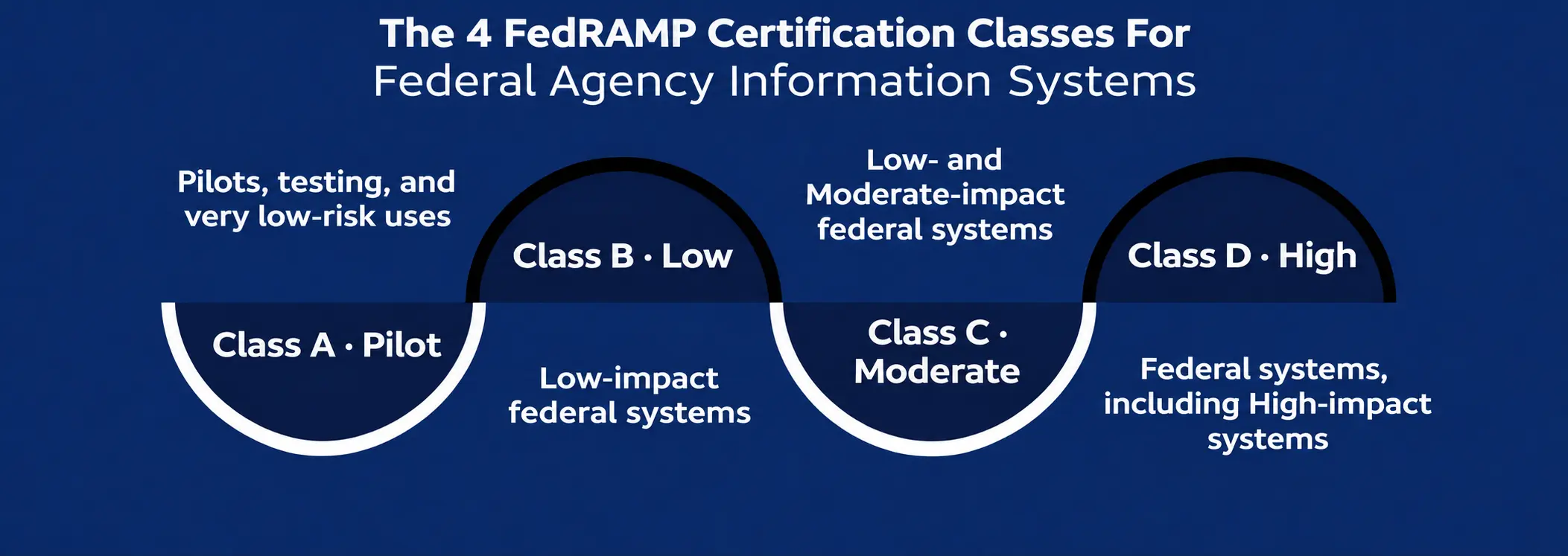
While the older material describes Low, Moderate and High impact levels, the 2026 rules replace those with Certification Classes A, B, C and D (Source: FedRAMP.gov). In the Rev5 transition, the former Low and LI-SaaS baselines map to Class B, Moderate to Class C, and High to Class D. Class A is designed for pilots and very low-risk uses. Agencies still categorize their own information systems by impact and evaluate the service against their specific use.
What Is FedRAMP Changing for Rev5 Providers?
The 2026 FedRAMP requirements shift Rev5 packages toward machine-readable JSON or, where permitted, OSCAL. The Certification Package Overview and Security Decision Record take the place of the provider’s traditional System Security Plan and appendices. Providers define most previously prescribed NIST SP 800-53 organizational parameters, document FIPS 140 encryption for sensitive data, and broaden vulnerability detection and response. Accepted Weaknesses replace Plans of Action and Milestones, and Ongoing Certification expands provider obligations. Agencies continue their own continuous monitoring.
New 20x applications have followed the 2026 rules since July 4, 2026. On January 1, 2027, the rules apply to new Rev5 applications and active 20x offerings, with separate deadlines and grace periods for specific rulesets.
FedRAMP vs SOC 2 in Practice
In SOC 2, an independent CPA evaluates management’s system description and whether controls are suitably designed against the applicable Trust Services Criteria.
FedRAMP assesses a defined cloud service offering against the rules for its certification type and class. The agency uses the resulting package when evaluating its own configuration, integrations, and responsibilities. For example, a provider may supply single sign-on capability while the agency remains responsible for configuring it for its users.
In practice, a SOC 2 examination tests controls against the criteria and scope the service organization defines, while FedRAMP tests against a federal control set. Overlap exists in areas like access control and change management, but overlap is not equivalence.
-
Result
FedRAMP: FedRAMP Certification
SOC 2: Attestation report with CPA opinion -
Issued by
FedRAMP: FedRAMP, after a Recognized independent assessor's assessment
SOC 2: Licensed CPA firm -
Built on
FedRAMP: NIST SP 800-53 Rev. 5 or 20x Key Security Indicators
SOC 2: AICPA Trust Services Criteria -
Ongoing duty
FedRAMP: Ongoing Certification and yearly independent assessment
SOC 2: New report each review period -
Audience
FedRAMP: Federal agencies
SOC 2: Customers and other report users
What a SOC 2 Report Can Support
What Is FedRAMP Looking for in Class A?
FedRAMP 20x Class A accepts a qualifying SOC 2 Type 2 examination completed within the preceding 12 months. The provider submits the complete report, verified engagement documentation, the expected schedule for the next report, and any applicable bridge or gap letter and supplemental evidence. The Class A package also includes FedRAMP-specific materials, such as the Security Decision Record. Certification depends on meeting the applicable FedRAMP requirements. fedramp-help
When Can Teams Reuse Control Evidence?
In a SOC 2–FedRAMP comparison, map the underlying evidence to the specific requirement before relying on it. Suppose the CPA tested quarterly privileged access reviews for the commercial platform. Those records may support a federal assessment if they cover the same administrator population, production environment, and relevant dates. If the federal deployment uses a separate identity tenant, records from that tenant would establish who had access and whether reviews occurred.
Conclusion
What is FedRAMP ultimately intended to support? A federal agency’s risk decision about using a specific cloud service. In the FedRAMP vs SOC 2 comparison, the CPA’s opinion provides assurance about the system and controls covered by the examination. That assurance has a defined role in 20x Class A. For providers pursuing both, the scope, dates, and evidence determine how much work can carry over. FedRAMP Consolidated Rules for 2026