
ISO 27001 Certification in Denver
CertPro is a Licensed CPA Firm delivering formal ISO 27001 Certification in Denver across technology, healthcare, financial services, and energy sectors. CertPro conducts structured Stage 1 and Stage 2 audits against ISO/IEC 27001:2022 requirements, issuing third-party attestations of conformance to Denver organizations operating in regulated and enterprise markets. Fixed pricing. Defined scope. No advisory services.
OUR CLIENTS









What Is ISO 27001 Certification?
ISO 27001 Certification is the formal, third-party attestation that an organization’s Information Security Management System (ISMS) conforms to the requirements of ISO/IEC 27001:2022 — the internationally recognized standard published jointly by the International Organization for Standardization (ISO) and the International Electrotechnical Commission (IEC). Certification is issued by an accredited certification body following a structured audit process. It constitutes an independently verified declaration of conformance — not a self-assessed or internally declared compliance posture. For Denver organizations, ISO 27001 Certification in Denver represents formal entry into a globally recognized information security framework adopted by thousands of enterprises across more than 150 countries.
Defining the ISO/IEC 27001:2022 Standard
ISO/IEC 27001:2022 is the current version of the standard, superseding the 2013 edition. The 2022 revision introduced a restructured Annex A with 93 controls organized across four themes — Organizational, People, Physical, and Technological — replacing the previous 14-category framework of 114 controls. The transition deadline for existing certified organizations to migrate to the 2022 standard is October 31, 2025, as set by accreditation bodies globally. Organizations pursuing new ISO 27001 Certification after the 2022 publication must certify directly against ISO/IEC 27001:2022 and cannot obtain certification against the superseded 2013 standard.
The standard applies to any organization, regardless of size, sector, or geography. It defines requirements for establishing, implementing, maintaining, and continually improving an ISMS — a systematic framework for managing information security risks that affect the confidentiality, integrity, and availability of information assets. ISO 27001 Certification requires that an organization formally document its ISMS, conduct structured risk assessments, implement and operate controls derived from those assessments, and submit to external audit by an accredited certification body. Denver-based organizations pursuing ISO 27001 Certification in Denver are subject to the same globally uniform standard requirements as enterprises in London, Singapore, or Tokyo.
ISMS as the Foundation of ISO 27001
An Information Security Management System (ISMS) is the structured set of policies, procedures, processes, and controls that an organization uses to manage information security risks in a systematic and documented manner. The ISMS is not a software platform or a single policy document — it is a governance framework that defines the scope of information assets covered, the risk assessment methodology applied, the treatment decisions made for identified risks, and the performance metrics used to evaluate ongoing control effectiveness. ISO 27001 Certification requires that the ISMS be fully operational and demonstrably effective before the Stage 2 audit commences.
The relationship between the ISMS and organizational data security is direct and measurable. A conformant ISMS defines the organizational context — including internal and external issues, interested party requirements, and the information security scope boundary — and translates that context into a documented risk register, a Statement of Applicability (SoA), and a set of operational controls. ISO 27001 compliance, in the context of the standard, means demonstrating that this chain of evidence — from risk identification through control implementation to performance monitoring — is intact, documented, and subject to management review. Denver organizations that achieve ISO 27001 Certification in Denver can present this verified chain to clients, regulators, and enterprise procurement teams with a formally issued third-party certificate.
ISO 27001 Certification vs. ISO 27001 Compliance
ISO 27001 compliance and ISO 27001 Certification are related but legally and commercially distinct outcomes. ISO 27001 compliance refers to an organization’s internal alignment with the requirements of the standard — adopting its controls, maintaining its documentation, and operating its ISMS in accordance with its clauses. ISO 27001 Certification, by contrast, is a third-party verified declaration issued by an accredited body following a formal audit, confirming that the organization’s ISMS has been independently evaluated and found to conform to ISO/IEC 27001:2022 requirements. Compliance can be self-declared; certification cannot. For Denver businesses engaging enterprise clients, government contracts, or regulated industries, this distinction is commercially significant — many procurement frameworks require the certificate, not a self-attestation of compliance.

ISO 27001 Certification Requirements
ISO 27001 certification requirements are defined across two primary components of the standard: the mandatory clauses (Clauses 4 through 10) and the control objectives in Annex A. All mandatory clauses must be fully addressed — no exclusions are permitted. Annex A controls may be excluded only where the organization documents a justified rationale in the Statement of Applicability, demonstrating that the excluded control is not applicable to the defined ISMS scope. Denver organizations pursuing ISO 27001 Certification in Denver must satisfy all mandatory clause requirements as a baseline condition of certification eligibility.
The mandatory clauses of ISO/IEC 27001:2022 define the structural requirements for the ISMS framework. Clause 4 requires the organization to define its internal and external context, understand interested party requirements, and establish the ISMS scope. Clause 5 requires demonstrable leadership commitment, including an information security policy signed by top management and clearly defined organizational roles and responsibilities. Clause 6 requires formal planning — including a documented risk assessment process, a risk treatment plan, and defined information security objectives. Clause 7 addresses support requirements such as competence, awareness, communication, and documented information. This clause is frequently cited in audit nonconformities due to incomplete documentation of awareness training or competence records.
Clause 8 governs operational planning and control, requiring that the organization implement and control the processes needed to meet information security requirements. This includes execution of the risk assessment and risk treatment processes defined in Clause 6, along with documented evidence that these processes have been completed within the defined ISMS scope. Clause 9 requires performance evaluation through internal audit, management review, and ongoing monitoring of ISMS performance. Clause 10 mandates a continual improvement process, including documented nonconformity and corrective action procedures. ISO 27001 audit evaluations assess conformance with all ten clauses, and evidence of operating the ISMS — not merely documenting it — is required at Stage 2.
Annex A of ISO/IEC 27001:2022 contains 93 controls organized across four control themes: Organizational controls (37 controls), People controls (8 controls), Physical controls (14 controls), and Technological controls (34 controls). The 2022 revision introduced 11 new controls not present in the 2013 edition — including controls for threat intelligence, information security for cloud services, ICT readiness for business continuity, and data masking. Each Annex A control must be assessed during risk treatment. The organization must determine whether each control is applicable to its defined scope, and where applicable, must implement it and demonstrate its operation during the ISO 27001 audit.
The Statement of Applicability (SoA) is a mandatory document that lists all 93 Annex A controls, states whether each is applicable or excluded, provides justification for any exclusions, and indicates the implementation status of each applicable control. The SoA is a critical audit evidence document — auditors examine it during both Stage 1 and Stage 2 to verify that control selection is logically derived from risk assessment results and that claimed implementations can be substantiated with operational evidence. For Denver technology companies, aerospace contractors, and healthcare IT organizations, the SoA typically includes the full set of Technological controls and a significant subset of Organizational controls, with Physical controls scoped to facilities within the certified ISMS boundary.
ISO 27001 certification requires a defined set of documented information as mandatory outputs of the ISMS. These include the information security policy, the ISMS scope statement, the risk assessment process documentation, the risk register, the risk treatment plan, the Statement of Applicability, information security objectives, evidence of competence and awareness programs, documented operational controls, internal audit programs and reports, management review minutes, and corrective action records. Each document must be version-controlled, approved by an appropriate authority, and retrievable on demand during the ISO 27001 audit. Incomplete or undated documentation is one of the most common sources of minor nonconformities identified during Stage 2 audits.
| ISO 27001 Clause | Requirement Category | Key Output Document |
|---|---|---|
| Clause 4 | Organizational Context | ISMS Scope Statement |
| Clause 6 | Planning | Risk Register, Risk Treatment Plan, SoA |
| Clause 8 | Operations | Risk Assessment Records, Control Evidence |
| Clause 9 | Performance Evaluation | Internal Audit Report, Management Review Minutes |
| Clause 10 | Improvement | Nonconformity and Corrective Action Records |
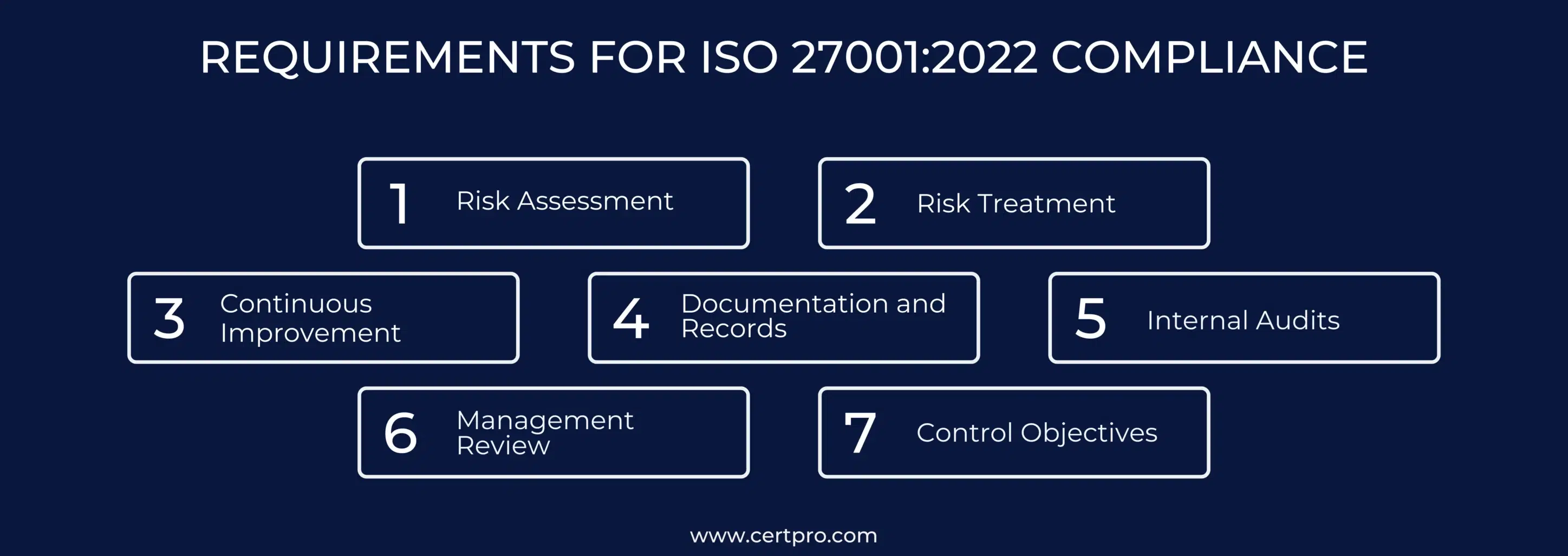
- ✓Mandatory Clause Requirements
- ✓Annex A Controls and the Statement of Applicability
- ✓Documentation and Audit Evidence Requirements
ISO 27001 Certification Process in Denver
The ISO 27001 certification process in Denver follows a structured sequence of activities defined by the accreditation framework and the requirements of ISO/IEC 27001:2022. The process proceeds from initial scoping through ISMS establishment, internal audit, Stage 1 audit, Stage 2 audit, and certificate issuance — followed by an ongoing surveillance and recertification cycle. Each stage produces defined outputs that serve as inputs to the next, creating an auditable chain of evidence. CertPro, as a Licensed CPA Firm, conducts the audit stages of this process with full independence from the ISMS design and implementation activities of the client organization.
The Stage 1 audit is a documentation review conducted by the accredited certification body to evaluate whether the organization’s ISMS documentation is sufficiently developed and complete to proceed to the Stage 2 on-site audit. During Stage 1, the auditor examines the ISMS scope document, the information security policy, the risk assessment methodology and outputs, the Statement of Applicability, the risk treatment plan, and evidence that internal audits and management reviews have been completed. The Stage 1 audit produces a formal report identifying any significant gaps or areas of concern that must be addressed before Stage 2 can proceed. For Denver organizations, Stage 1 audits may be conducted remotely or on-site depending on certification body procedures and organizational preference.
The Stage 1 audit typically requires two to four weeks between completion and the scheduling of Stage 2, allowing the organization to address findings from the documentation review. Minor gaps identified at Stage 1 do not necessarily delay Stage 2 — they are documented as areas for improvement that the auditor will verify have been resolved during the Stage 2 visit. Major gaps at Stage 1, such as an incomplete risk assessment or an absent Statement of Applicability, require resolution before Stage 2 can be scheduled. Denver companies that approach the Stage 1 audit with complete, internally reviewed documentation consistently demonstrate shorter overall ISO 27001 certification timelines.
The Stage 2 audit is the on-site, operational conformance assessment in which the auditor evaluates whether the organization’s ISMS is not only documented but also implemented, operated, and effective in practice. Stage 2 assessments involve interviews with personnel across the organization, inspection of physical and technical controls, review of operational records such as access control logs and incident records, and testing of the organization’s ability to demonstrate ISMS processes in operation. The Stage 2 audit produces a detailed report documenting conformities, nonconformities, and observations. Nonconformities identified at Stage 2 must be resolved and closed before the certification decision is made.
Nonconformities identified during Stage 2 are classified as major or minor. A major nonconformity indicates a significant failure of the ISMS to meet a mandatory clause requirement or the complete absence of an applicable Annex A control — it must be resolved before certification can be issued. A minor nonconformity indicates a partial implementation or isolated lapse that does not constitute a systemic failure — it must be resolved within a defined timeframe following certification and verified by the auditor through documented evidence. For ISO 27001 certified companies in Denver, Stage 2 audit duration ranges from one to five days depending on the size and complexity of the organization and the defined ISMS scope.
Following successful completion of Stage 2 and resolution of any identified nonconformities, the certification body makes a formal certification decision. The ISO 27001 certificate is issued for a three-year period and identifies the certified organization, the ISMS scope, the standard version (ISO/IEC 27001:2022), and the certificate validity dates. The certificate must be maintained through annual surveillance audits conducted in Year 1 and Year 2 of the certification cycle, with a full recertification audit conducted in Year 3. Surveillance audits are narrower in scope than Stage 2 audits but assess the continued operation of the ISMS, closure of previously identified nonconformities, and the organization’s performance against its information security objectives.
- Define ISMS scope and organizational context (Clause 4)
- Conduct information security risk assessment and document risk register
- Develop risk treatment plan and Statement of Applicability (SoA)
- Implement Annex A controls and document operational procedures
- Execute internal audit program and complete management review
- Engage accredited certification body and schedule Stage 1 audit
- Complete Stage 1 documentation review and address identified gaps
- Undergo Stage 2 on-site operational conformance audit
- Resolve any nonconformities identified during Stage 2
- Receive certification decision and ISO 27001 certificate issuance
- Maintain certification through annual surveillance audits (Year 1 and Year 2)
- Complete full recertification audit in Year 3 of the certification cycle

- ✓Stage 1 Audit: Documentation Review
- ✓Stage 2 Audit: Operational Conformance Assessment
- ✓Certification Decision, Issuance, and Surveillance Cycle
ISO 27001 Audit — What Denver Businesses Need to Know
The ISO 27001 audit is the formal evaluation mechanism through which an accredited certification body determines whether an organization’s ISMS conforms to the requirements of ISO/IEC 27001:2022. Denver businesses pursuing or maintaining ISO 27001 Certification in Denver encounter four principal audit types during the certification lifecycle: the internal audit, the Stage 1 audit, the Stage 2 audit, and the annual surveillance audit. Each audit type has a distinct scope, methodology, and output — and each produces documented findings that become part of the organization’s ISMS records. Understanding the purpose and scope of each audit type is essential for Denver organizations planning their certification timelines and resource allocations.
Internal Audit Requirements Under ISO 27001
ISO/IEC 27001:2022 Clause 9.2 requires that the organization conduct internal audits at planned intervals to determine whether the ISMS conforms to the organization’s own requirements and to the requirements of the standard, and whether the ISMS is effectively implemented and maintained. The internal audit must be planned with an audit program that defines the audit criteria, scope, frequency, and methods. Auditors conducting internal audits must be objective and impartial — they cannot audit their own work. Internal audit results must be reported to relevant management and documented as part of the ISMS records reviewed during the external Stage 1 and Stage 2 audits.
For Denver technology companies and financial services organizations, the internal audit function is frequently outsourced or supplemented by external parties to meet the objectivity requirement of Clause 9.2. The internal audit does not produce a certificate — but its outputs are essential evidence examined by the external auditor during Stage 1. An absent or incomplete internal audit program is a consistently identified major nonconformity during Stage 1 reviews, particularly for organizations undergoing their first ISO 27001 certification cycle. CertPro’s ISO 27001 audit Denver engagements include formal evaluation of the internal audit program as part of the Stage 1 documentation review.
Auditor Independence and the Licensed CPA Firm Advantage
Auditor independence is a foundational requirement of credible ISO 27001 certification. The certification body and its auditors must be independent of the organization being certified and must not have provided implementation services, documentation development, or advisory support to the same organization within a defined exclusion period. This independence requirement is governed by ISO/IEC 17021-1, which sets the accreditation requirements for certification bodies. CertPro operates as a Licensed CPA Firm — a designation that imposes statutory independence obligations under professional accounting standards that are structurally more stringent than those required of non-CPA certification consultancies. This distinction matters commercially for Denver enterprises whose clients require independently verified ISO 27001 certifications.
The Licensed CPA Firm structure means that CertPro’s ISO 27001 audit engagements are conducted under professional standards governing objectivity, conflict of interest identification, audit documentation, and attestation issuance. Denver financial services firms, healthcare organizations, and government contractors recognize the CPA firm credential as indicative of audit rigor and institutional accountability — the same standards applied to financial statement audits and SOC 2 engagements. For organizations that require both ISO 27001 Certification and SOC 2 attestation, the Licensed CPA Firm structure enables coordinated audit programs that reduce duplication of evidence collection and minimize management time.
Common ISO 27001 Audit Findings in Denver Organizations
Recurring nonconformities identified during ISO 27001 audit engagements with Denver-based organizations include: incomplete or undated risk assessment records that cannot demonstrate the risk assessment was conducted within the ISMS operational period; Statement of Applicability documents listing controls as implemented without supporting operational evidence; management review minutes that do not address all required inputs defined in Clause 9.3; internal audit programs with no documented criteria or evidence of auditor competence; and access control records lacking sufficient granularity to demonstrate least-privilege principles. These findings are among the most commonly identified nonconformities in ISO 27001 audit reports globally. Denver’s concentration of high-growth technology companies means many organizations are undergoing their first certification cycle with limited ISMS maturity — making proactive preparation especially valuable.
ISO 27001 Compliance for Denver Organizations
ISO 27001 compliance for Denver organizations operates within a multi-framework regulatory environment that includes federal requirements under HIPAA and NIST frameworks, state requirements under the Colorado Privacy Act (CPA) and other Colorado-specific data protection statutes, and contractual requirements imposed by enterprise clients, federal contractors, and regulated industry bodies. ISO 27001 Certification in Denver provides a structured framework for addressing multiple regulatory obligations simultaneously, using the ISMS as the governance layer through which compliance activities are coordinated, documented, and evidenced. Denver organizations that treat ISO 27001 compliance as a standalone activity rather than an integrating framework frequently find that they are duplicating effort across multiple compliance programs.
Alignment with GDPR, HIPAA, CCPA, and Colorado Privacy Act
ISO 27001 helps organizations map legal and regulatory requirements — including GDPR and HIPAA — to documented controls within the ISMS. For Denver organizations that process personal data of European Union residents, GDPR Article 32 requires the implementation of appropriate technical and organizational measures to ensure security appropriate to the risk. ISO/IEC 27001:2022 Annex A controls directly address this requirement. ISO 27001 certification does not constitute GDPR certification (which does not exist as a formal ISO mechanism), but the documented control implementation and risk assessment process required for ISO 27001 compliance in Denver provides substantial, auditable evidence of Article 32 conformance.
HIPAA compliance for Denver healthcare IT organizations and health technology companies aligns with ISO 27001 at the level of administrative, physical, and technical safeguards. The HIPAA Security Rule’s requirements for risk analysis, risk management, workforce training, access controls, audit controls, and transmission security each correspond to specific ISO/IEC 27001:2022 Annex A controls. Organizations maintaining an ISO 27001-conformant ISMS have a documented, audited evidence base that substantively addresses HIPAA Security Rule requirements. Similarly, the Colorado Privacy Act — enacted in 2021 and effective July 1, 2023 — requires data protection assessments for high-risk processing activities. An ISO 27001 compliance risk assessment process directly supports this requirement for Denver organizations subject to the Act.
ISO 27001 and SOC 2 Alignment for Denver Technology Companies
ISO 27001 compliance is frequently pursued alongside SOC 2 Type II attestation by Denver tech companies, as enterprise clients in financial services and healthcare commonly require both. The two frameworks are complementary but distinct: ISO 27001 is a management system standard that certifies the ISMS framework, while SOC 2 is an attestation standard that evaluates the operating effectiveness of controls against the Trust Services Criteria over a defined review period. ISO 27001 Annex A controls overlap significantly with the Security and Availability Trust Services Criteria, meaning that organizations maintaining an ISO 27001-conformant ISMS have a substantial evidence base applicable to SOC 2 Type II audit procedures.
CertPro’s Licensed CPA Firm structure enables Denver technology organizations to pursue coordinated ISO 27001 and SOC 2 audit programs under a single engagement team. This reduces the administrative burden of managing two separate audit relationships, minimizes personnel interview duplication, and enables unified evidence collection timelines. Denver financial services organizations simultaneously requiring SOC 2 Type II attestation benefit particularly from this structure, as both engagements can be scoped, scheduled, and evidenced within a single annual audit cycle. The ISO 27001 audit findings inform the SOC 2 control evaluation, and the integrated program produces two formally issued attestation documents from a single engagement process.
Denver Regulatory Environment and Information Security Obligations
Denver operates as a hub for financial technology, aerospace and defense contracting, healthcare information technology, and energy technology — four sectors with distinct and overlapping information security regulatory obligations. Colorado’s financial services organizations are subject to supervision by the Colorado Division of Banking and the Division of Securities, both of which have adopted cybersecurity examination frameworks that align with NIST SP 800-53 controls also mapped to ISO 27001 Annex A. Defense contractors operating in Denver are subject to CMMC (Cybersecurity Maturity Model Certification) requirements where DFARS clauses apply, and the security practices required for CMMC Level 2 align substantially with ISO 27001 controls. Denver healthcare organizations operating under HHS oversight use the ISO 27001 compliance framework to organize HIPAA Security Rule evidence for regulatory examination purposes.
ISO 27001 Cost in Denver
The ISO 27001 cost for Denver organizations is determined by a defined set of variables that affect audit scope, duration, and certification body fees. Understanding ISO 27001 certification cost in Denver requires distinguishing between the certification body audit fees charged by the accredited auditor, the internal resource costs associated with ISMS development and documentation, and any external support fees for technical implementation of security controls. CertPro operates a fixed pricing model for its ISO 27001 audit Denver engagements — published rates, no hidden fees, and no variable charges based on audit outcomes. This fixed pricing model provides Denver organizations with budget certainty during the engagement planning stage and eliminates the cost unpredictability associated with hourly-rate audit engagements.
Factors Influencing ISO 27001 Certification Cost
The primary factors that determine ISO 27001 cost for a specific Denver organization are: the number of employees within the defined ISMS scope (which directly influences audit day calculations under IAF MD 5:2019 guidelines), the complexity and number of locations included in the ISMS scope, the number and type of information assets subject to the risk assessment, the maturity of the existing ISMS at the time of Stage 1 audit, and the degree of overlap with existing compliance programs such as SOC 2 or NIST that have produced reusable audit evidence. Organizations with larger employee populations within scope, multiple facilities, or complex cloud and on-premises infrastructure will incur higher audit day counts and correspondingly higher ISO 27001 certification cost calculations.
A small Denver technology company with 25 employees and a cloud-only infrastructure scope can typically complete the Stage 1 and Stage 2 audit cycle within a total allocation of 3 to 5 audit days. A mid-market Denver enterprise with 500 employees, multiple office locations, and on-premises data center infrastructure may require 10 to 15 audit days across Stage 1, Stage 2, and the subsequent annual surveillance audit. These allocations are calculated using internationally recognized methodologies and are derived from the objective characteristics of the organization and its ISMS scope. Transparency in audit day calculation is a core component of CertPro’s fixed pricing model for ISO 27001 certification in Denver.
ISO 27001 Cost Components: Certification vs. Internal Investment
The total ISO 27001 cost for a Denver organization encompasses three distinct investment categories. The first is the certification body audit fee, which covers Stage 1 documentation review, Stage 2 on-site audit, certificate issuance, and the annual surveillance audits in Years 1 and 2, plus the recertification audit in Year 3. The second is the internal labor cost, representing the time invested by the organization’s personnel in documenting the ISMS, conducting risk assessments, implementing controls, executing the internal audit, and preparing management review materials. The third category, where applicable, is the cost of technical security tools and infrastructure changes required to implement Annex A controls not already in place — such as SIEM platforms, multi-factor authentication systems, or data loss prevention tools.
| Cost Component | Description | Typical Influence on Total ISO 27001 Cost |
|---|---|---|
| Certification Audit Fees | Stage 1, Stage 2, surveillance, and recertification audit days | Fixed — calculated by scope and employee count |
| Internal Labor Costs | ISMS documentation, risk assessment, internal audit, management review | Variable — depends on ISMS maturity at engagement start |
| Technical Control Implementation | Security tools, infrastructure changes for Annex A compliance | Variable — depends on existing security posture |
| Annual Surveillance Fees | Year 1 and Year 2 audit to maintain active certificate | Fixed — typically 30-50% of initial audit fee |
| Recertification Audit | Full re-audit at Year 3 to renew three-year certificate | Fixed — comparable to Stage 2 audit cost |
Cost of Non-Certification: Risk Quantification for Denver Organizations
The decision to invest in ISO 27001 Certification in Denver is properly evaluated against the cost of the information security risks that the ISMS is designed to mitigate. Data breach costs for U.S. organizations averaged $9.48 million per incident in 2023, according to IBM’s Cost of a Data Breach Report, with healthcare sector breaches averaging significantly higher. For Denver financial services and healthcare IT organizations, a single material security incident — resulting in regulatory investigation, client notification, legal costs, and reputational impact — typically exceeds the three-year total ISO 27001 cost by a substantial multiple. Viewed as a risk transfer and risk reduction investment, ISO 27001 certification cost is consistently favorable when measured against the quantified cost of the incidents that certified controls are designed to prevent.
Benefits of ISO 27001 Certification for Denver Businesses
ISO 27001 Certification delivers quantifiable business, operational, and competitive benefits to Denver organizations across all sectors. The certification’s value extends beyond information security management to encompass commercial differentiation, regulatory alignment, client trust, and organizational resilience. Denver’s position as a high-growth technology and financial services hub means that ISO 27001 certified companies in Denver operate with a verifiable competitive advantage in enterprise procurement processes where security certification is a mandatory supplier qualification criterion. The following benefits are consistently reported by organizations that achieve and maintain ISO 27001 Certification in Denver.
ISO 27001 Certification provides Denver businesses with a formally issued, internationally recognized certificate that can be presented to enterprise clients, government procurement bodies, and regulated industry partners as third-party verification of information security management conformance. In regulated sectors such as financial services, healthcare, and federal contracting, ISO 27001 Certification is increasingly specified as a mandatory qualification in RFP and vendor registration processes. Organizations without certification are excluded from consideration regardless of their actual security posture. Denver financial services firms use the ISO 27001 certificate as a key differentiator in competitive procurement, and several major Denver-based financial institutions specify ISO 27001 or SOC 2 as supplier qualification requirements.
Client trust benefits extend beyond formal procurement processes. Denver technology companies that display a valid ISO 27001 certificate on their website and in client-facing materials communicate a verifiable, third-party-validated security posture — not a self-declared one. Enterprise clients conducting vendor due diligence can verify the certificate’s validity through the certification body’s public register and confirm its current status, scope, and expiry date. This transparency reduces the client’s due diligence burden and accelerates vendor approval timelines — commercially valuable in competitive Denver technology markets where sales cycle length is a key performance metric.
The operational benefits of ISO 27001 Certification derive from the disciplined implementation of the ISMS framework. Organizations that achieve certification have completed a documented risk assessment identifying their material information security risks, implemented controls designed to treat those risks to acceptable levels, established monitoring mechanisms to detect security incidents and performance degradations, and instituted a management review process that ensures information security receives executive-level attention on a scheduled basis. These operational outcomes represent a measurable improvement in organizational security posture — regardless of the certificate itself. The certification process enforces the operational discipline that many organizations intend to implement but fail to formalize without an external audit deadline.
- ✓Third-party verified information security management framework, recognized in over 150 countries
- ✓Formal qualification for enterprise, government, and regulated industry procurement processes
- ✓Documented risk assessment and treatment process aligned with ISO/IEC 27001:2022 requirements
- ✓Structured incident response capability with documented procedures and tested effectiveness
- ✓Alignment with GDPR, HIPAA, Colorado Privacy Act, and CCPA compliance requirements
- ✓Competitive differentiation in Denver technology, financial services, and healthcare IT markets
- ✓Reduced cyber insurance premiums for ISO 27001 certified Denver organizations
- ✓Foundation for SOC 2 Type II, CMMC, and NIST-aligned compliance programs
- ✓Continual improvement framework enforced through annual surveillance audit cycle
- ✓Executive accountability for information security through mandated management review process
Denver’s technology sector has experienced consistent growth over the past decade, establishing the metropolitan area as a tier-one technology hub attracting FTSE-listed technology companies, private equity-backed growth-stage firms, and enterprise SaaS organizations. ISO 27001 compliance enables Denver tech companies to demonstrate to enterprise clients headquartered in regulated markets — including New York financial institutions, California healthcare systems, and European enterprises subject to GDPR — that their security management meets internationally recognized standards without requiring client-specific security assessments. This reduces sales friction associated with enterprise vendor qualification and provides a reusable evidence base for multiple concurrent client security reviews.
Denver’s aerospace and defense sector — concentrated along the US-36 and I-25 corridors and anchored by facilities including Buckley Space Force Base and numerous defense contractors across the metro area — represents a significant market for ISO 27001 certification. Defense prime contractors frequently specify ISO 27001 or equivalent security management certifications in subcontractor qualification requirements. ISO 27001 Certification in Denver provides aerospace and defense technology companies with a portable, internationally recognized security credential that supports both commercial and defense market positions. The alignment between ISO 27001 Annex A controls and NIST SP 800-171 requirements — the baseline for CMMC Level 2 compliance — means that ISO 27001 certified Denver defense contractors maintain a well-documented control baseline applicable to DFARS cybersecurity clause compliance.
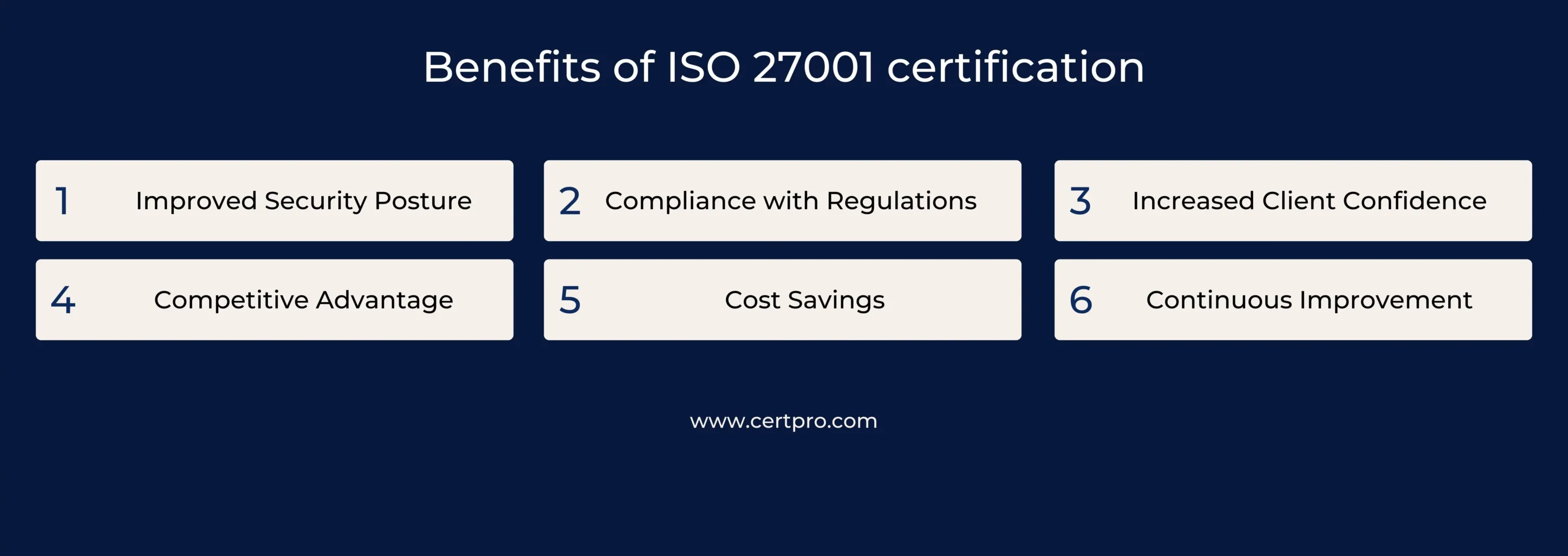
- ✓Commercial and Client Trust Benefits
- ✓Operational and Security Posture Benefits
- ✓Denver Market-Specific Competitive Advantages
ISO 27001 Certification Requirements — Industries in Denver
ISO 27001 Certification in Denver is pursued across multiple industry sectors, each with distinct drivers, regulatory contexts, and ISMS scope characteristics. Denver’s industry composition — spanning financial technology, healthcare information technology, energy technology, aerospace and defense, and enterprise SaaS — creates a diverse certification landscape in which the standard’s sector-agnostic framework is applied to materially different information asset profiles and risk environments. Organizations engaging ISO 27001 audit services in Denver must understand these sector-specific contexts to scope and execute certification engagements that are both technically rigorous and commercially efficient.
Denver hosts a significant and growing financial technology sector, including payment processing companies, digital banking platforms, investment management technology firms, and insurance technology organizations. ISO 27001 certification for Denver financial services organizations requires ISMS scopes that address specific information asset classes prevalent in financial services: payment card data (which may also trigger PCI DSS requirements), personally identifiable financial information subject to GLBA safeguards, trading and transaction data protected under SEC and FINRA regulations, and customer identity data subject to BSA/AML record-keeping requirements. The ISO 27001 risk assessment process for financial services organizations must account for these asset classes and their corresponding regulatory treatment obligations.
Colorado-based financial institutions are supervised by the Colorado Division of Banking, which has adopted examination procedures including cybersecurity assessments aligned with the FFIEC Cybersecurity Assessment Tool (CAT). ISO 27001 Certification provides a documented, independently audited evidence base that substantively addresses FFIEC CAT maturity indicators at the Evolving through Innovative levels, depending on the depth of control implementation. Denver financial services firms that maintain ISO 27001 Certification and can produce their Stage 2 audit report and corrective action records during examination have a structured, auditor-reviewed evidence base that accelerates examination completion and reduces examination burden.
ISO 27001 certification for Denver healthcare organizations typically encompasses health information technology platforms, electronic health record systems, telemedicine infrastructure, health data analytics platforms, and medical device software — each subject to HIPAA Security Rule requirements for electronic protected health information (ePHI). The ISMS scope for healthcare IT organizations in Denver must define the boundary of systems processing ePHI and ensure that all applicable Annex A controls are implemented and evidenced. ISO 27001 Annex A controls that directly correspond to HIPAA Security Rule administrative, physical, and technical safeguards include access control (A.8.2), information classification (A.5.12), physical security (A.7.1–A.7.4), operations security (A.8.8–A.8.19), and communications security (A.8.20–A.8.23).
- ✓ISO 27001 for Denver Financial Services and Fintech Organizations
- ✓ISO 27001 for Denver Healthcare IT Organizations
Why Denver Businesses Choose CertPro for ISO 27001 Certification
CertPro is a Licensed CPA Firm providing ISO 27001 Certification in Denver through formally structured, independently conducted audit engagements. The CertPro engagement model is built on institutional audit methodology, defined engagement scopes, fixed transparent pricing, and the professional independence obligations that attach to the Licensed CPA Firm credential. Denver organizations that engage CertPro for ISO 27001 Certification receive a formally issued certification outcome from an audit firm operating under the same professional standards framework as financial statement auditors and SOC 2 attestation providers — not from a consultancy that also provides implementation services.
Licensed CPA Firm Distinction in ISO 27001 Auditing
The Licensed CPA Firm designation distinguishes CertPro from non-CPA certification bodies and consultancies operating in the Denver ISO 27001 market. CPA firms are subject to AICPA professional standards, state board licensing requirements, peer review obligations, and ethics rules that impose independence standards, documentation requirements, and quality control processes not applicable to non-CPA entities. For ISO 27001 audit purposes, this means CertPro’s engagement procedures, evidence documentation, and attestation issuance processes are subject to professional review and accountability frameworks — providing Denver client organizations with an additional layer of assurance regarding audit quality and independence. When CertPro issues an ISO 27001 attestation or certification document, it is backed by the institutional accountability of a state-licensed CPA practice.
ISO 27001 consultants that Denver organizations engage for documentation and implementation support are not subject to these professional independence and accountability standards — and by definition cannot conduct the independent certification audit. CertPro’s position as a Licensed CPA Firm means the firm’s role is strictly as the certifying auditor, not as an implementation advisor. This structural independence is verifiable by CertPro’s clients and by their own clients and regulators — providing a transparent audit lineage that supports the credibility of the issued certification. Denver ISO 27001 certified companies that require their certification to withstand regulatory scrutiny or enterprise due diligence benefit from the institutional audit framing that the Licensed CPA Firm structure provides.
Fixed Pricing and Defined Engagement Model
CertPro’s fixed pricing model for ISO 27001 Certification in Denver is a defining feature of the engagement structure. Published pricing eliminates the budget uncertainty associated with hourly-rate certification engagements, where the final audit cost is determined by hours consumed — a metric that is difficult to predict and subject to scope creep. CertPro’s ISO 27001 certification cost for Denver engagements is priced based on objective scope variables (employee count, location count, ISMS complexity) determined at engagement initiation. The agreed price covers the complete Stage 1 and Stage 2 audit cycle through certificate issuance, with no additional charges for audit report preparation, nonconformity review periods, or certificate administration.
The defined engagement model means that Denver organizations know precisely what the ISO 27001 audit process will entail from the start: the audit schedule is fixed, the auditor team is identified, evidence requirements are specified, and output deliverables — Stage 1 report, Stage 2 report, corrective action review, and certificate — are contractually defined. This model is particularly valued by Denver technology companies with board-level oversight of the compliance budget, by private equity-backed organizations with defined compliance milestones, and by organizations pursuing ISO 27001 Certification under contractual timelines imposed by enterprise clients or regulators. Budget certainty is consistently cited as the primary factor in selecting CertPro for the ISO 27001 certification audit engagement in Denver.
Sector Expertise and Denver Market Experience
CertPro’s audit teams bring sector-specific expertise to ISO 27001 certification engagements with Denver organizations across financial services, healthcare IT, technology, and energy sectors. Sector expertise is material in ISO 27001 audit engagements because risk assessment, control selection, and audit evidence requirements vary significantly across industries. An ISO 27001 audit for a cloud-native SaaS company has materially different technical and operational evidence requirements than one for a Denver-based energy technology firm with operational technology (OT) networks and physical security requirements governing critical infrastructure assets. CertPro’s Denver market experience spans the full range of industries represented in the metropolitan area, with audit teams that include professionals with direct experience in the regulatory and technical environments specific to each sector.
FAQ
▶
What is ISO 27001 Certification and why do Denver businesses need it?
▶
How long does ISO 27001 Certification take for a Denver organization?
▶
What does ISO 27001 Certification cost for a Denver company?
▶
What is the difference between ISO 27001 compliance and ISO 27001 Certification?
▶
How does ISO 27001 align with HIPAA and Colorado Privacy Act requirements for Denver organizations?
▶
What are the surveillance and recertification requirements after initial ISO 27001 Certification?
▶
What is the ISO/IEC 27001:2022 transition deadline and does it affect Denver organizations?
▶
Can ISO 27001 Certification be combined with SOC 2 for Denver technology companies?
Multi-Framework Compliance Guide: Best Practices and Strategies
Most compliance teams aren’t managing one framework. They’re managing three, four, sometimes five — simultaneously. A SaaS company selling to enterpri…
HOW COMPLIANCE AUDIT SOFTWARE IMPROVES AUDIT READINESS
Today, most companies deal with a growing number of compliance regulations. From data privacy standards to security frameworks like SOC 2 and ISO 2700…

THE ROLE OF GRC IN ISO 27001, SOC 2, AND OTHER FRAMEWORKS
The term GRC stands for Governance Risk and Compliance. It’s a system of integrated and centralized approaches used by organizations. This system comb…
Get In Touch
have a question? let us get back to you.