
SOC 2 Certification in Denver
SOC 2 examinations are issued in two report types — Type 1 and Type 2 — each serving a distinct purpose in the attestation lifecycle. Understanding the difference between these report types is essential for Denver organizations planning their SOC 2 audit program and for customers evaluating vendor assurance documentation. The choice between Type 1 and Type 2 depends on the organization’s control maturity, the specific assurance requirements of its clients, and the timeline available for completing the examination.
OUR CLIENTS










What Is SOC 2 Certification?
SOC 2 Certification is a formal attestation engagement conducted by a Licensed CPA Firm under the American Institute of Certified Public Accountants (AICPA) attestation standards — specifically AT-C Section 205. The SOC 2 examination evaluates whether a service organization’s internal controls are designed and operating effectively to protect customer data in accordance with the Trust Services Criteria (TSC). SOC 2 is not a product certification or a self-declared compliance status. It is an independent third-party attestation that can only be issued by a qualified CPA firm following a structured examination process. The resulting SOC 2 report contains the auditor’s opinion, a description of the service organization’s system, and detailed findings regarding control design and operating effectiveness.
The Trust Services Criteria framework, established by the AICPA, defines the categories against which service organization controls are measured. These criteria address Security, Availability, Processing Integrity, Confidentiality, and Privacy. Security is the only mandatory category in every SOC 2 examination. The remaining four criteria are selected based on the nature of the services provided, the data handled, and the contractual commitments made to customers. An organization’s scope determination directly influences which criteria apply — and consequently, which controls are subject to independent examination and testing during the SOC 2 audit.
SOC 2 Defined: Attestation, Not Certification
The term “SOC 2 Certification” is widely used in commercial and procurement contexts, but technically the engagement is an attestation — not a product certification issued under ISO or ANSI frameworks. Under AICPA standards, a SOC 2 attestation means that a Licensed CPA Firm has independently examined a service organization’s controls and issued a formal opinion on whether those controls meet the applicable Trust Services Criteria. This distinction matters because the attestation is legally and professionally binding under CPA professional standards, and the issuing firm bears full accountability for the opinion expressed. Organizations that present a SOC 2 report in vendor questionnaires, customer contracts, or enterprise procurement processes are providing evidence of independent third-party examination — not a self-assessment or internal declaration.
SOC 2 compliance, in practical usage, refers to maintaining the internal controls, policies, and procedures that align with the Trust Services Criteria on an ongoing basis. However, SOC 2 compliance without an independent audit does not produce a recognized attestation report. Enterprise buyers, healthcare organizations, financial institutions, and government contractors in Denver and across the United States typically require a current SOC 2 report — not a self-assessment — as a condition of vendor approval. This requirement reflects the third-party risk management expectations that govern procurement in regulated and data-sensitive industries.
AICPA Trust Services Criteria: The Evaluation Framework
The AICPA Trust Services Criteria provide the structured framework against which all SOC 2 examinations are conducted. The five TSC categories are: Security (CC criteria), Availability (A criteria), Processing Integrity (PI criteria), Confidentiality (C criteria), and Privacy (P criteria). Each category contains specific criteria defining what controls must be in place and how they must operate. The Security category — also referred to as the Common Criteria — addresses logical and physical access controls, system operations, change management, and risk mitigation. It is the foundational category required in every SOC 2 examination, regardless of the organization’s industry or services.
| TSC Category | Focus Area | Typical Applicability |
|---|---|---|
| Security (CC) | Logical and physical access, change management, risk controls | Required for all SOC 2 examinations |
| Availability (A) | System uptime, performance monitoring, disaster recovery | SaaS platforms, cloud providers, MSPs |
| Processing Integrity (PI) | Complete, accurate, timely, and authorized processing | Fintech, payment processors, data processors |
| Confidentiality (C) | Protection of confidential business data | Professional services, enterprise data handlers |
| Privacy (P) | Personal information collection, use, retention, and disposal | Healthcare tech, consumer data platforms |
SOC 2 vs. Other Attestation Standards
SOC 2 differs from other common frameworks in several important respects. Unlike ISO 27001 — an internationally recognized certification standard resulting in a certificate issued by an accredited body — SOC 2 is a U.S.-centric attestation engagement specific to the AICPA framework. SOC 2 tests specific controls based on the Trust Services Criteria, service commitments, and contractual requirements, rather than requiring conformance to a management system standard. Unlike SOC 1, which addresses controls relevant to financial reporting, SOC 2 addresses operational and security controls relevant to data protection and service reliability. Organizations with U.S.-based clients — particularly in healthcare, financial services, and SaaS — typically prioritize SOC 2 attestation because it aligns with U.S. procurement standards and enterprise vendor assessment requirements.
When organizations evaluate whether to pursue SOC 2 or ISO 27001 first, the primary consideration is customer requirements and target markets. SOC 2 attestation is the standard expectation for U.S.-based enterprise clients — particularly in technology, healthcare, and financial services. ISO 27001 carries greater weight in European and global markets. Denver organizations serving U.S. enterprise clients, federal contractors, or healthcare networks will typically find that SOC 2 attestation satisfies the broadest range of customer security questionnaires and procurement requirements in their primary market.

ENQUIRE NOW
Related Resources
Related Services in Denver
SOC 2 Certification in Denver: Local Context and Industry Relevance
SOC 2 Certification in Denver has become a central requirement across the city’s expanding technology and professional services sectors. Denver’s growth as a technology hub — anchored by its concentration of SaaS companies, cybersecurity firms, healthcare technology providers, fintech startups, aerospace technology organizations, and managed service providers — has created significant demand for independent third-party attestation. Enterprise clients, federal agencies, and national healthcare networks serving Denver organizations routinely require a current SOC 2 report as a condition of vendor contracts and procurement approvals.
Colorado’s broader regulatory environment reinforces the relevance of SOC 2 attestation for Denver-based organizations. The Colorado Privacy Act (CPA), which took effect in July 2023, establishes data privacy obligations for organizations processing personal data of Colorado residents. While the CPA does not mandate SOC 2 specifically, the controls examined in a SOC 2 audit — particularly under the Privacy and Security Trust Services Criteria — directly address data handling, access management, and data subject rights obligations that align with CPA requirements. Denver organizations that have undergone SOC 2 examination are better positioned to demonstrate operational alignment with Colorado’s privacy standards during regulatory inquiries or enterprise security assessments.
Denver’s Technology Sector and SOC 2 Demand
Denver ranks among the fastest-growing technology markets in the United States, with over 170,000 technology professionals and a dense concentration of software companies, cloud service providers, and cybersecurity firms. The city’s technology corridor — extending from downtown Denver through the Denver Tech Center (DTC) — houses hundreds of SaaS companies and managed service providers whose enterprise customers routinely require SOC 2 reports. For these organizations, SOC 2 Certification in Denver is not a voluntary distinction; it is a procurement prerequisite enforced during vendor qualification, contract negotiation, and annual vendor review processes.
The cybersecurity sector in Denver has grown substantially in alignment with federal government contracting activity at nearby installations and agencies — including Department of Defense components, federal civilian agencies, and defense contractors operating in the Denver-Aurora metropolitan area. Cybersecurity firms providing services to these clients increasingly face SOC 2 audit requirements from their private-sector clients, in addition to federal-specific frameworks such as FedRAMP and CMMC. SOC 2 attestation serves as a foundational layer of third-party assurance that complements these federal frameworks and simultaneously satisfies commercial client requirements.
Healthcare Technology and Fintech Sectors in Denver
Denver’s healthcare technology sector includes electronic health record platforms, telemedicine providers, health information exchanges, pharmacy technology companies, and health data analytics firms. These organizations handle protected health information (PHI) governed by HIPAA. Enterprise healthcare clients — including hospital systems, payer organizations, and integrated delivery networks — require SOC 2 reports as a component of Business Associate Agreement (BAA) compliance and vendor risk assessment processes. The Privacy and Security Trust Services Criteria examined in a SOC 2 audit directly address the data handling, access control, and incident response requirements that healthcare technology organizations must demonstrate to their clients.
Denver’s fintech and financial services technology community — spanning payment processing platforms, banking technology providers, insurance technology firms, and investment management software companies — faces SOC 2 audit requirements from financial institution clients, banking regulators, and enterprise procurement functions. The Processing Integrity and Confidentiality Trust Services Criteria are particularly relevant to fintech organizations, as they address the accuracy, completeness, and protection of financial data. SOC 2 compliance that Denver fintech organizations demonstrate provides clients with independently verified assurance that transaction data, account information, and financial records are handled in accordance with defined control standards.
Aerospace, Energy Technology, and MSPs in Denver
Colorado’s aerospace technology sector — including satellite communications, defense systems, space technology, and aviation technology firms — increasingly requires SOC 2 attestation for technology service providers in their supply chains. Similarly, Denver’s energy technology sector, which spans smart grid technology, oil and gas technology platforms, and renewable energy management systems, generates SOC 2 audit requirements from utility clients and energy company procurement functions. Managed service providers (MSPs) operating in Denver face SOC 2 examination requirements from enterprise clients across all of these sectors, as MSPs access client systems, data, and networks subject to the same security and privacy requirements as internally operated systems.
SOC 2 Trust Services Criteria Explained
The AICPA Trust Services Criteria represent the definitive evaluation framework for all SOC 2 examinations. Each criterion specifies the control objectives and control activities that a service organization must demonstrate through evidence collection, documentation review, and operational testing. The criteria are organized into five categories — Security, Availability, Processing Integrity, Confidentiality, and Privacy — each addressing a distinct dimension of service organization control. An auditor conducting a SOC 2 examination evaluates the organization’s controls against each applicable criterion, documents findings, and issues an opinion on whether controls are suitably designed (Type 1) or operating effectively over the observation period (Type 2).
The Security category — formally designated as the Common Criteria (CC) — is mandatory in every SOC 2 examination. It encompasses controls addressing logical and physical access management, system operations, change management, and risk mitigation. The Common Criteria are organized into nine control environment components: CC1 (Control Environment), CC2 (Communication and Information), CC3 (Risk Assessment), CC4 (Monitoring Activities), CC5 (Control Activities), CC6 (Logical and Physical Access Controls), CC7 (System Operations), CC8 (Change Management), and CC9 (Risk Mitigation). Each component defines specific criteria that auditors evaluate through documentation review, personnel interviews, and technical testing during the SOC 2 audit.
The logical access controls within the Security criteria require organizations to demonstrate that access to systems, data, and networks is restricted to authorized personnel. Access provisioning and de-provisioning processes must be formally managed. Multi-factor authentication must be implemented for critical systems, and access reviews must be conducted at defined intervals. Physical access controls require evidence that data centers, server rooms, and physical infrastructure are protected against unauthorized entry. Change management criteria require that system changes are authorized, tested, and implemented through a defined change control process. These requirements apply directly to Denver technology organizations handling customer data in cloud, SaaS, or managed service environments.
The Availability criteria (A1) address whether a service organization’s systems are available for operation and use as committed or agreed. Controls examined under this category include system monitoring, performance capacity planning, disaster recovery and business continuity planning, backup procedures, and incident management. SaaS companies and cloud providers in Denver that make uptime commitments in their service-level agreements (SLAs) typically include the Availability criteria in their SOC 2 scope. The examination evaluates whether the organization’s controls are sufficient to meet those SLA commitments under both normal and disrupted operating conditions.
The Processing Integrity criteria (PI1) apply to organizations where the completeness, accuracy, timeliness, and authorization of processing is central to service delivery. Payment processors, financial data platforms, and healthcare data exchange organizations in Denver typically include Processing Integrity in their SOC 2 scope. The Confidentiality criteria (C1) address controls protecting confidential information — such as business data, trade secrets, and proprietary client information — from unauthorized disclosure. The Privacy criteria (P1–P8) address the organization’s practices for collecting, using, retaining, disclosing, and disposing of personal information in conformity with defined privacy commitments, including those required by Colorado’s Privacy Act and HIPAA where applicable.
- ✓Security Criteria (Common Criteria)
- ✓Availability, Processing Integrity, Confidentiality, and Privacy Criteria
SOC 2 Type 1 vs. SOC 2 Type 2: Choosing the Right Audit for Denver Organizations
SOC 2 examinations are issued in two report types — Type 1 and Type 2 — each serving a distinct purpose in the attestation lifecycle. Understanding the difference between these report types is essential for Denver organizations planning their SOC 2 audit program and for customers evaluating vendor assurance documentation. The choice between Type 1 and Type 2 depends on the organization’s control maturity, the specific assurance requirements of its clients, and the timeline available for completing the examination.
SOC 2 Type 1: Point-in-Time Design Assessment
A SOC 2 Type 1 audit evaluates whether a service organization’s controls are suitably designed to meet the applicable Trust Services Criteria as of a specific point in time — the report date. The Type 1 examination does not assess whether those controls have been operating effectively over an extended period; it addresses only the design of the control environment at the examination date. The auditor reviews control documentation, system descriptions, policies, and procedures to determine whether the designed controls, if operating as intended, would meet the relevant TSC requirements. A Type 1 report provides clients with assurance that the organization has established a control environment aligned with the Trust Services Criteria.
SOC 2 Type 1 audit engagements in Denver are commonly pursued by organizations that have recently formalized their control environment, are entering a new market requiring SOC 2 assurance, or are preparing for a subsequent Type 2 examination. The Type 1 report can serve as an interim assurance document that satisfies certain customer requirements while the organization accumulates the observation period evidence needed for a Type 2 report. Denver startups, early-stage SaaS companies, and organizations newly formalizing their security programs frequently use Type 1 as their initial step in the SOC 2 attestation cycle.
SOC 2 Type 2: Operating Effectiveness Over the Observation Period
A SOC 2 Type 2 audit evaluates both the design and the operating effectiveness of a service organization’s controls over a defined observation period. The observation period typically spans six to twelve months. During this time, the auditor collects evidence demonstrating that controls functioned consistently and as designed throughout the period. Evidence collection includes log reviews, configuration samples, access review records, incident reports, change management tickets, and control activity documentation drawn from across the observation window — not just at a single point in time. The Type 2 report provides a significantly higher level of assurance than a Type 1 report because it demonstrates sustained control performance.
SOC 2 Type 2 certification in Denver is the standard required by enterprise clients in most industries. Healthcare networks, financial institutions, federal contractors, and large technology companies typically require a Type 2 report — not a Type 1 — as a condition of vendor approval. The Type 2 report’s observation period requirement means organizations must maintain consistent control operation for a minimum of six months before the examination can be completed. For Denver organizations entering enterprise markets or responding to security questionnaires from large clients, SOC 2 Type 2 attestation represents the expected standard of third-party assurance.
| Attribute | SOC 2 Type 1 | SOC 2 Type 2 |
|---|---|---|
| Assessment Scope | Control design at a specific date | Control design and operating effectiveness |
| Time Period | Point-in-time (single date) | Observation period (typically 6–12 months) |
| Evidence Collected | Documentation, policies, procedures | Documentation plus operational evidence over time |
| Assurance Level | Design adequacy | Design adequacy and sustained operation |
| Typical Use Case | Initial attestation, control maturity demonstration | Enterprise vendor requirements, ongoing SOC 2 compliance assurance |
Observation Period Requirements and Evidence Standards
The observation period in a SOC 2 Type 2 examination is the defined timeframe over which the auditor collects and evaluates evidence of control operation. The minimum observation period is typically six months, though twelve-month periods are standard for annual renewal cycles. During the observation period, the service organization must maintain consistent operation of all controls within scope — including access reviews, change management processes, incident response activities, monitoring functions, and backup verification. Evidence is drawn from across the entire period, not selectively from specific dates, to provide the auditor with a representative view of control consistency.
Specific evidence collected during a SOC 2 examination observation period includes: system-generated access logs demonstrating user authentication and authorization events; change management records showing authorization, testing, and approval of system changes; security incident logs and response documentation; vulnerability scanning and penetration testing results; backup execution logs and restoration testing records; vendor management documentation; and periodic access review completion records. The auditor selects samples from these evidence categories across the observation window to test control consistency. Denver organizations that maintain comprehensive, date-stamped control evidence throughout the observation period are best positioned to support an efficient SOC 2 examination process.
SOC 2 Audit Process at CertPro
The SOC 2 audit process conducted by CertPro as a Licensed CPA Firm follows a structured, evidence-based examination methodology aligned with AICPA AT-C Section 205 attestation standards. Each stage of the process is designed to ensure the examination is independent, thorough, and produces an opinion that meets professional attestation standards. The process applies equally to SOC 2 Type 1 and Type 2 engagements, with Type 2 engagements including additional observation period evidence collection and testing phases. The following stages define CertPro’s structured SOC 2 examination process for Denver organizations.
Scope definition is the foundational stage of the SOC 2 examination because it determines which Trust Services Criteria apply, which controls will be examined, and which organizational units and systems fall within the audit boundary. The auditor and service organization establish the examination scope based on the nature of services provided, the data types handled, the systems involved in service delivery, and the contractual commitments made to customers. Scope definition also establishes the report period, the applicable criteria, and the organizational boundaries — including third-party service providers and subprocessors. Incomplete or imprecise scope definition can result in examination findings that fail to address a customer’s actual assurance requirements.
During engagement planning, the auditor establishes the audit program — the structured set of examination procedures, evidence collection methods, and testing techniques applied to evaluate each applicable criterion. The audit program specifies which controls will be tested, what evidence will be collected, how samples will be selected, and what professional standards govern each examination procedure. Engagement planning also confirms the independence of the examining firm from the service organization, as required by AICPA attestation standards. CertPro’s examination planning process establishes clear documentation requirements and evidence submission timelines that the service organization must meet to support the SOC 2 examination.
A critical component of the SOC 2 examination is the review of the service organization’s system description — a formal narrative prepared by management that describes the services provided, the system components involved, the boundaries of the system, the applicable Trust Services Criteria, and the controls implemented to meet those criteria. The auditor evaluates whether the system description is fairly presented, meaning it accurately describes the system and does not omit material information that would affect a reader’s understanding of the control environment. Discrepancies between the system description and the actual controls examined represent a finding that must be addressed in the auditor’s report.
Control documentation review involves examining the policies, procedures, configuration standards, and operational records that define and evidence the service organization’s control environment. The auditor evaluates whether each documented control is aligned with the applicable Trust Services Criterion, whether the control is formally defined and communicated to responsible personnel, and whether the control has been implemented as described. Documentation review is typically conducted before on-site or remote testing phases, allowing the auditor to identify areas requiring additional evidence or clarification prior to formal control testing.
Control testing is the substantive phase of the SOC 2 examination in which the auditor independently tests whether controls are operating as described. Testing methods include inquiry (interviews with responsible personnel), observation (direct observation of control activities), inspection (review of documents, logs, and records), and re-performance (independent execution of a control procedure to verify its operation). For Type 2 examinations, testing is performed using samples drawn from across the observation period to assess control consistency over time — not just at a single point. The auditor documents all testing procedures and results in working papers that support the final attestation report.
Technical evidence reviewed during SOC 2 audit control testing includes: user access provisioning and de-provisioning logs; system change management records; security monitoring alerts and responses; backup execution and restoration logs; vulnerability scan reports; penetration testing results; encryption configuration evidence; network architecture documentation; and vendor assessment records. Each evidence item is evaluated against the specific TSC criterion it is intended to satisfy. Where evidence is incomplete, inconsistent, or does not demonstrate the claimed control activity, the auditor identifies an exception — a finding that must be evaluated for materiality and reflected in the examination opinion.
Following control testing, the auditor evaluates all findings — including exceptions identified during evidence review — for materiality and their effect on the overall examination opinion. Material deviations from the Trust Services Criteria result in a qualified opinion, which discloses the specific control deficiency and its potential impact on the service organization’s ability to meet the applicable criterion. Where no material deviations are identified, the auditor issues an unqualified opinion, confirming that controls were suitably designed (Type 1) or operating effectively (Type 2) to meet the applicable Trust Services Criteria. The examination opinion is the central conclusion of the SOC 2 attestation.
The SOC 2 report issued at the conclusion of the examination contains several defined components: the service auditor’s report (containing the opinion), management’s assertion regarding the system description and control effectiveness, the system description prepared by management, and the detailed control description with testing results. For Type 2 reports, the report also includes the testing performed by the auditor on each control and the results of that testing, including any exceptions identified. The report is confidential and intended for restricted use — typically distributed only to the service organization, its customers, and prospective customers under nondisclosure conditions, as specified by AICPA standards.
- Scope Definition: Establish applicable Trust Services Criteria, system boundaries, and examination period
- Engagement Planning: Develop audit program, confirm independence, establish evidence requirements
- System Description Review: Evaluate management’s system description for fair presentation
- Control Documentation Review: Examine policies, procedures, and configuration standards
- Evidence Collection: Gather documentation, logs, and operational records from the observation period
- Control Testing: Perform inquiry, observation, inspection, and re-performance procedures
- Findings Evaluation: Assess exceptions for materiality and effect on examination opinion
- Management Representation: Obtain formal management assertion regarding system and controls
- Opinion Formation: Issue qualified or unqualified attestation opinion based on SOC 2 examination results
- Report Issuance: Deliver SOC 2 attestation report with auditor opinion and testing details
- ✓Stage 1: Scope Definition and Engagement Planning
- ✓Stage 2: System Description Review and Control Documentation
- ✓Stage 3: Control Testing and Evidence Collection
- ✓Stage 4: Findings Review, Opinion Formation, and Report Issuance
SOC 2 Certification Requirements for Denver Organizations
SOC 2 Certification in Denver requires that service organizations meet a defined set of structural, documentation, and operational prerequisites before a Licensed CPA Firm can conduct the formal examination. These requirements are not arbitrary administrative steps — they are the foundational elements that an auditor must be able to evaluate and test in order to issue an attestation opinion. Organizations that have not established the required control environment, documentation, and operational history cannot produce the evidence necessary to support a SOC 2 examination. The following requirements apply to Denver organizations pursuing SOC 2 attestation.
SOC 2 examination documentation requirements include a formally written information security policy, access control policy, incident response plan, change management policy, business continuity and disaster recovery plan, vendor management policy, and data classification and retention policy. Each policy must define the organization’s control objectives, the specific procedures implemented to achieve those objectives, the personnel responsible for executing each procedure, and the frequency at which each activity is performed. Policies must be approved by management, communicated to relevant personnel, and reviewed at defined intervals — typically annually — to remain current with the organization’s operating environment and applicable Trust Services Criteria.
In addition to policies, the organization must prepare a formal system description that accurately describes the services in scope, the infrastructure and software components involved in service delivery, the organizational roles responsible for control operation, the applicable Trust Services Criteria, and the controls implemented to address each criterion. The system description is reviewed by the auditor as part of the formal SOC 2 examination and must be complete, accurate, and consistent with the controls actually in place. Deficiencies or inaccuracies in the system description can result in examination findings that affect the audit opinion.
Technical control requirements for SOC 2 examination include implemented and operational access controls with formal provisioning and de-provisioning procedures, multi-factor authentication for critical system access, encryption of data in transit and at rest, network security controls including firewalls and intrusion detection systems, vulnerability management processes including regular scanning, and security monitoring capabilities that generate auditable logs. Each technical control must be both documented — in policy — and demonstrably operational. This means the auditor must be able to obtain evidence from system configurations, logs, or direct observation that the control is functioning as described.
Operational requirements include demonstrated execution of control activities over the relevant examination period. For a Type 2 examination, this means the organization must have conducted and documented periodic access reviews, change management approvals, incident response activities, backup verifications, vendor assessments, and security awareness activities during the observation window. The absence of operational evidence — even for a well-designed control — constitutes an exception during the Type 2 examination. Denver organizations should establish control activity logging and record retention practices that produce retrievable, date-stamped evidence of control execution throughout the year.
- ✓Formally approved and current information security, access control, and incident response policies
- ✓Written system description covering services, infrastructure, and applicable Trust Services Criteria
- ✓Implemented access control procedures with provisioning, de-provisioning, and periodic review records
- ✓Multi-factor authentication deployed for privileged and remote system access
- ✓Encryption controls for data in transit and data at rest across in-scope systems
- ✓Documented change management process with evidence of authorization and approval records
- ✓Operational vulnerability management program with scanning results and remediation tracking
- ✓Security monitoring capability with audit log retention for the full SOC 2 observation period
- ✓Business continuity and disaster recovery plan with documented testing evidence
- ✓Vendor management process with assessments of subprocessors handling in-scope data
- ✓Documentation and Policy Requirements
- ✓Technical and Operational Control Requirements
SOC 2 Readiness Assessment Denver: Preparing for the Formal Audit
Before initiating the formal SOC 2 examination, Denver organizations typically conduct an internal evaluation of their control environment to determine the current state of documentation, technical implementation, and operational evidence relative to the applicable Trust Services Criteria. This internal evaluation is distinct from the formal SOC 2 audit conducted by a Licensed CPA Firm — it is an organizational activity that helps management identify areas requiring attention before the examination begins. CertPro’s role is limited to independent examination and attestation; organizational preparation and control remediation activities remain management’s responsibility.
Organizations evaluating their SOC 2 readiness should assess the completeness of their policy documentation, the operational maturity of their technical controls, the availability of historical evidence covering the intended observation period, and the accuracy of their system description relative to their actual operating environment. Management should confirm that all in-scope systems have been identified, that all subprocessors and third-party service providers have been evaluated, and that personnel responsible for control activities have documented records of control execution. These organizational prerequisites support the auditor’s ability to conduct an efficient and thorough SOC 2 examination.
Control Environment Maturity and Evidence Availability
The control environment maturity of a Denver organization directly affects the efficiency and outcome of the SOC 2 examination. Organizations with formally documented controls, consistent operational evidence, and established review cycles are positioned to support comprehensive auditor testing without significant delays or evidence gaps. Organizations with informal or undocumented controls — where security practices exist operationally but are not captured in written policy or system logs — face examination challenges because auditors cannot form an opinion based on verbal descriptions or retrospective reconstructions of control activities.
Evidence availability is a particularly important factor for Type 2 examinations. The observation period requirement means that evidence must exist from across the defined window — not just from the weeks preceding the SOC 2 audit. Organizations should maintain rolling retention of access review records, change management approvals, security incident logs, monitoring outputs, backup verification records, and vendor assessment documentation. Automated logging and centralized evidence management practices support consistent evidence availability and facilitate efficient auditor evidence requests during the examination.
SOC 2 Certification Cost and Timeline in Denver
The timeline and investment associated with SOC 2 Certification in Denver vary based on examination scope, report type, organizational complexity, and control environment maturity. Denver organizations pursuing SOC 2 attestation should understand the structural timeline factors that govern examination scheduling and completion. These factors directly affect vendor contract timelines, procurement approvals, and customer onboarding processes that depend on current SOC 2 reports.
SOC 2 Type 1 Timeline
A SOC 2 Type 1 examination can typically be completed within 4 to 8 weeks from the commencement of fieldwork, assuming the organization’s control documentation is complete and evidence is available for auditor review. The Type 1 examination does not require an observation period — it evaluates the control environment at a specific date — so the examination timeline is driven primarily by the complexity of the control environment, the number of applicable Trust Services Criteria, and the responsiveness of the organization in providing requested evidence. Organizations with well-established documentation and operational controls tend to complete Type 1 examinations at the shorter end of this range.
SOC 2 Type 2 Timeline and Observation Period
A SOC 2 Type 2 examination requires a minimum observation period of six months before audit fieldwork can be completed. Organizations that begin their observation period immediately after formalizing their control environment can expect the full examination cycle — observation period plus fieldwork and report issuance — to require approximately 9 to 12 months from the start of formal control operation. For organizations renewing an existing SOC 2 Type 2 report, the annual cycle typically involves a 12-month observation period followed by 6 to 10 weeks of fieldwork and report issuance, creating a continuous cycle of examination that provides customers with annually renewed attestation coverage.
SOC 2 reports do not carry permanent validity. A SOC 2 report is generally considered current for the 12-month period following the end of the observation period covered by the report. After this period, the report is considered stale, and enterprise clients typically require a renewed report as a condition of continued vendor status. This renewal expectation drives the annual audit cycle that most Denver technology organizations maintain to provide clients with continuously current SOC 2 attestation. Organizations should plan their examination scheduling to ensure a renewed report is issued before the prior report expires — avoiding gaps in attestation coverage that could trigger customer contract reviews or vendor de-qualification.
Scope and Complexity Factors
The number of Trust Services Criteria included in scope, the size and complexity of the in-scope system infrastructure, the number of personnel and processes subject to examination, and the number of third-party subprocessors involved all affect the overall scope of the SOC 2 examination. Organizations with large infrastructure footprints, multiple product lines, or complex vendor ecosystems typically require more extensive examination procedures, longer evidence collection periods, and more detailed system descriptions than smaller, more focused service organizations. Denver organizations expanding their service offerings or adding new product lines mid-observation period should coordinate with their auditor on scope boundary management to ensure the SOC 2 examination accurately reflects current operations.
Benefits of SOC 2 Certification for Denver Organizations
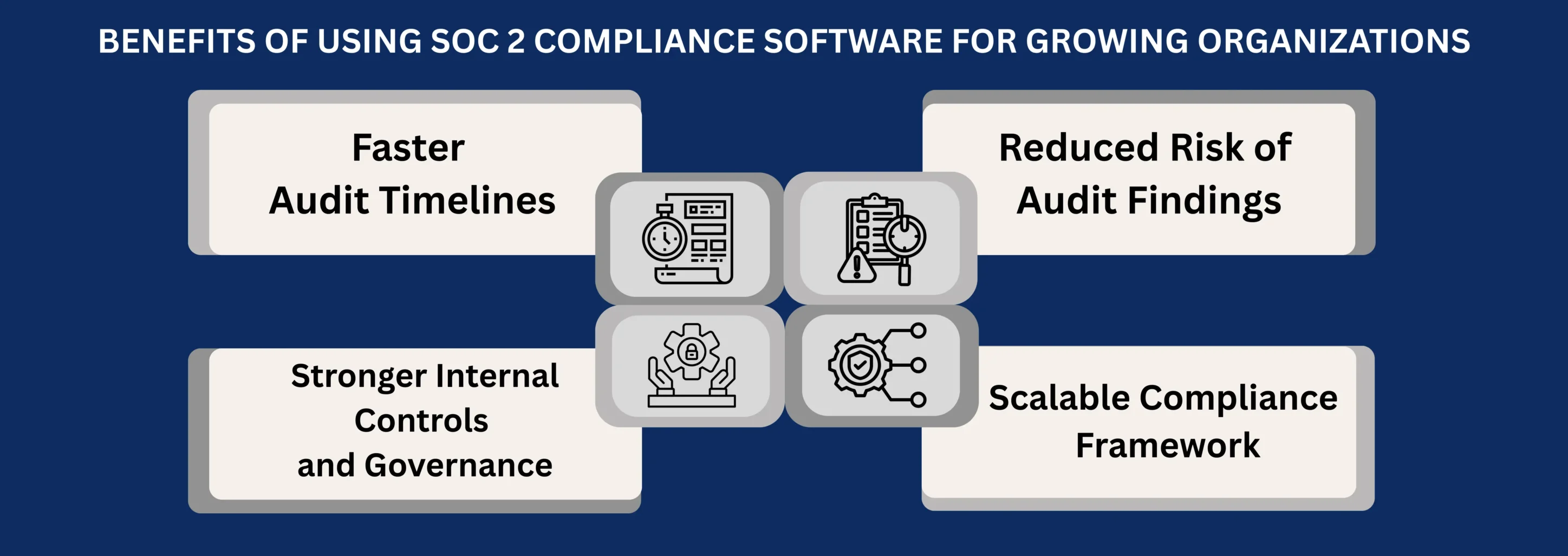
SOC 2 Certification for Denver companies delivers a range of concrete, measurable benefits that extend across commercial, operational, and regulatory dimensions. The independently verified assurance provided by a SOC 2 attestation report directly addresses the security and data protection verification requirements that govern procurement, vendor management, and client relationship management in Denver’s primary industry sectors. The following benefits reflect the practical outcomes that SOC 2 certified Denver organizations demonstrate through their attestation status.
Enterprise buyers across Denver’s primary client sectors — healthcare, financial services, government, telecommunications, and large technology companies — require SOC 2 reports as a standard component of vendor qualification. Without a current SOC 2 attestation, Denver technology organizations may be disqualified from enterprise procurement processes, excluded from vendor shortlists, or required to complete lengthy security questionnaires that substitute for — but do not carry the same weight as — an independent attestation report. SOC 2 Certification in Denver eliminates this barrier by providing a standardized, independently verified assurance document that satisfies most enterprise vendor security requirements.
The competitive differentiation provided by SOC 2 attestation is particularly significant in markets where multiple vendors offer comparable services. Enterprise buyers evaluating competing SaaS platforms, cloud providers, or managed service providers routinely use SOC 2 report status as a selection criterion. Denver organizations with current Type 2 reports are positioned to demonstrate a higher level of assurance than competitors without attestation, reducing friction in enterprise sales cycles and providing procurement teams with a recognized, auditor-verified assurance document rather than a self-reported security questionnaire response.
Third-party risk management programs maintained by Denver’s enterprise clients require periodic revalidation of vendor security and compliance status. A current SOC 2 Type 2 report satisfies this revalidation requirement by providing independently examined evidence that the vendor’s controls have operated effectively over the preceding observation period. Rather than relying on vendor-completed security questionnaires — which are self-reported and unverified — risk management teams can review the auditor’s testing results and findings directly from the SOC 2 report. This independently verified view of control performance is more defensible during internal audits, regulatory reviews, and board-level risk reporting than self-assessed vendor questionnaire responses.
SOC 2 attestation demonstrates operational alignment with multiple regulatory and contractual privacy and security requirements relevant to Denver organizations. The Security Trust Services Criteria address access control, change management, and incident response requirements that appear across HIPAA’s Technical Safeguards, the Colorado Privacy Act’s security obligations, PCI DSS access control requirements, and NIST cybersecurity framework expectations. Denver organizations that have undergone SOC 2 examination have established and independently validated control environments that partially address the overlapping requirements of these multiple regulatory frameworks — reducing the redundant assessment burden associated with satisfying each framework independently.
- ✓Satisfies enterprise vendor qualification requirements across healthcare, financial services, and technology sectors
- ✓Provides independently verified assurance that replaces or supplements security questionnaire responses
- ✓Demonstrates operational control effectiveness to customers, auditors, and regulators
- ✓Supports third-party risk management program requirements of enterprise clients
- ✓Aligns with Colorado Privacy Act security obligations and HIPAA Technical Safeguard requirements
- ✓Enables access to federal contractor and government-adjacent vendor markets requiring third-party SOC 2 attestation
- ✓Reduces duplicative security assessment burden by satisfying multiple client security requirements with a single report
- ✓Establishes independently examined security baseline that informs internal control improvement cycles
- ✓Provides documented evidence of control operation that supports cyber insurance underwriting and renewal processes
- ✓Supports continuous improvement of the control environment through annual SOC 2 audit cycles
- ✓Vendor Qualification and Enterprise Procurement Access
- ✓Third-Party Risk Management and Customer Assurance
- ✓Regulatory Alignment and Privacy Compliance Support
SOC 2 Compliance Denver: An Expert Framework
SOC 2 compliance in Denver extends beyond obtaining a single attestation report. Sustained SOC 2 compliance requires maintaining the control environment, operational evidence, and annual audit cycles that produce continuously current attestation reports. The distinction between initial SOC 2 attestation and sustained compliance is critical for Denver organizations managing ongoing enterprise client relationships: clients expect annually renewed reports, and gaps in attestation coverage can trigger vendor risk reviews or contract renegotiations.
Annual Audit Cycles and Report Renewal
Maintaining current SOC 2 attestation requires completing annual audit cycles that produce renewed SOC 2 Type 2 reports before the prior report period expires. The annual cycle begins with the start of the new observation period — typically aligned with the end date of the prior observation period — and concludes with the issuance of a new attestation report covering the subsequent 12-month window. Organizations must complete annual SOC 2 audit cycles to maintain current certified status and meet customer expectations. The examination opinion in a renewed report may address the same or updated Trust Services Criteria, reflecting any changes in the organization’s services, infrastructure, or contractual commitments.
Denver organizations managing multiple client contracts with varying SOC 2 report validity expectations should coordinate their examination scheduling to ensure the report period covered by the current attestation spans the timeframes most relevant to their largest client contracts. Organizations should also proactively notify clients of report renewal timelines and provide access to updated reports as soon as they are issued. This supports client third-party risk management program update cycles and prevents SOC 2 attestation coverage gaps from triggering vendor review processes.
Ongoing Control Monitoring and Evidence Management
Ongoing control monitoring is not merely a SOC 2 compliance requirement — it is the operational foundation that makes annual SOC 2 examinations possible. Denver organizations maintaining continuous monitoring of access logs, change management activity, security incidents, backup operations, and vulnerability management findings are producing the evidence base that the auditor will draw upon during the subsequent examination. Effective ongoing monitoring requires automated log collection, retention policies that preserve evidence for at least the full observation period, periodic internal reviews of monitoring data, and documented escalation procedures for control exceptions identified during the year.
Control environment changes — including new system deployments, personnel changes, infrastructure migrations, and policy updates — must be managed within the formal change management process and documented in a manner the auditor can evaluate. Unmanaged or undocumented changes to in-scope systems during the observation period can result in SOC 2 examination findings if the change disrupts control operation or introduces a control gap not addressed before the examination. Denver organizations should treat the observation period as a continuous examination window, maintaining the same standards of control operation and documentation throughout the year as they would during the formal audit fieldwork phase.
Why Choose CertPro for SOC 2 Audit in Denver
CertPro is a Licensed CPA Firm providing independent SOC 2 audit and attestation services exclusively to service organizations in Denver and across the United States. As a Licensed CPA Firm, CertPro’s examinations are conducted under AICPA AT-C Section 205 attestation standards, and the attestation opinions issued are professionally binding under CPA professional standards. CertPro’s exclusive focus on SOC 2 audit engagements in Denver — without advisory, consulting, implementation, or managed compliance services — ensures that CertPro’s relationship with each client organization is strictly that of independent examiner, preserving the independence required by AICPA attestation standards.
Independence and AICPA Attestation Standards
Independence is the foundational requirement of the SOC 2 attestation. AICPA attestation standards require that the examining CPA firm maintain independence from the service organization throughout the engagement — meaning the firm cannot have provided advisory, consulting, or implementation services that affect the controls being examined. CertPro’s strict limitation to audit and attestation services — with no consulting, implementation, or remediation work — ensures that independence requirements are met without qualification. Denver organizations engaging CertPro for SOC 2 attestation receive an examination opinion from a firm that has no advisory relationship with the organization and whose judgment is not influenced by prior or concurrent non-audit engagements.
The attestation opinion issued by CertPro carries the authority of a Licensed CPA Firm’s professional judgment, backed by examination procedures conducted in accordance with AICPA AT-C Section 205. This professional foundation distinguishes CertPro’s SOC 2 attestation from self-assessments, vendor questionnaire responses, or compliance reports issued by non-CPA consulting firms. Enterprise clients, healthcare organizations, financial institutions, and government-adjacent buyers reviewing CertPro-issued SOC 2 reports receive an attestation that meets the professional standards required by AICPA and expected by sophisticated procurement and risk management functions.
Examination Expertise Across Denver’s Industry Sectors
CertPro’s SOC 2 examination practice addresses the full range of industry sectors represented in Denver’s technology and professional services economy. The firm’s examination methodology is calibrated to the specific control environments and data handling practices of SaaS organizations, cloud infrastructure providers, healthcare technology companies, fintech platforms, cybersecurity service providers, managed service providers, and energy technology firms. This sector-informed approach ensures that the Trust Services Criteria are evaluated in the context of the actual service delivery model and data handling practices of each Denver organization — producing SOC 2 attestation reports that accurately reflect the organization’s control environment and provide meaningful assurance to its clients.
Denver organizations evaluating SOC 2 audit firms should assess each firm on the basis of Licensed CPA Firm status, AICPA attestation standards compliance, industry sector experience, and strict independence from advisory or implementation services. CertPro meets each of these criteria as an exclusively audit-focused Licensed CPA Firm with demonstrated SOC 2 examination experience across Denver’s primary technology and professional services sectors. Denver organizations requiring SOC 2 attestation for enterprise vendor qualification, customer assurance, or regulatory alignment are served by an examination firm whose institutional positioning, professional credentials, and examination standards align with the most stringent client expectations.
Structured Examination Process and Report Quality
CertPro’s SOC 2 examination process follows a structured, stage-based methodology that produces reports meeting AICPA format requirements and enterprise client expectations. Each examination is documented in formal working papers, each testing procedure is conducted in accordance with the engagement’s audit program, and each opinion is reviewed by licensed CPA professionals before issuance. The resulting SOC 2 report — including the auditor’s opinion, system description, and control testing details — is formatted to satisfy the review requirements of enterprise procurement functions, healthcare compliance offices, financial institution vendor management programs, and board-level risk reporting processes.
FAQ
▶
What is A SOC 2 Type 1 audit typically takes four to?
▶
What is the difference between SOC 2 certified and SOC 2 compliant?
▶
How long does a SOC 2 Type 2 observation period last?
▶
How long is a SOC 2 report valid?
▶
Which Trust Services Criteria are required in a SOC 2 examination?
▶
What is the difference between a SOC 2 Type 1 and Type 2 audit?
▶
Who can issue a SOC 2 report?
▶
Is SOC 2 required for Denver SaaS companies?
SOC 1 VS SOC 2: WHICH REPORT YOUR CUSTOMERS ACTUALLY ASK FOR
If you sell SaaS or provide outsourced services, you have likely been asked for a SOC report. However, the follow-up question is rarely easy to answer…

AICPA Issues New Guidance for Peer Reviewers Evaluating SOC 2 Engagements
AICPA SOC 2 guidance has been issued to help peer reviewers identify quality risks associated with SOC 2 engagements as the use of compliance automati…
SOC 2 Certified: What Does It Mean for Your Business
For companies that handle sensitive data or run cloud-based services, the question “Can you provide your SOC 2 report?” carries enormous weight. Yet, …
Get In Touch
have a question? let us get back to you.