
ISO 42001 Certification in Denver
CertPro is a Licensed CPA Firm conducting ISO 42001 certification audits for organizations operating AI management systems in Denver, Colorado. Our ISO 42001 audit activities cover AIMS scope definition, control evaluation, nonconformity review, and certification decision in accordance with ISO/IEC 42001:2023 requirements and applicable AI governance frameworks relevant to U.S.-based enterprises.
OUR CLIENTS



Introduction to ISO 42001 Certification in Denver
ISO 42001 Certification in Denver represents a formal, internationally recognized validation that an organization’s Artificial Intelligence Management System (AIMS) meets the requirements established under ISO/IEC 42001:2023. Published in December 2023, this standard is the first of its kind to provide a comprehensive, auditable framework specifically designed for organizations that develop, deploy, or utilize AI systems. As Denver’s technology sector expands rapidly across aerospace, financial services, SaaS, and data-intensive industries, ISO 42001 certification has emerged as a critical governance benchmark. Enterprises across the region rely on it to demonstrate responsible AI stewardship to regulators, clients, and investors.
Denver has established itself as one of the United States’ most significant technology hubs, with a growing concentration of cloud service providers, AI-driven startups, regional corporate headquarters, and expanding data center infrastructure. Organizations operating in this environment face increasing scrutiny from enterprise clients and federal procurement agencies that expect demonstrable AI governance. ISO 42001 Certification in Denver provides that demonstration through a structured audit process conducted by a Licensed CPA Firm—ensuring that every certification decision is grounded in objective evaluation rather than self-assessment or advisory opinion.
What Is ISO/IEC 42001:2023?
ISO/IEC 42001:2023—commonly referred to as ISO 42001—is an international standard published jointly by the International Organization for Standardization (ISO) and the International Electrotechnical Commission (IEC). It establishes requirements and guidelines for organizations to implement, maintain, and continually improve an Artificial Intelligence Management System. The standard directly addresses the unique challenges posed by AI technologies, including algorithmic bias, data quality risks, transparency obligations, and accountability structures that must be defined and documented within any organization deploying AI systems at scale.
The standard adopts the High-Level Structure (HLS) common to ISO management system standards, making it compatible with ISO 27001 (Information Security), ISO 9001 (Quality Management), and ISO 31000 (Risk Management). This structural alignment allows Denver organizations that already hold existing ISO certifications to integrate ISO 42001 requirements into their existing management system architecture—without establishing a wholly separate governance program. The standard defines specific clauses covering organizational context, leadership accountability, planning, operational controls, performance evaluation, and continual improvement. Each clause must be addressed during the ISO 42001 audit process.
ISO 42001 Certification Defined: Scope and Applicability
ISO 42001 certification applies to any organization—regardless of size or sector—that develops AI products, integrates AI into business operations, or provides AI-enabled services to clients. In Denver, this definition encompasses a broad range of enterprises. These include autonomous vehicle technology firms operating near Colorado’s I-70 corridor, AI-powered financial analytics providers serving the downtown finance district, healthcare technology companies leveraging machine learning for diagnostic assistance, and government contractors in the aerospace and defense sectors utilizing AI for data processing and decision support.
Certification scope under ISO 42001 is defined at the organizational level and must clearly delineate which AI systems, processes, and business units fall within the AIMS boundary. An ISO 42001 assessment conducted by CertPro evaluates whether the defined scope is appropriate, whether exclusions are justified, and whether all in-scope AI systems are subject to the governance controls documented in the organization’s AIMS. Certification is awarded upon successful completion of a Stage 1 documentation review and a Stage 2 on-site or remote audit confirming that documented controls are effectively implemented and operationally maintained.
ISO 42001 vs. Other AI Governance Frameworks
ISO 42001 differs from other AI governance frameworks because it is a certifiable management system standard rather than a voluntary guideline or regulatory checklist. Frameworks such as the NIST AI Risk Management Framework (AI RMF) and the EU AI Act provide policy guidance and regulatory obligations, respectively, but neither produces a third-party certification that organizations can present to clients as independent evidence of AIMS compliance. ISO 42001 certification fills this gap by providing an auditable, internationally recognized credential that confirms an organization’s AI governance practices have been independently evaluated by a qualified certification body.
| Framework | Type | Certifiable | Primary Focus |
|---|---|---|---|
| ISO 42001 | Management System Standard | Yes | AI governance, risk, and ethics |
| NIST AI RMF | Voluntary Framework | No | AI risk identification and mitigation |
| EU AI Act | Regulatory Legislation | No (compliance required) | High-risk AI system regulation |
| ISO 27001 | Management System Standard | Yes | Information security management |
| IEEE 7000 | Technical Standard | No | Ethical AI system design |

Why Denver Organizations Need ISO 42001 Certification
Denver’s position as a major technology and innovation center in the Mountain West region creates a distinctive environment where AI adoption is accelerating across multiple high-stakes industries simultaneously. The city’s growing concentration of aerospace and defense contractors, financial technology firms, healthcare informatics companies, and SaaS providers has produced a local economy where AI systems increasingly underpin critical decisions affecting public safety, financial integrity, and personal data. In this context, ISO 42001 compliance is not merely a competitive differentiator—it is an operational necessity for organizations that manage sensitive data, respond to federal procurement requirements, or operate under industry-specific regulatory obligations.
Denver’s AI Ecosystem and Regulatory Landscape
Colorado’s General Assembly has enacted legislation addressing algorithmic discrimination and automated decision-making, making the state one of the most proactively regulated AI environments in the United States. Colorado SB 205—the Colorado Artificial Intelligence Act—imposes obligations on developers and deployers of high-risk AI systems with respect to bias disclosures, impact assessments, and consumer notification. ISO 42001 compliance provides organizations with a structured framework for satisfying many of these statutory obligations. The standard’s requirements for AI system documentation, risk evaluation, and impact assessment align closely with Colorado’s evolving AI regulatory regime.
Beyond state-level regulation, Denver-based organizations serving federal government clients must navigate procurement requirements that increasingly reference AI governance standards. Federal agencies—including the Department of Defense, the Department of Energy (which operates facilities in Colorado through the National Renewable Energy Laboratory), and civilian agencies issuing AI-related contracts—have begun incorporating AI governance expectations into vendor qualification criteria. ISO 42001 certification provides Denver contractors with documented evidence of AIMS implementation that can be referenced in federal proposal submissions and supplier qualification processes.
Industry-Specific Drivers for ISO 42001 Certification in Denver
Denver’s aerospace and defense sector—anchored by companies operating near Buckley Space Force Base and Lockheed Martin facilities in Jefferson County—faces stringent AI governance expectations from both prime contractors and government program offices. For these organizations, ISO 42001 certification in Denver provides a formalized evidence base for responsible AI system management. It satisfies both internal quality management requirements and the external contract deliverables associated with defense AI applications.
The financial services sector in Denver—which includes regional offices of major banks, investment management firms, insurance companies, and fintech startups concentrated in the LoDo and RiNo districts—faces AI governance pressure from the Consumer Financial Protection Bureau (CFPB), the Office of the Comptroller of the Currency (OCC), and state financial regulators. AI systems used for credit scoring, fraud detection, investment recommendation, and customer service automation must demonstrate explainability, fairness, and auditability. ISO 42001 certification for Denver financial services organizations provides the governance documentation and independent audit evidence required to satisfy regulatory examiner inquiries regarding AI system controls.
AI Governance as a Market Differentiator in Denver’s Tech Market
Denver’s SaaS and technology startup community—concentrated in areas such as the Denver Tech Center and emerging innovation districts—competes for enterprise clients who impose vendor due diligence requirements that increasingly include AI governance documentation. Enterprise procurement teams routinely request evidence of AI system governance as part of security and compliance reviews. ISO 42001 certification in Denver gives tech companies third-party validated proof of responsible AI practices. This reduces procurement friction and accelerates enterprise sales cycles where AI governance scrutiny would otherwise delay or prevent contract award.
ISO 42001 Certification Requirements
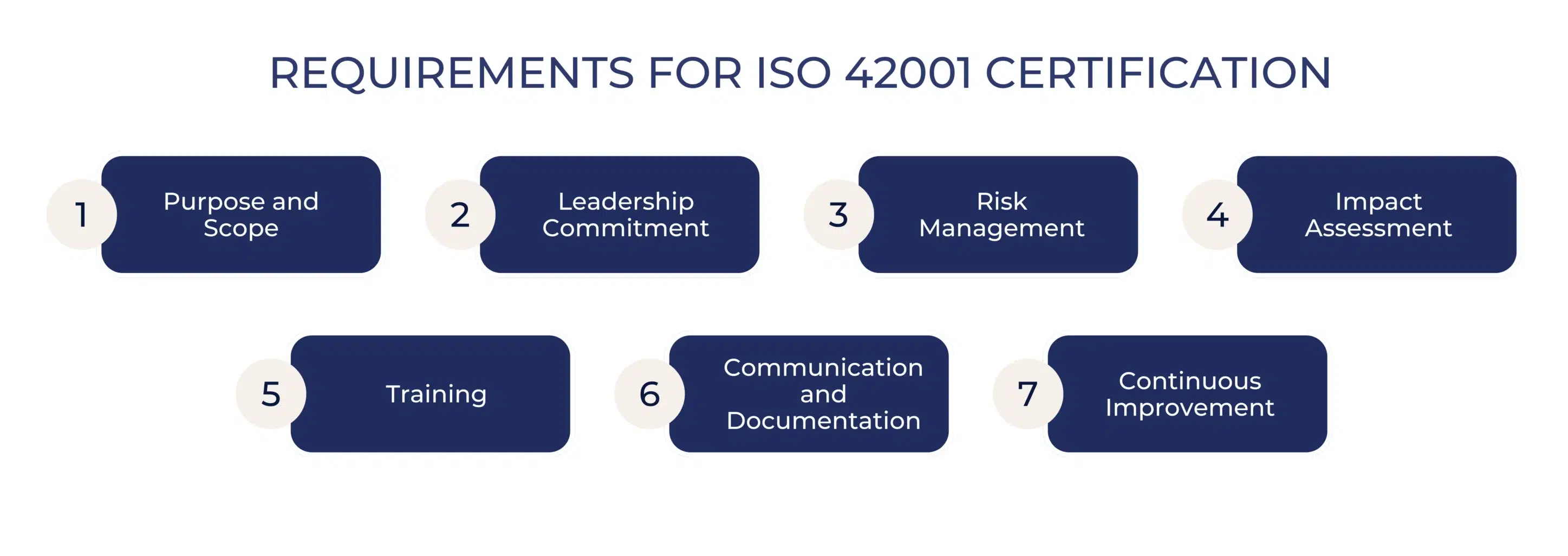
ISO 42001 certification requirements are structured across ten clauses of the standard, with Clauses 4 through 10 containing the normative requirements that organizations must satisfy to achieve certification. An ISO 42001 assessment conducted by CertPro evaluates each of these clauses against the organization’s documented AIMS policies, procedures, records, and operational evidence. The following overview addresses the principal requirement categories that form the basis of the ISO 42001 audit.
Clause 4 of ISO 42001 requires organizations to determine the external and internal factors relevant to their AI activities and to the AIMS’s ability to achieve its intended outcomes. For Denver organizations, this includes analysis of Colorado’s regulatory environment, federal AI governance expectations, industry sector obligations, and the organization’s own strategic AI objectives. The AIMS scope must be formally documented and must clearly identify the AI systems, organizational units, geographic locations, and third-party AI service providers that fall within the certification boundary.
Stakeholder needs and expectations must be identified and documented under Clause 4.2, including the requirements of regulators, clients, employees, and affected communities. Denver organizations that deploy AI systems affecting consumer decisions—such as credit assessment, insurance underwriting, or healthcare triage—must demonstrate that stakeholder interests are systematically considered within the AIMS framework. This includes the interests of individuals subject to AI-driven decisions. The ISO 42001 audit evaluates whether the organization’s stakeholder analysis is comprehensive, current, and reflected in the AIMS’s operational controls.
Clause 5 of ISO 42001 establishes that top management must demonstrate visible leadership and commitment to the AIMS. This requirement goes beyond policy signature. Organizational leaders must actively allocate resources for AIMS implementation, integrate AI governance considerations into strategic planning, and ensure that AI-related roles, responsibilities, and authorities are clearly assigned and communicated throughout the organization. The ISO 42001 audit includes evidence review of management review records, resource allocation decisions, and organizational charts documenting accountability for AI system oversight.
The AI policy required under Clause 5.2 must be appropriate to the organization’s purpose, must commit to satisfying applicable AI governance requirements, and must provide a framework for setting and reviewing AI objectives. For Denver-based organizations, the AI policy should reference applicable Colorado state regulations, federal AI governance expectations relevant to the organization’s sector, and the organization’s own ethical commitments regarding AI system design and deployment. The policy must be documented, communicated internally, and made available to relevant interested parties.
Clause 6 of ISO 42001 requires organizations to establish a systematic process for identifying and evaluating risks associated with AI systems—including risks to individuals, groups, and society arising from AI system outputs and decisions. The AI risk assessment must consider the probability and severity of potential adverse impacts, the organization’s risk tolerance, and the controls available to mitigate identified risks. For organizations pursuing ISO 42001 certification in Denver, the risk assessment must also address risks specific to the local regulatory environment, including obligations under Colorado’s AI legislation and federal sector-specific requirements.
AI impact assessment is a distinct but related requirement addressed in ISO 42001 Annex B, which provides guidance on evaluating the broader societal and ethical impacts of AI system deployment. While Annex B is informative rather than normative, the ISO 42001 audit evaluates whether the organization has considered AI impact dimensions including fairness, transparency, accountability, human oversight, and data privacy when designing and deploying AI systems. Organizations in Denver’s healthcare and financial sectors—where AI system outputs directly affect individual welfare and financial access—must demonstrate particularly rigorous impact assessment documentation.
Clause 8 of ISO 42001 addresses the operational planning and control requirements that organizations must implement to manage AI risks and achieve AI objectives. Operational controls include documented procedures for AI system development, testing, validation, deployment, monitoring, and decommissioning. The standard requires organizations to establish evaluation criteria for AI systems prior to deployment—including performance benchmarks, bias testing protocols, and data quality validation procedures. The ISO 42001 audit examines operational records demonstrating that these controls are consistently applied across all in-scope AI systems.
- ✓Documented AIMS scope statement covering all in-scope AI systems and organizational units
- ✓AI policy approved and communicated by top management
- ✓Comprehensive AI risk assessment and risk treatment documentation
- ✓AI impact assessment records addressing fairness, transparency, and accountability
- ✓Defined roles, responsibilities, and authorities for AI system governance
- ✓Operational procedures for AI system development, testing, and deployment lifecycle
- ✓Data governance documentation addressing data quality, provenance, and privacy
- ✓Third-party AI supplier evaluation and monitoring records
- ✓Internal audit program with documented AI audit findings and corrective actions
- ✓Management review records demonstrating top-level AIMS oversight
- ✓Continual improvement records tracking AI governance enhancements over time
- ✓Organizational Context and AIMS Scope Definition
- ✓Leadership, Policy, and Accountability Requirements
- ✓Risk Assessment and AI Impact Evaluation
- ✓Operational Controls and AI System Documentation
ISO 42001 Audit Process Conducted by CertPro
The ISO 42001 audit process conducted by CertPro as a Licensed CPA Firm follows a structured, multi-stage methodology that evaluates an organization’s AIMS against the normative requirements of ISO/IEC 42001:2023. Each stage is designed to produce objective, documented evidence that supports the certification decision. The process is conducted independently of any consulting or advisory relationship with the organization under evaluation. The following stages define the complete ISO 42001 audit that Denver organizations will complete when engaging CertPro for certification.
The Stage 1 audit is a documentation-focused evaluation in which CertPro auditors review the organization’s AIMS documentation to determine whether the system is sufficiently developed to proceed to Stage 2. During Stage 1, auditors examine the AIMS scope statement, AI policy, risk assessment documentation, objectives and plans, and key operational procedures. The audit team assesses whether the organization has identified applicable legal and regulatory requirements, whether the scope boundary is appropriately defined, and whether documented controls address the risks identified in the AI risk assessment.
Stage 1 findings are communicated to the organization in a formal audit report that identifies areas where the AIMS documentation satisfies standard requirements and areas where gaps must be addressed before Stage 2 can proceed. The Stage 1 report does not represent a certification decision—it is an evaluation of documentation readiness that informs the Stage 2 audit program. Organizations are expected to address all documented nonconformities and documentation gaps identified in the Stage 1 report prior to scheduling the Stage 2 audit.
The Stage 2 audit is the primary certification audit, conducted on-site at the organization’s Denver facilities or via secure remote audit protocols where on-site access is not practicable. During Stage 2, CertPro auditors evaluate whether the AIMS controls documented in the Stage 1 review are effectively implemented and operationally maintained. Auditors conduct interviews with personnel responsible for AI system governance, review operational records and monitoring data, examine AI system documentation including model cards and data sheets, and test the functioning of key controls such as bias monitoring procedures, human oversight mechanisms, and incident response protocols.
Stage 2 audit findings are documented in a formal audit report that classifies each finding as conformant, as an observation, as a minor nonconformity, or as a major nonconformity. Major nonconformities represent failures to satisfy normative requirements of ISO 42001 and must be resolved before certification can be granted. Minor nonconformities represent partial satisfactions of requirements that must be addressed within a defined corrective action period. The certification decision is made by a CertPro certification reviewer independent of the audit team, based on the totality of audit evidence and the resolution of all identified nonconformities.
Following the Stage 2 audit, the organization must submit documented corrective action plans for any nonconformities identified by the audit team. For major nonconformities, CertPro verifies the effectiveness of corrective actions through evidence review or a follow-up audit visit before proceeding to the certification decision. For minor nonconformities, corrective action evidence must be submitted within a period specified in the audit report—typically 30 to 90 days following Stage 2 audit completion.
The certification decision is a formal, documented determination made by a qualified certification reviewer who was not involved in the Stage 1 or Stage 2 audit activities. The reviewer evaluates the complete audit file—including Stage 1 and Stage 2 reports, nonconformity records, corrective action evidence, and the audit team’s recommendation. Upon a positive certification decision, CertPro issues the ISO 42001 certificate, which is valid for a three-year certification cycle subject to annual surveillance audits and a recertification audit prior to certificate expiry.
ISO 42001 certification is maintained through annual surveillance audits conducted during the three-year certification cycle. Surveillance audits are narrower in scope than the initial certification audit. They focus on verifying that the AIMS continues to function effectively, that corrective actions from previous audits have been sustained, and that changes to the organization’s AI systems or governance structure have been appropriately addressed within the AIMS. Surveillance audits also evaluate the organization’s internal audit program and management review process to confirm ongoing AIMS oversight.
Recertification audits are conducted at the end of the three-year certification cycle and are equivalent in scope to the initial certification audit. The recertification ISO 42001 audit evaluates the continued effectiveness of the entire AIMS—including significant changes made during the certification period, the results of internal audits and management reviews, and the organization’s track record of AIMS performance and continual improvement. Successful recertification extends the ISO 42001 certificate for an additional three-year cycle.
- ✓Stage 1: AIMS Documentation Review and Scope Audit
- ✓Stage 2: On-Site Control Evaluation and Operational Evidence Review
- ✓Nonconformity Review and Certification Decision
- ✓Surveillance Audits and Recertification
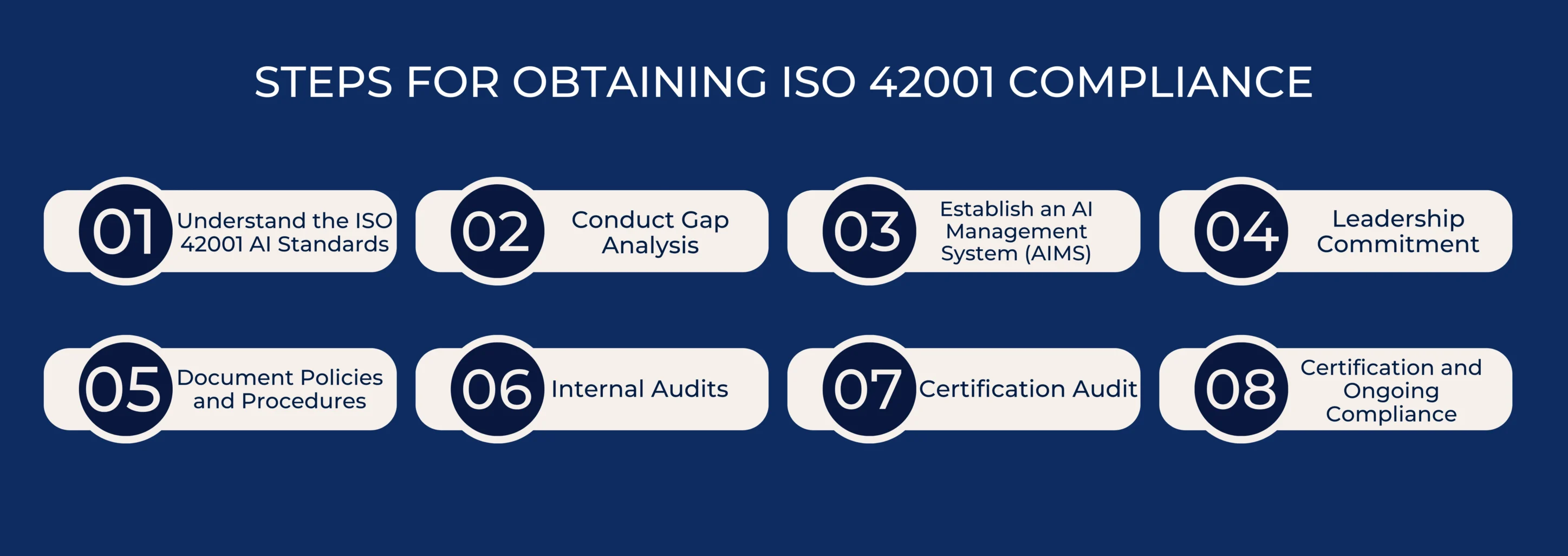
Steps to Achieve ISO 42001 Certification in Denver
Achieving ISO 42001 Certification in Denver requires organizations to complete a structured sequence of preparatory and audit activities that demonstrate AIMS conformance with ISO/IEC 42001:2023. The following steps outline the pathway from initial standard familiarization through certificate issuance, providing Denver organizations with a clear roadmap for the certification process.
- Familiarize the organization’s leadership and AI governance team with ISO/IEC 42001:2023 requirements, including all normative clauses and relevant informative annexes applicable to the organization’s AI activities.
- Define and document the AIMS scope, identifying all AI systems, organizational units, and geographic locations that fall within the certification boundary, and establishing justified exclusions for any AI activities outside the scope.
- Conduct a comprehensive organizational context analysis identifying internal and external factors affecting AI governance, stakeholder expectations, and applicable legal and regulatory requirements including Colorado AI legislation and federal sector-specific obligations.
- Develop and implement an AI risk assessment process that systematically identifies, evaluates, and treats risks associated with in-scope AI systems, producing documented risk assessment and risk treatment records.
- Establish the required AIMS policies, procedures, and operational controls addressing AI system development, testing, deployment, monitoring, and decommissioning lifecycles, ensuring alignment with ISO 42001 Clause 8 operational requirements.
- Implement data governance controls addressing data quality, provenance, consent, and privacy for data used in AI system training, validation, and operation, with documented records of data management activities.
- Establish and execute an internal audit program that evaluates AIMS conformance against ISO 42001 requirements, producing documented audit findings and corrective action records.
- Conduct a formal management review of AIMS performance, reviewing audit results, risk assessment outputs, AI objectives progress, and continual improvement opportunities, with documented management review minutes and decisions.
- Engage CertPro as a Licensed CPA Firm to initiate the ISO 42001 audit process, beginning with Stage 1 documentation review and proceeding through Stage 2 on-site evaluation upon demonstrated documentation readiness.
- Address all nonconformities identified during Stage 1 and Stage 2 audits with documented corrective actions, submitting evidence of corrective action effectiveness to the CertPro audit team for verification.
- Receive the ISO 42001 certification decision and certificate following successful resolution of all nonconformities and positive review by the independent certification decision-maker.
- Maintain AIMS conformance through annual surveillance audits and prepare for recertification audit at the end of the three-year certification cycle.
Benefits of ISO 42001 Certification for Denver Organizations
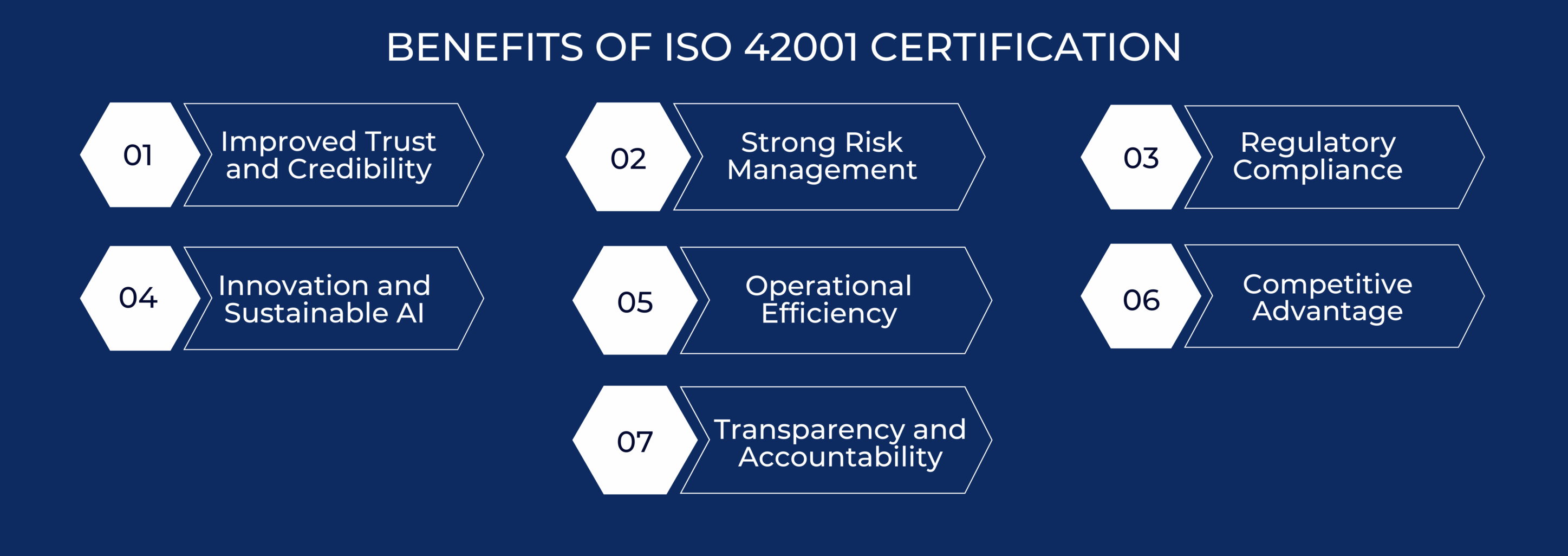
ISO 42001 Certification in Denver delivers measurable organizational benefits that extend across regulatory compliance, commercial positioning, operational risk management, and stakeholder trust. The certification provides Denver organizations with a formally validated credential demonstrating AI governance maturity to the full range of stakeholders that increasingly require evidence of responsible AI management—from enterprise clients and procurement agencies to regulators and board-level risk committees.
ISO 42001 compliance provides Denver organizations with a structured framework for satisfying the AI governance obligations imposed by Colorado’s Artificial Intelligence Act, federal sector-specific AI expectations, and the growing body of U.S. data protection law applicable to AI system data processing activities. By implementing the documentation, risk assessment, and control requirements of ISO 42001, organizations create an auditable evidence base that demonstrates regulatory good faith and systematic AI risk management. This evidence is directly relevant to regulatory examinations, enforcement inquiries, and litigation discovery processes.
For Denver organizations subject to the Colorado AI Act’s requirements regarding algorithmic discrimination and AI impact assessments, ISO 42001 compliance provides a documented methodology for satisfying statutory impact assessment obligations. The standard’s requirements for AI risk assessment, bias evaluation, and stakeholder impact analysis align with the substantive obligations imposed by Colorado’s AI legislation. This allows organizations to use their AIMS documentation as evidence of regulatory compliance—rather than developing separate compliance records for each applicable regulatory obligation.
ISO 42001 certification provides Denver technology companies with a competitive advantage in enterprise sales processes where AI governance documentation is required or expected. Enterprise procurement teams at Fortune 500 companies, government agencies, and regulated industry clients increasingly include AI governance requirements in vendor qualification criteria, security assessments, and contract terms. Organizations holding ISO 42001 certification can satisfy these requirements by referencing their certification credential—rather than completing custom governance questionnaires for each prospective client. This reduces administrative burden and accelerates contract award timelines significantly.
Denver-based AI technology vendors competing for federal government contracts benefit particularly from ISO 42001 certification, as federal acquisition guidance increasingly references AI governance standards in procurement activities. Organizations that can demonstrate ISO 42001 certification status in federal proposal submissions provide contracting officers with independent evidence of AI system governance maturity—supporting positive past performance evaluations and technical capability assessments. This advantage is especially significant for Denver’s aerospace and defense technology sector, where contract values are substantial and governance documentation is a critical differentiator.
The operational controls implemented as part of ISO 42001 compliance directly reduce the likelihood and severity of AI system failures, bias incidents, data breaches affecting AI training data, and regulatory violations arising from undocumented AI decision-making. Organizations that implement systematic AI testing, validation, and monitoring controls—as required by ISO 42001—identify potential AI system failures before they produce adverse outcomes in production environments. This proactive risk management approach reduces the operational and reputational costs associated with AI system incidents, which can be substantial for Denver organizations operating AI systems that affect consumer financial decisions, healthcare outcomes, or public safety.
- ✓Demonstrated regulatory compliance with Colorado AI legislation and federal sector-specific AI governance requirements
- ✓Third-party validated AI governance credential accepted by enterprise procurement teams and government agencies
- ✓Systematic AI risk identification and mitigation reducing the probability of AI system failures and bias incidents
- ✓Structured data governance controls improving AI training data quality and reducing data-related AI system errors
- ✓Enhanced organizational accountability through defined AI governance roles and management oversight structures
- ✓Competitive advantage in enterprise sales processes requiring AI governance documentation and vendor qualification
- ✓Reduced insurance and legal exposure through documented AI risk management evidence
- ✓Improved investor confidence through board-level AI governance visibility and certified AIMS maturity
- ✓Alignment with international AI governance expectations supporting cross-border commercial relationships
- ✓Foundation for integrating AI governance with existing ISO 27001, ISO 9001, or other management system certifications
- ✓Regulatory Compliance and Legal Risk Reduction
- ✓Commercial Advantage and Enterprise Market Access
- ✓Operational Risk Management and Incident Prevention
ISO 42001 Certification Cost in Denver
The cost of ISO 42001 Certification in Denver is determined by several organizational variables that affect the scope and duration of the certification audit. CertPro provides fixed-price certification packages that give Denver organizations cost certainty from the outset of the engagement—eliminating the variable cost exposure associated with open-ended audit fee arrangements. The principal cost determinants include the size of the organization, the number and complexity of in-scope AI systems, the maturity of existing governance documentation, and the geographic distribution of AI operations requiring audit coverage.
Cost Factors and Pricing Variables
Smaller Denver organizations with a limited number of in-scope AI systems, centralized operations, and well-documented AIMS governance structures can typically complete the ISO 42001 certification audit at a lower cost than large enterprises with multiple AI product lines, distributed development teams, and complex third-party AI supplier networks. The audit effort required for Stage 1 and Stage 2 assessments is directly proportional to the number of controls that must be evaluated, the number of personnel who must be interviewed, and the volume of operational records and AI system documentation that must be reviewed during the certification audit.
Organizations that have already achieved ISO 27001 certification or maintain mature quality management systems aligned with ISO 9001 can often reduce ISO 42001 audit costs by leveraging existing governance documentation, control frameworks, and audit evidence that satisfies overlapping requirements. The High-Level Structure of ISO 42001 means that organizations with existing ISO management system certifications already have foundational documentation in place for many Clause 4 through Clause 10 requirements. This reduces the documentation development effort required prior to the Stage 1 audit and can meaningfully decrease the overall audit duration.
| Organization Size | AI System Complexity | Estimated Audit Duration | Key Cost Drivers |
|---|---|---|---|
| Small (under 50 employees) | 1-3 AI systems, limited scope | 3-5 audit days | Documentation volume, AIMS maturity |
| Medium (50-250 employees) | 4-10 AI systems, moderate complexity | 6-10 audit days | Number of AI systems, third-party suppliers |
| Large (250+ employees) | 10+ AI systems, complex architecture | 12-20 audit days | Multi-site operations, integration complexity |
| Enterprise | Enterprise AI platform | Custom audit program | Global operations, regulatory overlay |
Annual Surveillance and Recertification Cost Structure
The total three-year cost of maintaining ISO 42001 certification includes the initial certification audit, two annual surveillance audits during the certification cycle, and the recertification audit at the end of the third year. Annual surveillance audits are narrower in scope than the initial certification audit and are typically priced at a fraction of the initial certification audit cost. CertPro’s fixed-price packages for ISO 42001 Certification in Denver include clearly defined pricing for each phase of the certification cycle—allowing organizations to budget accurately for the full three-year maintenance cost without exposure to variable audit fee escalation.
ISO 42001 Assessment: What CertPro Evaluates
The ISO 42001 assessment conducted by CertPro evaluates an organization’s AIMS across all normative requirement areas of ISO/IEC 42001:2023, producing an objective determination of whether the management system satisfies the standard’s requirements at the time of audit. The assessment is structured to provide maximum clarity and extractability of findings. Each audit finding is documented against the specific standard clause to which it relates, the evidence reviewed, the auditor’s evaluation of conformance, and the basis for any nonconformity classification.
AIMS Control Evaluation Methodology
CertPro’s ISO 42001 assessment methodology evaluates controls across five dimensions: documentation adequacy, implementation evidence, operational consistency, effectiveness indicators, and continual improvement activity. Documentation adequacy assesses whether controls are formally documented at the level of detail required to support consistent implementation. Implementation evidence evaluates whether personnel with AI governance responsibilities have received appropriate training, understand their obligations, and can demonstrate the application of documented controls in their day-to-day activities. Operational consistency assesses whether controls are applied uniformly across all in-scope AI systems and organizational units rather than selectively or inconsistently.
Effectiveness indicators are evaluated by examining the outputs of key AIMS controls—such as AI system monitoring reports, bias testing results, data quality assessment records, and incident reports—to determine whether controls are producing outcomes consistent with their intended purpose. Continual improvement activity is assessed by reviewing internal audit records, management review outputs, and corrective action logs to confirm whether the organization is actively identifying and addressing AIMS weaknesses. The ISO 42001 assessment that Denver organizations receive from CertPro covers all five evaluation dimensions across the full scope of in-scope AI systems and AIMS clauses.
AI System-Specific Audit Evidence Requirements
The ISO 42001 assessment requires organizations to produce system-level documentation for each AI system within the AIMS scope. This documentation typically includes model documentation describing the AI system’s purpose, architecture, training data sources, validation methodology, performance metrics, and known limitations. Model cards, AI system data sheets, and intended use documentation are common formats for capturing this information. The audit team evaluates whether system-level documentation is complete, accurate, and current—and whether the documented characteristics of each AI system are reflected in the organization’s risk assessment and operational control records.
For AI systems that make or significantly influence decisions affecting individuals—such as credit scoring models, hiring algorithm tools, healthcare diagnostic systems, or law enforcement predictive analytics—the ISO 42001 assessment places particular emphasis on the organization’s explainability mechanisms, human oversight controls, and appeal or correction procedures. These controls are evaluated not only for documentation adequacy but for the operational evidence demonstrating that they function as intended in production AI system deployment. Denver organizations operating high-stakes AI systems in regulated sectors should ensure that explainability and human oversight evidence is comprehensively documented prior to the Stage 2 audit.
CertPro’s ISO 42001 Certification Services in Denver
CertPro is a Licensed CPA Firm providing ISO 42001 certification audit services to organizations throughout Denver and the broader Colorado Front Range region. Operating under accreditation standards applicable to management system certification, CertPro conducts ISO 42001 audits with strict independence from any advisory, consulting, or implementation activities. This ensures that every certification decision reflects an objective evaluation of AIMS conformance rather than the organization’s relationship with its certification body.
CertPro’s Licensed CPA Firm Positioning
CertPro’s status as a Licensed CPA Firm distinguishes its ISO 42001 certification services from those of non-CPA certification bodies. It brings the professional accountability standards, independence requirements, and evidence-based evaluation methodology of the accounting profession to the ISO 42001 audit process. The CPA licensing framework imposes professional conduct obligations on CertPro’s auditors that reinforce the objectivity and rigor of each certification evaluation—providing Denver organizations and their stakeholders with additional assurance regarding the independence and quality of the ISO 42001 audit.
This positioning is particularly relevant for Denver organizations whose ISO 42001 certification will be presented to financial regulators, securities-regulated entities, or publicly traded companies where the credibility of the certification body is subject to independent scrutiny. The Licensed CPA Firm credential provides a recognized professional accountability framework that enhances the credibility of the ISO 42001 certification for stakeholders familiar with the standards of professional assurance services—including audit committees, general counsel, and institutional investors.
Customizable Certification Packages for Denver Organizations
CertPro offers customizable ISO 42001 certification packages designed to address the varying scope, complexity, and budget parameters of Denver organizations across different sectors and size categories. Certification packages are structured to provide fixed-price certainty for each phase of the certification cycle, with clearly defined deliverables, audit timelines, and communication protocols. This gives organizations full transparency regarding the certification process—from initial scope agreement through certificate issuance. Package customization accommodates industry-specific audit requirements, sector-specific regulatory overlays, and integration with existing ISO management system certifications held by the organization.
Sector Coverage: Denver Aerospace, Financial Services, and Technology
CertPro’s ISO 42001 certification engagements for Denver aerospace organizations address the specific AI governance requirements applicable to defense contractors and aerospace manufacturers operating under Department of Defense acquisition regulations and Federal Aviation Administration oversight. Audit programs for aerospace organizations include evaluation of AI systems used in autonomous navigation, predictive maintenance, quality inspection, and mission planning—with particular attention to safety-critical system documentation, failure mode analysis, and human oversight controls required for AI systems operating in safety-of-life environments.
ISO 42001 certification engagements for Denver financial services organizations address the AI governance requirements applicable to banks, investment advisers, insurance companies, and fintech providers subject to oversight by the Federal Reserve, OCC, CFPB, SEC, and Colorado financial regulators. Audit programs for financial services organizations evaluate AI controls governing credit decision models, anti-money laundering systems, fraud detection algorithms, robo-advisory platforms, and customer service AI tools—with emphasis on model risk management documentation, explainability requirements, and fair lending compliance evidence.
ISO 42001 Compliance: Maintaining Certification Status
ISO 42001 compliance is an ongoing organizational commitment that extends well beyond the initial certification audit. It encompasses the continuous operation and improvement of the AIMS throughout the full three-year certification cycle. Organizations that treat ISO 42001 compliance as a continuous governance discipline—rather than a point-in-time audit exercise—maintain stronger AIMS performance, generate more credible certification evidence during surveillance audits, and cultivate a genuine culture of responsible AI management that delivers operational benefits beyond the certification credential itself.
Continuous AIMS Monitoring and Performance Measurement
Clause 9 of ISO 42001 requires organizations to establish performance evaluation processes that monitor, measure, analyze, and evaluate AIMS effectiveness on an ongoing basis. Performance monitoring should include quantitative indicators for AI system performance—such as model accuracy, bias metrics, data quality scores, and incident frequency—as well as qualitative assessments of governance process effectiveness, stakeholder satisfaction, and regulatory compliance status. Denver organizations maintaining ISO 42001 compliance should establish regular cadences for performance data collection and review, producing records that demonstrate continuous AIMS oversight between certification audit visits.
Internal audit programs are a critical component of ongoing ISO 42001 compliance, providing systematic evaluation of AIMS conformance at intervals planned in relation to the risk associated with AI systems and processes. Internal audits must be conducted by personnel who are competent in ISO 42001 requirements and AI governance principles, and who are sufficiently independent of the activities they audit to provide objective findings. Internal audit findings should be reported to top management and tracked through to resolution—with records demonstrating that corrective actions have been implemented and verified as effective. These records are reviewed during CertPro’s surveillance audit as primary evidence of ongoing AIMS oversight.
Managing AIMS Changes and AI System Updates
Organizations maintaining ISO 42001 compliance must establish documented processes for managing changes to AI systems, data sources, organizational structures, and regulatory requirements that could affect AIMS conformance. When a Denver organization deploys a new AI system, significantly modifies an existing AI model, changes a key data supplier, or enters a new regulatory jurisdiction, these changes must be evaluated against AIMS requirements and documented accordingly. The change management process should include a risk assessment of how the change affects the organization’s AI risk profile, an update to relevant AIMS documentation, and notification to CertPro where changes are significant enough to affect the certification scope or the basis of previous certification decisions.
Secure Your ISO 42001 Certification in Denver with CertPro
ISO 42001 Certification in Denver positions organizations at the forefront of responsible AI governance in one of the United States’ most dynamic technology markets. As AI systems become increasingly central to Denver’s aerospace, financial services, healthcare, and technology sectors, the ability to demonstrate independently audited AI management system conformance is emerging as a fundamental requirement for enterprise market access, regulatory compliance, and stakeholder trust. CertPro’s ISO 42001 certification audit services provide Denver organizations with the rigorous, independent evaluation they need to achieve and maintain certification with confidence.
CertPro’s status as a Licensed CPA Firm conducting ISO 42001 certification audits in Denver ensures that every certification decision is grounded in objective, evidence-based evaluation conducted by qualified auditors operating under professional accountability standards. Organizations pursuing ISO 42001 Certification in Denver benefit from CertPro’s structured audit methodology, fixed-price certification packages, sector-specific audit expertise, and deep familiarity with the regulatory landscape affecting AI-driven enterprises across Colorado’s key industry sectors. Contact CertPro to initiate the ISO 42001 certification process and establish your organization’s AI governance credentials with an internationally recognized certification backed by Licensed CPA Firm authority.
The path to ISO 42001 Certification in Denver begins with a clear understanding of your organization’s AI footprint, governance obligations, and AIMS scope. CertPro’s audit team brings the technical expertise, regulatory knowledge, and professional independence required to conduct a rigorous ISO 42001 audit that produces a credible, defensible certification credential. Whether your organization is a Denver technology startup deploying its first AI product, a mid-market aerospace contractor integrating AI into mission-critical systems, or a regional financial institution managing AI-driven credit and compliance processes, CertPro’s ISO 42001 certification services are structured to deliver the independent evaluation your AI governance program requires.
FAQ
▶
What is ISO 42001 certification and why does it matter for Denver organizations?
▶
Which Denver organizations are required or expected to obtain ISO 42001 certification?
▶
How long does the ISO 42001 certification audit process take in Denver?
▶
What is the difference between an ISO 42001 audit and an ISO 42001 assessment?
▶
How does ISO 42001 compliance relate to Colorado’s AI legislation?
▶
Can Denver organizations integrate ISO 42001 with existing ISO certifications?
▶
How frequently must ISO 42001 surveillance audits be conducted?
▶
What evidence does CertPro review during the ISO 42001 audit Denver organizations undergo?
ISO 42001 CERTIFIED: WHY AI GOVERNANCE CERTIFICATION IS BECOMING A BOARD-LEVEL REQUIREMENT
AI is now an inevitable component of major business activities in the current corporate world. To elaborate, it is now part of product design, custome…

MindSec Launches AI Compliance for Law 25 & ISO 42001
Excerpt from Barchart Article, Published on December 3, 2025 Today, Canadian organizations face increasing pressure to comply with stringent privacy a…

UNDERSTANDING ISO 42001: A GUIDE FOR RESPONSIBLE AI MANAGEMENT SYSTEMS
The invention of artificial intelligence (AI) has changed the operational processes of many industries. However, the rapid growth of technology increa…
Get In Touch
have a question? let us get back to you.