
ISO 42001 Certification in Singapore
ISO 42001 shares its structural architecture with established management system standards through the ISO High Level Structure. Clauses 4 through 10 of ISO/IEC 42001:2023 mirror those of ISO 27001:2022, ISO 9001:2015, and ISO 14001:2015—covering context of the organisation, leadership, planning, support, operation, performance evaluation, and improvement. This structural alignment means that organisations pursuing ISO 42001 compliance can integrate AI governance requirements into existing management system frameworks rather than building isolated compliance silos.
OUR CLIENTS








ISO 42001 Certification in Singapore: An Executive Overview
ISO 42001 Certification in Singapore represents the internationally recognised benchmark for organisations seeking to establish, implement, maintain, and continually improve an Artificial Intelligence Management System (AIMS). Published by the International Organisation for Standardisation and the International Electrotechnical Commission as ISO/IEC 42001:2023, this standard provides a normative framework enabling organisations to demonstrate responsible AI governance through independently auditable controls. CertPro operates as a Licensed CPA Firm delivering third-party ISO 42001 audit and certification services across Singapore, evaluating conformity to the standard’s requirements without advisory or consulting involvement.
Singapore’s position as Southeast Asia’s leading technology, financial services, and AI innovation hub makes ISO 42001 Certification in Singapore particularly relevant. The city-state hosts hundreds of multinational corporations, fintech firms, AI-native startups, and major cloud infrastructure providers operating across regulated sectors. As AI systems become embedded in financial modelling, healthcare diagnostics, logistics optimisation, and customer interaction platforms, the need for a standardised governance framework—independently verified through formal audit—has become a boardroom-level priority. ISO 42001 Certification in Singapore provides that independently verified assurance, distinguishing certified organisations within the city-state’s competitive marketplace.
The standard follows the ISO High Level Structure (HLS), also known as Annex SL, which means it integrates naturally with other management system standards already prevalent in Singapore’s enterprise landscape—including ISO 27001 for information security management and ISO 9001 for quality management. Organisations that have already achieved these certifications can leverage existing governance structures—policies, risk registers, internal audit programmes, and management review cycles—when pursuing ISO AIMS certification. This structural alignment reduces duplication of effort while expanding organisational compliance coverage into the AI governance domain.

What Is ISO/IEC 42001:2023? Defining the Standard
Definition and Normative Scope
ISO/IEC 42001:2023 is an international management system standard that specifies requirements for establishing, implementing, maintaining, and continually improving an Artificial Intelligence Management System within the context of an organisation. The standard applies to any organisation—regardless of size, type, or sector—that develops, provides, or uses AI-based systems as part of its operational or product delivery activities. ISO AIMS certification, as certification against this standard is commonly known, is the formal third-party confirmation that an organisation’s AI management practices conform to the normative requirements of ISO/IEC 42001:2023.
The standard defines an Artificial Intelligence Management System as the set of interrelated and interacting elements that an organisation uses to establish AI-related policies and objectives—and to achieve those objectives. This encompasses organisational context analysis, leadership accountability structures, resource allocation for AI operations, risk and opportunity management specific to AI, and performance evaluation mechanisms. Critically, ISO 42001 is an auditable standard. Its requirements can be assessed against objective evidence by an independent third-party certification body, resulting in a formal certificate of conformity.
Relationship to Other ISO Management System Standards
ISO 42001 shares its structural architecture with established management system standards through the ISO High Level Structure. Clauses 4 through 10 of ISO/IEC 42001:2023 mirror those of ISO 27001:2022, ISO 9001:2015, and ISO 14001:2015—covering context of the organisation, leadership, planning, support, operation, performance evaluation, and improvement. This structural alignment means that organisations pursuing ISO 42001 compliance can integrate AI governance requirements into existing management system frameworks rather than building isolated compliance silos.
ISO 42001 also references ISO 31000 for risk management principles and aligns with ISO/IEC 27701 for privacy information management—a particularly relevant relationship given Singapore’s Personal Data Protection Act (PDPA) requirements enforced by the Personal Data Protection Commission (PDPC). Organisations deploying AI systems that process personal data of Singapore residents must address both PDPA obligations and AI-specific risk controls. ISO 42001 compliance provides a documented and auditable approach to managing AI-related data risks, supporting alignment with Singapore’s broader regulatory environment.
Distinction from Consulting Frameworks and Advisory Methodologies
ISO 42001 is an independently auditable certification standard—not a consulting methodology or advisory framework. Certification is issued by an accredited or recognised third-party certification body following a structured audit process that evaluates objective evidence of conformity. This distinguishes ISO AIMS certification from AI ethics frameworks, voluntary AI principles, or internal governance checklists that are self-declared rather than independently verified. The certification outcome is a formal, time-bound certificate valid for a defined surveillance cycle, carrying recognised international standing.
For organisations in Singapore, this distinction matters significantly in commercial and regulatory contexts. Procurement requirements from government-linked corporations, financial institutions regulated by the Monetary Authority of Singapore (MAS), and international enterprise clients increasingly specify third-party certified AI governance as a contractual condition. A self-assessed alignment to an AI framework does not satisfy these requirements. Only a certificate of conformity issued following a formal ISO 42001 audit meets the evidentiary standard demanded by sophisticated counterparties.
Why ISO 42001 Certification in Singapore Is Strategically Important
Singapore’s AI Governance Regulatory Landscape
Singapore has positioned itself as a global leader in responsible AI governance. The Infocomm Media Development Authority (IMDA) and Smart Nation and Digital Government Office (SNDGO) have published the Singapore Model AI Governance Framework, which outlines principles for trustworthy AI deployment across sectors. While this framework is currently voluntary, its principles closely align with the requirements of ISO/IEC 42001:2023. Organisations pursuing ISO 42001 Certification in Singapore therefore simultaneously address national AI governance expectations and internationally recognised certification standards.
The Monetary Authority of Singapore has issued guidelines on the use of artificial intelligence and data analytics (AIDA) for financial institutions, establishing specific expectations around fairness, ethics, accountability, and transparency in AI-driven financial services. These MAS expectations require documentation, governance structures, and audit trails that correspond directly to ISO 42001 certification requirements. Financial institutions in Singapore—banks, insurers, asset managers, and payment service providers—face the strongest immediate pressure to achieve ISO 42001 compliance as a means of demonstrating regulatory alignment to MAS.
Singapore’s Role as a Regional AI Hub
Singapore serves as the Asia-Pacific headquarters for a substantial number of global technology companies, AI research centres, and cloud service providers. Major hyperscalers including AWS, Google Cloud, Microsoft Azure, and Alibaba Cloud maintain significant data centre infrastructure in Singapore, serving enterprise clients across the region. AI workloads running on this infrastructure—from natural language processing systems to computer vision applications and algorithmic decision engines—require governance frameworks that can withstand scrutiny from regional regulators, international clients, and institutional investors.
The presence of a dense fintech ecosystem in Singapore, anchored by institutions such as DBS, OCBC, UOB, and hundreds of licensed payment and lending platforms, creates concentrated demand for AI management system certification. These organisations deploy machine learning models for credit scoring, fraud detection, anti-money laundering transaction monitoring, and customer segmentation. Each use case introduces AI-specific risks—model bias, data poisoning, unexplainability—that ISO 42001 Certification directly addresses through its structured risk management and control requirements.
Competitive and Commercial Imperatives
ISO 42001 Certification in Singapore provides a measurable competitive differentiator in commercial environments where trust in AI systems is a procurement criterion. Government procurement frameworks in Singapore increasingly require technology vendors to demonstrate responsible AI practices. The Government Technology Agency (GovTech) and various statutory boards that procure AI-enabled services are expected to require ISO 42001 compliance or equivalent as a baseline vendor qualification criterion. Certified organisations gain access to procurement categories that remain closed to non-certified competitors.
Beyond government procurement, enterprise clients in banking, healthcare, and professional services routinely conduct third-party risk assessments of their AI-enabled vendors. ISO 42001 certification provides the documented evidence base that satisfies these assessments efficiently. Rather than responding to bespoke due diligence questionnaires with manual evidence packages, a certified organisation can present its ISO 42001 certificate as prima facie evidence of AI governance maturity. This significantly reduces the administrative burden of maintaining enterprise client relationships in Singapore’s regulated sectors.
ISO 42001 Certification Requirements
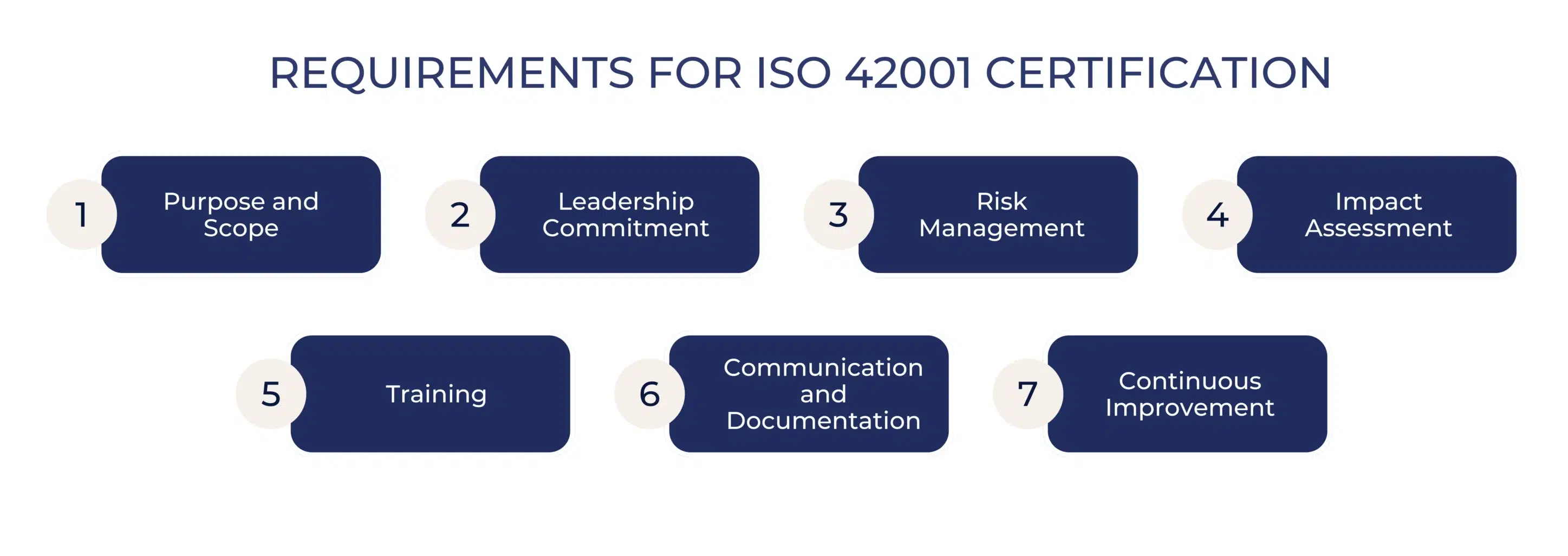
ISO 42001 requires organisations to define and document the internal and external context relevant to their AI activities. This includes identifying interested parties—regulators, clients, employees, affected communities—and understanding their requirements as they relate to AI system development and deployment. Organisations must define the scope of their AIMS, specifying which AI systems, processes, and organisational units fall within the certification boundary. The scope definition is a critical audit artefact, as the ISO 42001 assessment evaluates conformity only within the declared scope.
Leadership requirements under ISO 42001 mandate that top management demonstrate clear accountability for the AIMS. This includes establishing an AI policy appropriate to the organisation’s purpose, providing resources necessary for the AIMS, and ensuring that AI governance responsibilities are assigned and communicated. In Singapore’s corporate governance environment—where board-level accountability for technology risk is increasingly embedded in regulatory expectations—these ISO 42001 leadership requirements align naturally with existing obligations under the Singapore Code of Corporate Governance and MAS risk management guidelines.
ISO 42001 compliance requires organisations to establish and implement a systematic risk assessment process specific to AI systems. This process must identify risks arising from the development, deployment, and use of AI—including risks of model error, algorithmic bias, data quality failures, and unintended consequences of automated decision-making. Identified risks must be evaluated against defined criteria, and risk treatment plans must be documented, implemented, and monitored. The AI-specific risk register produced through this process is a primary audit artefact reviewed during the ISO 42001 audit.
Annex A of ISO/IEC 42001:2023 provides a reference set of AI-specific controls organised into categories covering AI policy, internal organisation, resources for AI systems, assessing AI systems, AI system life cycle, data for AI systems, information for interested parties, and the use of AI systems by the organisation. While Annex A controls are referenced rather than mandatory in the same way as main clause requirements, the ISO 42001 assessment evaluates the organisation’s Statement of Applicability (SoA)—which documents which controls have been selected, implemented, or excluded with documented justification.
ISO 42001 mandates a defined set of documented information as objective evidence of AIMS implementation. Required documentation includes the AIMS scope, AI policy, AI objectives and plans to achieve them, risk assessment and treatment records, Statement of Applicability, internal audit records, management review records, and records of nonconformities and corrective actions. Organisations seeking ISO 42001 Certification in Singapore must ensure that documented information is controlled, maintained, retained for defined periods, and accessible to auditors during the certification assessment.
Performance evaluation under ISO 42001 requires organisations to monitor, measure, analyse, and evaluate their AIMS against defined metrics. This includes conducting internal audits at planned intervals to confirm that the AIMS conforms to the organisation’s own requirements and to ISO/IEC 42001:2023. Management reviews must be conducted to evaluate AIMS performance and drive continual improvement. These performance evaluation activities generate the documented records that a certification body’s ISO 42001 audit team reviews to confirm that the management system is operating effectively—not merely documented on paper.
| ISO 42001 Requirement Area | Key Documentation Required | Relevance to Singapore Context |
|---|---|---|
| Organisational Context (Clause 4) | Scope document, stakeholder analysis, context register | Aligns with MAS technology risk management guidelines |
| Leadership (Clause 5) | AI policy, role assignments, management commitment records | Supports Singapore corporate governance code obligations |
| Risk Management (Clause 6) | AI risk register, risk treatment plan, Statement of Applicability | Addresses PDPA and MAS AIDA guideline risk categories |
| Operation (Clause 8) | AI system lifecycle records, data governance documentation | Covers AI systems processing Singapore resident data |
| Performance Evaluation (Clause 9) | Internal audit records, management review minutes, metrics | Provides audit evidence for third-party ISO 42001 audit |
- ✓Organisational Context and Leadership Requirements
- ✓Risk Management and AI-Specific Control Requirements
- ✓Documentation and Performance Evaluation Requirements
The ISO 42001 Certification Process: Stage-by-Stage Audit Structure
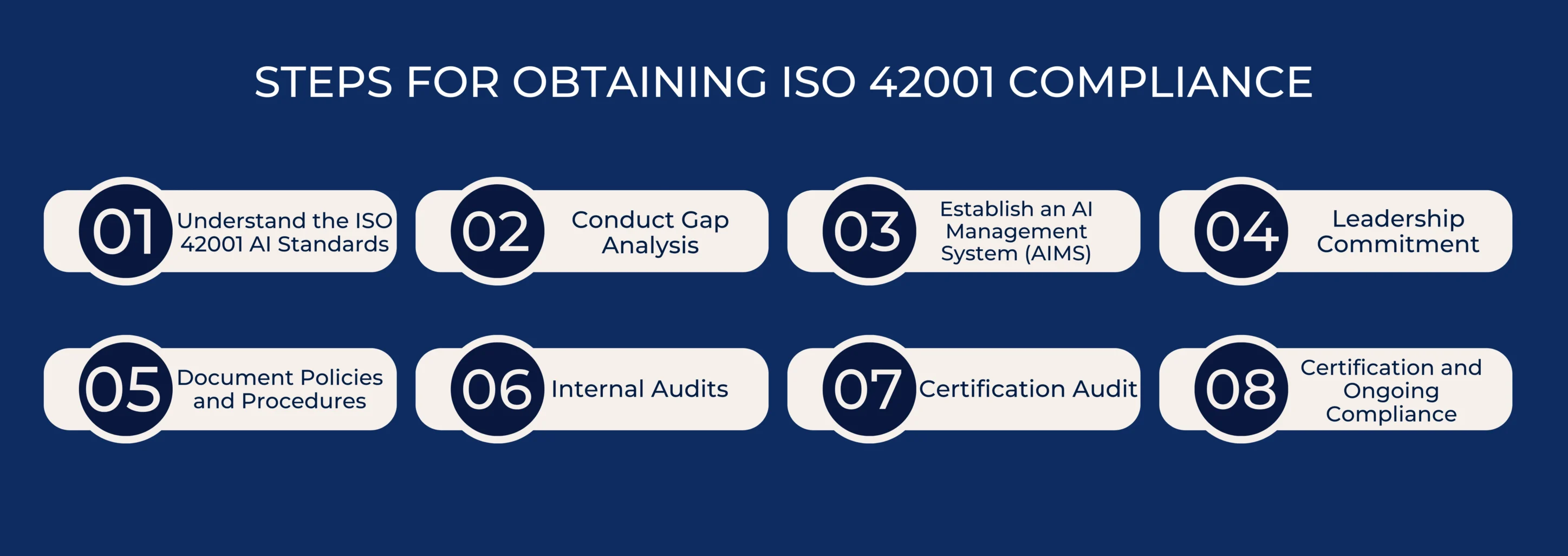
The ISO 42001 certification process begins with defining the certification scope—the precise boundary of AI systems, processes, locations, and organisational units to be covered by the certificate. The scope must be documented with sufficient precision to enable an auditor to determine which AI activities are subject to the AIMS. For multinational organisations with Singapore operations, the scope may encompass only the Singapore entity and its AI systems, or it may extend to regional or global AI operations depending on the organisation’s governance structure and certification objectives.
Following scope definition, the certification body determines the audit programme—including the audit plan, audit team composition, estimated audit duration, and scheduling of Stage 1 and Stage 2 audits. Audit duration is calculated based on the complexity and number of AI systems in scope, the size of the organisation, and the number of sites included. The audit programme is agreed between the organisation and the certification body before Stage 1 activities commence, establishing a clear timeline for the ISO 42001 assessment process.
The Stage 1 ISO 42001 audit focuses on reviewing the organisation’s documented information to confirm that the AIMS has been designed in conformity with ISO/IEC 42001:2023 requirements. The audit team reviews the AIMS scope document, AI policy, risk assessment methodology, Statement of Applicability, and key procedural documents. The objective of Stage 1 is to confirm that the organisation is sufficiently prepared to proceed to Stage 2, and to identify areas where documentation or AIMS design requires strengthening before the Stage 2 assessment commences.
Stage 1 audit findings are documented and communicated to the organisation following the review. Findings may include observations, opportunities for improvement, or areas of concern that must be addressed before Stage 2. The Stage 1 report serves as a formal assessment of AIMS documentation maturity and provides the organisation with documented audit findings to guide readiness for the next stage. The interval between Stage 1 and Stage 2 audits is typically four to twelve weeks, providing the organisation with time to address any significant documentation deficiencies identified.
The Stage 2 ISO 42001 audit evaluates the operational effectiveness of the AIMS by examining objective evidence that documented controls and processes are being implemented as intended. The audit team conducts interviews with personnel responsible for AI system development, deployment, monitoring, and governance; observes operational processes where applicable; and reviews records generated by AIMS activities—including risk treatment records, internal audit reports, management review minutes, nonconformity records, and corrective action documentation. Stage 2 can be conducted on-site or through remote audit methods approved by the certification body.
Nonconformities identified during the Stage 2 ISO 42001 audit are classified as major or minor. A major nonconformity indicates a significant failure to meet a requirement of ISO/IEC 42001:2023, or a situation where the AIMS is not operating effectively. A minor nonconformity indicates an isolated or limited failure. Major nonconformities must be addressed with documented corrective actions and objective evidence of resolution before the certification decision is issued. Minor nonconformities are subject to verification at the next surveillance audit. The audit team submits findings to the certification body’s technical reviewer for an independent certification decision.
The certification decision is made by the certification body following completion of the Stage 2 audit and resolution of any major nonconformities. The ISO 42001 certificate of conformity is issued for a three-year certification cycle, subject to annual surveillance audits conducted at approximately twelve-month intervals. Surveillance audits verify that the AIMS continues to conform to ISO/IEC 42001:2023 requirements and that the organisation is maintaining and improving its AI governance practices. Failure to maintain conformity during the surveillance cycle may result in suspension or withdrawal of the certificate.
Recertification audits are conducted at the end of the three-year certification cycle to renew the certificate for a further three years. The recertification audit evaluates the continued effectiveness of the AIMS, reviews changes to the organisation’s AI systems and context, and assesses the cumulative outcomes of the surveillance audit programme. Organisations that maintain effective AI governance practices throughout the certification cycle typically proceed through recertification without significant disruption—as the AIMS documentation and operational records generated during the cycle provide the objective evidence required for recertification assessment.
- Scope Definition: Document the precise boundary of AI systems, processes, and organisational units to be certified
- Audit Programme Agreement: Confirm audit plan, team composition, duration, and Stage 1/Stage 2 scheduling with certification body
- Stage 1 Audit: Submit documented information for review; receive formal findings on AIMS documentation conformity
- Stage 1 Finding Resolution: Address documentation deficiencies identified in Stage 1 audit report before Stage 2
- Stage 2 Audit: Undergo operational conformity assessment through evidence review, interviews, and process observation
- Nonconformity Resolution: Implement and document corrective actions for major nonconformities with objective evidence
- Certification Decision: Certification body conducts independent technical review and issues certification decision
- Certificate Issuance: Receive ISO 42001 certificate of conformity valid for three-year certification cycle
- Annual Surveillance Audits: Maintain conformity through annual surveillance assessments at approximately twelve-month intervals
- Recertification Audit: Undergo full reassessment at end of three-year cycle to renew certificate
- ✓Scope Definition and Audit Programme Determination
- ✓Stage 1 Audit: Documentation Review and AIMS Maturity Assessment
- ✓Stage 2 Audit: Operational Conformity Assessment and Evidence Evaluation
- ✓Certification Decision, Certificate Issuance, and Surveillance Cycle
Benefits of ISO 42001 Certification for Singapore Organisations
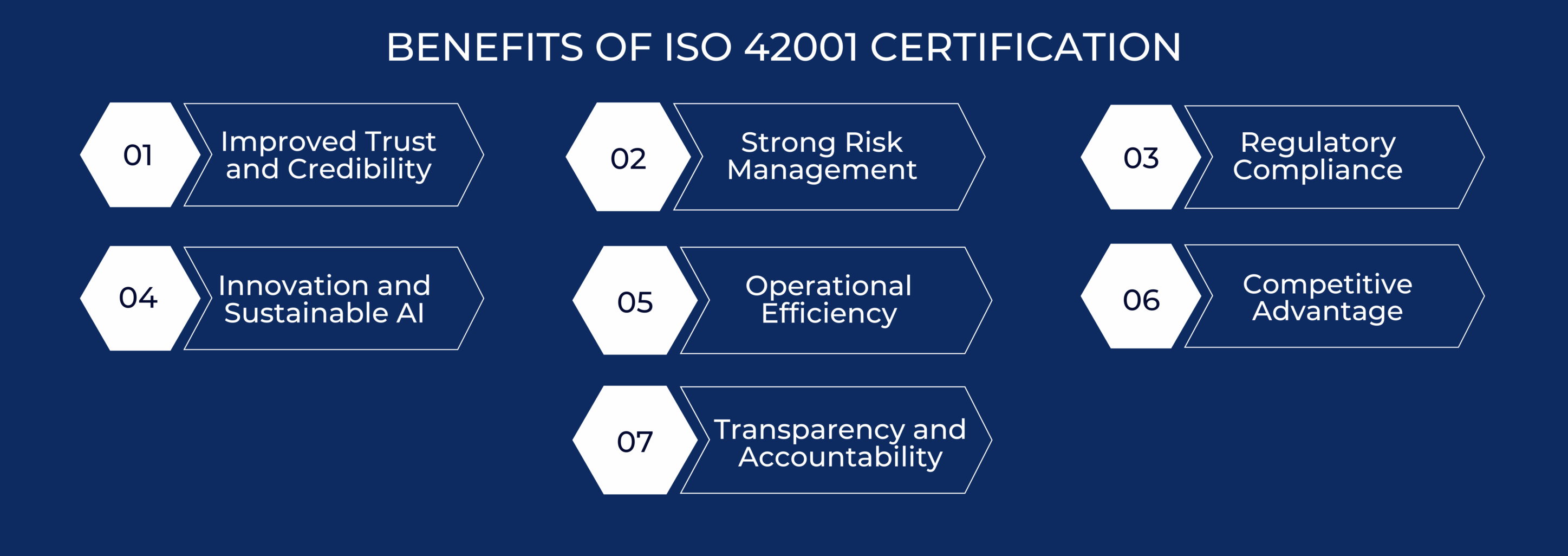
ISO 42001 certification delivers direct regulatory alignment benefits for Singapore organisations operating under existing and emerging AI governance expectations. The structured risk management requirements of ISO/IEC 42001:2023 provide a documented framework that evidences compliance with Singapore’s Model AI Governance Framework principles, MAS AIDA guidelines for financial institutions, and PDPA obligations for AI systems that process personal data. This documented alignment reduces regulatory examination risk by providing auditors and regulators with clear evidence of systematic AI governance, rather than ad hoc or undocumented practices.
For Singapore organisations that export AI-enabled products or services to international markets, ISO 42001 certification provides alignment with the European Union AI Act—which imposes risk-based governance requirements on AI systems deployed in EU markets. The EU AI Act’s requirements for high-risk AI systems, including transparency, human oversight, robustness, and accuracy, correspond closely to ISO 42001 control categories. Certified organisations can leverage their AIMS documentation as evidence of EU AI Act conformity, reducing the compliance burden associated with market access to the European Union from Singapore.
ISO 42001 certification provides independently verified evidence of AI governance maturity that builds trust with customers, business partners, investors, and regulators. Unlike self-declared AI principles or internal ethics policies, the ISO 42001 certificate is issued by an independent third party following a structured audit process—providing external validation that carries evidentiary weight in commercial and regulatory contexts. For Singapore-based AI companies seeking Series B and later-stage investment from institutional venture capital and private equity firms, certification provides an auditable governance artefact that supports due diligence processes.
Customer trust in AI systems is directly influenced by the ability of the deploying organisation to demonstrate systematic governance of AI risks. Singapore consumers and enterprise clients increasingly scrutinise the governance practices of organisations that deploy AI in high-stakes decisions—credit approvals, insurance underwriting, medical screening, and human resources management. ISO 42001 certification provides a recognised and verifiable signal of governance maturity that supports customer confidence in AI-driven products and services, differentiating certified organisations in markets where AI trust is a competitive variable.
Achieving ISO 42001 certification drives improvements in the operational governance of AI systems that yield tangible efficiency benefits. Organisations that implement the AIMS required by ISO/IEC 42001:2023 establish systematic processes for AI system lifecycle management—from requirements definition through development, testing, deployment, monitoring, and decommissioning—that reduce the frequency and severity of AI system failures. Documented AI risk management processes enable earlier identification of model performance degradation, data quality issues, and unintended system behaviours, reducing both remediation cost and the risk of regulatory enforcement.
Organisations that integrate ISO 42001 compliance within an existing management system framework achieve governance efficiency through consolidated policy structures, shared internal audit programmes, and unified management review processes. A Singapore organisation holding certifications for ISO 27001, ISO 9001, and ISO 42001 can conduct integrated internal audits that evaluate conformity across all three standards simultaneously. This reduces the total audit resource requirement compared to operating three separate management systems—a particularly valuable benefit for mid-sized Singapore enterprises managing multiple certification obligations with limited governance resources.
- ✓Regulatory alignment with Singapore’s Model AI Governance Framework and MAS AIDA guidelines
- ✓Demonstrated conformity to PDPA obligations for AI systems processing personal data of Singapore residents
- ✓Independently verified evidence of AI governance maturity for commercial due diligence processes
- ✓Competitive differentiation in government and enterprise procurement requiring certified AI governance
- ✓Market access facilitation for Singapore organisations exporting AI products to EU-regulated markets
- ✓Structured AI risk identification and treatment reducing the frequency of AI system failures and regulatory incidents
- ✓Investor confidence enhancement through auditable AI governance documentation for capital-raising activities
- ✓Integration efficiency for organisations maintaining multiple ISO management system certifications
- ✓Board-level accountability framework aligned with Singapore corporate governance expectations
- ✓Reduced vendor due diligence burden through ISO 42001 certification as a recognised governance credential
- ✓Regulatory Alignment and Risk Reduction
- ✓Stakeholder Trust and Market Credibility
- ✓Operational Efficiency and Governance Integration
ISO 42001 Certification Cost in Singapore
Factors Determining ISO 42001 Certification Cost
ISO 42001 certification cost in Singapore varies based on several structural factors that determine the scope and complexity of the audit programme. The primary cost driver is the number and complexity of AI systems included within the certification scope. An organisation certifying a single AI-enabled product with a contained data pipeline incurs lower audit costs than an organisation certifying a portfolio of ten or more AI systems operating across multiple business functions and data environments. Audit duration—calculated by the certification body based on scope complexity—directly determines the professional fee component of the overall certification cost.
Organisational size is a secondary cost factor. Larger organisations with more employees involved in AI development and deployment require longer audit durations to obtain sufficient coverage of AI governance activities across the workforce. Multi-site organisations where AI operations are distributed across multiple locations in Singapore or across the region incur higher costs reflecting the need for multi-site audit coverage. The maturity of existing management system infrastructure also influences cost indirectly—organisations with established ISO 27001 or ISO 9001 management systems typically require less extensive documentation development before the ISO 42001 assessment, affecting the overall project timeline and investment.
Cost Components and Investment Framework
The total investment associated with ISO 42001 certification in Singapore comprises several distinct cost components. The certification body audit fee covers Stage 1 and Stage 2 audit activities and the certification decision process. Annual surveillance audit fees apply throughout the three-year certification cycle. Internal resource costs—the time invested by the organisation’s AI governance, legal, compliance, risk, and technology teams in documenting the AIMS and supporting audit activities—represent a significant cost component that is often underestimated during initial budget planning for ISO 42001 certification projects.
| Organisation Profile | Estimated Audit Duration | Indicative Certification Cost Range (SGD) |
|---|---|---|
| Small organisation, 1-2 AI systems, single site | 3-5 audit days | SGD 8,000 – SGD 15,000 |
| Mid-sized organisation, 3-6 AI systems, single site | 5-8 audit days | SGD 15,000 – SGD 28,000 |
| Large organisation, 7+ AI systems, multi-function | 8-12 audit days | SGD 28,000 – SGD 50,000 |
| Enterprise, complex AI portfolio, multi-site | 12+ audit days | SGD 50,000+ |
| Annual surveillance audit (all profiles) | 50-70% of initial audit duration | Proportional to initial certification cost |
The indicative cost ranges presented above are illustrative and subject to variation based on specific organisational circumstances. Certification bodies determine audit durations and fees following an initial scope review that considers the precise number of AI systems, employee count, site configuration, and existing management system maturity. Organisations that have maintained ISO 27001 certification and can demonstrate integration of AI risk controls within their existing information security management system may qualify for reduced audit durations. Fixed-price certification packages—where the certification body quotes a defined fee for the full certification cycle—provide organisations with cost certainty for budgeting purposes.
ISO 42001 Assessment: Evaluating AI Management System Conformity
What the ISO 42001 Assessment Evaluates
The ISO 42001 assessment is a systematic, independent evaluation of an organisation’s AI Management System against the normative requirements of ISO/IEC 42001:2023. It evaluates both the design adequacy of the AIMS—whether documented policies, processes, and controls are sufficient to address the organisation’s AI risks—and the operational effectiveness of the AIMS—whether documented controls are consistently implemented and producing the intended governance outcomes. This dual evaluation distinguishes the ISO 42001 assessment from a documentation review exercise; auditors seek objective evidence of real-world implementation, not merely well-written policies.
The ISO 42001 assessment covers all clauses of ISO/IEC 42001:2023 from Clause 4 through Clause 10, as well as the controls selected in the organisation’s Statement of Applicability from Annex A. Auditors evaluate the organisation’s AI system lifecycle management processes, data governance practices, AI risk assessment methodology and records, change management processes for AI model updates, incident management for AI system failures, and continual improvement activities. This comprehensive scope ensures that the resulting certificate reflects genuine conformity rather than selective compliance.
AI-Specific Risk Assessment Evaluation
A distinctive feature of the ISO 42001 assessment is its evaluation of AI-specific risk management activities. Auditors review the organisation’s methodology for identifying risks inherent to AI systems—including algorithmic bias, model drift, data poisoning, adversarial attacks, and unintended automation of discriminatory decisions. The assessment examines whether identified risks have been treated with appropriate controls, whether residual risks have been accepted at appropriate levels of organisational authority, and whether risk treatment effectiveness is monitored through defined metrics and review processes.
For Singapore organisations, the ISO 42001 assessment of AI risk management is particularly relevant to risks arising from the use of AI in regulated activities. Financial institutions assessed for ISO 42001 compliance in Singapore may have their risk management frameworks evaluated in relation to MAS-regulated activities such as credit decisioning, market making, and anti-money laundering screening. Healthcare organisations may have AI diagnostic system risk controls evaluated against the Ministry of Health’s AI governance expectations. The ISO 42001 assessment provides a structured lens through which sector-specific AI risks are systematically evaluated.
Data Governance and AI Lifecycle Assessment
The ISO 42001 assessment includes evaluation of data governance practices specifically related to AI system development and operation. Auditors examine how organisations manage the quality, provenance, and security of training data used to develop AI models; how data pipelines are governed to prevent data corruption or unauthorised modification; and how data retention and deletion practices address the rights of individuals whose data has been used in AI system development. For Singapore organisations subject to PDPA, these data governance controls directly address personal data protection obligations applicable to AI training datasets.
AI system lifecycle management is a key domain within the ISO 42001 assessment. The evaluation covers whether the organisation has defined and implemented processes for requirements definition, design, development, validation, deployment, monitoring, maintenance, and decommissioning of AI systems. Lifecycle management records provide auditors with evidence that AI systems are developed and deployed through controlled processes—reducing the risk of unintended behaviour, security vulnerabilities, and performance degradation. This documentation also demonstrates that the organisation maintains ongoing awareness of the current state and performance of its AI systems throughout their operational life.
ISO 42001 Compliance: Maintaining Ongoing Conformity
Building a Culture of Continual Improvement
ISO 42001 compliance is not a one-time achievement but a sustained operational commitment to continual improvement of the AI Management System. The standard’s Clause 10 requirements obligate certified organisations to use internal audit findings, management review outputs, nonconformity records, and AI system performance metrics to drive systematic enhancement of AIMS effectiveness over time. This continual improvement requirement distinguishes ISO 42001 certification from point-in-time compliance assessments, ensuring that certified organisations maintain governance standards that evolve alongside their AI capabilities and risk environment.
In Singapore’s rapidly evolving AI landscape, continual improvement of AI governance is particularly critical. The pace of AI capability development—including the proliferation of large language models, generative AI systems, and autonomous decision-making applications—means that AI risks evolve continuously. ISO 42001 compliance requires organisations to maintain processes for identifying new and emerging AI risks and updating their risk treatment measures accordingly. Annual surveillance audits provide external verification that this adaptation is occurring systematically, rather than organisations allowing governance practices to fall behind their actual AI capabilities.
Internal Audit Programme Requirements for ISO 42001 Compliance
ISO 42001 compliance requires organisations to maintain an internal audit programme that evaluates AIMS conformity at planned intervals. The programme must cover all AIMS processes and controls over the certification cycle, with audit frequency determined by the risk significance of different AIMS activities. Internal auditors must be selected to ensure objectivity—auditors must not audit their own work. Findings must be documented and reported to relevant management, and corrective actions must be tracked to completion. These internal audit records are reviewed by the certification body’s external auditors during surveillance audits as evidence of ongoing ISO 42001 compliance.
For Singapore organisations where AI governance responsibilities are distributed across technology, legal, compliance, and business teams, the internal audit programme for ISO 42001 compliance requires cross-functional coordination. Internal audits must cover not only technical AI system controls but also organisational governance activities—management commitment, resource allocation, training and awareness, communication with interested parties, and supplier management for AI components procured from third parties. This breadth of coverage ensures that ISO 42001 compliance is assessed holistically rather than narrowly focused on technical AI system performance metrics alone.
Managing AI System Changes Within the AIMS
A critical aspect of maintaining ISO 42001 compliance is the management of changes to AI systems within the scope of certification. Model retraining with new datasets, architectural modifications, changes to inference thresholds or decision rules, integration of new AI components, and changes to the operational environment of existing AI systems all represent changes that must be assessed under the organisation’s AIMS change management process. This process must evaluate whether proposed changes introduce new risks, require updates to risk treatment measures, or affect the validity of existing controls—and must document this evaluation as objective evidence of controlled change.
Significant AI system changes that materially alter the scope or risk profile of certified activities must be notified to the certification body, which may determine that an additional audit activity is required to confirm continued conformity. This notification requirement is particularly relevant for Singapore’s fast-moving AI companies that regularly retrain and redeploy machine learning models. Organisations must maintain change log records that document the nature, rationale, risk assessment outcomes, and approval authorities for all significant AI system changes—providing the audit trail necessary to demonstrate controlled change management to external auditors.
ISO 42001 Audit Singapore: What Organisations Need to Know
Selecting a Certification Body for ISO 42001 Audit Singapore
Organisations seeking ISO 42001 audit Singapore services should select a certification body with demonstrated competence in both management system auditing and artificial intelligence governance. The audit team assigned to an ISO 42001 audit must include personnel with technical competence in AI systems, data science, and software development lifecycle management—not merely generic management system audit qualifications. ISO 42001 audit competence requires auditors capable of evaluating the technical adequacy of AI risk controls, assessing the validity of AI system performance metrics, and interrogating data governance practices at the level of depth appropriate for AI system complexity.
CertPro’s ISO 42001 audit Singapore programme deploys audit teams with combined expertise in management system certification, information security, data governance, and AI system governance. The ISO 42001 audit is conducted under CertPro’s Licensed CPA Firm framework, ensuring that audit findings and certification decisions are grounded in rigorous evidentiary standards consistent with professional attestation requirements. Organisations seeking ISO 42001 Certification in Singapore through CertPro receive a structured audit programme that evaluates conformity comprehensively—without advisory or consulting activities that would compromise auditor independence.
Preparing Objective Evidence for the ISO 42001 Audit
The ISO 42001 audit evaluates objective evidence—documented information, process records, system outputs, and direct observation—rather than assertions or representations. Organisations preparing for an ISO 42001 audit should ensure that required documentation is complete, current, and accurately reflects the AIMS as actually operated. Documentation that describes processes different from actual practices represents a significant conformity risk; auditors routinely identify discrepancies between documented and actual processes through staff interviews and process observation. Accurate, current documentation that faithfully describes implemented processes is the most important preparation for a successful ISO 42001 audit.
Specific objective evidence categories that ISO 42001 audit teams commonly request include: the AIMS scope document and justifications for any exclusions; the AI policy signed by top management; the AI risk register with documented risk assessment outcomes and treatment decisions; the Statement of Applicability with implementation status and justifications for excluded controls; internal audit activity records including audit plans, reports, and corrective action tracking; management review records demonstrating top management engagement with AIMS performance; and records of AI system incidents, nonconformities, and the corrective actions taken in response.
Remote and On-Site ISO 42001 Audit Delivery
ISO 42001 audit Singapore activities can be conducted through on-site audit visits, remote audit sessions using secure videoconferencing and document sharing platforms, or hybrid combinations of both. The appropriateness of remote audit methods depends on the nature of the AI systems in scope and whether remote access to system documentation, operational records, and relevant personnel is technically feasible and practically adequate for the assessment objectives. For Stage 1 documentation reviews, remote audit delivery is generally efficient. For Stage 2 operational assessments of complex AI systems, on-site audit activities may be preferable to enable direct observation of AI system operations and real-time interaction with technical personnel.
ISO 42001 Certification for Singapore Companies: Sector-Specific Considerations
Financial Services and Fintech Organisations
ISO 42001 certification for Singapore companies in the financial services sector addresses the specific AI governance requirements that arise from MAS-regulated activities. Financial institutions deploying AI in credit scoring, fraud detection, algorithmic trading, robo-advisory services, and anti-money laundering screening face regulatory expectations from MAS that require documented governance of AI model risk, data quality, explainability, and human oversight mechanisms. ISO 42001 certification provides a structured framework for meeting these expectations and producing the documented evidence that MAS examinations may require.
Singapore’s fintech ecosystem—encompassing digital banks, payment service providers, insurtech platforms, and wealthtech applications—is particularly active in deploying AI for customer-facing decision-making. The AI systems used in these applications determine credit limits, flag suspicious transactions, price insurance products, and recommend investment portfolios. Errors or biases in these systems carry direct financial, reputational, and regulatory consequences. ISO 42001 certification for Singapore companies in fintech provides the governance infrastructure to manage these AI-specific risks systematically and demonstrably.
Technology Companies and AI Developers
Technology companies and AI developers based in Singapore that build and sell AI-enabled products and services to enterprise clients face increasing demand for ISO 42001 certification as a vendor qualification requirement. Enterprise procurement teams in banking, healthcare, and government assess AI vendors’ governance practices as part of third-party risk management processes. ISO 42001 certification for Singapore companies in the technology sector provides a recognised certification credential that satisfies enterprise procurement requirements efficiently—without requiring bespoke due diligence responses to each client’s AI governance questionnaire.
AI developers that train large machine learning models or large language models using datasets that include personal data of Singapore residents must address PDPA compliance obligations within their AI development processes. ISO 42001 certification encompasses data governance controls that align with PDPA requirements for the lawful collection, use, and protection of personal data in AI training contexts. The AIMS data governance documentation produced for ISO 42001 compliance provides evidence that the organisation manages training data in accordance with applicable privacy law, supporting PDPC compliance positions for AI development activities.
Healthcare, Professional Services, and Critical Infrastructure
Healthcare organisations in Singapore deploying AI-assisted diagnostic tools, clinical decision support systems, and patient management applications face governance requirements from the Ministry of Health and the Health Sciences Authority addressing AI system safety, accuracy, and clinical validation. ISO 42001 certification provides a management system framework for governing these requirements systematically—with documented risk assessments for clinical AI systems, change management controls for AI model updates, and incident management processes for AI system performance failures. The certification supports healthcare organisations in demonstrating to regulatory bodies and clinical governance committees that AI systems are managed with appropriate rigour.
Critical infrastructure operators in Singapore—including energy, water, telecommunications, and transport organisations—are subject to the Computer Misuse Act and sector-specific cybersecurity requirements administered by the Cyber Security Agency of Singapore (CSA). As these organisations adopt AI for predictive maintenance, anomaly detection, and operational optimisation, the AI systems involved become part of the operational technology risk landscape. ISO 42001 certification for Singapore companies in critical infrastructure provides a governance framework that complements existing operational technology security controls, supporting a comprehensive approach to AI risk management in high-consequence environments.
Why Choose CertPro for ISO 42001 Certification in Singapore
Licensed CPA Firm Delivering Independent Audit Services
CertPro is a Licensed CPA Firm delivering independent ISO 42001 certification and audit services in Singapore. Operating under professional standards that mandate auditor independence, evidentiary rigour, and ethical conduct, CertPro is distinguished from certification bodies without professional accounting firm credentials. This institutional positioning provides organisations with assurance that the ISO 42001 audit process is conducted under the highest standards of professional independence and technical competence. CertPro’s certification decisions are made by qualified technical reviewers independent of the audit team, ensuring no conflict of interest influences the certification outcome.
CertPro’s ISO 42001 audit Singapore programme is strictly limited to certification and audit activities. CertPro does not provide consulting, advisory, or implementation services to organisations seeking ISO 42001 certification. This strict separation between audit and advisory activities preserves auditor independence and ensures that CertPro’s certification decisions are based solely on objective evidence of conformity. Organisations that engage CertPro for ISO 42001 Certification in Singapore receive a credible, independent third-party assessment that carries full evidentiary weight in commercial, regulatory, and legal contexts.
Technical Competence in AI Governance Auditing
CertPro’s ISO 42001 audit teams include personnel with technical backgrounds in artificial intelligence, machine learning, data science, information security, and software engineering. This technical depth enables CertPro auditors to evaluate AI risk controls at the level of detail required to assess whether controls are genuinely effective—not merely whether they are documented. Auditors can interrogate AI system architecture documentation, evaluate the adequacy of model validation methodologies, assess data governance controls for training and inference datasets, and identify gaps between documented and actual AI system behaviour through technical evidence review.
CertPro’s auditors maintain current knowledge of Singapore’s AI regulatory landscape, including MAS guidelines, PDPA requirements, Ministry of Health AI governance expectations, and CSA cybersecurity frameworks. This regulatory awareness enables CertPro to conduct ISO 42001 audits that are contextually relevant to Singapore’s specific regulatory environment—producing audit findings and certification outcomes that address the governance challenges most significant to Singapore-based organisations. The combination of technical AI competence and Singapore regulatory expertise positions CertPro as the specialist certification body of choice for ISO 42001 Certification in Singapore.
Structured Audit Process and Transparent Certification Outcomes
CertPro’s ISO 42001 certification programme follows a structured, transparent audit process with clearly defined milestones, documented findings at each stage, and explicit certification decision criteria. Organisations receive detailed Stage 1 audit reports identifying specific conformity and nonconformity findings with reference to ISO/IEC 42001:2023 clause requirements, enabling precise and targeted responses to identified gaps. Stage 2 audit reports provide comprehensive assessment findings covering all audited AIMS activities, with nonconformities clearly classified and root cause analysis requirements specified. This transparency enables organisations to understand the basis for all audit findings and certification decisions.
CertPro provides fixed-price certification packages for ISO 42001 Certification in Singapore, enabling organisations to budget with certainty for the full certification cycle—including Stage 1, Stage 2, and annual surveillance audits. Fixed pricing eliminates the uncertainty associated with time-and-materials audit billing and enables organisations to obtain board approval for certification investment with a defined cost commitment. Organisations can request a formal certification proposal from CertPro based on a documented scope description, receiving a structured quotation that defines audit activities, timelines, and fees for the complete three-year certification cycle.
Secure ISO 42001 Certification in Singapore with CertPro
ISO 42001 Certification in Singapore represents the internationally recognised standard for organisations committed to responsible, auditable AI governance. As artificial intelligence systems become embedded in financial services, healthcare, critical infrastructure, technology products, and public sector applications across Singapore, the demand for independent verification of AI management system conformity continues to grow. CertPro’s ISO 42001 certification programme delivers rigorous, independent audit and certification services that provide organisations with the documented evidence of AI governance maturity required in Singapore’s regulatory, commercial, and procurement environments.
CertPro operates as a Licensed CPA Firm, conducting ISO 42001 certification audits under professional standards that mandate auditor independence, evidentiary rigour, and institutional accountability. The structured audit process—from scope definition through Stage 1 documentation assessment, Stage 2 operational conformity evaluation, nonconformity resolution, certification decision, and ongoing surveillance—delivers a certification outcome that carries recognised international standing. This satisfies the evidentiary requirements of Singapore’s regulatory bodies, enterprise procurement processes, and institutional investors. Organisations seeking to establish AI governance leadership in Singapore’s competitive marketplace should engage CertPro to initiate their ISO 42001 certification programme.
To initiate the ISO 42001 certification process with CertPro in Singapore, organisations should document a preliminary scope description identifying the AI systems, processes, and organisational units proposed for certification. CertPro’s technical team will conduct an initial scope review and provide a formal certification proposal defining audit activities, estimated duration, and fixed-price fees for the complete three-year certification cycle. This proposal gives organisations the cost certainty and process clarity needed to secure internal approval for ISO 42001 certification investment. Contact CertPro today to schedule an initial scope discussion and receive your ISO 42001 Certification in Singapore proposal.
FAQ
▶
What is ISO 42001 and what does ISO AIMS certification mean?
▶
Which organisations in Singapore need ISO 42001 certification?
▶
How long does the ISO 42001 certification process take in Singapore?
▶
What is the difference between ISO 42001 audit and ISO 42001 assessment?
▶
How does ISO 42001 compliance relate to Singapore’s PDPA requirements?
▶
Can ISO 42001 be integrated with existing ISO 27001 or ISO 9001 certification?
▶
What is the ISO 42001 certification cost in Singapore for a small organisation?
▶
How does ISO 42001 relate to the EU AI Act for Singapore organisations?
ISO 42001 CERTIFIED: WHY AI GOVERNANCE CERTIFICATION IS BECOMING A BOARD-LEVEL REQUIREMENT
AI is now an inevitable component of major business activities in the current corporate world. To elaborate, it is now part of product design, custome…

MindSec Launches AI Compliance for Law 25 & ISO 42001
Excerpt from Barchart Article, Published on December 3, 2025 Today, Canadian organizations face increasing pressure to comply with stringent privacy a…

UNDERSTANDING ISO 42001: A GUIDE FOR RESPONSIBLE AI MANAGEMENT SYSTEMS
The invention of artificial intelligence (AI) has changed the operational processes of many industries. However, the rapid growth of technology increa…
Get In Touch
have a question? let us get back to you.