
ISO 27001 Certification in Amsterdam
ISO 27001 Certification in Amsterdam is issued by CertPro CPA LLC, a Licensed CPA Firm operating as an independent third-party certification body. CertPro evaluates organizations against the requirements of ISO/IEC 27001:2022 — the internationally recognized standard for Information Security Management Systems (ISMS) — and issues certification upon confirmed conformance. The ISO 27001 certification audit process encompasses Stage 1 and Stage 2 audits, followed by a structured three-year surveillance and recertification cycle.
OUR CLIENTS










What Is ISO 27001 Certification and Why Does It Matter in Amsterdam?
ISO 27001 Certification in Amsterdam is issued by CertPro CPA LLC, a Licensed CPA Firm operating as an independent third-party certification body. CertPro evaluates organizations against the requirements of ISO/IEC 27001:2022 — the internationally recognized standard for Information Security Management Systems (ISMS) — and issues certification upon confirmed conformance. The ISO 27001 certification audit process encompasses Stage 1 and Stage 2 audits, followed by a structured three-year surveillance and recertification cycle.
ISO 27001 Certification is the globally recognized benchmark for organizations that design, implement, maintain, and continuously improve a documented Information Security Management System. Published jointly by the International Organization for Standardization (ISO) and the International Electrotechnical Commission (IEC), the standard establishes a systematic framework for identifying information security risks, selecting proportionate controls, and demonstrating operational effectiveness to an independent third party.
ISO/IEC 27001:2022 — the current version — introduced a restructured Annex A containing 93 controls organized across four themes: Organizational, People, Physical, and Technological. Organizations certified to the 2013 edition are required to transition to the 2022 standard by October 31, 2025, as mandated by accredited certification bodies internationally.
Amsterdam occupies a structurally significant position in the European technology and financial landscape. The city hosts one of the densest concentrations of SaaS providers, cloud infrastructure operators, fintech firms, AI companies, data centers, and multinational headquarters in continental Europe. The Amsterdam Metropolitan Area is home to major financial institutions, leading life sciences organizations, telecommunications providers, and a rapidly expanding cybersecurity sector.
This concentration of data-intensive industries — many of which process sensitive personal data at scale under GDPR jurisdiction — creates a clear institutional requirement for ISO 27001 compliance across Amsterdam and the broader Dutch market.
The regulatory environment reinforces this demand. The EU General Data Protection Regulation (GDPR), the Dutch GDPR Implementation Act (Uitvoeringswet AVG), the NIS2 Directive, and the Digital Operational Resilience Act (DORA) collectively impose stringent information security obligations on organizations operating in the Netherlands and across the European Union.
ISO 27001 compliance provides a structured, auditable framework that organizations can reference when demonstrating alignment with these regulatory requirements. While ISO 27001 certification does not automatically establish legal compliance with any specific regulation, it provides documented evidence of systematic information security governance that regulators and institutional counterparties routinely recognize as a credibility indicator.
ISO 27001 Certification in Amsterdam serves as a formal attestation that an organization’s ISMS has been independently evaluated and found to conform to the requirements of ISO/IEC 27001:2022. For organizations operating in Amsterdam’s competitive B2B environment — where enterprise procurement, public sector contracting, and financial services partnerships routinely require third-party security attestations — ISMS certification functions as a foundational trust credential.
It enables organizations to respond to vendor security questionnaires with documented audit evidence, satisfy contractual security requirements from institutional clients, and demonstrate ongoing commitment to information security governance through annual surveillance audits. The three-year certification cycle, anchored by regular independent review, ensures that ISMS certification in Amsterdam reflects current operational practice rather than a point-in-time snapshot.

ENQUIRE NOW
Related Resources
Related Services in Amsterdam
ISO/IEC 27001:2022 Standard: Scope, Structure, and ISMS Requirements
ISO/IEC 27001:2022 defines the requirements for establishing, implementing, maintaining, and continually improving an Information Security Management System within the context of an organization. The standard applies to all organization types — regardless of size, sector, or geographic location — and is designed to scale from small technology firms to large multinational enterprises.
The ISMS scope is defined by the organization and must address the boundaries and applicability of the management system, including interfaces and dependencies with activities performed by external parties.
An Information Security Management System (ISMS) is a documented management framework that enables an organization to systematically manage information security risks. The ISMS encompasses policies, procedures, processes, organizational structures, and technical and physical controls.
Under ISO/IEC 27001:2022, the ISMS must address six core requirement clauses beyond scope and normative references: organizational context (Clause 4), leadership (Clause 5), planning (Clause 6), support (Clause 7), operation (Clause 8), and performance evaluation (Clause 9), alongside continual improvement (Clause 10). Each clause establishes specific requirements that auditors evaluate during the ISO 27001 certification audit to determine whether the ISMS is designed effectively and operating as intended.
The ISMS must be proportionate to the organization’s context — including its internal and external issues, the needs of interested parties such as clients, regulators, and supply chain partners, and the nature of information assets processed. For Amsterdam-based organizations handling financial data, health records, or personal data subject to GDPR, the ISMS scope definition is a critical audit consideration.
Auditors assess whether the defined scope accurately reflects the organization’s information processing activities and whether exclusions are appropriately justified. A precisely scoped ISMS supports more focused control selection and a more efficient ISO 27001 certification audit in Amsterdam.
Annex A of ISO/IEC 27001:2022 provides a reference set of 93 information security controls organized across four control themes. Organizational controls (37 controls) address policies, roles, responsibilities, and supply chain security. People controls (8 controls) cover screening, terms of employment, awareness, training, and disciplinary processes. Physical controls (14 controls) address physical security perimeters, equipment security, and clear desk and screen policies. Technological controls (34 controls) encompass access control, cryptography, malware protection, vulnerability management, network security, and security monitoring.
Organizations are not required to implement all 93 controls. Instead, the risk assessment process determines which controls are applicable and proportionate to identified risks.
Five new controls were introduced in the 2022 revision: threat intelligence (5.7), information security for use of cloud services (5.23), ICT readiness for business continuity (5.30), physical security monitoring (7.4), and data masking (8.11), alongside web filtering (8.23) and secure coding (8.28). These additions reflect the evolution of information security risks since the 2013 edition, directly addressing cloud adoption, supply chain risk, and threat intelligence practices relevant to Amsterdam’s technology and financial services sectors.
During the ISO 27001 audit, auditors assess the completeness and accuracy of control selection as documented in the Statement of Applicability and the operational effectiveness of implemented controls.
ISO/IEC 27001:2022 requires organizations to define and apply an information security risk assessment process that identifies risks associated with the loss of confidentiality, integrity, and availability of information within the ISMS scope. The risk assessment must produce consistent, valid, and comparable results and must be fully documented. Risk owners must be identified, and risks must be analyzed and evaluated against defined criteria for risk acceptance.
The output of the risk assessment directly informs the risk treatment plan, which documents how the organization intends to address each identified risk — through control implementation, risk transfer, risk avoidance, or risk acceptance.
The risk treatment process establishes the direct relationship between identified risks and the Annex A controls selected to address them. Each treatment decision must be justified and documented. Residual risks — those remaining after treatment — must be assessed and accepted by risk owners.
This documented chain from risk identification through treatment to control selection forms the evidentiary foundation that auditors review during the ISO 27001 certification audit in Amsterdam. Auditors evaluate not only whether a risk assessment was performed, but whether it was systematic, whether results are traceable, and whether the treatment plan reflects proportionate control selection for the organization’s specific risk profile.
- ✓Information Security Management System (ISMS): Definition and Structure
- ✓Annex A Controls: Purpose, Structure, and Applicability
- ✓Risk Assessment and Risk Treatment Under ISO 27001
Statement of Applicability: Definition, Role, and Audit Relevance
The Statement of Applicability (SoA) is a mandatory document under ISO/IEC 27001:2022 that records every Annex A control, specifies whether each control is applicable or excluded, provides justification for each inclusion or exclusion, and documents the implementation status of each applicable control. The SoA is not merely a checklist — it functions as the authoritative linkage document between the risk assessment, the risk treatment plan, and the operational controls the organization has implemented. It is one of the primary documents reviewed during every ISO 27001 certification audit.
SoA Documentation Requirements
A complete and audit-ready SoA must address all 93 controls defined in Annex A of ISO/IEC 27001:2022. For each control, the SoA must state the justification for inclusion — typically referencing specific risk treatment decisions, legal or regulatory obligations, or contractual requirements — or the justification for exclusion, demonstrating that the excluded control is not applicable to the defined ISMS scope.
For controls that are applicable, the SoA must document whether the control is fully implemented, partially implemented, or planned for implementation, along with references to the relevant policy, procedure, or technical evidence.
During the Stage 1 audit, auditors review the SoA for completeness, logical consistency with the risk treatment plan, and appropriate justification of exclusions. During the Stage 2 audit, auditors sample controls referenced in the SoA and verify that implementation evidence corresponds to the documented status. A SoA that claims full implementation of a control but lacks corresponding operational evidence will result in a nonconformity finding.
For Amsterdam-based organizations in regulated sectors such as financial services, healthcare, or cloud infrastructure, auditors pay particular attention to controls addressing data classification, access management, cryptography, and third-party security — areas with direct relevance to GDPR, NIS2, and DORA obligations.
Management Review and Continual Improvement
ISO/IEC 27001:2022 requires top management to review the ISMS at planned intervals to ensure its continuing suitability, adequacy, and effectiveness. Management review inputs must include the status of actions from previous reviews, changes in external and internal issues relevant to the ISMS, feedback on information security performance — including trends in nonconformities, corrective actions, monitoring results, and audit outcomes — and opportunities for continual improvement.
Documented outputs must record decisions and actions related to continual improvement and any changes to the ISMS. Auditors verify the existence, completeness, and follow-through of management review records during every ISO 27001 audit cycle.
ISO 27001 Certification Audit Process in Amsterdam
The ISO 27001 certification audit process follows a defined sequence of stages, from initial application through certification issuance and ongoing surveillance. CertPro conducts ISO 27001 certification audits for organizations in Amsterdam and across the Netherlands under a structured, evidence-based methodology aligned with ISO/IEC 27001:2022 requirements. Each stage is governed by formal audit procedures, documented findings, and defined decision criteria.
The Stage 1 audit is a documentation and design review conducted to evaluate whether the organization’s ISMS is sufficiently developed and ready for Stage 2 evaluation. During the Stage 1 audit, auditors examine the ISMS scope definition, information security policy, risk assessment methodology and outputs, risk treatment plan, Statement of Applicability, and key supporting documentation — including procedures, roles and responsibilities, and internal audit records. The Stage 1 audit also assesses the organization’s understanding of the standard’s requirements and the maturity of ISMS implementation relative to the defined scope.
The output of the Stage 1 audit is a formal report identifying areas where the ISMS documentation and design meet the requirements of ISO/IEC 27001:2022, alongside any areas of concern or identified weaknesses that must be addressed before Stage 2 can proceed. Stage 1 findings are classified as major nonconformities, minor nonconformities, or observations.
Major nonconformities identified at Stage 1 must be resolved before the Stage 2 ISO 27001 certification audit in Amsterdam can be scheduled. The interval between Stage 1 and Stage 2 is typically a minimum of four weeks, allowing the organization time to address identified issues — though this timeline varies based on the nature and scope of findings.
The Stage 2 audit evaluates the operational effectiveness of the ISMS — that is, whether the controls and processes documented in the ISMS are functioning as intended in practice. Auditors conduct interviews with personnel at various levels of the organization, review operational records and logs, and test the implementation of specific controls across the ISMS scope.
Control testing during Stage 2 is risk-based and evidence-driven. Auditors select samples from areas of higher risk or complexity, including access management, incident response, vulnerability management, business continuity, and supplier security management.
Nonconformities identified during Stage 2 are classified as major or minor. A major nonconformity — such as a complete absence of an implemented control claimed as applicable in the SoA, or a systemic failure of the risk assessment process — will prevent certification issuance until a corrective action plan is submitted and verified. Minor nonconformities must be closed within a defined timeframe, typically within 90 days of the audit.
Upon satisfactory resolution of all nonconformities, the ISO 27001 audit findings are reviewed by the certification decision authority and the ISO 27001 certification is issued. The certification is valid for three years from the date of issue, subject to successful annual surveillance audits.
Surveillance audits are conducted annually throughout the three-year certification cycle to verify that the ISMS continues to conform to ISO/IEC 27001:2022 requirements and remains operationally effective. Surveillance audits are substantive evaluations — not administrative reviews. Auditors assess areas identified for follow-up from previous audits, changes to the organization or its ISMS since the last audit, internal audit results, management review outputs, and the status of corrective actions. Surveillance audits confirm that the ISMS is subject to continual improvement and that the organization is actively managing its information security risks.
Recertification audits are conducted at the end of the three-year certification cycle and encompass a comprehensive review of the entire ISMS, comparable in scope to the original Stage 2 audit. A successful recertification audit results in the issuance of a new three-year ISO 27001 certification.
Failure to maintain surveillance audit schedules, or failure to address findings from surveillance audits within defined timeframes, may result in suspension or withdrawal of certification. For Amsterdam organizations in regulated sectors — particularly those operating under NIS2 or DORA obligations — maintaining uninterrupted ISMS certification status is both a commercial and regulatory priority.
| Audit Stage | Primary Focus | Typical Duration | Outcome |
|---|---|---|---|
| Stage 1 Audit | ISMS documentation and design review | 1–2 days | Readiness report; Stage 2 scheduling decision |
| Stage 2 Audit | Operational effectiveness of ISMS controls | 2–5 days | Nonconformity findings; ISO 27001 certification decision |
| Surveillance Audit (Year 1 & 2) | Ongoing ISMS conformance and continual improvement | 1–2 days | Conformance confirmation or corrective action required |
| Recertification Audit (Year 3) | Full ISMS re-evaluation | 2–4 days | Issuance of new 3-year ISO 27001 certification |
- ✓Stage 1 Audit: Documentation and Design Review
- ✓Stage 2 Audit: Operational Effectiveness Evaluation
- ✓Surveillance Audits and Recertification
Requirements for ISO 27001 Certification in Amsterdam
To achieve ISO 27001 Certification in Amsterdam, organizations must satisfy the mandatory requirements specified in Clauses 4 through 10 of ISO/IEC 27001:2022. These requirements apply irrespective of organization size, sector, or ISMS scope. The following constitute the core documentation and operational requirements that auditors evaluate during the ISO 27001 certification audit.
- ✓Defined ISMS scope document specifying boundaries, applicability, and exclusion justifications
- ✓Information security policy approved and communicated by top management
- ✓Documented risk assessment process, methodology, and outputs including identified risks and risk owners
- ✓Risk treatment plan linking identified risks to selected Annex A controls and residual risk acceptance decisions
- ✓Statement of Applicability (SoA) covering all 93 Annex A controls with inclusion/exclusion justifications and implementation status
- ✓Information security objectives and documented plans for achieving them
- ✓Evidence of internal ISMS audits conducted at planned intervals with documented findings
- ✓Management review records demonstrating top management engagement with ISMS performance and improvement
Beyond documentation, the ISO 27001 certification audit evaluates whether the ISMS is operationally embedded within the organization. Key operational requirements include demonstrated risk assessment execution using the documented methodology, evidence of risk treatment plan implementation (controls are implemented, not merely planned), operational records confirming that monitoring, measurement, and logging activities are being performed, and records of nonconformities and corrective actions. Internal audit programs must demonstrate independence from the areas being audited and must produce actionable findings reviewed by management.
Personnel with information security responsibilities must demonstrate awareness of the information security policy, their contribution to ISMS effectiveness, and the implications of not conforming to ISMS requirements. Supplier and third-party management controls are subject to particular scrutiny for Amsterdam-based organizations with complex supply chains or cloud-dependent operations.
Auditors assess supplier agreements, security requirements communicated to suppliers, and evidence that supplier performance is monitored against agreed security criteria. Organizations operating across multiple sites or in hybrid cloud environments must demonstrate that the ISMS applies consistently across all in-scope systems and locations.
- ✓Documentation Requirements
- ✓Operational Requirements
Steps for Obtaining ISO 27001 Certification in Amsterdam
The process for obtaining ISO 27001 Certification in Amsterdam follows a defined sequence of activities. The following steps represent the standard pathway from ISMS development through certification issuance under ISO/IEC 27001:2022.
- Define the ISMS scope: Identify the organizational boundaries, information assets, and business processes within the certification perimeter, including interfaces with external parties and any justified exclusions.
- Conduct information security risk assessment: Apply the documented risk assessment methodology to identify information security risks, analyze their likelihood and impact, and evaluate them against defined acceptance criteria.
- Develop the risk treatment plan: Select Annex A controls and other measures to address identified risks; document risk owner acceptance of residual risks.
- Prepare the Statement of Applicability: Document all 93 Annex A controls, justify inclusions and exclusions, and record implementation status for each applicable control.
- Implement ISMS controls and processes: Establish policies, procedures, technical controls, and organizational measures consistent with the risk treatment plan and SoA.
- Conduct internal ISMS audit: Execute an independent internal audit of the ISMS to identify nonconformities and opportunities for improvement before the certification audit.
- Conduct management review: Obtain formal top management review of ISMS performance, internal audit results, and improvement decisions.
- Schedule and complete Stage 1 audit: Engage CertPro to conduct the documentation and design review; address any identified nonconformities or concerns.
- Complete Stage 2 certification audit: Undergo the operational effectiveness evaluation; resolve any nonconformities identified within the required timeframe.
- Receive ISO 27001 certification: Upon certification decision approval, receive the formal ISO 27001 certificate valid for three years, subject to annual surveillance audits.
Benefits of ISO 27001 Certification for Amsterdam-Based Organizations
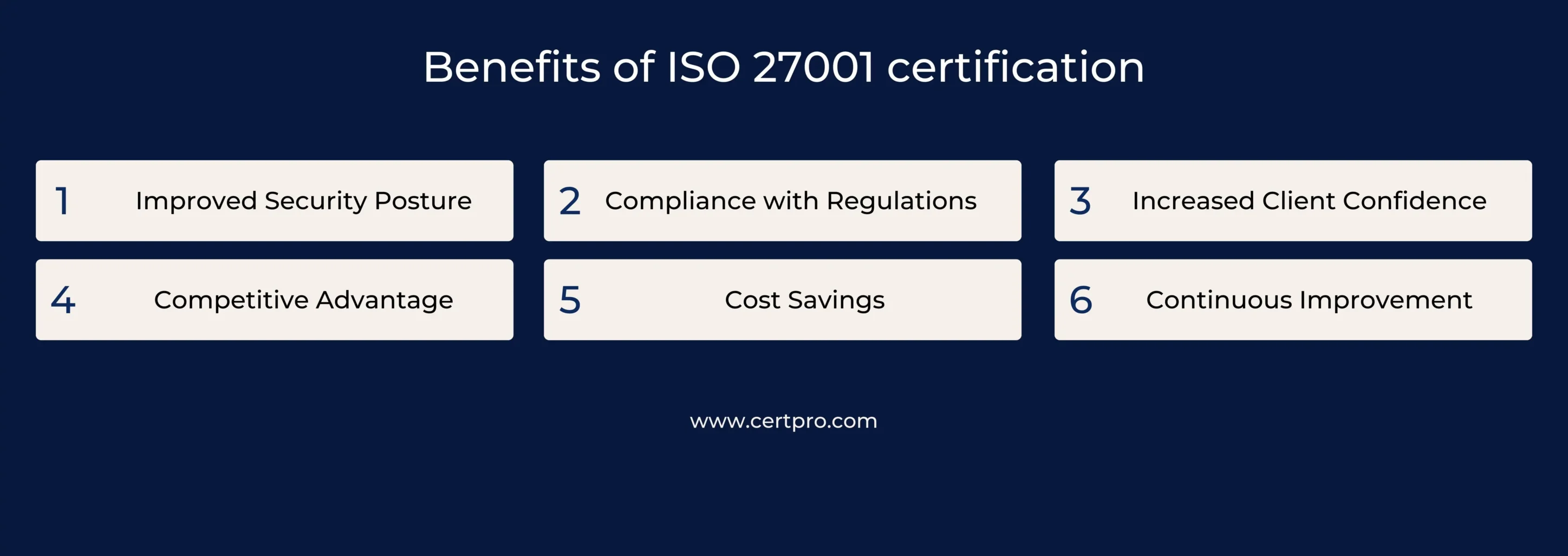
ISO 27001 Certification in Amsterdam delivers measurable institutional, commercial, and operational benefits for organizations across all sectors. The following benefits reflect the direct outcomes of achieving and maintaining ISMS certification under ISO/IEC 27001:2022.
Third-party ISO 27001 certification provides independent attestation of an organization’s information security governance to clients, regulators, investors, and supply chain partners. For Amsterdam-based SaaS providers, fintech firms, cloud infrastructure operators, and multinational enterprises, ISMS certification in Amsterdam is increasingly a prerequisite for enterprise procurement processes, public sector contracting, and cross-border commercial partnerships within the EU and internationally.
Certified organizations can reference their certification status in vendor security questionnaires and RFP responses with documented audit evidence — reducing the administrative burden associated with bespoke security assessments from prospective clients.
ISO 27001 certification also strengthens an organization’s position in markets beyond the Netherlands. The standard’s international recognition means that ISO 27001 Certification in Amsterdam is accepted as a credible security attestation by enterprise clients in the United States, the United Kingdom, the broader European Union, and Asia-Pacific markets.
For Amsterdam-based technology exporters and cloud service providers targeting international enterprise clients, ISMS certification reduces the friction associated with cross-border security due diligence and enables faster enterprise sales cycles.
ISO 27001 compliance provides a structured mechanism for mapping legal and regulatory requirements — including GDPR Article 32 technical and organizational measures, NIS2 security obligations, and DORA ICT risk management requirements — to documented and audited controls. While certification does not constitute legal compliance with any specific regulation, the documented control framework and audit trail produced by the ISMS provide substantive evidence of systematic security governance that regulators and supervisory authorities recognize.
Organizations in Amsterdam’s financial services sector operating under Dutch Central Bank (DNB) supervision increasingly reference ISO 27001 certification as part of their ICT risk management documentation.
- ✓Documented risk assessment and treatment process demonstrating systematic identification and management of information security risks
- ✓Audit-verified control implementation providing evidence of technical and organizational security measures under GDPR Article 32
- ✓Supply chain security controls (Annex A 5.19–5.22) directly addressing NIS2 supply chain risk management obligations
- ✓Business continuity and ICT resilience controls (Annex A 5.30) supporting DORA operational resilience requirements
- ✓Annual surveillance audits providing ongoing verification of ISMS effectiveness to regulators and institutional counterparties
- ✓Incident management procedures (Annex A 5.24–5.28) establishing documented processes for security event detection, response, and notification
- ✓Institutional Trust and Commercial Credibility
- ✓Regulatory Alignment and Risk Reduction
ISO 27001 Certification for Amsterdam’s Key Industry Sectors
ISO 27001 certification for Amsterdam companies spans a broad range of sectors, reflecting the city’s diverse and data-intensive economic base. The following sector profiles identify the primary drivers of ISO 27001 certification demand and the specific ISMS focus areas relevant to each industry.
Financial Services, Fintech, and Insurance
Fintech and financial services organizations pursuing ISO 27001 Certification in Amsterdam do so to satisfy regulatory expectations, institutional client requirements, and cross-border partnership obligations. Amsterdam hosts a significant concentration of payment processors, digital banking platforms, insurance technology providers, and asset management firms operating under the supervision of the Dutch Central Bank (DNB) and the Authority for the Financial Markets (AFM).
ISO 27001 compliance in financial services helps organizations evidence systematic ICT risk management under DORA, which requires financial entities to maintain comprehensive ICT risk management frameworks with documented policies, procedures, and independent audit evidence.
The ISO 27001 certification audit for financial services organizations in Amsterdam focuses particularly on access control (Annex A 8.2–8.6), cryptographic key management (Annex A 8.24), security logging and monitoring (Annex A 8.15–8.16), and incident management (Annex A 5.24–5.28). Business continuity management (Annex A 5.29–5.30) is also a high-priority audit area, given DORA’s specific requirements for ICT continuity and recovery.
Organizations subject to both DORA and GDPR benefit from the ISMS’s ability to consolidate compliance-relevant controls into a single, auditable framework.
SaaS, Cloud, AI, and Technology Companies
Amsterdam’s technology ecosystem is anchored by SaaS providers, cloud infrastructure operators, artificial intelligence companies, and cybersecurity firms. For SaaS and cloud service providers, ISO 27001 certification functions as the primary third-party security attestation demanded by enterprise clients during procurement. The 2022 revision of Annex A specifically added cloud service security (control 5.23), directly addressing the risk management requirements for organizations whose ISMS scope includes cloud-based infrastructure or cloud-delivered services.
ISO 27001 compliance for Amsterdam cloud providers demonstrates to enterprise clients that information security risks associated with cloud service usage are systematically identified, treated, and monitored.
AI companies operating in Amsterdam face increasing regulatory scrutiny under the EU AI Act and evolving data protection requirements related to training data, model security, and algorithmic transparency. ISO 27001 ISMS certification provides a documented governance framework that addresses information asset classification, data access controls, and secure development practices relevant to AI system development and deployment.
Cybersecurity firms pursuing ISO 27001 certification in Amsterdam demonstrate that their own security posture meets the same rigorous standards they recommend to clients — a significant factor in institutional credibility within the sector.
Healthcare, Life Sciences, Data Centers, and Telecommunications
Healthcare and life sciences organizations in Amsterdam process sensitive personal health data subject to both GDPR and sector-specific regulations. ISO 27001 certification provides a structured control framework addressing data classification, access management, medical device security, and research data protection. The Netherlands’ leading position in genomics, pharmaceutical research, and digital health creates specific ISMS scope considerations related to high-sensitivity data assets and stringent international data transfer requirements.
Auditors evaluate whether the ISMS adequately addresses the sensitivity of health data throughout its lifecycle — from collection and processing through storage and disposal.
Data centers and telecommunications providers operating in the Amsterdam Metropolitan Area — one of Europe’s largest data center hubs, anchored by the Amsterdam Internet Exchange (AMS-IX) — face specific physical security, network security, and operational resilience requirements. ISO 27001 certification for these organizations encompasses Annex A physical controls (7.1–7.14), network security management (8.20–8.22), and capacity management (8.6) as high-priority audit areas.
Gaming companies and e-commerce platforms processing large volumes of personal data and financial transactions similarly benefit from ISMS certification as a structured mechanism for managing information security risks at scale.
ISO 27001 Compliance and the Amsterdam Regulatory Environment
ISO 27001 compliance for Amsterdam organizations operates within a complex, multilayered regulatory environment. Understanding the relationships between ISO 27001 and applicable Dutch and European regulations is essential for organizations establishing ISMS scope and control selection priorities.
GDPR, Dutch Data Protection, and ISO 27001
The EU General Data Protection Regulation (GDPR) requires organizations processing personal data to implement appropriate technical and organizational measures to ensure a level of security appropriate to the risk (Article 32). The Dutch GDPR Implementation Act (Uitvoeringswet AVG) transposes GDPR into Dutch national law and is enforced by the Dutch Data Protection Authority (Autoriteit Persoonsgegevens).
ISO 27001 compliance provides a documented, auditable framework for implementing and evidencing the Article 32 technical and organizational measures. Specific Annex A controls address pseudonymization (8.11), data masking (8.11), encryption (8.24), access control (8.2–8.6), and incident notification (5.26) — directly mapping to GDPR security and breach notification requirements.
ISO 27001 certification does not constitute GDPR compliance, and organizations must address GDPR obligations beyond information security — including lawful basis for processing, data subject rights, and data protection impact assessments — through dedicated data protection governance. However, the ISMS provides the technical security infrastructure that underpins data protection compliance, and ISO 27001 audit evidence can be referenced in response to regulatory inquiries or data protection authority investigations.
For Amsterdam organizations processing personal data at scale, the intersection of ISO 27001 compliance and GDPR obligations makes ISMS certification a foundational element of the overall compliance framework.
NIS2 Directive and DORA: ISO 27001 as a Supporting Framework
The NIS2 Directive — transposed into Dutch national law — imposes cybersecurity risk management and incident reporting obligations on essential and important entities across sixteen critical sectors, including energy, transport, banking, financial market infrastructure, health, digital infrastructure, and ICT service management. Organizations subject to NIS2 are required to implement technical, operational, and organizational measures to manage cybersecurity risks and to report significant incidents to the competent national authority.
ISO 27001 certification provides a structured audit trail demonstrating that systematic cybersecurity risk management is implemented and operationally effective — directly relevant to NIS2 compliance documentation.
The Digital Operational Resilience Act (DORA) applies to financial entities operating in the EU and introduces mandatory ICT risk management, incident reporting, digital operational resilience testing, and third-party ICT risk management requirements. DORA shares substantial conceptual overlap with ISO/IEC 27001:2022, particularly in the areas of ICT risk identification and assessment, ICT business continuity management, ICT third-party risk management, and information security incident management.
Amsterdam-based financial institutions, payment institutions, investment firms, and insurance undertakings subject to DORA can leverage ISO 27001 audit evidence as a component of their DORA compliance documentation, while recognizing that DORA requirements extend beyond what ISMS certification alone addresses.
Why CertPro for ISO 27001 Certification in Amsterdam
CertPro CPA LLC conducts ISO 27001 certification audits for organizations in Amsterdam, across the Netherlands, and internationally as a Licensed CPA Firm operating as an independent third-party certification body. CertPro’s ISO 27001 audit methodology is structured around ISO/IEC 27001:2022 requirements and applies consistent, evidence-based evaluation criteria across all certification engagements. The following characteristics define CertPro’s approach to ISO 27001 audit engagements in Amsterdam.
Independent Certification Body with Licensed CPA Firm Status
CertPro operates as a Licensed CPA Firm, providing ISO 27001 certification audits under the professional standards and independence requirements applicable to CPA-licensed audit and attestation engagements. This institutional positioning distinguishes CertPro from non-CPA certification bodies and reinforces the credibility of issued certifications for clients in regulated industries, financial services, and public sector procurement — where auditor independence and professional licensure are carefully evaluated.
ISO 27001 certification issued by CertPro reflects an independent third-party determination of ISMS conformance — not a self-assessment or advisory engagement outcome.
CertPro’s ISO 27001 certification audits serve organizations across Amsterdam’s key sectors, including SaaS providers, cloud service companies, fintech and financial services firms, healthcare and life sciences organizations, data centers, telecommunications providers, AI companies, e-commerce platforms, gaming companies, and multinational enterprises. ISO 27001 certification engagements encompass the full certification lifecycle — from Stage 1 and Stage 2 audits through annual surveillance audits and three-year recertification. Organizations across the Netherlands, the European Union, the United States, and international markets are served by CertPro’s certification practice.
Structured Audit Methodology and Sector-Specific Expertise
CertPro’s ISO 27001 certification audit methodology applies a structured, risk-based approach to control sampling and evidence evaluation. Audit programs are tailored to the organization’s ISMS scope, sector, and risk profile — ensuring that the ISO 27001 certification audit in Amsterdam is proportionate and focused on the areas of highest information security risk. Auditors with sector-specific knowledge in financial services, healthcare, cloud infrastructure, and technology evaluate the operational effectiveness of controls against the specific risks relevant to the organization’s operating environment, including the Amsterdam regulatory context.
FAQ
▶
What are the benefits of pursuing ISO 27001 Certification in Amsterdam? The benefits are substantial. Here’s how it helps your business:
▶
What is ISO 27001 certification and why does it matter for organizations in Amsterdam?
▶
What are the ISMS requirements under ISO/IEC 27001:2022?
▶
What is the Statement of Applicability and how is it used in audits?
▶
What happens during Stage 1 and Stage 2 ISO 27001 audits?
▶
How long is ISO 27001 certification valid?
▶
What are surveillance audits and when do they occur?
▶
How does ISO 27001 relate to GDPR, NIS2, and DORA?
Get In Touch
have a question? let us get back to you.