
ISO 27001 Certification in Hamburg
Executive Summary: ISO 27001 Certification in Hamburg is conducted by CertPro, a Licensed CPA Firm delivering independent, third-party certification audits against the ISO/IEC 27001:2022 standard. CertPro evaluates Information Security Management Systems (ISMS) across Hamburg-based organizations in logistics, maritime trade, aviation, manufacturing, SaaS, and cloud services. Certification decisions are issued based on objective, evidence-based audit methodology — ensuring each ISO 27001 audit meets the highest standards of independence and rigor.
OUR CLIENTS










ISO 27001 Certification for Hamburg-Based Financial and Technology Organizations
ISO 27001 Certification in Hamburg is conducted by CertPro, a Licensed CPA Firm operating as an independent third-party certification body. CertPro evaluates the design, implementation, and operating effectiveness of Information Security Management Systems (ISMS) in accordance with the ISO/IEC 27001:2022 standard. The ISO 27001 certification process is strictly audit-based: CertPro does not provide consulting, advisory, or implementation services of any kind. Organizations that engage CertPro receive an objective certification decision grounded in structured audit methodology and evidence-based evaluation — making every ISO 27001 assessment fully independent and credible.
Hamburg stands as one of Germany’s most economically significant cities, home to Europe’s third-largest seaport, a global aviation and aerospace industry cluster, extensive manufacturing operations, and a rapidly expanding digital and technology sector. The city’s economy is deeply internationalized, with thousands of organizations engaged in cross-border logistics, multinational supply chain management, financial services, and cloud-based software delivery. These operational characteristics generate substantial information security obligations — both regulatory and contractual — that increasingly require independent ISMS certification from a recognized third-party body.
Demand for ISO 27001 certification among Hamburg-based organizations reflects growing expectations from enterprise customers, financial sector procurement teams, and European regulatory authorities. Organizations seeking to demonstrate information security governance to global trading partners, insurance underwriters, or public sector clients are routinely required to present a valid ISO 27001 certificate issued by an independent certification authority. CertPro’s position as a Licensed CPA Firm provides this independent institutional validation — distinct from internal assessments or consulting-led evaluations that do not carry equivalent evidential weight in enterprise procurement contexts.
Hamburg’s Economic Ecosystem and Information Security Obligations
Hamburg’s role as a global logistics and maritime trade hub creates information security obligations that extend well beyond typical enterprise contexts. Port operators, freight forwarders, shipping companies, and customs agents handle vast volumes of sensitive trade data — including cargo manifests, shipper information, financial transaction records, and regulatory filings. The Hamburg Port Authority (HPA) and major terminal operators such as HHLA have accelerated digital infrastructure investments, making cybersecurity and ISMS certification increasingly relevant to port operations and supply chain integrity. Organizations within Hamburg’s maritime ecosystem face scrutiny from international trading partners who require evidence of formal information security certification before entering data-sharing or integrated logistics arrangements.
Hamburg’s aviation and aerospace sector — anchored by Lufthansa Technik, Airbus, and a network of tier-one and tier-two suppliers — operates under stringent information security requirements derived from aviation safety frameworks, defense supply chain standards, and international procurement requirements. Technology organizations in the HafenCity innovation district and established SaaS providers operating from Hamburg increasingly pursue ISO 27001 compliance to satisfy enterprise customer due diligence requirements and expand into regulated European markets. The city’s growing fintech and digital payments sector adds further demand for ISMS certification, as financial institutions require verified security governance from their technology vendors.
European Regulatory Context: GDPR and Information Security Governance
Hamburg-based organizations operate within the European Union’s regulatory framework, which places significant obligations on information security governance. The General Data Protection Regulation (GDPR) requires organizations processing personal data to implement appropriate technical and organizational measures to protect data against unauthorized access, loss, or disclosure. ISO 27001 certification provides a structured, internationally recognized framework for demonstrating compliance with GDPR’s security obligations under Article 32, which mandates risk-appropriate security measures commensurate with the nature and sensitivity of data processed.
The Hamburg Commissioner for Data Protection and Freedom of Information (HmbBfDI) enforces GDPR obligations across public and private sector organizations within the city. Demonstrating ISO 27001 compliance through independent third-party certification strengthens an organization’s documented position in regulatory inquiries and data breach investigations. While ISO 27001 certification does not constitute legal GDPR compliance certification, it provides substantive evidence of systematic information security governance that regulators recognize as indicative of due diligence. Organizations subject to the EU Network and Information Security Directive (NIS2) — including operators of essential services in Hamburg’s logistics, energy, and digital infrastructure sectors — may similarly demonstrate NIS2 technical measures through ISO 27001 certification.
CertPro’s Position as a Licensed CPA Firm in Hamburg’s Certification Market
CertPro operates as a Licensed CPA Firm and independent third-party certification body, conducting ISO 27001 audit engagements in Hamburg under a structured, evidence-based methodology. The firm’s institutional positioning as a Licensed CPA Firm distinguishes its certifications from assessments conducted by consulting firms or internal audit teams, which do not carry equivalent recognition in enterprise vendor due diligence processes or regulatory submissions. CertPro issues certification decisions exclusively on the basis of audit evidence, applying objective evaluation criteria derived from ISO/IEC 27001:2022 and associated ISO 27000 family standards. The certification body does not engage in any pre-certification consulting, ISMS implementation, or organizational preparation activities for any organization it certifies.

What Is ISO 27001 Certification
ISO 27001 is the internationally recognized standard for Information Security Management Systems (ISMS), published by the International Organization for Standardization (ISO) and the International Electrotechnical Commission (IEC). The current version, ISO/IEC 27001:2022, establishes requirements for establishing, implementing, maintaining, and continually improving an ISMS within the context of an organization’s specific risk environment, business objectives, and regulatory obligations. ISO 27001 certification confirms that an organization’s information security management system conforms to the ISO/IEC 27001:2022 standard — verified through an independent third-party ISO 27001 audit conducted by a qualified certification body.
ISO 27001 certification requires organizations to demonstrate conformity with Clauses 4 through 10 of the standard, which define the management system requirements: organizational context, leadership, planning, support, operation, performance evaluation, and improvement. In addition, organizations select and implement controls from Annex A — a catalog of 93 information security controls organized across four domains: Organizational, People, Physical, and Technological. The selection of Annex A controls is documented in a Statement of Applicability (SoA), which records which controls are applicable, which are implemented, and the justification for any exclusions. The SoA is a mandatory artifact reviewed during every ISO 27001 assessment.
ISO 27001 certification signifies that an organization has established a systematic, risk-driven approach to protecting information assets — including digital data, physical records, intellectual property, and operational processes — against confidentiality, integrity, and availability threats. For organizations in Hamburg’s enterprise ecosystem, certification communicates to customers, regulators, trading partners, and insurers that information security is governed through a documented, audited management system rather than ad hoc practices. The ISO/IEC 27001:2022 update introduced significant changes from the 2013 version, including restructured Annex A controls, new control themes, and updated attribute tagging. Organizations holding 2013 certifications were required to transition to the 2022 standard by October 31, 2025.
ISO 27001 vs. Other Information Security Standards
ISO 27001 certification differs from SOC 2 attestation, GDPR compliance documentation, and other information security frameworks in several fundamental respects. ISO 27001 is a management system certification standard — it evaluates whether an organization’s ISMS meets defined requirements and whether controls are implemented and operating effectively. SOC 2, by contrast, is an attestation framework under AICPA standards that evaluates controls against Trust Services Criteria. ISO 27001 is globally recognized across European, Asian, and Middle Eastern markets, making it the preferred certification standard for Hamburg-based organizations engaged in international trade and multinational enterprise sales where a single, globally accepted security certification is required.
| Standard | Type | Scope | Primary Recognition |
|---|---|---|---|
| ISO 27001 | Management System Certification | ISMS — information security governance | Global — Europe, Asia, Middle East, Americas |
| SOC 2 | Attestation Report | Controls against Trust Services Criteria | Primarily North American enterprises |
| GDPR | Legal Regulation | Personal data processing and protection | European Union — legally binding |
| NIS2 Directive | Regulatory Obligation | Essential service operators and digital providers | European Union — sector-specific |
ISO 27001 ISMS Framework Components
The ISO/IEC 27001:2022 standard defines the architecture of an Information Security Management System through a structured set of requirements organized across Clauses 4 to 10, supplemented by Annex A controls. An effective ISMS integrates governance structures, risk management practices, security controls, monitoring mechanisms, and continual improvement processes into a cohesive organizational framework. CertPro evaluates each of these components during the ISO 27001 assessment process to determine whether the ISMS conforms to the standard’s requirements and whether implemented controls are operating effectively. The subsections below describe each principal ISMS component as evaluated during a CertPro ISO 27001 audit engagement in Hamburg.
Governance Structures and Leadership Accountability
Clause 5 of ISO/IEC 27001:2022 establishes leadership and governance requirements for the ISMS. Senior management must demonstrate commitment to the ISMS by establishing an information security policy, assigning roles and responsibilities, and ensuring that information security objectives are integrated with the organization’s strategic direction. The information security policy must be documented, communicated to all relevant parties, and reviewed at defined intervals. Governance structures must clearly assign accountability for ISMS maintenance, internal audit functions, management review processes, and corrective action implementation.
During the ISO 27001 assessment, CertPro examines governance documentation including the information security policy, roles and responsibilities matrices, management review records, and evidence of top management engagement with ISMS performance outcomes. For Hamburg-based organizations with complex corporate structures — such as logistics conglomerates, multinational manufacturing groups, or SaaS companies with distributed development teams — the governance evaluation also examines how ISMS accountability is maintained across organizational units, subsidiaries, and geographic locations. Governance deficiencies at the leadership level frequently generate major nonconformities, as they indicate systemic failures in ISMS ownership rather than isolated control gaps.
Risk Management Practices and Risk Treatment
Clause 6 and Clause 8 of ISO/IEC 27001:2022 establish risk management requirements at both the planning and operational levels. Organizations must implement an information security risk assessment process that identifies risks associated with the loss of confidentiality, integrity, and availability; analyzes and evaluates the likelihood and consequences of identified risks; and determines risk treatment options in accordance with defined risk acceptance criteria. The risk assessment must be documented, repeatable, and conducted at planned intervals or when significant changes occur in the organization’s risk environment.
The risk treatment plan documents how identified risks will be addressed — through implementing controls from Annex A, accepting risks within defined thresholds, transferring risks through insurance or contractual arrangements, or avoiding risk-generating activities entirely. The Statement of Applicability links risk treatment decisions to specific Annex A controls, providing the traceability that auditors examine during the ISO 27001 audit. For Hamburg organizations operating in high-risk sectors such as maritime logistics, financial data processing, or cloud infrastructure provision, the risk assessment must adequately capture threats specific to those operational environments — including supply chain cyberattacks, insider threats, and cross-border data transfer risks.
Annex A Security Controls: Four Control Domains
ISO/IEC 27001:2022 Annex A defines 93 information security controls organized across four domains: Organizational controls (37 controls), People controls (8 controls), Physical controls (14 controls), and Technological controls (34 controls). Organizational controls address governance, policies, supplier relationships, information classification, and incident management. People controls address personnel security, including pre-employment screening, training, and disciplinary processes. Physical controls address access to facilities and secure areas. Technological controls address access management, cryptography, network security, secure development, and vulnerability management.
The ISO/IEC 27001:2022 revision introduced 11 new controls not present in the 2013 standard, including threat intelligence (A.5.7), information security for cloud services (A.5.23), ICT readiness for business continuity (A.5.30), physical security monitoring (A.7.4), data masking (A.8.11), data leakage prevention (A.8.12), monitoring activities (A.8.16), web filtering (A.8.23), and secure coding (A.8.28). These additions reflect the evolving threat landscape and are particularly relevant to Hamburg organizations managing cloud infrastructure, SaaS platforms, or distributed software development operations. CertPro evaluates control implementation across all four domains — examining both design adequacy and operating effectiveness — through the ISO 27001 audit process.
Monitoring, Measurement, and Management Review
Clause 9 of ISO/IEC 27001:2022 requires organizations to monitor, measure, analyze, and evaluate the performance of the ISMS and the effectiveness of implemented controls. Organizations must define what is to be monitored and measured, the methods for analysis and evaluation, when monitoring occurs, and who is responsible for performing and reviewing results. Internal audits must be conducted at planned intervals to provide objective evidence that the ISMS conforms to requirements and is effectively implemented. Management reviews must also be conducted at planned intervals to assess ISMS suitability, adequacy, and effectiveness — drawing on inputs such as audit results, performance metrics, nonconformity records, and changes in the risk environment.
Continual Improvement and Corrective Action
Clause 10 establishes the requirement for continual improvement of the ISMS’s suitability, adequacy, and effectiveness. When nonconformities occur — whether identified through internal audits, management reviews, security incidents, or external audits — organizations must respond with corrective actions that address root causes rather than superficial symptoms. Corrective action records must document the nature of the nonconformity, the root cause analysis performed, the actions taken, and the verification of effectiveness. CertPro examines corrective action processes during both Stage 2 audits and surveillance audits to assess whether the organization demonstrates systematic improvement rather than isolated reactive responses to identified control failures.
ISO 27001 Certification Requirements for Hamburg Organizations
ISO 27001 certification requires organizations to demonstrate conformity with all mandatory requirements of ISO/IEC 27001:2022, as verified through an independent third-party ISO 27001 audit conducted by a qualified certification body such as CertPro. The certification scope defines the boundaries and applicability of the ISMS — specifying the organizational units, business processes, physical locations, and information assets included within the certified management system. Scope definition is a critical early-stage determination: an overly narrow scope may fail to capture material information security risks, while an excessively broad scope may generate audit findings across systems not yet covered by the ISMS.
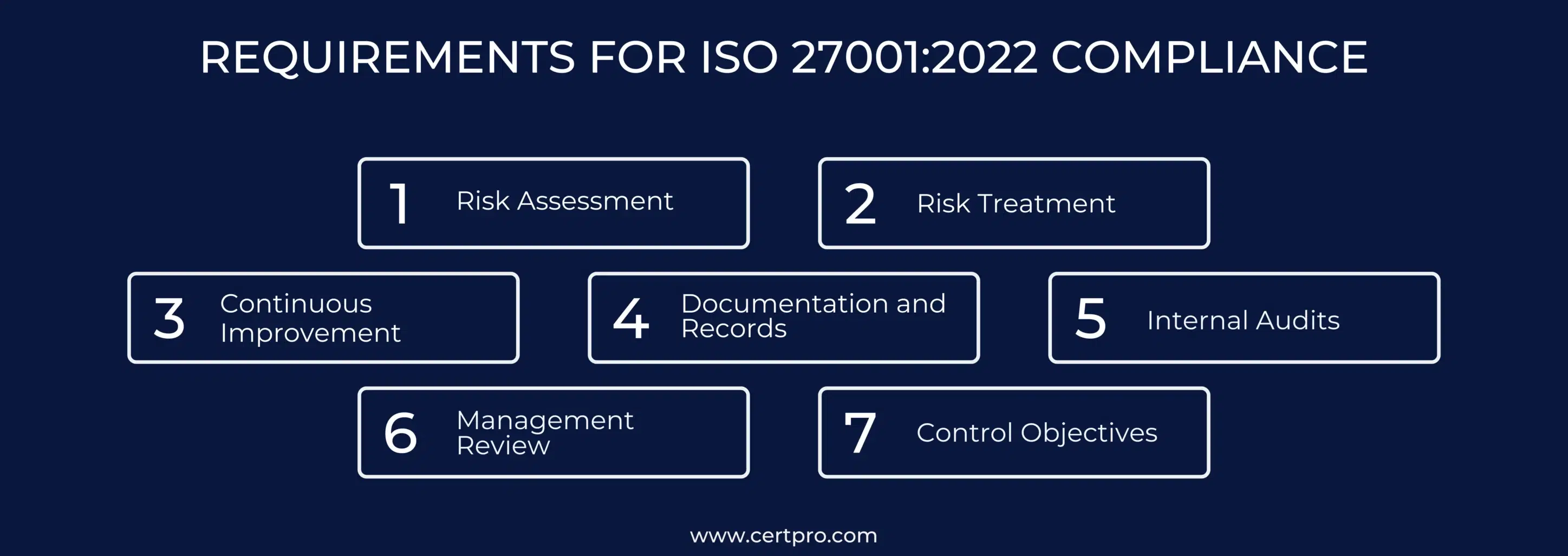
ISO/IEC 27001:2022 specifies a set of mandatory documented information that organizations must maintain and retain as evidence of ISMS conformity. Core mandatory documentation includes the information security policy, the ISMS scope document, information security risk assessment results, the risk treatment plan, the Statement of Applicability (SoA), information security objectives, evidence of competence, documented information required by individual clauses, and records of management reviews and internal audits. CertPro examines this documentation during the Stage 1 ISO 27001 audit to assess whether the ISMS is sufficiently documented to proceed to Stage 2 on-site certification.
- ✓Information Security Policy — documented, approved by top management, and communicated to all relevant personnel
- ✓ISMS Scope Statement — defining organizational units, processes, locations, and assets within the certified boundary
- ✓Information Security Risk Assessment — documented methodology, risk identification, analysis, and evaluation results
- ✓Risk Treatment Plan — documenting selected treatment options, responsible owners, and implementation status
- ✓Statement of Applicability (SoA) — mapping Annex A controls to risk treatment decisions with justification for exclusions
- ✓Information Security Objectives — measurable targets aligned with the information security policy
- ✓Evidence of Competence — training records, qualifications, and awareness activities for ISMS-relevant roles
- ✓Internal Audit Program and Results — scheduled audit activities, audit scope, findings, and corrective actions
- ✓Management Review Records — documented inputs, outputs, and decisions from periodic management review meetings
- ✓Nonconformity and Corrective Action Records — documenting identified nonconformities, root cause analysis, and corrective actions taken
All clauses from Clause 4 (Context of the Organization) through Clause 10 (Improvement) are mandatory — no exclusions are permitted from any clause of ISO/IEC 27001:2022. Clause 4 requires organizations to determine internal and external issues relevant to ISMS purpose, identify interested parties and their requirements, and define the ISMS scope. Clause 5 requires demonstrated leadership commitment, establishment of the information security policy, and assignment of ISMS roles and responsibilities. Clauses 6, 7, and 8 address planning, support resources, and operational execution of risk management and control implementation. Clauses 9 and 10 address performance evaluation and improvement mechanisms.
Annex A control exclusions are permissible only where supported by documented justification in the Statement of Applicability demonstrating that the excluded control is not applicable to the organization’s risk treatment decisions. Organizations cannot exclude Annex A controls solely on the basis of implementation difficulty or cost; exclusions must be substantiated by risk assessment evidence showing the control addresses no identified risk within the certified scope. During the ISO 27001 assessment, CertPro evaluates the completeness and reasonableness of SoA exclusion justifications as a component of the overall conformity determination.
- ✓Mandatory Documentation Requirements
- ✓Clause Conformity Requirements
ISO 27001 Certification Audit Process for Organizations in Hamburg
The ISO 27001 audit process conducted by CertPro follows a structured, multi-stage methodology designed to evaluate ISMS conformity objectively and systematically. Each stage produces documented findings that form the basis of the certification decision. The process applies consistently across all organizational types and sectors — ensuring that ISO 27001 Certification in Hamburg for a maritime logistics operator is evaluated with the same rigor as for a SaaS provider or financial technology organization. The numbered stages below describe the complete audit cycle from initial application through recertification.
- Application Review — CertPro reviews the certification application, evaluates the proposed ISMS scope, confirms organizational structure and sector context, and determines audit program requirements based on scope complexity and risk profile.
- Audit Program Determination — CertPro establishes the audit plan, including audit days, team composition, audit criteria, and methodology, based on the scope, size, and complexity of the ISMS.
- Stage 1 Audit (Documentation Review) — CertPro conducts a review of the organization’s ISMS documentation, including the information security policy, risk assessment, risk treatment plan, Statement of Applicability, and internal audit records, to determine readiness for Stage 2.
- Stage 2 Audit (On-Site Certification Audit) — CertPro conducts an on-site or remote ISO 27001 audit examining the implementation and operating effectiveness of the ISMS and Annex A controls through document review, process walkthroughs, personnel interviews, and technical evidence examination.
- Nonconformity Assessment and Reporting — All audit findings are documented; nonconformities are classified and reported to the organization with required corrective action timelines.
- Corrective Action Review — CertPro evaluates the organization’s corrective action responses to identified nonconformities before the certification decision is issued.
- Certification Committee Decision — An independent certification committee reviews the audit report and corrective action responses; the committee issues the certification decision based solely on audit evidence.
- Certificate Issuance — Upon a positive certification decision, CertPro issues the ISO 27001 certificate specifying the certified scope, issue date, and validity period of three years.
- Surveillance Audits — Annual surveillance audits verify continued ISMS conformity and operating effectiveness throughout the three-year certification cycle.
- Recertification Audit — A full recertification audit is conducted prior to certificate expiry to renew ISO 27001 certification for a further three-year period.
The Stage 1 audit is a documentation-focused evaluation conducted by CertPro to assess whether the organization’s ISMS has been sufficiently documented, scoped, and planned to warrant proceeding to the Stage 2 certification audit. During Stage 1, CertPro examines the ISMS scope statement to confirm it accurately reflects the organization’s information processing activities and risk boundaries. The information security risk assessment is reviewed to evaluate whether identified risks are comprehensive, the methodology is appropriate, and risk evaluation criteria are consistently applied. The Statement of Applicability is examined to verify that control selections are linked to risk treatment decisions and that exclusion justifications are documented and defensible.
Stage 1 findings that indicate significant gaps in ISMS documentation may result in CertPro recommending deferral of the Stage 2 audit until identified documentation deficiencies are addressed. This determination is made objectively based on the nature and extent of findings; it does not involve CertPro providing guidance on how deficiencies should be remediated. The Stage 1 report documents all findings and serves as the basis for audit program adjustments ahead of Stage 2. For Hamburg-based organizations with distributed ISMS scope — such as logistics operators with multiple terminal locations or SaaS companies with development centers in multiple cities — the Stage 1 review also confirms that scope boundaries and interface controls are adequately defined across all included locations.
The Stage 2 audit is the primary certification audit, during which CertPro evaluates the implementation and operating effectiveness of the ISMS and associated Annex A controls within the certified scope. Audit evidence is gathered through document review, records examination, process walkthroughs, technical configuration reviews, and structured personnel interviews with ISMS-relevant roles — including the Information Security Officer, IT operations personnel, HR representatives, physical security staff, and senior management. The audit program covers all mandatory ISMS clauses and the applicable Annex A controls identified in the Statement of Applicability.
For ISO 27001 audit engagements in Hamburg, Stage 2 audits may be conducted on-site at the organization’s Hamburg facilities, at remote office locations included within the scope, or through a combination of on-site and remote audit techniques as determined by the audit program. Evidence of control operating effectiveness is particularly important in Stage 2: auditors examine whether documented controls are actually implemented in practice, whether control activities are performed consistently, and whether records of control performance are maintained. Findings from Stage 2 are categorized as major nonconformities, minor nonconformities, or observations — each carrying different resolution requirements and certification decision implications.
ISO 27001 certificates are valid for three years from the date of issue, subject to satisfactory completion of annual surveillance audits in years one and two. Surveillance audits are less comprehensive than full certification audits but must cover at minimum: changes to the ISMS and its context, progress toward information security objectives, corrective actions from previous audits, internal audit results, management review outcomes, and operation of selected Annex A controls. CertPro’s surveillance audits for Hamburg-certified organizations focus on verifying continued ISMS operation and identifying any systemic deterioration in control effectiveness since initial certification.
The recertification audit, conducted in year three before certificate expiry, is a comprehensive re-evaluation of the entire ISMS against ISO/IEC 27001:2022 requirements. This audit examines the full scope — including all mandatory clauses and applicable Annex A controls — and produces a new certification decision and certificate. Organizations that fail to complete recertification before their certificate expires must restart the full certification process. CertPro notifies certified Hamburg organizations of upcoming surveillance and recertification audit schedules in advance to support organizational planning, without providing preparation guidance that would compromise audit independence.

- ✓Stage 1 Audit: Documentation Review
- ✓Stage 2 Audit: On-Site Certification Audit
- ✓Surveillance Audits and Recertification
Why Organizations in Hamburg Pursue ISO 27001 Certification
The demand for ISO 27001 certification among Hamburg-based organizations is driven by a combination of enterprise procurement requirements, regulatory obligations, supply chain security expectations, and competitive positioning in international markets. Organizations across Hamburg’s diverse economic sectors — from port logistics operators to SaaS vendors to financial services firms — pursue ISMS certification to satisfy formal contractual requirements, demonstrate information security governance to institutional customers, and establish a structured framework for managing information security risks systematically. The subsections below describe the principal demand drivers specific to Hamburg’s economic ecosystem.
Enterprise Vendor Due Diligence and Procurement Requirements
Enterprise procurement processes at large Hamburg-headquartered organizations — including multinational logistics operators, insurance companies, banks, and manufacturers — routinely require third-party vendors to present valid ISO 27001 certificates as a prerequisite for inclusion in preferred vendor lists or execution of data processing agreements. A Hamburg-based SaaS provider seeking to supply customer relationship management software to a major Hamburg shipping company will typically encounter an information security questionnaire with a mandatory request for ISO 27001 certificate documentation. The absence of a valid certificate may disqualify the vendor from the procurement process regardless of the quality of the software itself.
This vendor due diligence dynamic is particularly pronounced in Hamburg’s port and logistics ecosystem, where HHLA, Hapag-Lloyd, and other major terminal and shipping operators maintain formal supplier qualification processes incorporating information security requirements. A logistics technology company providing route optimization software, container tracking systems, or customs documentation platforms to Hamburg port operators will be subject to formal security assessments that include ISO 27001 compliance verification as a standard evaluation criterion. Independent certification from a Licensed CPA Firm such as CertPro carries greater evidentiary weight in these procurement evaluations than self-assessments or consulting-led reviews.
Financial Sector and Fintech Certification Demand
Hamburg’s financial services sector — including private banks, insurance underwriters, asset managers, and an expanding fintech community — generates substantial demand for ISO 27001 certification among technology vendors and data service providers. Financial institutions regulated by BaFin (Bundesanstalt für Finanzdienstleistungsaufsicht) operate under information security governance obligations derived from MaRisk (Mindestanforderungen an das Risikomanagement) and BAIT (Bankaufsichtliche Anforderungen an die IT), both of which require documented information security management and third-party vendor risk management frameworks. ISO 27001 certification for Hamburg fintech companies demonstrates alignment with these regulatory expectations and facilitates integration into financial institution vendor panels.
ISO 27001 compliance for Hamburg fintech organizations also supports expansion into regulated financial markets beyond Germany. The certification is recognized by financial regulators and enterprise buyers across European, Middle Eastern, and Asian markets. A Hamburg-based payment technology startup holding a valid ISO 27001 certificate from an independent Licensed CPA Firm can present this certification in due diligence processes with potential partners and investors in London, Dubai, Singapore, or New York — without requiring jurisdiction-specific security assessments in each market. This cross-border portability is a material business advantage that drives certification demand among Hamburg’s growing fintech community.
Cloud and SaaS Vendors in Hamburg’s Digital Ecosystem
Hamburg’s technology sector includes a significant and growing concentration of SaaS providers, cloud infrastructure operators, and digital platform companies serving regulated industry customers. SaaS vendors serving Hamburg logistics companies, healthcare organizations, or public sector institutions frequently encounter ISO 27001 certification requirements in enterprise sales processes. Cloud service providers hosting data on behalf of Hamburg-based financial institutions or healthcare organizations must demonstrate information security governance commensurate with the sensitivity of hosted data. For these organizations, ISO 27001 Certification in Hamburg provides independent, internationally recognized validation of security controls that satisfies both contractual requirements and customer due diligence processes.
Benefits of ISO 27001 Certification for Hamburg-Based Organizations
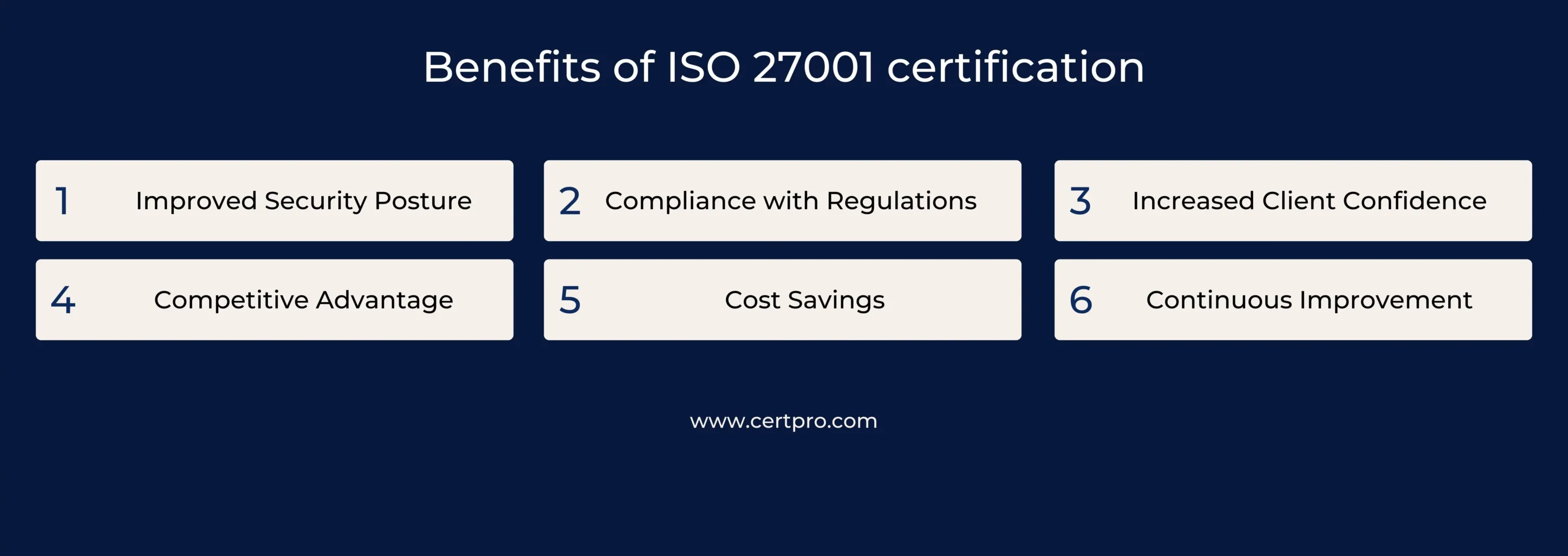
ISO 27001 certification for Hamburg companies delivers verifiable, independently validated benefits across information security governance, market access, regulatory positioning, and organizational risk management. The certification is recognized across all sectors of Hamburg’s economy — from maritime trade and aviation to financial services and digital technology — as evidence of a structured, audited approach to information security. The following list summarizes the primary benefits of ISO 27001 Certification in Hamburg as evaluated through CertPro’s independent audit methodology.
- ✓Independent Verification of ISMS Conformity — CertPro’s ISO 27001 audit confirms that the ISMS meets all ISO/IEC 27001:2022 requirements through objective, evidence-based evaluation rather than self-assessment.
- ✓Demonstrated GDPR Technical Measures Compliance — ISO 27001 certification provides structured, documented evidence of security measures that address GDPR Article 32 obligations for appropriate technical and organizational measures.
- ✓Enterprise Procurement Qualification — A valid ISO 27001 certificate satisfies vendor information security requirements in procurement processes conducted by Hamburg’s major logistics operators, financial institutions, and multinational manufacturers.
- ✓Recognition Across Global Markets — ISO 27001 certification is recognized in enterprise sales and vendor qualification processes across European, Asian, Middle Eastern, and North American markets, supporting Hamburg organizations’ international expansion.
- ✓Structured Risk Management Framework — Certification demonstrates that information security risks are systematically identified, assessed, treated, and monitored rather than managed informally.
- ✓NIS2 Directive Alignment — ISO 27001 certification supports demonstration of technical security measures required for operators of essential services under the EU NIS2 Directive.
- ✓Insurance Underwriting Recognition — Many cyber insurance underwriters in the Hamburg and German market recognize ISO 27001 certification as evidence of security governance maturity, which may influence underwriting assessments.
- ✓Supply Chain Security Assurance — Hamburg’s maritime and logistics supply chains require documented evidence of information security governance from technology and data service providers; ISO 27001 certification directly addresses this requirement.
- ✓Ongoing Surveillance and Continuous Improvement — The three-year certification cycle with annual surveillance audits maintains organizational accountability for sustained ISMS performance.
- ✓BaFin Regulatory Alignment — For Hamburg financial sector organizations, ISO 27001 certification supports documented compliance with MaRisk and BAIT information security governance requirements.
For Hamburg’s port logistics, maritime shipping, and freight forwarding organizations, ISO 27001 certification delivers specific operational and commercial benefits tied to the sector’s information security obligations. Port operators managing electronic cargo documentation systems, electronic bill of lading platforms, and port community systems handle highly sensitive commercial and customs data. A security incident affecting these systems could disrupt Hamburg port operations, expose shipper data, and trigger regulatory investigations. ISO 27001 Certification in Hamburg demonstrates that information security risks in these systems are managed through a structured, audited framework — a demonstration increasingly required by international trading partners executing data-sharing agreements with Hamburg port stakeholders.
Aviation and aerospace organizations in Hamburg similarly benefit from ISO 27001 certification as evidence of security governance in supply chain and production data systems. Airbus suppliers and Lufthansa Technik service providers managing aircraft maintenance records, design documentation, or production scheduling systems are subject to information security requirements in their contractual relationships with major OEMs. ISO 27001 certification for Hamburg logistics and aviation organizations demonstrates conformity with these contractual security requirements through independent third-party verification — reducing the frequency and administrative burden of customer-driven security audits.
- ✓Benefits for Hamburg Logistics and Maritime Sector Organizations
Regulatory and Compliance Alignment for Hamburg Organizations
ISO 27001 compliance in Hamburg operates within a multi-layered regulatory context that includes GDPR obligations, sector-specific German financial regulations, the EU NIS2 Directive, and international information security governance expectations derived from trading relationships and supply chain requirements. ISO 27001 certification does not replace legal compliance obligations; rather, it provides a structured framework for implementing and documenting the technical and organizational security measures required by applicable regulations. The relationships between ISO 27001, GDPR, NIS2, and sector-specific German regulations are described in the subsections below.
GDPR Technical and Organizational Measures
GDPR Article 32 requires controllers and processors to implement appropriate technical and organizational measures to ensure a level of security appropriate to the risk of processing personal data. These measures must account for the state of the art, implementation costs, the nature and scope of processing, and the likelihood and severity of risks to personal data. ISO 27001 certification provides a structured mechanism for demonstrating that these measures are implemented, documented, reviewed, and operating effectively. The ISO 27001 risk assessment methodology is directly applicable to the data protection risk assessment required by GDPR, and many Annex A controls directly address GDPR technical requirements — including access control, encryption, incident management, and backup and recovery.
The Hamburg Commissioner for Data Protection and Freedom of Information has published guidance indicating that ISO 27001 certification, while not a substitute for GDPR compliance documentation, provides substantive evidence of systematic security governance. In GDPR enforcement investigations, organizations holding valid ISO 27001 certificates can present the certificate and associated audit reports as evidence of documented security measures. This evidentiary value is greatest when the certificate is issued by an independent third-party certification body such as a Licensed CPA Firm — as opposed to a self-assessment or consulting firm’s review. For Hamburg organizations processing significant volumes of personal data, including HR data, customer databases, or health information, ISO 27001 Certification in Hamburg represents a significant component of their overall GDPR documentation framework.
NIS2 Directive and Critical Infrastructure Obligations
The EU NIS2 Directive, transposed into German law through the NIS2-Umsetzungs- und Cybersicherheitsstärkungsgesetz, imposes cybersecurity governance obligations on operators of essential services (OES) and important entities across sectors including transport, energy, digital infrastructure, financial market infrastructure, and manufacturing. Hamburg hosts numerous organizations classified as essential service operators under NIS2 — including port operators, logistics companies, energy utilities, financial market participants, and digital infrastructure providers. These organizations are required to implement security measures addressing risk management, incident response, business continuity, supply chain security, and encryption — all of which align with ISO 27001 Annex A control requirements.
ISO 27001 certification in Hamburg does not constitute NIS2 compliance certification; however, it provides a structured, audited framework for documenting and demonstrating the technical security measures required by NIS2. Organizations seeking to demonstrate NIS2-required security governance to the German Federal Office for Information Security (BSI) may reference their ISO 27001 certification as evidence of implemented security measures. The BSI’s IT-Grundschutz methodology is aligned with ISO 27001 requirements, and organizations holding ISO 27001 certification in Hamburg typically satisfy a substantial portion of IT-Grundschutz implementation requirements.
BaFin, MaRisk, and Financial Sector IT Security Requirements
Hamburg-based financial institutions regulated by BaFin operate under MaRisk (AT 7.2) and BAIT requirements that mandate documented information security management, IT risk management, and information security governance proportionate to the size and complexity of the institution’s IT operations. The Digital Operational Resilience Act (DORA), applicable to EU financial entities from January 2025, further extends ICT risk management, incident reporting, and third-party technology risk obligations. ISO 27001 certification for Hamburg companies in the financial sector supports documented alignment with MaRisk, BAIT, and DORA technical security requirements, though it does not substitute for direct regulatory compliance submissions to BaFin.
Certification Scope and Independent Decision Framework
The integrity of ISO 27001 Certification in Hamburg depends on the independence of the certification decision from any advisory or consulting relationship between the certification body and the certified organization. CertPro maintains strict independence as a Licensed CPA Firm; the certification committee that reviews audit reports and issues certification decisions operates separately from the audit team and applies objective criteria based solely on audit evidence. This independence framework ensures that certified organizations can present CertPro-issued ISO 27001 certificates as evidence of genuinely independent third-party validation — in enterprise procurement processes, regulatory inquiries, and contractual due diligence reviews alike.
Scope Definition and Boundary Determination
The ISMS scope determines which organizational units, business processes, physical locations, systems, and information assets are included within the certified boundary. Scope definition is the organization’s responsibility; CertPro evaluates whether the defined scope is coherent, accurately reflects the organization’s information processing activities, and does not artificially exclude significant risk areas to simplify certification. Scope statements must reference the organization’s products and services, the locations where the ISMS applies, and any interfaces with external parties or out-of-scope organizational units. For Hamburg-based organizations with complex scope boundaries — such as a logistics company certifying its port IT operations but not its trucking subsidiary — interface controls between in-scope and out-of-scope units are examined during the ISO 27001 audit.
Conditions for Certificate Suspension and Withdrawal
ISO 27001 certificates may be suspended or withdrawn by CertPro upon determination that the certified organization has failed to maintain ISMS conformity, failed to complete required corrective actions within prescribed timeframes, refused to permit scheduled surveillance audits, experienced significant changes to the certified scope without notification, or engaged in conduct that misrepresents the scope or validity of the certification. Certificate suspension is typically a temporary status pending resolution of identified issues; withdrawal results in cancellation of the certificate and removal from CertPro’s certified organization registry. Organizations whose certificates are suspended or withdrawn must undergo a new certification audit to re-establish certified status.
ISO 27001 Assessment: Evaluation Criteria and Evidence Standards
The ISO 27001 assessment conducted by CertPro applies defined evaluation criteria derived from ISO/IEC 27001:2022 requirements to audit evidence gathered through structured audit activities. The evaluation distinguishes between the design effectiveness of ISMS controls — whether controls are designed appropriately to address identified risks — and the operating effectiveness of controls — whether controls are functioning as designed and consistently applied over time. Both dimensions are evaluated during the Stage 2 audit, with operating effectiveness receiving greater emphasis during annual surveillance audits and the recertification audit.
CertPro’s ISO 27001 assessment methodology requires auditors to gather sufficient, appropriate audit evidence to support each finding and the overall certification decision. Audit evidence types include documented information (policies, procedures, records, configuration documentation), observations of implemented processes and controls, and verbal confirmation obtained through structured interviews with ISMS-relevant personnel. Auditors apply professional judgment in evaluating evidence adequacy and in determining whether identified deviations from ISO 27001 requirements constitute major nonconformities, minor nonconformities, or observations. The audit report documents the evidence basis for each finding, ensuring clear traceability between observations and conclusions.
For ISO 27001 audit engagements in Hamburg, CertPro’s auditors are drawn from professionals with domain expertise relevant to the certified organization’s sector. Audits of maritime logistics organizations benefit from auditors familiar with port information systems and trade data flows; audits of financial sector organizations incorporate knowledge of BaFin regulatory requirements and financial data security obligations. This sector-specific expertise strengthens the quality and relevance of audit findings without compromising the independence of the certification decision.
Nonconformities identified during the ISO 27001 audit are classified as major or minor based on their impact on ISMS integrity and conformity with ISO/IEC 27001:2022 requirements. A major nonconformity indicates a significant failure to meet a standard requirement — such as the absence of a documented risk assessment, failure to implement critical Annex A controls within the certified scope, or absence of management review processes. A minor nonconformity indicates a partial failure or isolated deviation that does not represent a systemic breakdown in ISMS requirements. Major nonconformities must be resolved before a certification decision can be issued; minor nonconformities must be addressed within the timeframe specified in the corrective action plan, with closure verified at the next surveillance audit or through documentary evidence review.
- ✓Evidence-Based Audit Methodology
- ✓Nonconformity Classification and Resolution
Industry Sectors in Hamburg Seeking ISO 27001 Certification
ISO 27001 Certification in Hamburg is relevant across all industry sectors that manage sensitive information, operate digital infrastructure, or engage in regulated data processing activities. Hamburg’s economic profile — encompassing Europe’s third-largest port, major aviation and aerospace operations, a globally integrated financial services sector, and a growing technology ecosystem — generates certification demand across a wide range of organizational types. The table below summarizes key Hamburg sectors, their primary ISO 27001 drivers, and the Annex A control domains most relevant to their information security risk profiles.
| Hamburg Sector | Primary ISO 27001 Driver | Key Annex A Control Domains |
|---|---|---|
| Maritime and Port Logistics | Supply chain partner requirements, trade data protection, NIS2 obligations | Organizational, Technological (access management, network security) |
| Financial Services and Fintech | BaFin MaRisk/BAIT, DORA, enterprise vendor qualification, GDPR | Organizational, Technological (cryptography, access control, incident management) |
| Aviation and Aerospace | OEM supply chain security requirements, defense-related data protection | Organizational, People, Physical, Technological |
| SaaS and Cloud Services | Enterprise customer due diligence, GDPR processor obligations, market expansion | Technological (cloud controls, secure development, vulnerability management) |
| Manufacturing and Industry | Global supply chain security, customer procurement requirements, NIS2 | Physical, Organizational, Technological |
Maritime, Port, and Logistics Organizations
Hamburg’s port and logistics sector represents one of the highest-priority areas for ISO 27001 certification, given the concentration of sensitive commercial, customs, and operational data processed by port operators, freight forwarders, shipping companies, and logistics technology providers. The Port of Hamburg processes millions of container movements annually, each generating data across customs systems, terminal operating systems, vessel management platforms, and logistics coordination networks. Cybersecurity incidents affecting these systems can cause cascading disruptions to international supply chains — as demonstrated by the 2017 NotPetya attack on Maersk, which disrupted global shipping operations including Hamburg port activities for weeks.
Organizations in Hamburg’s logistics ecosystem seeking ISO 27001 certification typically define ISMS scopes covering their digital operational systems — including terminal management software, customs documentation platforms, and customer data portals — alongside the physical and personnel security controls protecting their operational facilities. ISMS certification in Hamburg’s logistics sector demonstrates to international shipping partners, port authority stakeholders, and customs authorities that information security governance is maintained at a level commensurate with the sensitivity and commercial importance of data handled in port and freight operations.
Manufacturing and Industrial Organizations
Hamburg’s manufacturing sector — including precision engineering, food processing, chemical production, and electronics manufacturing — increasingly pursues ISO 27001 certification to satisfy supply chain information security requirements from major OEM customers and to protect operational technology (OT) environments from cybersecurity threats. German manufacturing organizations participating in Industry 4.0 digital transformation initiatives manage increasing volumes of sensitive production data, intellectual property, and operational technology data that require formal information security governance. ISO 27001 certification for Hamburg manufacturing organizations demonstrates that these data assets are protected through systematic risk management and structured security controls, as independently evaluated through CertPro’s certification audit process.
Why CertPro for ISO 27001 Certification in Hamburg
CertPro is a Licensed CPA Firm operating as an independent third-party ISO 27001 certification body with extensive experience conducting ISMS certification audits across Europe’s major economic centers. CertPro’s institutional positioning as a Licensed CPA Firm distinguishes it from certification bodies that also provide consulting, advisory, or implementation services — a distinction with material significance in enterprise procurement and regulatory contexts where the independence and objectivity of the certifying body is evaluated as part of the due diligence process. CertPro issues ISO 27001 certificates exclusively on the basis of audit evidence, applying structured methodology and professional judgment without influence from advisory or commercial relationships.
Structured Audit Methodology and Fixed-Fee Certification
CertPro conducts ISO 27001 audit engagements in Hamburg using a structured, documented audit methodology that ensures consistency, reproducibility, and evidentiary rigor across all certification audits. The audit program is determined based on the specific scope, complexity, and sector context of each organization’s ISMS, ensuring that audit resources are allocated appropriately to higher-risk areas and more complex control environments. CertPro offers fixed-fee certification pricing, providing Hamburg-based organizations with transparent cost visibility for the full certification cycle — including Stage 1 audit, Stage 2 audit, certification decision, and annual surveillance audits — without variable pricing structures that make total certification cost uncertain.
The fixed-fee model reflects CertPro’s commitment to transparent, accessible certification services for Hamburg organizations across all size categories — from SMEs in the SaaS and technology sector to large-scale logistics operators and manufacturing groups. The fee structure is determined at the outset based on scope and complexity factors, with no variable additions for audit findings or corrective action reviews. This pricing transparency supports organizational budget planning and removes financial uncertainty from the certification process. CertPro does not charge separately for certificate issuance, audit report preparation, or certification committee review, ensuring that the published fee encompasses the complete certification engagement.
Independence, Objectivity, and Institutional Authority
CertPro’s independence as a Licensed CPA Firm certification body is maintained through organizational separation between audit and certification functions, prohibition on consulting or advisory services to certified organizations, and application of professional independence standards consistent with CPA firm governance requirements. This independence structure ensures that CertPro’s ISO 27001 certificates carry institutional authority recognized in enterprise procurement processes, financial institution vendor reviews, and regulatory submissions. Hamburg organizations holding CertPro-issued ISO 27001 certificates can present these credentials as evidence of independent third-party validation — backed by the full institutional authority of a Licensed CPA Firm.
The value of CertPro’s institutional positioning is particularly evident in Hamburg’s financial sector procurement context, where banks, insurance companies, and asset managers conducting vendor due diligence evaluate not only the existence of an ISO 27001 certificate but also the qualifications and independence of the issuing certification body. A certificate issued by a Licensed CPA Firm conducting dedicated certification audits carries greater evidential weight than certificates issued by organizations with consulting relationships with the certified entity. CertPro’s institutional authority satisfies the most stringent vendor qualification requirements encountered in Hamburg’s enterprise and financial sector markets.
FAQ
▶
What is ISO 27001 certification and why is it important for Hamburg organizations?
▶
How is the ISO 27001 audit conducted by CertPro in Hamburg?
▶
What is the difference between ISO 27001 and GDPR compliance?
▶
What is included in the ISO 27001 certification scope for a Hamburg logistics company?
▶
How long does ISO 27001 certification take for a Hamburg organization?
▶
What is the ISO 27001 audit frequency after initial certification?
▶
Does ISO 27001 certification satisfy Hamburg’s NIS2 Directive obligations?
▶
What mandatory documentation is required for ISO 27001 certification?

NEW BLOG DESIGN
Ethical Hacking for SOC 2, ISO 27001, HIPAA Audit Readiness | CertPro CPA LLC HERO Dark bg, full width, padded Image as rounded card LEFT | Info panel…
ETHICAL HACKING FOR AUDIT ASSURANCE: STRENGTHENING SOC 2, ISO 27001, AND HIPAA COMPLIANCE
Ethical Hacking For Control Effectiveness. Uncover Gaps And Strengthen Audit Evidence For SOC 2, ISO 27001, And HIPAA Compliance Reviews.
HOW COMPLIANCE AUDIT SOFTWARE IMPROVES AUDIT READINESS
Today, most companies deal with a growing number of compliance regulations. From data privacy standards to security frameworks like SOC 2 and ISO 2700…
Get In Touch
have a question? let us get back to you.