
ISO 27001 Certification in Frankfurt
Executive Summary: ISO 27001 Certification in Frankfurt is conducted by CertPro, a Licensed CPA Firm delivering independent, third-party certification audits against the ISO/IEC 27001:2022 standard. Frankfurt-based organizations in financial services, fintech, cloud infrastructure, and enterprise technology sectors obtain ISMS certification through a structured audit process encompassing documentation review, control evaluation, and independent certification committee decisions. CertPro’s ISO 27001 audit methodology ensures every certificate reflects a genuine, evidence-based conformance assessment recognized across enterprise, regulatory, and cross-border procurement contexts.
OUR CLIENTS










ISO 27001 Certification for Frankfurt-Based Financial and Technology Organizations
Frankfurt occupies a singular position in the European economic and regulatory landscape. As the home of the European Central Bank, the Deutsche Bundesbank, and dozens of globally systemically important financial institutions, Frankfurt serves as the continent’s primary financial center. This concentration of regulated entities creates pervasive demand for independently verified information security governance — a demand that ISO 27001 Certification in Frankfurt directly addresses.
Organizations operating in Frankfurt’s financial district face rigorous vendor due diligence requirements, cross-border data protection obligations under the General Data Protection Regulation, and enterprise procurement standards that require verified evidence of control effectiveness. ISO 27001 assessment provides the structured, independently audited framework these organizations need to satisfy those demands.
Beyond its banking and regulatory institutions, Frankfurt has emerged as one of Central Europe’s most significant data center and cloud hosting corridors. The DE-CIX Internet Exchange Point — one of the largest in the world by traffic volume — is headquartered in Frankfurt, facilitating enormous volumes of cross-border data flows. Major cloud service providers, colocation facilities, and managed security service organizations maintain substantial infrastructure in the Frankfurt metropolitan area.
These organizations operate under data protection, security governance, and service assurance obligations that make ISMS certification a standard component of contractual and regulatory compliance frameworks. ISO 27001 compliance provides the recognized, independently verified foundation these obligations require.
Frankfurt’s fintech ecosystem has expanded significantly over the past decade. SaaS platforms, payment processors, regulatory technology firms, and digital asset organizations have all established operations across the city. Many of these organizations process financial data subject to both German federal data protection law and EU-level regulatory requirements.
ISO 27001 compliance Frankfurt fintech organizations must demonstrate extends beyond internal governance — it reflects a verified, independently audited standard that procurement teams at regulated institutions recognize and require. CertPro, as a Licensed CPA Firm, conducts ISO 27001 certification audits that produce independently issued certificates recognized across enterprise, regulatory, and cross-border procurement contexts.
Frankfurt as a European Financial and Regulatory Center
The European Central Bank, headquartered in Frankfurt’s Ostend district, oversees monetary policy for the 20 Eurozone member states and maintains extensive information security governance requirements for its operational systems, vendor relationships, and technology service providers. Deutsche Bundesbank similarly operates with stringent information security expectations that cascade to technology suppliers and financial infrastructure providers.
Organizations supplying services to these institutions — including IT vendors, data analytics firms, software developers, and managed service providers — are routinely required to demonstrate ISO 27001 compliance. ISO 27001 Certification in Frankfurt satisfies the information security governance requirements these financial services procurement processes mandate.
Frankfurt’s role as the primary seat of European banking supervision also positions it as a critical node in the EU’s evolving digital operational resilience framework. The Digital Operational Resilience Act (DORA), applicable to financial entities operating in the EU, introduces binding requirements around ICT risk management, incident reporting, and third-party risk oversight.
For organizations subject to DORA, ISO 27001 certification provides a recognized framework for evidencing ICT risk governance and control effectiveness. The alignment between ISO 27001’s structured risk management approach and DORA’s ICT risk management requirements makes ISMS certification increasingly relevant in a regulatory context that extends well beyond GDPR alone.
Frankfurt’s Data Center and Cloud Infrastructure Ecosystem
Frankfurt ranks among the top five data center markets in Europe, alongside London, Amsterdam, Paris, and Dublin. The city’s geographic centrality, robust fiber connectivity, and access to the DE-CIX exchange have attracted hyperscale cloud providers, colocation operators, and network service organizations. AWS, Microsoft Azure, Google Cloud, and numerous regional cloud providers maintain Frankfurt-based infrastructure regions or points of presence.
These organizations are routinely subject to ISO 27001 assessment requirements from enterprise customers and regulated industry clients who require verified evidence of information security control effectiveness before entrusting sensitive workloads to cloud environments.
Colocation providers, managed hosting firms, and network service organizations operating in Frankfurt’s data center ecosystem face ongoing pressure from enterprise customers to maintain current ISO 27001 certification. Procurement teams at major banks, insurance companies, and pharmaceutical organizations headquartered in Frankfurt and the broader Rhine-Main region conduct annual vendor security reviews in which ISO 27001 certificates — issued by independent certification bodies — function as primary evidence of security governance maturity.
CertPro’s independent certification audit process produces certificates that satisfy these enterprise vendor review requirements across Frankfurt’s data center and cloud hosting sector.
CertPro as an Independent Certification Body in Frankfurt
CertPro operates as a Licensed CPA Firm conducting independent, third-party ISO 27001 certification audits. The independence of the certification body from any advisory, implementation, or consulting relationship with the auditee is a foundational requirement of the ISO 27001 certification process. CertPro’s audit teams evaluate documented information security management systems against ISO/IEC 27001:2022 requirements without prior involvement in the design, implementation, or governance of those systems.
This structural independence ensures that ISO 27001 Certification in Frankfurt issued by CertPro reflects an objective, evidence-based assessment of control design and operating effectiveness — providing Frankfurt organizations with a certification credential that stands up to scrutiny from enterprise clients and regulatory supervisors alike.

What Is ISO 27001 and What Does ISMS Certification Mean
ISO/IEC 27001 is an internationally recognized standard published by the International Organization for Standardization (ISO) and the International Electrotechnical Commission (IEC). It specifies requirements for establishing, implementing, maintaining, and continually improving an Information Security Management System (ISMS). An ISMS is a systematic framework of policies, procedures, controls, and processes that an organization uses to manage information security risks and protect the confidentiality, integrity, and availability of its information assets.
ISMS certification — the formal outcome of a successful ISO 27001 audit — demonstrates that an organization’s information security management system has been independently evaluated and found to conform to the standard’s requirements.
ISO 27001 certification differs fundamentally from self-assessment or internal security reviews. Certification requires an independent third-party audit body to examine documented evidence, interview personnel, observe operational processes, and evaluate the design and operating effectiveness of security controls against ISO/IEC 27001:2022 requirements.
The current version — ISO/IEC 27001:2022 — was published in October 2022, replacing the 2013 edition. Organizations certified under the 2013 version must transition to the 2022 standard by October 31, 2025, as established by international certification bodies. ISO 27001 Certification in Frankfurt conducted by CertPro is performed against the requirements of the current 2022 standard.
The Information Security Management System Framework
ISO/IEC 27001:2022 structures the ISMS framework through two interconnected components: the management system requirements defined in Clauses 4 through 10, and the security controls listed in Annex A. The management system clauses establish governance, planning, support, operational, performance evaluation, and improvement requirements that define how an organization manages information security at a strategic and operational level.
Clause 4 requires understanding the organization’s context and interested parties. Clause 5 addresses leadership and policy commitment. Clause 6 covers planning, including risk assessment and risk treatment. Clause 7 addresses support resources. Clause 8 governs operations. Clause 9 covers performance evaluation through internal audit and management review. Clause 10 addresses nonconformity and continual improvement.
Annex A of ISO/IEC 27001:2022 contains 93 controls organized across four domains: Organizational controls (37), People controls (8), Physical controls (14), and Technological controls (34). This structure replaced the 114 controls across 14 domains defined in the 2013 edition.
Organizations must produce a Statement of Applicability (SoA) documenting which Annex A controls apply to the defined ISMS scope, which have been implemented, and the justification for any excluded controls. The SoA is a mandatory document evaluated during the ISO 27001 audit and serves as the central reference for assessing control coverage relative to identified risks.
Relationship Between ISO 27001, GDPR, and Data Protection Obligations
ISO 27001 compliance and GDPR compliance address overlapping but distinct sets of requirements. GDPR establishes legal obligations for organizations processing personal data of EU residents, including requirements for data protection by design, processing records, data subject rights management, breach notification, and international data transfer mechanisms.
ISO 27001 provides a structured framework for managing information security risks that directly supports GDPR compliance. It requires documented risk assessments, implemented security controls, incident management procedures, and continual improvement processes. Organizations in Frankfurt subject to GDPR — which encompasses virtually all organizations processing EU resident data — frequently use ISO 27001 certification as documented evidence of the technical and organizational measures required under Article 32 of the GDPR.
While ISO 27001 certification does not constitute GDPR compliance by itself — the two frameworks have different scopes and legal bases — the controls and governance structures required for ISMS certification substantively address many GDPR technical and organizational requirements. For Frankfurt-based organizations operating across multiple EU member states or processing cross-border data transfers, combining ISO 27001 certification with GDPR compliance documentation provides a comprehensive evidentiary basis for data protection governance.
CertPro’s ISO 27001 audit evaluates information security controls directly relevant to data protection obligations, including access control, encryption, incident response, and asset management.
ISO 27001 Certification Requirements for Organizations in Frankfurt
ISO 27001 certification requirements apply uniformly to all organizations regardless of size, sector, or geographic location. However, the specific controls, risks, and scope definitions will vary based on the organization’s information assets, operational context, and applicable legal and regulatory obligations. For Frankfurt-based organizations, the certification scope will typically include information systems, data processing activities, third-party relationships, and physical and logical security environments relevant to core operations.
Understanding what the standard requires is essential before initiating the ISO 27001 audit process. The following sections outline key documentation, technical, and scope requirements that Frankfurt organizations must address.
ISO/IEC 27001:2022 mandates a specific set of documented information that organizations must maintain and make available during the certification audit. Core mandatory documents include:
- Information Security Policy — establishes management commitment and direction for information security
- ISMS Scope Statement — defines the boundaries and applicability of the management system
- Risk Assessment methodology and results — documents how risks have been identified, analyzed, and evaluated
- Risk Treatment Plan — specifies how identified risks will be addressed through selected controls
- Statement of Applicability (SoA) — maps all Annex A controls to identified risks and documents implementation status and justification for exclusions
Beyond core documents, ISO 27001 requires organizations to maintain evidence of operational controls through documented procedures, work instructions, activity records, and audit logs. Key required records include results of risk assessments and treatment decisions, evidence of competence and awareness training, records of internal audit programs and findings, management review records, and documentation of nonconformities and corrective actions.
The completeness and accessibility of this documented information is evaluated during the Stage 1 audit. It provides the evidentiary basis for the Stage 2 control assessment. Frankfurt organizations undergoing ISO 27001 assessment must ensure documentation reflects actual operational practice — not theoretical or aspirational statements of intent.
The technical and operational requirements of ISO 27001 derive from the combination of identified risks and the applicable controls selected from Annex A. The 34 technological controls in Annex A of ISO/IEC 27001:2022 address areas including user endpoint devices, privileged access rights, information access restrictions, authentication systems, cryptographic controls, secure system engineering, network security, web filtering, secure coding practices, configuration management, information deletion, data masking, data leakage prevention, monitoring activities, technical vulnerability management, and ICT readiness for business continuity.
Frankfurt organizations operating digital infrastructure must demonstrate that technological controls are not only designed appropriately but are operating effectively over time — a key focus of the ISO 27001 audit’s Stage 2 assessment.
Physical controls under Annex A address security perimeters, physical entry controls, securing offices and facilities, physical security monitoring, protection against environmental threats, working in secure areas, and clear desk and screen policies. For Frankfurt organizations with physical data center infrastructure, colocation agreements, or office environments where sensitive information is processed, physical control requirements are assessed through site observation and review of physical security records.
People controls address screening, terms and conditions of employment, information security awareness, training and education, disciplinary processes, responsibilities after termination, confidentiality agreements, remote working, and information security event reporting. These controls must be implemented through documented HR processes and evidenced through training records, signed agreements, and policy acknowledgments.
The ISMS scope defines the boundaries within which the ISO 27001 management system operates and within which certification applies. Scope definition is one of the most consequential decisions in the certification process. It determines which organizational units, processes, information assets, technologies, and locations are included within the certified ISMS.
A narrowly defined scope may exclude significant portions of an organization’s information processing activities, while an overly broad scope may create audit complexity without proportionate business value. For Frankfurt organizations, the scope statement must accurately reflect the information assets, processing activities, and organizational boundaries subject to the ISMS. It must also remain consistent with risk assessment results and the controls documented in the Statement of Applicability.
| ISMS Component | ISO 27001 Requirement | Audit Evidence |
|---|---|---|
| Information Security Policy | Clause 5.2 – Leadership | Signed policy document, management approval records |
| Risk Assessment | Clause 6.1.2 – Risk Assessment | Risk register, assessment methodology documentation |
| Statement of Applicability | Clause 6.1.3 – Risk Treatment | SoA document with control justifications |
| Internal Audit Program | Clause 9.2 – Internal Audit | Audit schedules, findings reports, corrective actions |
| Management Review Records | Clause 9.3 – Management Review | Meeting minutes, review outputs, action items |
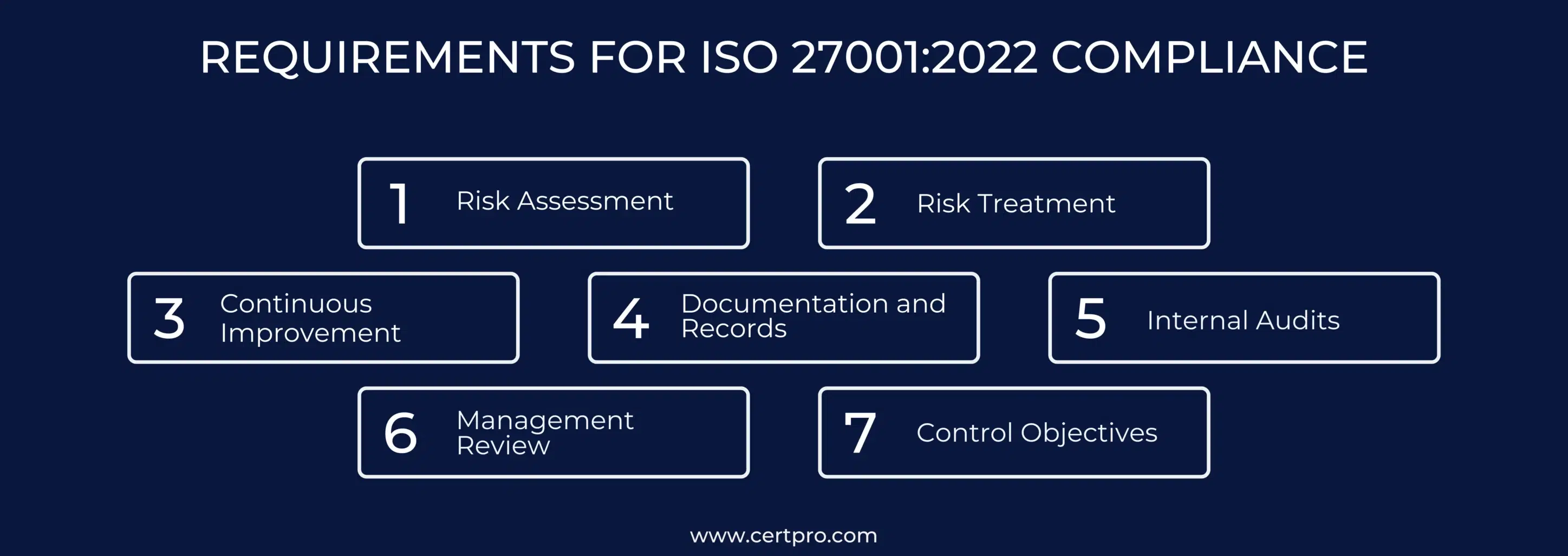
- ✓Documentation Requirements
- ✓Technical and Operational Control Requirements
- ✓Scope Definition and Eligibility
ISO 27001 Certification Audit Process for Organizations in Frankfurt
The ISO 27001 audit process conducted by CertPro follows a structured, staged methodology that evaluates the conformance of an organization’s ISMS against the requirements of ISO/IEC 27001:2022. Each stage of the audit process is distinct, with defined objectives, evidence requirements, and decision points. The process is independent of any prior advisory or implementation involvement, ensuring the certification decision reflects an objective assessment of how the ISMS actually operates.
ISO 27001 audit Frankfurt engagements conducted by CertPro proceed through the following numbered stages.
- Application Review: The organization submits an application identifying the ISMS scope, organizational context, and applicable regulatory requirements. CertPro reviews the application to confirm certification scope clarity and audit program feasibility.
- Audit Program Determination: CertPro determines the audit program structure, including the number of audit days required based on scope complexity, organizational size, number of personnel, and the nature of information assets within the defined ISMS boundary.
- Stage 1 Audit (Documentation Review): Auditors conduct a systematic review of the organization’s ISMS documentation, including the Information Security Policy, ISMS Scope Statement, Risk Assessment and Risk Treatment Plan, Statement of Applicability, internal audit records, and management review outputs. The Stage 1 audit identifies documentation gaps and determines readiness for the Stage 2 field audit.
- Stage 2 Audit (Control Effectiveness Assessment): Auditors conduct on-site or remote evaluation of implemented controls against the requirements of ISO/IEC 27001:2022 Clauses 4–10 and applicable Annex A controls. Evidence is gathered through interviews, observation of processes, review of operational records, and testing of control mechanisms.
- Nonconformity Identification and Reporting: Auditors document any nonconformities identified during Stage 1 or Stage 2. Nonconformities are classified and reported to the organization with specific reference to the ISO 27001 requirement not met and the objective evidence supporting the finding.
- Corrective Action Review: The organization responds to identified nonconformities with documented corrective actions. CertPro auditors review the adequacy and evidence of corrective actions before advancing the certification decision.
- Certification Committee Decision: An independent certification committee reviews the complete audit file — including Stage 1 and Stage 2 findings, nonconformity reports, and corrective action responses — and makes an independent certification decision based solely on audit evidence.
- Certificate Issuance: Upon a positive certification decision, CertPro issues an ISO 27001 certificate specifying the organization’s name, certified ISMS scope, applicable standard version, certificate issue date, and expiry date.
- Surveillance Audit Cycle: ISO 27001 certificates are valid for three years. Annual surveillance audits verify that the ISMS continues to conform to standard requirements and that corrective actions from previous audits have been effectively implemented.
- Recertification Audit: Prior to certificate expiry, a full recertification audit evaluates continued ISMS conformance and determines whether the certificate should be renewed for a subsequent three-year period.
The Stage 1 audit focuses on evaluating the completeness and conformance of the organization’s documented ISMS against ISO/IEC 27001:2022 requirements. Auditors examine whether mandatory documents are present, appropriately structured, and reflect the actual scope and context of the organization’s information security management activities.
The Information Security Policy is reviewed for management commitment, scope coverage, and alignment with organizational strategy. The Risk Assessment documentation is evaluated for methodological rigor, completeness of asset identification, and consistency between identified risks and selected risk treatment options. The Statement of Applicability is assessed for internal consistency — specifically whether selected controls align with identified risks and whether exclusions are adequately justified.
During the Stage 1 audit, CertPro auditors also review the organization’s internal audit program results and management review records. These documents provide insight into how the organization evaluates its own ISMS performance, identifies improvement opportunities, and responds to identified deficiencies.
For Frankfurt organizations operating under multiple regulatory frameworks, the internal audit program may incorporate ISO 27001 compliance assessments alongside GDPR audit activities, DORA ICT risk reviews, or sector-specific security governance evaluations. Auditors assess whether the internal audit scope covers all relevant ISMS processes and whether management review inputs and outputs reflect substantive engagement with information security performance data.
The Stage 2 audit transitions from documentation review to operational assessment, evaluating whether the controls documented in the ISMS are implemented as described and operating effectively in practice. CertPro auditors conduct structured interviews with personnel responsible for key security controls, observe operational processes, examine system configurations, review access control logs, assess physical security arrangements, and test monitoring and alerting mechanisms.
The audit sample encompasses controls across all four Annex A domains — Organizational, People, Physical, and Technological — with sampling depth calibrated to the scope complexity and risk profile of the certified ISMS.
For Frankfurt-based technology and financial services organizations, Stage 2 audit activities typically include assessment of network security architecture and segmentation controls, privileged access management systems, cryptographic key management practices, incident response procedures and their operational evidence, third-party supplier security management processes, and business continuity and disaster recovery controls.
Auditors evaluate not only whether controls exist but whether they are applied consistently, monitored continuously, and subject to periodic effectiveness review. Evidence of control operation — such as system logs, access review records, penetration test results, vulnerability scan outputs, and training completion records — is examined to support findings during the ISO 27001 assessment.
ISO 27001 certification is maintained through a three-year certification cycle that includes annual surveillance audits and a full recertification audit at the end of the cycle. Surveillance audits are not re-audits of the entire ISMS. Rather, they assess a targeted subset of ISMS processes and controls to verify that the management system continues to operate effectively and that any nonconformities from previous audits have been resolved through documented corrective actions.
Surveillance audit scope typically includes review of the organization’s internal audit findings, management review outputs, significant changes to the ISMS scope or risk profile, and assessment of controls in areas of ongoing or newly identified risk.
Organizations that fail to maintain ISMS conformance with ISO 27001 requirements between audits — for example, by allowing documented controls to lapse, failing to conduct scheduled internal audits, or neglecting management review obligations — may receive nonconformities during surveillance audits that place the certificate at risk of suspension or withdrawal.
For Frankfurt organizations where ISO 27001 certification is a contractual requirement with enterprise clients or a regulatory expectation, continuous ISMS maintenance between audits is essential. The recertification audit conducted at the end of the three-year cycle is a comprehensive evaluation of the full ISMS scope and determines whether the certificate is renewed for a subsequent three-year period.

- ✓Stage 1 Audit: Documentation and ISMS Readiness Review
- ✓Stage 2 Audit: On-Site Control Effectiveness Evaluation
- ✓Surveillance and Recertification Audit Requirements
Why Organizations in Frankfurt Pursue ISO 27001 Certification
The demand for ISO 27001 Certification in Frankfurt is driven by a combination of enterprise procurement requirements, regulatory expectations, contractual obligations, and competitive differentiation factors that are particularly pronounced in Frankfurt’s concentrated financial and technology ecosystem. Unlike general-purpose security frameworks, ISO 27001 provides independently verified evidence of control effectiveness that satisfies specific requirements in enterprise vendor due diligence processes, financial sector procurement standards, and cross-border data processing agreements.
Enterprise Vendor Security Review Requirements
Major financial institutions, insurance companies, pharmaceutical organizations, and multinational corporations headquartered in or operating from Frankfurt conduct rigorous third-party vendor security assessments as part of their supply chain risk management programs. These vendor review processes — which may be governed by internal risk management policies, sector-specific regulatory requirements such as EBA outsourcing guidelines, or contractual requirements negotiated between organizations — routinely require evidence of ISO 27001 certification as a condition of vendor approval or contract renewal.
A technology vendor providing software-as-a-service to a Frankfurt-based bank, for example, may be required to maintain current ISO 27001 certification before being approved for access to the bank’s production systems or customer data environments.
The vendor security review landscape in Frankfurt reflects the regulatory environment governing financial institutions in Germany and the EU. The European Banking Authority’s guidelines on outsourcing arrangements, the German Federal Financial Supervisory Authority (BaFin) circulars on IT operations and risk management (BAIT), and the emerging requirements of DORA all establish expectations around ICT third-party risk management.
These frameworks effectively require financial institutions to verify and document the security posture of their technology suppliers. ISO 27001 certification, as an independently issued certificate covering a defined scope of information security controls, satisfies a core component of these third-party verification requirements and reduces the audit burden on both the vendor and the procuring institution.
Fintech and SaaS Expansion into Regulated Markets
Frankfurt’s fintech sector includes payment processors, digital banking platforms, regulatory technology providers, insurance technology firms, and blockchain-based financial service organizations. Many of these organizations are at growth stages where expanding their customer base to include regulated financial institutions — banks, investment managers, insurers — requires satisfying the security assurance requirements that institutional clients impose on technology suppliers.
ISO 27001 compliance Frankfurt fintech organizations demonstrate through independent certification provides the recognized, structured evidence of information security governance that institutional clients require before onboarding SaaS platforms to regulated workflows.
SaaS organizations operating from Frankfurt and serving clients across the EU face additional considerations related to cross-border data transfers and the processing of personal data under GDPR. Enterprise clients in regulated sectors increasingly require SaaS providers to demonstrate not only contractual data processing commitments but independently verified technical and organizational security controls.
ISO 27001 certification for Frankfurt companies in the SaaS sector provides this independently verified evidence in a format recognized across EU member states. It facilitates procurement approvals from enterprise clients in Germany, France, the Netherlands, and other major European markets without requiring multiple jurisdiction-specific security assessments.
Regulatory Alignment and Information Security Governance
ISO 27001 assessment provides organizations with a structured methodology for identifying, evaluating, and treating information security risks within a governance framework aligned with international best practices. For Frankfurt organizations operating under BaFin’s IT security requirements (BAIT), ESMA’s operational resilience guidelines, or sector-specific cybersecurity frameworks applicable to critical infrastructure operators, ISO 27001 certification demonstrates alignment with recognized international information security governance standards.
This regulatory alignment value extends to interactions with supervisory bodies, where ISO 27001 certification provides documented evidence of systematic information security governance that supports regulatory reporting and supervisory engagement.
ISO 27001 ISMS Framework: Governance, Risk, and Control Structures
The Information Security Management System framework defined by ISO/IEC 27001:2022 integrates governance, risk management, security controls, monitoring, and continual improvement into a cohesive management system. Understanding the structural components of the ISMS framework is essential for organizations in Frankfurt preparing for ISO 27001 audit evaluation and for stakeholders seeking to understand what ISMS certification represents as an assurance artifact.
Governance Structures Within the ISMS
ISO 27001 governance requirements, established through Clauses 4 and 5, define how information security is managed at a strategic level within the organization. Clause 4 requires organizations to define their organizational context by identifying internal and external factors relevant to information security, understanding the expectations of interested parties, and defining the ISMS scope in light of this contextual analysis.
For Frankfurt-based organizations, relevant external context includes the EU regulatory environment, sector-specific supervisory expectations from BaFin or the ECB, GDPR obligations, and contractual requirements from enterprise clients operating in regulated industries.
Clause 5 establishes leadership requirements, including the obligation for top management to demonstrate active commitment to the ISMS. This is achieved by establishing and communicating the Information Security Policy, ensuring that information security roles and responsibilities are assigned and understood, and actively participating in ISMS governance through management review.
The Information Security Policy must articulate the organization’s commitment to protecting information, establish a framework for setting information security objectives, and commit the organization to meeting applicable legal, regulatory, and contractual requirements. This policy document is a primary artifact reviewed during the ISO 27001 certification audit and must reflect genuine management commitment rather than a pro-forma declaration.
Risk Management Practices and Risk Treatment
ISO 27001’s risk management requirements, defined in Clause 6.1, form the analytical core of the ISMS framework. Organizations must define and apply an information security risk assessment process that identifies risks associated with the loss of confidentiality, integrity, and availability of information within the ISMS scope. The process must also analyze assessed risks by evaluating the likelihood and consequences of risk scenarios, evaluate risks against defined acceptance criteria, and prioritize risks for treatment based on assessment results.
The risk assessment process must be reproducible — producing consistent results when applied by different assessors to the same information assets and threat scenarios. This reproducibility requirement is evaluated as part of the ISO 27001 assessment.
The Risk Treatment Plan, required by Clause 6.1.3, documents how each identified risk will be addressed — through implementing Annex A controls, applying additional organizational measures, accepting the risk based on documented criteria, or avoiding the risk by eliminating the risk-generating activity.
For each risk selected for treatment through control implementation, the Risk Treatment Plan must reference the specific Annex A controls selected, and this mapping must be reflected in the Statement of Applicability. The SoA serves as the definitive record linking identified risks to implemented controls, making it the central reference document for understanding the organization’s information security control landscape during the ISO 27001 audit.
Security Controls: Annex A Domains and Operational Implementation
The 93 controls in Annex A of ISO/IEC 27001:2022 address the full spectrum of information security concerns across organizational, personnel, physical, and technological dimensions. Organizational controls govern how information security is structured and managed at a policy and procedural level, covering areas such as information security policies, roles and responsibilities, threat intelligence, information security in project management, supplier relationships, cloud security, and incident management.
These controls address the governance architecture within which technical and physical security measures operate — and are evaluated in detail during the ISO 27001 audit as part of the Stage 2 control effectiveness assessment.
Technological controls represent the largest Annex A domain in ISO/IEC 27001:2022, reflecting the increasing centrality of digital infrastructure to information security risk. Key technological controls evaluated during the ISO 27001 audit include user endpoint device management, identity and access management, privileged access rights management, cryptographic controls covering encryption of data at rest and in transit, network security architecture and segmentation, security information and event management (SIEM) systems, vulnerability management processes, and secure application development practices.
For Frankfurt organizations with complex digital infrastructure — including cloud-native architectures, hybrid environments, and API-based integration ecosystems — the design and operational effectiveness of technological controls is a primary focus of the Stage 2 audit.
Monitoring, Internal Audit, and Continual Improvement
ISO 27001’s performance evaluation requirements (Clause 9) establish how organizations measure, monitor, and assess the effectiveness of the ISMS. Organizations must define which information security metrics and indicators will be measured, the methods used to collect and analyze performance data, the frequency of measurement and analysis, and who is responsible for evaluating and acting on performance information.
For operational technology environments, cloud-hosted systems, and network security infrastructure, monitoring controls typically include automated log aggregation, security event correlation through SIEM platforms, intrusion detection and prevention system alerts, and periodic vulnerability scan outputs that feed into structured performance review processes.
The internal audit program required by Clause 9.2 is an independent internal assessment function that evaluates whether the ISMS conforms to the organization’s own requirements and to the requirements of ISO/IEC 27001:2022. Internal auditors must be independent of the areas they audit — a requirement that may necessitate cross-functional audit arrangements or qualified external parties for internal audit activities.
Internal audit findings feed directly into the management review process and inform corrective action priorities. The continual improvement obligation under Clause 10 requires that organizations not merely correct identified nonconformities but address their root causes to prevent recurrence — embedding improvement into the operational rhythm of the ISMS rather than treating it as a discrete remediation activity.
Benefits of ISO 27001 Certification for Frankfurt-Based Organizations
ISO 27001 Certification in Frankfurt delivers a range of demonstrable organizational benefits that extend beyond information security governance to encompass market positioning, regulatory alignment, operational discipline, and risk management maturity. The following benefits reflect outcomes documented through the independent certification audit process — not projected outcomes or promotional claims.
- ✓Independent Verification of Control Effectiveness: ISO 27001 certification provides documented, independently verified evidence that information security controls are designed appropriately and operating effectively within the certified ISMS scope — satisfying enterprise procurement requirements and regulatory expectations.
- ✓Structured Risk Management Framework: The risk assessment and risk treatment process required by ISO 27001 produces a documented, structured approach to identifying and treating information security risks, replacing ad-hoc security decisions with a governed, auditable risk management methodology.
- ✓GDPR Technical Measure Documentation: For organizations subject to GDPR — effectively all Frankfurt organizations processing EU resident personal data — ISO 27001 certification provides documented evidence of technical and organizational measures under Article 32, supporting data protection compliance governance.
- ✓Enterprise Vendor Approval Qualification: ISO 27001 certification satisfies vendor security qualification requirements imposed by financial institutions, enterprise technology buyers, and regulated industry procurement teams across Frankfurt’s business ecosystem.
- ✓Ongoing Surveillance Oversight: The three-year certification cycle with annual surveillance audits provides structured, periodic external verification of ISMS continued conformance, maintaining the assurance value of certification between full recertification audits.
- ✓Regulatory Alignment Across Multiple Frameworks: The ISMS framework aligns with BaFin BAIT requirements, DORA ICT risk management expectations, GDPR technical measure obligations, and international security governance standards, providing a unified governance structure across multiple regulatory obligations.
- ✓Information Security Incident Reduction: Organizations maintaining ISO 27001-certified ISMS environments apply structured incident detection, response, and post-incident learning processes that support systematic reduction in the frequency and impact of information security incidents.
- ✓Cross-Border Market Access: ISO 27001 certification is internationally recognized, enabling Frankfurt-based organizations to satisfy security assurance requirements from clients and partners across EU member states and global markets without country-specific security re-assessments.
- ✓Board-Level Security Governance Visibility: The management review and reporting requirements of ISO 27001 produce structured information security performance data that informs board-level governance decisions, supporting directors’ oversight responsibilities for information security risk.
- ✓Contractual Obligation Satisfaction: Many technology contracts, data processing agreements, and SaaS service agreements in Frankfurt’s market require suppliers to maintain current ISO 27001 certification — providing certified organizations with a qualification that supports contract retention and renewal.
Frankfurt’s concentration of major financial institutions creates a procurement environment where ISO 27001 certification functions as a baseline qualification standard for technology vendors, data processors, and service providers. Banks and investment managers subject to EBA outsourcing guidelines, BaFin BAIT IT governance requirements, and ECB cyber resilience expectations require third-party vendors to demonstrate documented, independently verified information security governance as a condition of supplier onboarding and ongoing contract maintenance.
ISO 27001 certification issued by an independent certification body satisfies this vendor qualification requirement in a format that procurement and risk teams at major financial institutions recognize as authoritative evidence of security governance maturity.
For Frankfurt-based technology organizations seeking to expand their customer base within the financial services sector — or to retain existing financial sector clients as vendor security requirements become more stringent — ISO 27001 certification for Frankfurt companies provides the foundational qualification that enables access to regulated procurement processes.
The certification’s three-year validity period with annual surveillance oversight provides continuous assurance to financial institution clients without requiring annual full re-audits, making it a cost-effective mechanism for maintaining ongoing vendor qualification status in Frankfurt’s regulated financial market.
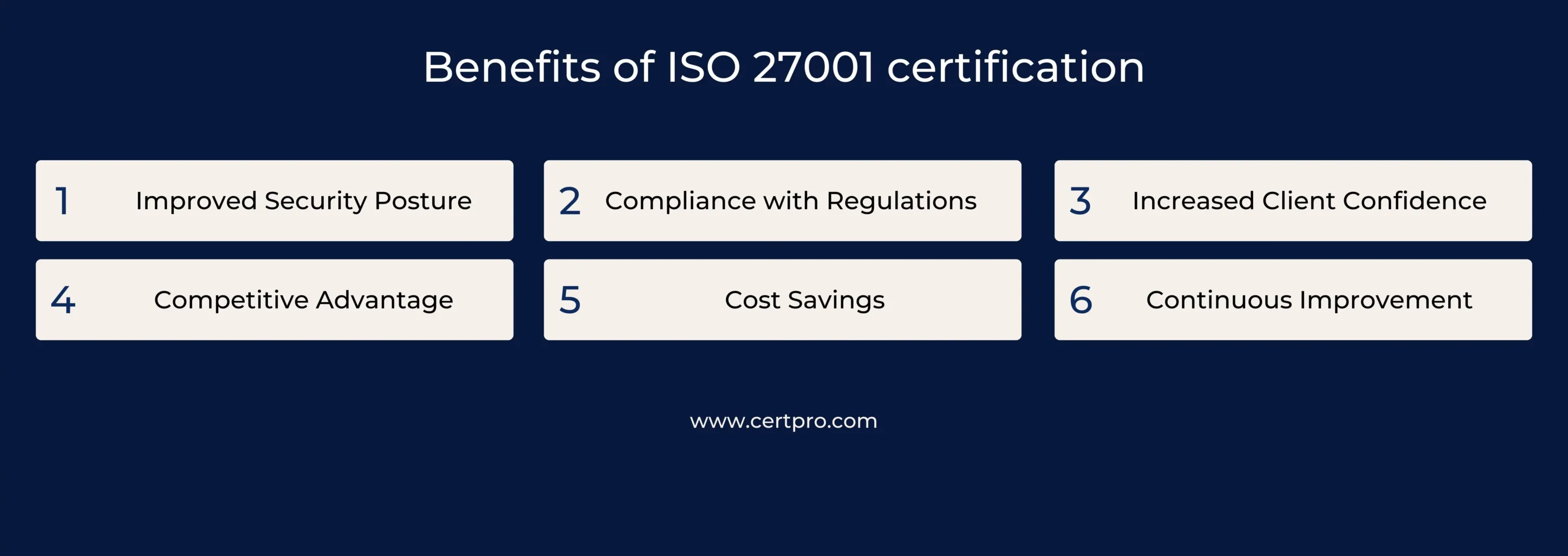
- ✓Certification Value in Financial Sector Procurement
ISO 27001 Certification Scope and Independent Decision Framework
The scope and independence framework governing ISO 27001 certification distinguishes the independent third-party certification process from internal security assessments, customer security questionnaires, and self-attestation mechanisms. Understanding how the certification scope is defined, how the independent decision framework operates, and under what circumstances certificates may be suspended or withdrawn is essential for organizations evaluating ISO 27001 certification as an assurance mechanism.
Evidence-Based Assessment and Control Design Evaluation
ISO 27001 assessment conducted by CertPro is evidence-based — every finding, whether confirmatory of conformance or identifying nonconformity, is supported by specific documented or observed evidence gathered during the audit. Auditors do not make findings based on subjective impressions, general industry norms, or comparison against organizations outside the audit scope. Each control evaluated during the audit is assessed against the specific requirements of ISO/IEC 27001:2022 and the organization’s own documented ISMS requirements.
Evidence is drawn from document review, personnel interviews, system observation, and operational record examination — ensuring that every ISO 27001 audit finding is fully traceable to objective audit evidence.
Control design evaluation assesses whether the controls implemented by the organization are designed in a manner that would, if operating as intended, meet the control objective and satisfy the corresponding ISO 27001 requirement. Control operating effectiveness evaluation assesses whether the controls are actually functioning as designed — producing consistent outputs, applied uniformly across the ISMS scope, and generating auditable evidence of operation.
Both dimensions of control evaluation are required for a complete ISO 27001 compliance assessment. Controls that are appropriately designed but inconsistently applied fail to satisfy the standard’s requirements. This dual-dimensional assessment approach is embedded in CertPro’s ISO 27001 audit methodology for all Frankfurt certification engagements.
Nonconformity Classification and Certification Decision
Nonconformities identified during the ISO 27001 audit represent instances where the organization’s ISMS does not conform to a specific requirement of ISO/IEC 27001:2022. Nonconformities are documented with reference to the specific clause or Annex A control requirement not met, the objective evidence supporting the finding, and a clear statement of the deficiency.
Organizations are required to respond with documented corrective actions that address not only the immediate deficiency but its root cause, to prevent recurrence. The adequacy of corrective action responses is evaluated by CertPro auditors before the certification decision is advanced to the certification committee.
The certification committee decision is independent of the audit team — a structural separation that ensures the certification decision reflects objective evaluation of the full audit file rather than the views of individual auditors. The committee reviews audit findings, nonconformity reports, corrective action responses, and the audit team’s overall assessment before issuing a certification decision.
This independent review function is a fundamental component of the ISO 27001 certification integrity framework. It ensures that every certificate issued to Frankfurt organizations represents a genuine, independently validated conformance assessment.
Certificate Suspension and Withdrawal Conditions
ISO 27001 certificates may be suspended or withdrawn if the certified organization fails to maintain the ISMS in conformance with standard requirements between scheduled audit activities. Conditions that may trigger certificate suspension include failure to complete required surveillance audits within the scheduled timeframe, identification of major nonconformities during surveillance that are not resolved within an agreed corrective action period, voluntary notification of significant ISMS scope changes not reflected in the certified scope, or evidence of systemic ISMS breakdown that materially undermines the basis for certification.
Certificate withdrawal occurs when suspension conditions are not resolved or when evidence indicates fundamental non-conformance that cannot be addressed through corrective action without a complete ISMS re-assessment.
ISO 27001 Certification and Information Security in Frankfurt’s Regulated Sectors
Frankfurt’s industrial composition — dominated by financial services, professional services, information technology, pharmaceutical research, and logistics — creates a diverse range of information security certification demands. Each sector presents distinct risk profiles, regulatory requirements, and certification scope considerations that shape the ISO 27001 audit engagement and the information security governance framework evaluated during certification.
Financial Services: Banking, Insurance, and Investment Management
Frankfurt’s financial services sector — encompassing commercial banks, investment banks, central banks, insurance companies, asset managers, and specialized financial institutions — operates under the most stringent information security governance requirements of any sector in the city. ISO 27001 Certification in Frankfurt supports financial services organizations’ compliance with BaFin’s Banking Supervisory Requirements for IT (BAIT), the European Banking Authority’s ICT risk management guidelines, and the security-related requirements of DORA.
Major financial institutions in Frankfurt’s banking district regularly require their technology vendors and service providers to maintain current ISO 27001 certification as a contractual security qualification.
For Frankfurt-based financial institutions themselves, ISO 27001 certification of internal IT operations or specific information processing environments provides documented evidence of structured information security governance that supports regulatory reporting and supervisory engagement. Technology subsidiaries of major banks, specialized fintech operating subsidiaries, and payment processing entities within Frankfurt’s financial sector regularly pursue ISMS certification to satisfy both internal group security governance requirements and external regulatory expectations.
CertPro’s independent ISO 27001 audit process evaluates the ISMS of financial sector organizations against the same standard requirements applied to all certified organizations, without sector-specific modifications that would compromise the international recognition of the certificate.
Technology, SaaS, and Cloud Service Providers
Technology organizations — including SaaS platform providers, cloud infrastructure operators, managed security service providers, and enterprise software vendors — represent one of the largest demand segments for ISO 27001 Certification in Frankfurt. These organizations supply services to Frankfurt’s regulated industries and are subject to vendor security qualification requirements imposed by their financial sector, healthcare, and enterprise clients.
The scope of ISO 27001 certification for technology organizations typically encompasses the development and operational environments for the certified software or cloud service, including application security controls, cloud infrastructure security configurations, development pipeline security, customer data isolation mechanisms, and service availability management.
Professional Services and Data-Intensive Organizations
Law firms, management consulting practices, accounting organizations, and other professional services firms operating in Frankfurt handle sensitive client information — including financial data, legal documents, M&A transaction details, and regulatory correspondence — that requires robust information security governance. ISO 27001 certification of professional services organizations’ information management environments provides clients with independently verified evidence that confidential information entrusted to the firm is protected through a governed, audited security management system.
For Frankfurt-based professional services firms competing for mandates from major financial institutions and multinational corporations, ISMS certification provides a differentiated security governance credential that supports client relationship development in data-sensitive practice areas.
| Frankfurt Sector | Primary ISO 27001 Driver | Key Regulatory Alignment |
|---|---|---|
| Banking & Financial Services | BaFin BAIT, EBA ICT guidelines, DORA | GDPR Article 32, EU financial regulatory framework |
| Fintech & Payment Processing | Enterprise vendor qualification, PSD2 security requirements | GDPR, EBA Strong Customer Authentication guidelines |
| Cloud & Data Center Operators | Enterprise customer security due diligence | GDPR, EU Cloud Security Certification Scheme (EUCS) |
| SaaS & Enterprise Software | Regulated sector client procurement requirements | GDPR data processing agreement obligations |
| Professional Services | Client confidentiality obligations, enterprise RFP requirements | GDPR, German professional secrecy requirements |
CertPro’s ISO 27001 Audit Methodology as an Independent Certification Body
CertPro operates as a Licensed CPA Firm providing independent, third-party ISO 27001 certification audit services. The structural independence of CertPro from advisory, implementation, and consulting services is foundational to the integrity of the certification process and the recognition of issued certificates by enterprise procurement teams, regulatory bodies, and international counterparties. CertPro’s audit teams comprise qualified information security auditors with expertise in ISO/IEC 27001:2022 requirements, technology infrastructure evaluation, and the regulatory environments applicable to Frankfurt’s key industry sectors.
Independence, Objectivity, and Certification Integrity
The independence requirement for ISO 27001 certification bodies is not merely a procedural formality — it is the structural guarantee that the certification reflects a genuine independent assessment rather than a validation of the certifying body’s own prior work. CertPro does not provide information security consulting, ISMS design, security control implementation, or management system advisory services to organizations it certifies.
This separation ensures that CertPro auditors evaluate the ISMS as designed and implemented by the organization, without prior knowledge, involvement, or financial interest in those design and implementation decisions. For Frankfurt organizations where the independence of the certification body is scrutinized by enterprise clients and regulatory supervisors, CertPro’s CPA Firm status and independent audit mandate provide a clear, documentable credential of certification integrity.
The certification committee structure employed by CertPro ensures that the decision to issue, refuse, suspend, or withdraw an ISO 27001 certificate is made by personnel independent of the audit team. This separation of audit execution and certification decision functions creates a dual-layer independence structure that mirrors the governance standards applied in financial audit and professional certification contexts.
The certification committee reviews the complete audit file and makes its decision based solely on documented audit evidence — not on commercial considerations, relationship management factors, or strategic preferences of the auditee organization. This structure ensures that every ISO 27001 Certification in Frankfurt issued by CertPro represents a genuine, independently validated conformance assessment.
Audit Team Qualifications and Sector Expertise
CertPro’s ISO 27001 audit Frankfurt engagements are conducted by audit teams with verified qualifications in information security management systems auditing, relevant technical domains, and applicable regulatory frameworks. Lead auditors hold recognized qualifications in ISO 27001 auditing — such as ISO/IEC 27001 Lead Auditor certification from accredited training and examination programs — and maintain continuing professional development requirements that ensure current knowledge of the ISO/IEC 27001:2022 standard and evolving information security practices.
For sector-specific engagements in financial services, cloud infrastructure, or healthcare information systems, CertPro deploys auditors with technical expertise relevant to the organization’s operational context and risk profile, ensuring that the ISO 27001 assessment reflects an informed understanding of sector-specific information security risks and regulatory expectations.
ISO 27001 Certification Process: Key Milestones and Timeline Overview
Organizations pursuing ISO 27001 Certification in Frankfurt benefit from understanding the structured sequence of certification milestones and the dependencies between audit stages. The following overview maps the key process stages and their relationship to the overall certification timeline, providing a reference for organizational planning and stakeholder communication purposes. This structured format is designed to support direct extraction by procurement teams, vendor security reviewers, and management stakeholders evaluating the ISO 27001 audit process.
| Certification Stage | Primary Activity | Output |
|---|---|---|
| Application Review | Scope confirmation, audit program scoping | Audit program agreement, engagement confirmation |
| Stage 1 Audit | ISMS documentation review, management system evaluation | Stage 1 report, identification of Stage 2 readiness |
| Stage 2 Audit | On-site/remote control effectiveness evaluation | Stage 2 audit report, nonconformity findings |
| Corrective Action Review | Organization submits corrective actions; auditor reviews adequacy | Nonconformity closure records |
| Certification Committee Decision | Independent committee reviews complete audit file | Certification decision (grant, refuse, or defer) |
Following the certification committee’s positive decision, the ISO 27001 certificate is issued specifying the organization’s certified ISMS scope, the standard version (ISO/IEC 27001:2022), the certificate issue date, and the certificate expiry date three years from issuance. The certificate then enters a three-year surveillance cycle with scheduled annual surveillance audits.
Frankfurt organizations should communicate the certification outcome — including the certified scope and certificate validity period — to enterprise clients, procurement teams, and regulatory stakeholders as part of their ongoing vendor qualification and security governance documentation.
Maintaining ISO 27001 certification between scheduled audit activities requires sustained operational engagement with ISMS governance processes. Organizations must conduct their own internal audit program on the schedule defined in the ISMS documentation, hold management reviews that address information security performance data and ISMS improvement opportunities, maintain and update risk assessments as the threat landscape and organizational context evolve, and ensure that documented controls continue to operate effectively across the certified ISMS scope.
Any significant changes to the ISMS scope — such as new information systems, organizational restructuring, changes to key technology suppliers, or changes to the nature of processed information — must be reflected in updated ISMS documentation and may require notification to CertPro for scope review.
For Frankfurt organizations in fast-moving technology or financial services environments, ISMS maintenance between audits presents ongoing operational governance challenges. Mergers and acquisitions activity, adoption of new cloud services or technology platforms, changes to outsourcing arrangements, and evolving regulatory requirements all have potential implications for the certified ISMS scope and the continued effectiveness of implemented controls.
Organizations should establish ISMS change management processes that assess the information security implications of significant organizational or operational changes. This ensures that ISMS documentation, risk assessments, and control implementation remain current and reflective of actual operational practice throughout the three-year ISO 27001 certification cycle — preserving the assurance value of ISO 27001 Certification in Frankfurt across the full certification period.
- ✓Maintaining ISO 27001 Certification Between Audit Cycles
FAQ
▶
What is ISO 27001 Certification in Frankfurt and who issues it?
▶
How long does the ISO 27001 audit process take for Frankfurt organizations?
▶
What is the difference between ISO 27001 certification and ISO 27001 compliance?
▶
Which organizations in Frankfurt are required to obtain ISO 27001 certification?
▶
Does ISO 27001 certification satisfy GDPR requirements for Frankfurt-based organizations?
▶
What is the validity period of an ISO 27001 certificate and what are the surveillance requirements?
▶
How does CertPro ensure the independence of its ISO 27001 certification audits in Frankfurt?
▶
What version of ISO 27001 does CertPro certify against, and when does the 2013 standard expire?

NEW BLOG DESIGN
Ethical Hacking for SOC 2, ISO 27001, HIPAA Audit Readiness | CertPro CPA LLC HERO Dark bg, full width, padded Image as rounded card LEFT | Info panel…
ETHICAL HACKING FOR AUDIT ASSURANCE: STRENGTHENING SOC 2, ISO 27001, AND HIPAA COMPLIANCE
Ethical Hacking For Control Effectiveness. Uncover Gaps And Strengthen Audit Evidence For SOC 2, ISO 27001, And HIPAA Compliance Reviews.
HOW COMPLIANCE AUDIT SOFTWARE IMPROVES AUDIT READINESS
Today, most companies deal with a growing number of compliance regulations. From data privacy standards to security frameworks like SOC 2 and ISO 2700…
Get In Touch
have a question? let us get back to you.