
SOC 2 Certification in Virginia
The SOC 2 audit process follows a structured sequence of stages governed by AICPA attestation standards. Each stage produces defined outputs that collectively form the evidence base for the Licensed CPA Firm’s attestation opinion. Virginia organizations undertaking a SOC 2 examination — whether a first-time engagement or a recurring annual audit — proceed through the following structured stages.
OUR CLIENTS










Executive Summary: SOC 2 Attestation in Virginia
SOC 2 Certification in Virginia is conducted by CertPro CPA LLC, a Licensed CPA Firm performing independent SOC 2 examinations under the AICPA Trust Services Criteria (TSC). CertPro serves technology, cloud, healthcare, fintech, defense, and government-technology organizations throughout the Commonwealth. The SOC 2 examination evaluates whether an organization’s security controls are suitably designed and operating effectively across five Trust Services Criteria categories: Security, Availability, Processing Integrity, Confidentiality, and Privacy. CertPro issues SOC 2 Type I and SOC 2 Type II attestation reports accepted by enterprise procurement teams, federal agencies, and institutional buyers as independent third-party verification of control performance.
Virginia occupies a uniquely significant position in the U.S. technology and security landscape. Northern Virginia — encompassing Arlington, Alexandria, Reston, Tysons, Ashburn, and Fairfax — hosts the world’s largest concentration of data centers and a dense ecosystem of cloud service providers, AI companies, cybersecurity firms, federal contractors, and government-technology organizations. Richmond anchors financial technology, healthcare information, and business process outsourcing sectors across central Virginia. Virginia Beach and the Hampton Roads region support defense, aerospace, and maritime technology organizations with federal and Department of Defense procurement relationships. Across all these markets, enterprise buyers, federal agencies, and institutional clients increasingly require SOC 2 attestation as a prerequisite for vendor qualification, procurement award, and contract renewal.
The SOC 2 examination is a formal attestation engagement governed by the AICPA’s AT-C Section 205 standards and the Trust Services Criteria codified in TSP Section 100. It is not a product certification, a self-assessment, or a consulting deliverable. Only a Licensed CPA Firm holding attestation authority under applicable professional standards can issue a SOC 2 report. CertPro CPA LLC conducts all SOC 2 examinations through qualified personnel applying structured audit methodologies, evidence evaluation procedures, and professional judgment consistent with AICPA standards. The resulting report provides management’s assertion and the CPA firm’s independent opinion on whether controls meet the applicable criteria — creating a reliable basis for customer trust decisions.
Organizations pursuing SOC 2 Certification in Virginia operate across SaaS, cloud infrastructure, cybersecurity, AI, fintech, healthcare technology, e-commerce, telecommunications, data center operations, defense contracting, and government technology sectors. These organizations share a common operational reality: they process, store, or transmit sensitive customer data, and their clients — whether enterprise buyers, federal agencies, or regulated-industry operators — require independent evidence that security controls function as designed. SOC 2 attestation delivers that evidence through a structured examination process, producing a report that enterprise procurement teams, vendor risk management programs, and institutional clients can evaluate with confidence. CertPro serves organizations of all sizes seeking SOC 2 Certification in Virginia, from growth-stage SaaS providers to established defense contractors and large-scale data center operators.

What Is SOC 2 Certification?
SOC 2 Certification refers to the process by which a service organization undergoes an independent examination by a Licensed CPA Firm and receives an attestation report confirming that its security controls meet the AICPA Trust Services Criteria. The term “SOC 2 certified” is widely used in commercial contexts to describe organizations that have completed this examination and received an unqualified — or clean — attestation opinion. Formally, SOC 2 is an attestation engagement rather than an ISO-style certification issued by an accreditation body. Even so, the outcome carries equivalent weight in enterprise vendor risk programs and procurement qualification processes across Virginia and the broader U.S. market.
Defining the SOC 2 Examination Framework
The SOC 2 examination is governed by the AICPA’s AT-C Section 205 standards and evaluates a service organization’s controls against the Trust Services Criteria. The examination produces two distinct report types. A SOC 2 Type I report assesses the suitability of control design at a specific point in time. A SOC 2 Type II report evaluates both design suitability and operating effectiveness across an observation period — typically six to twelve months. Enterprise buyers, federal agencies, and regulated-industry clients consistently prefer SOC 2 Type II reports because they demonstrate sustained control performance rather than a one-time snapshot. SOC 2 attestation differs from internal compliance assessments in one essential respect: only an independent Licensed CPA Firm can issue the report, giving the examination its credibility and broad market acceptance.
The five Trust Services Criteria categories define what auditors evaluate during a SOC 2 examination. Security — also called the Common Criteria — is mandatory for every SOC 2 engagement. The remaining four categories (Availability, Processing Integrity, Confidentiality, and Privacy) are applied selectively based on the nature of the service organization’s commitments to its customers. An organization hosting sensitive client data in Ashburn’s data center corridor might select Security and Confidentiality. A SaaS provider offering uptime-critical services might add Availability. A healthcare technology organization processing protected health information might include Privacy. Scope selection is driven by the organization’s system description, service commitments, and contractual obligations — not by arbitrary preference.
SOC 2 Compliance Versus SOC 2 Attestation: Key Distinctions
SOC 2 compliance refers to an organization’s internal state of having controls in place that align with the Trust Services Criteria. SOC 2 attestation refers to the independent verification of that compliance state by a Licensed CPA Firm through a formal examination. The distinction is significant: SOC 2 compliance without attestation provides no externally verifiable evidence of control effectiveness. Enterprise procurement teams and vendor risk management programs require SOC 2 attestation — the independently examined and opined report — not merely a claim of internal compliance. Organizations that implement security controls but do not subject them to an independent SOC 2 examination cannot provide the third-party assurance that institutional buyers require. This is why SOC 2 certification, in its practical commercial meaning, always refers to the completion of a formal attestation engagement with a Licensed CPA Firm.
Trust Services Criteria: The Evaluation Framework for SOC 2 Certification
The Trust Services Criteria (TSC), codified in AICPA TSP Section 100, establish the control requirements against which a Licensed CPA Firm evaluates a service organization during a SOC 2 examination. The TSC are organized into five categories, each addressing a distinct dimension of control performance relevant to the security, availability, and integrity of systems and data. Understanding the TSC is essential for Virginia organizations planning a SOC 2 audit, as scope selection and control documentation are structured around these categories from the outset.
| TSC Category | Scope | Applicability |
|---|---|---|
| Security (Common Criteria) | Protection of system resources against unauthorized access, use, disclosure, modification, and destruction | Mandatory — required in every SOC 2 engagement |
| Availability | System availability for operation and use as committed or agreed | Optional — relevant for uptime-critical SaaS and infrastructure providers |
| Processing Integrity | Complete, valid, accurate, timely, and authorized system processing | Optional — relevant for transaction processing, financial platforms, and data pipelines |
| Confidentiality | Protection of information designated as confidential | Optional — relevant for organizations handling proprietary, financial, or sensitive client data |
| Privacy | Collection, use, retention, disclosure, and disposal of personal information consistent with privacy commitments | Optional — relevant for healthcare technology, consumer data, and HR platforms |
The Security category contains the Common Criteria (CC), which function as the foundational control requirements applicable to all SOC 2 engagements regardless of which additional categories are included. The Common Criteria address logical and physical access controls, system operations, change management, risk assessment, monitoring, and incident response — the core elements of a functioning information security program. When additional TSC categories are in scope, auditors apply supplemental criteria that address the specific requirements of Availability, Processing Integrity, Confidentiality, or Privacy as relevant. These supplemental criteria build on the Common Criteria foundation rather than replacing it. As a result, every SOC 2 examination begins with a thorough evaluation of the organization’s Security controls before extending into any additional categories.
Virginia organizations in heavily regulated sectors — including healthcare technology firms subject to HIPAA, federal contractors operating under CMMC or FedRAMP requirements, and fintech companies subject to financial regulatory expectations — often select Privacy and Confidentiality in addition to the mandatory Security criteria. This selection reflects the nature of the data they process and the contractual commitments they make to enterprise clients and federal agency customers. The SOC 2 report’s system description section documents which TSC categories are in scope, and auditors test controls against each applicable category during the examination period. Selecting appropriate TSC categories is a foundational decision that shapes the entire SOC 2 audit program.
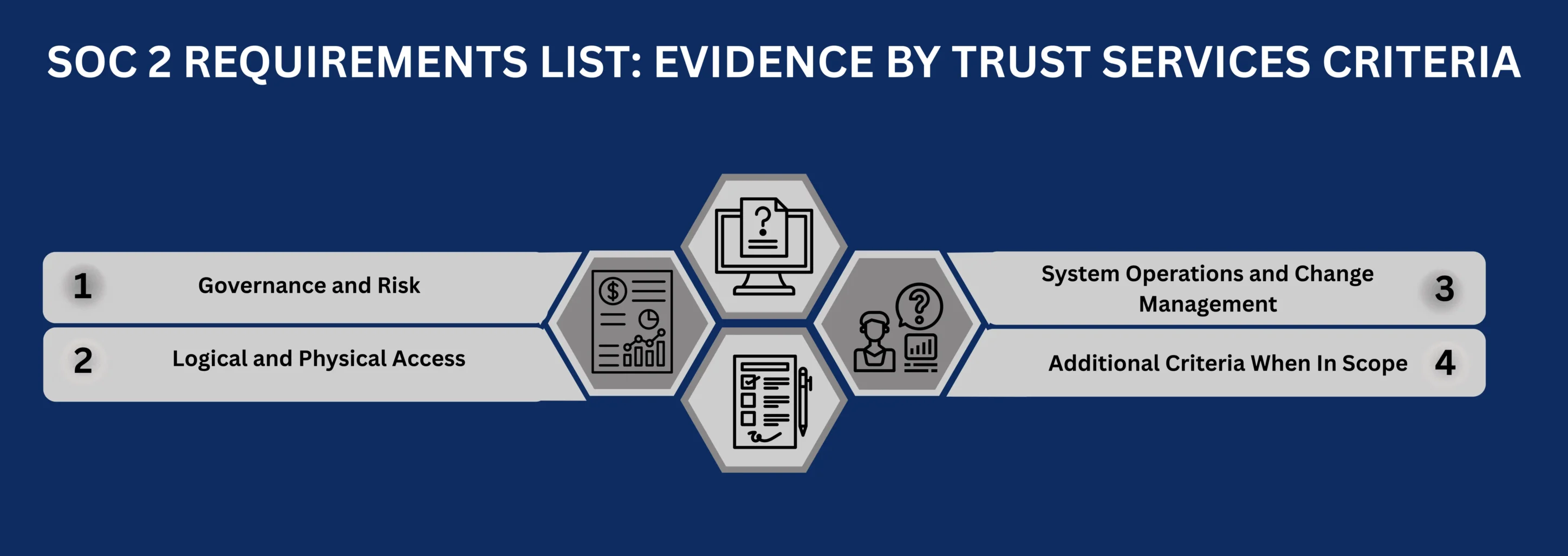
- ✓The Five Trust Services Criteria Categories
- ✓Common Criteria and Supplemental Criteria Structure
SOC 2 Certification Audit Process for Virginia Organizations
The SOC 2 audit process follows a structured sequence of stages governed by AICPA attestation standards. Each stage produces defined outputs that collectively form the evidence base for the Licensed CPA Firm’s attestation opinion. Virginia organizations undertaking a SOC 2 examination — whether a first-time engagement or a recurring annual audit — proceed through the following structured stages.
- Scope Definition: The auditor and management determine which TSC categories apply, identify the systems and infrastructure within the examination boundary, and establish the observation period for Type II engagements. This stage produces a documented scope agreement that governs all subsequent audit activities.
- Audit Program Determination: The Licensed CPA Firm develops specific control tests, evidence requests, and evaluation procedures aligned to the in-scope Trust Services Criteria. The audit program specifies what evidence will be collected, how controls will be tested, and what constitutes sufficient appropriate evidence for each criterion.
- System Description Review: Management prepares a written description of the service organization’s system — covering infrastructure, software, people, procedures, and data. Auditors evaluate the completeness and accuracy of this description as a prerequisite to control testing.
- Stage 1 Audit (Design Evaluation): Auditors evaluate whether controls identified in the system description are suitably designed to meet the applicable Trust Services Criteria. This stage forms the basis for a SOC 2 Type I report and serves as the prerequisite for Type II control testing.
- Observation Period and Control Testing (Type II): For SOC 2 Type II engagements, auditors test controls across the defined observation period — typically six to twelve months — to evaluate operating effectiveness. Testing includes inspection of evidence, inquiry of personnel, observation of processes, and reperformance of control procedures.
- Nonconformity Review: When testing reveals control deficiencies, exceptions, or deviations, auditors document these findings and evaluate their significance. Management responds to identified exceptions, and auditors assess whether exceptions rise to the level of material weaknesses, significant deficiencies, or qualified opinion conditions.
- Certification Decision and Report Drafting: Based on accumulated evidence, the Licensed CPA Firm determines the appropriate audit opinion — unqualified (clean), qualified, adverse, or disclaimer. The report is drafted to include management’s assertion, the auditor’s opinion, the system description, and the description of tests and results.
- Issuance of Attestation Report: The final SOC 2 attestation report is issued under the signature of the Licensed CPA Firm. This report constitutes the formal output of the SOC 2 examination and is distributed to the service organization for sharing with customers, prospects, and enterprise procurement teams under appropriate use restrictions.
The observation period is the defined window of time during which auditors evaluate control operating effectiveness in a SOC 2 Type II engagement. For initial Type II audits, the observation period typically spans six months. For established organizations with prior SOC 2 history, twelve-month observation periods are standard and preferred by enterprise buyers and federal procurement teams. During this period, auditors collect evidence across multiple control categories — examining access logs, change management records, incident response documentation, backup and recovery test results, vendor management records, and personnel security procedures, among other evidence types. The volume and specificity of evidence required for a twelve-month Type II period is substantially greater than for a six-month initial period, reflecting the higher assurance level that a longer observation period provides.
Evidence quality standards in a SOC 2 audit Virginia engagement follow AICPA professional standards for attestation engagements. Auditors evaluate evidence for sufficiency (enough evidence to support conclusions) and appropriateness (relevance and reliability of the evidence). Documentary evidence — such as system-generated logs, approved change records, and vendor contracts — carries higher reliability than inquiry-only evidence. Auditors employ a combination of inquiry, observation, inspection, and reperformance procedures to obtain evidence that meets professional standards. Virginia organizations operating complex technology environments — including multi-cloud architectures, hybrid infrastructure, and distributed development teams — must ensure that evidence collection encompasses all in-scope systems and environments. Gaps in evidence coverage can result in scope limitations or qualified audit opinions.
- ✓Stage-by-Stage SOC 2 Audit Methodology
- ✓Observation Period and Evidence Collection Standards
SOC 2 Certification Requirements for Virginia Organizations
SOC 2 Certification requirements encompass both organizational prerequisites and specific documentation, technical, and operational control standards that must be demonstrated during the examination. Virginia organizations preparing for a SOC 2 audit should understand these requirements across three key dimensions: management responsibilities, documentation requirements, and technical control requirements.
Management of the service organization bears primary responsibility for designing, implementing, and maintaining controls that meet the applicable Trust Services Criteria. In a SOC 2 examination, management provides a written assertion — included in the final report — stating that the system description is fairly presented and that controls meet the relevant criteria. This assertion carries legal and professional weight, as it represents management’s formal representation to the Licensed CPA Firm and to report recipients. Documentation requirements include a complete and accurate system description, documented security policies and procedures, evidence of control operation across the observation period, risk assessment documentation, and records of management review and oversight activities. Incomplete or inaccurate documentation is one of the most common sources of audit exceptions in SOC 2 examinations.
Technical control requirements in a SOC 2 examination address the specific mechanisms by which an organization protects its systems and data. Under the Security (Common Criteria), organizations must demonstrate controls over logical access (user provisioning, authentication, and privilege management), physical access to data centers and offices, network security (firewalls, intrusion detection, and segmentation), change management (testing, approval, and deployment controls), system monitoring and alerting, incident response procedures, and vendor and third-party management. For Virginia data center operators and cloud infrastructure providers — particularly those in Ashburn and Reston — physical security controls receive heightened scrutiny given the critical infrastructure classification of many Northern Virginia facilities. For healthcare technology organizations, Privacy criteria controls address data collection limitation, consent management, data retention, and disposal procedures.
- ✓Logical access controls: user provisioning, role-based access, privileged account management, and periodic access reviews
- ✓Authentication controls: multi-factor authentication for remote access and privileged system access
- ✓Change management: documented approval, testing, and deployment procedures for system and configuration changes
- ✓Risk assessment: formal risk identification and evaluation processes updated at defined intervals
- ✓Incident response: documented procedures for detecting, responding to, and recovering from security incidents
- ✓Vendor management: third-party risk assessment and monitoring for subservice organizations within the system boundary
- ✓Monitoring and alerting: continuous or periodic monitoring of systems for anomalous activity and security events
- ✓Business continuity and disaster recovery: documented and tested procedures for maintaining or restoring operations
- ✓Management Responsibilities and Documentation Requirements
- ✓Technical Control Requirements Across the Trust Services Criteria
SOC 2 Type I and Type II Reports: Structure and Scope
The SOC 2 examination produces two distinct report types that differ in the nature of the assurance they provide. Understanding the structural and substantive differences between SOC 2 Type I and Type II reports is essential for Virginia organizations selecting the appropriate engagement type — and for their customers evaluating the reports received from service providers.
SOC 2 Type I: Point-in-Time Design Assessment
A SOC 2 Type I report expresses the Licensed CPA Firm’s opinion on whether, as of a specific date, the service organization’s controls are suitably designed to meet the applicable Trust Services Criteria. Type I reports do not evaluate whether controls operated effectively over time — they assess design suitability at a single point in the examination. For Virginia organizations new to SOC 2 compliance, a Type I report can serve as an initial milestone that demonstrates control design maturity and supports the transition to a full Type II engagement in the subsequent year. Some enterprise procurement programs accept Type I reports for initial vendor qualification, particularly when a vendor commits to completing a Type II audit within a defined timeframe. However, Type I reports provide substantially less assurance than Type II reports and are not accepted as substitutes in most mature vendor risk management programs.
SOC 2 Type II: Operating Effectiveness Over Time
A SOC 2 Type II report provides the highest level of assurance available through the SOC 2 framework by evaluating both the suitability of control design and the operating effectiveness of those controls across the observation period. The observation period typically spans six to twelve months, during which auditors collect and evaluate evidence of control operation at multiple points in time. For Virginia technology companies competing for enterprise contracts, federal agency work, and regulated-industry clients, a SOC 2 Type II report is effectively a requirement rather than an option. Federal contractors in Northern Virginia, cloud providers in Ashburn, and healthcare IT firms in Richmond routinely provide SOC 2 Type II reports as part of standard vendor qualification packages. The Type II report’s tests-and-results section — which documents specific control tests, the timing of those tests, and any exceptions noted — gives procurement teams detailed evidence they cannot obtain from any other source.
| Feature | SOC 2 Type I | SOC 2 Type II |
|---|---|---|
| Assessment Basis | Point-in-time (single date) | Observation period (6–12 months) |
| Control Evaluation | Design suitability only | Design suitability and operating effectiveness |
| Evidence Collection | As of the report date | Throughout the observation period |
| Market Acceptance | Initial qualification; accepted by limited programs | Standard requirement for enterprise and federal buyers |
| Report Output | System description, management assertion, auditor opinion on design | System description, assertion, opinion, and detailed tests-and-results section |
Industries and Organizations in Virginia Pursuing SOC 2 Certification
SOC 2 Certification in Virginia is pursued across a wide range of industries, driven by the Commonwealth’s extraordinary concentration of technology, defense, healthcare, financial, and government-serving organizations. Virginia’s unique position as the global hub for data center operations — combined with its proximity to federal agencies and defense contractors — creates demand for SOC 2 attestation across virtually every technology-adjacent sector operating in the state.
Technology, Cloud, and Cybersecurity Organizations
Northern Virginia is home to the world’s highest density of data centers, concentrated particularly in Ashburn’s Data Center Alley and extending through Reston, Tysons, and Fairfax. Cloud service providers, colocation operators, managed security service providers (MSSPs), SaaS companies, and AI technology firms operating in this corridor routinely pursue SOC 2 Certification in Virginia as a baseline requirement for enterprise customer acquisition. Cybersecurity firms in the region — including those providing endpoint protection, threat intelligence, security operations center (SOC) services, and identity management solutions — frequently require their own SOC 2 attestation to demonstrate that the security controls protecting their clients’ data environments meet professional standards. For these organizations, SOC 2 attestation is both a commercial differentiator and an operational imperative, as enterprise clients and federal agencies evaluate provider security posture before granting access to sensitive systems and data.
Federal Contractors, Defense, and Government Technology Providers
Virginia’s federal contracting ecosystem — spanning defense technology, intelligence community support, government IT modernization, and civilian agency services — generates substantial demand for SOC 2 audit Virginia engagements. Federal contractors and government technology providers in Arlington, Reston, Fairfax, and Tysons increasingly encounter SOC 2 attestation requirements in federal procurement vehicles, GSA schedule qualifications, and agency-specific vendor security assessments. While FedRAMP and CMMC represent separate compliance frameworks with distinct requirements, SOC 2 attestation Virginia serves as a complementary demonstration of security control maturity that federal procurement officials evaluate alongside framework-specific authorizations. Defense contractors managing sensitive but unclassified information, controlled unclassified information (CUI), or federal contract information (FCI) benefit from SOC 2 certification as part of a multi-framework security posture addressing both commercial and government customer requirements.
Healthcare Technology, Fintech, and Financial Services Organizations
Healthcare technology organizations operating across Virginia — including electronic health record providers, health information exchanges, telehealth platforms, clinical analytics firms, and healthcare revenue cycle management companies — pursue SOC 2 Certification in Virginia to demonstrate security and privacy control maturity to healthcare system clients. SOC 2 attestation complements HIPAA compliance programs by providing independent third-party verification of security controls, though it does not by itself establish HIPAA compliance. Financial technology companies and financial services organizations in Richmond and Northern Virginia — including payment processors, lending platforms, wealth management technology firms, and banking infrastructure providers — pursue SOC 2 compliance Virginia attestation in response to financial institution client requirements, investor due diligence requests, and applicable financial regulatory expectations. SOC 2 Type II reports are routinely requested during financial institution vendor risk assessments and investment due diligence processes.
Benefits of SOC 2 Certification for Virginia-Based Organizations
SOC 2 Certification delivers measurable benefits to Virginia organizations competing across technology, defense, healthcare, financial, and government-serving markets. These benefits extend well beyond regulatory compliance to encompass commercial competitive advantage, risk management maturity, and institutional credibility with enterprise and federal buyers.
SOC 2 certification for Virginia companies creates direct commercial advantages in enterprise sales cycles and procurement qualification processes. Enterprise buyers and institutional clients increasingly require SOC 2 Type II reports as a precondition for vendor selection, contract award, and ongoing engagement renewal. Virginia technology companies that hold current SOC 2 attestation reports progress through enterprise procurement processes faster than those without attestation, as security questionnaire responses supported by a SOC 2 report require substantially less follow-up documentation and security team review time. For Virginia SaaS providers and cloud infrastructure companies competing for enterprise contracts, SOC 2 certification differentiates qualified vendors from those without independent third-party validation of their security controls. In federal contracting markets — where Virginia companies compete intensively for agency IT, cybersecurity, and cloud services contracts — SOC 2 attestation increasingly appears as a listed qualification criterion in Requests for Proposals and vendor qualification packages.
The SOC 2 examination process itself delivers operational benefits by requiring organizations to document, evaluate, and demonstrate their security controls in a structured and evidence-based manner. Organizations that complete SOC 2 audit Virginia engagements typically develop more mature control documentation, stronger evidence management practices, and more disciplined access review and change management processes as a direct consequence of examination requirements. These operational improvements reduce the likelihood and impact of security incidents, strengthen vendor management programs, and create a more defensible security posture when evaluated by insurance underwriters, legal counsel, or regulatory bodies. For Virginia organizations subject to the Virginia Consumer Data Protection Act (VCDPA) or operating under sector-specific regulatory expectations, a mature SOC 2 control environment supports — though does not automatically establish — compliance with applicable data protection requirements. SOC 2 attestation also provides documented evidence of due care in the management of customer data, which can be highly relevant in the event of a data breach or security incident investigation.
- ✓Enterprise vendor qualification: SOC 2 Type II reports satisfy vendor security assessment requirements from Fortune 500 buyers, financial institutions, healthcare systems, and federal agencies
- ✓Accelerated sales cycles: documented third-party attestation reduces the time and resources required to complete enterprise security questionnaires and procurement reviews
- ✓Federal contract competitiveness: SOC 2 attestation supports qualification for federal procurement vehicles, agency IT contracts, and government technology programs
- ✓Cyber insurance positioning: current SOC 2 Type II attestation is increasingly evaluated by cyber insurance underwriters when assessing policy terms and premium rates
- ✓Investor and M&A due diligence: SOC 2 reports are standard documentation requests in Series B and later-stage investment due diligence and technology company acquisition reviews
- ✓Regulatory alignment: a mature SOC 2 control environment supports alignment with VCDPA, HIPAA, financial regulatory, and applicable federal cybersecurity requirements
- ✓Customer trust and transparency: SOC 2 attestation provides customers with independently verified evidence of security control performance, reducing reliance on self-reported security claims
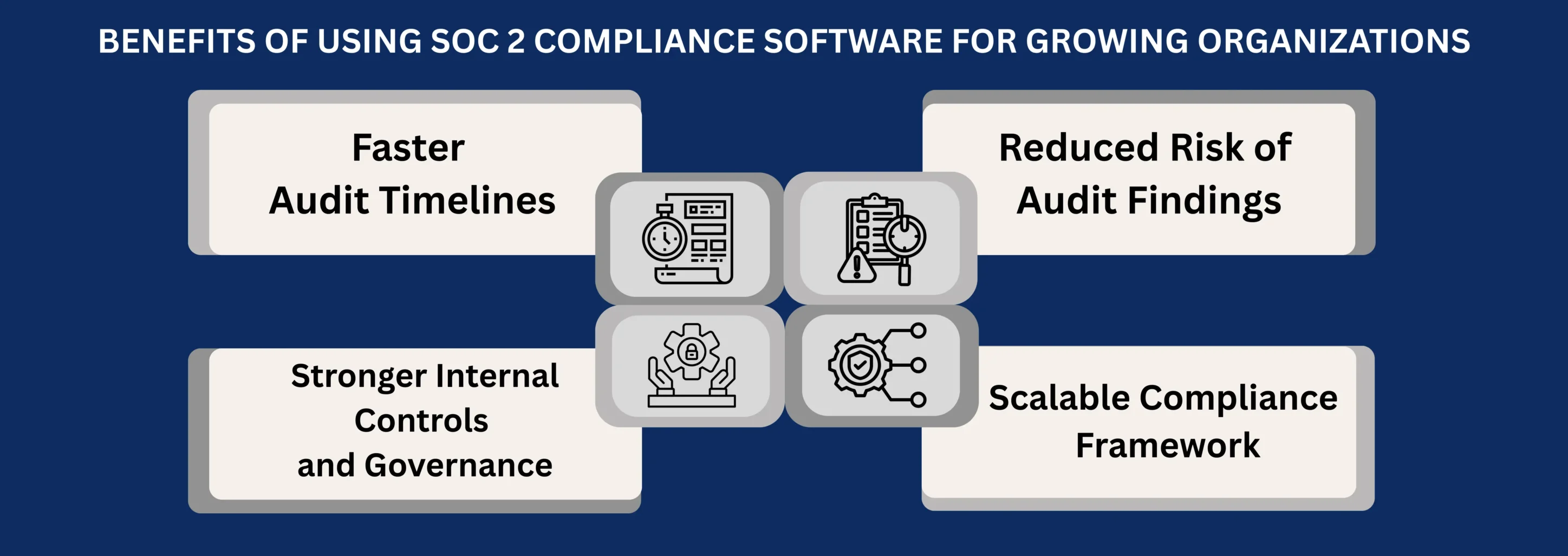
- ✓Commercial and Competitive Advantages
- ✓Risk Management and Operational Benefits
SOC 2 Certification Scope, Recertification, and Ongoing Compliance
SOC 2 Certification is not a one-time achievement. SOC 2 attestation reports cover a defined period and reflect the control environment as evaluated during that period. Enterprise buyers and procurement programs evaluate the currency of SOC 2 reports — most require reports issued within the past twelve months for active vendor qualification. Understanding scope management, recertification timing, and ongoing control monitoring is essential for Virginia organizations maintaining continuous SOC 2 compliance.
Defining and Managing the SOC 2 System Boundary
The SOC 2 system boundary defines which infrastructure, applications, data flows, personnel, and processes are included within the examination scope. For Virginia organizations with complex technology environments — including multi-cloud deployments across AWS, Azure, and Google Cloud; hybrid on-premises and colocation data center configurations; and distributed development and operations teams — establishing an accurate and complete system boundary is a critical first step in every SOC 2 engagement. The system boundary must include all components relevant to the security, availability, integrity, confidentiality, or privacy commitments made to customers. Subservice organizations — third-party vendors that perform functions included within the service organization’s system description — must be addressed either through the inclusive method (requiring the subservice organization’s controls to be tested) or the carve-out method (excluding those controls from the examination and noting the reliance relationship in the report).
Annual Recertification and Report Currency
Organizations must complete annual audit cycles to maintain current SOC 2 certified status and meet customer expectations. A SOC 2 Type II report covers a specific observation period — once that period ends, the report reflects historical control performance rather than current control effectiveness. Enterprise buyers and vendor risk management programs typically require reports with observation periods ending within the past twelve months. Virginia organizations operating in competitive technology markets should plan annual SOC 2 audit schedules that ensure continuous report currency, avoiding gaps between successive observation periods that could trigger customer inquiries or vendor re-qualification requirements. Annual recertification engagements also provide management with recurring independent assessments of control effectiveness, enabling earlier identification of control degradation, configuration drift, or emerging gaps relative to evolving Trust Services Criteria interpretations and industry control expectations.
SOC 2 Certification Compared to Related Compliance Frameworks
Virginia organizations frequently evaluate SOC 2 Certification alongside other compliance frameworks — including ISO 27001, FedRAMP, CMMC, HIPAA, and PCI DSS — as they develop multi-framework security postures to address diverse customer, regulatory, and contractual requirements. Understanding how SOC 2 relates to and differs from these frameworks helps organizations make informed decisions about sequencing, scope, and framework selection.
SOC 2 Versus ISO 27001: Key Structural Differences
SOC 2 and ISO 27001 are both third-party security assurance frameworks but differ significantly in structure, geographic recognition, and commercial application. SOC 2 is a U.S.-originated attestation standard governed by the AICPA, conducted exclusively by Licensed CPA Firms, and structured around the Trust Services Criteria. ISO 27001 is an international certification standard governed by ISO/IEC, issued by accredited certification bodies, and structured around an Information Security Management System (ISMS) framework. SOC 2 is the dominant framework in U.S.-centric enterprise and federal procurement markets — including Virginia’s technology and defense sectors — while ISO 27001 carries stronger recognition in European and international markets. U.S.-focused SaaS companies, cloud providers, and federal contractors in Virginia typically prioritize SOC 2 certification as their primary assurance framework. Organizations serving international markets often pursue both to address the full spectrum of customer requirements across different geographic markets and regulatory environments.
SOC 2 in the Context of FedRAMP, CMMC, and Sector-Specific Frameworks
FedRAMP authorization and CMMC certification address federal-specific security requirements that go beyond SOC 2 scope — they are separate, mandatory frameworks for cloud service providers and defense contractors, respectively, rather than alternatives to SOC 2. Virginia organizations pursuing FedRAMP authorization or CMMC certification typically maintain SOC 2 attestation as a parallel demonstration of general commercial security maturity. For healthcare technology organizations, HIPAA establishes specific regulatory requirements for protected health information that SOC 2 does not independently satisfy — though a SOC 2 examination incorporating the Privacy criteria provides independent evidence of privacy control operation relevant to HIPAA compliance programs. PCI DSS governs payment card data environments and is assessed separately from SOC 2. Virginia organizations with overlapping framework requirements benefit from coordinated audit planning that identifies control testing overlaps across frameworks, reducing redundant evidence collection while maintaining the integrity and independence of each separate examination.
Virginia-Specific Context for SOC 2 Compliance
Virginia’s regulatory environment, technology ecosystem, and federal market concentration create a distinct context for SOC 2 compliance Virginia engagements that differs from other U.S. markets. Organizations pursuing SOC 2 Certification in Virginia should understand the state-specific legal, regulatory, and commercial factors that shape the demand for — and application of — SOC 2 attestation across the Commonwealth.
Virginia Consumer Data Protection Act and Data Breach Notification
The Virginia Consumer Data Protection Act (VCDPA), effective January 2023, establishes data protection obligations for controllers and processors of Virginia residents’ personal data, including requirements for data minimization, purpose limitation, security practices, and consumer rights. The VCDPA does not mandate SOC 2 attestation, but the security controls evaluated in a SOC 2 examination — particularly those addressing the Confidentiality and Privacy Trust Services Criteria — align closely with VCDPA security obligations. Virginia’s data breach notification statute requires organizations to notify affected individuals and the Attorney General’s office promptly following a breach of personal information. Organizations with mature SOC 2 control environments, including documented incident response and monitoring controls tested through a SOC 2 audit, are better positioned to detect, contain, and respond to security incidents in a manner consistent with Virginia’s notification requirements. SOC 2 attestation does not automatically establish VCDPA compliance, but it provides independent evidence of security program maturity relevant to regulatory and legal evaluations following a security incident.
Northern Virginia’s Data Center and Cloud Infrastructure Ecosystem
Northern Virginia’s data center ecosystem — concentrated in Ashburn’s Data Center Alley and expanding through Manassas, Gainesville, and Loudoun County — represents the world’s largest aggregation of internet exchange points, hyperscale data centers, and colocation facilities. Organizations operating within this ecosystem face consistent SOC 2 attestation requirements from colocation clients, cloud service consumers, and enterprise data center customers who require independent verification of physical security, environmental controls, availability controls, and logical access management. SOC 2 examination Virginia engagements for data center operators typically emphasize physical security controls, environmental monitoring (power, cooling, and environmental sensors), availability and redundancy controls, logical access segregation between customers, and change management procedures for critical infrastructure. The density and criticality of Northern Virginia’s data center infrastructure makes it one of the most active markets for SOC 2 audit firms in Virginia, with annual and biannual examination cycles common across large colocation and hyperscale operators.
Independent SOC 2 Certification by a Licensed CPA Firm in Virginia
CertPro CPA LLC is a Licensed CPA Firm conducting independent SOC 2 examinations for organizations across Virginia under the AICPA Trust Services Criteria and applicable attestation standards. CertPro’s SOC 2 examination Virginia engagements serve technology companies, cloud providers, cybersecurity firms, AI organizations, fintech businesses, healthcare technology providers, federal contractors, data center operators, and enterprises handling sensitive customer data across Northern Virginia, Richmond, Virginia Beach, and the broader Commonwealth.
Attestation Authority and Independence Standards
SOC 2 attestation can only be issued by a Licensed CPA Firm that meets AICPA independence requirements and holds the professional qualifications required to conduct attestation engagements under AT-C Section 205. CertPro CPA LLC maintains full independence from the organizations it examines — meaning CertPro does not provide consulting, implementation, remediation, policy development, or control design services to organizations for which it conducts SOC 2 examinations. This independence is fundamental to the credibility and market acceptance of SOC 2 reports: enterprise buyers, federal agencies, and institutional clients rely on the CPA firm’s independence as the basis for trusting the attestation opinion. Organizations that receive SOC 2 reports from non-CPA entities or vendors that also provide consulting services to the examined organization should be aware that such reports do not constitute valid SOC 2 attestation under AICPA professional standards.
SOC 2 Examination Services Across Virginia’s Technology Markets
CertPro conducts SOC 2 examinations for organizations of all sizes across Virginia’s technology and business ecosystem. For SOC 2 compliance Virginia technology companies — including established enterprises and growth-stage providers — CertPro applies structured audit methodologies appropriate to the organization’s system complexity, control environment maturity, and selected Trust Services Criteria. SOC 2 examination engagements are conducted on a defined schedule aligned to the organization’s observation period and business calendar, ensuring that report issuance timing supports annual vendor qualification cycles and enterprise procurement timelines. CertPro issues SOC 2 Type I and SOC 2 Type II reports under the Licensed CPA Firm’s professional standards, providing Virginia organizations with attestation documentation recognized by enterprise procurement programs, federal agencies, financial institution vendor risk teams, and institutional buyers across domestic and international markets.
FAQ
▶
What is SOC 2 Certification in Virginia?
▶
What is SOC 2 Certification in Virginia and who conducts it?
▶
How long does a SOC 2 audit take for Virginia organizations?
▶
Which Trust Services Criteria should Virginia organizations include in their SOC 2 scope?
▶
How does SOC 2 attestation differ from SOC 2 compliance?
▶
Does SOC 2 certification establish VCDPA or HIPAA compliance for Virginia organizations?
▶
How often must Virginia organizations renew their SOC 2 certification?
▶
What is the difference between SOC 2 and ISO 27001 for Virginia technology companies?
SOC 1 VS SOC 2: WHICH REPORT YOUR CUSTOMERS ACTUALLY ASK FOR
If you sell SaaS or provide outsourced services, you have likely been asked for a SOC report. However, the follow-up question is rarely easy to answer…

AICPA Issues New Guidance for Peer Reviewers Evaluating SOC 2 Engagements
AICPA SOC 2 guidance has been issued to help peer reviewers identify quality risks associated with SOC 2 engagements as the use of compliance automati…
SOC 2 Certified: What Does It Mean for Your Business
For companies that handle sensitive data or run cloud-based services, the question “Can you provide your SOC 2 report?” carries enormous weight. Yet, …
Get In Touch
have a question? let us get back to you.