
ISO 42001 Certification in Virginia
ISO 42001 compliance requires organizations to establish a documented Artificial Intelligence Management System that addresses the requirements of all applicable clauses of ISO/IEC 42001:2023. The AIMS framework integrates AI governance into organizational management structures, connecting AI risk management to business objectives, leadership accountability, and operational controls. Understanding what the standard requires is foundational to pursuing ISO 42001 Certification in Virginia. CertPro’s ISO 42001 assessment evaluates conformity against each of the requirement areas described below.
OUR CLIENTS








What Is ISO 42001 and Why Does It Matter for Virginia Organizations?
ISO 42001 Certification in Virginia is the independently verified confirmation that an organization’s Artificial Intelligence Management System (AIMS) conforms to ISO/IEC 42001:2023 — the first internationally recognized standard specifying requirements for establishing, implementing, maintaining, and continually improving an AIMS. Published by the International Organization for Standardization in 2023, the ISO AIMS standard provides a structured framework for AI governance, risk management, human oversight, transparency, accountability, and data governance across the full AI system lifecycle. For Virginia organizations that develop, provide, integrate, or deploy AI systems, certification under this standard delivers independently verified evidence of responsible AI system management.
Virginia occupies a singular position in the United States technology landscape. Northern Virginia hosts the world’s largest concentration of data centers, anchoring global cloud infrastructure for major hyperscale providers. The state’s dense corridor of federal contractors, defense and aerospace organizations, cybersecurity firms, and government technology providers extends from Arlington and Alexandria through Reston, Tysons, Fairfax, and Ashburn. Richmond supports a growing fintech and financial services sector, while Virginia Beach anchors a regional technology and defense ecosystem.
Across the Commonwealth, organizations are actively developing and deploying AI systems in contexts that carry significant governance, security, privacy, and accountability obligations. ISO 42001 Certification in Virginia addresses these obligations through a structured management system framework — not through isolated technical controls.
The ISO AIMS standard applies to any organization regardless of size, sector, or the nature of its AI involvement. This includes AI developers building foundation models or application-layer systems, SaaS providers embedding AI features into products, cloud service providers offering AI infrastructure, healthcare technology companies using AI for diagnostics or operational decisions, and enterprises integrating AI into procurement, hiring, fraud detection, or customer engagement.
Virginia’s concentration of federal contractors subject to emerging U.S. federal AI governance requirements makes ISO/IEC 42001:2023 particularly relevant. ISO 42001 certification provides a documented, audited management system that aligns with frameworks including the NIST AI Risk Management Framework (AI RMF). Note that ISO 42001 certification does not automatically establish compliance with applicable laws or regulations — including the Virginia Consumer Data Protection Act (VCDPA) or U.S. federal AI governance requirements — but it demonstrates structured governance aligned with recognized international standards.
CertPro operates as a Licensed CPA Firm providing independent third-party ISO 42001 certification audit services in Virginia. As a certification body, CertPro conducts structured conformity assessments against the requirements of ISO/IEC 42001:2023, evaluating the design, implementation, and operating effectiveness of an organization’s AIMS. CertPro does not provide consulting, implementation, or advisory services — its role is exclusively that of an independent certification body conducting structured audit and assessment activities.
Organizations seeking ISO 42001 Certification in Virginia through CertPro receive an objective, evidence-based evaluation conducted by qualified auditors with demonstrated competence in AI governance, AI risk management, and management system auditing. The result is a certification that carries institutional credibility with clients, regulators, procurement authorities, and AI governance stakeholders across Virginia’s diverse technology ecosystem.

What Is ISO 42001 Certification?
ISO 42001 certification is the formal confirmation — issued by an accredited or independent certification body — that an organization’s Artificial Intelligence Management System conforms to the requirements specified in ISO/IEC 42001:2023. Certification is achieved following a structured ISO 42001 audit process that evaluates documented policies, risk treatment plans, control implementation, internal audit records, management review outputs, and evidence of continual improvement.
Unlike self-declarations of conformity, ISO 42001 certification involves an independent third-party assessment that produces a verifiable, time-bound certificate with defined surveillance and recertification obligations. For Virginia technology companies and AI system operators, certification signals that AI governance is embedded in organizational processes — not treated as an ad hoc compliance activity.
The ISO/IEC 42001:2023 Standard Structure
ISO/IEC 42001:2023 follows the High-Level Structure (HLS) common to ISO management system standards, comprising ten clauses and two normative annexes. Clauses 1 through 3 establish scope, normative references, and terms and definitions. Clauses 4 through 10 specify operational requirements: context of the organization, leadership, planning, support, operation, performance evaluation, and improvement.
Annex A provides a reference set of AI-specific controls organized into domains including AI policies, internal organization, AI risk management, AI system impact assessment, AI system lifecycle management, data for AI, information for interested parties, and use of AI by external parties. Annex B provides implementation guidance for the Annex A controls. Organizations must prepare a Statement of Applicability (SoA) identifying which Annex A controls are applicable, implemented, or excluded — along with justifications for any exclusions.
The High-Level Structure of ISO/IEC 42001:2023 enables integration with other management system standards that Virginia organizations commonly hold. ISO 27001 for information security management, ISO 9001 for quality management, and ISO 31000 for risk management share compatible clause structures. This allows organizations to align policies, roles, internal audit programs, and management review processes rather than building entirely separate systems.
This structural alignment reduces administrative burden while enabling a coordinated approach to AI governance, information security, and organizational risk management. For Virginia federal contractors and defense organizations already operating under CMMC, FedRAMP, or NIST CSF frameworks, the ISO AIMS standard’s structured approach supports coherent governance without displacing existing management system investments.
Who Needs ISO 42001 Certification in Virginia?
ISO 42001 certification applies to any organization that develops, provides, integrates, uses, or decommissions AI systems where those systems have a material impact on organizational operations, customers, or third parties. In Virginia, this encompasses a wide range of organizations: AI software developers and data science firms building machine learning models; cloud infrastructure providers operating AI platforms; SaaS companies embedding AI-driven features; cybersecurity vendors using AI for threat detection and automated response; healthcare technology organizations deploying AI in clinical or administrative contexts; fintech companies using AI for credit decisioning, fraud detection, or compliance monitoring; and government technology contractors deploying AI in federal agency workflows. Universities and research organizations in Virginia that develop AI systems for external deployment also fall within the standard’s scope.
Organizations that use AI systems provided by third parties — without developing them internally — are also within scope when those systems influence significant operational, financial, or compliance decisions. Virginia enterprises that integrate AI tools into hiring processes, contract management, procurement, or customer-facing interactions carry governance obligations that the ISO AIMS standard addresses through its external party controls and AI system impact assessment requirements.
ISO 42001 Certification in Virginia is relevant regardless of whether AI is the organization’s primary product or an embedded operational capability. The standard addresses both contexts through a scalable management system framework that can be calibrated to the organization’s specific AI activities, risk profile, and objectives.
ISO 42001 Certification Audit Process in Virginia
The ISO 42001 certification audit process in Virginia follows a structured sequence of evaluation stages designed to provide independent assurance that an organization’s AIMS conforms to ISO/IEC 42001:2023. CertPro, as a Licensed CPA Firm and independent certification body, conducts the ISO 42001 certification audit Virginia organizations undergo in accordance with established audit and attestation standards. The process is evidence-based and structured, producing documented findings at each stage. The following outlines the defined stages of the ISO 42001 certification audit process in Virginia.
- Scope Definition: The organization defines the AIMS boundary, specifying which AI systems, organizational units, and processes fall within the certification scope, documented in the AIMS scope statement.
- Audit Program Determination: CertPro determines the audit program, audit team composition, and audit objectives based on the defined scope, complexity of AI systems, and applicable Annex A controls.
- Stage 1 Audit (Documentation Review): CertPro auditors evaluate the AIMS documentation — including the AIMS scope, AI policy, risk assessment methodology, Statement of Applicability, objectives, and internal audit records — to determine readiness for Stage 2.
- Stage 1 Findings Review: Identified documentation gaps or areas requiring clarification are communicated to the organization. The Stage 1 output determines whether the organization is prepared to proceed to Stage 2.
- Stage 2 Audit (Operational Effectiveness): CertPro conducts an on-site or remote operational audit evaluating the implementation and operating effectiveness of AIMS controls, risk treatment plans, management review processes, and continual improvement activities.
- Nonconformity Review: Any major or minor nonconformities identified during Stage 2 are documented. Major nonconformities must be resolved before certification is issued; minor nonconformities require a documented corrective action plan.
- Certification Decision: CertPro’s certification decision process reviews Stage 1 and Stage 2 findings, nonconformity resolutions, and audit evidence to determine whether ISO/IEC 42001:2023 conformity is demonstrated.
- Issuance of Certification: Upon a positive certification decision, CertPro issues the ISO 42001 certificate specifying the certified scope, certificate validity period (typically three years), and applicable standard.
- Surveillance Audits and Recertification: Annual surveillance audits verify ongoing AIMS conformity and continual improvement. A full recertification audit is conducted at the end of the three-year certification cycle.
The Stage 1 ISO 42001 audit evaluates the organization’s AIMS documentation to determine whether the management system has been adequately designed and documented prior to operational assessment. CertPro auditors review the AIMS scope statement, AI policy, risk assessment and risk treatment documentation, Statement of Applicability with control justifications, AI objectives and metrics, internal audit program records, management review documentation, and evidence of support processes — including competence, awareness, and communication.
The Stage 1 audit does not evaluate operational effectiveness. Its purpose is to establish whether the documented system is sufficient to support a meaningful Stage 2 assessment. Findings from Stage 1 are communicated through a formal report identifying areas of concern that the organization must address before Stage 2 proceeds.
The Stage 2 ISO 42001 certification audit assesses whether the AIMS is implemented and operating effectively in accordance with the documented design and the requirements of ISO/IEC 42001:2023. CertPro auditors evaluate AI risk assessment and treatment processes against actual AI system inventories, review AI system impact assessment records, test the operation of applicable Annex A controls, examine incident management and corrective action records, and interview personnel responsible for AI governance activities.
The ISO 42001 audit Virginia organizations undergo at Stage 2 produces detailed findings organized by clause and control domain. Nonconformities are classified as major — requiring resolution before certification is issued — or minor, requiring documented corrective action plans. The Stage 2 audit output constitutes the primary evidence base for the certification decision.
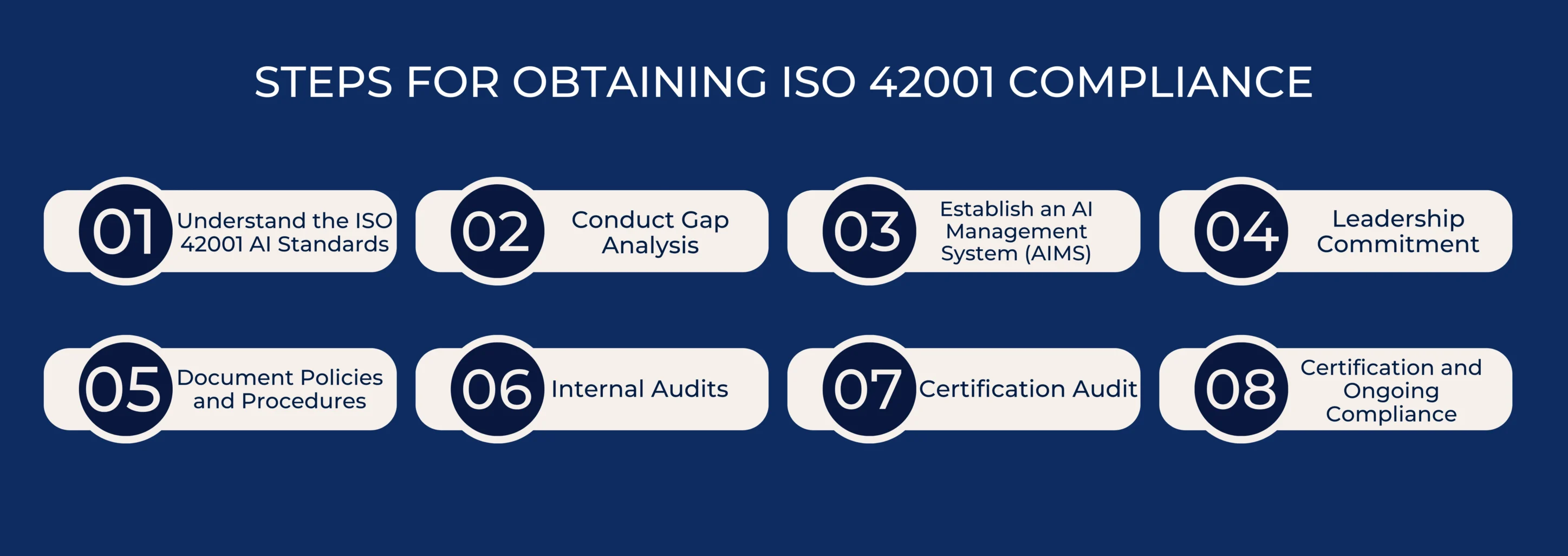
- ✓Stage 1 Audit: AIMS Documentation Evaluation
- ✓Stage 2 Audit: Operational Conformity Assessment
ISO 42001 Certification Requirements and AIMS Framework
ISO 42001 compliance requires organizations to establish a documented Artificial Intelligence Management System that addresses the requirements of all applicable clauses of ISO/IEC 42001:2023. The AIMS framework integrates AI governance into organizational management structures, connecting AI risk management to business objectives, leadership accountability, and operational controls. Understanding what the standard requires is foundational to pursuing ISO 42001 Certification in Virginia. CertPro’s ISO 42001 assessment evaluates conformity against each of the requirement areas described below.
Clause 4 requires organizations to determine the internal and external factors that affect their ability to achieve AIMS objectives, identify interested parties and their requirements, and define the AIMS scope. For Virginia organizations, relevant contextual factors include applicable privacy requirements under the VCDPA, U.S. federal AI governance expectations, contractual requirements from federal agency clients, and sector-specific regulations governing AI use in healthcare, financial services, or defense.
Clause 5 establishes leadership requirements: top management must demonstrate commitment to the AIMS, establish a documented and communicated AI policy, and assign roles and responsibilities for AI governance. The AI policy must address the organization’s approach to responsible AI, ethical AI development, human oversight, and continual improvement.
Clause 6 specifies planning requirements, including AI risk assessment and risk treatment. Organizations must establish a documented AI risk assessment process that identifies AI-related risks and opportunities, evaluates risk levels against defined criteria, and determines appropriate risk treatment options. Risk treatment plans must specify the controls to be implemented, the responsible parties, and implementation timelines.
Organizations must also establish measurable AI objectives that are consistent with the AI policy, aligned with business objectives, and monitored through defined performance indicators. The planning clause requires explicit linkage between identified AI risks, selected Annex A controls, the Statement of Applicability, and documented AI objectives — a requirement that CertPro’s ISO 42001 assessment evaluates through review of risk treatment documentation and the SoA.
Clause 7 addresses support requirements including competence, awareness, communication, and documented information. Organizations must ensure that personnel involved in AI system development, deployment, and governance possess appropriate competence — documented through training records, qualifications, or experience evidence. Awareness programs must ensure that relevant personnel understand the AI policy, their contribution to AIMS objectives, and the consequences of non-conformity.
Clause 8 specifies operational requirements, including the planning and control of processes needed to meet AIMS requirements, the conduct of AI risk assessments, the implementation of risk treatment plans, and the management of changes to AI systems and processes. AI system impact assessments — evaluating potential effects on individuals, groups, and society — are an operational requirement that must be documented and periodically reviewed.
Clause 9 requires performance evaluation through monitoring, measurement, internal audits, and management review. Internal audits must be conducted at planned intervals to assess AIMS conformity and effectiveness, with documented audit programs, findings, and corrective actions. Management reviews must address AIMS performance, audit results, corrective actions, AI risk treatment status, and opportunities for continual improvement.
Clause 10 addresses improvement — requiring organizations to respond to nonconformities with corrective actions and to pursue continual improvement of the AIMS. CertPro’s ISO 42001 compliance assessment evaluates performance evaluation evidence including internal audit reports, management review minutes, corrective action records, and evidence of improvement activities across the certification period.
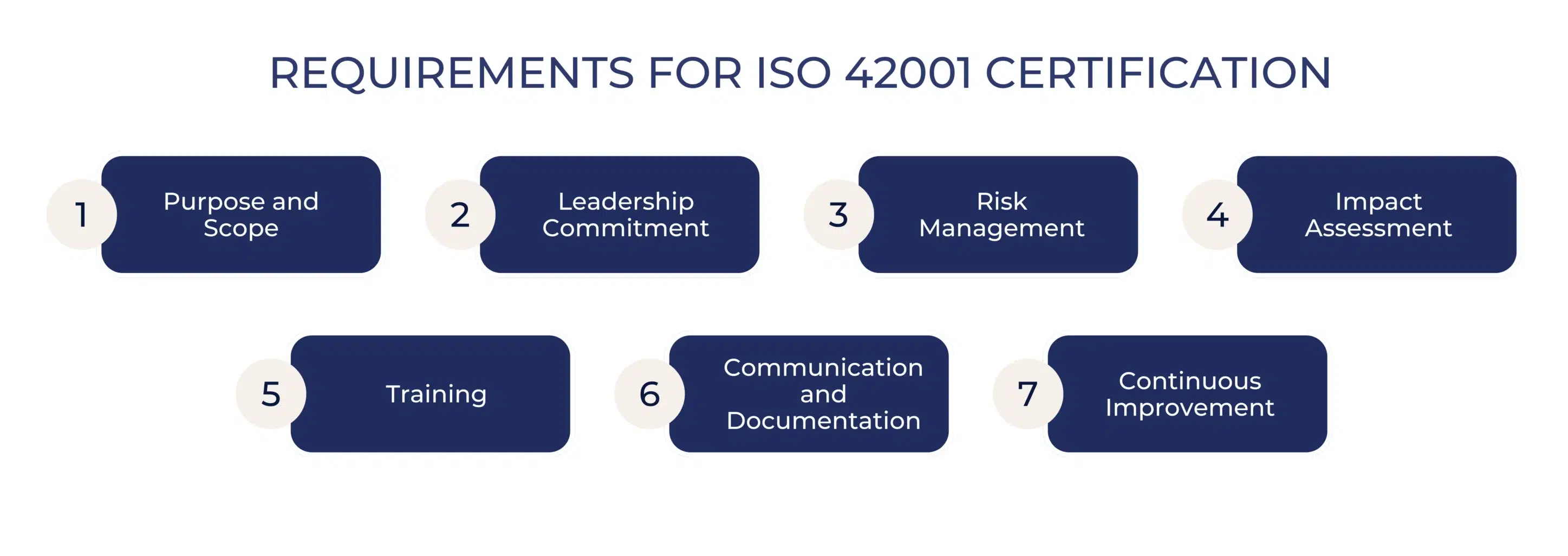
- ✓Context, Leadership, and Planning Requirements
- ✓Support, Operation, and Performance Evaluation Requirements
ISO 42001 Compliance: Key Clauses and Control Domains
ISO 42001 compliance is operationalized through the implementation of applicable controls drawn from Annex A of ISO/IEC 42001:2023. Annex A organizes AI-specific controls into nine control domains, providing a structured reference set that organizations must evaluate for applicability in their Statement of Applicability. The following table summarizes the Annex A control domains and their primary governance focus areas.
| Annex A Control Domain | Primary Governance Focus |
|---|---|
| A.2 – Policies for AI | Establishing and maintaining documented AI policies that govern responsible AI development and deployment across the organization |
| A.3 – Internal Organization | Defining roles, responsibilities, and accountability structures for AI governance and AIMS management |
| A.4 – Resources for AI Systems | Managing the data, compute, personnel, and tools required for AI system operation and governance |
| A.5 – AI System Impact Assessment | Evaluating potential impacts of AI systems on individuals, groups, organizations, and society prior to deployment |
| A.6 – AI System Lifecycle | Governing AI system design, development, testing, deployment, monitoring, maintenance, and decommissioning |
| A.7 – Data for AI | Ensuring data quality, provenance, governance, and protection across AI system training and operational data pipelines |
| A.8 – Information for Interested Parties | Providing transparent information about AI systems to customers, users, regulators, and other stakeholders |
| A.9 – Use of AI by Affected Parties | Managing how external parties and end users interact with and rely upon AI system outputs |
AI System Lifecycle Controls
Annex A.6 addresses the AI system lifecycle, establishing controls for each phase of AI system development and operation. Organizations must document and implement controls for AI system design — specifying intended use, performance requirements, and ethical considerations. Development controls address model training, validation, and testing procedures. Deployment controls govern how AI systems are released into operational environments, including human oversight mechanisms and escalation procedures.
Monitoring controls require ongoing evaluation of AI system performance against defined metrics, with defined thresholds for intervention. Decommissioning controls address the responsible retirement of AI systems, including data deletion and model disposal. For Virginia AI developers and SaaS providers, the lifecycle controls in Annex A.6 translate directly into documented development processes, version control, model validation records, and deployment authorization evidence — all evaluated during the ISO 42001 audit.
Data Governance and Transparency Controls
Annex A.7 data controls and Annex A.8 transparency controls address two of the most significant AI governance challenges for Virginia organizations. Data controls require documented processes for evaluating data quality, managing data provenance, addressing data bias, and governing personal data used in AI system training and operation. For Virginia organizations subject to the VCDPA, these data governance controls intersect with privacy obligations — though ISO 42001 certification does not establish VCDPA compliance.
Transparency controls in Annex A.8 require organizations to document and communicate meaningful information about AI systems to customers, procurement authorities, and regulators. This includes information about AI system capabilities and limitations, intended use cases, performance characteristics, and human oversight mechanisms. Virginia federal contractors and government technology providers face particular expectations around AI transparency from agency clients, making these controls directly relevant to procurement positioning and competitive differentiation.
ISO 42001 Assessment: What Organizations Must Demonstrate
The ISO 42001 assessment conducted by CertPro evaluates whether an organization can produce documented, objective evidence of AIMS conformity across all applicable clauses and Annex A controls. The ISO 42001 assessment Virginia organizations undergo requires demonstration across six primary evidence categories, each addressed systematically during the certification audit process.
Documented Information and Evidence Requirements
ISO/IEC 42001:2023 specifies mandatory documented information that organizations must maintain and retain as evidence of AIMS operation. Mandatory documentation includes the AIMS scope statement, AI policy, AI risk assessment results and risk treatment plan, Statement of Applicability, AI objectives and monitoring records, internal audit program and audit reports, management review records, and corrective action records. Organizations must also maintain evidence of competence for personnel with AI governance responsibilities, communication records, and operational process documentation.
During the ISO 42001 assessment, CertPro auditors review this documented information to evaluate whether records are complete, current, controlled, and consistent with the organization’s stated AIMS design. Document control processes — version management, access controls, and retention schedules — are themselves evaluated as AIMS support requirements under Clause 7.5.
Beyond mandatory documented information, organizations must produce evidence of operational control — demonstrating that documented processes are executed consistently in practice. This includes AI system impact assessment records for each in-scope AI system, risk treatment implementation evidence, change management records for AI system updates, incident and nonconformity records, and supplier and third-party AI governance documentation.
Virginia organizations that deploy AI systems developed by external vendors must demonstrate how third-party AI governance obligations are managed — including contractual requirements, performance monitoring, and access to necessary information about vendor AI systems. CertPro’s ISO 42001 compliance assessment evaluates operational evidence through document review, personnel interviews, and examination of system records and process outputs.
AI Risk Management Demonstration
Demonstrating a functioning AI risk management process is central to the ISO 42001 assessment. Organizations must show that AI risks are systematically identified against a defined risk assessment methodology, that risk levels are evaluated against established criteria, and that risk treatment decisions are documented and implemented. The risk assessment must address AI-specific risk sources including model bias and fairness concerns, explainability limitations, data quality and provenance risks, adversarial attack vulnerabilities, unintended use or misuse risks, and impacts on privacy and human rights.
Risk treatment plans must link identified risks to specific Annex A controls, responsible parties, implementation timelines, and residual risk acceptance decisions. The ISO 42001 audit evaluates whether the risk management process produces actionable outputs reflected in operational AI governance activities — not merely in documentation.
Benefits of ISO 42001 Certification for Virginia-Based Organizations
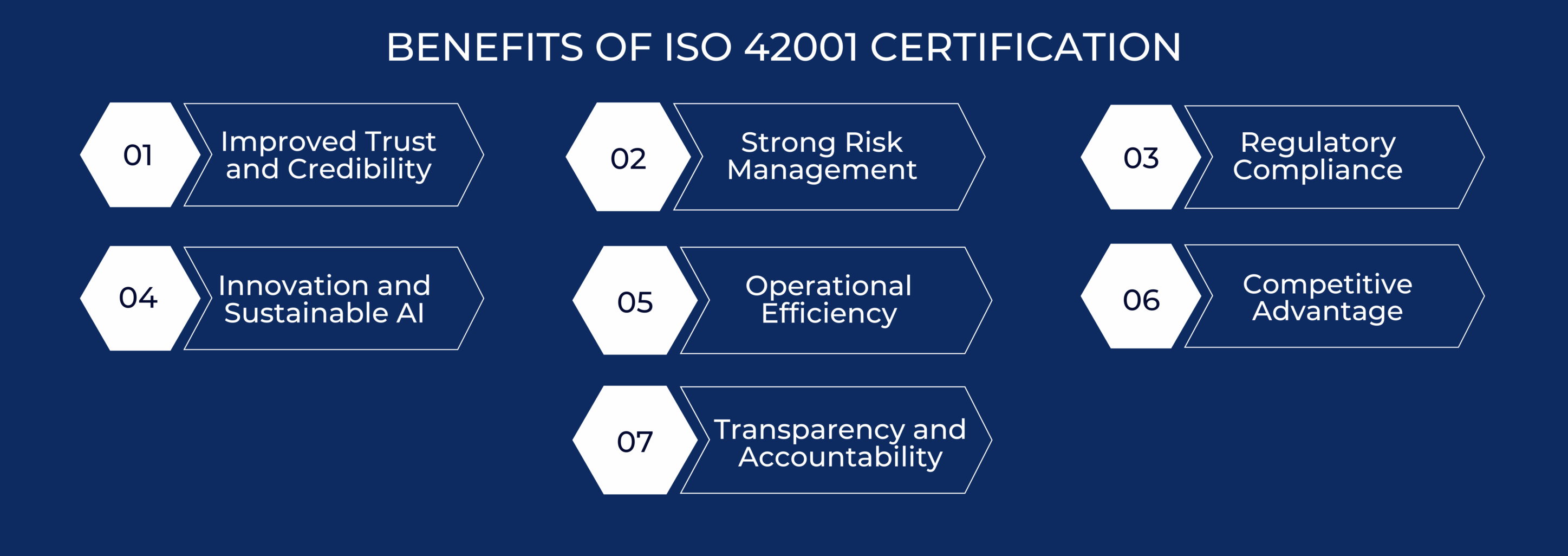
ISO 42001 Certification in Virginia delivers measurable organizational benefits across commercial, operational, regulatory, and reputational dimensions. For Virginia organizations operating in competitive technology markets, federal contracting environments, and regulated industries, certification under the ISO AIMS standard provides independently verified differentiation that self-assessments and internal attestations cannot replicate.
- ✓Independent verification of AIMS conformity that carries credibility with federal agency clients, enterprise procurement teams, and regulatory bodies evaluating AI governance maturity
- ✓Structured AI risk management framework that identifies, evaluates, and treats AI-specific risks across the full AI system lifecycle — reducing the probability of AI system failures, bias incidents, and unintended consequences
- ✓Documented accountability structures that assign clear roles and responsibilities for AI governance, supporting organizational accountability obligations under emerging U.S. federal and state AI governance expectations
- ✓Alignment with the NIST AI Risk Management Framework (AI RMF) through mapped controls, supporting organizations that must demonstrate AI governance maturity to U.S. federal agency clients or partners
- ✓Competitive differentiation in Virginia’s technology procurement markets, where federal contractors, cloud providers, and AI vendors increasingly face AI governance due diligence requirements
- ✓Integration with existing ISO 27001 and ISO 9001 management systems through the shared High-Level Structure, reducing governance duplication and enabling coordinated internal audit programs
- ✓Documented evidence base for AI transparency obligations — enabling organizations to respond to customer, regulator, and stakeholder inquiries about AI system governance with reference to a certified management system
- ✓Defined surveillance and recertification cycle that drives continual improvement of AI governance processes, ensuring the AIMS evolves as AI systems and organizational AI activities develop
Virginia’s federal contracting community represents one of the most significant sectors pursuing ISO 42001 certification. Federal agencies and prime contractors in the defense, intelligence, and civilian agency technology sectors are increasingly requiring documented evidence of AI governance maturity from technology vendors and AI system providers. ISO 42001 Certification in Virginia provides a recognized, independently audited credential that can be referenced in contract proposals, vendor qualification processes, and supplier due diligence reviews.
For Northern Virginia and Arlington-based defense contractors, systems integrators, and government technology companies, certification demonstrates that AI systems deployed in federal contexts are governed by a documented management system with defined risk assessment, human oversight, and accountability structures — directly addressing considerations relevant to agency AI governance requirements and executive branch AI policy developments.
Beyond external market benefits, ISO 42001 Certification in Virginia drives internal operational improvements that reduce AI-related risks across the organization. The AIMS framework requires organizations to systematically identify AI risks before systems are deployed, implement documented controls to treat those risks, and monitor AI system performance against defined criteria. This structured approach reduces the probability of AI system failures, algorithmic bias incidents, data quality problems, and unintended AI outputs that carry reputational, legal, and financial consequences.
For Virginia healthcare technology companies and fintech organizations where AI system errors carry direct harm potential, the operational discipline imposed by the ISO AIMS standard’s lifecycle and impact assessment controls provides governance infrastructure that isolated technical testing cannot replicate. Management review requirements ensure that AI governance remains visible at executive and board levels — not confined to technical teams alone.
- ✓Federal Contracting and Procurement Advantages
- ✓Operational Risk Reduction and AI Governance Maturity
Business Sectors in Virginia Seeking ISO 42001 Certification
ISO 42001 certification for Virginia companies spans the full breadth of the Commonwealth’s technology and business ecosystem. Virginia’s unique concentration of cloud infrastructure, federal contracting, cybersecurity, defense, healthcare technology, and financial services creates a diverse population of organizations with AI governance certification needs that the ISO AIMS standard addresses directly.
| Virginia Business Sector | AI Governance Drivers | Relevant ISO 42001 Controls |
|---|---|---|
| Cloud and Data Center Operators (Ashburn, Northern Virginia) | AI service delivery, hyperscale infrastructure AI integration, multi-tenant AI governance | A.3 Internal Organization, A.6 AI Lifecycle, A.8 Transparency |
| Federal Contractors and Defense Organizations (Arlington, Fairfax, Reston) | Federal AI governance requirements, agency procurement due diligence, national security AI systems | A.2 AI Policies, A.5 Impact Assessment, A.6 AI Lifecycle |
| Cybersecurity Firms (Northern Virginia, Tysons) | AI-driven threat detection, automated response systems, AI model security and adversarial risk management | A.4 Resources, A.6 AI Lifecycle, A.7 Data Governance |
| Healthcare Technology Companies (Richmond, Northern Virginia) | Clinical AI systems, diagnostic AI governance, patient safety, HIPAA-adjacent AI compliance | A.5 Impact Assessment, A.6 AI Lifecycle, A.7 Data Governance |
| Fintech and Financial Services (Richmond, Virginia Beach) | AI credit decisioning, fraud detection, algorithmic fairness, regulatory AI governance requirements | A.5 Impact Assessment, A.8 Transparency, A.9 Affected Parties |
AI and Technology Companies in Northern Virginia
Northern Virginia’s technology corridor — anchored by Reston, Tysons, Fairfax, and Ashburn — hosts a dense population of AI software developers, SaaS providers, cloud service companies, and AI platform operators. Organizations in this corridor develop and deploy AI systems across a wide range of applications including natural language processing, computer vision, predictive analytics, autonomous decision support, and AI-driven automation.
ISO 42001 Certification in Virginia provides these organizations with a certified AIMS that demonstrates responsible AI development and deployment practices to enterprise clients, government procurement officers, and international customers. As global AI governance expectations tighten — driven by the EU AI Act, NIST AI RMF, and emerging U.S. federal AI requirements — Virginia technology companies holding ISO 42001 certification are positioned to meet due diligence requirements without delays in commercial or government procurement cycles.
Universities, Research Organizations, and AI Startups
Virginia’s research universities and AI startup ecosystem represent an emerging segment of ISO 42001 Certification in Virginia demand. University technology transfer offices and research organizations deploying AI systems for external use — in partnership with government agencies, healthcare systems, or commercial partners — face governance obligations that the ISO AIMS standard directly addresses. AI startups based in Virginia’s innovation hubs seeking enterprise contracts or federal agency partnerships increasingly encounter AI governance certification requirements in vendor qualification processes.
Early-stage ISO 42001 certification under ISO/IEC 42001:2023 establishes governance infrastructure that scales with organizational growth, avoiding the more costly and disruptive process of retrofitting governance controls onto mature AI systems. CertPro’s ISO 42001 assessment is structured to accommodate organizations at varying stages of AIMS maturity, evaluating conformity against the standard’s requirements rather than against an idealized implementation model.
ISO 42001 and Integration with Existing Frameworks
ISO 42001 compliance does not exist in isolation for most Virginia organizations. The Commonwealth’s technology and business ecosystem is characterized by layered governance obligations spanning information security, privacy, quality management, and sector-specific regulatory requirements. ISO/IEC 42001:2023 is designed for integration with existing management system standards and regulatory frameworks, enabling organizations to build coherent governance structures rather than maintaining separate, uncoordinated compliance programs.
ISO 42001 and ISO 27001 Integration
ISO 27001 for information security management and ISO/IEC 42001:2023 for AI management systems share the High-Level Structure, enabling direct integration of policies, risk management processes, internal audit programs, and management review activities. For Virginia cybersecurity firms, cloud providers, and technology companies that already hold ISO 27001 certification, adding ISO 42001 Certification in Virginia builds on existing management system infrastructure rather than requiring entirely new processes.
The AI risk management requirements of the ISO AIMS standard extend and complement ISO 27001’s information security risk management — addressing AI-specific risk sources such as model bias, explainability limitations, and AI system misuse that fall outside the scope of information security management alone. Organizations with integrated ISO 27001 and ISO 42001 management systems can conduct combined internal audits and consolidated management reviews, reducing governance overhead while maintaining distinct certification scopes for each standard.
Alignment with NIST AI RMF and U.S. Federal AI Governance
The NIST AI Risk Management Framework (AI RMF), published by the National Institute of Standards and Technology, provides a voluntary framework for managing AI risks across the functions of Govern, Map, Measure, and Manage. ISO/IEC 42001:2023 and the NIST AI RMF share conceptual alignment around AI risk identification, assessment, treatment, and monitoring — enabling organizations that adopt one framework to leverage significant structural overlap when implementing the other.
Virginia federal contractors and government technology providers that must demonstrate AI governance maturity to U.S. federal agency clients can reference ISO 42001 certification as evidence of structured AI risk management aligned with NIST AI RMF principles. ISO 42001 certification does not constitute NIST AI RMF conformity assessment, but the documented AIMS controls, risk treatment records, and performance evaluation evidence produced through the ISO 42001 certification audit process directly support NIST AI RMF documentation requirements.
Why Virginia Organizations Pursue ISO 42001 Certification
The drivers behind ISO 42001 Certification in Virginia reflect the Commonwealth’s distinctive position at the intersection of global cloud infrastructure, U.S. federal technology contracting, cybersecurity leadership, and a rapidly expanding AI development ecosystem. Organizations across Virginia pursue certification for a combination of commercial, regulatory, operational, and strategic reasons that reflect the specific governance challenges of their sectors and markets.
Client and Procurement Requirements
Enterprise technology procurement processes increasingly include AI governance requirements as standard due diligence criteria. Virginia technology vendors serving financial institutions, healthcare systems, federal agencies, and large enterprise clients face formal or informal requirements to demonstrate AI governance maturity through recognized certifications. ISO 42001 certification provides a documented, independently audited credential that satisfies AI governance due diligence inquiries without requiring vendors to respond to individual client questionnaires with varying scope and criteria.
For Virginia SaaS companies and AI platform providers serving multiple enterprise sectors, ISO 42001 Certification in Virginia streamlines the due diligence process and reduces the time and resources devoted to responding to AI governance inquiries from prospective clients and existing customers conducting periodic vendor reviews.
Regulatory and Policy Environment
Virginia organizations operate within a developing AI governance regulatory environment spanning state, federal, and international dimensions. The Virginia Consumer Data Protection Act (VCDPA) includes provisions relevant to automated decision-making and profiling that intersect with AI system governance. U.S. federal executive orders and agency-specific AI policies impose AI governance requirements on federal contractors and technology providers. International customers and partners subject to the EU AI Act require AI governance evidence from U.S.-based AI system providers.
ISO 42001 Certification in Virginia does not establish conformity with any specific law or regulation, but the documented AIMS framework, risk assessment records, impact assessment documentation, and transparency controls required for certification provide structured evidence that supports regulatory due diligence. Organizations that establish an ISO 42001-certified AIMS are better positioned to respond to evolving AI governance requirements as the regulatory landscape continues to develop.
CertPro: Independent ISO 42001 Certification Audit Services in Virginia
CertPro is a Licensed CPA Firm providing independent ISO 42001 certification audit services for organizations across Virginia. CertPro conducts structured conformity assessments under ISO/IEC 42001:2023, evaluating AIMS design, implementation, and operating effectiveness through a rigorous, evidence-based audit process. CertPro’s role is exclusively that of an independent certification body — CertPro does not provide AIMS implementation services, AI governance consulting, or advisory services of any kind. This independence is essential to the credibility and integrity of the ISO 42001 certification audit Virginia organizations receive.
Licensed CPA Firm and Independent Certification Authority
CertPro’s operation as a Licensed CPA Firm distinguishes it from non-CPA certification providers. CPA licensure imposes professional standards for independence, objectivity, evidence evaluation, and professional judgment that underpin the credibility of CertPro’s certification activities. These professional standards are applied directly to the ISO 42001 certification audit process, ensuring that audit findings are grounded in objective evidence, that nonconformity determinations are based on documented criteria, and that certification decisions reflect impartial evaluation of AIMS conformity.
For Virginia organizations presenting ISO 42001 certification to federal agency clients, enterprise procurement teams, and regulatory bodies, CertPro’s CPA firm status provides an additional layer of institutional credibility — reinforcing confidence in the certification’s integrity and independence.
Auditor Competence and AI Governance Expertise
The ISO 42001 certification audit Virginia organizations undergo through CertPro is conducted by auditors with demonstrated competence in AI governance, AI risk management, management system auditing, and the specific requirements of ISO/IEC 42001:2023. Auditor competence encompasses understanding of AI system lifecycle processes, AI risk identification and treatment methodologies, Annex A control domains, data governance requirements, and the operational realities of AI development and deployment across different industries.
CertPro’s audit team applies this competence consistently across the full ISO 42001 certification audit process — from documentation review in Stage 1 through operational effectiveness assessment in Stage 2 — ensuring that the audit produces technically credible findings and a certification decision grounded in thorough evaluation of the organization’s actual AIMS operation.
Getting Started with ISO 42001 Certification in Virginia
Initiating ISO 42001 Certification in Virginia begins with defining the AIMS scope and establishing contact with CertPro to determine the audit program appropriate for the organization’s AI activities, risk profile, and organizational structure. The following steps outline the pathway from initial engagement through certification issuance.
- Define the AIMS scope: Identify which AI systems, organizational units, locations, and processes will be included within the certification boundary, documented in the AIMS scope statement.
- Establish the AI policy and governance structure: Top management must formally establish the AI policy, assign AIMS roles and responsibilities, and demonstrate leadership commitment to the management system.
- Conduct AI risk assessment: Apply the documented risk assessment methodology to identify and evaluate AI-related risks across all in-scope AI systems, producing a risk register and risk treatment plan.
- Develop and implement the Statement of Applicability: Evaluate all Annex A controls for applicability, document implementation status, and justify any exclusions with reference to the risk assessment and organizational context.
- Implement AIMS operational processes: Establish and operate AI system lifecycle controls, impact assessment processes, data governance controls, and third-party AI governance procedures across the defined scope.
- Conduct internal audits and management review: Complete at least one internal audit cycle and one management review covering all AIMS clauses before Stage 1 to demonstrate that the management system is operational.
- Engage CertPro for Stage 1 and Stage 2 ISO 42001 certification audit: Submit AIMS documentation for Stage 1 review, address Stage 1 findings, and proceed to Stage 2 operational assessment with CertPro’s audit team.
- Resolve nonconformities and receive certification decision: Address any nonconformities identified during Stage 2, provide evidence of corrective actions, and receive the certification decision and ISO 42001 certificate.
Certification Validity, Surveillance, and Recertification
ISO 42001 certification is issued for a three-year validity period, subject to satisfactory completion of annual surveillance audits. Surveillance audits are conducted at defined intervals — typically at twelve and twenty-four months after initial certification — to verify that the AIMS continues to conform to ISO/IEC 42001:2023 requirements and that the organization is pursuing continual improvement. Surveillance audits evaluate a defined subset of AIMS elements, with specific focus areas determined by the audit program established at certification.
At the end of the three-year certification cycle, a full recertification audit is conducted, evaluating AIMS conformity across all clauses and applicable Annex A controls. Maintaining ISO 42001 Certification in Virginia requires sustained investment in AIMS operation, internal audit execution, management review, and corrective action — activities that the certification cycle structure reinforces through defined audit touchpoints and documented evidence requirements.
Frequently Asked Questions: ISO 42001 Certification in Virginia
| Question | Answer |
|---|---|
| What is ISO 42001 certification? | ISO 42001 certification is third-party confirmation that an organization’s Artificial Intelligence Management System conforms to ISO/IEC 42001:2023, the international standard specifying AIMS requirements. It is issued following a structured Stage 1 and Stage 2 ISO 42001 certification audit conducted by an independent certification body such as CertPro, a Licensed CPA Firm. |
| How long does the ISO 42001 certification audit process take in Virginia? | The ISO 42001 certification audit timeline varies based on AIMS scope, organizational size, and complexity of AI systems. The Stage 1 documentation audit typically takes two to four weeks. Stage 2 operational assessment follows within a defined period. Total time from initial engagement to certificate issuance typically ranges from three to six months for organizations with an operational AIMS in place. |
| What is the ISO AIMS standard and how does it differ from other AI frameworks? | The ISO AIMS standard (ISO/IEC 42001:2023) is an internationally recognized management system standard specifying requirements for AI governance, AI risk management, and AI system lifecycle management. Unlike voluntary frameworks such as the NIST AI RMF, the ISO AIMS standard supports third-party certification, providing independently verified conformity evidence that self-assessment frameworks cannot produce. |
| Does ISO 42001 compliance establish conformity with the Virginia Consumer Data Protection Act (VCDPA)? | No. ISO 42001 compliance does not establish conformity with the VCDPA, U.S. federal AI requirements, or any other specific law or regulation. Certification demonstrates that the organization operates a documented AIMS conforming to ISO/IEC 42001:2023. Organizations must separately assess their obligations under applicable laws and regulations. |
| Which Virginia organizations are most likely to need ISO 42001 certification? | ISO 42001 Certification in Virginia is most directly relevant to AI software developers, SaaS providers, cloud infrastructure operators, federal contractors deploying AI systems, cybersecurity firms using AI for threat detection, healthcare technology companies using AI in clinical or operational contexts, fintech organizations using AI for credit or fraud decisioning, and enterprises with material AI system deployments. |
| What is the difference between a Stage 1 and Stage 2 ISO 42001 audit? | The Stage 1 ISO 42001 audit evaluates AIMS documentation — including policies, risk assessment records, Statement of Applicability, objectives, and internal audit records — to determine readiness for operational assessment. The Stage 2 ISO 42001 audit evaluates whether the documented AIMS is implemented and operating effectively, testing controls, reviewing operational records, and interviewing personnel with AI governance responsibilities. |
| How does ISO 42001 certification relate to ISO 27001 for Virginia organizations? | ISO 42001 and ISO 27001 share the High-Level Structure, enabling integration of policies, risk management processes, internal audit programs, and management review activities. Virginia organizations holding ISO 27001 certification can extend their existing management system infrastructure to encompass the AIMS requirements of ISO 42001, addressing AI-specific governance obligations that information security management alone does not cover. |
| What surveillance obligations apply after ISO 42001 certification is issued? | ISO 42001 certification is valid for three years, subject to annual surveillance audits conducted at approximately twelve and twenty-four months after initial certification. Surveillance audits verify ongoing AIMS conformity and continual improvement. A full recertification audit covering all clauses and applicable Annex A controls is required at the end of the three-year cycle to maintain certification status. |
FAQ
▶
What is ISO 42001 certification?
▶
What is ISO 42001 certification?
▶
Who needs ISO 42001 certification?
▶
How long does the ISO 42001 certification process take?
▶
What are the benefits of ISO 42001 certification?
▶
How should an organization prepare for ISO 42001 certification?
▶
What does the ISO 42001 audit assess?
▶
What happens after ISO 42001 certification is achieved?
ISO 42001 CERTIFIED: WHY AI GOVERNANCE CERTIFICATION IS BECOMING A BOARD-LEVEL REQUIREMENT
ISO 42001 Certified: Board-Level AI Governance Guide | CertPro CPA LLC HERO ══════════════════════════════ –> src=”https://certpro.com/wp-content/uplo…
Get In Touch
have a question? let us get back to you.