
ISO 42001 Certification in Nevada
ISO 42001 Certification in Nevada is conducted by CertPro as an independent, Licensed CPA Firm performing third-party certification audits under ISO/IEC 42001:2023 — the international standard for Artificial Intelligence Management Systems (AIMS). CertPro evaluates organizational AIMS controls exclusively against ISO/IEC 42001:2023 requirements and issues certification decisions through an independent certification committee. This ISO 42001 certification does not constitute legal compliance with Nevada statutes or U.S. federal regulations.
OUR CLIENTS

Independent ISO 42001 Certification by a Licensed CPA Firm in Nevada
CertPro CPA LLC is a Licensed CPA Firm providing independent third-party ISO 42001 Certification in Nevada to organizations that develop, deploy, integrate, or operate artificial intelligence systems. The certification audit evaluates an organization’s Artificial Intelligence Management System (AIMS) against the requirements of ISO/IEC 42001:2023 exclusively. Certification does not constitute legal compliance with Nevada statutes, U.S. federal regulations, or industry-specific mandates.
What Is ISO/IEC 42001:2023 — The Artificial Intelligence Management System Standard
ISO/IEC 42001:2023 is the first internationally recognized standard for Artificial Intelligence Management Systems, published by the International Organization for Standardization in December 2023. The ISO 42001 AIMS standard establishes a structured framework for organizations to govern the development, deployment, and operation of AI systems responsibly.
The standard addresses AI-specific risks including algorithmic bias, opacity, data integrity, human oversight failures, and unintended system behavior across the full AI system lifecycle. It follows the ISO High Level Structure (HLS), aligning with management system standards such as ISO 27001 and ISO 9001. The framework spans clauses 4 through 10, covering organizational context, leadership, planning, support, operation, performance evaluation, and continual improvement.
Annex A of the ISO 42001 AIMS standard contains a reference set of AI-specific controls spanning policies for AI, resources for AI, AI system impact assessment, AI system lifecycle, data for AI systems, third-party and customer relationships, and transparency and accountability. ISO 42001 compliance requires an organization to implement, maintain, and continually improve an AIMS that addresses its specific AI objectives, risk profile, and stakeholder obligations.
For Nevada-based organizations operating AI-enabled products or services, ISO 42001 Certification in Nevada provides a recognized international benchmark for demonstrating AI governance maturity to customers, regulators, investors, and procurement decision-makers.
Independent Certification Body vs. AI Consulting and Implementation Services
ISO 42001 Certification in Nevada issued by CertPro CPA LLC reflects an independent, evidence-based audit conclusion by a Licensed CPA Firm operating as a certification body. This role is strictly distinct from AI consulting, implementation support, AIMS design, control development, policy drafting, or any advisory activity.
An independent certification body evaluates an organization’s existing AIMS against ISO/IEC 42001:2023 requirements through documented audit evidence — it does not advise on how to construct or remediate that system. This distinction is material: organizations seeking ISO 42001 Certification must establish and operate their own AIMS before the ISO 42001 certification audit commences.
CertPro conducts Stage 1 and Stage 2 audits, reviews documented information, evaluates control implementation, identifies nonconformities, and issues a certification decision through an independent certification committee. The Licensed CPA Firm structure means audit conclusions are held to professional standards of objectivity, documentation, and evidence sufficiency — the same standards applied in financial attestation engagements. The result is a certification outcome that enterprise procurement teams, regulated financial institutions, and government agencies recognize as credible third-party validation.
Nevada Regulatory and U.S. AI Governance Context for ISO 42001 Certification
Nevada’s technology ecosystem spans AI software companies, cloud service providers, data centers, fintech platforms, gaming technology operators, healthcare IT organizations, autonomous vehicle developers, and logistics automation businesses headquartered or operating across Las Vegas, Henderson, Reno, Sparks, and Summerlin. These organizations increasingly face enterprise vendor due diligence requirements from federally regulated financial institutions, healthcare networks, and government contractors demanding demonstrated AI governance controls as a condition of procurement.
At the federal level, the NIST Artificial Intelligence Risk Management Framework (AI RMF) and the Executive Order on Safe, Secure, and Trustworthy AI establish governance expectations that ISO 42001 compliance in Nevada addresses structurally. However, ISO/IEC 42001:2023 certification does not itself establish compliance with NIST AI RMF or any federal mandate.
Nevada’s data security and privacy statutes — including the Nevada Privacy of Information Collected on the Internet from Consumers Act (NPICICA) and Nevada Revised Statutes Chapter 603A — create a regulatory environment where AI system data governance controls documented under an AIMS are increasingly relevant to enterprise risk management.
A representative scenario: a Nevada-based cloud AI SaaS provider serving federally regulated banks may be required by those institutions to produce ISO 42001 Certification in Nevada as a condition of vendor onboarding, given the provider’s AI-driven credit decisioning or fraud detection functions that process customer financial data.

ISO 42001 Certification Audit Process in Nevada
The ISO 42001 certification audit in Nevada follows a structured multi-stage process consistent with internationally recognized certification body practices. Each stage produces documented outputs that feed the independent certification committee’s decision. The table below summarizes the key stages, activities, and outputs of the ISO 42001 certification audit process as conducted by CertPro for Nevada-based organizations.
| Audit Stage | Key Activities | Output |
|---|---|---|
| Application Review | Scope confirmation, AIMS boundary definition, conflict-of-interest check, audit program determination | Signed audit agreement, confirmed scope document |
| Stage 1 Audit | Review of AIMS documentation, policies, risk assessment records, AI system inventory, Statement of Applicability, and management system readiness | Stage 1 audit report, identification of areas requiring attention before Stage 2 |
| Stage 2 Audit | On-site or remote evidence evaluation, control effectiveness testing, Annex A control review, interviews with process owners, sampling of AI system lifecycle records | Stage 2 audit report, nonconformity log |
| Nonconformity Review | Organization submits documented corrective action evidence; auditor reviews adequacy of responses to identified nonconformities | Corrective action closure records, updated audit findings |
| Certification Decision | Independent certification committee reviews complete audit file, nonconformity dispositions, and auditor recommendations | ISO 42001 Certificate issued or withheld; three-year certification cycle initiated |
| Surveillance Audit | Annual review of AIMS continued operation, control maintenance, management review records, and internal audit outputs | Surveillance audit report confirming ongoing certification status |
| Recertification Audit | Full system re-evaluation at end of three-year certification cycle against current ISO/IEC 42001:2023 requirements | Recertification decision; renewed three-year certificate |
The Stage 1 audit under the ISO 42001 certification audit process is a structured review of the organization’s documented AIMS against the requirements of ISO/IEC 42001:2023 clauses 4 through 10 and its Annex A controls. The auditor examines the AI governance policy, organizational context documentation, AI system inventory, risk assessment methodology, risk treatment plan, AI system impact assessment records, and Statement of Applicability.
This review confirms that the management system is sufficiently documented and that the organization understands its ISO 42001 compliance obligations before proceeding to operational testing. For SaaS providers, cloud platforms, and technology companies operating distributed teams across Nevada locations — including Las Vegas, Henderson, and Reno — the Stage 1 audit is typically conducted remotely.
Where Stage 1 findings indicate significant documentation gaps or an undefined AIMS scope, the ISO 42001 certification audit in Nevada will pause to allow the organization to address those matters before Stage 2 commences. Stage 1 outputs directly inform the Stage 2 audit sampling plan, determining which AI systems, business units, and Annex A control domains will receive the most intensive evaluation.
The Stage 2 audit is the operational phase of the ISO 42001 assessment in Nevada, during which auditors evaluate whether implemented AIMS controls are operating effectively and consistently with documented policies and ISO/IEC 42001:2023 requirements. Auditors sample AI system lifecycle records, data governance logs, human oversight documentation, third-party AI provider agreements, internal audit reports, management review minutes, and training records for personnel with AI system responsibilities.
For Nevada gaming technology operators, this may include review of AI-driven player behavior analytics controls, responsible gaming algorithm oversight, and incident response records. For Nevada fintech organizations, audit evidence may include AI model validation records, explainability documentation, and customer impact assessment logs.
Nonconformities identified during the ISO 42001 certification audit are documented with specific clause references and assigned to the organization for corrective action prior to the certification committee’s decision. The Stage 2 audit produces a comprehensive ISO 42001 assessment report that serves as the primary basis for the certification committee’s independent decision.
ISO 42001 Certification in Nevada is issued for a three-year certification cycle, subject to annual surveillance audits that confirm the organization’s AIMS remains operational, maintained, and compliant with ISO/IEC 42001:2023. Surveillance audits are narrower in scope than the initial certification audit but evaluate continued control operation, internal audit completion, management review execution, corrective action closure, and any material changes to AI systems or organizational context that affect certification scope.
Organizations that expand their AI system portfolio, enter new markets, or undergo significant structural changes must notify the certification body to assess whether scope amendments are required. At the end of the three-year cycle, a full recertification ISO 42001 assessment in Nevada re-evaluates the entire AIMS against current standard requirements.
Certification may be suspended or withdrawn if surveillance audit findings reveal systemic control failures, unresolved major nonconformities, or failure to maintain the management system. The structured surveillance cycle is a key reason enterprise procurement teams in regulated Nevada industries recognize ISO 42001 Certification as ongoing verified assurance — not a one-time attestation.
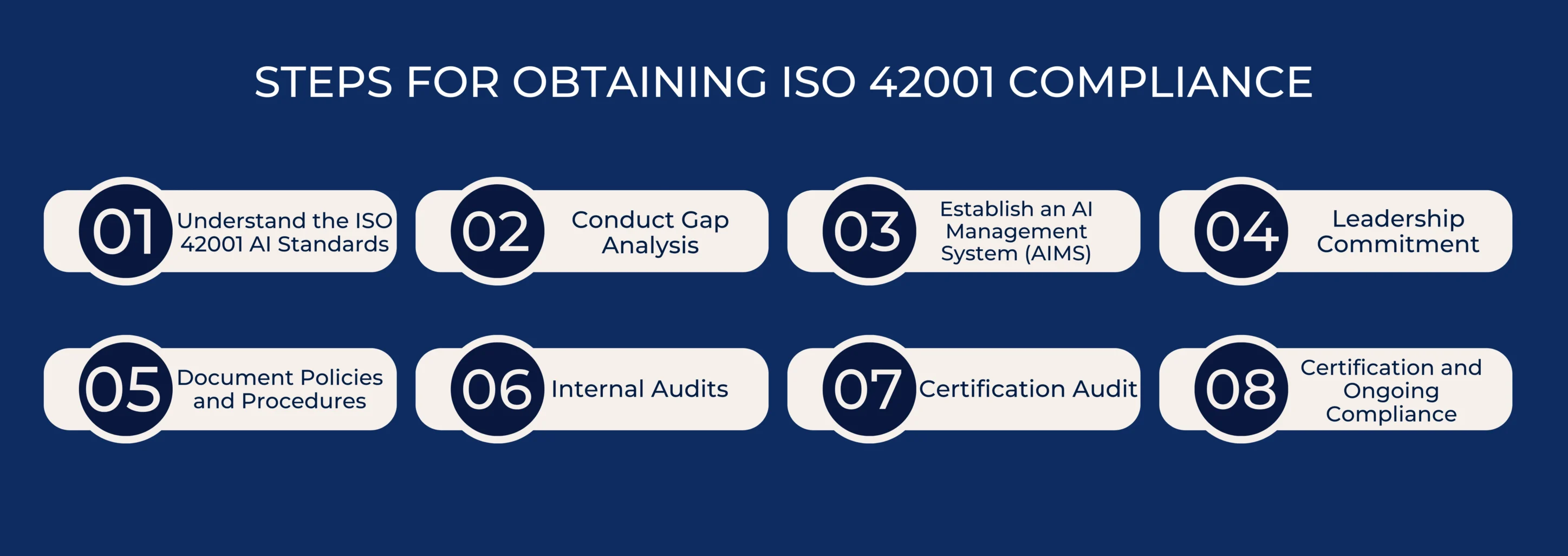
- ✓Stage 1 Audit — Documentation and AIMS Readiness Review
- ✓Stage 2 Audit — Control Effectiveness and Evidence Evaluation
- ✓Surveillance Audits and Recertification Cycle
ISO 42001 Certification Requirements for Nevada Organizations
ISO 42001 compliance requires Nevada organizations to establish, document, implement, maintain, and continually improve an Artificial Intelligence Management System addressing the full scope of clauses 4 through 10 and applicable Annex A controls. The following summarizes core documented information and system requirements evaluated during the ISO 42001 certification audit in Nevada.
ISO/IEC 42001:2023 requires organizations seeking ISO 42001 Certification in Nevada to maintain a defined set of documented information demonstrating that the AIMS is systematically governed. Core required documentation includes:
An AI governance policy aligned with organizational objectives; a documented organizational context analysis identifying internal and external issues relevant to AI; a stakeholder needs and expectations register; a defined AIMS scope boundary specifying which AI systems and organizational units are included; an AI risk assessment methodology with completed risk assessment records; a risk treatment plan identifying selected Annex A controls and their rationale; and a Statement of Applicability confirming included and excluded controls with justification.
Additional required records include operational procedures for AI system lifecycle management, AI system impact assessment records, an internal audit program with completed audit records, and management review minutes documenting leadership oversight of the AIMS.
For Nevada technology companies operating multiple AI products — such as a Las Vegas-based AI SaaS platform offering predictive analytics, recommendation engines, and automated decision modules — the AIMS scope must clearly define which AI systems fall within the certification boundary and how cross-system data flows are governed.
Annex A of the ISO 42001 AIMS standard provides a structured reference set of controls organized across eight domains that the ISO 42001 certification audit in Nevada evaluates against the organization’s Statement of Applicability. The eight Annex A domains are: policies for AI, resources for AI, AI system lifecycle processes, data for AI systems, AI system information security, AI system impact assessment, human oversight of AI systems, and responsible disclosure and third-party relationships.
Within these domains, auditors evaluate control design and operating effectiveness through document review, process walkthroughs, personnel interviews, and records sampling. For example, in the data for AI systems domain, the ISO 42001 assessment in Nevada examines whether the organization maintains documented data provenance records, data quality validation procedures, and controls for detecting and managing training data bias relevant to its deployed AI models.
In the human oversight domain, auditors evaluate whether the organization has defined escalation procedures for AI system outputs that exceed configured confidence thresholds or produce anomalous results requiring human review. Controls selected for inclusion in the Statement of Applicability must be actively implemented and evidenced — declarative policies without operational evidence do not satisfy ISO 42001 compliance requirements.
A defining requirement of the ISO 42001 AIMS standard in Nevada is the AI system lifecycle process. This mandates that organizations manage AI systems through defined phases including specification, design, data acquisition and preparation, training or configuration, validation, deployment, monitoring, and decommissioning. The ISO 42001 assessment evaluates whether lifecycle controls are documented, consistently applied, and linked to the organization’s risk treatment decisions.
AI system impact assessment — a specific Annex A control domain — requires organizations to evaluate the potential impacts of AI systems on individuals, groups, and society before deployment and at material points of system change. For Nevada healthcare technology companies deploying clinical decision support AI tools, impact assessment records must document potential patient safety risks, bias evaluation outcomes, and mitigation measures implemented prior to clinical use.
For autonomous vehicle technology developers operating in Nevada corridors where autonomous testing is authorized, impact assessment documentation must address safety case analysis, sensor failure modes, and override mechanism adequacy. The ISO 42001 certification audit in Nevada reviews impact assessment records as primary evidence that the organization systematically identifies and treats AI-specific risks before those risks materialize in production systems.
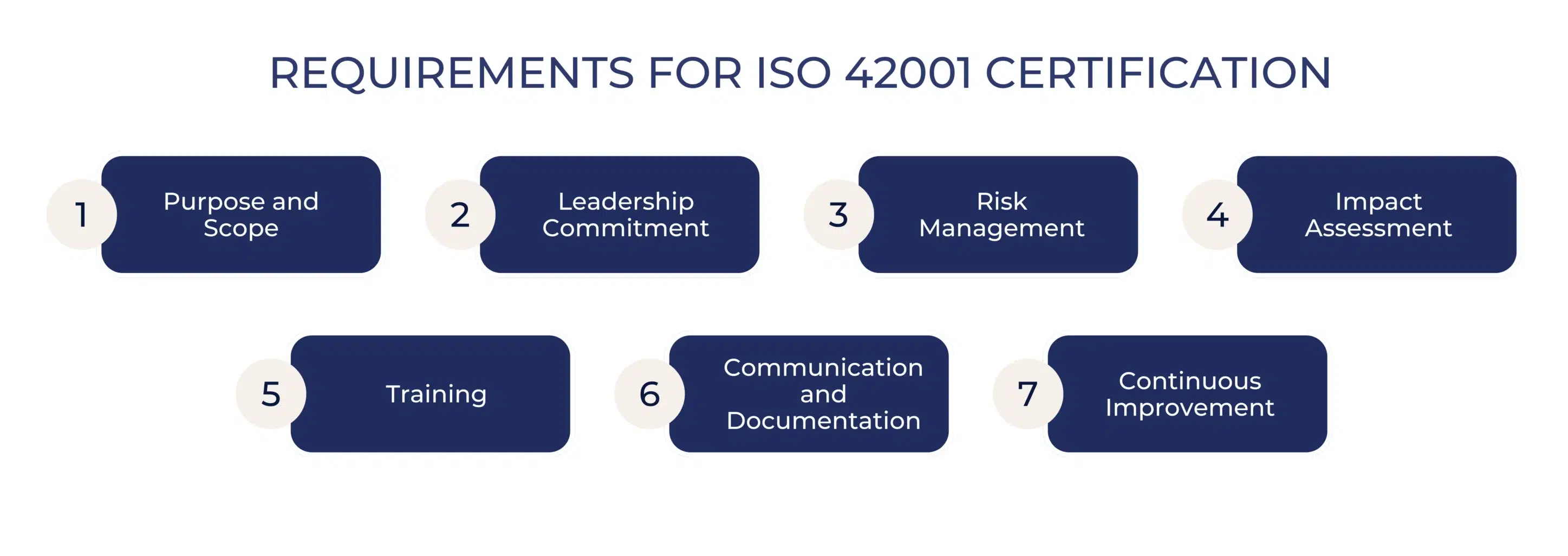
- ✓AIMS Documentation and Management System Requirements
- ✓Annex A AI-Specific Controls Evaluated in the Certification Audit
- ✓AI System Lifecycle and Impact Assessment Requirements
Nevada Industries and Organizations Seeking ISO 42001 Certification
ISO 42001 Certification in Nevada is pursued across a broad spectrum of industries reflecting the state’s diverse and rapidly growing technology and business ecosystem. The following sectors represent organizations for which an ISO 42001 assessment in Nevada is particularly relevant, based on AI system deployment scope, regulatory exposure, and enterprise procurement requirements.
Technology, AI, SaaS, and Cloud Service Providers
Nevada’s technology sector has expanded significantly across the Las Vegas metropolitan area and the Reno-Sparks corridor, hosting AI software companies, SaaS platforms, cloud infrastructure providers, cybersecurity technology firms, and data analytics businesses. Nevada technology organizations seeking ISO 42001 certification face growing demand for AI governance evidence from enterprise customers in regulated industries — particularly financial services, healthcare, and government contracting — who require third-party validated AIMS as a condition of vendor onboarding.
A Nevada-based AI-powered cybersecurity platform serving federally regulated financial institutions, for example, may be required to produce ISO 42001 Certification in Nevada as part of the institution’s third-party risk management program. This demonstrates that the vendor’s AI threat detection and response systems operate under documented governance controls addressing transparency, human oversight, and data integrity.
Cloud service providers operating large-scale data centers in Nevada — the state has become a significant data center hub due to favorable power and land economics — may also seek ISO 42001 certification for AI-driven infrastructure management, predictive maintenance, and resource optimization systems embedded in their platform offerings.
Gaming, Hospitality Technology, and Financial Services
Nevada’s gaming and hospitality industry is among the most technology-intensive in the world, deploying AI systems for player behavior analytics, dynamic pricing, fraud detection, responsible gaming compliance, surveillance and security, and personalized customer experience platforms. Nevada gaming industry organizations pursuing ISO 42001 certification operate in a uniquely regulated environment under the Nevada Gaming Control Board, where AI system transparency and accountability are increasingly relevant to regulatory expectations.
Gaming technology vendors supplying AI-enabled slot management, table game analytics, or patron risk assessment tools to Nevada casinos may be required to demonstrate ISO 42001 compliance as a condition of technology licensing or procurement approval.
Nevada’s financial services and fintech sector — including digital payment platforms, cryptocurrency exchanges, lending technology companies, and insurtech providers concentrated in Las Vegas and Henderson — deploy AI systems for credit decisioning, fraud detection, anti-money laundering transaction monitoring, and algorithmic trading. ISO 42001 certification for Nevada companies in financial services provides a structured framework for demonstrating that AI models used in regulated financial activities operate under documented governance, bias evaluation, and human oversight controls aligned with enterprise and regulatory expectations.
Healthcare Technology, Logistics, and Emerging AI Sectors
Nevada’s healthcare technology sector includes AI-driven clinical decision support vendors, telehealth platforms, medical imaging AI providers, and health data analytics companies serving hospitals, health systems, and insurers across the state. ISO 42001 Certification in Nevada for healthcare AI organizations provides documented evidence of AI governance controls relevant to patient safety, clinical AI model validation, and data privacy — areas where enterprise health system procurement teams increasingly require third-party AI governance validation.
Nevada’s logistics and supply chain technology sector — serving the state’s significant warehousing, distribution, and e-commerce fulfillment operations — deploys AI systems for demand forecasting, route optimization, warehouse automation, and inventory management. Autonomous vehicle technology companies conducting testing and development under Nevada’s permissive autonomous vehicle legislation represent another emerging sector for ISO 42001 certification, given the safety-critical nature of AI systems controlling autonomous navigation.
Telecommunications providers operating AI-driven network management and customer service automation systems, as well as energy and utilities organizations deploying AI for grid management and demand response, are additional Nevada sectors for which an ISO 42001 assessment is operationally relevant.
Benefits of ISO 42001 Certification for Nevada-Based Organizations
ISO 42001 Certification in Nevada delivers documented, independently verified outcomes for organizations that have established and maintained an AIMS aligned with ISO/IEC 42001:2023. The benefits listed below reflect verifiable outcomes of the certification process rather than promotional claims.
- ✓Independent third-party validation of AI governance controls by a Licensed CPA Firm, providing evidence that the AIMS has been evaluated against ISO/IEC 42001:2023 requirements through a documented ISO 42001 certification audit process
- ✓Recognition in enterprise procurement and vendor due diligence processes, where regulated customers in financial services, healthcare, and government contracting require demonstrated AI governance maturity as a condition of vendor qualification
- ✓Structured AI risk management framework that documents how the organization identifies, assesses, and treats AI-specific risks including algorithmic bias, data integrity failures, model opacity, and unintended AI system behavior
- ✓Alignment with U.S. AI governance expectations including NIST AI RMF functions — Govern, Map, Measure, and Manage — through documented AIMS controls that address comparable AI risk management objectives
- ✓Defined AI system lifecycle governance providing documented evidence of systematic controls from AI system specification through decommissioning, relevant to product liability, contractual representations, and regulatory inquiries
- ✓Stakeholder transparency through the certification process, enabling Nevada AI companies to communicate AI governance commitments to customers, investors, regulators, and the public through a recognized international standard
- ✓Continual improvement discipline embedded in the AIMS through internal audit requirements, management review obligations, and surveillance audit cycles that sustain governance effectiveness over the three-year certification period
- ✓Competitive differentiation for ISO 42001 certification Nevada AI companies competing for contracts with enterprise customers, government agencies, or international markets where ISO 42001 compliance is increasingly specified in RFPs
The most immediate operational benefit of ISO 42001 Certification in Nevada for technology and AI companies is recognition in enterprise procurement processes. Regulated organizations — including federally supervised banks, insurance companies, healthcare systems, and government contractors — conduct structured third-party risk assessments that increasingly evaluate AI governance controls as a distinct risk domain separate from information security.
ISO 42001 compliance in Nevada, validated through an independent ISO 42001 certification audit by a Licensed CPA Firm, provides procurement teams with a standardized, externally audited evidence base. This satisfies vendor questionnaire requirements more efficiently than self-attested documentation.
For Nevada-based AI SaaS companies pursuing contracts with national enterprise customers headquartered outside the state, ISO 42001 Certification in Nevada also serves as a cross-jurisdictional AI governance credential. It is recognized by international procurement frameworks — relevant when Nevada technology companies serve customers in the European Union, where the EU AI Act establishes mandatory AI governance requirements for high-risk AI system providers, or in jurisdictions across Asia-Pacific and Latin America where national AI governance frameworks reference ISO 42001 AIMS standard compliance as a benchmark.
Beyond external recognition, the ISO 42001 assessment process in Nevada requires organizations to build and document internal AI risk management structures that clarify accountability, define decision authority, and establish escalation pathways for AI system incidents. Organizations that complete the ISO 42001 certification audit have — by necessity — defined roles and responsibilities for AI governance, documented their AI system inventory with risk classification, established processes for AI impact assessment before deployment, and implemented monitoring controls for AI system performance degradation or behavioral drift.
These structural outcomes are relevant beyond marketing. They directly address AI governance accountability expectations emerging from the U.S. federal regulatory environment, including banking regulators’ model risk management guidance applicable to AI systems in financial services, FDA expectations for AI-enabled medical devices, and the FTC’s algorithmic accountability enforcement posture.
For Nevada organizations, ISO 42001 compliance simultaneously satisfies enterprise customer procurement requirements and builds the internal AI governance infrastructure that regulators, courts, and investors increasingly scrutinize in AI-related liability, enforcement, and due diligence contexts.
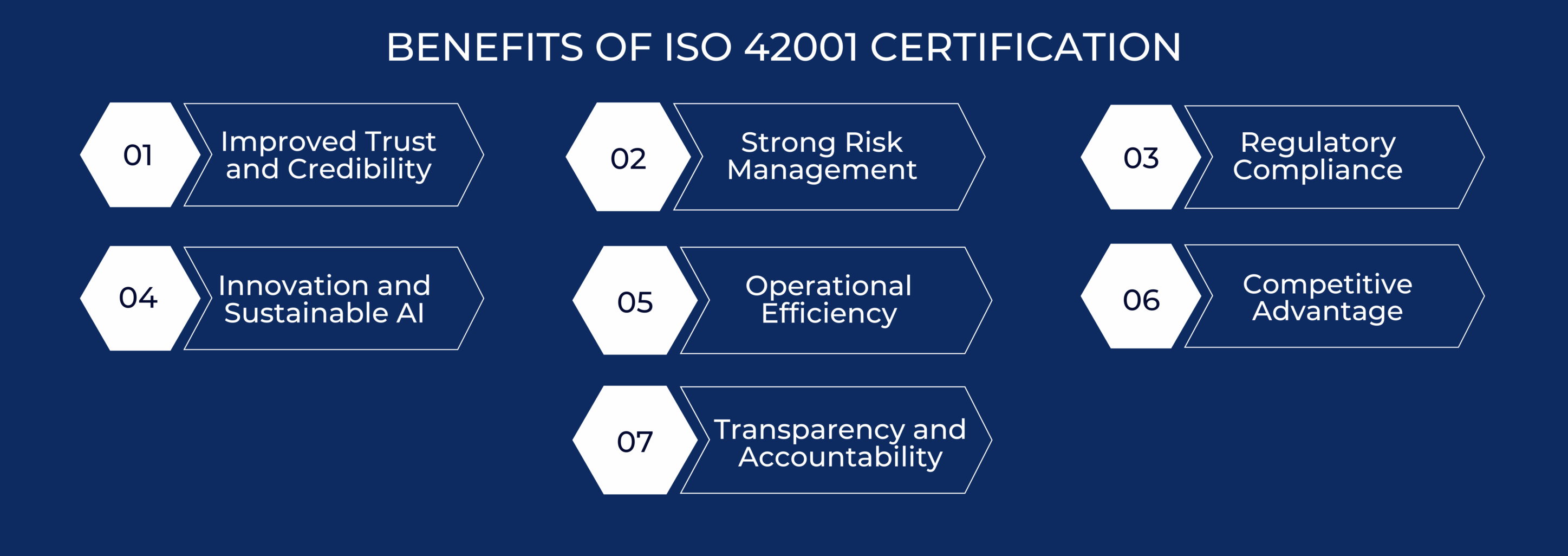
- ✓Enterprise Procurement and Vendor Due Diligence Recognition
- ✓AI Risk Management Structure and Organizational Accountability
ISO 42001 Certification Scope and Independent Decision Framework
The scope of ISO 42001 Certification in Nevada is defined by the organization’s AIMS boundary, which specifies which AI systems, organizational units, geographic locations, and AI system lifecycle phases fall within the certification perimeter. Scope definition is a foundational step in the ISO 42001 assessment process that directly shapes audit program design and the meaning of the issued certificate.
Defining AIMS Scope and Certification Boundary
An organization seeking ISO 42001 Certification in Nevada must define the AIMS scope in documented form before the Stage 1 audit commences. The scope document specifies the AI systems included in the certification boundary, the organizational units and business functions covered, relevant internal and external interfaces, and any exclusions with documented justification.
Scope definition decisions have direct consequences for the certification’s value to procurement audiences. A narrowly scoped certificate covering only one AI product line will satisfy vendor due diligence requirements only for that specific system, while an enterprise-wide AIMS scope covering all AI systems developed or deployed by the organization carries broader procurement recognition.
For Nevada organizations operating multiple AI products — such as a Reno-based data analytics company offering separate AI modules for healthcare analytics, financial reporting, and supply chain optimization — the AIMS scope decision determines whether a single ISO 42001 certification audit in Nevada covers all products or whether separate scoped audits are required for each regulated customer context. Auditors verify that the defined scope is accurate and complete relative to the organization’s actual AI system portfolio, and that material AI systems have not been improperly excluded without documented justification.
Independent Certification Committee and Nonconformity Management
The certification decision for ISO 42001 Certification in Nevada is made by an independent certification committee that reviews the complete ISO 42001 assessment audit file — including Stage 1 and Stage 2 reports, nonconformity records, corrective action evidence, and auditor recommendations — without involvement from the auditors who conducted the fieldwork. This structural separation between audit execution and certification decision is a core independence requirement that distinguishes accredited certification bodies from self-assessment or consulting-led attestation programs.
Nonconformities identified during the ISO 42001 certification audit are classified as major or minor based on the degree of systemic failure or deviation from ISO/IEC 42001:2023 requirements. Major nonconformities — indicating that a required AIMS element is absent, non-functional, or systematically ineffective — must be resolved with verified corrective action before the certification committee can issue a positive certification decision. Minor nonconformities require documented corrective action plans but may be accepted pending verification at the next surveillance audit.
The committee’s decision to issue, defer, decline, suspend, or withdraw ISO 42001 Certification in Nevada is recorded with documented rationale that the organization may access as part of the certification file.
How ISO 42001 Relates to Other Standards and Frameworks in Nevada
Nevada organizations often operate within multi-framework compliance environments where ISO 42001 compliance intersects with information security, privacy, and AI governance requirements from multiple sources. Understanding the relationships between ISO 42001 and other applicable frameworks helps avoid duplication and clarifies what each framework addresses exclusively.
ISO 42001 and ISO 27001 — AI Governance and Information Security
ISO 42001 and ISO 27001 are complementary management system standards that address distinct risk domains. ISO 27001 governs information security management systems (ISMS) with controls focused on confidentiality, integrity, and availability of information assets. The ISO 42001 AIMS standard in Nevada governs AI-specific risks — including algorithmic bias, model explainability, AI system impact on individuals, and human oversight of automated decisions — that fall outside the scope of ISO 27001’s information security controls.
For Nevada technology organizations already holding ISO 27001 certification, pursuing ISO 42001 Certification in Nevada means extending governance structures to cover AI-specific risk domains not addressed by the ISMS. Because both standards follow the ISO High Level Structure, existing management system infrastructure — including policy frameworks, internal audit programs, management review processes, and document control systems — can be extended to cover the AIMS without creating a parallel governance structure.
The ISO 42001 certification audit in Nevada evaluates AIMS controls independently of any ISO 27001 certification status. ISO 27001 certification does not satisfy or substitute for ISO 42001 compliance requirements.
ISO 42001 and NIST AI RMF — Framework Alignment and Distinctions
The NIST Artificial Intelligence Risk Management Framework (AI RMF 1.0), published in January 2023, provides a voluntary U.S. government-developed framework for AI risk management organized around four functions: Govern, Map, Measure, and Manage. The ISO 42001 AIMS standard addresses comparable AI risk management objectives through its management system requirements and Annex A controls, with meaningful structural overlap — both frameworks emphasize AI governance policies, AI system risk identification, impact assessment, monitoring, and stakeholder transparency.
However, ISO 42001 compliance in Nevada is independently auditable and results in a third-party certification that NIST AI RMF self-assessment does not produce. Organizations applying the NIST AI RMF in Nevada — including federal contractors, technology companies engaging with federal agencies, and organizations voluntarily adopting NIST guidance — can align their AI RMF implementation with ISO/IEC 42001:2023 requirements to support an ISO 42001 certification audit in Nevada.
ISO 42001 Certification in Nevada does not constitute compliance with NIST AI RMF or any U.S. federal AI regulation, and NIST AI RMF conformance is not a prerequisite or substitute for ISO 42001 compliance. The two frameworks serve different purposes: NIST AI RMF is a risk management guide; ISO 42001 is a certifiable management system standard with independent third-party audit validation.
ISO 42001 Certification for Nevada AI Companies — Sector-Specific Considerations
ISO 42001 certification for Nevada companies varies in implementation complexity and audit evidence requirements based on the sector, type of AI systems deployed, regulatory environment, and customer due diligence expectations. The following sector-specific considerations inform how the ISO 42001 assessment in Nevada is scoped and conducted across different Nevada industries.
AI Governance Controls for Nevada Fintech and Financial Services Organizations
Fintech and financial services organizations in Nevada — including digital lending platforms, payment processors, cryptocurrency exchanges, and robo-advisory services operating under Nevada financial institution licenses — deploy AI systems in contexts where model risk management, algorithmic fairness, and explainability are directly relevant to regulatory expectations from the OCC, CFPB, FDIC, and Federal Reserve.
The ISO 42001 certification audit in Nevada for financial sector organizations places particular emphasis on AI system impact assessment records. These records document potential adverse effects on credit access, pricing equity, or customer financial outcomes, as well as human oversight controls ensuring that automated financial decisions can be reviewed, explained, and overridden by qualified personnel.
ISO 42001 compliance in Nevada for fintech organizations also requires documented third-party AI provider controls addressing how vendor-supplied AI models are evaluated, monitored, and governed under the organization’s AIMS. This is critical for fintech companies relying on third-party machine learning APIs or data enrichment services embedded in their underwriting or fraud detection workflows. The ISO 42001 certification audit evaluates whether vendor AI governance obligations are formalized in contractual arrangements and whether the organization maintains documented oversight of third-party AI system performance.
Data Center Operators and AI Infrastructure Providers in Nevada
Nevada hosts a substantial concentration of large-scale data center operations serving cloud computing, colocation, and AI infrastructure markets, driven by the state’s favorable regulatory environment, energy access, and geographic positioning relative to West Coast technology markets. Data center operators and AI infrastructure providers deploying AI systems for facility management — including AI-driven power management, cooling optimization, predictive maintenance, and physical security analytics — are within scope for ISO 42001 Certification in Nevada where those AI systems operate with meaningful autonomous decision-making capability affecting facility operations, customer data, or safety systems.
The ISO 42001 assessment in Nevada for data center operators evaluates AIMS controls addressing AI system monitoring procedures, anomaly detection governance, human escalation protocols for AI system interventions in critical infrastructure, and documentation of AI system impacts on hosted customer environments.
For hyperscale data center operators in Nevada’s emerging technology corridor serving AI model training workloads, ISO 42001 certification provides a market differentiator when competing for enterprise AI infrastructure contracts with customers whose procurement requirements include third-party validated AI governance for infrastructure layer providers.
FAQ
▶
What is ISO 42001 Certification and who needs it in Nevada?
▶
What is the ISO 42001 AIMS standard and how does it differ from ISO 27001?
▶
How does the ISO 42001 certification audit process work in Nevada?
▶
Does ISO 42001 Certification in Nevada establish compliance with Nevada or U.S. federal laws?
▶
What documentation is required for ISO 42001 compliance Nevada?
▶
How long is ISO 42001 Certification valid and what is the surveillance requirement?
▶
Can ISO 42001 Certification be scoped to a single AI product rather than the entire organization?
▶
What is the role of a Licensed CPA Firm in ISO 42001 Certification?
ISO 42001 CERTIFIED: WHY AI GOVERNANCE CERTIFICATION IS BECOMING A BOARD-LEVEL REQUIREMENT
ISO 42001 Certified: Board-Level AI Governance Guide | CertPro CPA LLC HERO ══════════════════════════════ –> src=”https://certpro.com/wp-content/uplo…
Get In Touch
have a question? let us get back to you.