
ISO 42001 Certification in Georgia
The ISO 42001 certification audit process conducted by CertPro for Georgia-based organizations follows a structured, multi-stage program designed to assess AIMS conformance against the requirements of ISO/IEC 42001:2023. The process is independent, evidence-based, and governed by established certification body procedures. Each stage produces documented outputs that inform the certification committee’s determination. The table below summarizes the key stages, activities, and outputs of the ISO 42001 certification audit process in Georgia.
OUR CLIENTS



What Is ISO 42001 Certification in Georgia?
ISO 42001 Certification in Georgia is a formal, independent, third-party certification audit conducted against ISO/IEC 42001:2023 — the international standard specifying requirements for an Artificial Intelligence Management System (AIMS). CertPro, a Licensed CPA Firm, performs ISO 42001 certification audits for organizations across Georgia that develop, deploy, or operate AI systems. Certification confirms that an organization has established, implemented, maintained, and continually improved an AIMS in conformance with the ISO 42001 standard requirements. It does not constitute legal or regulatory compliance with any specific U.S. federal or Georgia state law.
ISO/IEC 42001:2023 is the first globally recognized management system standard specifically designed to govern artificial intelligence. Published by the International Organization for Standardization (ISO) and the International Electrotechnical Commission (IEC) in 2023, the ISO 42001 standard establishes a structured framework — the AIMS — through which organizations define AI objectives, assign organizational responsibilities, conduct AI risk assessments, implement AI controls, and demonstrate continual improvement. The AIMS framework is built on ISO’s high-level structure, meaning it integrates naturally with ISO 27001 for information security and ISO 9001 for quality management. This allows organizations to reuse existing policies, roles, and review cycles rather than building entirely new governance systems from scratch.
An Artificial Intelligence Management System, as defined in the ISO 42001 standard, is the set of interrelated policies, processes, roles, responsibilities, objectives, and controls through which an organization manages AI systems across their full lifecycle — from design and development through deployment, monitoring, and decommissioning. The AIMS addresses AI-specific risk categories, including algorithmic bias, model opacity, data quality, unintended outcomes, and loss of human oversight. These risks are distinct from the information security risks governed by ISO 27001. Annex A of ISO/IEC 42001:2023 provides a structured catalogue of AI controls organized across domains including organizational controls, data governance controls, AI system lifecycle controls, and responsible AI controls covering transparency, accountability, human oversight, and privacy.
Georgia’s technology economy makes ISO 42001 Certification in Georgia directly relevant to a wide range of organizations. Atlanta functions as a major AI, fintech, cybersecurity, and enterprise technology hub, with significant concentrations of SaaS providers, cloud platforms, financial institutions, healthcare systems, logistics companies, telecommunications operators, and research universities. Organizations in Alpharetta, Sandy Springs, Marietta, Athens, Augusta, and Savannah are similarly engaged in developing or deploying AI-enabled products and services. As enterprise procurement processes increasingly require evidence of structured AI governance — and as U.S. federal frameworks such as the NIST AI Risk Management Framework (AI RMF) gain traction — ISO 42001 certification provides organizations across Georgia with a recognized, independently audited basis for demonstrating AIMS conformance to customers, regulators, and business partners.
ISO 42001 certification is structurally distinct from AI governance consulting, NIST AI RMF alignment assessments, and regulatory compliance audits. The ISO 42001 certification audit evaluates whether an organization’s AIMS conforms to the requirements of ISO/IEC 42001:2023 — specifically Clauses 4 through 10, which cover organizational context, leadership, planning, support, operation, performance evaluation, and improvement — together with applicable Annex A controls documented in a Statement of Applicability. Certification is issued by an independent certification body following a structured audit program, not by a consulting firm or advisory practice. CertPro’s role as a Licensed CPA Firm and independent certification body is strictly confined to audit, assessment, and certification determination activities.

ISO/IEC 42001:2023 Standard Requirements and AIMS Structure
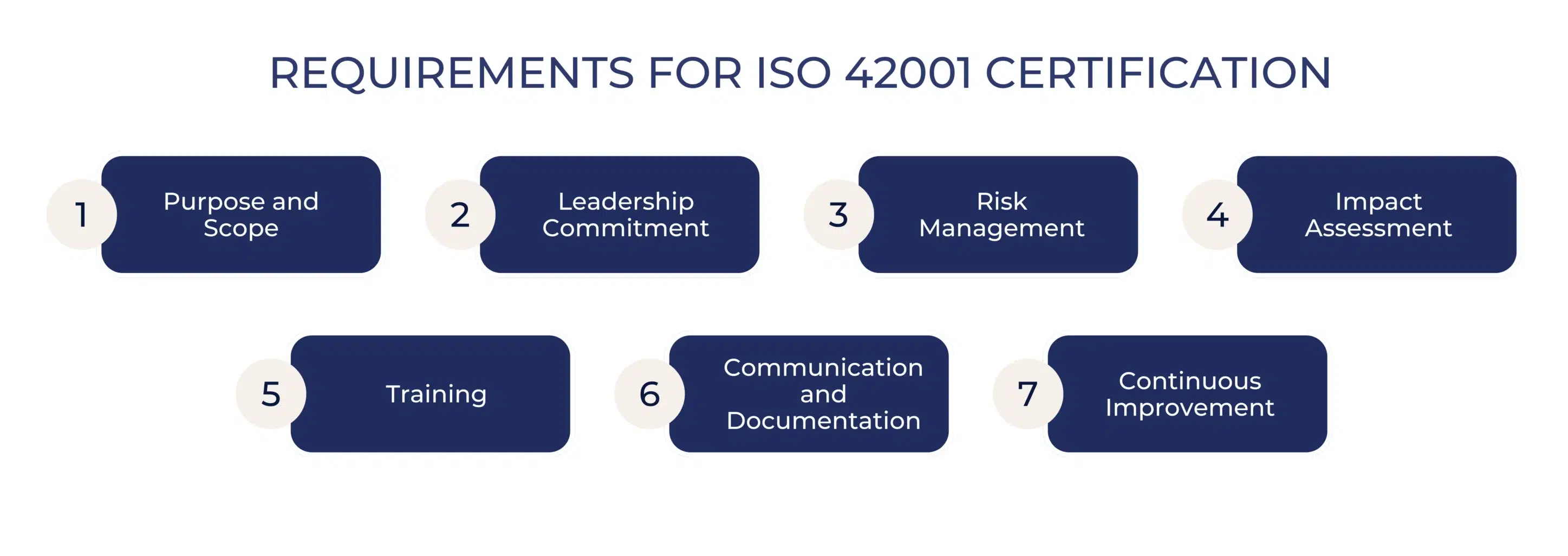
The ISO 42001 standard is organized around ISO’s harmonized high-level structure, comprising ten clauses. Clauses 1 through 3 establish scope, normative references, and terminology. Clauses 4 through 10 specify the management system requirements that organizations must satisfy to achieve and maintain ISO 42001 certification. These clauses govern organizational context and interested party requirements, leadership and AI policy commitment, planning for AI risks and objectives, support resources and competence, operational AI system controls, performance evaluation through internal audits and management review, and continual improvement activities. Organizations pursuing ISO 42001 compliance in Georgia must demonstrate conformance across all applicable clauses through documented evidence reviewed during the ISO 42001 certification audit.
Clause 4 requires organizations to determine the internal and external factors relevant to their AI activities, identify interested parties and their requirements, and define the scope of the AIMS. For a Georgia-based healthcare AI company, this may include patients, regulators, clinical staff, and technology partners. Clause 5 establishes leadership requirements, including top management commitment, the establishment of an AI policy, and the assignment of roles and responsibilities for AIMS governance. Clause 6 addresses planning — requiring organizations to conduct an AI risk assessment, define risk treatment plans, and set measurable AI objectives aligned with organizational goals. Clause 7 governs support requirements including competence, awareness, communication, and the maintenance of documented information. This AIMS documentation set forms the primary evidence base for the ISO 42001 certification audit.
Clause 8 covers operational planning and control, requiring organizations to plan, implement, and control AI system lifecycle processes — including design, development, testing, deployment, monitoring, and decommissioning — in accordance with AIMS requirements. Clause 9 mandates performance evaluation through monitoring and measurement, internal AIMS audits conducted at planned intervals, and management review of AIMS performance. Internal audits must assess whether the AIMS conforms to the ISO 42001 standard and is effectively implemented and maintained. Management review outputs must include decisions on continual improvement opportunities and any needed AIMS changes. Clause 10 addresses improvement, requiring organizations to address nonconformities, take corrective actions, and pursue ongoing enhancement of AIMS effectiveness. Together, these requirements form the operational and evaluative backbone of ISO 42001 compliance for Georgia organizations.
Annex A of ISO/IEC 42001:2023 provides a structured catalogue of AI controls that organizations may select and implement as part of their AIMS risk treatment. These controls span domains including organizational AI policies, AI system impact assessment, data governance for AI, AI system lifecycle controls, and responsible AI controls addressing transparency, explainability, fairness, and accountability. Additional controls cover human oversight mechanisms, AI security, and privacy controls for AI systems. The Statement of Applicability (SoA) is a required AIMS document that records which Annex A controls are applicable, which are implemented, and the justification for any exclusions. During the ISO 42001 audit, auditors review the SoA to confirm alignment between the organization’s risk treatment decisions and the AI controls documented as applicable. Complete and accurate SoA documentation is a critical evidence requirement for ISO 42001 certification.
- ✓Clauses 4–7: Context, Leadership, Planning, and Support
- ✓Clauses 8–10: Operation, Performance Evaluation, and Improvement
- ✓Annex A AI Controls and Statement of Applicability
ISO 42001 Certification Audit Process in Georgia
The ISO 42001 certification audit process conducted by CertPro for Georgia-based organizations follows a structured, multi-stage program designed to assess AIMS conformance against the requirements of ISO/IEC 42001:2023. The process is independent, evidence-based, and governed by established certification body procedures. Each stage produces documented outputs that inform the certification committee’s determination. The table below summarizes the key stages, activities, and outputs of the ISO 42001 certification audit process in Georgia.
| Audit Stage | Key Activities | Output |
|---|---|---|
| Application Review | Scope definition, AIMS boundary confirmation, audit program determination | Audit plan and scope confirmation |
| Stage 1 Audit | Review of AIMS documentation, AI policy, risk assessment records, SoA, and readiness for Stage 2 | Stage 1 findings report; Stage 2 readiness determination |
| Stage 2 Audit | Evidence-based evaluation of AIMS implementation and operational effectiveness across Clauses 4–10 and Annex A controls | Audit findings report; nonconformity identification |
| Nonconformity Review | Review of corrective action evidence submitted by the organization for identified nonconformities | Nonconformity closure determination |
| Certification Decision | Independent certification committee review of audit findings and corrective action evidence | ISO 42001 certificate issuance or deferral |
| Surveillance Audit | Periodic assessment of continued AIMS conformance and continual improvement evidence | Surveillance audit report; certificate maintenance determination |
The Stage 1 ISO 42001 audit is a documentation-focused assessment in which the auditor reviews the organization’s AIMS documentation to determine whether the management system has been sufficiently established to proceed to Stage 2. Key documents reviewed during Stage 1 include the AI policy, the AIMS scope statement, the AI risk assessment and risk treatment plan, the Statement of Applicability, AI objectives documentation, and records of internal AIMS audits and management review. For Georgia-based organizations, the Stage 1 audit may be conducted on-site or remotely. The Stage 1 output is a findings report that identifies any areas requiring attention before Stage 2 and confirms the organization’s readiness for the operational effectiveness assessment. No ISO 42001 certification determination is made at Stage 1.
The Stage 2 ISO 42001 certification audit evaluates whether the organization’s AIMS is not only documented but implemented and operating effectively in conformance with ISO/IEC 42001:2023. Auditors examine evidence of AI risk assessments conducted for specific AI systems, records of AI system lifecycle controls in operation, evidence of human oversight mechanisms, data governance documentation, training and competence records, and outputs of internal audits and management reviews. In Georgia technology and fintech environments, Stage 2 testing may include review of AI model governance records, AI incident logs, bias assessment documentation, and data provenance records. Nonconformities identified during Stage 2 are documented in the audit findings report. The organization must then submit corrective action evidence before the certification committee makes its ISO 42001 certification determination.
ISO 42001 certification is valid for a three-year cycle, subject to satisfactory surveillance audits conducted at defined intervals — typically annually — to confirm that the organization’s AIMS continues to conform to ISO/IEC 42001:2023 and that continual improvement activities are actively pursued. Surveillance audits are narrower in scope than the initial ISO 42001 certification audit but must cover key AIMS processes, any areas of previous nonconformity, and evidence of ongoing AI risk management and performance evaluation. At the end of the three-year cycle, a recertification audit is conducted to renew the certificate. Georgia organizations with dynamic AI development programs — particularly those deploying new AI models, expanding AI use cases, or integrating AI into new product lines — should ensure their AIMS documentation remains current and reflective of operational changes throughout the surveillance cycle.
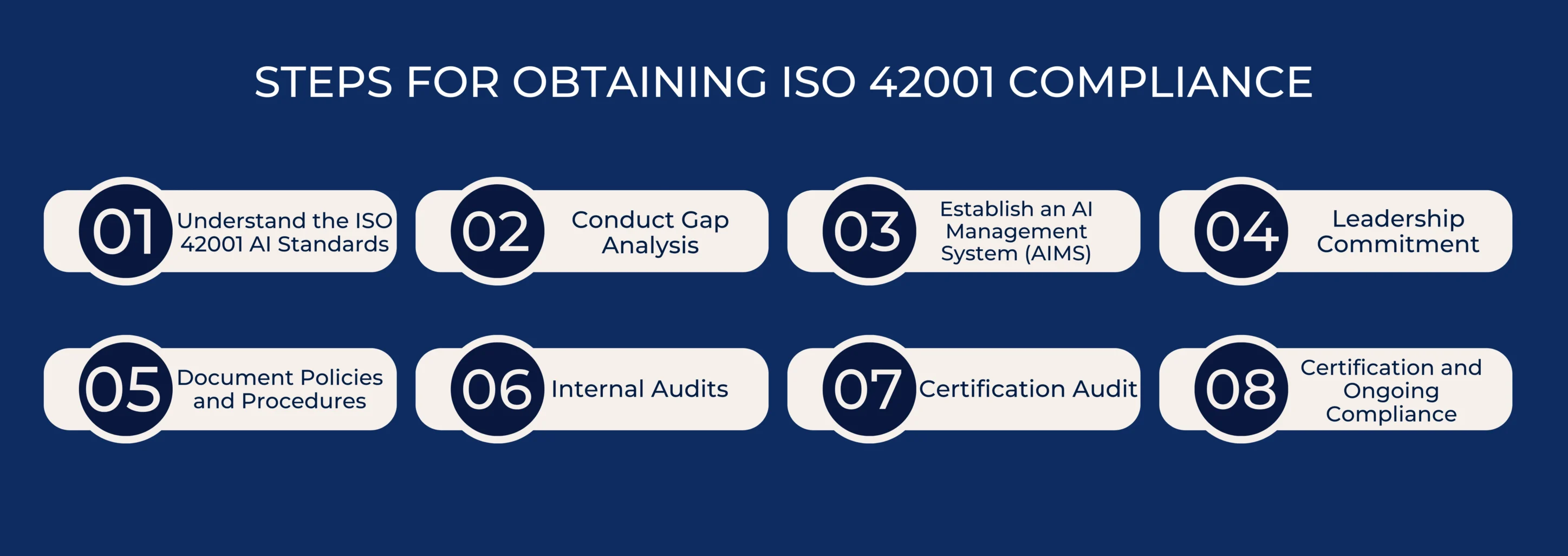
- ✓Stage 1 Audit: Documentation and Readiness Review
- ✓Stage 2 Audit: Operational Effectiveness Assessment
- ✓Surveillance Audits and Recertification
Who Needs ISO 42001 Certification in Georgia?
ISO 42001 Certification in Georgia is relevant to any organization that develops, deploys, operates, or procures AI systems as a material part of its business activities. Georgia’s technology ecosystem — anchored in Atlanta and extending through Alpharetta, Sandy Springs, Marietta, Athens, Augusta, and Savannah — includes a diverse range of organizations for which structured AI governance and independent certification carry direct operational and commercial value. The categories below represent the primary organization types pursuing ISO 42001 compliance in Georgia.
Technology, SaaS, and Cloud Organizations
Georgia-based SaaS providers, cloud platform operators, AI software companies, and technology product developers are among the most active pursuers of ISO 42001 certification. Atlanta’s technology corridor hosts numerous companies delivering AI-enabled SaaS products to enterprise customers in financial services, healthcare, retail, and logistics. For these organizations, ISO 42001 certification provides independently audited evidence that AI systems embedded in their products are governed by a conforming AIMS — a credential increasingly requested in enterprise vendor security reviews and procurement qualification processes. Cloud service providers operating data centers in Georgia that process AI workloads for regulated-industry customers similarly benefit from ISO 42001 certification as evidence of structured AI governance alongside existing ISO 27001 or SOC 2 certifications.
Fintech, Financial Services, and Healthcare Organizations
ISO 42001 Georgia fintech and financial services demand is substantial. Atlanta is recognized as one of the leading U.S. fintech centers, with a concentration of payment processors, lending platforms, insurance technology companies, and banking technology providers deploying AI for credit decisioning, fraud detection, risk scoring, and customer service automation. ISO 42001 Georgia financial services organizations face growing customer and counterparty scrutiny of AI governance practices, particularly where AI outputs influence regulated financial decisions. Healthcare organizations — including hospital systems, health IT companies, medical device manufacturers, and life sciences research organizations in Atlanta, Augusta, and Athens — deploy AI for clinical decision support, diagnostic imaging, patient risk stratification, and research analytics. For these organizations, structured AIMS governance and independent ISO 42001 certification are directly relevant to patient safety and regulatory expectations.
Logistics, Telecommunications, and Research Organizations
Georgia’s position as a major U.S. logistics hub — anchored by Hartsfield-Jackson Atlanta International Airport, the Port of Savannah, and extensive freight rail and trucking networks — has driven rapid AI adoption in supply chain optimization, route planning, warehouse automation, and demand forecasting. Telecommunications companies operating in Georgia deploy AI for network optimization, customer service, predictive maintenance, and fraud management. Universities and research organizations including Georgia Institute of Technology, the University of Georgia, and Emory University conduct AI research and develop AI systems whose responsible governance and accountability are directly addressed by the ISO 42001 standard. Enterprises across manufacturing, retail, and the public sector deploying AI in Georgia complete the broad addressable market for ISO 42001 certification for Georgia companies.
AI Governance, Risk Management, and AIMS Requirements
The ISO 42001 standard establishes AI governance as a management system discipline, requiring organizations to define governance structures, assign accountabilities, and operate systematic processes for AI risk identification, assessment, treatment, and monitoring. This section addresses the specific governance, risk management, and AIMS requirements that Georgia organizations must satisfy to achieve ISO 42001 compliance and maintain certification.
The ISO 42001 standard requires organizations to establish and maintain a formal AI risk assessment process. This process must identify AI risks associated with specific AI systems in scope, evaluate the likelihood and consequence of those risks, and determine appropriate risk treatment options. AI risks addressed by the standard include algorithmic bias producing discriminatory outputs, lack of transparency or explainability in AI decisions, data quality or data provenance issues, unintended AI behaviors, AI system security vulnerabilities, and adverse impacts on individuals or society. Risk treatment plans must document the selected controls — drawn from Annex A or defined by the organization — applied to address each identified AI risk, and must be reviewed and updated as AI systems evolve. For Georgia organizations operating AI systems in regulated sectors, AI risk assessment documentation is a primary evidence item reviewed during both Stage 1 and Stage 2 of the ISO 42001 certification audit.
The ISO 42001 standard requires top management to establish an AI policy that defines the organization’s commitments with respect to responsible AI development and deployment, alignment with organizational values, and conformance with AIMS requirements. AI objectives must be measurable, monitored, and communicated, and must be consistent with the AI policy. Organizational responsibilities for AIMS governance must be clearly assigned — including roles for AI system owners, data governance leads, AI risk management functions, and AIMS internal audit responsibilities. In Georgia enterprises with distributed AI development — such as Atlanta-based technology companies with multiple product teams deploying AI features — clear role assignments and documented accountability structures are essential. They demonstrate that governance is applied consistently across all AI activities, not only at the corporate policy level, which is a key expectation during the ISO 42001 audit.
Clause 8 and Annex A of the ISO 42001 standard require organizations to manage AI systems across their full lifecycle — encompassing requirements definition, data acquisition and preparation, model design and development, testing and validation, deployment, operational monitoring, and decommissioning. Data governance controls for AI address data quality, data provenance, data representativeness, and the handling of sensitive or personal data used to train or operate AI systems. These controls are directly relevant to Georgia healthcare and fintech organizations processing patient data, financial records, or protected personal information in AI pipelines. Lifecycle controls also require organizations to document AI system specifications, record testing and validation outcomes, and maintain monitoring evidence. This evidence must demonstrate that AI systems operate as intended and that performance degradation or unexpected behaviors are detected and addressed through defined corrective processes.
- ✓AI Risk Assessment and Risk Treatment
- ✓AI Objectives, Policies, and Organizational Responsibilities
- ✓AI System Lifecycle Management and Data Governance
Responsible AI: Transparency, Accountability, Human Oversight, and Privacy
Responsible AI principles — including transparency, explainability, fairness, accountability, human oversight, security, and privacy — are embedded throughout ISO/IEC 42001:2023 and are specifically addressed in Annex A controls. These principles distinguish the ISO 42001 standard from general information security or quality management standards and reflect the unique ethical and societal dimensions of AI system governance. Georgia organizations seeking ISO 42001 certification must demonstrate that responsible AI principles are operationalized through documented controls, not merely stated as organizational values.
Transparency, Explainability, and Fairness Controls
Annex A controls related to transparency require organizations to document the intended purpose, capabilities, and limitations of AI systems and to communicate relevant AI system information to affected stakeholders. Explainability controls require that AI system outputs can be explained at a level appropriate to the impact of the decision and the stakeholder receiving it. This is a particularly significant requirement for Georgia fintech organizations whose AI systems produce credit decisions, risk scores, or fraud determinations that affect consumers. Fairness controls require organizations to assess AI systems for potential bias in outputs — particularly where AI systems process data related to protected characteristics — and to implement and monitor controls that address identified fairness risks. Evidence of bias testing, fairness assessments, and model validation records are reviewed during the ISO 42001 audit.
Human Oversight, Accountability, Security, and Privacy
Human oversight controls in Annex A require organizations to define the degree of human involvement in AI-assisted or AI-automated decisions, establish mechanisms for human intervention where AI outputs are consequential, and maintain audit trails that support accountability for AI decisions. Accountability controls require that responsibility for AI system outcomes is clearly assigned within the organization and that AI-related incidents are recorded and investigated. AI security controls address adversarial attacks, model poisoning, data integrity, and unauthorized access to AI systems or training data. Privacy controls require that personal data processed by AI systems is handled in conformance with applicable data protection requirements — including U.S. federal privacy frameworks and applicable Georgia data security requirements. Collectively, these controls address the responsible AI dimensions that regulators, enterprise customers, and civil society increasingly expect organizations to demonstrate through independent ISO 42001 certification.
Benefits of ISO 42001 Certification for Georgia-Based Organizations
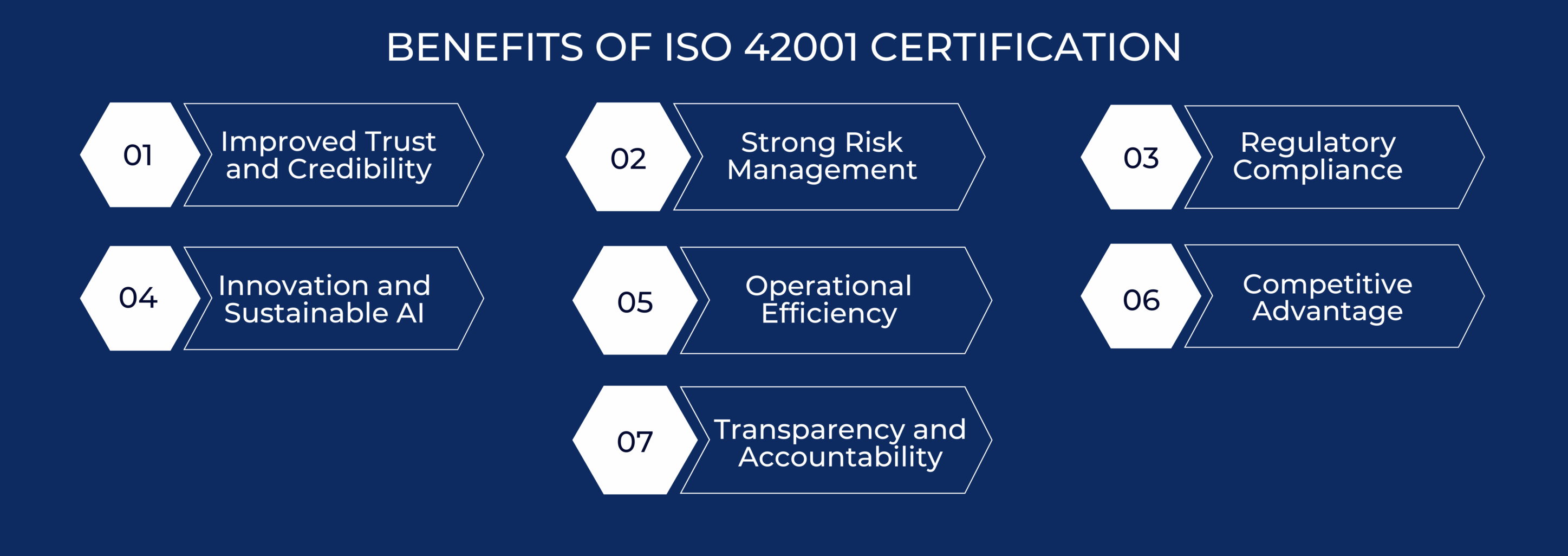
ISO 42001 Certification in Georgia delivers structured, independently verified benefits to organizations across technology, financial services, healthcare, and other AI-intensive sectors. The benefits listed below are grounded in the operational and commercial outcomes of achieving certification against the ISO 42001 standard through an independent ISO 42001 certification audit conducted by a Licensed CPA Firm.
- ✓Independent third-party verification that an AIMS conforming to ISO/IEC 42001:2023 is established and operational — a credential that enterprise customers and procurement teams can evaluate objectively.
- ✓Structured AI risk assessment and treatment documentation that enables organizations to identify, evaluate, and address AI-specific risks systematically, reducing unplanned AI incidents and governance gaps.
- ✓Recognized evidence of responsible AI governance — transparency, accountability, human oversight, fairness, and privacy controls — for presentation to regulators, customers, and business partners in Georgia and internationally.
- ✓Integration with existing ISO 27001 and ISO 9001 management systems through the harmonized high-level structure, enabling efficiency in documentation, internal audits, and management reviews.
- ✓Competitive differentiation in enterprise procurement processes, particularly for Georgia fintech, healthcare, and SaaS organizations competing for contracts with regulated-sector customers requiring evidence of AI governance.
- ✓Alignment with the NIST AI Risk Management Framework (AI RMF) principles at the management system level — noting that ISO 42001 certification does not itself establish NIST AI RMF conformance or regulatory compliance.
- ✓Ongoing surveillance audit oversight that maintains AIMS conformance accountability and supports continual improvement of AI governance practices across the certification cycle.
- ✓Demonstrated organizational commitment to responsible AI development and deployment, supporting stakeholder trust and board-level AI governance accountability.
Georgia-based AI vendors and SaaS providers increasingly encounter enterprise procurement processes that include structured AI governance assessments as part of vendor qualification. Large financial institutions, hospital systems, and enterprise technology buyers operating in Atlanta and across Georgia request documented evidence of AI risk management, data governance, and responsible AI controls from vendors whose AI-enabled products influence regulated or sensitive business processes. An ISO 42001 certification — issued by an independent Licensed CPA Firm following a structured ISO 42001 certification audit — provides a standardized, audited credential that procurement teams can evaluate against defined requirements. This reduces the burden of individual customer audits and questionnaire responses. For Georgia organizations competing in national and international markets, ISO 42001 certification carries weight in vendor due diligence processes that AI governance self-assessments or consulting attestations simply cannot replicate.
ISO 42001 compliance provides a governance foundation that aligns with the principles underlying U.S. federal AI governance developments, including Executive Order 14110 on Safe, Secure, and Trustworthy AI and the NIST AI Risk Management Framework. Georgia organizations in regulated sectors — financial services under federal banking oversight, healthcare under HIPAA and FDA frameworks, and defense contractors subject to federal AI acquisition requirements — can reference ISO 42001 certification as evidence of structured AI management system governance. Certification does not substitute for sector-specific regulatory compliance, but it provides a recognized governance baseline. For board-level stakeholders and investors, ISO 42001 certification provides independently audited confirmation that AI governance accountability structures are established and operating — addressing the growing expectation that AI risk management is a board-level responsibility, not solely an IT or product development function.
- ✓Enterprise Procurement and Vendor Due Diligence Value
- ✓Regulatory Alignment and Stakeholder Confidence
ISO 42001 Certification Requirements: Documentation and Evidence
Achieving ISO 42001 certification requires organizations to produce and maintain a defined set of documented information that serves as the primary evidence base for the ISO 42001 certification audit. The requirements below reflect the documentation mandated by ISO/IEC 42001:2023 Clauses 4 through 10 and Annex A. Organizations pursuing ISO 42001 compliance in Georgia should treat this documentation set as the foundation of their AIMS readiness.
- AIMS Scope Statement: A documented definition of the boundaries of the Artificial Intelligence Management System, identifying the AI systems, organizational units, and activities within scope.
- AI Policy: A top-management-endorsed policy establishing the organization’s commitments to responsible AI development, deployment, and governance in conformance with the ISO 42001 standard.
- AI Risk Assessment Documentation: Records of the AI risk assessment process, identified AI risks, risk evaluation criteria, and risk levels assigned to AI systems within AIMS scope.
- Risk Treatment Plan: Documented risk treatment decisions, selected Annex A and organizational controls, and the rationale for control selection or exclusion.
- Statement of Applicability (SoA): A document recording all applicable Annex A AI controls, their implementation status, and justification for any exclusions.
- AI Objectives Documentation: Measurable AI objectives aligned with the AI policy, with documented monitoring, measurement, and review evidence.
- Internal AIMS Audit Records: Evidence of internal audits conducted at planned intervals, including audit plans, findings, and records of corrective actions taken.
- Management Review Records: Minutes and outputs of management reviews of AIMS performance, including decisions on continual improvement and resource allocation.
In addition to core AIMS documentation, organizations must maintain operational records demonstrating that AI system lifecycle controls are functioning as intended. Annex A controls related to AI system impact assessment require organizations to evaluate the potential impact of AI systems on individuals, groups, and society before deployment — producing documented impact assessment records that are reviewed during the ISO 42001 audit. Georgia healthcare AI organizations, for example, must document clinical impact assessments for AI systems used in diagnostic or treatment decision support. Operational records for AI system monitoring, incident management, corrective action, and data governance must be maintained and made available to auditors. The quality, completeness, and currency of these operational records are key determinants of ISO 42001 certification audit outcomes, as they provide the auditable evidence that AIMS controls are consistently applied in practice — not only well designed on paper.
- ✓AI System Impact Assessment and Operational Records
ISO 42001 and the Georgia Regulatory and Governance Landscape
Georgia-based organizations seeking ISO 42001 certification operate within a regulatory and governance environment shaped by U.S. federal AI governance initiatives, sector-specific federal regulations, and applicable Georgia state data security and privacy requirements. Understanding the relationship between ISO 42001 certification and these regulatory frameworks is essential for organizations positioning their AIMS within a broader compliance architecture.
NIST AI RMF and ISO 42001 Standard Alignment
The NIST AI Risk Management Framework (AI RMF), published by the National Institute of Standards and Technology in January 2023, provides a voluntary framework for managing AI risks organized around four core functions: Govern, Map, Measure, and Manage. ISO/IEC 42001:2023 and the NIST AI RMF share conceptual alignment in their emphasis on organizational AI governance, risk assessment, and continual improvement — but they are structurally distinct. The ISO 42001 standard specifies management system requirements that can be independently audited and certified through a formal ISO 42001 audit; the NIST AI RMF provides guidance for voluntary adoption without a certification mechanism. Georgia organizations that have adopted NIST AI RMF principles can reference their AIMS documentation as supporting evidence of AI risk management practices. However, ISO 42001 certification is issued against the ISO/IEC 42001:2023 standard — not against NIST AI RMF conformance. Both frameworks can coexist in a Georgia organization’s governance architecture without conflict.
Georgia Data Security Requirements and Federal Sector Regulations
Georgia’s data security framework includes the Georgia Personal Identity Protection Act (GPIPA), which imposes data breach notification requirements on organizations handling personal information, and sector-specific data security standards applicable to financial institutions and healthcare providers under federal law. ISO 42001 certification is not a substitute for compliance with GPIPA, the Gramm-Leach-Bliley Act (GLBA), HIPAA, or other applicable regulatory requirements. However, AIMS data governance controls — including controls over data quality, data provenance, access to training data, and personal data processing in AI systems — address data management practices that are also relevant to these regulatory obligations. Georgia organizations should evaluate ISO 42001 compliance requirements in coordination with their legal and compliance functions to understand how AIMS controls interact with sector-specific regulatory obligations. Organizations should not represent ISO 42001 certification as evidence of regulatory compliance without appropriate legal review.
FAQ
▶
What is ISO 42001 certification?
▶
Who needs ISO 42001 certification?
▶
How long does ISO 42001 certification take?
▶
What are the benefits of ISO 42001 certification?
▶
What is the cost of ISO 42001 certification?
▶
How do I prepare for ISO 42001 certification?
▶
What happens after ISO 42001 certification?
▶
How long does the ISO 42001 certification process take?
ISO 42001 CERTIFIED: WHY AI GOVERNANCE CERTIFICATION IS BECOMING A BOARD-LEVEL REQUIREMENT
ISO 42001 Certified: Board-Level AI Governance Guide | CertPro CPA LLC HERO ══════════════════════════════ –> src=”https://certpro.com/wp-content/uplo…
Get In Touch
have a question? let us get back to you.