
ISO 42001 Certification in Michigan
CertPro is a Licensed CPA Firm providing independent, third-party ISO 42001 Certification in Michigan through conformity assessment audits conducted against the requirements of ISO/IEC 42001:2023. Certification is issued by an objective certification body — not an advisory or consulting firm — based solely on audit evidence and an independent certification committee decision. This structure ensures that every ISO 42001 Certification in Michigan reflects a genuine, evidence-based evaluation of an organization’s Artificial Intelligence Management System.
OUR CLIENTS










Independent ISO 42001 Certification by a Licensed CPA Firm in Michigan
CertPro is a Licensed CPA Firm providing independent, third-party ISO 42001 Certification in Michigan through conformity assessment audits conducted against the requirements of ISO/IEC 42001:2023. Certification is issued by an objective certification body — not an advisory or consulting firm — based solely on audit evidence and an independent certification committee decision. This structure ensures that every ISO 42001 Certification in Michigan reflects a genuine, evidence-based evaluation of an organization’s Artificial Intelligence Management System.
ISO 42001 Certification in Michigan is relevant across the state’s dominant economic sectors, including automotive manufacturing, mobility technology, advanced manufacturing, healthcare, financial services, and a rapidly expanding ecosystem of SaaS providers, cloud service companies, and enterprises deploying or developing artificial intelligence systems. Michigan-based organizations in these sectors face rising expectations from enterprise customers, regulators, and procurement teams who require independent, third-party verification of AI governance and AI risk management controls.
ISO 42001 Certification in Michigan delivers that verification through a structured, evidence-based audit methodology aligned with ISO/IEC 42001:2023. As demand for documented AI governance grows, organizations that obtain an ISO 42001 Certification are better positioned to meet customer requirements and demonstrate responsible AI practices.
Michigan’s automotive sector has emerged as one of the most active adopters of AI-driven systems in the United States. Tier-1 and Tier-2 suppliers integrating machine learning into quality control, predictive maintenance, and autonomous vehicle development increasingly encounter customer and regulatory requirements for AI governance documentation and third-party certification.
ISO 42001 Certification in Michigan addresses these requirements by providing an independent ISO 42001 audit of the Artificial Intelligence Management System (AIMS) against ISO/IEC 42001:2023 clause requirements and Annex A controls. The certification audit evaluates control design, operating effectiveness, risk management processes, and organizational accountability structures governing AI system development and deployment.
Michigan’s healthcare sector — anchored by major health systems and medical device manufacturers in Detroit, Grand Rapids, and Ann Arbor — represents a significant source of demand for ISO 42001 compliance. Healthcare organizations deploying AI in clinical decision support, diagnostic imaging, patient triage, and administrative automation require documented AI governance frameworks to satisfy federal oversight expectations, institutional procurement requirements, and patient safety standards.
An ISO 42001 assessment conducted by an independent certification body provides healthcare organizations with an objective, structured evaluation of their AIMS relative to the standard’s requirements. This independent evaluation distinguishes certified organizations from those relying solely on self-assessments or consulting reports.
Financial services institutions and fintech companies based in Michigan represent a primary audience for ISO 42001 Certification in Michigan. Organizations using AI in credit decisioning, fraud detection, customer service automation, and risk modeling face scrutiny from regulators, auditors, and enterprise clients regarding the governance and transparency of those AI systems.
ISO 42001 Certification for Michigan companies in the financial sector provides a recognized, structured framework for demonstrating AI risk management maturity and accountability to external stakeholders. The certification process is conducted independently, without advisory involvement, and results in a certificate issued on the basis of audit findings reviewed by a certification committee separate from the audit team.
U.S. vendor assurance expectations and third-party risk management frameworks increasingly reference AI governance standards as part of supplier qualification processes. Organizations seeking to supply AI-enabled products or services to enterprise customers, government agencies, or regulated institutions in Michigan and nationally benefit from ISO 42001 Certification as a recognized demonstration of AIMS conformity.
CertPro conducts each ISO 42001 audit under an independent certification framework, issuing certificates based on objective evidence evaluation and a formal certification committee decision — consistent with internationally recognized conformity assessment practices.

What Is ISO 42001 Certification?
ISO 42001 Certification is the formal, independent confirmation that an organization’s Artificial Intelligence Management System (AIMS) conforms to the requirements of ISO/IEC 42001:2023 — the first international standard establishing requirements for establishing, implementing, maintaining, and continually improving an AIMS. The standard was published in December 2023 by the International Organization for Standardization and the International Electrotechnical Commission.
ISO 42001 applies to any organization that develops, provides, or uses AI-based products or services, regardless of size, sector, or geography. ISO 42001 Certification is issued by an independent third-party certification body following a structured ISO 42001 audit process that evaluates objective evidence of AIMS conformity against the standard’s clause requirements and Annex A controls.
ISO/IEC 42001:2023 Standard Structure
ISO/IEC 42001:2023 follows the High-Level Structure (HLS) common to modern ISO management system standards, covering Clauses 4 through 10 that govern the management system framework. Each clause addresses a distinct aspect of AIMS governance:
- Clause 4 addresses organizational context and interested party requirements.
- Clause 5 establishes leadership and policy obligations.
- Clause 6 covers planning, including AI risk and opportunity assessment.
- Clause 7 defines support requirements including resources, competence, and documentation.
- Clause 8 governs operational planning and control, including the AI system impact assessment process.
- Clause 9 covers performance evaluation through monitoring, measurement, internal audit, and management review.
- Clause 10 addresses improvement, including nonconformity and corrective action management.
This structure enables straightforward integration with other management systems, including ISO 27001 for information security and ISO 31000 for risk management.
Annex A of ISO/IEC 42001:2023 provides a set of AI-specific controls organized into domains that address organizational policies, data governance, AI system lifecycle management, impact assessment, and third-party AI supply chain considerations. Annex B provides guidance on AI-specific organizational objectives and risk sources. Annex C details implementation guidance for AI controls.
These annexes are normative and informative references that auditors use during an ISO 42001 AIMS audit to evaluate the completeness and appropriateness of an organization’s control environment relative to its AI-related risks and objectives. Organizations selecting controls from Annex A must document their selection rationale — an approach similar to the Statement of Applicability used in ISO 27001.
AIMS Scope and Applicability
The scope of ISO 42001 Certification defines the boundaries of the Artificial Intelligence Management System subject to audit and certification. An organization must establish a defined AIMS scope that identifies the AI systems, processes, organizational units, and geographic locations included in the certification boundary. The scope statement must reflect the organization’s actual AI development and deployment activities, the roles of the organization (AI provider, AI deployer, or both), and the nature of the AI systems managed.
During the ISO 42001 audit, auditors evaluate whether the defined scope accurately represents the organization’s AI-related activities and whether all material AI systems within scope are governed by the documented AIMS. Scope limitations that exclude material AI systems without documented justification are subject to auditor inquiry and potential nonconformity identification.
ISO 42001 Certification in Michigan is applicable to a wide range of organizational roles. AI providers — organizations that develop or supply AI systems, models, or platforms — must demonstrate that their AIMS governs the full lifecycle of AI system development, including design, training, validation, and deployment. AI deployers — organizations that integrate or use AI systems developed by third parties — must demonstrate that their AIMS addresses the governance, monitoring, and risk management of deployed systems within their operational environment.
Many Michigan-based organizations function in both roles simultaneously. This is particularly common among automotive technology suppliers and healthcare IT companies that develop proprietary AI tools while also integrating third-party AI platforms. ISO 42001 compliance requirements apply equally to both roles within the defined certification scope.
ISO 42001 Certification Audit Process in Michigan
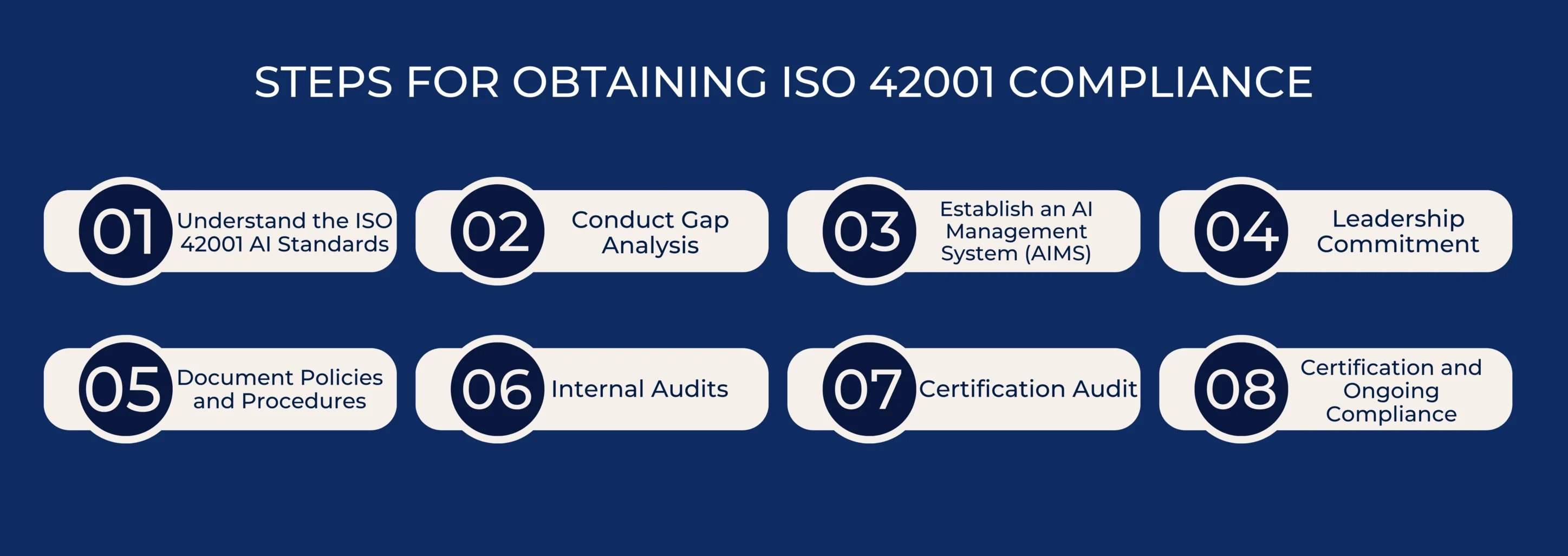
The ISO 42001 certification audit process conducted by CertPro for Michigan-based organizations follows a structured, multi-stage program designed to assess conformity of the organization’s AIMS against ISO/IEC 42001:2023. Each stage produces documented findings that contribute to the certification committee’s independent decision on certificate issuance. The process is audit-only and does not include advisory, consulting, or implementation activities at any stage — preserving the independence that makes ISO 42001 Certification in Michigan meaningful to enterprise customers and regulators alike.
| Audit Stage | Key Activities | Output |
|---|---|---|
| Application Review | Scope confirmation, AIMS documentation intake, audit program determination | Audit plan and scope agreement |
| Stage 1 Audit | Documentation review, readiness assessment, AIMS clause evaluation against ISO/IEC 42001:2023 | Stage 1 findings report, Stage 2 readiness determination |
| Stage 2 Audit | On-site or remote evidence evaluation, control testing, Annex A control assessment | Stage 2 audit report with nonconformity findings |
| Nonconformity Review | Review of corrective action evidence submitted against identified nonconformities | Nonconformity closure determination |
| Certification Decision | Independent certification committee review of audit findings and corrective actions | ISO 42001 certificate issuance or deferral |
| Surveillance Audit | Annual review of AIMS continued conformity and corrective action effectiveness | Surveillance audit report, certificate maintenance determination |
| Recertification Audit | Full AIMS reassessment at three-year certificate renewal cycle | Renewed ISO 42001 certificate |
The Stage 1 ISO 42001 audit focuses on reviewing the organization’s AIMS documentation and assessing readiness to proceed to Stage 2. During Stage 1, auditors review the AIMS scope statement, AI policy, AI risk assessment methodology, AI impact assessment documentation, Annex A control selection rationale, and key operational procedures governing AI system development and deployment.
Auditors assess whether the documented AIMS addresses the requirements of ISO/IEC 42001:2023 Clauses 4 through 10, and whether the organization has established the foundational documentation necessary for a meaningful Stage 2 evidence evaluation. Stage 1 findings are documented and provided to the organization before Stage 2 commences. Any documentation deficiencies identified during Stage 1 must be addressed prior to the Stage 2 ISO 42001 audit.
Key AIMS documentation reviewed during the Stage 1 ISO 42001 audit in Michigan includes the AI policy, AI risk assessment and risk treatment plan, AI impact assessment records, Annex A control applicability documentation, internal audit records, and management review outputs. The auditor evaluates the completeness and internal consistency of these documents relative to the defined AIMS scope.
For Michigan organizations with complex AI environments — such as automotive suppliers managing multiple AI-enabled product lines or healthcare organizations deploying AI across clinical and administrative functions — the Stage 1 review also assesses whether the scope boundary is adequately defined and whether all material AI systems are addressed within the documented AIMS.
The Stage 2 ISO 42001 AIMS audit constitutes the primary conformity assessment activity. During Stage 2, auditors collect and evaluate objective evidence of AIMS implementation and operational effectiveness across the requirements of ISO/IEC 42001:2023 and the Annex A controls selected by the organization.
Evidence collection methods include document and record review, interviews with personnel responsible for AI governance, observation of AI system management processes, and review of AI impact assessment outputs, training data governance records, model validation documentation, and incident records. The ISO 42001 audit Stage 2 assessment evaluates both the design adequacy of controls and their consistent operational application throughout the audit period.
Nonconformities identified during the Stage 2 ISO 42001 assessment are documented in the audit report and communicated to the organization. The organization must submit corrective action evidence demonstrating root cause analysis and remediation of each identified nonconformity before the certification committee renders its decision.
The certification committee — which operates independently from the audit team — reviews the complete audit file, nonconformity records, and corrective action submissions before making a determination on certificate issuance. This independent review structure ensures that the certification decision is objective and free from audit team influence, consistent with internationally recognized conformity assessment requirements for certification bodies.
An ISO 42001 certificate issued by CertPro is valid for a three-year certification cycle, subject to annual surveillance audits and a recertification audit at the end of the cycle. Annual surveillance audits assess the continued conformity of the AIMS, the effectiveness of corrective actions taken since the previous audit, changes to the organization’s AI systems or operational environment, and the status of internal audit and management review activities.
Surveillance audits may be conducted on-site or remotely, depending on the nature of the AIMS and the audit plan established at certification. Failure to maintain AIMS conformity or to facilitate surveillance audit access may result in certificate suspension or withdrawal, as determined by the certification committee.
- ✓Stage 1 Audit: Documentation and Readiness Review
- ✓Stage 2 Audit: Evidence Evaluation and Control Assessment
- ✓Surveillance Audits and Certificate Lifecycle
ISO 42001 Requirements and AIMS Control Environment
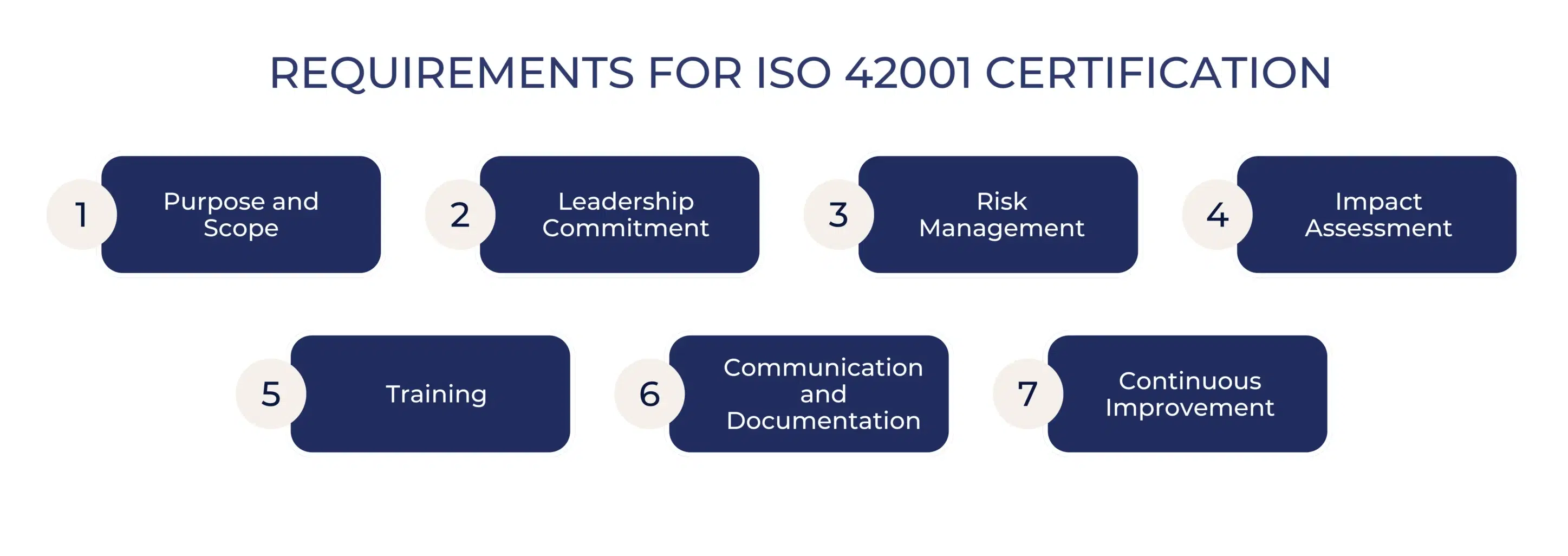
ISO 42001 compliance requires organizations to establish a documented AIMS that addresses both the management system framework in Clauses 4 through 10 and the AI-specific controls in Annex A. During an ISO 42001 assessment, auditors evaluate the organization’s control environment against these requirements using objective evidence collected through document review, personnel interviews, and process observation.
The following section outlines the primary AIMS requirements evaluated during an ISO 42001 audit, providing Michigan-based organizations with a clear picture of what the certification process examines.
- ✓AI Policy: A documented organizational policy establishing AI governance objectives, accountability structures, and commitments to responsible AI development and use
- ✓AI Risk Assessment: A systematic process for identifying, analyzing, and evaluating risks associated with AI systems within the defined AIMS scope
- ✓AI Risk Treatment Plan: Documented risk treatment decisions, including selected controls and residual risk acceptance
- ✓AI Impact Assessment: Structured assessments of the potential impacts of AI systems on individuals, groups, and society, addressing fairness, transparency, and accountability
- ✓Annex A Control Applicability Documentation: Documented justification for the inclusion or exclusion of each Annex A control relative to the organization’s risk profile
- ✓Internal Audit Program: A documented schedule and methodology for internal audits of AIMS conformity and effectiveness
- ✓Management Review Records: Documented outputs of leadership reviews of AIMS performance, including decisions on improvement actions
Annex A of ISO/IEC 42001:2023 organizes AI-specific controls into domains that address the governance and operational management of AI systems across their full lifecycle. These control domains cover organizational policies for responsible AI, resources dedicated to AI governance, the AI system lifecycle from design through decommissioning, impact assessment processes, data governance controls for AI training and operational data, third-party AI supply chain management, and information and communication obligations related to AI system transparency.
During an ISO 42001 AIMS audit, auditors evaluate whether the organization has implemented its selected Annex A controls and whether those controls operate effectively to address identified AI risks within the AIMS scope.
For Michigan organizations operating AI systems in regulated environments — such as healthcare AI diagnostic tools, automotive ADAS systems, or financial AI decisioning platforms — Annex A control evaluation during the ISO 42001 assessment includes scrutiny of data quality controls, model validation and testing documentation, human oversight mechanisms, and incident management procedures.
Auditors review evidence of systematic control operation, not merely policy documentation. The distinction between documented controls and operationally effective controls is a central focus of the Stage 2 ISO 42001 audit. Organizations that maintain AIMS documentation without corresponding operational evidence routinely receive nonconformity findings during this phase of the ISO 42001 audit in Michigan.
- ✓Core AIMS Documentation Requirements
- ✓Annex A AI-Specific Control Domains
Michigan Industries Pursuing ISO 42001 Certification
ISO 42001 Certification for Michigan companies spans a diverse range of industries, reflecting the state’s position as a national leader in automotive technology, advanced manufacturing, healthcare, and financial services. Each sector presents distinct AI governance requirements and audit considerations that shape the structure and focus of the ISO 42001 assessment conducted by CertPro for Michigan-based organizations. Understanding how the standard applies to each industry helps organizations prepare more effectively for the certification process.
ISO 42001 Certification for Michigan Automotive Industry
ISO 42001 Certification for Michigan’s automotive industry addresses the rapid integration of AI into vehicle systems, manufacturing quality control, supply chain management, and autonomous mobility development. Michigan remains the global center of automotive engineering, with major OEMs and thousands of Tier-1 and Tier-2 suppliers headquartered or operating throughout the state.
These organizations deploy AI in applications ranging from computer vision-based defect detection on production lines to machine learning algorithms embedded in advanced driver assistance systems (ADAS) and connected vehicle platforms. ISO 42001 Certification in Michigan enables automotive industry participants to document AI risk management, establish accountability for AI system outputs, and provide OEM customers and regulatory bodies with independent verification of AI governance conformity.
Automotive suppliers in Michigan seeking to qualify for OEM programs that require AI governance documentation increasingly reference ISO 42001 Certification as part of their supplier qualification packages. The ISO 42001 audit evaluates whether the supplier’s AIMS addresses AI system design controls, validation testing documentation, change management for AI model updates, and human oversight requirements — all of which are relevant to automotive safety and product liability considerations.
The independent nature of ISO 42001 Certification, issued by a certification body rather than a consulting firm, satisfies OEM procurement requirements for objective third-party verification of AI governance maturity.
ISO 42001 Certification for Michigan Healthcare and Manufacturing
Michigan healthcare organizations pursue ISO 42001 Certification to address growing regulatory and institutional expectations around AI governance in clinical settings. Michigan’s major health systems — concentrated in Detroit, Grand Rapids, Lansing, and Ann Arbor — are deploying AI in clinical decision support, diagnostic imaging analysis, patient flow management, and revenue cycle automation.
Federal oversight expectations from CMS, FDA guidance on AI-enabled medical devices, and institutional governance requirements all point toward documented, independently audited AI management systems. The ISO 42001 assessment for healthcare organizations evaluates AIMS controls governing data quality, model performance monitoring, clinical validation processes, and transparency obligations to patients and clinicians.
Michigan manufacturing organizations pursue ISO 42001 Certification to address AI integration in production optimization, predictive maintenance, quality assurance, and supply chain logistics. Advanced manufacturers throughout Michigan’s industrial corridor — from Flint and Saginaw to Kalamazoo and Lansing — rely on AI systems to maintain competitive production efficiency.
The ISO 42001 AIMS audit for manufacturing organizations evaluates controls governing AI system performance monitoring, operational data governance, and incident response procedures for AI system failures that could affect production quality or worker safety. Independent ISO 42001 Certification provides manufacturing organizations with documentation of AI governance maturity suitable for customer audits, industry certifications, and regulatory inquiries.
ISO 42001 Certification for Michigan Fintech, SaaS, and Cloud Providers
Michigan’s growing technology sector includes a significant concentration of fintech companies, SaaS providers, and cloud service organizations in the Detroit metropolitan area and university-anchored technology corridors in Ann Arbor and East Lansing. These organizations frequently deploy AI in product offerings sold to regulated financial institutions, healthcare systems, and enterprise customers who impose AI governance requirements through vendor contracts and third-party risk management programs.
ISO 42001 Certification in Michigan addresses these enterprise procurement requirements by providing an independently issued certification that documents AIMS conformity against ISO/IEC 42001:2023. The ISO 42001 Certification is issued by a Licensed CPA Firm operating as an independent certification body, satisfying customer and procurement requirements for objective third-party verification of AI compliance.
Benefits of ISO 42001 Certification for Michigan-Based Organizations
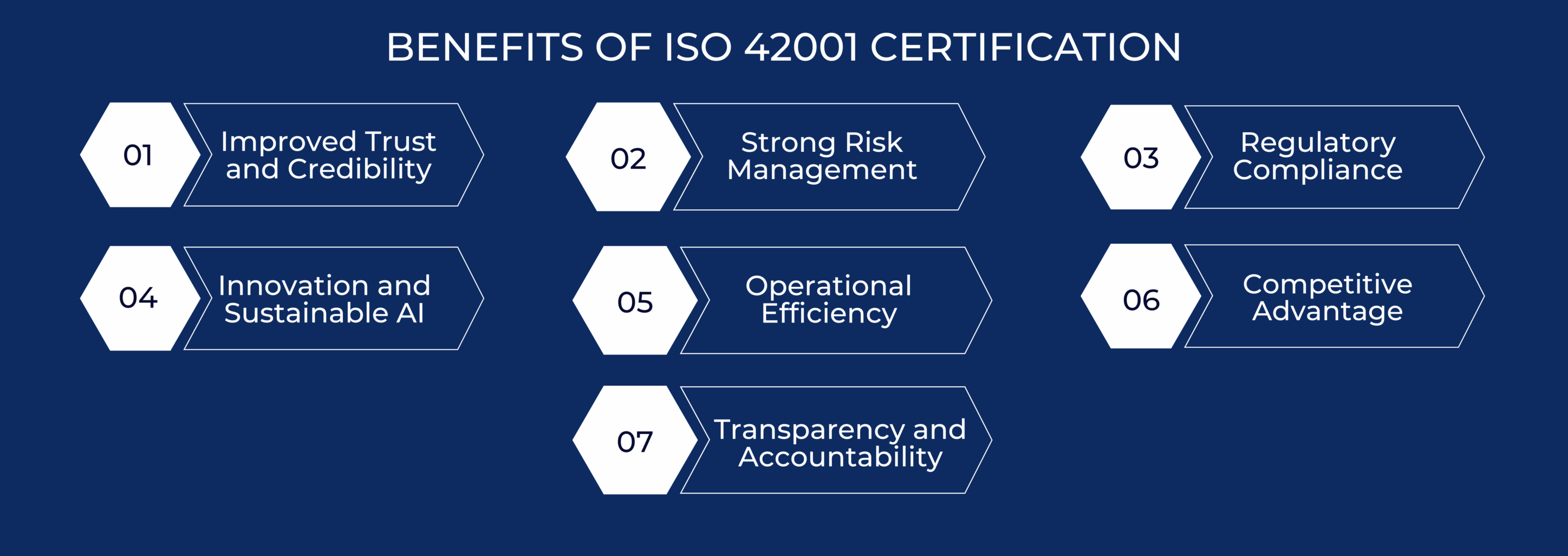
ISO 42001 Certification in Michigan provides organizations with independently verified documentation of AI governance conformity, supporting enterprise procurement qualification, regulatory engagement, and stakeholder trust. The benefits outlined below reflect the practical outcomes of ISO 42001 Certification for organizations operating across Michigan’s primary AI-intensive industries — from automotive and healthcare to fintech and advanced manufacturing.
- ✓Independent third-party verification of AIMS conformity against ISO/IEC 42001:2023, issued by a Licensed CPA Firm operating as a certification body
- ✓Recognition in enterprise procurement processes requiring AI governance documentation and independent ISO 42001 audit results
- ✓Structured audit methodology that evaluates both control design and operational effectiveness across the AIMS scope
- ✓Ongoing surveillance oversight through annual ISO 42001 audit cycles that maintain certification validity and support continuous AIMS improvement
- ✓Demonstrated accountability and transparency in AI system development and deployment, relevant to regulatory engagement and customer due diligence
- ✓Integration compatibility with ISO 27001 information security management and ISO 31000 risk management frameworks, enabling unified management system governance
- ✓Support for U.S. federal AI governance expectations, including alignment with NIST AI Risk Management Framework (AI RMF) principles addressed through the AIMS control structure
- ✓Competitive differentiation for Michigan-based AI providers and deployers in markets where ISO 42001 Certification is an enterprise supplier qualification requirement
Enterprise organizations in Michigan’s automotive, healthcare, and financial services sectors are increasingly incorporating AI governance certification requirements into vendor qualification and third-party risk management programs. A Michigan-based SaaS company providing AI-enabled analytics to a major automotive OEM, for example, may be required to demonstrate ISO 42001 compliance as part of the OEM’s supplier assurance process.
Similarly, a healthcare IT vendor deploying AI tools to hospital systems may encounter AI governance certification requirements embedded in vendor contracts or information security assessment questionnaires. ISO 42001 Certification in Michigan, issued by an independent certification body, provides the level of third-party assurance that enterprise procurement teams and third-party risk managers require — a certification committee decision based on objective audit evidence, not a self-assessment or consulting report.
ISO 42001 Certification that Michigan organizations obtain through CertPro’s independent audit process provides documented evidence of AI governance maturity relevant to multiple regulatory and standards frameworks. The AIMS structure under ISO/IEC 42001:2023 addresses principles aligned with the NIST AI Risk Management Framework, including AI risk identification, measurement, management, and governance.
The EU AI Act — which affects Michigan-based organizations with products or services sold in European markets — references risk management, transparency, and human oversight requirements that the AIMS framework directly addresses. Organizations subject to federal agency AI governance expectations, state-level AI legislation, or sector-specific AI guidance from FDA, OCC, or other regulators can reference their ISO 42001 Certification as evidence of systematic AI risk management conformity in regulatory engagements and examinations.
- ✓Enterprise Procurement and Vendor Assurance Recognition
- ✓Regulatory Alignment and AI Governance Maturity
ISO 42001 Certification Scope, Decisions, and Certificate Validity
The ISO 42001 certification scope, certification committee decision process, and certificate validity conditions are governed by the certification body’s program requirements and the accreditation standards applicable to independent conformity assessment. CertPro’s certification decisions for Michigan-based organizations are made by a certification committee that operates independently from the audit team. The committee reviews the complete audit file before rendering a determination on certificate issuance, suspension, or withdrawal — ensuring that every ISO 42001 Certification in Michigan reflects an objective, evidence-based conclusion.
Certification Scope Definition and Boundary Setting
The ISO 42001 certification scope is established during the application review stage and confirmed during the Stage 1 audit. The scope defines the AI systems, organizational units, processes, and geographic locations included within the certified AIMS boundary. Organizations must ensure that the defined scope reflects all material AI systems and related processes for which certification is sought.
Scope exclusions — such as AI systems managed by a separate business unit or geographic location — must be documented with justification and must not compromise the integrity of the certified AIMS. During the ISO 42001 assessment, auditors evaluate whether the scope boundary is accurately defined and whether the evidence collected is sufficient to support a certification conclusion for the declared scope. Changes to the organization’s AI systems or operational structure that materially affect the AIMS scope must be reported to the certification body and may trigger an unscheduled audit review.
Certificate Suspension and Withdrawal Conditions
An ISO 42001 certificate may be suspended or withdrawn by the certification committee under defined conditions. Suspension conditions include failure to facilitate a scheduled surveillance audit, identification of major nonconformities that are not remediated within the required corrective action period, and voluntary request by the certificate holder. Withdrawal conditions include persistent AIMS failures that demonstrate fundamental nonconformity with ISO/IEC 42001:2023 requirements, material misrepresentation in the certification application, or failure to pay applicable certification body fees.
Certificate suspension is not equivalent to withdrawal; a suspended certificate may be reinstated following evidence of corrective action reviewed and accepted by the certification committee. These conditions are disclosed in the certification agreement executed at the commencement of the certification program and are applied consistently across all Michigan-based certificate holders under CertPro’s ISO 42001 Certification program.
ISO 42001 Compliance and Integration with Related Standards
ISO 42001 compliance does not exist in isolation. For most Michigan-based organizations, ISO 42001 Certification is pursued alongside or in integration with existing management system certifications, including ISO 27001 for information security and ISO 9001 for quality management. The High-Level Structure shared by these standards enables significant documentation and process reuse, reducing the incremental burden of establishing a standalone AIMS.
The ISO 42001 audit Michigan assessment evaluates whether the organization has established a coherent AIMS that addresses AI-specific risks within the broader management system context — supporting a unified governance approach rather than a siloed compliance effort.
Integration with ISO 27001 Information Security Management
ISO 27001 and ISO 42001 share structural alignment that enables integrated implementation and, in many cases, combined or coordinated audit programs. Organizations holding ISO 27001 certification can leverage existing information security policies, risk assessment methodologies, internal audit programs, and management review processes as foundational elements of their AIMS under ISO 42001.
The AI-specific control domains in Annex A of ISO 42001 address risks and governance requirements that extend beyond information security — including AI model fairness, transparency, impact assessment, and AI supply chain management. However, the management system infrastructure established under ISO 27001 provides a compatible foundation for ISO 42001 compliance. During a combined ISO 27001 and ISO 42001 audit, auditors evaluate the distinct requirements of each standard while recognizing shared management system evidence where applicable.
For Michigan organizations in the automotive, healthcare, and financial services sectors that already hold ISO 27001 certification, adding ISO 42001 Certification provides a documented, independently audited extension of their governance framework to cover AI-specific risks. This is particularly relevant for organizations that have integrated AI systems into previously certified information security environments and need to demonstrate to customers or regulators that AI governance controls are in place alongside information security controls.
The ISO 42001 AIMS audit evaluates AI-specific governance requirements that ISO 27001 does not address, including AI impact assessments, AI policy governance, and Annex A AI-specific control implementation — making ISO 42001 Certification a natural complement to an existing ISO 27001 program.
Alignment with NIST AI RMF and U.S. Regulatory Expectations
The NIST AI Risk Management Framework (AI RMF 1.0), published in January 2023, establishes voluntary guidance for AI risk management organized around four core functions: Govern, Map, Measure, and Manage. ISO/IEC 42001:2023 addresses equivalent themes through its management system clause structure and Annex A controls, including organizational governance (Clause 5, Annex A organizational controls), AI risk identification and assessment (Clause 6, Annex A impact assessment controls), AI system performance measurement (Clause 9), and risk treatment and corrective action (Clause 10).
Organizations that reference both the NIST AI RMF and ISO 42001 in their AI governance frameworks can use their ISO 42001 certification audit findings as structured evidence of AI RMF implementation for regulatory and customer reporting purposes. This alignment is particularly relevant for Michigan-based federal contractors, defense suppliers, and organizations subject to sector-specific AI guidance from U.S. regulatory agencies.
How to Pursue ISO 42001 Certification in Michigan
Organizations in Michigan seeking ISO 42001 Certification initiate the process by engaging CertPro as an independent certification body. The application process begins with a scope discussion and documentation intake to establish the AIMS boundary and determine the appropriate audit program. The steps below outline the structured process for pursuing ISO 42001 Certification in Michigan through CertPro’s certification program — from initial application through certificate issuance and ongoing surveillance.
- Submit a certification application identifying the organization, proposed AIMS scope, AI systems included within scope, and organizational roles as AI provider, AI deployer, or both
- Complete the application review stage, during which CertPro confirms the scope, reviews preliminary AIMS documentation, and establishes the audit program including Stage 1 and Stage 2 ISO 42001 audit dates
- Facilitate the Stage 1 audit, providing auditors with access to AIMS documentation including the AI policy, risk assessment, impact assessment records, and Annex A control applicability documentation
- Review Stage 1 findings and address any documentation deficiencies identified before the Stage 2 audit commences
- Facilitate the Stage 2 ISO 42001 AIMS audit, providing auditors with access to personnel, AI system records, operational evidence, and supporting documentation across the AIMS scope
- Submit corrective action evidence for any nonconformities identified during the Stage 2 audit, within the timeframe specified in the audit report
- Receive the certification committee decision on ISO 42001 certificate issuance, based on the complete audit file and corrective action submissions reviewed independently from the audit team
- Maintain AIMS conformity and facilitate annual surveillance audits to sustain certificate validity throughout the three-year ISO 42001 certification cycle
Documentation Preparation for the ISO 42001 Audit
Organizations preparing for an ISO 42001 audit in Michigan should ensure that their AIMS documentation is complete, internally consistent, and accurately reflects their operational AI governance practices. The primary documentation set evaluated during the Stage 1 audit includes the AI policy, the AI risk assessment methodology and completed risk assessment records, the AI risk treatment plan, AI impact assessment records for in-scope AI systems, the Annex A control applicability statement, documented AIMS procedures, internal audit reports, and management review minutes.
The documentation must demonstrate that the organization has systematically addressed all ISO/IEC 42001:2023 clause requirements within the defined AIMS scope. Incomplete or inconsistent documentation is a frequent source of Stage 1 findings and can delay the commencement of the Stage 2 ISO 42001 audit for Michigan-based organizations undergoing their initial ISO 42001 assessment.
FAQ
▶
What is ISO 42001 Certification and who issues it in Michigan?
▶
Which Michigan industries benefit most from ISO 42001 Certification?
▶
What is the difference between Stage 1 and Stage 2 of the ISO 42001 audit?
▶
How long is an ISO 42001 certificate valid?
▶
What documentation is required for an ISO 42001 audit in Michigan?
▶
Does ISO 42001 Certification apply to AI deployers as well as AI developers?
▶
How does ISO 42001 compliance relate to the EU AI Act for Michigan organizations?
▶
Can ISO 42001 be integrated with an existing ISO 27001 certification in Michigan?
ISO 42001 CERTIFIED: WHY AI GOVERNANCE CERTIFICATION IS BECOMING A BOARD-LEVEL REQUIREMENT
ISO 42001 Certified: Board-Level AI Governance Guide | CertPro CPA LLC HERO ══════════════════════════════ –> src=”https://certpro.com/wp-content/uplo…
Get In Touch
have a question? let us get back to you.