
ISO 42001 Certification in Ohio
CertPro is a Licensed CPA Firm providing independent, third-party ISO 42001 Certification in Ohio through conformity assessment audits conducted against the requirements of ISO/IEC 42001:2023. CertPro operates exclusively as a certification body — evaluating, assessing, and rendering independent certification decisions — and does not provide consulting, implementation, or advisory services of any kind. This strict separation ensures every ISO 42001 certification audit we conduct reflects genuine, unbiased conformity assessment.
OUR CLIENTS










Independent ISO 42001 Certification by a Licensed CPA Firm in Ohio
CertPro is a Licensed CPA Firm providing independent, third-party ISO 42001 Certification in Ohio through conformity assessment audits conducted against the requirements of ISO/IEC 42001:2023. CertPro operates exclusively as a certification body — evaluating, assessing, and rendering independent certification decisions — and does not provide consulting, implementation, or advisory services of any kind. This strict separation ensures every ISO 42001 certification audit we conduct reflects genuine, unbiased conformity assessment.
Ohio’s AI and Technology Ecosystem
Ohio occupies a distinctive position within the U.S. technology and innovation landscape, supporting a dense and diversified ecosystem of organizations that develop, deploy, or rely on artificial intelligence systems. The state’s economy spans advanced manufacturing, automotive and mobility technology, aerospace and defense, semiconductor fabrication, healthcare and life sciences, financial services, insurance, logistics, cybersecurity, cloud computing, robotics, and software development.
Major technology and business centers — including Columbus, Cleveland, Cincinnati, Dayton, and Akron — house a growing concentration of SaaS providers, AI-focused startups, enterprise technology companies, research universities, and regulated institutions. These organizations face U.S. AI governance expectations, sector-specific compliance obligations, and increasingly rigorous third-party vendor assurance requirements. For organizations in these sectors, ISO 42001 Certification in Ohio provides an independently verified demonstration that an Artificial Intelligence Management System (AIMS) has been established, implemented, and maintained in conformity with an internationally recognized standard.
The ISO 42001 standard defines requirements for responsible AI governance, AI risk management, and systematic control of AI systems across the entire AI system lifecycle — from design and development through deployment, monitoring, and decommissioning.
CertPro as an Independent Certification Body
As a Licensed CPA Firm, CertPro operates under the professional and ethical standards applicable to independent assurance and attestation engagements. Our role in ISO 42001 Certification in Ohio is strictly that of a conformity assessor — evaluating whether an organization’s AIMS meets the normative requirements of ISO/IEC 42001:2023 and rendering a certification decision based on objective evidence collected during the ISO 42001 audit.
CertPro does not design, implement, or advise on AI management systems, AI policies, AI risk treatments, or AI controls. This structural separation between the certification body and the organization being certified is a foundational requirement of the ISO 42001 standard and is essential to the credibility of the resulting certification. Organizations across Ohio’s advanced manufacturing, healthcare, financial services, automotive technology, cloud platform, and AI development sectors rely on this independence to demonstrate AI governance conformity to enterprise customers, regulators, and procurement authorities.
ISO/IEC 42001:2023 and Ohio’s Regulatory Context
ISO/IEC 42001:2023 is the first international standard specifically designed to establish requirements for an Artificial Intelligence Management System. Published in December 2023 by the International Organization for Standardization, it specifies how organizations should govern AI systems responsibly, assess and treat AI-related risks, implement controls over AI development and deployment, and maintain ongoing oversight through internal audit and management review.
In Ohio, the relevance of ISO 42001 compliance extends across multiple regulatory and commercial dimensions. Healthcare organizations deploying AI-assisted diagnostics face HIPAA and patient safety considerations. Financial institutions and fintech companies using AI-driven decisioning are subject to federal regulatory expectations and vendor risk management requirements. SaaS providers, cloud companies, and AI developers serving enterprise clients face increasingly standardized third-party assurance demands.
The ISO 42001 standard provides a structured, internationally recognized framework that addresses these AI governance requirements systematically. As a result, ISO 42001 Certification in Ohio has become a meaningful signal of institutional AI accountability across industries.

What Is ISO 42001 Certification?
ISO 42001 Certification is the formal, third-party verified confirmation that an organization has established and maintains an Artificial Intelligence Management System conforming to the requirements of ISO/IEC 42001:2023. Certification is issued by an independent certification body following a structured ISO 42001 certification audit that evaluates the organization’s documented AIMS, implemented controls, AI risk management processes, and operational evidence.
ISO 42001 Certification is distinct from self-declaration or internal audit findings. It requires an external conformity assessment conducted by a qualified, independent body and results in a time-bound certificate subject to ongoing surveillance audits. For Ohio organizations, this distinction is particularly important when demonstrating AI governance maturity to enterprise customers, regulators, and procurement authorities.
The ISO/IEC 42001:2023 Standard Structure
ISO/IEC 42001:2023 follows the ISO High Level Structure (HLS), also known as Annex SL — the common framework used for ISO management system standards including ISO 27001 and ISO 9001. The ISO 42001 standard is organized into ten clauses: Clause 1 (Scope), Clause 2 (Normative References), Clause 3 (Terms and Definitions), Clause 4 (Context of the Organization), Clause 5 (Leadership), Clause 6 (Planning), Clause 7 (Support), Clause 8 (Operation), Clause 9 (Performance Evaluation), and Clause 10 (Improvement).
Clauses 4 through 10 contain the normative management system requirements that form the basis of the ISO 42001 certification audit. In addition, the standard includes Annex A, which specifies AI-specific controls and guidance across domains including AI policy, internal organization, AI system impact assessment, data governance, responsible AI development, and third-party AI relationships. During an ISO 42001 audit, auditors evaluate conformity against both the clause requirements and the applicable Annex A controls selected through the organization’s AI risk treatment process.
Artificial Intelligence Management System (AIMS) Defined
An Artificial Intelligence Management System (AIMS), as defined by ISO/IEC 42001:2023, is a structured set of policies, processes, procedures, and controls through which an organization manages the development, deployment, monitoring, and decommissioning of AI systems in a responsible and accountable manner. The AIMS addresses the full AI system lifecycle — from initial design and training data governance through model deployment, operational monitoring, and eventual retirement.
The AIMS encompasses AI risk management processes, including the identification, assessment, and treatment of AI-specific risks such as bias, opacity, safety failures, privacy violations, and unintended societal impacts. It also covers documented information requirements, human oversight mechanisms, transparency and explainability controls, and performance evaluation through internal audit and management review.
The AIMS is the system that an organization implements and operates — and it is the primary subject of the ISO 42001 certification audit. The audit evaluates whether the AIMS has been established in conformity with the ISO 42001 standard’s requirements and whether it is operating effectively, as evidenced by objective, verifiable documentation.
ISO 42001 Annex A Controls Overview
Annex A of ISO/IEC 42001:2023 specifies a reference set of AI-specific controls that organizations select and implement as part of their AI risk treatment process. The applicable controls are documented in the organization’s Statement of Applicability, which forms a key piece of evidence reviewed during the ISO 42001 certification audit.
Annex A control domains include: AI policies and organizational roles; internal organizational structure for AI governance; AI system impact assessment processes; data acquisition, preparation, and governance controls; controls over the AI system development lifecycle; responsible AI deployment and operational controls; human oversight and intervention mechanisms; transparency and explainability provisions; and controls governing third-party and supply chain AI relationships.
During the ISO 42001 audit, auditors assess whether the organization has appropriately selected Annex A controls, documented its justifications for inclusion or exclusion, and implemented the selected controls in a manner consistent with its AI risk assessment findings and risk treatment plan.
ISO 42001 Certification Audit Process in Ohio
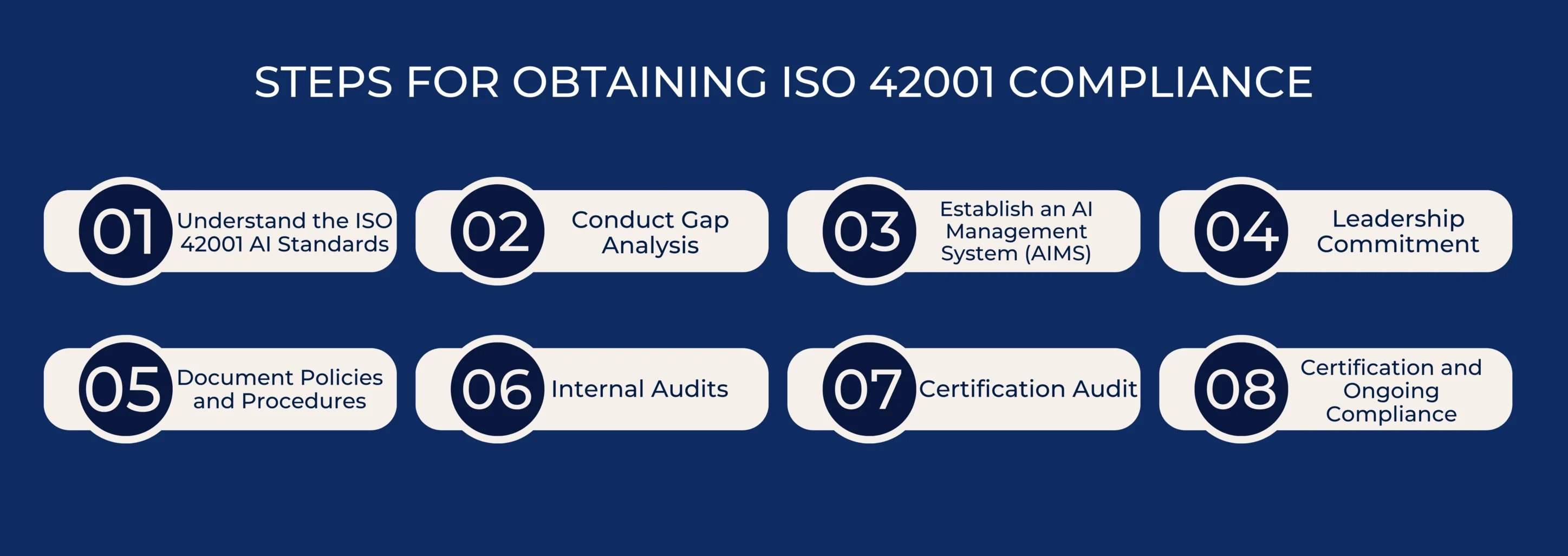
The ISO 42001 certification audit process conducted by CertPro for Ohio-based organizations follows a structured, multi-stage program designed to assess conformity with ISO/IEC 42001:2023 in a systematic and evidence-based manner. Each stage of the audit program generates documented findings that feed into the subsequent stage and ultimately inform the independent certification decision rendered by CertPro’s certification committee.
| Audit Stage | Key Activities | Output |
|---|---|---|
| Application Review | Review of organizational scope, AI system inventory, and AIMS documentation completeness | Audit program determination and scope confirmation |
| Stage 1 Audit | Documentation review: AIMS policies, AI risk assessment, risk treatment plan, Statement of Applicability, and internal audit records | Stage 1 findings report; readiness determination for Stage 2 |
| Stage 2 Audit | On-site or remote evaluation of AIMS implementation and operating effectiveness; evidence collection against ISO 42001 requirements and Annex A controls | Detailed audit findings report including any nonconformities identified |
| Nonconformity Review | Evaluation of corrective actions submitted in response to identified nonconformities | Acceptance or rejection of corrective action evidence |
| Certification Decision | Independent review by CertPro certification committee; issuance of ISO 42001 certificate where conformity is established | ISO 42001 certificate (3-year validity with annual surveillance audits) |
The Stage 1 audit is the initial formal evaluation phase of the ISO 42001 certification audit process. During Stage 1, the CertPro audit team reviews the organization’s AIMS documentation to assess whether the management system has been established in a manner consistent with the requirements of ISO/IEC 42001:2023.
Key documents reviewed during Stage 1 include the AI policy, AI risk assessment records, AI risk treatment plan, Statement of Applicability (including Annex A control selections and exclusion justifications), internal audit program and results, and management review records. The Stage 1 audit also evaluates the defined scope of the AIMS — including which AI systems, organizational units, and business functions are within scope — and assesses whether the scope is appropriately documented and justified.
The output of the Stage 1 audit is a formal findings report that identifies any areas of documentation deficiency or scope concern and determines whether the organization is ready to proceed to Stage 2. Importantly, Stage 1 does not assess the operational effectiveness of controls — that evaluation occurs during the Stage 2 audit.
The Stage 2 audit is the substantive conformity assessment phase of the ISO 42001 certification audit. During Stage 2, CertPro auditors evaluate whether the AIMS has been implemented as documented and whether the selected controls are operating effectively in practice.
Evidence collection during Stage 2 encompasses interviews with personnel responsible for AI governance, review of operational records such as AI impact assessment reports, model monitoring logs, incident records, training data governance documentation, and third-party AI provider assessment records, as well as observations of operational processes where applicable. Auditors assess conformity against each applicable clause requirement of ISO/IEC 42001:2023 (Clauses 4 through 10) and against the Annex A controls included in the organization’s Statement of Applicability.
Any nonconformities identified during Stage 2 are documented in the audit findings report. The organization must address these through documented corrective actions, which CertPro reviews before rendering the certification decision. The Stage 2 audit serves as the primary basis for the ISO 42001 certification decision.
An ISO 42001 certificate issued following a successful certification audit is valid for three years from the date of the certification decision, subject to satisfactory completion of annual surveillance audits. CertPro conducts surveillance audits at defined intervals — typically annually — to assess whether the certified AIMS continues to conform to ISO/IEC 42001:2023 requirements and whether the organization’s AI governance controls remain effective.
Surveillance audits are narrower in scope than the initial ISO 42001 certification audit. They focus on areas identified during the previous audit cycle, changes to the organization’s AI systems or operational environment, internal audit and management review results, and the status of previously identified nonconformities.
A recertification audit is conducted prior to the expiration of the three-year certificate to reassess full conformity and renew certification. CertPro’s certification committee retains authority to suspend or withdraw ISO 42001 certification where continued conformity cannot be established through objective evidence during the surveillance or recertification cycle.
- ✓Stage 1 Audit: Documentation and Scope Review
- ✓Stage 2 Audit: Implementation and Operating Effectiveness
- ✓Surveillance Audits and Certification Validity
ISO 42001 Requirements: AIMS Documentation and Controls
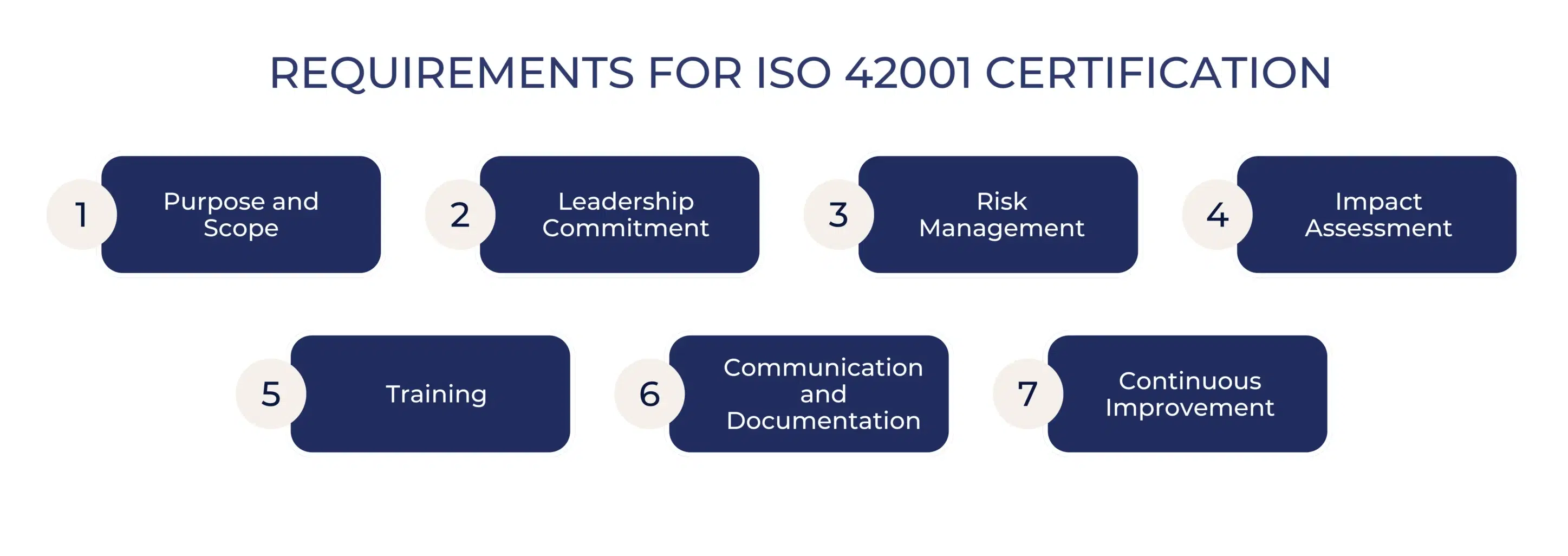
ISO/IEC 42001:2023 specifies both the management system requirements that an organization’s AIMS must satisfy and the documentation that must be maintained as objective evidence of conformity. Understanding these requirements is essential to evaluating what will be assessed during the ISO 42001 certification audit. The following sections describe the principal documentation and control requirements that CertPro auditors evaluate during the ISO 42001 compliance process for Ohio-based organizations.
Achieving ISO 42001 compliance requires organizations to establish and maintain a defined body of documented information demonstrating the establishment and operation of the AIMS. The core documentation evaluated during an ISO 42001 audit includes:
The AI policy (Clause 5.2) articulates the organization’s commitment to responsible AI governance and sets the tone for the management system. The AI risk assessment (Clause 6.1) systematically identifies and evaluates AI-related risks within the defined scope. The AI risk treatment plan (Clause 6.1) documents selected risk treatment options and the Annex A controls applied to address identified risks. The Statement of Applicability (Clause 6.1) lists all Annex A controls and documents inclusion or exclusion justifications. AI system impact assessment records (Annex A) document the evaluation of potential impacts of AI systems on individuals, groups, and society. Finally, records of internal audit results and management review outcomes demonstrate ongoing performance evaluation.
These documents collectively constitute the evidentiary foundation against which ISO 42001 conformity is assessed during the certification audit.
The ISO 42001 standard requires organizations to conduct and document AI risk assessments that identify risks arising from AI systems across the AI system lifecycle. Risk identification must consider AI-specific risk categories including bias and fairness risks, safety and reliability risks, privacy and data protection risks, transparency and explainability limitations, security vulnerabilities specific to AI systems (such as adversarial attacks or model poisoning), and risks arising from third-party AI components or supply chain dependencies.
In addition to the AI risk assessment, the ISO 42001 standard requires organizations to conduct AI system impact assessments. These evaluate the potential positive and negative impacts of AI systems on individuals, affected communities, and broader society. The AI impact assessment is a distinctive requirement of ISO/IEC 42001:2023 that distinguishes it from other management system standards and reflects the unique societal implications of AI system deployment.
During the ISO 42001 certification audit, auditors review the methodologies, records, and outputs of both assessments to evaluate whether they are conducted with sufficient rigor and documented in a manner consistent with the standard’s requirements.
ISO/IEC 42001:2023 Clause 9 requires organizations to conduct internal audits of the AIMS at planned intervals. These audits evaluate whether the management system conforms to the organization’s own requirements and to the ISO 42001 standard’s requirements, and whether it is effectively implemented and maintained. Internal audit results must be documented and reported to relevant management.
Clause 9 also requires management review of the AIMS at planned intervals to ensure its continuing suitability, adequacy, and effectiveness. Management review inputs must include the status of actions from previous reviews, changes in external and internal factors relevant to the AIMS, AI risk assessment and treatment outcomes, internal audit results, nonconformities and corrective actions, and performance data related to AI system monitoring. Management review outputs must include decisions on improvement opportunities and any required changes to the AIMS.
During the ISO 42001 certification audit, CertPro auditors review internal audit records and management review minutes as evidence of the organization’s ongoing performance evaluation activities and leadership commitment to the AIMS.
- ✓Core AIMS Documentation Requirements
- ✓AI Risk Assessment and Impact Assessment Requirements
- ✓Internal Audit and Management Review Requirements
Ohio Industries Pursuing ISO 42001 Certification
ISO 42001 Certification in Ohio is pursued by organizations across a broad range of industries that develop, integrate, or deploy AI systems as part of their products, services, or internal operations. The diversity of Ohio’s economy — spanning traditional manufacturing alongside emerging technology sectors — creates a wide field of organizations for which independent AI governance certification carries material commercial, regulatory, and reputational significance.
Advanced Manufacturing, Automotive, and Aerospace
Ohio is home to one of the largest advanced manufacturing ecosystems in the United States, with significant concentrations of automotive and mobility technology companies, aerospace and defense contractors, semiconductor manufacturers, and industrial automation providers. Organizations in these sectors increasingly deploy AI systems for predictive maintenance, quality inspection, autonomous vehicle technology, supply chain optimization, and production process control.
Ohio manufacturing organizations pursuing ISO 42001 Certification seek to demonstrate that AI systems embedded in safety-critical or operationally critical environments are governed through a structured AIMS with documented risk assessments, human oversight mechanisms, and performance monitoring controls. Aerospace and defense suppliers operating under U.S. Department of Defense and prime contractor vendor assurance requirements face growing expectations for AI governance documentation, making ISO 42001 certification a relevant credential in vendor qualification processes.
Honda, Lordstown Motors’ successors, and numerous Tier 1 and Tier 2 automotive suppliers operating across the Dayton, Columbus, and Toledo corridors represent the type of organizations for which ISO 42001 Certification in Ohio is increasingly relevant and strategically valuable.
Healthcare, Financial Services, and Insurance
Ohio healthcare organizations — including hospitals, health systems, clinical AI developers, and life sciences companies — operate at the intersection of AI deployment and stringent patient safety, HIPAA, and FDA regulatory requirements. AI systems used for diagnostic imaging analysis, clinical decision support, patient risk stratification, and drug discovery carry significant safety and liability implications. For these organizations, pursuing ISO 42001 Certification in Ohio through a structured AIMS and independent ISO 42001 certification audit represents a meaningful risk management and regulatory alignment strategy. The Cleveland Clinic, OhioHealth, and the broader healthcare ecosystem surrounding Ohio’s academic medical centers are examples of institutions where AI governance maturity is increasingly subject to scrutiny.
For Ohio financial services organizations — including banks, insurance carriers, fintech companies, and investment managers — AI systems used in credit decisioning, fraud detection, claims automation, underwriting, and customer interaction are subject to federal regulatory expectations around model risk management, fairness, and explainability. ISO 42001 compliance provides Ohio fintech and financial services organizations with a structured framework for demonstrating AI governance accountability to regulators and enterprise clients alike.
SaaS, Cloud, and AI Technology Companies
Ohio’s technology sector includes a growing population of SaaS providers, cloud service providers, AI platform developers, cybersecurity firms, and software companies headquartered in or operating from Columbus, Cleveland, Cincinnati, and the broader Ohio Third Frontier ecosystem. These organizations frequently serve regulated enterprise clients in financial services, healthcare, government, and critical infrastructure sectors, where third-party vendor assurance requirements mandate evidence of AI governance maturity.
ISO 42001 Certification in Ohio for these technology companies provides a recognized, independently verified credential that can be submitted in response to vendor security questionnaires, procurement evaluations, and enterprise due diligence processes. SaaS companies deploying AI-driven features — such as automated recommendations, predictive analytics, or generative AI content — face growing customer demand for evidence of responsible AI practices.
ISO 42001 certification for Ohio companies in the SaaS and cloud space delivers structured documentation of AI governance controls that can be referenced in sales processes, contract negotiations, and regulatory inquiries — providing a measurable competitive advantage in enterprise markets.
Benefits of ISO 42001 Certification for Ohio-Based Organizations
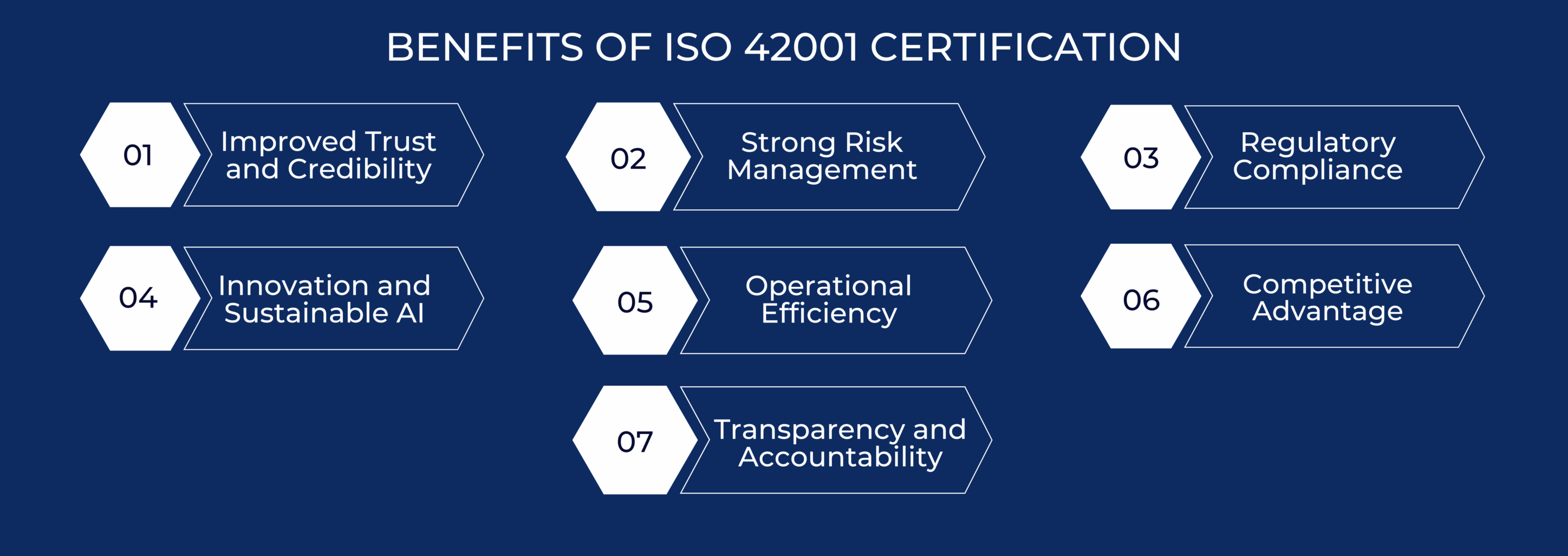
ISO 42001 Certification in Ohio provides independently verified evidence that an organization’s Artificial Intelligence Management System conforms to an internationally recognized standard for responsible AI governance. The benefits are concrete and measurable — reflecting the value of a structured ISO 42001 certification audit conducted by an independent Licensed CPA Firm rather than self-attestation or internal review alone.
- ✓Independent verification of AIMS conformity with ISO/IEC 42001:2023 through a structured third-party ISO 42001 certification audit
- ✓Credible, internationally recognized credential demonstrating responsible AI governance to customers, regulators, and procurement authorities
- ✓Structured AI risk management framework that systematically identifies, assesses, and treats AI-related risks across the AI system lifecycle
- ✓Documented evidence base — including AI policies, risk assessments, impact assessments, and Annex A control implementation — that supports regulatory inquiries and enterprise vendor reviews
- ✓Ongoing surveillance audit oversight that validates continued AIMS conformity and drives continuous improvement in AI governance practices
- ✓Competitive differentiation in enterprise procurement processes where AI governance maturity is evaluated as part of vendor qualification
- ✓Alignment with U.S. AI governance expectations, international AI regulatory developments, and sector-specific AI risk management frameworks applicable to Ohio industries
- ✓Demonstrated human oversight, transparency, and accountability mechanisms that support ethical AI deployment across healthcare, financial services, manufacturing, and technology sectors
One of the most immediate and practical benefits of ISO 42001 Certification in Ohio is its recognition in enterprise vendor qualification and procurement processes. Large enterprises — particularly those in regulated sectors such as financial services, healthcare, and defense — conduct systematic vendor risk assessments that increasingly include AI governance as a distinct evaluation domain.
Organizations that have obtained ISO 42001 certification can provide their certificate and audit scope documentation as structured evidence of AI governance conformity. This streamlines vendor assessment processes and reduces the burden of responding to bespoke AI questionnaires. In Ohio’s competitive technology and services market — where SaaS companies and AI vendors compete for contracts with major financial institutions, hospital systems, manufacturers, and government agencies — ISO 42001 certification provides a verifiable third-party credential that distinguishes certified organizations from those relying solely on self-reported AI governance documentation.
The ISO 42001 standard’s international recognition also benefits Ohio companies seeking contracts with multinational enterprises or expanding into European and Asian markets where AI governance standards are being incorporated into procurement requirements.
ISO 42001 compliance achieved through certification provides Ohio organizations with a structured basis for alignment with emerging U.S. AI governance requirements. These include the National Institute of Standards and Technology (NIST) AI Risk Management Framework (AI RMF), sector-specific AI guidance from the Office of the Comptroller of the Currency (OCC) and other financial regulators, FDA guidance on AI in medical devices and clinical decision support, and evolving state-level AI policy frameworks.
While ISO 42001 certification does not substitute for regulatory compliance determinations, the structured AIMS and documented controls that form the basis of the ISO 42001 certification audit provide a defensible, evidence-based record of AI governance activities. This record can support regulatory examinations and audits across sectors.
For Ohio organizations deploying AI systems with potential impacts on individuals — including credit applicants, patients, employees, or consumers — the AI impact assessment and human oversight controls required by ISO/IEC 42001:2023 provide documented evidence of responsible AI deployment practices relevant to liability and risk management considerations.
- ✓Enterprise Vendor Assurance and Procurement Recognition
- ✓Regulatory Alignment and Risk Reduction
ISO 42001 Certification Scope and Independent Decision Framework
The scope of ISO 42001 Certification in Ohio is defined by the organization being certified, subject to review and confirmation by CertPro during the Stage 1 audit. Scope definition is a critical element of the certification process — it determines which AI systems, organizational units, business processes, and geographic locations are covered by the AIMS and, consequently, by the certification. The scope must be documented, justified, and consistently applied throughout the AIMS and across all audit stages.
Defining the AIMS Scope for Ohio Organizations
ISO/IEC 42001:2023 Clause 4.3 requires organizations to determine the scope of the AIMS by considering the external and internal issues identified under Clause 4.1, the interested parties and their requirements identified under Clause 4.2, and the interfaces and dependencies between activities performed by the organization and those performed by other parties.
For Ohio-based organizations, scope decisions must account for the specific AI systems in operation, the organizational functions responsible for AI development and deployment, and any third-party AI components or platforms incorporated into AI system operation. An Ohio SaaS company might define its AIMS scope to cover all AI-driven features embedded in its production platform, including the data pipelines, model development processes, and operational monitoring systems associated with those features. A healthcare organization might define scope to encompass specific AI-assisted diagnostic tools deployed in clinical settings.
The scope must be realistic, verifiable, and consistently supported by the documented evidence reviewed during the ISO 42001 certification audit. Artificially narrow or poorly justified scope definitions are subject to challenge and clarification during the Stage 1 audit.
Independence of the Certification Committee Decision
The certification decision in CertPro’s ISO 42001 audit process is rendered by an independent certification committee that reviews the complete audit file — including Stage 1 findings, Stage 2 audit findings, evidence of corrective actions, and the audit team’s conformity assessment — and determines whether the evidence supports issuance of an ISO 42001 certificate.
The certification committee operates separately from the audit team that conducted the field work, maintaining the independence and objectivity of the certification decision. The committee evaluates whether all normative requirements of ISO/IEC 42001:2023 have been addressed, whether identified nonconformities have been resolved through documented corrective actions, and whether the overall AIMS as evidenced in the audit record demonstrates conformity with the standard.
Certification is not granted where material nonconformities remain unresolved or where objective evidence collected during the ISO 42001 certification audit does not support a conformity conclusion. The committee also retains authority to suspend or withdraw an issued certificate where subsequent surveillance audit findings indicate that conformity has been lost.
ISO 42001 Standard: Key Concepts and AI Governance Framework
The ISO 42001 standard introduces several AI-specific concepts and requirements that distinguish it from other management system standards and reflect the unique governance challenges posed by AI systems. Understanding these concepts is important for organizations preparing their AIMS documentation and for appreciating what is evaluated during an ISO 42001 audit conducted by CertPro in Ohio.
Responsible AI Principles in ISO/IEC 42001:2023
ISO/IEC 42001:2023 is built on a set of responsible AI principles that inform the standard’s requirements for AI governance. These principles — which include transparency, fairness, accountability, reliability, safety, privacy, and human oversight — are not aspirational statements. They are operationalized through the AIMS requirements and Annex A controls.
For example, the transparency principle is reflected in requirements for AI system documentation, explainability controls, and communication to affected stakeholders. The fairness principle is addressed through AI impact assessment requirements and controls over training data governance and bias evaluation. The accountability principle is embedded in the leadership and organizational role requirements of Clause 5.
During the ISO 42001 certification audit, CertPro auditors assess whether the organization has operationalized these principles through documented controls and processes rather than relying on policy statements alone. The ISO 42001 audit evaluates actual implementation evidence — records, outputs, and operational indicators — that demonstrate the principles are active in the organization’s AI governance practices.
AI System Lifecycle and Data Governance Controls
The ISO 42001 standard requires organizations to govern AI systems across the full AI system lifecycle — from initial problem definition and design through data acquisition, model development, testing and validation, deployment, operational monitoring, and eventual decommissioning. This lifecycle orientation distinguishes the ISO 42001 standard from point-in-time controls frameworks and requires organizations to demonstrate that governance activities are sustained throughout each phase.
Data governance is a particularly significant domain within ISO/IEC 42001:2023. The standard requires organizations to address data quality, data provenance, data bias evaluation, and data privacy considerations as part of their AI governance controls. For Ohio organizations handling personal data from Ohio residents, patients, financial customers, or employees as part of AI system training or operation, the intersection of ISO 42001 data governance requirements with HIPAA, Gramm-Leach-Bliley Act (GLBA), and other applicable data protection frameworks creates important alignment opportunities.
The ISO 42001 audit evaluates whether data governance controls are documented, implemented, and evidenced through operational records such as data provenance logs, bias testing results, and data processing agreements with third-party data providers.
Human Oversight and Intervention Requirements
Human oversight is a core requirement of ISO/IEC 42001:2023 and is reflected across multiple clauses and Annex A controls. The standard requires organizations to establish controls ensuring that human judgment can be applied at critical decision points in AI system operation, that mechanisms exist for human intervention when AI system outputs are unreliable or potentially harmful, and that AI systems do not operate in fully autonomous modes where the consequences of error are unacceptable without appropriate human review.
For Ohio organizations deploying AI in high-stakes domains — including clinical decision support in healthcare, credit and underwriting decisions in financial services, quality inspection in safety-critical manufacturing, or autonomous systems in aerospace and defense — human oversight controls are directly relevant to both ISO 42001 compliance and sector-specific regulatory requirements.
The ISO 42001 certification audit assesses whether human oversight mechanisms are defined in the AIMS, documented in operational procedures, and evidenced through records of human review activities, escalation procedures, and override mechanisms in practice.
Why Ohio Organizations Choose CertPro for ISO 42001 Certification
Organizations seeking ISO 42001 Certification in Ohio select CertPro as their certification body based on the organization’s standing as a Licensed CPA Firm, its exclusive focus on independent third-party conformity assessment, and its structured audit methodology applied consistently across all ISO 42001 certification audit engagements in Ohio and nationally. CertPro does not provide consulting, implementation, or advisory services — a structural position that ensures the independence and credibility of every certification decision rendered under the ISO 42001 standard.
Licensed CPA Firm Independence and Professional Standards
CertPro’s status as a Licensed CPA Firm provides a distinctive institutional foundation for ISO 42001 certification activities. CPA firms operate under professional standards — including independence requirements, quality control obligations, and ethical rules — that impose structural safeguards on assurance and attestation activities. These standards are directly relevant to the independence requirements that underpin credible third-party certification.
In the context of ISO 42001 Certification in Ohio, the Licensed CPA Firm structure means that CertPro’s certification decisions are made under professional accountability frameworks that go beyond those applicable to general management system certification bodies. This positioning is particularly valued by Ohio financial services organizations, healthcare systems, and publicly accountable enterprises that require their third-party assessors to operate under recognized professional standards.
The combination of ISO 42001 standard expertise and CPA firm professional discipline creates an audit and certification methodology that supports high-confidence certification decisions based on objective, documented evidence rather than qualitative judgment alone.
Consistent Audit Methodology Across Ohio Sectors
CertPro applies a consistent, evidence-based audit methodology to ISO 42001 certification audit engagements across all Ohio industry sectors, ensuring that the evaluation approach is systematic and reproducible rather than subject to auditor-by-auditor variation. The methodology encompasses defined audit planning procedures, structured evidence collection protocols, documented nonconformity classification criteria, and an independent certification committee review process that provides an additional quality control layer over field audit findings.
This consistency is important for Ohio organizations that may be subject to external scrutiny of their ISO 42001 certification — including in vendor qualification processes, regulatory examinations, or M&A due diligence — where the credibility of the certification depends not only on the certificate itself but on the rigor and independence of the process that produced it.
ISO 42001 compliance achieved through CertPro benefits organizations across sectors — from Columbus-based SaaS companies to Cleveland healthcare systems and Cincinnati financial institutions — all applying the same disciplined audit methodology through a certification body that maintains structural independence from the organizations it certifies.
FAQ
▶
What is ISO 42001 Certification in Ohio?
▶
What is ISO/IEC 42001:2023?
▶
Which Ohio organizations need ISO 42001 Certification?
▶
How does the ISO 42001 audit process work in Ohio?
▶
What is the difference between Stage 1 and Stage 2 of the ISO 42001 certification audit?
▶
What documents are required for ISO 42001 compliance in Ohio?
▶
How long is an ISO 42001 certificate valid in Ohio?
▶
Does ISO 42001 certification cover Annex A controls?
ISO 42001 CERTIFIED: WHY AI GOVERNANCE CERTIFICATION IS BECOMING A BOARD-LEVEL REQUIREMENT
ISO 42001 Certified: Board-Level AI Governance Guide | CertPro CPA LLC HERO ══════════════════════════════ –> src=”https://certpro.com/wp-content/uplo…
Get In Touch
have a question? let us get back to you.