
ISO 42001 Certification in Indiana
The ISO 42001 Certification audit process conducted by CertPro for Indiana-based organizations follows a structured, multi-stage program designed to assess conformity with ISO/IEC 42001:2023 in an objective, evidence-based manner. Each stage serves a defined purpose within the overall certification determination, and no stage is combined with or substituted by advisory or implementation activities. The full process — from initial application through certificate issuance — is governed by CertPro’s certification program requirements and applicable accreditation standards.
OUR CLIENTS



Independent ISO 42001 Certification by a Licensed CPA Firm in Indiana
CertPro is a Licensed CPA Firm providing independent, third-party ISO 42001 Certification in Indiana through conformity assessment audits conducted against the requirements of ISO/IEC 42001:2023 — the international standard governing Artificial Intelligence Management Systems (AIMS). Certification decisions are made by an independent certification committee, separate from the auditing team, ensuring objectivity and consistency with applicable accreditation requirements. CertPro operates strictly as a certification body — not as a consultant, advisor, or implementation provider — delivering ISO 42001 Certification grounded in audit evidence alone.
Indiana’s economy spans advanced manufacturing, life sciences and pharmaceuticals, logistics and distribution, agricultural technology, motorsports engineering, and a rapidly expanding base of SaaS providers, cloud companies, and technology startups. Organizations across these sectors are increasingly deploying and developing AI systems — from predictive maintenance tools in Elkhart’s recreational vehicle manufacturing corridor to clinical decision support systems in Indianapolis-area health networks, automated inventory platforms in Columbus-area logistics hubs, and AI-driven crop analytics in Purdue’s agricultural technology ecosystem.
Each of these deployments introduces risks related to AI transparency, bias, accountability, data governance, and regulatory compliance. ISO/IEC 42001:2023 is specifically designed to address these risks through a structured management system framework, making ISO 42001 Certification in Indiana increasingly relevant across every major sector of the state’s economy.
ISO 42001 Certification in Indiana is increasingly relevant to organizations subject to U.S. federal AI governance expectations — including guidance issued by the National Institute of Standards and Technology (NIST) under the AI Risk Management Framework (AI RMF), Executive Order 14110 on Safe, Secure, and Trustworthy Artificial Intelligence, and sector-specific vendor assurance requirements from regulated industries such as healthcare, financial services, and defense contracting.
Indiana-based organizations that supply AI-enabled products or services to enterprise customers, government agencies, or federally regulated entities face growing procurement demands for third-party evidence of AI governance controls. ISO 42001 Certification directly addresses these demands by providing an internationally recognized, independently audited credential tied to a specific AIMS scope and audit period.
CertPro’s ISO 42001 audit Indiana engagements evaluate whether an organization’s AIMS satisfies the standard’s requirements across all mandatory clauses — from context of the organization and leadership commitment through planning, support, operation, performance evaluation, and continual improvement. The audit examines both the design and operating effectiveness of controls within the AIMS scope, assesses documented evidence against ISO/IEC 42001:2023 requirements, and identifies nonconformities for resolution.
Certification is issued only upon completion of both audit stages and a favorable determination by the independent certification committee. There are no guarantees of outcome prior to audit completion. ISO 42001 Certification in Indiana through CertPro reflects an evidence-based, independent evaluation of an organization’s AI management controls as of the audit period.

What Is ISO 42001 Certification?
ISO 42001 Certification is a formal, third-party attestation that an organization has established, implemented, maintained, and continually improved an Artificial Intelligence Management System (AIMS) conforming to the requirements of ISO/IEC 42001:2023. Published by the International Organization for Standardization (ISO) and the International Electrotechnical Commission (IEC) in 2023, ISO/IEC 42001 is the first internationally recognized management system standard specifically designed for organizations that develop, deploy, operate, or are otherwise involved in AI systems.
Certification is awarded by an independent certification body — such as CertPro — following a structured conformity assessment audit. That audit evaluates documented evidence against the standard’s requirements across all applicable clauses and controls, producing an objective, evidence-based certification determination.
Structure and Scope of ISO/IEC 42001:2023
ISO/IEC 42001:2023 follows the High-Level Structure (HLS) common to modern ISO management system standards, organizing requirements across ten clauses. Clauses 1 through 3 define scope, normative references, and terms. Clauses 4 through 10 specify the core management system requirements:
- Clause 4: Understanding organizational context and interested parties
- Clause 5: Leadership and AI policy
- Clause 6: Planning for risk and opportunity
- Clause 7: Support, including resources and competence
- Clause 8: Operational planning and AI system impact assessment
- Clause 9: Performance evaluation through monitoring and internal audit
- Clause 10: Continual improvement
The standard also includes normative Annex A, which provides an AIMS-specific control set addressing AI policy, internal organization, resources for AI systems, assessing AI systems, AI system lifecycle, and stakeholder engagement. Organizations pursuing ISO 42001 compliance must address all mandatory clauses and applicable Annex A controls within their defined AIMS scope.
Who Requires ISO 42001 Certification in Indiana?
ISO 42001 Certification is applicable to any organization that develops, operates, deploys, provides, or uses AI systems — regardless of size, sector, or whether the AI is built internally or procured from a third party. In Indiana, this encompasses:
- SaaS companies embedding machine learning into their platforms
- Manufacturing technology providers using AI for quality control or predictive maintenance
- Life sciences organizations deploying AI in drug discovery or clinical workflows
- Logistics firms using AI for route optimization or demand forecasting
- Managed service providers operating AI-enabled monitoring tools
Additionally, any Indiana-based organization supplying AI products or services to enterprise customers in regulated industries — including healthcare, financial services, or defense — may encounter contractual or procurement requirements mandating ISO 42001 assessment or certification as a condition of vendor approval.
ISO 42001 vs. Other AI and Information Security Standards
ISO 42001 differs from other standards primarily in its exclusive focus on AI-specific governance, risk, and accountability requirements. ISO/IEC 27001 governs information security management systems and addresses confidentiality, integrity, and availability of information assets — it does not specifically address AI transparency, bias evaluation, or AI lifecycle management. The NIST AI RMF provides a voluntary framework for AI risk management but does not include a third-party certification mechanism.
ISO 42001, by contrast, establishes certifiable management system requirements with auditable controls specific to AI systems. These include requirements for AI impact assessments, human oversight, AI system documentation, and stakeholder transparency. Organizations in Indiana that already hold ISO 27001 certification will find ISO 42001 structurally familiar but substantively distinct — the two standards can be integrated within a combined management system but address different risk domains. ISO 42001 compliance in Indiana addresses the governance gap that general information security or quality management certifications do not fill.
ISO 42001 Certification Audit Process in Indiana
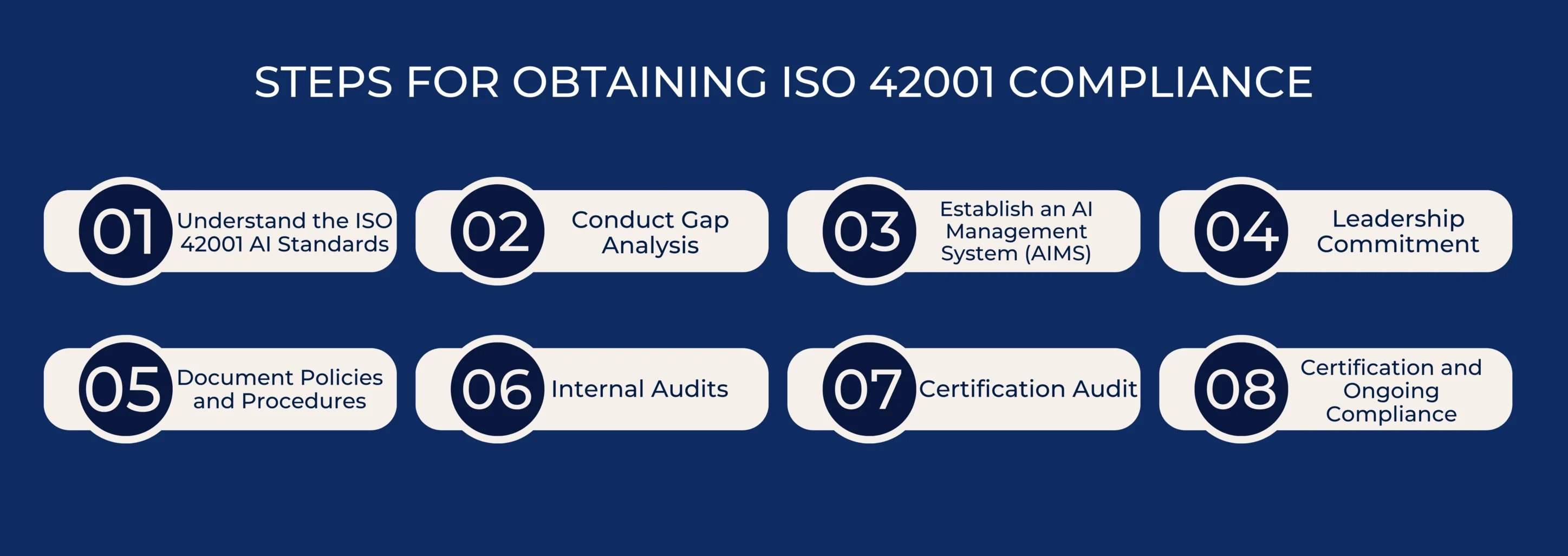
The ISO 42001 Certification audit process conducted by CertPro for Indiana-based organizations follows a structured, multi-stage program designed to assess conformity with ISO/IEC 42001:2023 in an objective, evidence-based manner. Each stage serves a defined purpose within the overall certification determination, and no stage is combined with or substituted by advisory or implementation activities. The full process — from initial application through certificate issuance — is governed by CertPro’s certification program requirements and applicable accreditation standards.
| Audit Stage | Key Activities | Output |
|---|---|---|
| Application & Scope Review | Review of AIMS scope, organizational context, AI systems in scope, and audit program determination | Agreed audit scope and program schedule |
| Stage 1 Audit | Documentation review: AIMS policy, AI impact assessments, risk treatment plan, Annex A control selection, internal audit records, and management review outputs | Stage 1 findings report; readiness determination for Stage 2 |
| Stage 2 Audit | On-site or remote evidence-based evaluation of AIMS implementation and operating effectiveness across Clauses 4–10 and applicable Annex A controls | Audit report with findings and nonconformity log |
| Nonconformity Review & Certification Decision | Review of corrective action evidence for any nonconformities; independent certification committee determination | Certification decision; certificate issuance if conformant |
| Surveillance & Recertification | Annual surveillance audits assessing continued conformity; full recertification audit at three-year cycle | Surveillance reports; renewed certificate upon recertification |
The Stage 1 audit is a documentation-focused review that evaluates whether the organization’s AIMS documentation satisfies the requirements of ISO/IEC 42001:2023 at a level sufficient to proceed to the Stage 2 evidence assessment. During the Stage 1 ISO 42001 audit, auditors examine:
- The AIMS scope statement and context analysis
- AI policy documentation
- AI impact assessment records for in-scope AI systems
- Risk identification and treatment documentation
- Annex A control selection rationale and applicability statement
- Internal audit program and completed audit records
- Management review outputs
The Stage 1 audit also assesses whether the organization has identified and documented its AI-related obligations, stakeholder requirements, and AIMS boundaries. Findings from Stage 1 directly inform the planning and focus areas of the Stage 2 audit. Significant documentation gaps identified at Stage 1 must be addressed before Stage 2 proceeds, though minor clarifications may be resolved during Stage 2 planning.
The Stage 2 ISO 42001 AIMS audit is an evidence-based conformity assessment evaluating the implementation and operating effectiveness of the organization’s AIMS controls across all mandatory clauses and applicable Annex A controls within the defined audit scope. Auditors examine objective evidence — including records, system configurations, meeting minutes, training logs, incident records, monitoring outputs, and AI system documentation — to determine whether controls operate as designed and whether the management system meets ISO/IEC 42001:2023 requirements in practice.
For Indiana-based organizations, Stage 2 audits may be conducted on-site at the organization’s facilities, remotely using secure audit platforms, or through a combination of both approaches. The method depends on the nature of the AI systems in scope and the physical distribution of the organization’s operations. The Stage 2 audit produces a detailed audit report documenting findings, any identified nonconformities classified by severity, and the auditor’s recommendation to the independent certification committee.
Following Stage 2 audit completion, the audit report and any nonconformity records are submitted to CertPro’s independent certification committee — a body separate from the audit team — which reviews all evidence and makes the final certification determination. Where nonconformities have been identified, the organization must submit documented corrective action evidence for committee review before a positive certification decision can be rendered.
Upon a favorable determination, CertPro issues the ISO 42001 certificate specifying the organization’s name, AIMS scope, applicable standard (ISO/IEC 42001:2023), certificate number, and validity period. ISO 42001 certificates are valid for three years from the date of issue, subject to satisfactory annual surveillance audits. The certificate may be suspended or withdrawn if the organization fails a surveillance audit, materially changes its AIMS scope without notification, or no longer satisfies the standard’s requirements as determined through audit evidence. Recertification audits are conducted prior to certificate expiry to evaluate continued conformity and renew the certificate for a further three-year cycle.
- ✓Stage 1 Audit: Documentation and Readiness Review
- ✓Stage 2 Audit: Evidence-Based AIMS Evaluation
- ✓Certification Decision, Issuance, and Certificate Validity
ISO 42001 AIMS Requirements and Control Framework
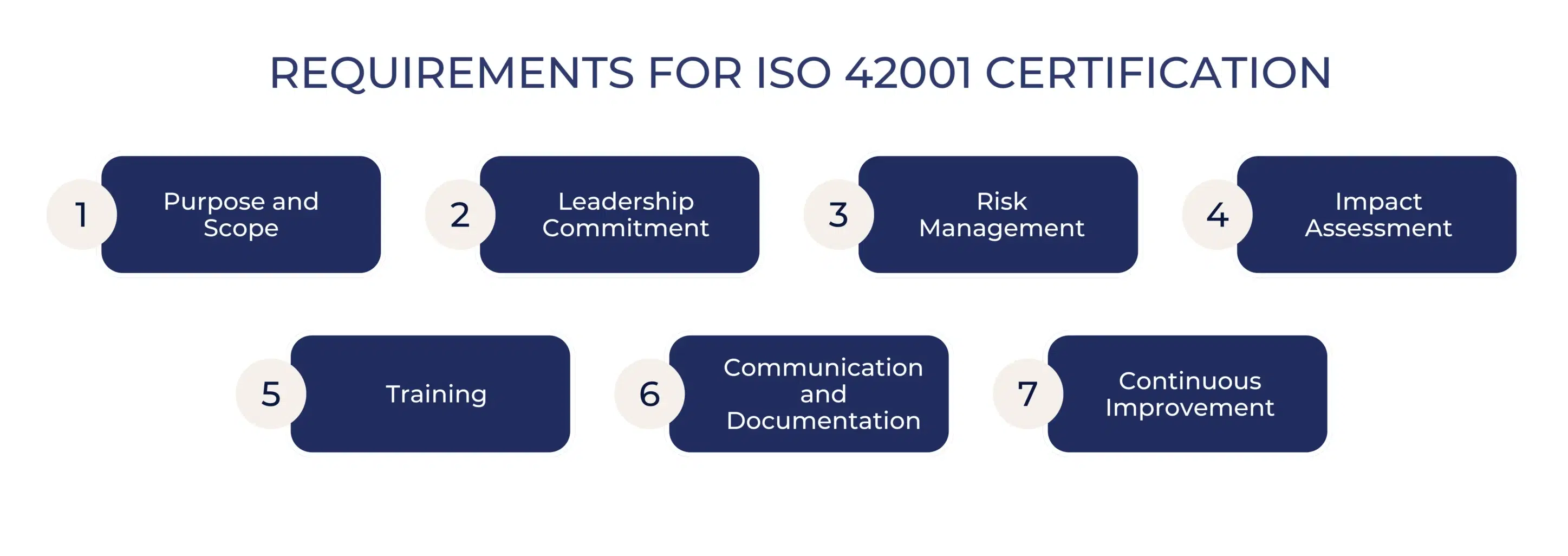
ISO/IEC 42001:2023 establishes a comprehensive set of management system requirements and AI-specific controls that organizations must address to achieve and maintain ISO 42001 compliance. The standard’s requirements span organizational governance, AI system lifecycle management, risk and impact assessment, resource management, operational controls, performance monitoring, and continual improvement. Each of these areas is subject to evaluation during the ISO 42001 assessment process conducted by CertPro’s auditors, making thorough preparation across all clauses essential to a successful certification outcome.
ISO/IEC 42001:2023 specifies mandatory documented information that an organization must maintain as part of its AIMS. Key documentation requirements evaluated during an ISO 42001 assessment include:
- AIMS scope statement defining which AI systems, organizational units, and processes are covered
- AI policy approved by top management, articulating objectives and commitments regarding responsible AI
- AI risk assessment documenting identified risks associated with in-scope AI systems
- AI risk treatment plan specifying selected controls and rationale
- Applicability statement recording which Annex A controls apply and any exclusions with justification
- AI system impact assessments evaluating potential harms to individuals, groups, or society
- Competence and training records for personnel involved in AI system development or operation
- Internal audit records demonstrating that the AIMS has been audited against the standard’s requirements
- Management review records confirming top management’s periodic review of AIMS performance
Each of these documents constitutes a primary source of audit evidence during the ISO 42001 AIMS audit conducted by CertPro.
Annex A of ISO/IEC 42001:2023 provides a normative set of controls organized across six domains that specifically address AI management system requirements:
- Policies for AI: Requires documented organizational policies on responsible AI use, bias mitigation, transparency, and accountability
- Internal Organization: Addresses governance structures, roles, responsibilities, and accountability for AI systems
- Resources for AI Systems: Covers data governance, computational resources, tooling, and human competence required for responsible AI development and operation
- Assessing AI Systems: Mandates systematic impact assessments and risk evaluations throughout the AI system lifecycle
- AI System Lifecycle: Establishes controls for design, development, testing, deployment, monitoring, and decommissioning of AI systems
- Stakeholder Engagement: Requires documented processes for communicating with affected parties — including users, data subjects, and regulators — about AI systems and their impacts
During the ISO 42001 assessment, auditors evaluate the design and operating effectiveness of controls selected from Annex A based on the organization’s risk assessment and applicability statement.
One of the most distinctive requirements of ISO/IEC 42001:2023 — relative to other management system standards — is the mandatory AI impact assessment. This is a structured evaluation of potential harms that an AI system may cause to individuals, groups, or broader society. AI impact assessments must be conducted for all AI systems within the AIMS scope and must be documented, reviewed, and updated whenever material changes occur to the AI system or its operating context.
The assessment must consider factors including the nature and severity of potential harms, the likelihood and reversibility of those harms, the populations affected, and the degree to which the organization can detect and mitigate adverse outcomes. For Indiana-based organizations in life sciences — where AI systems may influence clinical diagnoses or drug development decisions — or in financial services, where AI models may affect credit or underwriting determinations, the AI impact assessment is a critical governance control that receives significant audit scrutiny. During ISO 42001 audit Indiana engagements, CertPro’s auditors evaluate whether impact assessments are proportionate to the risk profile of each in-scope AI system and whether findings are integrated into the organization’s risk treatment decisions.
- ✓Core AIMS Documentation Requirements
- ✓Annex A Controls for AI System Governance
- ✓AI Impact Assessment Requirements
Indiana Industry Sectors Pursuing ISO 42001 Certification
ISO 42001 Certification Indiana engagements conducted by CertPro span a broad range of industry sectors, reflecting the state’s diverse and AI-active economy. Indiana’s concentration of advanced manufacturing, life sciences, logistics, agricultural technology, motorsports engineering, and technology services creates a substantial and growing population of organizations for which AI governance certification is operationally and commercially relevant. The following sectors represent the primary demand drivers for ISO 42001 Certification for Indiana companies.
Advanced Manufacturing and Motorsports Engineering
Indiana is the largest U.S. manufacturer of recreational vehicles, a significant producer of steel and auto parts, and home to the Indianapolis Motor Speedway and a globally recognized motorsports engineering ecosystem. Manufacturers across these sectors are deploying AI systems for predictive maintenance, computer vision-based quality inspection, supply chain optimization, and process automation.
AI systems embedded in manufacturing operations introduce risks related to safety, product quality, and regulatory compliance — particularly where AI-driven decisions affect production outcomes or worker safety. ISO 42001 Certification provides Indiana manufacturers with a structured governance framework for managing these AI-related risks and demonstrating to customers, insurers, and regulators that AI systems are subject to documented oversight and accountability controls. Tier 1 and Tier 2 automotive and aerospace suppliers in Indiana increasingly encounter customer quality assurance programs that reference AI governance standards, making ISO 42001 compliance a competitive consideration in supplier qualification processes.
Life Sciences, Pharmaceuticals, and Healthcare Technology
Indiana is home to Eli Lilly and Company — one of the world’s largest pharmaceutical companies — as well as a substantial concentration of contract research organizations, medical device manufacturers, and health information technology companies in the Indianapolis metro area. AI applications in this sector include drug discovery acceleration, clinical trial optimization, medical imaging analysis, patient risk stratification, and electronic health record analytics.
These AI systems operate in regulatory environments governed by the FDA’s emerging AI and machine learning guidance for software as a medical device, HIPAA privacy and security requirements, and the 21st Century Cures Act’s information blocking provisions. Indiana healthcare and life sciences organizations pursue ISO 42001 Certification in Indiana to obtain third-party validation that their AI governance controls — including bias evaluation, human oversight mechanisms, and AI system documentation — meet internationally recognized standards. CertPro’s ISO 42001 assessment evaluates these controls against ISO/IEC 42001:2023 requirements, independent of any regulatory submission or approval process.
SaaS, Cloud Providers, and Technology Companies
Indiana technology companies — including SaaS providers, cloud service providers, and AI-native startups — pursue ISO 42001 Certification to address enterprise customer vendor assurance requirements and differentiate their AI-enabled products in competitive procurement processes. Indiana’s technology ecosystem, anchored by the Indianapolis metro area and university-adjacent innovation districts near Purdue University and Indiana University, includes a growing number of companies building AI capabilities into vertical SaaS platforms for agriculture, logistics, legal services, and financial technology.
Enterprise buyers of these platforms — particularly those in regulated industries — increasingly require contractual evidence that AI features embedded in vendor software are governed by documented, auditable controls. ISO 42001 Certification satisfies this requirement by providing an independent, third-party attestation that the SaaS provider’s AIMS conforms to ISO/IEC 42001:2023. For Indiana-based technology companies competing for contracts with national enterprises, healthcare systems, or government agencies, ISO 42001 Certification in Indiana functions as a recognized vendor qualification credential across procurement review processes.
Benefits of ISO 42001 Certification for Indiana-Based Organizations
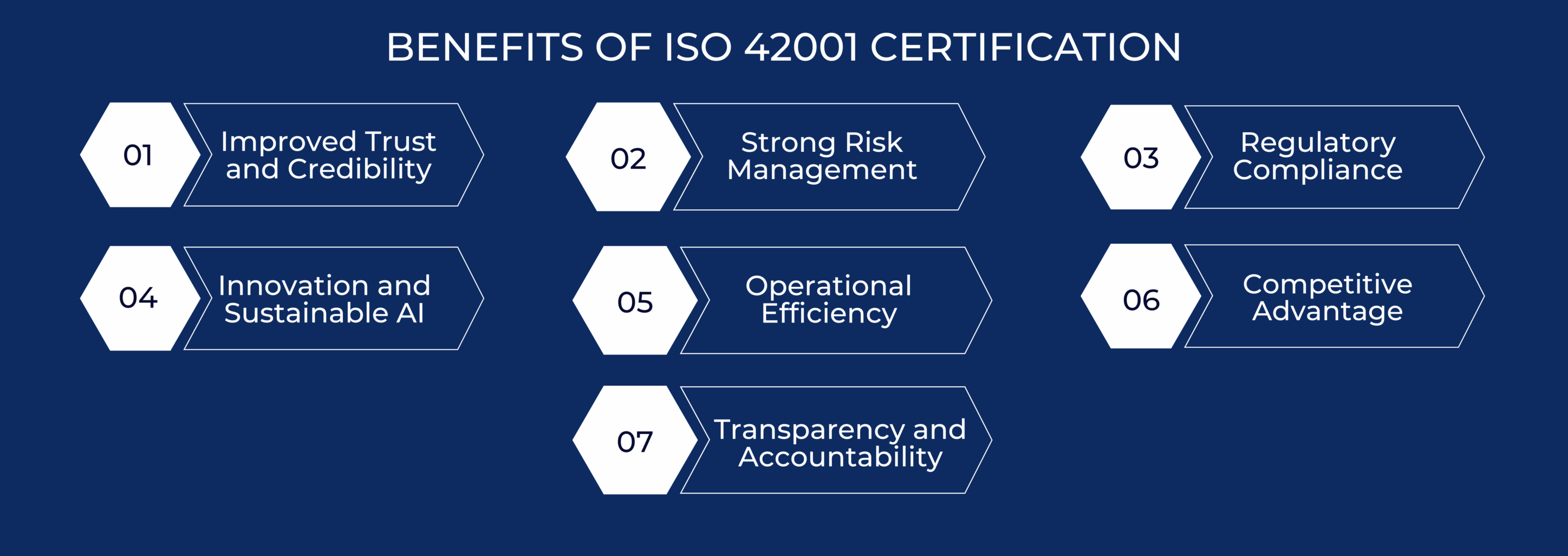
ISO 42001 Certification in Indiana provides organizations with independently verified evidence that their AI management systems conform to the requirements of ISO/IEC 42001:2023 — the international standard for responsible AI governance. The outcomes listed below represent substantive, audit-framed results associated with certification, stated objectively rather than as promotional claims.
- ✓Independent third-party verification of AIMS conformity with ISO/IEC 42001:2023, providing evidence usable in enterprise vendor due diligence and procurement reviews
- ✓Structured ISO 42001 audit methodology that evaluates both the design and operating effectiveness of AI governance controls, producing documented findings for management review
- ✓Recognition in enterprise procurement processes requiring evidence of AI governance — particularly in healthcare, financial services, defense supply chains, and technology vendor assessments
- ✓Ongoing surveillance oversight through annual audit cycles that assess continued conformity and support the organization’s continual improvement obligations under Clause 10
- ✓Alignment with U.S. federal AI governance expectations, including NIST AI RMF principles and Executive Order 14110 requirements for safe, secure, and trustworthy AI
- ✓Differentiation in competitive markets where ISO 42001 Certification signals organizational maturity and accountability to customers, partners, and regulators
- ✓Documented evidence of AI impact assessment practices and human oversight controls — governance attributes increasingly scrutinized in regulatory and contractual contexts
- ✓Certificate recognized for a three-year validity period, subject to successful annual surveillance audits, providing sustained third-party assurance to stakeholders
Enterprise organizations conducting third-party risk assessments and vendor security reviews increasingly include AI governance controls within their evaluation criteria. For Indiana-based technology companies, SaaS providers, and managed service providers supplying AI-enabled services to regulated-industry customers, ISO 42001 Certification provides a standardized, auditable credential that can be presented in response to vendor questionnaires, security assessments, and contractual due diligence requirements.
Consider a localized example: an Indiana-based SaaS company providing AI-driven claims adjudication software to regional insurance carriers may be required by carrier procurement teams to demonstrate independent verification of its AI governance controls before contract award. ISO 42001 Certification — issued by CertPro following a completed ISO 42001 AIMS audit Indiana engagement — satisfies this requirement with a third-party attestation document that is internationally recognized and tied to a specific audit scope, period, and standard version. This positions certified Indiana organizations favorably in multi-vendor procurement evaluations where AI governance evidence is a qualifying criterion.
ISO 42001 compliance achieved by Indiana organizations through certification supports alignment with the U.S. regulatory environment governing AI — including NIST’s AI Risk Management Framework, the FDA’s AI/ML-based software as a medical device guidance, and sector-specific requirements from the OCC, FFIEC, and HHS regarding algorithmic decision-making in banking, financial services, and healthcare.
While ISO 42001 Certification does not constitute regulatory approval or satisfy all jurisdiction-specific legal requirements, it provides documented evidence that the organization has implemented a structured AI governance management system subject to independent audit. For Indiana organizations facing regulatory inquiries, customer audits, or litigation involving AI system outputs, an ISO 42001 certified AIMS — with documented impact assessments, risk treatment records, and internal audit trails — provides a substantive governance record. The certification also supports Indiana organizations integrating AI governance into broader enterprise risk management frameworks, where documented AI controls and independent audit findings contribute to board-level reporting on technology and operational risk.
- ✓Vendor Assurance and Procurement Recognition
- ✓Regulatory Alignment and Risk Governance
ISO 42001 Certification Scope and Independent Decision Framework
The scope of ISO 42001 Certification in Indiana is defined by the organization in coordination with CertPro’s audit program determination process. Scope definition is a critical precursor to audit program planning and directly determines the boundaries within which the ISO 42001 assessment is conducted. CertPro’s certification decisions are made independently of the auditing team by a certification committee that reviews all audit evidence and findings before rendering a determination — ensuring the integrity of every ISO 42001 Certification issued.
Defining the AIMS Certification Scope
The AIMS scope statement specifies which AI systems, organizational processes, business units, and geographic locations are included within the certification boundary. Organizations may elect to certify their entire AI management system or limit scope to specific AI systems, product lines, or operational functions — provided the scope boundaries are clearly documented and the management system controls within scope genuinely address the AI risks within those boundaries.
For Indiana-based organizations, scope decisions are often driven by the AI systems most material to customer contracts, regulatory obligations, or enterprise risk profiles. For example, an Indianapolis-area health information technology company might scope its AIMS certification to AI systems used in clinical decision support, excluding unrelated internal administrative automation tools. CertPro’s audit program determination process reviews each proposed scope for appropriateness and flags any limitations that could undermine certification integrity. The agreed scope is documented in the audit program and reflected on the issued certificate — giving stakeholders a precise understanding of what the ISO 42001 Certification covers.
Independent Certification Committee and Decision Process
A fundamental principle of ISO 42001 Certification under accreditation requirements is the strict separation of auditing and certification decision-making functions. CertPro maintains an independent certification committee whose members review the audit report, nonconformity log, and corrective action evidence submitted by the audited organization before making the certification determination. The committee does not include members of the audit team that conducted the Stage 1 or Stage 2 audits for the engagement under review — ensuring the certification decision reflects an objective evaluation of the audit record.
Where the audit report identifies nonconformities, the committee reviews documented evidence of corrective actions before determining whether certification requirements have been satisfied. The committee may request additional evidence, defer the decision pending clarification, issue a positive certification decision, or decline to certify if the audit evidence does not support conformity. This process ensures that ISO 42001 Certification in Indiana through CertPro reflects a genuine, evidence-based conformity determination consistent with international accreditation expectations.
Surveillance Audits and Certificate Maintenance
ISO 42001 certificates issued by CertPro are valid for three years from the certification date, subject to satisfactory annual surveillance audits conducted at approximately 12-month intervals following initial certification. Surveillance audits assess whether the organization’s AIMS continues to conform to ISO/IEC 42001:2023 requirements, specifically evaluating:
- Whether corrective actions from previous audit cycles have been implemented and sustained
- Whether material changes to AI systems or organizational context have been reflected in the AIMS documentation
- Whether continual improvement requirements under Clause 10 are being actively addressed
Surveillance audits are typically narrower in scope than the full Stage 2 audit, focusing on areas of elevated risk, previous nonconformities, and changes reported since the last audit. If a surveillance audit identifies nonconformities that the organization fails to resolve within the specified timeframe, CertPro’s certification committee may suspend or withdraw the certificate. Organizations approaching the end of the three-year certificate cycle must undergo a full recertification audit to maintain uninterrupted ISO 42001 Certification in Indiana for a further three-year period.
ISO 42001 Compliance Indiana: Regulatory and Procurement Context
ISO 42001 compliance that Indiana organizations pursue reflects the intersection of U.S. federal AI policy, sector-specific regulatory frameworks, and enterprise procurement expectations — collectively creating demand for documented, independently audited AI governance. Understanding this regulatory and procurement context is essential for Indiana-based organizations evaluating whether ISO 42001 Certification is appropriate for their operations and stakeholder relationships.
U.S. Federal AI Governance Expectations
Executive Order 14110, signed in October 2023, directs federal agencies to develop standards, tools, and tests for AI safety and to require providers of AI systems to the federal government to demonstrate that their AI systems are safe, secure, and trustworthy. The NIST AI Risk Management Framework (AI RMF 1.0), published in January 2023, provides a voluntary but widely referenced structure for identifying, assessing, and managing AI risks — organized around four functions: Govern, Map, Measure, and Manage.
ISO/IEC 42001:2023 aligns with and operationalizes many of the AI RMF’s governance principles within a certifiable management system framework. Indiana-based organizations supplying AI-enabled products or services to federal agencies or federally regulated entities — including Department of Defense contractors, Medicare and Medicaid service organizations, and recipients of federal research funding — face increasing expectations to demonstrate AI governance controls aligned with these federal frameworks. ISO 42001 Certification provides third-party evidence of AIMS conformity that supports these obligations without constituting regulatory approval from any federal agency.
Enterprise Vendor Security Reviews in Indiana
Indiana’s enterprise ecosystem includes a substantial concentration of large employers — including Salesforce, Eli Lilly, Cummins, Indiana University Health, Anthem (Elevance Health), and Simon Property Group — that conduct structured vendor security and risk assessments as part of procurement and contract renewal processes. Vendors supplying AI-enabled software, data analytics platforms, or technology services to these organizations increasingly encounter AI governance questions within vendor questionnaires, security assessments, and contractual requirements.
ISO 42001 audit Indiana engagements produce certification evidence that vendors can present in response to these assessments, demonstrating that their AIMS has been independently evaluated against an internationally recognized standard. This is particularly relevant for Indiana-based technology companies whose customer base includes one or more of the state’s major employers or healthcare systems, where AI governance due diligence has become a standard component of third-party risk management programs. ISO 42001 Certification also supports multi-year vendor contracts by providing annual surveillance audit assurance that governance controls remain effective throughout the contract period.
FAQ
▶
What is ISO 42001 certification and who issues it in Indiana?
▶
What does the ISO 42001 audit process involve for Indiana organizations?
▶
How long is an ISO 42001 certificate valid in Indiana?
▶
Which Indiana organizations need ISO 42001 certification?
▶
What is the difference between an ISO 42001 audit and an ISO 42001 assessment?
▶
What is an ISO 42001 AIMS audit and what does it evaluate?
▶
Does ISO 42001 certification satisfy regulatory requirements for AI in Indiana?
▶
How does ISO 42001 certification differ from ISO 27001 certification?
ISO 42001 CERTIFIED: WHY AI GOVERNANCE CERTIFICATION IS BECOMING A BOARD-LEVEL REQUIREMENT
ISO 42001 Certified: Board-Level AI Governance Guide | CertPro CPA LLC HERO ══════════════════════════════ –> src=”https://certpro.com/wp-content/uplo…
Get In Touch
have a question? let us get back to you.