
ISO 42001 Certification in Pittsburgh
ISO 42001 Certification in Pittsburgh is conducted by CertPro, a Licensed CPA Firm providing independent, third-party conformity assessment audits evaluated against ISO/IEC 42001:2023 — the international standard for Artificial Intelligence Management Systems (AIMS). CertPro issues certification solely upon verified conformity with the standard’s requirements. No advisory, implementation, readiness, or consulting services are offered, ensuring a fully independent ISO 42001 certification audit process.
OUR CLIENTS



ISO 42001 Certification for Pittsburgh-Based AI, Technology, and Healthcare Organizations
ISO 42001 Certification in Pittsburgh is conducted by CertPro, a Licensed CPA Firm providing independent, third-party conformity assessment audits evaluated against ISO/IEC 42001:2023 — the international standard for Artificial Intelligence Management Systems (AIMS). CertPro issues certification solely upon verified conformity with the standard’s requirements. No advisory, implementation, readiness, or consulting services are offered, ensuring a fully independent ISO 42001 certification audit process.
Pittsburgh occupies a distinctive position in the United States AI and technology landscape. Carnegie Mellon University — one of the world’s foremost institutions in artificial intelligence and robotics research — is headquartered in Pittsburgh and has produced foundational contributions to machine learning, computer vision, natural language processing, and autonomous systems. The University of Pittsburgh’s health sciences programs and UPMC’s integrated health system represent one of the largest healthcare and life sciences ecosystems in the northeastern United States, with substantial AI deployment across clinical decision support, diagnostic imaging, and patient data management.
These institutions, along with a growing ecosystem of AI startups, robotics companies, SaaS providers, advanced manufacturing enterprises, energy technology firms, cybersecurity organizations, and financial services companies, create concentrated demand for independent ISO 42001 Certification in Pittsburgh across multiple sectors.
ISO/IEC 42001:2023 is the first internationally recognized management system standard specifically addressing artificial intelligence governance. Published by the International Organization for Standardization and the International Electrotechnical Commission in 2023, the ISO 42001 standard establishes requirements for organizations that develop, provide, or use AI systems. It implements structured governance frameworks covering AI risk management, AI impact assessment, data governance, transparency and explainability, human oversight mechanisms, and Annex A control domains.
The ISO 42001 standard applies to organizations of any size and sector where AI systems interact with business processes, products, services, or stakeholders in ways that require governance accountability.
For Pittsburgh organizations, the relevance of ISO 42001 Certification is directly connected to the city’s industrial concentration. Healthcare organizations deploying AI in clinical workflows must demonstrate that AI systems operate with appropriate human oversight and bias controls. Robotics and autonomous systems companies must document AI risk management processes for safety-critical applications. SaaS providers and cloud companies serving regulated enterprise clients face vendor due diligence requirements that increasingly reference ISO 42001 compliance as a condition of procurement.
Financial services firms using AI in credit scoring, fraud detection, or customer interaction must address explainability and fairness requirements aligned with regulatory expectations. CertPro’s ISO 42001 certification audit evaluates each of these dimensions through objective evidence assessment against ISO/IEC 42001:2023 requirements.
The ISO 42001 certification audit conducted by CertPro assesses the organization’s AIMS against all applicable clauses of ISO/IEC 42001:2023, including Clauses 4 through 10. These clauses cover context, leadership, planning, support, operation, performance evaluation, and improvement. The audit also examines Annex A control domains addressing AI policy, internal organization, resources for AI systems, assessing AI impacts, AI system lifecycle, data governance, third-party and customer relationships, and transparency and accountability for AI.
Organizations that successfully complete the certification audit and satisfy all conformity requirements receive an ISO 42001 certificate issued by CertPro. The certificate remains valid subject to ongoing surveillance audits and a three-year recertification cycle.

ISO 42001 Certification Audit Process for Organizations in Pittsburgh
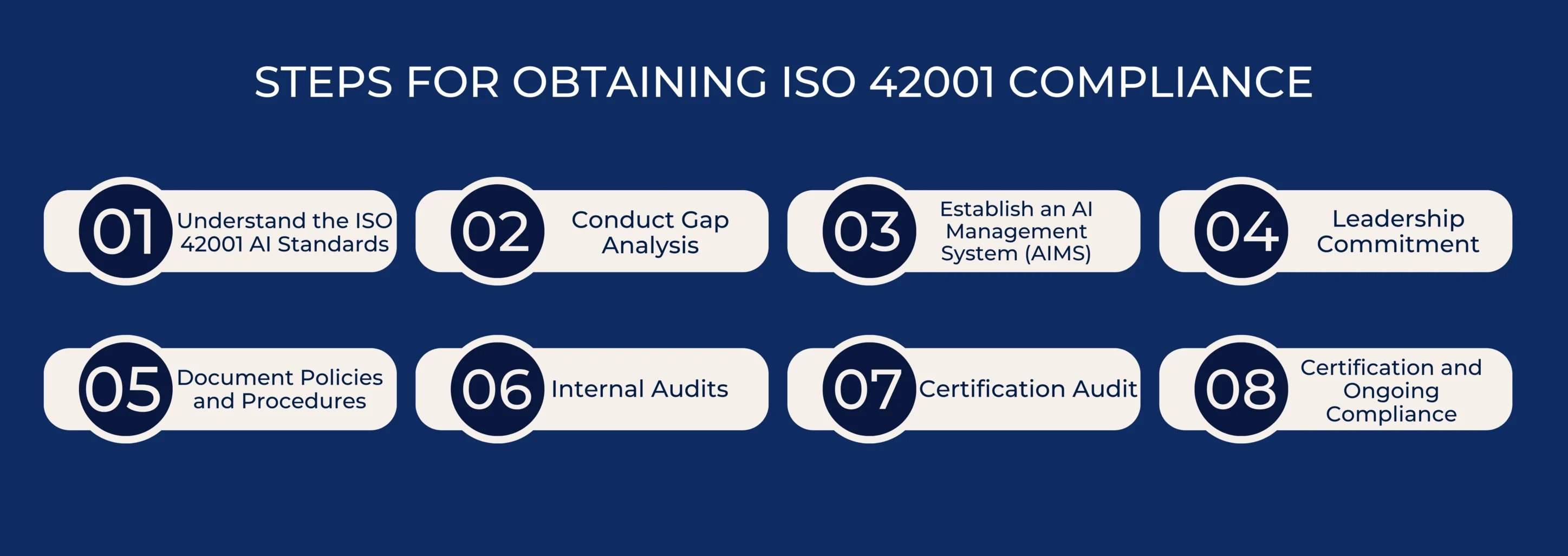
The ISO 42001 certification audit process conducted by CertPro follows a structured, stage-based methodology aligned with internationally recognized conformity assessment practices. Each stage generates objective evidence that forms the basis of an independent certification decision. The process applies consistently to Pittsburgh organizations regardless of sector, ensuring that AI governance structures, documented information, operational controls, and continual improvement mechanisms are all evaluated against ISO/IEC 42001:2023 requirements. Critically, these audit activities remain separate from and independent of the organization’s own internal audit function.
The Stage 1 audit focuses on reviewing the organization’s documented information, AIMS scope definition, AI policy, AI risk assessment outputs, AI impact assessment records, and the extent to which mandatory ISO/IEC 42001:2023 requirements have been addressed in the management system documentation. The auditor evaluates whether the organization has:
• Defined the scope of its AIMS
• Identified relevant AI systems within that scope
• Established a structured AI risk management process
• Documented evidence of leadership commitment, resource allocation, and internal audit and management review activities
Stage 1 findings inform the audit program for Stage 2 and identify areas requiring clarification or additional evidence before the ISO 42001 conformity assessment proceeds.
For Pittsburgh organizations operating across multiple AI use cases — such as a health system using AI in radiology alongside a separate AI-driven patient scheduling system — the Stage 1 audit examines whether the AIMS scope accurately reflects all AI systems subject to certification. Scope definition errors identified at Stage 1 are addressed before the Stage 2 audit commences. The Stage 1 audit does not result in a certification decision; it produces an audit finding report that structures all subsequent ISO 42001 conformity assessment activities.
The Stage 2 audit constitutes the primary conformity assessment of the organization’s implemented AIMS against all applicable requirements of ISO/IEC 42001:2023. Auditors evaluate operational controls, AI risk treatment records, AI impact assessment documentation, Annex A control implementation evidence, data governance practices, human oversight mechanisms, transparency and explainability processes, and performance monitoring outputs.
The ISO 42001 certification audit at Stage 2 also includes interviews with personnel responsible for AI governance, review of AI system lifecycle documentation, and examination of objective evidence demonstrating that controls are both designed and operating effectively.
Nonconformities identified during the Stage 2 ISO 42001 audit are classified and reported to the organization. The organization must address nonconformities and submit corrective action evidence before a certification decision is rendered. The certification committee — operating independently of the audit team — reviews the complete audit record, including findings, nonconformity reports, and corrective action responses, before issuing a certification decision. This independent review is a structural safeguard ensuring that the ISO 42001 certification audit decision remains objective and fully evidence-based.
Following initial certification, the ISO 42001 certificate is maintained through annual surveillance audits conducted by CertPro. Surveillance audits evaluate whether the AIMS continues to conform to ISO/IEC 42001:2023 requirements and whether controls identified during Stage 2 remain effective. They also assess whether the organization has addressed any changes to AI systems, risk profiles, or operational environments that may affect AIMS conformity. Failure to maintain conformity may result in certificate suspension or withdrawal following surveillance audit findings.
Recertification audits are conducted at the conclusion of the three-year certification cycle and evaluate full conformity with ISO/IEC 42001:2023 across the entire AIMS scope. Recertification follows the same structured, evidence-based assessment methodology applied during initial certification. For Pittsburgh organizations that have modified AI systems, expanded their AIMS scope, or introduced new AI use cases, the recertification audit examines whether AIMS documentation, risk management records, and Annex A control evidence accurately reflect current operational realities. Successful recertification results in issuance of a renewed ISO 42001 certificate for a further three-year period.
| Audit Stage | Key Activities | Output |
|---|---|---|
| Application Review | Scope confirmation, documentation submission, audit program determination | Audit program and scheduling confirmation |
| Stage 1 Audit | AIMS documentation review, scope validation, readiness assessment | Stage 1 findings report identifying Stage 2 focus areas |
| Stage 2 Audit | Conformity assessment of implemented AIMS controls, evidence evaluation, nonconformity reporting | Stage 2 audit report with nonconformity findings |
| Certification Decision | Independent certification committee review of full audit record | ISO 42001 certificate issued upon verified conformity |
| Surveillance Audit | Annual review of AIMS continued conformity and control effectiveness | Surveillance audit report confirming certificate status |
- ✓Stage 1 Audit: Documentation and Readiness Review
- ✓Stage 2 Audit: Conformity Assessment Against ISO/IEC 42001:2023
- ✓Surveillance Audits and Recertification
ISO 42001 Standard Requirements Evaluated During Certification
The ISO 42001 standard establishes a comprehensive set of requirements that organizations must satisfy to achieve and maintain certification. These requirements are organized into the management system structure defined by Clauses 4 through 10 and the AI-specific control domains set out in Annex A. Understanding what is evaluated during an ISO 42001 certification audit is essential for Pittsburgh organizations preparing to submit their AIMS for independent conformity assessment. The following subsections outline the primary requirement domains assessed during the ISO 42001 certification audit conducted by CertPro.
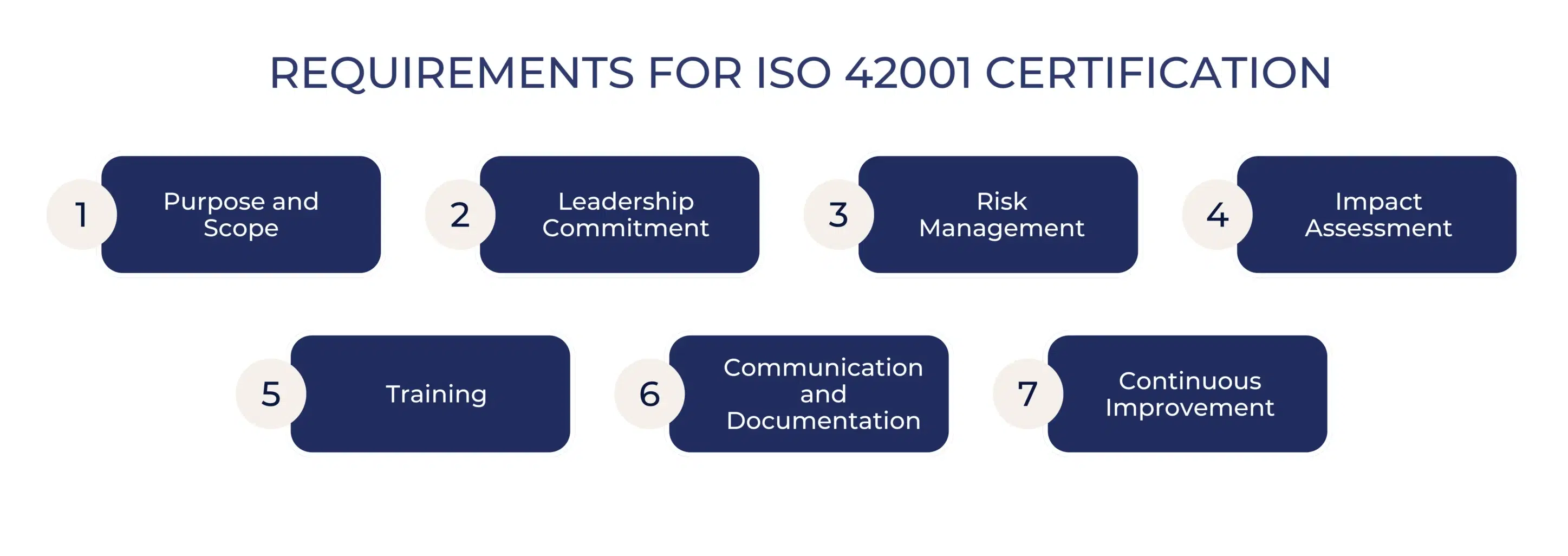
Clauses 4 through 10 of ISO/IEC 42001:2023 establish the foundational management system requirements applicable to any organization seeking ISO 42001 certification. Key clause requirements include:
Clause 4 requires the organization to define the internal and external context relevant to its AI activities and identify interested parties and their AI-related requirements. Clause 5 requires demonstrable leadership commitment to the AIMS, including an established AI policy, defined roles and responsibilities, and evidence that top management has integrated AI governance into organizational strategy. Clause 6 covers planning requirements, including AI risk assessment methodology, AI impact assessment processes, and AIMS objectives. Clause 7 addresses support requirements including competence, awareness, communication, and documented information management.
Clause 8 governs operational requirements, including the implementation of AI risk treatment plans, the conduct of AI impact assessments for AI systems within scope, and the management of AI system lifecycle activities from design through decommissioning. Clause 9 requires internal audit activities, management review processes, and performance monitoring of AIMS objectives. Clause 10 addresses continual improvement, including the treatment of nonconformities identified through internal audits, management review, or external audit findings.
During the ISO 42001 certification audit, CertPro auditors examine objective evidence demonstrating that each clause requirement has been addressed through documented information, defined processes, and operational controls within the organization’s AIMS.
Annex A of ISO/IEC 42001:2023 provides a reference set of AI-specific controls organized into domains that address the governance, operational, and accountability dimensions of AI management. The Annex A control domains evaluated during an ISO 42001 certification audit include:
• AI policy and organizational objectives
• Internal organization and roles for AI governance
• Resources allocated to AI systems
• Processes for assessing AI impacts on individuals and society
• AI system lifecycle management covering design, development, testing, deployment, monitoring, and decommissioning
• Data governance controls addressing data quality, provenance, and access
• Management of third-party relationships involving AI systems
• Transparency and accountability mechanisms including explainability and human oversight controls
The organization’s Statement of Applicability for ISO 42001 documents which Annex A controls are applicable within the defined AIMS scope, the justification for any controls considered not applicable, and the implementation status of selected controls. During the ISO 42001 compliance assessment, auditors verify the Statement of Applicability against the organization’s actual AI system inventory and risk treatment decisions to confirm consistency.
For Pittsburgh AI companies developing autonomous systems, machine learning models, or AI-driven data products, the Annex A controls governing AI system lifecycle management, data governance, and transparency represent particularly material areas of audit focus.
ISO/IEC 42001:2023 requires organizations to conduct AI impact assessments for AI systems that may affect individuals, groups, or society. The AI impact assessment process evaluates potential harms, fairness considerations, privacy implications, and societal effects associated with AI system outputs and decisions.
During the ISO 42001 certification audit, auditors review AI impact assessment records to confirm that:
• Assessments have been conducted for all in-scope AI systems
• Identified impacts have been addressed through risk treatment controls
• Assessment outputs have informed AIMS planning and control selection
AI risk management documentation — including the risk assessment methodology, risk register, and risk treatment records — is examined for completeness and alignment with ISO 42001 standard requirements.
- ✓Management System Requirements: Clauses 4 Through 10
- ✓Annex A Control Domains for AI Governance
- ✓AI Impact Assessment and Risk Management Documentation
Pittsburgh Organizations and Sectors Pursuing ISO 42001 Certification
ISO 42001 Certification in Pittsburgh is relevant to a broad range of organizations across the city’s technology, healthcare, manufacturing, energy, financial services, and research ecosystems. Pittsburgh’s industrial history, university research base, and concentration of technology-driven enterprises create a distinct profile of organizations for which AI governance certification addresses genuine operational and procurement requirements. The table below identifies key Pittsburgh sectors and the primary ISO 42001 relevance factors applicable to each.
| Pittsburgh Sector | AI Use Cases | ISO 42001 Relevance |
|---|---|---|
| Healthcare and Life Sciences (UPMC, Allegheny Health Network) | Clinical decision support, diagnostic imaging AI, patient data management | AI impact assessment, data governance, human oversight controls |
| Robotics and Autonomous Systems (Carnegie Mellon spinouts, autonomous vehicle companies) | Autonomous navigation, machine perception, AI-driven control systems | AI system lifecycle, risk management, transparency and accountability |
| Financial Services and Fintech | Credit scoring AI, fraud detection, algorithmic trading, customer service AI | Explainability, fairness, AI impact assessment, third-party AI governance |
| Advanced Manufacturing and Energy | Predictive maintenance AI, quality control AI, energy optimization systems | AI risk management, operational controls, data governance |
| SaaS Providers and Cloud Technology Companies | AI-embedded software products, AI APIs, enterprise AI platforms | Vendor assurance, AI system lifecycle, transparency and third-party controls |
Healthcare and Life Sciences Organizations
Pittsburgh’s healthcare and life sciences sector — anchored by UPMC, one of the largest integrated health systems in the United States — represents one of the most active areas for ISO 42001 compliance in the region. Healthcare organizations deploying AI in clinical workflows face regulatory expectations from the FDA regarding AI-based medical devices and software as a medical device, as well as broader institutional requirements for AI governance documentation.
ISO 42001 Certification in Pittsburgh for healthcare organizations provides independent verification that AI systems used in patient care, clinical research, administrative operations, and population health management are governed by a structured AIMS aligned with internationally recognized requirements. Audit evaluation focuses on AI impact assessments, data governance controls, human oversight mechanisms, and AI system lifecycle documentation for clinical AI tools.
Robotics, Autonomous Systems, and AI Research Organizations
Carnegie Mellon University’s National Robotics Engineering Center, the Software Engineering Institute, and a cluster of CMU-affiliated technology spinouts position Pittsburgh as a global center for robotics and autonomous systems development. Companies developing autonomous vehicles, industrial robots, AI-driven inspection systems, and AI-enabled logistics platforms operate in environments where AI governance accountability is increasingly required by enterprise customers, government procurement agencies, and international partners.
ISO 42001 Certification in Pittsburgh for robotics and autonomous systems organizations provides a third-party verified framework demonstrating that AI risk management, safety-related human oversight controls, and AI system lifecycle management practices conform to ISO/IEC 42001:2023. The ISO 42001 audit evaluates objective evidence of these governance structures rather than assessing the technical performance of individual AI systems.
SaaS Providers, Cloud Companies, and Financial Services Firms
Pittsburgh’s growing SaaS and cloud technology sector includes organizations providing AI-embedded enterprise software, AI APIs, and managed AI platforms to regulated industries including financial services, healthcare, and government. Enterprise procurement processes for AI-embedded SaaS products increasingly require vendors to demonstrate structured AI governance through independent certification.
ISO 42001 Certification in Pittsburgh for SaaS providers and cloud companies strengthens vendor qualification responses, supports enterprise security reviews, and provides documented evidence of AI governance conformity that can be referenced in vendor agreements and due diligence questionnaires. Financial services firms operating in Pittsburgh’s market use AI in credit assessment, fraud detection, anti-money laundering monitoring, and customer experience applications — all areas where explainability, fairness, and human oversight controls evaluated during the ISO 42001 audit are directly relevant to regulatory expectations.
Benefits of ISO 42001 Certification for Pittsburgh-Based Organizations
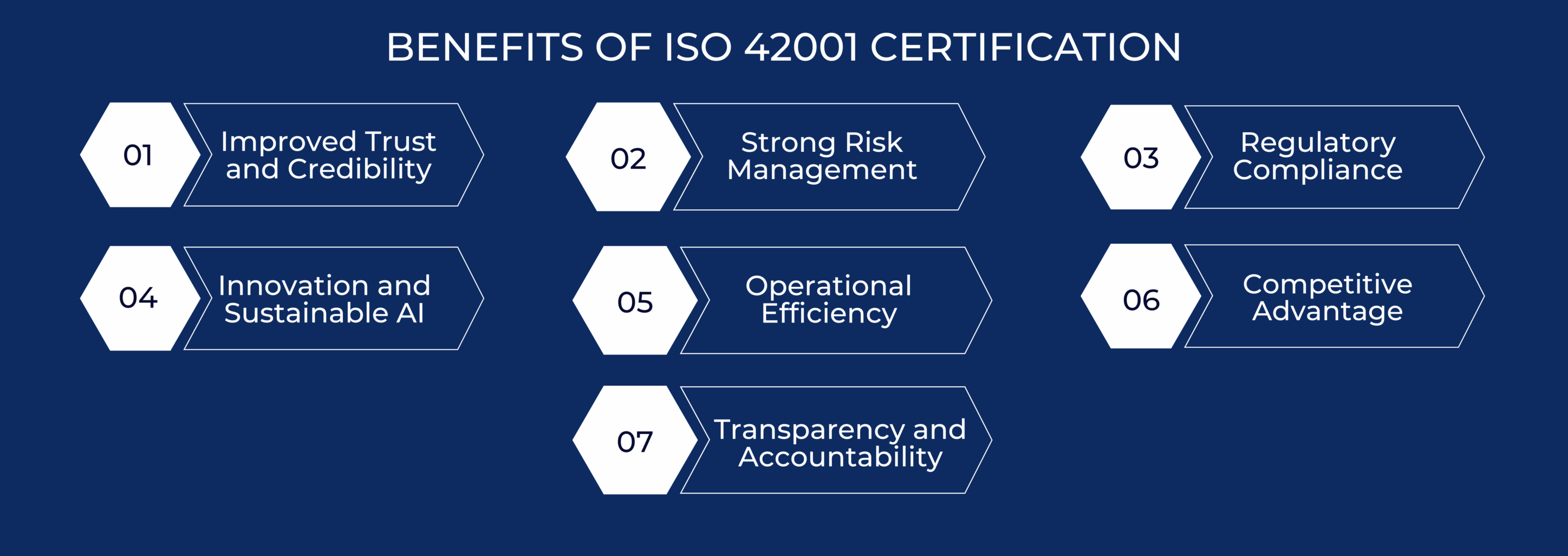
ISO 42001 Certification delivers verifiable, structured outcomes for Pittsburgh organizations operating in AI-intensive sectors. The ISO 42001 certification audit conducted by CertPro provides independent third-party validation of the organization’s AIMS against ISO/IEC 42001:2023, producing documented evidence of AI governance conformity that serves multiple organizational, commercial, and regulatory purposes. The benefits below reflect the direct outcomes of achieving and maintaining ISO 42001 certification through an independent conformity assessment process.
- ✓Independent verification that AI governance structures conform to ISO/IEC 42001:2023 requirements, providing credible evidence for enterprise procurement and due diligence processes
- ✓Demonstrated AI risk management maturity through audited documentation of risk assessment methodology, risk treatment records, and AI impact assessment outputs
- ✓Structured accountability for AI system lifecycle governance from design through decommissioning, evaluated by an independent certification body
- ✓Strengthened vendor qualification positioning in enterprise and government procurement processes that require ISO 42001 compliance as a vendor qualification criterion
- ✓Recognition in regulated industries — including healthcare, financial services, and energy — where AI governance accountability is subject to regulatory and contractual scrutiny
- ✓Ongoing surveillance audit oversight maintaining the integrity of the certified AIMS through annual conformity evaluations
- ✓Third-party validated transparency and explainability controls addressing stakeholder expectations regarding responsible AI practices
- ✓A certification framework aligned with emerging U.S. and international AI regulatory expectations, including NIST AI Risk Management Framework alignment and EU AI Act governance principles
For Pittsburgh SaaS providers, AI product companies, and technology vendors, ISO 42001 Certification in Pittsburgh directly addresses the growing enterprise requirement for independent evidence of AI governance conformity. Enterprise security review processes, third-party risk management frameworks, and vendor qualification questionnaires increasingly include AI governance requirements that reference ISO/IEC 42001:2023.
An ISO 42001 certificate issued by an independent certification body such as CertPro — a Licensed CPA Firm — provides procurement teams with third-party validated evidence that the vendor’s AIMS has been assessed against the international standard by an organization without advisory or consulting interests in the outcome. This structural independence is a critical element of the certificate’s value in vendor due diligence contexts.
Consider a practical scenario relevant to Pittsburgh organizations: a Pittsburgh-based healthcare SaaS company providing an AI-driven clinical decision support platform to hospital systems across Pennsylvania and the Mid-Atlantic region may face vendor security review requirements from hospital procurement committees that include AI governance documentation as a condition of contract award.
ISO 42001 Certification for this organization provides a structured, independently audited response to those requirements — replacing ad hoc documentation submissions with a recognized certification backed by a third-party audit record. The ISO 42001 compliance evidence generated through CertPro’s certification audit can be referenced directly in vendor qualification responses, reducing procurement friction and demonstrating AI governance maturity to institutional buyers.
ISO 42001 Certification aligns with the AI governance framework established by the NIST AI Risk Management Framework (AI RMF), which provides a voluntary structure for identifying, assessing, and managing AI risks across the full AI lifecycle. While the NIST AI RMF and ISO/IEC 42001:2023 are distinct frameworks, both address AI risk management, AI impact considerations, human oversight, transparency, and accountability.
Organizations pursuing ISO 42001 Certification in Pittsburgh that have already implemented NIST AI RMF practices will find meaningful conceptual alignment between the two frameworks — though ISO 42001 certification requires independent third-party audit conformity assessment rather than self-assessment. The ISO 42001 standard also addresses dimensions relevant to the EU AI Act’s requirements for high-risk AI systems, supporting Pittsburgh organizations serving European markets or partnering with EU-based enterprises that require demonstrable AI governance conformity.
- ✓Enterprise Vendor Assurance and Procurement Recognition
- ✓Alignment with U.S. AI Governance and Regulatory Expectations
What ISO 42001 Certification Evaluates: Key AIMS Components
The ISO 42001 certification audit evaluates the organization’s Artificial Intelligence Management System across a defined set of AIMS components that together constitute a governed, accountable AI operating environment. Understanding what the ISO 42001 audit assesses enables Pittsburgh organizations to approach the conformity assessment process with a clear picture of the evidence requirements across each component domain. The following subsections describe the primary AIMS components evaluated during the CertPro ISO 42001 certification audit.
AI Policy, Governance Structure, and Leadership Accountability
The ISO 42001 standard requires the organization to establish an AI policy that reflects top management’s commitment to responsible AI practices, defines the objectives of the AIMS, and provides a framework for AI-related decision-making. The AI policy is evaluated during the ISO 42001 certification audit for alignment with the organization’s context, the AI systems within scope, and the interests of affected stakeholders.
The auditor examines evidence that leadership has assigned specific roles and responsibilities for AI governance, that accountability for AIMS performance has been communicated throughout the organization, and that AI governance is integrated into organizational governance structures rather than treated as a standalone compliance activity. For Pittsburgh organizations with distributed AI development teams or multiple business units deploying AI systems, the governance structure documentation must reflect the AIMS scope defined at Stage 1.
Documented information supporting the leadership and governance component of the ISO 42001 audit includes the AI policy document, role assignment records, evidence of management review meetings, and documentation demonstrating that the AI policy has been communicated to relevant internal and external parties.
Where the organization’s AIMS encompasses AI systems developed or operated by third parties — such as AI APIs integrated into a Pittsburgh SaaS product or AI models licensed from an external provider — the ISO 42001 compliance assessment evaluates whether governance documentation addresses third-party AI relationships within the applicable Annex A control domain.
Data Governance Controls and AI System Lifecycle Management
Data governance is a central evaluation domain within the ISO 42001 certification audit because AI system performance, fairness, and safety are directly dependent on the quality, integrity, and governance of training data, inference data, and output data. ISO/IEC 42001:2023 requires organizations to establish data governance controls addressing data quality assessment, data provenance documentation, data access controls, and data lifecycle management for AI systems within the AIMS scope.
During the certification audit, auditors examine records demonstrating that data governance controls are designed and operating for each in-scope AI system, that data quality issues have been identified and addressed through documented processes, and that the organization maintains awareness of data-related risks that may affect AI system outputs.
AI system lifecycle management requirements under ISO/IEC 42001:2023 encompass the full lifecycle — from AI system design and requirements specification through development, testing, deployment, monitoring in production, and decommissioning. The ISO 42001 certification audit examines whether the organization has defined lifecycle processes for AI systems within scope, whether AI-specific risk assessments are conducted at key lifecycle stages, and whether decommissioning processes address data retention, model disposal, and accountability handover.
For Pittsburgh AI companies developing commercially deployed machine learning models, the lifecycle management audit domain examines version control practices, model change management procedures, and post-deployment monitoring records as objective evidence of ongoing AIMS conformity.
Human Oversight Mechanisms and Transparency Controls
Human oversight is a foundational requirement of the ISO 42001 standard, reflecting recognition that AI systems operating without appropriate human review mechanisms create accountability gaps that governance frameworks must address. The ISO 42001 certification audit evaluates whether the organization has implemented controls ensuring that AI system outputs — particularly in high-stakes contexts such as clinical decision support, credit assessment, or autonomous system operation — are subject to defined human review processes before consequential actions are taken.
Oversight controls are assessed for design adequacy and operating effectiveness through examination of process documentation, system configuration records, and evidence of oversight activities. Transparency and explainability controls are evaluated in terms of the organization’s ability to describe how in-scope AI systems reach outputs and what factors influence AI-driven decisions, addressing both internal accountability and external stakeholder communication requirements.
ISO 42001 Compliance: Documented Information and Evidence Requirements
ISO 42001 compliance requires organizations to maintain a defined set of documented information demonstrating that the AIMS is planned, implemented, monitored, and continually improved in conformance with ISO/IEC 42001:2023. Documented information is the primary source of objective evidence evaluated during the ISO 42001 certification audit. CertPro auditors assess documented information for completeness, accuracy, currency, and alignment with the operational reality of the organization’s AI systems and governance practices. The key categories of documented information required to support ISO 42001 compliance are identified below.
- ✓AI policy document establishing the organization’s AI governance commitments and AIMS objectives
- ✓AIMS scope statement defining the AI systems, organizational boundaries, and interested parties within the certification scope
- ✓AI risk assessment methodology and completed risk assessment records for in-scope AI systems
- ✓AI risk treatment plan documenting selected controls, treatment decisions, and residual risk acceptance
- ✓AI impact assessment records for AI systems with potential effects on individuals, groups, or society
- ✓Statement of Applicability documenting selected and justified Annex A controls
- ✓Internal audit program and completed internal audit reports
- ✓Management review records demonstrating AIMS performance evaluation and continual improvement decisions
ISO/IEC 42001:2023 requires organizations to conduct internal audits of the AIMS at planned intervals to assess whether the management system conforms to both the organization’s own requirements and the ISO 42001 standard’s requirements. Internal audit records examined during the ISO 42001 certification audit must demonstrate that:
• The internal audit program covers all AIMS clauses and applicable Annex A controls within the certification scope
• Auditors are sufficiently independent from the areas being audited
• Internal audit findings have been reported to relevant management and addressed through documented corrective actions
Management review records must demonstrate that top management has reviewed AIMS performance using defined inputs — including internal audit results, AI incident records, and stakeholder feedback — and has made documented decisions regarding continual improvement of the AIMS.
For Pittsburgh organizations new to formal management system certification, internal audit and management review documentation frequently represents an area requiring particular attention before the Stage 2 ISO 42001 audit. The internal audit function must be operationally independent from the AIMS functions being audited — a requirement that may necessitate organizational planning for smaller Pittsburgh AI companies or startups where staff responsibilities are broadly distributed.
Management review meetings must address a defined set of agenda items specified in ISO/IEC 42001:2023 and produce documented outputs including decisions and actions for AIMS improvement. Auditors examine meeting minutes, action tracking records, and follow-up evidence as part of the management review ISO 42001 compliance assessment.
- ✓Internal Audit and Management Review Evidence
Why Pittsburgh Organizations Choose CertPro for ISO 42001 Certification
CertPro is a Licensed CPA Firm providing independent, third-party ISO 42001 certification audits to organizations across the United States, including Pittsburgh. The Licensed CPA Firm structure positions CertPro as an objective conformity assessment body without financial, advisory, or consulting interests in the outcome of any certification audit. This structural independence is the foundation of the certification’s value.
The ISO 42001 certificate issued by CertPro reflects an evidence-based determination made by a certification committee that has reviewed the complete audit record independently of the audit team. Pittsburgh organizations pursuing ISO 42001 Certification in Pittsburgh through CertPro benefit from a certification process exclusively focused on objective conformity assessment against ISO/IEC 42001:2023.
Independent Certification Body Positioning
The independence of the ISO 42001 certification body is critical to the integrity of the certification outcome. CertPro does not provide AI governance consulting, AIMS implementation services, AI risk management advisory, AI policy development, or any form of readiness preparation to organizations subject to its certification audits. This strict separation ensures that the certification decision is based solely on objective evidence of AIMS conformity evaluated during the ISO 42001 audit — not on the organization’s relationship with the certifier or the certifier’s financial interest in a certification outcome.
For Pittsburgh organizations evaluating certification providers, the absence of dual advisory and certification roles is a structural quality indicator in certification body selection.
CertPro’s ISO 42001 audit engagements in Pittsburgh follow a consistent, structured methodology applicable across all sectors represented in Pittsburgh’s economy — from healthcare AI systems subject to FDA regulatory oversight, to autonomous systems developed for defense and manufacturing applications, from SaaS platforms serving enterprise financial services clients, to AI research tools deployed in university and national laboratory settings.
The audit methodology adapts to the organization’s sector, AI system inventory, and AIMS scope while maintaining uniform adherence to ISO/IEC 42001:2023 requirements and the evidence standards required for a credible ISO 42001 certification decision.
Certification Validity, Certificate Scope, and Suspension Conditions
An ISO 42001 certificate issued by CertPro specifies the certification scope — the AI systems, organizational boundaries, and AIMS activities covered by the certification — and remains valid for a three-year period subject to satisfactory annual surveillance audits. The certificate scope is determined during the Stage 1 audit based on the organization’s AIMS scope statement and may be expanded or contracted at recertification to reflect changes in the organization’s AI system portfolio or operational boundaries.
Certificate suspension may occur if the organization fails to facilitate a scheduled surveillance audit, if significant nonconformities are identified during a surveillance audit and not addressed within the required corrective action timeframe, or if evidence emerges that the certified AIMS no longer conforms to ISO/IEC 42001:2023 requirements. Certificate withdrawal terminates the certification and removes the organization’s right to reference ISO 42001 certification in commercial or procurement communications.
FAQ
▶
What is ISO 42001 certification and what does it certify?
▶
Which Pittsburgh organizations need ISO 42001 certification?
▶
How long does the ISO 42001 certification audit process take?
▶
What is the difference between Stage 1 and Stage 2 of the ISO 42001 audit?
▶
What documented information is required for ISO 42001 compliance?
▶
How does ISO 42001 differ from ISO 27001 for Pittsburgh organizations?
▶
What are Annex A controls in ISO/IEC 42001:2023?
▶
How often must ISO 42001 certified organizations undergo surveillance audits in Pittsburgh?
ISO 42001 CERTIFIED: WHY AI GOVERNANCE CERTIFICATION IS BECOMING A BOARD-LEVEL REQUIREMENT
ISO 42001 Certified: Board-Level AI Governance Guide | CertPro CPA LLC HERO ══════════════════════════════ –> src=”https://certpro.com/wp-content/uplo…
Get In Touch
have a question? let us get back to you.