
ISO 42001 Certification in Salt Lake City
ISO 42001 Certification in Salt Lake City is conducted by CertPro, a Licensed CPA Firm operating exclusively as an independent third-party certification body. CertPro evaluates whether an organization’s Artificial Intelligence Management System satisfies the requirements of ISO/IEC 42001:2023 through structured, evidence-based conformity assessment audits. Certification is issued only upon objective evidence of conformity. CertPro does not provide consulting, advisory, implementation, policy development, or AI governance advisory services of any kind.
OUR CLIENTS



ISO 42001 Certification for Salt Lake City AI, Technology, and Financial Organizations
ISO 42001 Certification in Salt Lake City is conducted by CertPro, a Licensed CPA Firm operating exclusively as an independent third-party certification body. CertPro evaluates whether an organization’s Artificial Intelligence Management System satisfies the requirements of ISO/IEC 42001:2023 through structured, evidence-based conformity assessment audits. Certification is issued only upon objective evidence of conformity. CertPro does not provide consulting, advisory, implementation, policy development, or AI governance advisory services of any kind.
ISO/IEC 42001:2023 and the Artificial Intelligence Management System
ISO/IEC 42001:2023 is the international standard that specifies requirements for establishing, implementing, maintaining, and continually improving an Artificial Intelligence Management System. The AIMS framework addresses AI governance, AI risk management, AI impact assessment, human oversight, transparency, explainability, data governance, and AI-related controls across the full AI system lifecycle. The ISO 42001 standard follows the ISO High-Level Structure, making it architecturally compatible with ISO 27001 and ISO 31000.
Organizations assume full responsibility for establishing and operating their AIMS in conformity with the standard. CertPro’s role is confined exclusively to independently evaluating that conformity through the ISO 42001 certification audit process. The standard applies to organizations of all sizes and sectors that develop, deploy, operate, or are affected by AI systems — making ISO 42001 AIMS certification broadly relevant across Salt Lake City’s diverse technology, financial services, healthcare, and advanced manufacturing ecosystem.
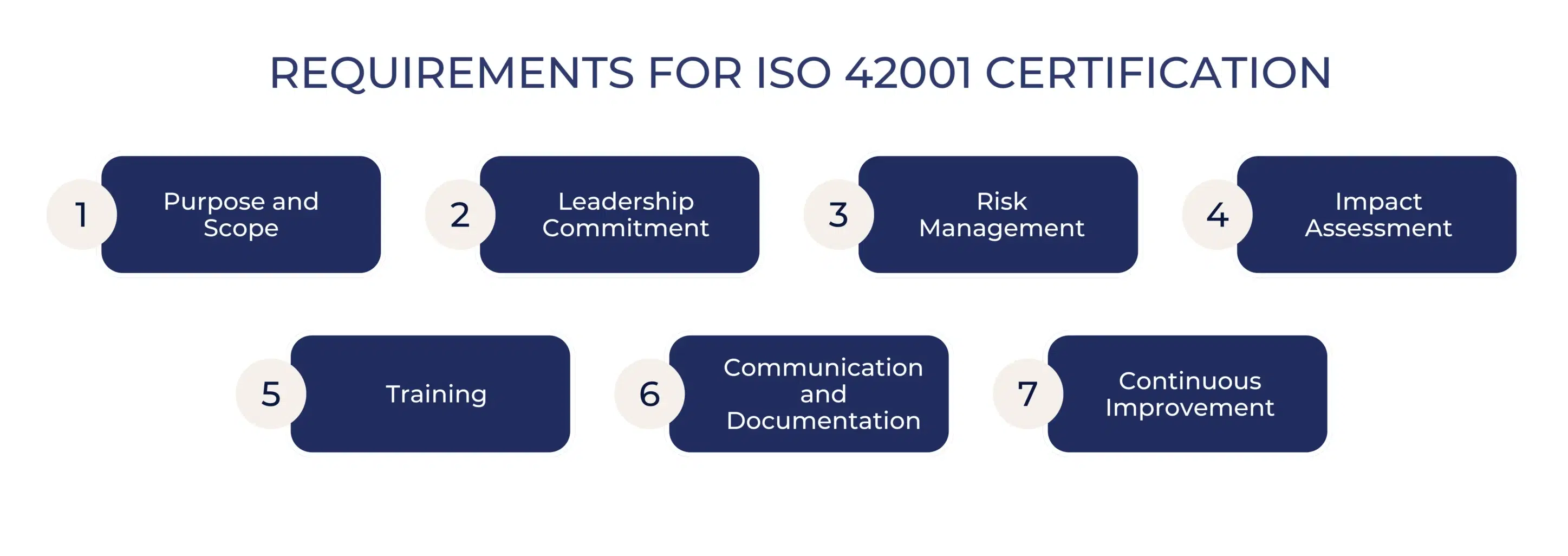
The ISO 42001 standard is structured around eleven primary clauses, with Clauses 4 through 10 forming the core management system requirements. Clause 4 addresses organizational context and interested parties. Clause 5 requires demonstrated leadership commitment to the AIMS. Clause 6 covers planning, including AI risk management and AI impact assessment processes. Clause 7 governs support resources such as documented information, competence, and awareness. Clause 8 addresses AI system operational controls. Clause 9 requires performance evaluation through internal audits and management review. Clause 10 mandates continual improvement in response to nonconformities.
Annex A provides a reference set of AI-specific controls covering AI policy, internal organization, resources for AI systems, AI system impact assessment, AI system lifecycle controls, data governance, third-party AI relationships, and responsible use commitments. During each ISO 42001 certification audit, auditors evaluate objective evidence against every applicable requirement across these clauses and Annex A controls.
Salt Lake City’s AI and Technology Ecosystem Driving AIMS Certification Demand
Salt Lake City anchors the Silicon Slopes corridor, one of the fastest-growing technology markets in the United States. The city hosts a dense concentration of SaaS providers, AI-native companies, cloud computing firms, healthcare and life sciences organizations, financial services and fintech enterprises, cybersecurity companies, telecommunications providers, aerospace and defense contractors, and advanced manufacturers.
This ecosystem generates measurable demand for independent AI governance certification. Enterprise procurement programs, regulated-sector vendor requirements, and U.S. AI governance frameworks increasingly reference or expect ISO 42001 conformity as evidence of responsible AI practices. ISO 42001 Certification in Salt Lake City positions organizations to respond to these expectations with an independently verified attestation of AIMS conformity — rather than a self-assessed declaration. Technology companies in the Silicon Slopes corridor that develop or deploy AI-enabled products face procurement questionnaires from enterprise customers that increasingly request structured AI governance evidence, making ISO 42001 compliance a measurable market differentiator.
Fintech and financial services organizations operating in Salt Lake City face an additional dimension of AI governance scrutiny. Utah’s financial sector includes nationally significant mortgage technology companies, insurance technology providers, payment processors, and banking institutions that deploy AI for credit decisioning, fraud detection, customer service automation, and regulatory compliance monitoring. Each of these use cases creates accountability obligations that ISO 42001 AIMS certification addresses through independently verified evidence of conformity.
Healthcare and life sciences organizations in the Salt Lake City area similarly face heightened AI accountability expectations — particularly where AI systems inform clinical decision support, patient triage, or population health analytics. The ISO 42001 certification that Salt Lake City tech companies pursue in response to these sector-specific pressures provides a structured, auditable framework that enterprise customers, regulators, and institutional investors can independently assess. CertPro’s ISO 42001 audit engagements in Salt Lake City apply a consistent, evidence-based methodology regardless of the organization’s sector or size.
Licensed CPA Firm Positioning and Independent Certification Body Authority
CertPro operates exclusively as an independent certification body and Licensed CPA Firm. This institutional structure distinguishes CertPro from organizations that combine certification with consulting, implementation, or advisory services. The firm does not provide AI governance consulting, AIMS implementation, policy development, control design, readiness assistance, or AI risk advisory services.
This structural independence is not incidental — it is the foundational condition that preserves the objectivity and institutional credibility of the certification decision. Organizations in Salt Lake City engaging CertPro for ISO 42001 Certification receive a conformity assessment conducted by auditors who evaluate objective evidence against ISO/IEC 42001:2023 requirements without prior involvement in the organization’s AIMS design or operation. The Licensed CPA Firm designation reflects CertPro’s accountability to professional standards governing independence, objectivity, and evidence-based evaluation — standards directly applicable to the rigor expected of ISO 42001 AIMS certification that Salt Lake City organizations and their stakeholders can rely upon.

ISO 42001 Certification Audit Process for Organizations in Salt Lake City
The ISO 42001 certification audit process applied by CertPro to Salt Lake City organizations follows a structured, multi-stage methodology aligned with internationally recognized conformity assessment practices. Each stage is designed to produce objective, documented evidence that supports an independent certification decision.
The process is distinct from any form of consulting, readiness advisory, or implementation involvement. Organizations are evaluated against ISO/IEC 42001:2023 requirements as they exist at the time of audit. CertPro does not participate in designing, recommending, or modifying the organization’s AIMS prior to or during the certification process.
| Audit Stage | Key Activities | Output |
|---|---|---|
| Application Review | Scope definition, AIMS boundary confirmation, audit program determination | Confirmed audit scope and program |
| Stage 1 Audit | Documentation review, AIMS readiness evaluation, identification of areas requiring clarification | Stage 1 findings report |
| Stage 2 Audit | On-site or remote evidence evaluation, control testing, Annex A conformity assessment | Audit findings and nonconformity report |
| Nonconformity Review | Review of corrective action evidence submitted by the organization | Conformity determination recommendation |
| Certification Decision | Independent certification committee review and determination | ISO 42001 certificate issued or withheld |
| Surveillance Audit | Periodic evaluation of continued AIMS conformity | Surveillance audit report |
| Recertification Audit | Full-scope conformity reassessment at three-year cycle | Renewed ISO 42001 certificate |
The Stage 1 audit is a structured review of the organization’s documented information and AIMS readiness relative to ISO/IEC 42001:2023 requirements. CertPro auditors examine the organization’s AI policy, AI risk management documentation, AI impact assessment records, Annex A control selection and exclusion justifications, Statement of Applicability equivalent documentation, internal audit records, and management review evidence.
The Stage 1 audit does not constitute a pass or fail determination. It identifies areas where the organization’s documented information is sufficiently developed to proceed to Stage 2, and areas where clarification or additional documentation is needed before the Stage 2 evidence assessment begins. Findings from the Stage 1 audit are documented and communicated to the organization. The organization is responsible for addressing any Stage 1 findings before the Stage 2 audit commences. CertPro auditors conducting the ISO 42001 audit do not advise on how to address Stage 1 findings — responsibility for AIMS operation and documentation rests entirely with the organization.
The Stage 2 audit constitutes the substantive conformity assessment phase of the ISO 42001 certification audit. CertPro auditors evaluate objective evidence demonstrating that the organization’s AIMS satisfies each applicable clause requirement of ISO/IEC 42001:2023 and the Annex A controls selected in the organization’s control selection documentation.
Evidence evaluation encompasses interviews with personnel responsible for AI governance and AI system operations, review of AI risk registers and treatment plans, examination of AI impact assessment records, inspection of data governance procedures, evaluation of human oversight mechanisms, assessment of AI system monitoring and performance measurement practices, and review of internal audit and management review documentation. Nonconformities identified during the Stage 2 audit are classified, documented, and reported to the organization. The organization submits corrective action evidence within defined timeframes, which CertPro reviews before the certification decision proceeds. ISO 42001 compliance demonstrated by Salt Lake City organizations through this process is evaluated on the basis of objective evidence — not assertions or representations.
Following completion of the Stage 2 audit and nonconformity review, the audit findings and conformity determination recommendation are submitted to CertPro’s independent certification committee. The committee reviews the full audit evidence package and makes the certification decision independent of the audit team that conducted fieldwork. This separation of audit function and certification decision function is a structural safeguard of the independent certification process.
Where the committee determines conformity is demonstrated, the ISO 42001 certificate is issued for a three-year validity period. The certificate specifies the certified organization, the AIMS scope, and the applicable standard. Surveillance audits are conducted at defined intervals — typically annually — to evaluate continued AIMS conformity throughout the certificate validity period. Surveillance audit findings indicating a significant AIMS breakdown may result in suspension or withdrawal of the certificate. At the conclusion of the three-year period, a full recertification audit is required to renew ISO 42001 AIMS certification. ISO 42001 Certification in Salt Lake City issued by CertPro follows this complete cycle without exception.
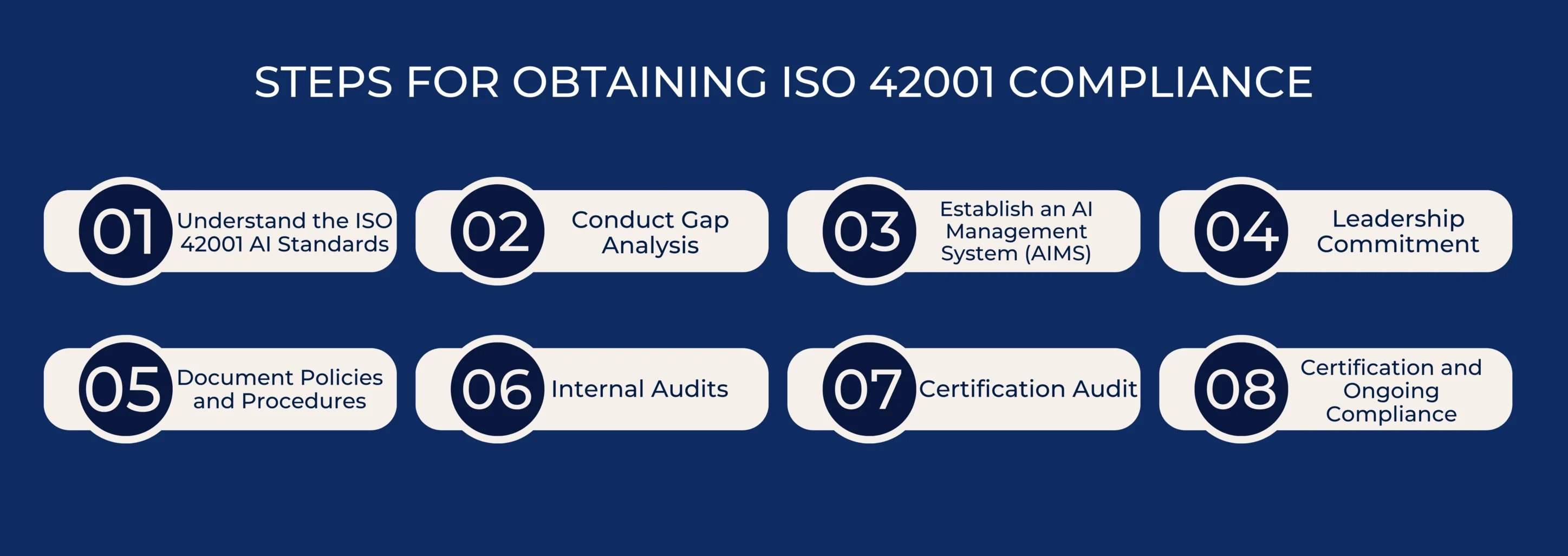
- ✓Stage 1 Audit: Documentation Review and AIMS Readiness Evaluation
- ✓Stage 2 Audit: Objective Evidence Evaluation and Annex A Control Assessment
- ✓Certification Decision, Certificate Issuance, and Surveillance Cycle
ISO 42001 Requirements Evaluated During the Certification Audit
ISO 42001 compliance requires organizations to demonstrate conformity with specific, documented requirements across the management system clauses and the Annex A control framework. During each ISO 42001 certification audit, CertPro auditors evaluate objective evidence against every applicable requirement.
The following represents the primary areas of the standard against which organizations are assessed. Organizations are solely responsible for establishing, implementing, and maintaining conformity with these requirements. CertPro evaluates the evidence — it does not design, advise on, or prescribe how any requirement should be satisfied.
ISO/IEC 42001:2023 requires organizations to determine the internal and external context relevant to their AI activities, identify interested parties and their AI-related requirements, and define the scope of the AIMS with documented justification. The AI policy must be established, approved at the appropriate organizational level, communicated to relevant personnel, and available as documented information. Leadership must demonstrate commitment to the AIMS through visible actions — including assigning AI governance roles and responsibilities, allocating resources, and integrating AI governance into organizational processes.
During the ISO 42001 certification audit, auditors examine the AI policy document, scope statement, interested party analysis records, leadership commitment evidence, and role assignment documentation. Organizations in Salt Lake City whose AI governance documentation does not reflect the actual scope of their AI activities will encounter nonconformity findings during the Stage 1 or Stage 2 audit. The breadth and specificity of the documented AIMS context directly affects the scope of the certification ultimately issued.
ISO/IEC 42001:2023 requires organizations to establish and implement an AI risk management process that identifies, analyzes, evaluates, and treats risks associated with their AI systems. The AI impact assessment process must evaluate the potential consequences of AI systems on individuals, groups, and society — including considerations of fairness, bias, safety, privacy, and societal impact. Organizations must document the results of AI impact assessments for each in-scope AI system and use those results to inform the selection and implementation of Annex A controls.
Annex A of the ISO 42001 standard provides controls across domains including AI policy, internal organization, resources for AI systems, AI system lifecycle, data for AI systems, third-party AI relationships, AI system impact assessment, and responsible AI practices. During the ISO 42001 certification audit, auditors evaluate the organization’s AI risk register, risk treatment plan, AI impact assessment records, and control selection justification documentation. CertPro’s ISO 42001 audit engagements in Salt Lake City apply consistent evaluation criteria to these requirements regardless of the specific AI systems or technologies in scope.
ISO/IEC 42001:2023 requires organizations to conduct internal audits of the AIMS at planned intervals to determine whether it conforms to requirements and is effectively implemented and maintained. Internal audit programs must be documented, and internal audit results must be reported to relevant management. Management review must be conducted at defined intervals to evaluate the continuing suitability, adequacy, and effectiveness of the AIMS.
Management review inputs include internal audit results, AI risk management outcomes, AI impact assessment updates, nonconformity and corrective action status, and performance measurement data. Management review outputs must include decisions and actions related to continual improvement opportunities. During the ISO 42001 certification audit, CertPro auditors examine internal audit schedules, internal audit reports, management review meeting records, and evidence of corrective actions implemented in response to identified nonconformities. Organizations that lack documented internal audit programs or management review records will receive nonconformity findings under Clauses 9 and 10 of the standard. ISO 42001 AIMS certification that Salt Lake City organizations obtain requires demonstrated evidence of these ongoing evaluation activities — not merely their existence on paper.
- ✓AIMS Documentation and Organizational Context Requirements
- ✓AI Risk Management, AI Impact Assessment, and Annex A Controls
- ✓Internal Audit, Management Review, and Continual Improvement Evidence
Why Organizations in Salt Lake City Pursue ISO 42001 Certification
Organizations in Salt Lake City pursue ISO 42001 Certification for a range of commercially and operationally specific reasons. The demand drivers are distinct from general compliance checkbox activities — they reflect real procurement expectations, regulatory developments, investor requirements, and competitive positioning considerations specific to the Silicon Slopes technology market and Utah’s broader economic context. ISO 42001 Certification in Salt Lake City provides an independently verified attestation of AIMS conformity that self-assessments and internal declarations cannot replicate.
Enterprise Vendor Reviews and Procurement Requirements
Enterprise organizations deploying AI-enabled software and services from Salt Lake City technology vendors increasingly include AI governance requirements in their vendor due diligence and procurement processes. A SaaS company in the Silicon Slopes corridor responding to a vendor security questionnaire from a Fortune 500 financial institution may encounter explicit requests for evidence of structured AI governance, responsible AI practices, and third-party validation of AI risk management processes.
ISO 42001 Certification in Salt Lake City provides a defensible, independently verified response to these requests — one that reflects conformity assessment by a Licensed CPA Firm rather than a vendor-produced self-attestation. As enterprise procurement programs evolve to address AI-specific risks — including algorithmic bias, AI system reliability, data governance in AI training, and explainability of AI-generated outputs — ISO 42001 compliance can become a procurement prerequisite rather than a differentiating attribute. Salt Lake City technology companies anticipating this trajectory pursue ISO 42001 certification proactively to position themselves ahead of procurement gatekeeping requirements.
Regulatory and Contractual AI Accountability Obligations
U.S. AI governance frameworks — including the NIST AI Risk Management Framework, Executive Order 14110 on Safe, Secure, and Trustworthy Artificial Intelligence, and emerging sector-specific regulatory guidance from financial services and healthcare regulators — increasingly reference structured AI governance and AI risk management as baseline expectations. Organizations subject to these frameworks that operate in Salt Lake City’s financial services, healthcare, telecommunications, or defense sectors may encounter contractual or regulatory expectations that ISO 42001 AIMS certification directly addresses.
Federal contractors and defense suppliers in Salt Lake City’s aerospace and defense cluster, for example, may face AI accountability obligations from Department of Defense AI ethics and assurance programs that align with ISO 42001’s risk management and human oversight requirements. Financial services organizations deploying AI for credit, fraud, or compliance functions face regulatory scrutiny from the CFPB, OCC, and Federal Reserve — scrutiny that ISO 42001 compliance evidence can materially support. The ISO 42001 audit findings and resulting certification provide documented, third-party-evaluated evidence of AI governance structure that regulatory examiners and contract counterparties can independently assess.
International Market Access and Cross-Border AI Governance Expectations
Salt Lake City technology companies with international operations or customer bases face AI governance requirements from jurisdictions with formal AI regulatory frameworks. The European Union AI Act imposes risk-tiered obligations on providers and deployers of AI systems — and applies to organizations placing AI systems on the EU market regardless of their geographic location. ISO 42001 certification for Salt Lake City companies pursuing EU market access provides a structured, internationally recognized framework that maps to EU AI Act governance obligations.
While ISO 42001 certification is not a legal substitute for EU AI Act compliance, the AIMS controls and documentation disciplines it requires — including AI impact assessments, risk management processes, data governance documentation, and human oversight mechanisms — align with the operational requirements the EU AI Act imposes on high-risk AI system providers. Salt Lake City SaaS companies, AI developers, and technology exporters pursuing European enterprise customers increasingly encounter ISO 42001 Certification as an expected component of AI vendor qualification packages, reinforcing the certification’s role in international market access strategy.
Benefits of ISO 42001 Certification for Salt Lake City-Based Organizations
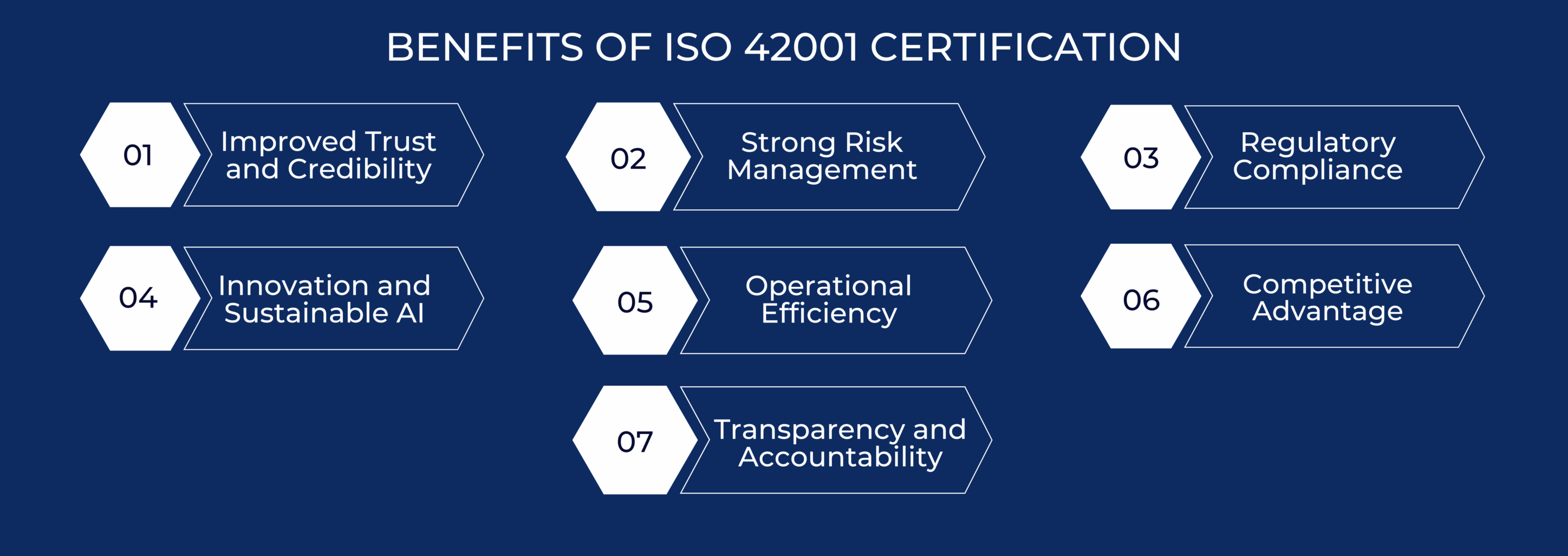
ISO 42001 Certification in Salt Lake City delivers specific, demonstrable outcomes for organizations across the technology, financial services, healthcare, and advanced manufacturing sectors. The following benefits reflect the direct consequences of independently verified AIMS conformity. They are not assertions about what CertPro does for organizations — rather, they describe what independently verified ISO 42001 compliance positions organizations to demonstrate to their stakeholders.
- ✓Independent third-party verification of AIMS conformity with ISO/IEC 42001:2023 requirements, issued by a Licensed CPA Firm
- ✓Structured, auditable evidence of AI governance, AI risk management, and AI impact assessment processes for enterprise vendor reviews
- ✓Internationally recognized certification supporting market access in jurisdictions with formal AI governance expectations, including EU AI Act-aligned markets
- ✓Documented Annex A control conformity providing defensible evidence in regulatory examinations and contractual AI accountability reviews
- ✓Surveillance audit cycle maintaining ongoing AIMS evaluation and continuous conformity verification throughout the certificate period
- ✓Differentiated positioning in Silicon Slopes procurement processes where enterprise customers require structured AI governance evidence from technology vendors
- ✓Objective evidence of human oversight mechanisms, transparency commitments, and explainability controls addressing investor and board-level AI governance inquiries
- ✓Conformity certification applicable across AI system types — including predictive models, generative AI, decision-support systems, and automated processing pipelines
ISO 42001 certification provides Salt Lake City organizations with documented, third-party-evaluated evidence that their AI governance controls exist, are implemented, and operate as documented. This verification is categorically different from an internal self-assessment or a vendor-produced AI ethics statement. The ISO 42001 certification audit evaluates objective evidence of control design and operating effectiveness across the AIMS scope — including AI policy implementation, AI risk treatment measures, AI impact assessment execution, data governance practices, and Annex A control operation.
For organizations in Salt Lake City’s fintech and financial services sector, this third-party-evaluated evidence addresses enterprise customer concerns about AI system reliability, fairness, and accountability that self-attestations cannot resolve. For AI-native technology companies in the Silicon Slopes corridor, the independently verified AIMS controls documented through ISO 42001 compliance provide a structured basis for customer trust that internal declarations of responsible AI practices cannot replicate with equivalent credibility.
The structured audit methodology applied in CertPro’s ISO 42001 certification audit engagements in Salt Lake City provides organizations with a repeatable, documented conformity assessment that produces consistent, comparable results. Unlike internal reviews or informal third-party assessments, the ISO 42001 certification audit follows a defined process — from scope determination through certification decision — that external stakeholders, including enterprise customers, regulators, and institutional investors, can understand and assess.
The surveillance audit cycle embedded in the three-year certificate period ensures that ISO 42001 compliance is not a point-in-time assertion but an ongoing, monitored state. Surveillance audits conducted at annual intervals evaluate whether the AIMS continues to conform to ISO/IEC 42001:2023 requirements as the organization’s AI systems, risk environment, and operational context evolve. This ongoing oversight structure provides Salt Lake City organizations’ stakeholders with continuing assurance rather than a historical snapshot — supporting the sustained AI governance credibility that enterprise procurement programs and regulated-sector customers require.
- ✓Verification of AI Governance Controls and Risk Management Processes
- ✓Structured Audit Methodology and Ongoing Surveillance Oversight
ISO 42001 Certification Scope for Salt Lake City Industry Sectors
ISO 42001 Certification in Salt Lake City applies across a wide range of industry sectors that develop, deploy, operate, or are materially affected by AI systems. The AIMS scope certified under ISO/IEC 42001:2023 is defined by the organization based on its AI system portfolio, organizational boundaries, and relevant interested party requirements. CertPro evaluates conformity within the defined scope — it does not determine the scope on the organization’s behalf. The following sectors represent the primary industry concentrations in Salt Lake City for which ISO 42001 AIMS certification is most frequently relevant.
| Industry Sector | Representative AI Use Cases | Primary ISO 42001 Relevance |
|---|---|---|
| SaaS and Software Providers | AI-powered product features, recommendation engines, automated analytics | Enterprise vendor procurement requirements, responsible AI product governance |
| Fintech and Financial Services | Credit scoring, fraud detection, customer service AI, regulatory compliance monitoring | Regulatory AI accountability, enterprise customer vendor reviews, fair lending governance |
| Healthcare and Life Sciences | Clinical decision support, patient triage, population health analytics, diagnostic AI | Patient safety governance, regulatory AI accountability, health system vendor requirements |
| Cybersecurity Companies | Threat detection AI, behavioral analytics, automated incident response | Enterprise customer AI governance requirements, AI system reliability assurance |
| Aerospace and Defense | Autonomous systems, AI-enabled surveillance, predictive maintenance | Defense AI ethics compliance, federal contractor AI accountability obligations |
ISO 42001 Certification for Salt Lake City Technology and SaaS Companies
Salt Lake City’s Silicon Slopes technology corridor hosts one of the highest concentrations of SaaS companies and software developers in the western United States. Technology companies in this ecosystem that embed AI capabilities in their products — including machine learning models, natural language processing, automated decisioning, and generative AI features — face growing pressure from enterprise customers to demonstrate structured AI governance.
ISO 42001 certification that Salt Lake City tech companies pursue addresses this pressure by providing an independently verified attestation that the company’s AIMS satisfies internationally recognized AI governance requirements. The certification scope for a SaaS company typically encompasses the AI systems embedded in customer-facing products, the data governance processes governing AI training and operation, the AI impact assessment records for each certified AI system, and the Annex A controls implemented to manage AI-specific risks. CertPro’s ISO 42001 audit evaluates objective evidence across each of these areas, producing an audit-based certification rather than a self-assessed declaration.
ISO 42001 Certification for Salt Lake City Fintech and Healthcare Organizations
ISO 42001 certification that Salt Lake City fintech organizations pursue reflects the sector’s acute sensitivity to AI governance failures. AI systems that inform credit decisions, detect fraudulent transactions, or automate compliance monitoring carry regulatory, reputational, and legal consequences when they operate outside structured governance frameworks. ISO 42001 AIMS certification provides fintech organizations with documented, independently evaluated evidence that their AI risk management, AI impact assessment, human oversight, and transparency controls conform to ISO/IEC 42001:2023 requirements.
Healthcare and life sciences organizations in Salt Lake City face parallel considerations. AI systems influencing patient care pathways, diagnostic recommendations, or clinical resource allocation require governance structures that regulators, accreditation bodies, and health system customers can independently assess. The ISO 42001 certification audit applies the same evidence-based evaluation methodology to healthcare AI systems as to fintech applications, producing conformity determinations that reflect the specific AI systems and controls within the certified scope. ISO 42001 compliance that Salt Lake City healthcare and fintech organizations demonstrate through independent certification supports both internal governance accountability and external stakeholder assurance requirements.
ISO 42001 Standard: Annex A Controls and Key AIMS Requirements
ISO/IEC 42001:2023 Annex A specifies a reference control set that organizations use to address AI-specific risks identified through the AI risk management and AI impact assessment processes. Organizations select applicable controls from Annex A based on their risk treatment decisions and document the rationale for any control exclusions. During the ISO 42001 certification audit, CertPro auditors evaluate objective evidence of each selected Annex A control’s implementation and operation. The following control domains constitute the primary areas of Annex A evaluation during ISO 42001 AIMS certification audits.
- ✓AI Policy controls: Establishment, approval, communication, and maintenance of the organization’s AI governance policy framework
- ✓Internal Organization controls: Assignment of AI governance roles, responsibilities, and accountability structures within the organization
- ✓Resources for AI Systems controls: Management of computational resources, human expertise, and tooling required for AI system development and operation
- ✓AI System Lifecycle controls: Governance of the full AI system lifecycle from conception through deployment, monitoring, and decommissioning
- ✓Data for AI Systems controls: Data governance, data quality, data lineage, and data management practices governing AI training and operational data
- ✓Third-Party AI Relationships controls: Management of AI risks introduced through third-party AI systems, AI components, or AI service providers
- ✓AI System Impact Assessment controls: Processes for assessing and documenting the impacts of AI systems on individuals, groups, and society
- ✓Responsible Use controls: Transparency, explainability, human oversight, and fairness commitments embedded in AI system design and operation
Data governance controls under ISO/IEC 42001:2023 Annex A address the quality, provenance, management, and security of data used to train, validate, and operate AI systems. Organizations must demonstrate that data governance processes exist and are operated to address AI-specific risks — including training data bias, data drift, data poisoning, and inappropriate use of personal or sensitive data in AI training pipelines.
For Salt Lake City organizations operating in healthcare and fintech, where AI training data frequently includes personal health information or financial records, the intersection of ISO 42001 data governance requirements with HIPAA and consumer financial data protection obligations creates a specific audit focus area. AI system lifecycle controls require organizations to demonstrate governance processes spanning the full AI development and deployment cycle — from initial problem framing and design decisions through model development, validation, deployment, operational monitoring, and eventual decommissioning. During the ISO 42001 certification audit, auditors examine lifecycle governance records, model validation documentation, monitoring logs, and decommissioning procedures as objective evidence of Annex A lifecycle control implementation and operation.
Human oversight controls under ISO/IEC 42001:2023 Annex A require organizations to establish and maintain mechanisms that enable humans to monitor, review, intervene in, and override AI system outputs where appropriate. The design and operation of human oversight mechanisms must be documented, and the appropriateness of oversight levels must be calibrated to the risk profile and impact potential of each AI system.
Transparency and explainability controls require organizations to document their commitments and processes for communicating the purpose, capabilities, and limitations of AI systems to affected parties — including customers, employees, and the public where applicable. During the ISO 42001 certification audit, auditors examine the documented human oversight mechanisms for each in-scope AI system, review evidence of oversight mechanism operation, and evaluate the organization’s transparency disclosures and explainability processes. For Salt Lake City AI-native companies and fintech organizations, these controls frequently represent the most substantive area of audit focus. Human oversight and explainability are where AI governance theory most directly intersects with operational AI system design — and conformity with these controls requires documented evidence, not general statements of commitment to responsible AI.
- ✓Data Governance and AI System Lifecycle Controls
- ✓Human Oversight, Transparency, and Explainability Controls
ISO 42001 Certification Scope Definition and Independent Decision Framework
The scope of ISO 42001 Certification in Salt Lake City is defined by the organization seeking certification based on its AI system portfolio, organizational boundaries, internal and external context, and interested party requirements. CertPro evaluates conformity within the scope the organization defines — it does not determine the appropriate scope on the organization’s behalf.
Scope definition is a management decision with direct consequences for the certification’s commercial and regulatory utility. A scope that excludes high-risk AI systems from AIMS coverage will produce a certificate of limited value to enterprise customers or regulators who require evidence of governance over those specific systems. The following framework describes how scope definition and the independent certification decision interact in CertPro’s ISO 42001 audit process.
AIMS Scope Boundaries and Certification Validity Conditions
The AIMS scope document must clearly define the organizational functions, AI systems, processes, and facilities included within the certification boundary. Organizations must document the basis for any exclusions and demonstrate that excluded areas do not affect the organization’s ability to meet ISO/IEC 42001:2023 requirements within the certified scope. During the Stage 1 audit, CertPro auditors review the scope document for completeness and consistency with the organization’s AI system inventory and operational context.
A scope document that materially understates the organization’s AI activities, or that excludes AI systems without documented justification, will generate Stage 1 audit findings that must be resolved before the Stage 2 audit proceeds. Certificate validity conditions include continued operation of the AIMS within the certified scope, completion of surveillance audits at defined intervals, and timely corrective action on nonconformities identified during surveillance. Material changes to the organization’s AI systems, organizational structure, or operational context that affect AIMS scope may require a scope update review. Certificate suspension or withdrawal conditions apply where surveillance audit findings indicate a significant breakdown in AIMS conformity, or where the organization fails to maintain required surveillance audit engagement.
Independent Certification Committee and Evidence-Based Decision Process
CertPro’s certification decision is made by an independent certification committee that reviews the complete audit evidence package — including Stage 1 findings, Stage 2 audit results, nonconformity documentation, and corrective action evidence — without the involvement of the audit team that conducted the fieldwork. This structural separation of audit execution and certification decision is a fundamental safeguard of the independent certification process and a requirement of internationally recognized conformity assessment practice.
The certification committee applies the same objective evidence standard as the audit team. The decision to issue, withhold, suspend, or withdraw ISO 42001 AIMS certification is based on documented evidence of conformity or nonconformity — not on the organization’s representations or intentions. Organizations in Salt Lake City that receive nonconformity findings during the certification audit are not denied certification categorically. The process includes a defined corrective action review stage in which organizations submit evidence of corrective action for committee evaluation. ISO 42001 Certification in Salt Lake City is issued by CertPro only when the certification committee independently determines that objective evidence of AIMS conformity with ISO/IEC 42001:2023 requirements is sufficient to support the certification decision.
FAQ
▶
What is ISO 42001 Certification and what does it certify?
▶
Which organizations in Salt Lake City need ISO 42001 Certification?
▶
How does the ISO 42001 audit process work for Salt Lake City organizations?
▶
What is the difference between the Stage 1 and Stage 2 ISO 42001 audit?
▶
What documented information is required for ISO 42001 certification?
▶
How long is an ISO 42001 certificate valid and what is required to maintain it?
▶
Does ISO 42001 certification cover all AI systems an organization operates?
▶
Is ISO 42001 certification the same as ISO 27001 certification?
ISO 42001 CERTIFIED: WHY AI GOVERNANCE CERTIFICATION IS BECOMING A BOARD-LEVEL REQUIREMENT
ISO 42001 Certified: Board-Level AI Governance Guide | CertPro CPA LLC HERO ══════════════════════════════ –> src=”https://certpro.com/wp-content/uplo…
Get In Touch
have a question? let us get back to you.