
ISO 42001 Certification in Raleigh
ISO 42001 Certification in Raleigh provides organizations with independently verified evidence of AIMS conformity that produces measurable operational, commercial, and governance benefits. The following list identifies the primary benefits associated with ISO 42001 certification for organizations in the Raleigh and Research Triangle technology ecosystem. These benefits reflect the outcomes of the certification process itself — not advisory or implementation activities — and are expressed in objective terms consistent with CertPro’s independent certification body positioning.
OUR CLIENTS




ISO 42001 Certification for Raleigh-Based AI and Technology Organizations
ISO 42001 Certification in Raleigh is conducted by CertPro, a Licensed CPA Firm operating exclusively as an independent third-party certification body. CertPro evaluates conformity of an organization’s Artificial Intelligence Management System (AIMS) against the requirements of ISO/IEC 42001:2023 through a structured, evidence-based certification audit process. The certification body function remains fully independent of any implementation, advisory, or consulting role. CertPro does not assist organizations in establishing, designing, or operating their AIMS — the ISO 42001 certification audit evaluates what organizations have independently built and documented.
Raleigh occupies a central position in the Research Triangle technology and research ecosystem — one of the most concentrated technology corridors in the United States. The city and the broader Research Triangle Park (RTP) environment host a dense population of AI companies, SaaS providers, cloud service providers, biotechnology and life sciences firms, healthcare organizations, cybersecurity companies, financial services and fintech organizations, telecommunications companies, advanced manufacturers, research institutions, and enterprises that develop or deploy AI systems at scale.
This concentration of technology and data-intensive organizations creates substantial and growing demand for independently verified AI governance frameworks. Organizations operating in Raleigh and the Research Triangle face enterprise vendor security reviews, U.S. AI governance expectations, third-party risk management requirements, and procurement due diligence processes — all of which increasingly reference ISO 42001 standard certification as evidence of organizational accountability and control.
ISO/IEC 42001:2023 is the first internationally recognized standard establishing requirements for an Artificial Intelligence Management System. The standard defines the framework organizations must establish, implement, maintain, and continually improve to govern the responsible development, deployment, and use of AI systems. The ISO 42001 standard addresses AI governance structures, AI risk management processes, AI impact assessments, human oversight mechanisms, transparency and explainability controls, data governance practices, and the full set of Annex A controls applicable to AI system lifecycle activities.
ISO 42001 compliance requires organizations to demonstrate, through documented information and operational evidence, that their AIMS conforms to each applicable clause and control requirement. This evidence is evaluated during the ISO 42001 certification audit conducted by CertPro as an independent Licensed CPA Firm. The certification decision is made independently by CertPro’s certification committee following a structured review of audit findings, evidence collected during the Stage 1 and Stage 2 audits, and any nonconformities identified and resolved during the process.
The Research Triangle Park environment reinforces demand for structured, independently verified AI governance certification across both regulated and unregulated sectors. Multinational technology companies headquartered or operating in Raleigh face enterprise procurement expectations from global clients who require ISO 42001 Certification in Raleigh as a vendor qualification criterion. High-growth AI startups in the Raleigh-Durham corridor pursue ISO 42001 certification to demonstrate governance maturity to institutional investors, enterprise customers, and regulated-sector clients.
Government contractors and research institutions in the RTP area face heightened expectations around responsible AI use, documented risk management, and audit-ready evidence of AIMS conformity. CertPro’s role as a Licensed CPA Firm and independent certification body positions its certification decisions as objective, evidence-based determinations that carry institutional credibility across procurement, contracting, regulatory, and investor contexts relevant to Raleigh’s technology ecosystem.

What Is ISO 42001 Certification?
ISO 42001 Certification is the formal, independent confirmation that an organization’s Artificial Intelligence Management System conforms to the requirements of ISO/IEC 42001:2023 — the international standard published by the International Organization for Standardization and the International Electrotechnical Commission. The ISO 42001 standard establishes specific requirements that organizations developing, providing, or using AI systems must satisfy through documented information, operational processes, and demonstrable controls.
Certification is issued by an independent third-party certification body following a structured audit process in which objective evidence of AIMS conformity is collected, evaluated, and independently assessed. ISO 42001 Certification in Raleigh, as conducted by CertPro, represents a conformity determination rather than a consultative endorsement — the certificate confirms that the AIMS as audited meets the standard’s requirements at the time of the audit.
The ISO/IEC 42001:2023 Standard and AIMS Requirements
ISO/IEC 42001:2023 follows the ISO High-Level Structure (HLS), sharing a common clause architecture with other management system standards such as ISO 27001 and ISO 9001. The standard’s core clauses — Clauses 4 through 10 — establish requirements for organizational context, leadership and commitment, planning, support, operation, performance evaluation, and continual improvement as applied to AI management systems.
Clause 4 requires organizations to define the context of their AIMS, including internal and external factors influencing AI governance, and to identify interested parties and their AI-related requirements. Clause 6 requires organizations to address AI risks and opportunities through a documented AI risk management process, including AI impact assessments for AI systems posing significant risks. Clauses 8 and 9 require operational controls, internal audit programs, and management review processes that demonstrate the AIMS is functioning as designed. These requirements form the evidentiary basis evaluated during the ISO 42001 certification audit.
Annex A of the ISO 42001 standard provides a reference set of controls specifically designed for AI management, grouped into control domains addressing policies for responsible AI use, internal organizational responsibilities, resources for AI systems, assessing impacts of AI systems, AI system lifecycle considerations, and data governance for AI. Organizations select applicable Annex A controls based on their AI risk assessment results and document the rationale for inclusions and exclusions in a Statement of Applicability.
CertPro evaluates whether selected controls are implemented and operating effectively during the ISO 42001 certification audit, using the Statement of Applicability as a key reference document. Annex B provides additional guidance for AI-specific risk management, while Annex C and D address AI system impact assessment considerations and cross-domain considerations for AI systems used in specific contexts. The full scope of Annex A controls is a mandatory area of evaluation during the certification audit for organizations seeking ISO 42001 Certification in Raleigh.
Who Needs ISO 42001 Certification in Raleigh?
ISO 42001 certification applies to any organization that develops, deploys, provides, or uses AI systems — regardless of sector, size, or AI system complexity. In Raleigh’s technology ecosystem, organizations across multiple sectors pursue ISO 42001 Certification in Raleigh to satisfy specific operational, procurement, or regulatory demands. AI software companies and SaaS providers face enterprise customer requirements for independently certified AI governance as a condition of vendor onboarding. Biotechnology and life sciences organizations using AI for drug discovery, clinical trial analysis, or diagnostic applications operate in environments where AI governance accountability is subject to regulatory scrutiny.
Healthcare organizations deploying AI-assisted clinical decision support systems require structured evidence of human oversight mechanisms and AI risk controls. Cybersecurity companies using AI for threat detection require documented governance of AI system behavior, data inputs, and model outputs. The ISO 42001 standard provides the structured framework against which these organizations’ AIMS practices can be independently evaluated and certified through the ISO 42001 audit process.
Financial services and fintech organizations in Raleigh using AI for credit scoring, fraud detection, customer analytics, or algorithmic trading face expectations from regulators, institutional counterparties, and enterprise clients that AI systems be governed through documented, auditable processes. Telecommunications companies deploying AI for network optimization, predictive maintenance, or customer-facing applications require structured governance of AI system inputs, outputs, and performance monitoring.
Advanced manufacturers using AI in quality control, supply chain optimization, or autonomous production environments need documented AI risk management processes and operational controls. Research institutions and universities in the Research Triangle using AI for scientific computing, research data analysis, or automated research workflows may require ISO 42001 compliance as a condition of research funding agreements or institutional partnership contracts. Cloud service providers hosting AI workloads for Raleigh-based enterprises also face increasing vendor due diligence requirements that reference ISO 42001 certification as a qualification criterion.
ISO 42001 Certification Audit Process in Raleigh
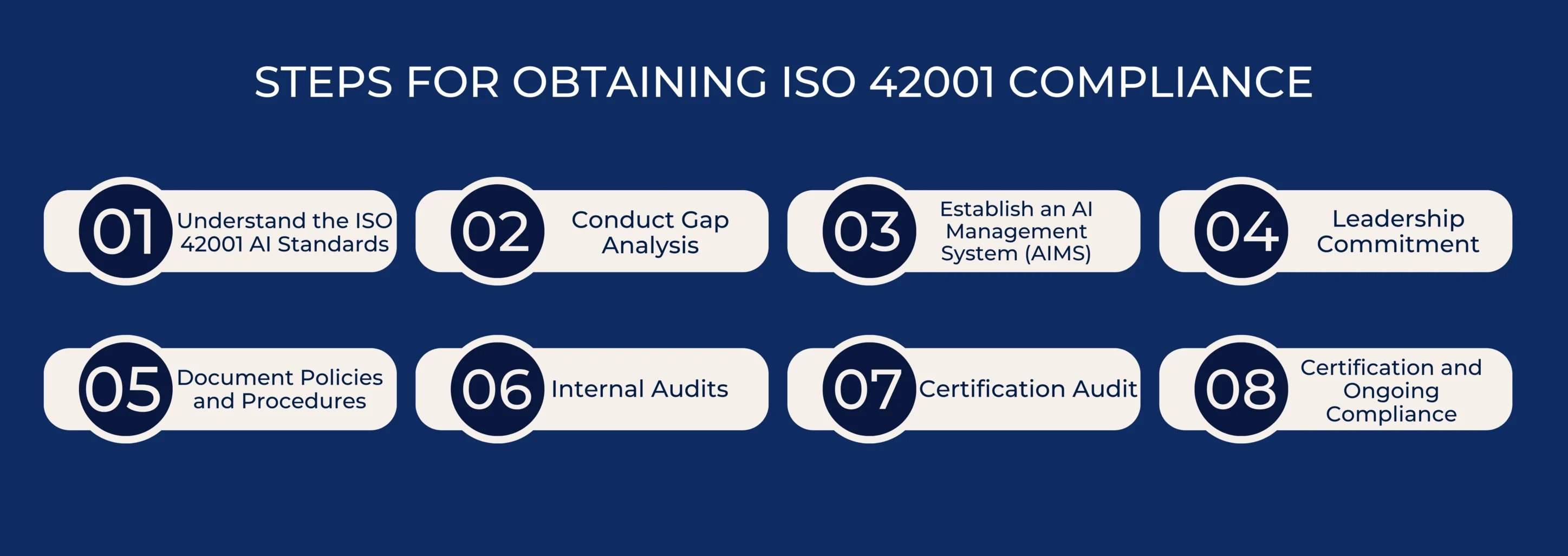
The ISO 42001 certification audit conducted by CertPro follows a structured, multi-stage process designed to collect and evaluate objective evidence of AIMS conformity against ISO/IEC 42001:2023 requirements. The process is strictly independent — CertPro functions as the certification body, not as an implementation advisor or readiness consultant. Each stage of the ISO 42001 audit produces specific outputs that inform the subsequent stage and ultimately the certification committee’s conformity determination.
The audit process for ISO 42001 Certification in Raleigh proceeds through defined stages — from initial application through certificate issuance and ongoing surveillance — ensuring a consistent, evidence-based evaluation at every step.
| Audit Stage | Key Activities | Output |
|---|---|---|
| Application Review | Scope definition, audit program determination, AIMS boundary confirmation | Audit plan and scope agreement |
| Stage 1 Audit | Documentation review, AIMS readiness assessment, identification of areas for Stage 2 focus | Stage 1 findings report |
| Stage 2 Audit | Evidence collection, control effectiveness evaluation, Annex A assessment, personnel interviews | Audit findings and nonconformity report |
| Nonconformity Review | Review of corrective actions and supporting evidence submitted for identified nonconformities | Nonconformity closure determination |
| Certification Decision | Independent committee review of full audit evidence and findings | Certificate issuance or deferral decision |
The Stage 1 audit is a structured review of the organization’s AIMS documentation and the completeness of its management system framework against ISO/IEC 42001:2023 requirements. During the Stage 1 ISO 42001 audit, CertPro reviews the organization’s AIMS scope document, AI policy, AI risk assessment documentation, AI impact assessment records, Statement of Applicability, AI system lifecycle documentation, and management review records.
The purpose of the Stage 1 audit is to assess whether AIMS documentation demonstrates sufficient planning and implementation to proceed to the Stage 2 field evaluation. The Stage 1 audit identifies areas where documentation gaps or process ambiguities exist that require focused evaluation during Stage 2, and produces a Stage 1 findings report that defines the audit program for the subsequent stage. Organizations are not required to have perfect documentation at Stage 1, but they must demonstrate that the core AIMS framework is established and that required documented information exists in a form that can be evaluated against ISO 42001 standard requirements.
The Stage 2 ISO 42001 certification audit is the substantive field evaluation in which CertPro collects and evaluates objective evidence of AIMS conformity against all applicable ISO/IEC 42001:2023 clauses and selected Annex A controls. Evidence collection during the Stage 2 audit includes document review, personnel interviews, observation of operational processes, and inspection of AI system governance records.
CertPro auditors evaluate whether AI governance policies are implemented as documented, whether AI risk management processes produce evidence-based risk treatment decisions, whether AI impact assessments are conducted for AI systems within scope, and whether human oversight mechanisms, transparency controls, and data governance practices operate as described in AIMS documentation. The Stage 2 audit also evaluates the organization’s internal audit program and management review process as required by Clauses 9.2 and 9.3 of the standard. Nonconformities identified during Stage 2 are documented and communicated to the organization for corrective action prior to the certification decision.
Following the Stage 2 ISO 42001 audit, the organization must address any identified nonconformities through documented corrective actions supported by objective evidence. CertPro reviews submitted corrective action evidence to determine whether nonconformities have been adequately resolved before forwarding the complete audit package to the certification committee.
The certification committee, operating independently of the auditors who conducted the field evaluation, reviews the full audit record — including Stage 1 findings, Stage 2 evidence, nonconformity records, and corrective action responses — and makes an independent determination on whether to issue the ISO 42001 certificate. This separation between audit execution and certification decision is a structural feature of CertPro’s independent certification body function. The resulting ISO 42001 certificate specifies the certified organization, the defined AIMS scope, and the applicable standard — ISO/IEC 42001:2023 — and is valid for a defined certification cycle subject to ongoing surveillance.
ISO 42001 certification is maintained through a structured surveillance and recertification cycle. Following initial certificate issuance, CertPro conducts periodic surveillance audits to evaluate whether the certified AIMS continues to conform to ISO/IEC 42001:2023 requirements and whether the organization maintains the corrective action and continual improvement processes required by the standard.
Surveillance audits are less extensive than the initial ISO 42001 certification audit but include targeted evaluation of AIMS performance indicators, internal audit results, management review outputs, and any significant changes to AI systems, processes, or organizational context that may affect AIMS conformity. Organizations in Raleigh that expand their AI system portfolio, enter new markets, or modify their AI governance framework during the certification cycle must report material changes to CertPro for evaluation of potential impact on certification scope. Recertification is conducted at the end of the certification cycle and involves a full re-evaluation of AIMS conformity equivalent in scope to the initial certification audit, ensuring ongoing validity of the ISO 42001 certification.
- ✓Stage 1 Audit — Documentation and AIMS Readiness Review
- ✓Stage 2 Audit — Evidence Collection and Control Evaluation
- ✓Surveillance Audits and Recertification
ISO 42001 Requirements — Key Areas Evaluated During the Certification Audit
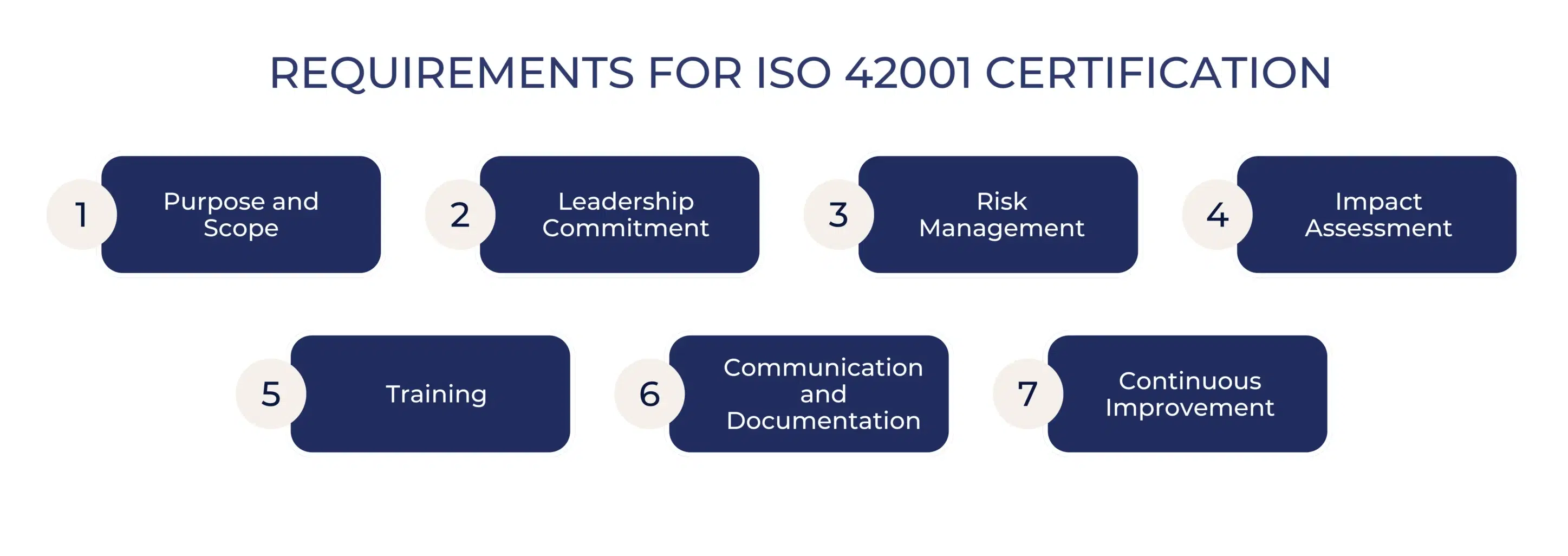
ISO 42001 compliance requires organizations to demonstrate conformity across a structured set of management system requirements and AI-specific control domains. The ISO 42001 certification audit evaluates evidence across the full scope of ISO/IEC 42001:2023 requirements — from organizational context and leadership commitment through operational controls and performance evaluation.
Understanding the key areas evaluated during the ISO 42001 audit is essential for Raleigh-based organizations establishing the documented AIMS that will be subject to independent evaluation by CertPro. The following subsections outline the primary areas of evaluation during the ISO 42001 certification audit.
The ISO 42001 standard requires organizations to establish a formal AI governance framework supported by demonstrable leadership commitment. Clause 5 of the standard specifies that top management must demonstrate accountability for the AIMS by establishing an AI policy, assigning roles and responsibilities for AI governance, and integrating AIMS requirements into the organization’s strategic planning processes. The AI policy must define the organization’s approach to responsible AI use, including commitments to ethical AI principles, compliance with applicable AI-related legal and regulatory requirements, and continual improvement of the AIMS.
During the ISO 42001 certification audit, CertPro evaluates whether leadership commitment is evidenced through documented decisions, resource allocation records, management review participation, and organizational accountability structures. Evidence of leadership engagement is a mandatory area of evaluation — an AIMS that exists only as documented policy without demonstrable top management engagement does not satisfy the ISO 42001 standard’s requirements.
AI governance requirements under ISO/IEC 42001:2023 extend beyond policy documentation to include defined roles for AI system owners, AI risk managers, and individuals responsible for specific AIMS processes such as AI impact assessment and internal audit. Organizations must demonstrate that personnel assigned AI governance responsibilities possess the competence required to execute those responsibilities effectively — supported by appropriate training, experience, or qualification records.
The ISO 42001 audit evaluates documented role assignments, competence records, and evidence that AI governance responsibilities are actively exercised rather than nominally assigned. For Raleigh-based AI companies and SaaS providers, where AI system development and deployment involve cross-functional teams spanning engineering, product, legal, and compliance functions, the AIMS must demonstrate how AI governance responsibilities are coordinated across organizational boundaries and how accountability is maintained through documented oversight mechanisms.
AI risk management is a central requirement of the ISO 42001 standard and a primary focus of the ISO 42001 certification audit. Clause 6.1 requires organizations to establish a documented AI risk assessment process that identifies AI-related risks and opportunities, evaluates their significance, and determines appropriate risk treatment actions. The risk assessment must address risks arising from AI system design, training data, model behavior, operational deployment, and interactions with affected parties.
AI impact assessment — required for AI systems that pose significant risks to individuals, groups, or society — must produce documented evidence of impact evaluation, stakeholder consideration, and treatment decisions. During the ISO 42001 audit, CertPro evaluates whether the organization’s AI risk assessment process is systematic, repeatable, and produces evidence-based treatment decisions documented in a risk treatment plan. The risk treatment plan must map risk treatment decisions to specific Annex A controls and document the rationale for any applicable controls excluded from implementation. Together, these elements form a critical portion of ISO 42001 compliance evidence.
ISO/IEC 42001:2023 requires organizations to maintain specific categories of documented information as evidence of AIMS operation. Key documented information evaluated during the ISO 42001 certification audit includes the AI policy, AIMS scope document, AI risk assessment records, AI impact assessment records, Statement of Applicability, risk treatment plan, Annex A control implementation evidence, internal audit program records, internal audit results, and management review records.
These documents collectively constitute the evidentiary foundation of ISO 42001 compliance and must be current, controlled, and accessible at the time of the audit. Internal audit records must demonstrate that the organization conducts planned, systematic reviews of AIMS conformity using personnel independent of the areas being audited, and that audit findings are reported to management with documented follow-up actions. Management review records must demonstrate that top management periodically reviews AIMS performance data, internal audit results, and risk management outcomes to make informed improvement decisions — satisfying the Clause 9.3 requirement for documented management review outputs.
- ✓AI Governance Framework and Leadership Requirements
- ✓AI Risk Management and Impact Assessment Requirements
- ✓Documented Information, Internal Audit, and Management Review
ISO 42001 Annex A Controls Evaluated During Certification
Annex A of the ISO 42001 standard provides a normative reference set of controls that organizations implementing an AIMS must consider and, where applicable, implement. The Statement of Applicability documents which Annex A controls apply to the organization’s AIMS scope, which are implemented, and the justification for any exclusions. During the ISO 42001 certification audit, CertPro evaluates the completeness of the Statement of Applicability and the adequacy of control implementation across all applicable Annex A domains.
The following table summarizes the primary Annex A control domains evaluated during ISO 42001 certification in Raleigh.
| Annex A Control Domain | Key Focus Areas | Relevance to AIMS |
|---|---|---|
| Policies for AI | Responsible AI use policy, AI objectives, AI governance commitments | Establishes organizational direction for AIMS implementation |
| Internal Organization | Roles, responsibilities, and resources for AI governance and AI system management | Defines accountability structure for AIMS operation |
| Resources for AI Systems | Data governance, computing resources, human competence for AI development and operation | Ensures AI systems are developed and operated with appropriate inputs |
| Assessing AI System Impacts | AI impact assessment process, affected party identification, impact evaluation methodology | Addresses potential harms from AI system deployment |
| AI System Lifecycle | Design controls, testing, deployment, monitoring, and decommissioning of AI systems | Governs AI system operation across its full lifecycle |
Data Governance Controls for AI Systems
Data governance is a critical Annex A control domain under ISO/IEC 42001:2023, reflecting the fundamental dependence of AI system behavior on the quality, provenance, and governance of training and operational data. The ISO 42001 standard requires organizations to establish controls governing data acquisition, data quality assessment, data labeling processes, data access controls, and data retention and disposal practices as they relate to AI system inputs.
During the ISO 42001 certification audit, CertPro evaluates whether the organization has documented data governance processes specifically addressing AI system data, whether data quality issues are identified and resolved through documented processes, and whether data lineage is traceable for AI systems within the certification scope. For Raleigh-based biotechnology and healthcare organizations using AI with sensitive clinical or patient data, data governance controls must also address how personal information is handled in AI training and inference processes — in a manner consistent with applicable data protection requirements and the AIMS data governance framework.
Transparency, Explainability, and Human Oversight Controls
Transparency, explainability, and human oversight are interconnected control areas addressed by the ISO 42001 standard and evaluated during the ISO 42001 certification audit. The standard requires organizations to implement controls ensuring that AI system outputs are explainable to the extent appropriate for the system’s application and the affected parties’ needs. Affected parties must also receive sufficient information about AI system involvement in decisions that affect them.
Human oversight controls require that AI systems in high-risk applications have defined mechanisms through which humans can review, override, or intervene in AI-generated outputs. During the ISO 42001 audit, CertPro evaluates whether these controls are documented, implemented, and operating effectively — including whether oversight mechanisms are practically usable by the personnel responsible for exercising oversight, rather than merely described in policy documents. Raleigh-based financial services and healthcare organizations, where AI system outputs may directly affect individual financial or health outcomes, must demonstrate particularly robust evidence of transparency and oversight control implementation and effectiveness.
Why Organizations in Raleigh Pursue ISO 42001 Certification
Organizations in Raleigh and the Research Triangle pursue ISO 42001 Certification in Raleigh for a range of operational, commercial, regulatory, and governance-related reasons specific to the city’s technology and research ecosystem. The demand for ISO 42001 compliance in the Raleigh market is driven by enterprise procurement requirements, U.S. AI governance expectations, international market access considerations, investor due diligence standards, and institutional risk management frameworks applicable to AI-intensive organizations.
The following subsections describe the primary demand drivers for ISO 42001 certification among Raleigh-based organizations.
Enterprise Vendor Security Reviews and Procurement Requirements
Enterprise vendor security reviews and third-party risk management programs represent a primary driver of ISO 42001 certification demand among Raleigh-based technology and AI companies. Large enterprises, financial institutions, healthcare systems, and government agencies operating in or procuring from the Raleigh market increasingly include ISO 42001 certification as a qualification criterion in vendor security questionnaires, master service agreement requirements, and procurement due diligence processes.
An AI company in the Research Triangle providing a SaaS platform to a Fortune 500 enterprise may face a specific procurement condition requiring evidence of ISO 42001 compliance before contract execution. CertPro’s ISO 42001 certification audit, conducted by an independent Licensed CPA Firm, produces a certification outcome that satisfies these vendor qualification requirements through independently verified evidence of AIMS conformity — rather than self-attested compliance claims that do not meet the independent verification standard required by sophisticated enterprise procurement programs.
Research Triangle Park hosts the North American operations of numerous multinational technology and life sciences companies that conduct AI governance vendor reviews aligned with their global procurement standards. Raleigh-based suppliers providing AI-enabled products or services to these multinational entities face procurement review processes that may reference ISO 42001 certification as an accepted evidence standard for AI governance maturity.
Cybersecurity companies in Raleigh using AI for threat detection, incident response, or security analytics face similar procurement expectations from enterprise security buyers who require third-party-certified AI governance as part of their vendor qualification process. The independent ISO 42001 certification audit conducted by CertPro as a Licensed CPA Firm produces a certification decision that satisfies these enterprise procurement requirements through objective, evidence-based conformity assessment — a more credible basis than self-assessment or internal audit alone.
U.S. AI Governance Expectations and Regulatory Context
The U.S. AI governance landscape has evolved significantly, with federal executive orders, agency guidance documents, and sector-specific regulatory expectations creating increasing pressure on organizations to demonstrate structured, documented AI governance practices. The White House Executive Order on Safe, Secure, and Trustworthy Artificial Intelligence established expectations for AI risk management across federal agency AI applications and AI systems procured by federal agencies — creating downstream ISO 42001 compliance expectations for government contractors and technology suppliers operating in the Research Triangle.
The National Institute of Standards and Technology (NIST) AI Risk Management Framework (AI RMF) provides a complementary voluntary framework that aligns conceptually with ISO 42001 standard requirements. Organizations in Raleigh that have aligned their AI governance practices with the NIST AI RMF may find that their ISO 42001 compliance documentation reflects significant structural overlap with their existing framework. ISO 42001 Certification in Raleigh provides an independent, audited confirmation of AIMS conformity that satisfies the third-party verification expectations of both federal procurement requirements and enterprise due diligence programs referencing U.S. AI governance standards.
International Market Access and Global AI Compliance Requirements
Raleigh-based AI companies and SaaS providers serving international markets face AI governance requirements in multiple jurisdictions that reference ISO/IEC 42001:2023 as a recognized evidence standard for AI system governance. The European Union AI Act, which establishes binding requirements for high-risk AI systems placed on the EU market, creates compliance obligations that Raleigh-based technology exporters must satisfy to maintain or expand their European market presence.
ISO 42001 certification, while not a mandatory compliance mechanism under the EU AI Act, provides a structured, independently verified governance framework that supports compliance demonstration under the EU AI Act’s conformity assessment requirements. Organizations in Raleigh providing AI-enabled financial services, healthcare applications, or critical infrastructure tools to EU customers face the most direct exposure to EU AI Act requirements and may pursue ISO 42001 Certification in Raleigh as a foundational element of their international AI compliance program. ISO 42001 certification also satisfies AI governance vendor qualification requirements in the United Kingdom, Canada, Australia, Singapore, and other jurisdictions where international technology companies conduct due diligence on AI supplier governance frameworks.
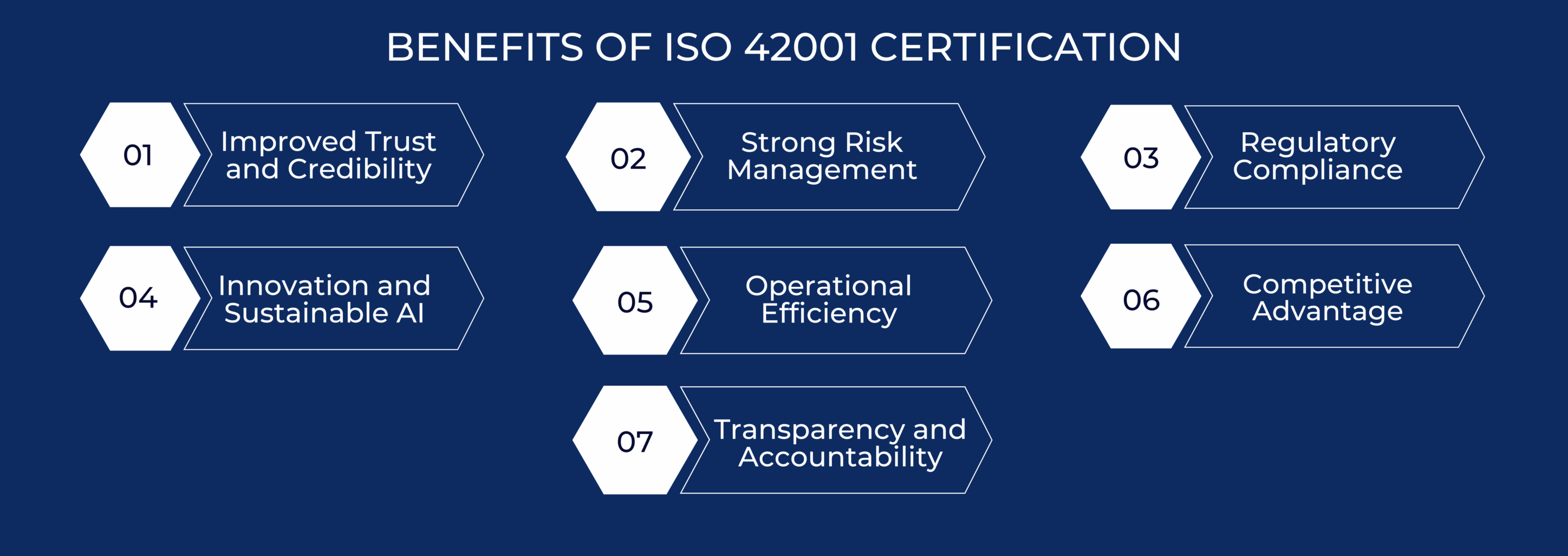
Benefits of ISO 42001 Certification for Raleigh-Based Organizations
ISO 42001 Certification in Raleigh provides organizations with independently verified evidence of AIMS conformity that produces measurable operational, commercial, and governance benefits. The following list identifies the primary benefits associated with ISO 42001 certification for organizations in the Raleigh and Research Triangle technology ecosystem. These benefits reflect the outcomes of the certification process itself — not advisory or implementation activities — and are expressed in objective terms consistent with CertPro’s independent certification body positioning.
- ✓Independent, third-party verification of AIMS conformity against ISO/IEC 42001:2023 requirements by a Licensed CPA Firm, providing objective evidence for enterprise vendor qualification and procurement due diligence processes
- ✓Structured ISO 42001 audit methodology that evaluates AI governance controls, AI risk management processes, AI impact assessments, and Annex A control implementation across the defined AIMS scope
- ✓Recognition in enterprise procurement processes — ISO 42001 certification satisfies vendor security questionnaire requirements that reference independently certified AI governance as a qualification criterion
- ✓Demonstrated accountability for responsible AI use, enabling Raleigh-based AI companies and SaaS providers to differentiate in competitive procurement environments where AI governance maturity is evaluated
- ✓Ongoing surveillance oversight through periodic ISO 42001 surveillance audits that maintain certification validity and confirm continued AIMS conformity throughout the certification cycle
- ✓Support for international market access to jurisdictions including the EU, UK, Canada, and others that reference ISO 42001 standard conformity in AI vendor due diligence and regulatory guidance
- ✓Evidence-based foundation for investor due diligence, institutional partnership requirements, and research funding agreements that reference AI governance accountability as a qualifying condition
- ✓Documented ISO 42001 compliance record that supports U.S. AI governance expectations applicable to federal contractors, healthcare organizations, financial institutions, and regulated-sector technology suppliers operating in Raleigh
For AI startups and high-growth technology companies in the Raleigh-Durham corridor, ISO 42001 Certification in Raleigh provides a credibility signal that distinguishes certified organizations from competitors offering equivalent AI capabilities without independently verified governance frameworks. Institutional investors conducting technology due diligence increasingly evaluate AI governance maturity as a risk factor — a certified AIMS provides documented, audit-based evidence of governance discipline that supports investor confidence.
Enterprise customers conducting security and compliance reviews before awarding contracts to AI startups require evidence of structured AI risk management that self-attested governance claims cannot satisfy. The ISO 42001 certification audit, conducted by CertPro as an independent Licensed CPA Firm, produces an objective conformity determination that carries the credibility of independent professional certification rather than vendor self-assessment. For startups competing for enterprise contracts against larger, more established competitors, ISO 42001 certification provides a governance evidence baseline that levels the competitive playing field in procurement evaluation processes.
- ✓Certification Value for AI Startups and High-Growth Technology Companies
ISO 42001 Certification Scope for Raleigh’s Technology Sectors
The scope of ISO 42001 certification defines the boundaries of the AIMS subject to evaluation during the ISO 42001 certification audit and specified in the issued certificate. Organizations in Raleigh’s diverse technology ecosystem define their certification scope based on the AI systems they develop, deploy, or use, the organizational units responsible for those systems, and the processes and controls within the AIMS boundary.
Scope definition is the organization’s responsibility and is a foundational element of AIMS establishment reviewed during the Stage 1 ISO 42001 audit. The following subsections describe scope considerations relevant to specific technology sectors in Raleigh.
Scope Considerations for AI Software, SaaS, and Cloud Providers
AI software companies, SaaS providers, and cloud service providers in Raleigh typically define their ISO 42001 certification scope to encompass the organizational units responsible for developing, operating, and governing AI systems or AI-enabled features included in their products or platforms. The scope document must clearly identify which AI systems are within the AIMS boundary, the organizational functions responsible for those systems, and the geographic locations — including Raleigh-based development centers and any remote or distributed operations — included in the certification scope.
For multi-product SaaS companies, the scope may cover all AI-enabled products or may be limited to specific products where ISO 42001 compliance is required by enterprise customers. During the ISO 42001 certification audit, CertPro evaluates whether the defined scope accurately reflects the organization’s AI activities and whether AIMS controls operate effectively across all locations and functions within the scope boundary. Scope accuracy is a critical audit evaluation criterion — an overly narrow scope that excludes material AI systems or organizational functions may result in audit findings requiring scope expansion before certification issuance.
Scope Considerations for Healthcare, Biotechnology, and Life Sciences Organizations
Healthcare organizations and biotechnology and life sciences companies in Raleigh using AI systems for clinical decision support, drug discovery, diagnostic imaging analysis, patient monitoring, or clinical trial data analysis face specific scope definition considerations driven by the high-risk nature of their AI applications. The ISO 42001 standard’s AI impact assessment requirements are particularly significant for organizations in these sectors, where AI system outputs may directly affect patient safety, clinical decisions, or regulatory submissions.
The certification scope for a healthcare organization may encompass AI systems used in clinical workflows, the data governance processes governing clinical data used in AI training and inference, and the human oversight mechanisms through which clinical professionals review or override AI-generated recommendations. During the ISO 42001 certification audit, CertPro evaluates whether AI impact assessments for high-risk clinical AI systems are documented, whether oversight mechanisms are implemented and evidence their operation, and whether data governance controls for sensitive clinical data operate as documented in AIMS records. Raleigh’s concentration of biotechnology and life sciences companies in the Research Triangle Park area makes this sector a significant portion of regional ISO 42001 Certification in Raleigh demand.
CertPro — Independent ISO 42001 Certification Body
CertPro is a Licensed CPA Firm that operates exclusively as an independent third-party certification body for ISO 42001 certification audits. CertPro’s role is strictly limited to the evaluation of AIMS conformity against ISO/IEC 42001:2023 requirements — CertPro does not provide implementation services, AI governance consulting, readiness assessment activities, policy development, or any form of advisory service to organizations seeking certification.
This structural independence between certification body and auditee is a fundamental requirement of credible, trustworthy certification and is maintained rigorously across all CertPro certification engagements. Organizations in Raleigh engaging CertPro for ISO 42001 Certification in Raleigh receive an independent evaluation of what their AIMS has achieved — not assistance in building or improving it.
Licensed CPA Firm Positioning and Certification Authority
CertPro’s positioning as a Licensed CPA Firm is material to the institutional credibility of its ISO 42001 certification decisions. CPA firms are subject to professional licensing requirements, ethical standards, and independence obligations that reinforce the objectivity and reliability of certification determinations. The CPA firm structure provides a governance framework for audit independence, professional standards compliance, and accountability that enterprise customers, regulatory bodies, and institutional counterparties recognize as a marker of credible, professional certification practice.
When a Raleigh-based organization presents an ISO 42001 certificate issued by CertPro as a Licensed CPA Firm, the certificate carries the weight of a professionally governed, independently conducted conformity determination — not a self-assessment or a commercially motivated certification from a body with financial interests in the outcome. This positioning is particularly relevant in enterprise vendor security reviews and financial sector procurement processes, where the independence and professional governance of the certification body are evaluated alongside the certification outcome itself.
Certification Decision Independence and Nonconformity Framework
The independence of CertPro’s certification decision from the audit execution function is a structural feature of its certification body governance framework. Nonconformities identified during the ISO 42001 certification audit are documented, communicated to the organization, and must be addressed through documented corrective actions before the certification decision is made.
The certification committee reviews the complete audit record — independent of the auditors who conducted the field evaluation — and makes a conformity determination based on the totality of evidence collected and the adequacy of corrective actions for any identified nonconformities. This separation protects the integrity of the ISO 42001 audit outcome and ensures that the certificate, when issued, reflects a genuine independent conformity determination rather than a commercially influenced result. Certificates issued by CertPro specify the certified organization, the AIMS scope, the applicable standard (ISO/IEC 42001:2023), and the certification validity period — providing a clear, auditable record of the ISO 42001 compliance outcome for organizational, procurement, and regulatory reference purposes.
FAQ
▶
What is ISO 42001 Certification and what does it certify?
▶
Which organizations in Raleigh need ISO 42001 Certification?
▶
How does the ISO 42001 audit process work?
▶
What is the difference between Stage 1 and Stage 2 of the ISO 42001 certification audit?
▶
What documentation is required for ISO 42001 compliance?
▶
How long is an ISO 42001 certificate valid?
▶
Does CertPro provide implementation support or readiness preparation for ISO 42001?
▶
How does ISO 42001 relate to other standards like ISO 27001 or the NIST AI RMF?
ISO 42001 CERTIFIED: WHY AI GOVERNANCE CERTIFICATION IS BECOMING A BOARD-LEVEL REQUIREMENT
ISO 42001 Certified: Board-Level AI Governance Guide | CertPro CPA LLC HERO ══════════════════════════════ –> src=”https://certpro.com/wp-content/uplo…
Get In Touch
have a question? let us get back to you.