
ISO 42001 Certification in Queensland
ISO 42001 Certification in Queensland is conducted by CertPro, a Licensed CPA Firm operating exclusively as an independent third-party certification body. CertPro evaluates organisational conformity with ISO/IEC 42001:2023 — the international standard for Artificial Intelligence Management Systems (AIMS) — through structured ISO 42001 certification audits. Certification decisions are made independently by CertPro’s certification committee, based solely on objective audit evidence, with no advisory or implementation activities involved.
OUR CLIENTS








Independent ISO 42001 Certification by a Licensed CPA Firm in Queensland
ISO 42001 Certification in Queensland is conducted by CertPro, a Licensed CPA Firm operating exclusively as an independent third-party certification body. CertPro evaluates organisational conformity with ISO/IEC 42001:2023 — the international standard for Artificial Intelligence Management Systems (AIMS) — through structured ISO 42001 certification audits. Certification decisions are made independently by CertPro’s certification committee, based solely on objective audit evidence, with no advisory or implementation activities involved.
What ISO/IEC 42001:2023 Establishes
ISO/IEC 42001:2023 is the first internationally recognised management system standard specifically addressing Artificial Intelligence. Published by the International Organization for Standardization in 2023, the ISO 42001 standard establishes requirements for organisations to develop, implement, maintain, and continually improve an Artificial Intelligence Management System. The AIMS framework addresses AI governance, AI risk management, AI impact assessment, human oversight, transparency and explainability, data governance, and the AI system lifecycle from design through deployment and decommissioning.
The standard applies to any organisation — regardless of size, sector, or geography — that develops, deploys, or procures AI systems. ISO 42001 compliance requires organisations to document policies, define roles and responsibilities, assess and treat AI-related risks, evaluate AI impacts, implement Annex A controls proportionate to identified risks, conduct internal audits, and perform regular management reviews. ISO/IEC 42001:2023 follows the High-Level Structure (HLS) common to ISO management system standards, meaning its Clauses 4 through 10 align with ISO 9001, ISO 27001, and other frameworks — enabling integrated implementation where applicable.
Queensland’s AI Ecosystem and Regulatory Context
Queensland operates a diverse and expanding AI ecosystem spanning mining and resources, energy and utilities, healthcare and life sciences, financial services and fintech, technology and software, tourism and hospitality, agriculture and agribusiness, advanced manufacturing, logistics and transportation, maritime operations, telecommunications, cybersecurity, cloud computing, data and analytics, and education and research. Brisbane serves as a major technology, financial services, healthcare, research, and business hub — hosting a growing concentration of SaaS providers, AI companies, cloud providers, and enterprises deploying AI systems at scale.
The Australian regulatory environment reinforces the relevance of ISO 42001 Certification in Queensland. The Australian Privacy Act 1988 governs the handling of personal information — including personal data processed by AI systems — and applies broadly to Queensland organisations in regulated sectors. The Australian AI Ethics Framework articulates principles for responsible AI, including fairness, accountability, transparency, privacy protection, and human-centred values. Emerging procurement requirements across Commonwealth and state agencies increasingly reference responsible AI frameworks as vendor qualification criteria.
Queensland organisations developing or deploying AI systems that process personal information, affect regulated decisions, or serve enterprise and government clients operate within this layered regulatory and procurement environment. This makes ISO 42001 Certification in Queensland a material consideration for any organisation seeking to demonstrate structured AI governance.
Cross-Border Certification Relevance for Queensland Organisations
Queensland-based organisations supplying AI-enabled products or services to international markets face growing third-party AI risk assurance expectations. A Queensland-based SaaS provider supplying AI-enabled platforms to enterprise clients in the United States or the European Union may be required to demonstrate ISO 42001 certification as part of vendor due diligence programmes, international procurement qualification processes, or third-party AI risk management frameworks.
Similarly, Queensland mining technology companies, agricultural technology providers, healthcare AI developers, and financial services technology firms supplying global enterprise customers increasingly encounter ISO 42001 compliance requirements embedded in enterprise risk management and supply chain assurance programmes. Certification by an independent Licensed CPA Firm provides externally verifiable attestation that the organisation’s AIMS conforms to ISO/IEC 42001:2023 requirements — attestation that carries institutional credibility in enterprise procurement, regulatory engagement, and international business development contexts.
ISO 42001 Certification in Queensland, issued following an independent certification audit, satisfies the third-party validation requirements that enterprise customers, government agencies, and international partners seek when evaluating AI system providers.

What Is ISO 42001 Certification?
ISO 42001 certification is an independent, third-party conformity assessment that determines whether an organisation’s Artificial Intelligence Management System satisfies the requirements of ISO/IEC 42001:2023. The certification is not self-declared — it is issued by an accredited or independent certification body following a structured ISO 42001 audit process that evaluates documented evidence, operational practices, and management system effectiveness. ISO 42001 certification is distinct from internal assessments, self-attestation, or advisory engagements. It provides an external, objective determination of AIMS conformity that stakeholders and procurement teams can rely upon.
The ISO 42001 Standard: Scope and Structure
The ISO 42001 standard is structured around management system Clauses 4 through 10, covering organisational context and stakeholder needs, leadership and AI policy, planning and AI risk management, support and resource allocation, operational controls and AI impact assessment, performance evaluation including internal audit and management review, and continual improvement.
Annex A of ISO/IEC 42001:2023 provides a reference set of AI-specific controls organised into domains covering policies for AI, internal organisation, resources for AI systems, assessing AI impacts, the AI system lifecycle, data for AI systems, information for interested parties, use of AI systems, and human oversight. Organisations select Annex A controls proportionate to identified AI risks and justify any exclusions in a Statement of Applicability. All documented information across these clauses — including the AI policy, risk assessment records, risk treatment plans, AI impact assessments, internal audit reports, and management review outputs — is evaluated during the ISO 42001 certification audit.
Artificial Intelligence Management System: Core Components
An Artificial Intelligence Management System established in conformance with ISO/IEC 42001:2023 comprises interconnected components that govern how an organisation manages AI-related risks, responsibilities, and operational controls throughout the AI system lifecycle. The core components include:
An AI policy committing the organisation to responsible AI practices; AI risk assessment processes that identify, analyse, and evaluate risks from AI system development, deployment, or use; AI risk treatment plans that define controls and actions to address identified risks; AI impact assessments that evaluate potential effects on individuals, groups, and society; Annex A controls implemented in proportion to AI risk; human oversight mechanisms ensuring accountability for AI-driven decisions; data governance practices addressing data quality, provenance, and bias; and internal audit and management review functions that evaluate AIMS performance and drive continual improvement.
During an ISO 42001 certification audit, each of these components is evaluated through document review, personnel interviews, and objective evidence assessment to determine whether the AIMS conforms to the ISO 42001 standard requirements.
ISO 42001 Certification vs. Self-Assessment and Internal Audit
ISO 42001 certification by an independent Licensed CPA Firm is substantively different from an organisation’s internal audit or self-declared conformity. Internal audits — required by the ISO 42001 standard itself — are conducted by or on behalf of the organisation to evaluate internal AIMS performance. Management reviews are conducted by senior leadership to assess AIMS effectiveness and strategic alignment. These internal activities are prerequisites for certification readiness, but they do not constitute third-party certification.
ISO 42001 certification requires an independent certification body to conduct a formal audit programme, evaluate objective evidence against ISO/IEC 42001:2023 requirements, identify nonconformities, and render a certification decision through an independent committee. The resulting certificate provides externally verifiable attestation that cannot be produced through internal assessment alone. For Queensland organisations subject to enterprise procurement requirements, government vendor qualification programmes, or international AI assurance expectations, independent ISO 42001 certification provides the third-party validation that stakeholders require.
ISO 42001 Certification Audit Process in Queensland
The ISO 42001 certification audit process in Queensland follows a structured multi-stage methodology consistent with international conformity assessment practices. CertPro conducts each stage with full independence from the organisation’s AIMS implementation activities, evaluating objective evidence to determine conformity with ISO/IEC 42001:2023. The ISO 42001 audit programme encompasses application review, Stage 1 documentation audit, Stage 2 on-site conformity audit, nonconformity review, certification committee decision, certificate issuance, and ongoing surveillance audits.
| Audit Stage | Key Activities | Output |
|---|---|---|
| Application Review | Scope determination, AIMS boundary confirmation, ISO 42001 audit programme planning | Agreed audit scope and programme |
| Stage 1 Audit | Documentation review: AI policy, risk assessment, risk treatment plan, Statement of Applicability, AI impact assessments, internal audit records | Stage 1 findings report; readiness determination for Stage 2 |
| Stage 2 Audit | Objective evidence evaluation, personnel interviews, operational control assessment, Annex A control evaluation, management system clause conformity assessment | Audit findings report; nonconformity identification |
| Nonconformity Review | Organisation submits corrective action evidence; CertPro evaluates adequacy of responses to identified nonconformities | Nonconformity closure determination |
| Certification Decision | Independent certification committee reviews ISO 42001 audit evidence and findings; renders conformity determination | ISO 42001 certificate issued or withheld |
| Surveillance Audit | Annual surveillance evaluation of AIMS performance, key control areas, and continual improvement activities | Surveillance audit report; certificate maintenance or suspension decision |
The Stage 1 ISO 42001 audit involves a structured review of the organisation’s documented information to assess whether the AIMS framework satisfies the documentation requirements of ISO/IEC 42001:2023. During Stage 1, CertPro auditors review the AI policy, organisational context documentation, stakeholder needs and expectations records, AI risk assessment outputs, risk treatment plans, Statement of Applicability covering Annex A controls, AI impact assessment records, internal audit reports, and management review outputs.
The Stage 1 audit also evaluates whether the AIMS scope is appropriately defined, whether the organisation has identified all AI systems within scope, and whether documented processes address the operational requirements of the ISO 42001 standard. Stage 1 findings identify documentation gaps or conformity concerns that inform the Stage 2 audit programme. For most Queensland organisations, the Stage 1 ISO 42001 audit is conducted remotely — though on-site review may be appropriate depending on AIMS complexity and the nature of AI systems in scope.
The Stage 2 ISO 42001 certification audit is the primary conformity assessment, conducted on-site or through a combination of on-site and remote evaluation depending on the organisation’s operational structure. Stage 2 evaluates whether the AIMS is implemented, operational, and effective in conformance with ISO/IEC 42001:2023.
CertPro auditors collect objective evidence through document examination, personnel interviews, process observation, and records review across all applicable management system clauses and Annex A control domains. Areas evaluated during Stage 2 include the implementation of AI risk management processes, AI impact assessment execution and outcomes, selected Annex A controls, human oversight mechanisms, data governance practices, internal audit programme operation, management review conduct and outputs, and continual improvement activities.
Nonconformities identified during Stage 2 are classified and documented in the audit findings report. The organisation must submit corrective action evidence addressing identified nonconformities before the ISO 42001 certification audit proceeds to the certification committee review.
Following completion of the Stage 2 audit and nonconformity review, CertPro’s independent certification committee reviews the complete audit record — including audit findings, nonconformity responses, and auditor recommendations — and renders a certification decision based exclusively on objective audit evidence. The certification committee operates independently of the audit team to maintain the integrity of the ISO 42001 certification decision.
Where conformity with ISO/IEC 42001:2023 is confirmed, an ISO 42001 certificate is issued specifying the organisation’s name, AIMS scope, certification standard, issue date, and validity period. ISO 42001 certificates are valid for three years, subject to satisfactory annual surveillance audits. Surveillance audits verify that the AIMS continues to conform to the ISO 42001 standard, that identified nonconformities have been addressed, and that the organisation maintains continual improvement activities. Recertification audits are conducted prior to certificate expiry to renew the certification for a further three-year period.
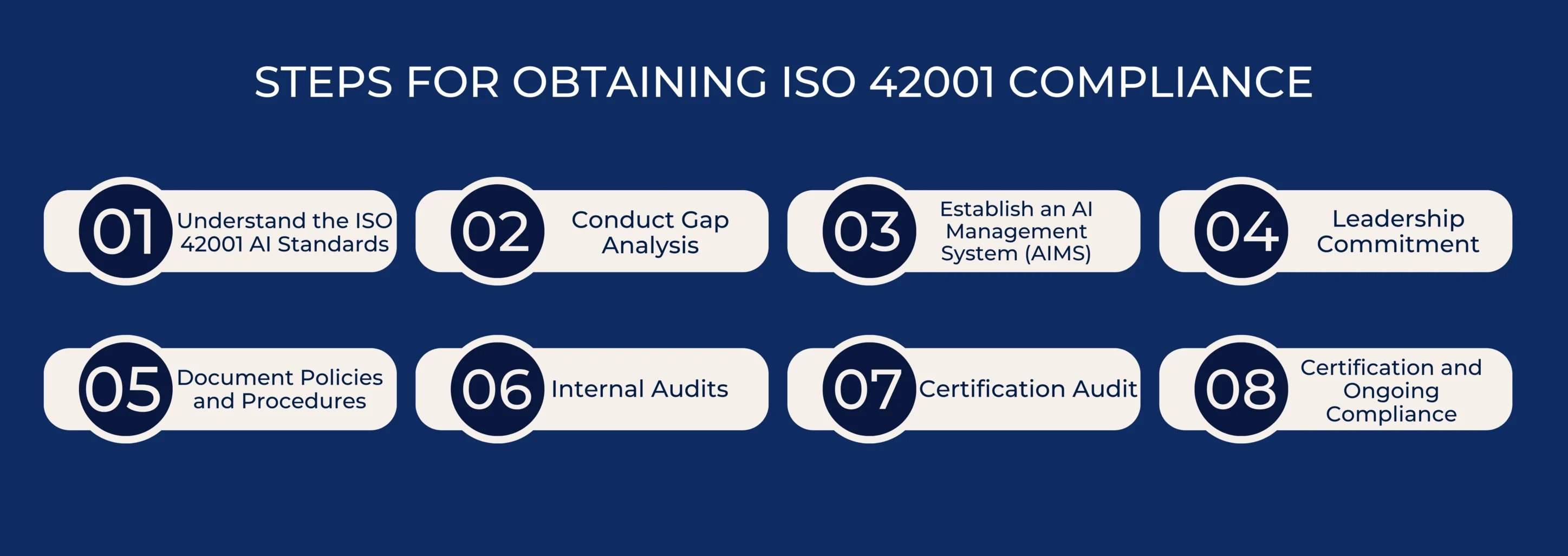
- ✓Stage 1 Audit: Documentation and Readiness Review
- ✓Stage 2 Audit: Conformity Assessment and Evidence Evaluation
- ✓Certification Decision, Certificate Issuance, and Surveillance
ISO 42001 Requirements and Evaluation Criteria
ISO 42001 compliance requires organisations to satisfy requirements across the management system clauses of ISO/IEC 42001:2023 and to implement Annex A controls proportionate to identified AI risks. During the ISO 42001 certification audit, CertPro evaluates conformity against each applicable clause and control through objective evidence assessment. The sections below outline the primary evaluation criteria applied throughout the ISO 42001 certification audit process.
ISO/IEC 42001:2023 Clauses 4 through 10 establish the management system requirements that form the backbone of ISO 42001 compliance. Clause 4 requires organisations to determine internal and external issues relevant to their AI activities, identify interested parties and their expectations, and define the AIMS scope and boundaries. Clause 5 requires demonstrated leadership commitment to the AIMS, including a documented AI policy that is communicated and available to relevant parties.
Clause 6 requires AI risk assessment processes that systematically identify and evaluate risks from AI system development, deployment, and use, along with risk treatment plans and AI objectives aligned with the organisation’s AI policy. Clause 7 addresses support requirements including personnel competence, awareness, communication, and documented information management. Clause 8 covers operational planning, AI impact assessment requirements, and requirements relating to AI system suppliers and customers. Clause 9 requires performance evaluation through monitoring and measurement, internal audit, and management review. Clause 10 requires documented nonconformity and corrective action processes, along with evidence of continual improvement activities.
Annex A of ISO/IEC 42001:2023 provides a structured reference set of AI-specific controls that organisations select based on AI risk assessment outcomes. The Annex A control domains evaluated during the ISO 42001 certification audit cover policies for AI, internal organisation and roles related to AI, resources for AI systems, assessing the impacts of AI systems on individuals and society, AI system lifecycle controls from design through monitoring, data governance for AI including data quality and bias management, transparency and explainability information for interested parties, controls governing the use of AI systems, and human oversight mechanisms to ensure human review of AI-generated outcomes.
Organisations document their control selection and justification in a Statement of Applicability, which is reviewed during the Stage 1 ISO 42001 audit and assessed for implementation during Stage 2. Controls excluded from scope must be justified based on the organisation’s risk profile and the absence of applicable AI activities.
AI impact assessment is a distinctive requirement of ISO/IEC 42001:2023. It evaluates the potential effects of AI systems on individuals, groups, and society across dimensions including fundamental rights, fairness, privacy, safety, and societal wellbeing. The ISO 42001 standard requires organisations to conduct AI impact assessments for AI systems within scope, document assessment outcomes, and use findings to inform risk treatment and control selection decisions.
During the ISO 42001 certification audit, CertPro evaluates whether AI impact assessments have been conducted for applicable systems, whether the assessment methodology addresses relevant impact dimensions, whether outputs are documented and retained, and whether findings have been integrated into risk treatment and Annex A control selection. For Queensland organisations in healthcare, financial services, and government-facing sectors — where AI systems may affect regulated decisions, personal information, or vulnerable populations — AI impact assessment is a particularly significant ISO 42001 compliance area. The Australian Privacy Act 1988’s requirements for personal information handling provide relevant context for AI impact assessments involving personal data.
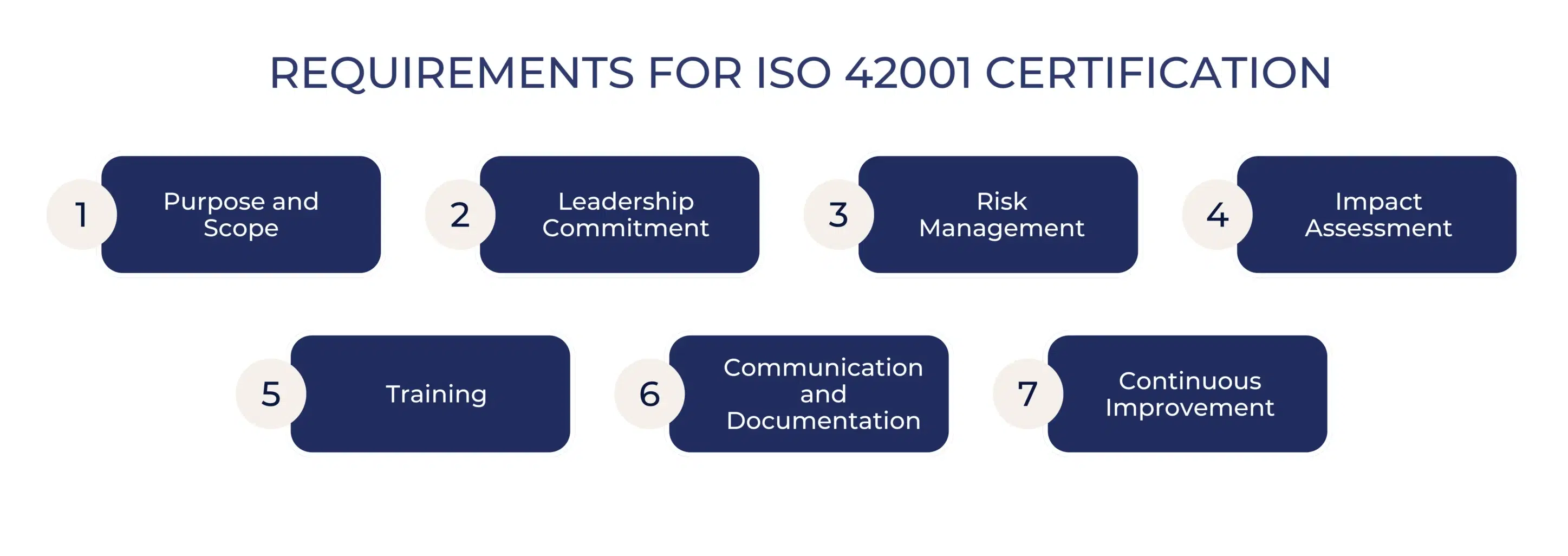
- ✓Management System Clause Requirements (Clauses 4–10)
- ✓Annex A Controls: AI-Specific Control Domains
- ✓AI Impact Assessment Requirements
Queensland Industries Seeking ISO 42001 Certification
ISO 42001 Certification in Queensland is relevant across the full breadth of Queensland’s industrial and commercial economy. Organisations developing, deploying, or procuring AI systems in the following sectors pursue ISO 42001 certification to demonstrate structured AI governance, satisfy enterprise procurement requirements, and provide independent third-party validation of AIMS conformity to stakeholders.
Mining, Resources, Energy, and Agriculture
Queensland’s mining and resources sector — encompassing coal, metallurgical minerals, base metals, and critical minerals — is a significant and growing adopter of AI systems for predictive maintenance, autonomous equipment operation, ore grade estimation, safety monitoring, and production optimisation. Energy and utilities organisations, including Queensland’s electricity generation, transmission, distribution, and renewable energy operators, deploy AI systems for grid management, demand forecasting, and infrastructure maintenance. These AI deployments carry material safety, operational, and environmental implications, making structured AI governance under an AIMS a significant operational priority.
Agriculture and agribusiness organisations across Queensland deploy AI systems for precision agriculture, crop monitoring, yield prediction, and supply chain optimisation. ISO 42001 Certification in Queensland provides mining, energy, and agriculture organisations with independently verified evidence that AI systems within their operations are governed by documented risk management processes, impact assessments, and operational controls consistent with the ISO 42001 standard.
Healthcare, Financial Services, Technology, and SaaS
Healthcare and life sciences organisations in Queensland — including hospitals, pathology providers, medical imaging organisations, pharmaceutical companies, and health technology developers — deploy AI systems for clinical decision support, diagnostic imaging analysis, patient risk stratification, and research data analysis. These AI applications affect clinical outcomes and patient safety, requiring rigorous AI governance aligned with both ISO/IEC 42001:2023 and the Australian Privacy Act 1988’s requirements for sensitive health information.
Financial services and fintech organisations in Brisbane and across Queensland deploy AI systems for credit assessment, fraud detection, anti-money laundering monitoring, customer analytics, and investment decision support — areas where AI governance, transparency, and human oversight are material regulatory and risk management considerations.
Technology companies, SaaS providers, AI development firms, cloud service providers, and cybersecurity organisations operating from Queensland’s technology ecosystem pursue ISO 42001 Certification in Queensland to satisfy the AI governance requirements embedded in enterprise customer due diligence programmes, government procurement frameworks, and international expansion strategies. Tourism and hospitality, advanced manufacturing, logistics, maritime operations, telecommunications, and education and research organisations across Queensland also develop and deploy AI systems that benefit from structured AIMS conformity demonstrated through independent ISO 42001 certification.
Benefits of ISO 42001 Certification for Queensland-Based Organisations
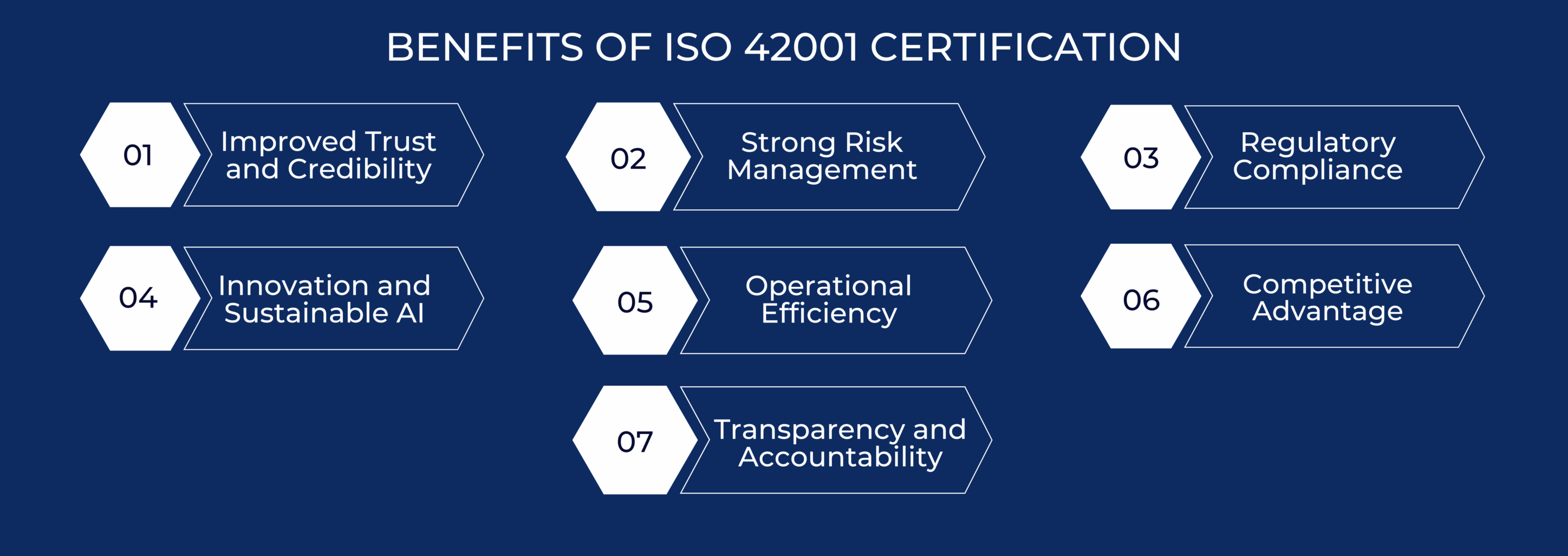
ISO 42001 Certification in Queensland produces measurable operational, commercial, and governance outcomes for organisations that develop, deploy, or procure AI systems. The benefits below reflect the independently verified conformity assessment that ISO 42001 certification provides — not advisory or implementation outcomes.
- ✓Independent third-party verification that the organisation’s AIMS conforms to ISO/IEC 42001:2023 requirements, providing externally credible attestation for stakeholder and regulatory engagement
- ✓Structured documentation of AI governance policies, risk management processes, AI impact assessments, and Annex A controls that satisfies enterprise procurement due diligence requirements
- ✓Recognition in government and enterprise vendor qualification programmes that require or favour ISO 42001 compliance as a condition of AI system procurement
- ✓Demonstrated alignment with the Australian AI Ethics Framework principles — including accountability, transparency, fairness, and human oversight — through independently audited management system conformity
- ✓Strengthened AI risk management discipline through the systematic identification, assessment, and treatment of AI-related risks required by the ISO 42001 standard
- ✓Facilitated cross-border market access to clients in the United States, European Union, and other jurisdictions where ISO 42001 certification is recognised in AI vendor assurance programmes
- ✓Ongoing AIMS performance oversight through annual surveillance audits that verify continued conformity and drive documented continual improvement
- ✓Competitive differentiation in Queensland’s technology, SaaS, and AI company market through independently certified AI governance that peers without certification cannot self-attest
Enterprise procurement programmes and government vendor qualification frameworks increasingly embed AI governance requirements as conditions for AI system supplier approval. A Queensland-based AI technology provider tendering for a contract with a major resources company, a Queensland Health-affiliated organisation, a financial institution, or a Commonwealth government agency may encounter requirements for demonstrated ISO 42001 compliance or independently certified AI governance practices.
ISO 42001 certification issued by an independent Licensed CPA Firm following a structured ISO 42001 certification audit provides the objective, third-party validated evidence that procurement teams and vendor risk management functions require. Certification eliminates the need to respond to individual AI governance questionnaires with self-attested information — the certificate itself constitutes independently verified conformity evidence.
For Queensland SaaS providers and AI companies expanding into international markets, ISO 42001 certification satisfies AI vendor due diligence requirements from enterprise clients operating AI risk assurance programmes aligned with frameworks such as the US NIST AI Risk Management Framework or the EU AI Act’s supplier conformity expectations.
Organisations operating AI systems that affect individuals, communities, or regulated decisions face increasing stakeholder expectations around AI governance transparency and accountability. ISO 42001 certification provides a credible, independently verified basis for communicating AI governance maturity to boards of directors, investors, regulators, customers, and the public. The certification demonstrates that the organisation’s AIMS has been evaluated against an internationally recognised standard by an independent certification body — a materially stronger foundation for stakeholder communication than self-declared AI ethics policies or internal assessments.
For Queensland organisations in healthcare, financial services, and government-facing sectors — where AI system decisions may affect individual rights, financial outcomes, or public services — the accountability and transparency dimensions of ISO 42001 compliance are particularly significant. Organisations holding ISO 42001 Certification in Queensland also demonstrate alignment with the accountability and transparency principles embedded in the Australian AI Ethics Framework and the responsible information handling requirements of the Australian Privacy Act 1988.
- ✓Procurement and Vendor Assurance Recognition
- ✓AI Governance Credibility and Stakeholder Confidence
ISO 42001 Certification Scope and Independent Decision Framework
The scope of ISO 42001 Certification in Queensland is defined by the organisation’s AIMS boundary — specifically, the AI systems, organisational units, processes, and locations covered by the Artificial Intelligence Management System subject to certification. Scope definition is a critical determinant of what the ISO 42001 certificate attests and what is evaluated during the ISO 42001 certification audit.
Defining the AIMS Scope for Certification
The AIMS scope defines the AI systems, organisational functions, and operational boundaries subject to certification under ISO/IEC 42001:2023. Organisations must document the AIMS scope, identify the AI systems within scope, and define the organisational units and processes covered. The scope must be sufficient to capture the organisation’s material AI activities and must not exclude AI systems or functions in a manner that misrepresents AI governance coverage.
During the application review phase of the ISO 42001 certification audit process, CertPro reviews the proposed scope to determine its appropriateness and plan the audit programme accordingly. Where AI systems are provided by or to third parties — including AI suppliers, cloud-based AI platforms, or AI systems deployed by customers — the scope documentation must address how the organisation manages AI-related risks and controls in those third-party relationships. Scope boundaries are documented in the AIMS documentation and stated on the ISO 42001 certificate issued following successful certification.
Independent Certification Committee and Decision Integrity
The certification decision is made by CertPro’s independent certification committee, which operates separately from the audit team to preserve the integrity of the conformity determination. The committee reviews the complete audit record — including Stage 1 and Stage 2 audit findings, nonconformity reports, corrective action evidence, and auditor recommendations — and renders a decision based exclusively on objective audit evidence.
The committee may issue the ISO 42001 certificate, request additional evidence, or decline certification where conformity with the ISO 42001 standard has not been demonstrated. Certificate suspension or withdrawal occurs where an organisation fails to maintain AIMS conformity during the surveillance period, fails to address nonconformities within defined timeframes, or requests suspension. This independent decision structure distinguishes ISO 42001 certification from internal assessments and self-attestation — providing the objective validation that external stakeholders require. The certification committee’s independence is a fundamental characteristic of ISO 42001 Certification in Queensland for companies seeking credible third-party attestation.
Certificate Validity, Surveillance, and Recertification
An ISO 42001 certificate issued following a successful certification audit is valid for three years from the certification decision date. Certificate maintenance requires satisfactory annual surveillance audits conducted by CertPro during the certification period. Surveillance audits evaluate continued conformity with the ISO 42001 standard, verify that nonconformities identified in previous audits have been effectively addressed, and assess whether the AIMS continues to operate effectively and drive continual improvement.
Surveillance audit scope typically focuses on key AIMS performance areas, changes to AI systems or organisational context that may affect AIMS conformity, and internal audit and management review outputs from the preceding period. Prior to certificate expiry, a recertification audit is conducted to renew the ISO 42001 certificate for a further three-year period. The recertification ISO 42001 audit Queensland process evaluates AIMS conformity comprehensively, similar to the initial certification audit programme. Organisations that maintain continuous certification through surveillance and recertification demonstrate sustained AI governance maturity over time.
Why Queensland Organisations Pursue ISO 42001 Certification
ISO 42001 certification Queensland demand is driven by a convergence of regulatory, commercial, and governance factors specific to Queensland’s industrial and technology ecosystem. Organisations across mining, energy, healthcare, financial services, technology, agriculture, and advanced manufacturing sectors pursue ISO 42001 certification for distinct but complementary reasons — each reflecting the growing importance of independently verified AI governance in their markets.
Australian Regulatory and Governance Drivers
The Australian regulatory environment creates material drivers for ISO 42001 certification among Queensland organisations. The Australian Privacy Act 1988 imposes obligations on organisations handling personal information — including personal data processed or used by AI systems for profiling, decision-making, or analytics. AI systems used in healthcare diagnosis, financial services credit assessment, or government service delivery may process significant volumes of personal information, making AIMS controls over data governance, transparency, and human oversight directly relevant to Privacy Act compliance.
The Australian Government’s Voluntary AI Safety Standard, released in 2024, provides ten guardrails for responsible AI use — several of which align with ISO/IEC 42001:2023 requirements including AI risk assessment, impact assessment, transparency, human oversight, and accountability. While not a legislative requirement, the Voluntary AI Safety Standard signals the direction of Australian AI governance policy and reinforces the relevance of ISO 42001 compliance for Queensland organisations engaging with government stakeholders. Queensland’s digital transformation initiatives and the broader Digital Economy Strategy further reinforce the governance expectations for AI system operators across the state.
Enterprise Procurement and Vendor Risk Management Demands
Enterprise organisations in Queensland’s financial services, resources, healthcare, and government sectors operate formal vendor risk management programmes that increasingly include AI governance assessments for technology suppliers. A Queensland-based AI software provider whose platform is used by a major bank, a resources company, or a health system for automated decision support or operational analytics may be required to demonstrate ISO 42001 compliance as part of third-party risk assessment, supplier onboarding, or annual vendor review processes.
ISO 42001 audit activities in Queensland produce the independently verified evidence that enterprise risk teams require — evidence that cannot be produced through vendor-completed questionnaires or self-declared AI governance policies. Similarly, Queensland organisations participating in government procurement programmes face increasing AI governance expectations as Commonwealth and state agencies develop procurement frameworks aligned with responsible AI principles. ISO 42001 certification provides the objective third-party validation that satisfies these procurement and vendor risk requirements without requiring the organisation to respond to multiple individual assessments.
International Expansion and Global AI Assurance Requirements
Queensland technology companies, SaaS providers, and AI developers seeking to expand into international markets face AI governance requirements embedded in enterprise procurement, regulatory frameworks, and market access conditions. The European Union’s AI Act — which entered into force in 2024 and applies tiered requirements based on AI system risk classification — references ISO standards, including ISO/IEC 42001:2023, as a basis for demonstrating conformity with high-risk AI system requirements. US enterprise procurement programmes and financial services vendor management frameworks increasingly reference ISO 42001 certification as evidence of AI governance maturity in supplier qualification processes.
A Queensland-based agritech company deploying AI-enabled precision agriculture platforms to clients in North America, a Queensland cybersecurity firm providing AI-powered threat detection to European enterprises, or a Queensland SaaS provider supplying AI-enabled financial analytics to global institutions may all encounter ISO 42001 certification requirements in international expansion contexts. The ISO 42001 standard provides a single internationally recognised framework against which Queensland organisations can demonstrate AI governance conformity to diverse global stakeholders.
ISO 42001 Certification Audit Queensland: Evidence Evaluation Methodology
The ISO 42001 certification audit evaluates conformity through systematic collection and assessment of objective evidence across the AIMS. CertPro’s ISO 42001 audit methodology applies structured evidence evaluation techniques consistent with international conformity assessment practices — focusing on documented information review, personnel interviews, process observation, and records examination.
Documented Information and Records Review
ISO/IEC 42001:2023 requires organisations to maintain and retain documented information across all management system clauses and Annex A control domains. During the ISO 42001 certification audit, CertPro auditors review documented information to assess whether required documents exist, are appropriately controlled, and accurately reflect the organisation’s actual AIMS practices.
Key documented information evaluated includes the AI policy, AIMS scope documentation, AI risk assessment records, risk treatment plans and evidence of treatment implementation, AI impact assessment records, the Statement of Applicability covering Annex A control selection and justification, training and competence records for personnel involved in AI activities, internal audit programme documentation and audit reports, management review records and outputs, and nonconformity and corrective action records.
The quality, completeness, and currency of documented information are significant factors in the ISO 42001 certification audit evaluation. Documented information that accurately reflects operational practice provides strong objective evidence of AIMS conformity. Gaps or discrepancies between documented processes and observed practice constitute potential nonconformities.
Personnel Interviews and Process Observation
Personnel interviews conducted during the Stage 2 ISO 42001 certification audit provide objective evidence of AIMS awareness, competence, and operational effectiveness that complements documented information review. CertPro auditors interview personnel across roles with AIMS responsibilities — including AI system owners, data scientists, machine learning engineers, risk management personnel, compliance officers, and senior leadership — to assess their understanding of AI policies, risk management processes, impact assessment procedures, and Annex A control responsibilities.
Process observation involves direct examination of AI system development, deployment, monitoring, or operational processes to assess whether AIMS controls are implemented as documented. For Queensland organisations with complex AI deployments — such as mining technology companies operating autonomous systems, healthcare AI developers running clinical decision support platforms, or financial services firms operating AI-driven credit assessment systems — process observation provides direct evidence of operational control implementation that documentation alone cannot supply. The combination of documented information review, personnel interviews, and process observation enables CertPro to form a comprehensive, evidence-based assessment of AIMS conformity with the ISO 42001 standard.
FAQ
▶
What is ISO 42001 certification and who conducts it in Queensland?
▶
Which Queensland organisations require ISO 42001 certification?
▶
What does the ISO 42001 audit process involve?
▶
How long is an ISO 42001 certificate valid?
▶
What is an AI impact assessment under ISO 42001?
▶
How does ISO 42001 relate to the Australian Privacy Act 1988?
▶
What are Annex A controls in ISO 42001?
▶
Does ISO 42001 certification apply to organisations that use third-party AI systems?
ISO 42001 CERTIFIED: WHY AI GOVERNANCE CERTIFICATION IS BECOMING A BOARD-LEVEL REQUIREMENT
ISO 42001 Certified: Board-Level AI Governance Guide | CertPro CPA LLC HERO ══════════════════════════════ –> src=”https://certpro.com/wp-content/uplo…
Get In Touch
have a question? let us get back to you.