
ISO 42001 Certification in Madrid
Madrid is one of Spain’s principal centers for financial services, fintech, telecommunications, enterprise software, and cloud infrastructure. Organizations across these sectors deploy AI systems that face increasing regulatory scrutiny under the EU AI Act and international procurement requirements. ISO 42001 Certification in Madrid is conducted by CertPro, a Licensed CPA Firm and independent certification body operating exclusively within an audit and certification scope under ISO/IEC 42001:2023.
OUR CLIENTS










ISO 42001 Certification for Madrid-Based Financial and Technology Organizations
Madrid is one of Spain’s principal centers for financial services, fintech, telecommunications, enterprise software, and cloud infrastructure. Organizations across these sectors deploy AI systems that face increasing regulatory scrutiny under the EU AI Act and international procurement requirements. ISO 42001 Certification in Madrid is conducted by CertPro, a Licensed CPA Firm and independent certification body operating exclusively within an audit and certification scope under ISO/IEC 42001:2023.
ISO/IEC 42001:2023 establishes the internationally recognized requirements for an Artificial Intelligence Management System (AIMS). The standard addresses AI governance, risk management, transparency, accountability, and responsible AI use across the full AI system lifecycle. For Madrid-based organizations — including banks, insurance firms, SaaS providers, AI platform developers, and managed service providers — ISO 42001 Certification provides an independently verified, evidence-based attestation that their AI management practices meet the standard’s requirements. CertPro conducts ISO 42001 audits across all industry sectors in Madrid, evaluating documented controls, operational evidence, and management system effectiveness. CertPro does not provide advisory, consulting, implementation, or readiness services.
Madrid’s position as a hub for financial and technology activity creates concentrated demand for ISO 42001 Certification in Madrid. The city hosts the headquarters of major Spanish banks, insurance groups, and securities firms — all of which operate AI-driven risk models, credit scoring systems, fraud detection platforms, and customer-facing decision tools. Fintech companies in Madrid’s growing startup ecosystem deploy AI for payment processing, regulatory technology, lending automation, and customer segmentation. Telecommunications providers and enterprise IT services firms develop and manage AI workloads for clients across Europe and Latin America. Each of these organizational profiles encounters AI governance requirements from regulators, institutional clients, and international procurement processes — requirements that ISO 42001 Certification in Madrid directly addresses through independent third-party audit and certification.
CertPro’s positioning as a Licensed CPA Firm distinguishes its certification activities from consulting or advisory engagements. The certification process is governed by ISO/IEC 42001:2023 and applicable accreditation standards. Audit teams evaluate the design and operating effectiveness of an organization’s AIMS controls, assess evidence against the standard’s requirements, and issue an independent certification decision through a structured certification committee. ISO 42001 attestation issued by CertPro documents the scope, basis, and outcome of the audit for use in vendor due diligence, regulatory submissions, and enterprise procurement processes. Organizations in Madrid seeking ISO 42001 Certification engage CertPro as an independent evaluator — not as an implementation consultant or compliance advisor.
The relevance of ISO 42001 Certification in Madrid has intensified since the publication of ISO/IEC 42001:2023 and the phased enforcement timeline of the EU AI Act. Madrid-based organizations operating high-risk AI applications — including AI systems used in financial decision-making, insurance underwriting, human resources, and critical infrastructure management — face both regulatory obligations and enterprise client expectations that require demonstrable AI governance. ISO 42001 compliance, verified through an independent audit, gives organizations a structured framework aligned with both international standards and EU regulatory requirements. CertPro conducts ISO 42001 audits for Madrid companies across all sectors, evaluating AIMS documentation, risk treatment records, AI system inventories, and governance controls to determine conformance with the standard.

What Is ISO 42001 Certification?
ISO 42001 Certification is the formal, third-party verified confirmation that an organization’s Artificial Intelligence Management System conforms to the requirements of ISO/IEC 42001:2023. The certification is issued following an independent audit conducted by an accredited or licensed certification body. ISO 42001 Certification differs from self-assessment or internal audit activities because the certification decision is made by an independent party — a certification committee — based on objective audit evidence collected and evaluated by qualified auditors. The certification is time-limited, typically valid for three years, and is subject to surveillance audits during the certification cycle and recertification at the end of the cycle.
ISO/IEC 42001:2023 Standard Requirements
ISO/IEC 42001:2023 is structured around the ISO High-Level Structure (HLS), consistent with other management system standards such as ISO 27001 and ISO 9001. The standard is organized into Clauses 4 through 10, covering organizational context, leadership, planning, support, operation, performance evaluation, and continual improvement. Annex A of ISO/IEC 42001:2023 provides a set of controls specifically designed for AI management. These controls address AI policy, AI risk assessment, data management, AI system transparency, human oversight, and supplier responsibilities. Organizations pursuing ISO 42001 Certification in Madrid must document an AIMS that addresses each applicable clause and implement controls proportionate to their AI risk profile.
The standard requires organizations to establish, implement, maintain, and continually improve an AIMS. Key documentation requirements include an AI policy, an AI risk assessment methodology, a risk treatment plan, a Statement of Applicability (SoA) referencing Annex A controls, and records demonstrating operational control over AI systems throughout their lifecycle. The ISO 42001 audit conducted by CertPro evaluates whether this documentation exists, whether implemented controls reflect the documented design, and whether the organization demonstrates ongoing management review and improvement activity. The ISO 42001 examination encompasses both document review and evidence-based testing of control effectiveness.
Relationship to AI Governance Frameworks and Regulations
ISO 42001 aligns with the EU AI Act’s requirements for risk-based AI governance, particularly for organizations operating high-risk AI systems as defined under the Act. The standard’s control framework addresses bias mitigation, explainability, human oversight, and AI system documentation — areas directly relevant to EU AI Act compliance obligations. ISO 42001 compliance, established through certification, gives Madrid-based organizations documented evidence of structured AI governance that regulators and enterprise clients can independently verify. The standard also harmonizes with ISO 27001 for information security and ISO 31000 for risk management, allowing organizations to integrate AIMS controls into existing management system structures and reuse established policies, roles, and review processes without duplicating governance infrastructure.
For financial services organizations in Madrid, ISO 42001 Certification supports alignment with guidance from the European Banking Authority (EBA) and the Bank of Spain on AI governance in financial institutions. For technology companies exporting AI services to international markets, the certification provides documented conformance with an internationally recognized management system standard — a requirement increasingly embedded in enterprise vendor assessment processes and cross-border procurement frameworks. The ISO 42001 attestation issued following a successful audit is recognized in procurement processes across the EU, North America, and APAC markets, making it a highly relevant credential for Madrid-based organizations competing for international business.
ISO 42001 Certification Audit Process for Organizations in Madrid
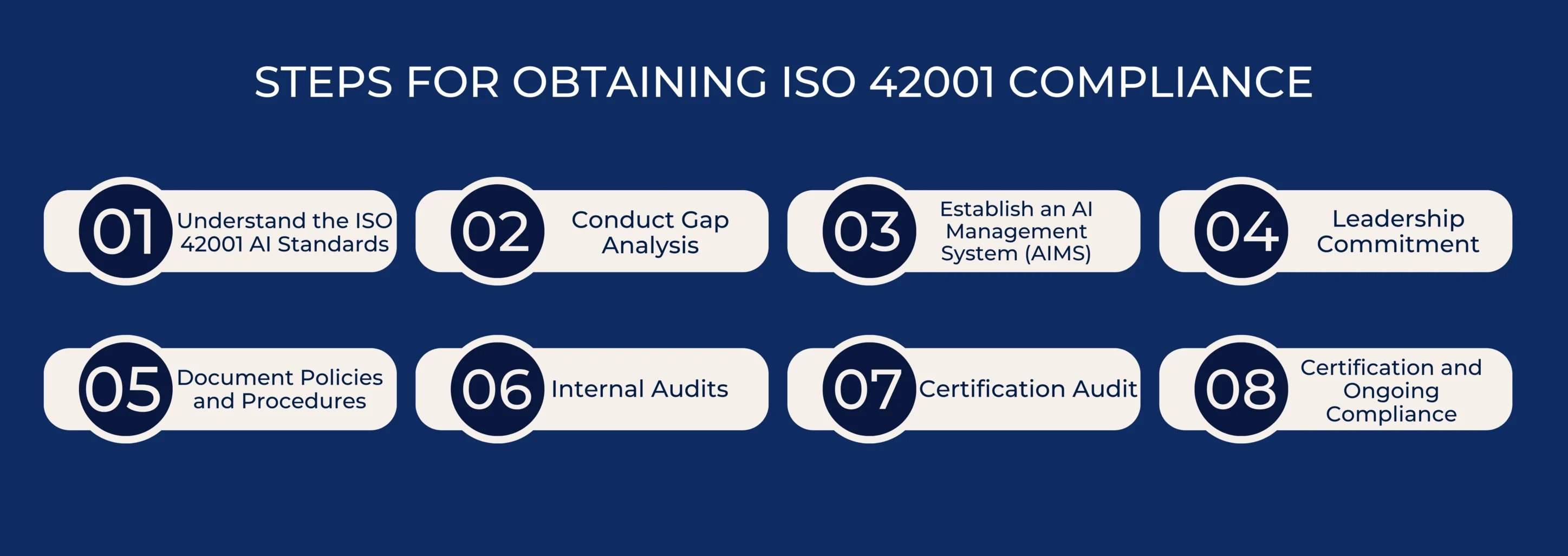
The ISO 42001 audit process conducted by CertPro for Madrid-based organizations follows a structured, stage-based methodology consistent with ISO/IEC 17021 certification body requirements. Each stage of the audit is distinct and produces documented outputs. The process begins with an application review and scope definition and concludes with a certification committee decision and issuance of the ISO 42001 attestation. Surveillance audits are conducted during the three-year certification cycle to verify ongoing conformance.
| Audit Stage | Key Activities | Output |
|---|---|---|
| Application Review & Scope Definition | Review of organization profile, AI system inventory, AIMS scope documentation, and applicable regulatory context | Confirmed audit scope and audit program |
| Stage 1 Audit | Documentation review of AIMS policies, risk assessment methodology, SoA, AI system records, and management review evidence | Stage 1 findings report; readiness determination for Stage 2 |
| Stage 2 Audit | On-site or remote evaluation of control implementation, evidence testing, personnel interviews, and operational records review | Audit findings report with nonconformities identified |
| Nonconformity Review | Assessment of corrective action evidence submitted in response to identified nonconformities | Nonconformity closure determination |
| Certification Committee Decision | Independent review of audit findings and corrective action evidence by certification committee | ISO 42001 attestation issued or withheld |
The Stage 1 audit is a structured review of the organization’s AIMS documentation against the requirements of ISO/IEC 42001:2023. Auditors evaluate the AI policy, AI risk assessment records, risk treatment plan, Statement of Applicability, AI system inventory, and management review documentation. The Stage 1 audit determines whether the organization’s documented AIMS is sufficiently developed to support a Stage 2 audit. Stage 1 findings are documented in a formal report that identifies areas requiring clarification or additional documentation before Stage 2 activities proceed. The Stage 1 audit does not itself produce a certification decision; its output is a documented determination of readiness for Stage 2 evaluation.
For Madrid-based organizations, the Stage 1 audit typically encompasses documentation covering the full AIMS scope — including all AI systems, data sources, governance structures, and stakeholder accountability arrangements within the defined scope boundary. Organizations that operate AI systems across multiple business units or deploy AI in regulated contexts — such as credit decisioning, fraud detection, or automated underwriting — are evaluated on whether their AIMS documentation accurately reflects the operational scope and risk profile of each system. Auditors also assess whether the SoA accurately maps applicable Annex A controls to the organization’s AI context, including justifications for any excluded controls.
The Stage 2 audit evaluates the operational effectiveness of the AIMS controls documented in Stage 1. Auditors conduct structured interviews with personnel responsible for AI governance, review operational records demonstrating control execution, test evidence samples, and assess whether the implemented AIMS reflects the documented design. The ISO 42001 audit at Stage 2 evaluates controls across the full Annex A domain — including AI risk treatment records, data quality management practices, AI system monitoring logs, incident and nonconformity records, supplier AI management arrangements, and human oversight documentation. Stage 2 activities may be conducted on-site at the organization’s Madrid premises or remotely, depending on audit scope and operational context.
Nonconformities identified during the Stage 2 ISO 42001 audit are classified and documented in the audit findings report. The organization is required to submit corrective action evidence within a defined timeframe. Auditors review the submitted evidence to determine whether identified nonconformities have been adequately addressed before the findings are forwarded to the certification committee. The certification committee — which is independent of the audit team — reviews the complete audit record, including Stage 1 findings, Stage 2 findings, and corrective action evidence, before issuing the ISO 42001 attestation. This independence between audit execution and certification decision is a structural requirement of the certification process.
Following initial ISO 42001 Certification, organizations are subject to surveillance audits conducted at defined intervals during the three-year certification cycle — typically annually. Surveillance audits evaluate whether the AIMS continues to conform to ISO/IEC 42001:2023 requirements and whether corrective actions from previous audits have been sustained. These audits cover a defined subset of the full AIMS scope, with focus areas determined by the audit program. Significant changes to AI systems, organizational structure, or operational scope within the certification period may trigger an unscheduled surveillance review. Recertification audits are conducted prior to the expiry of the three-year certificate and evaluate the AIMS in full scope to support renewal of the ISO 42001 attestation.
- ✓Stage 1 Audit — Documentation and Readiness Review
- ✓Stage 2 Audit — Control Implementation and Evidence Testing
- ✓Surveillance Audits and Recertification
Why Organizations in Madrid Pursue ISO 42001 Certification
Madrid-based organizations pursue ISO 42001 Certification in response to a convergence of regulatory, commercial, and institutional demand drivers. The EU AI Act establishes binding obligations for organizations deploying high-risk AI systems, and ISO 42001 compliance — verified through independent audit — provides documented evidence of structured AI governance aligned with the Act’s requirements. Enterprise procurement processes in financial services, telecommunications, and public sector contracting increasingly require AI governance certifications from technology vendors. ISO 42001 Certification in Madrid addresses these requirements with an internationally recognized, independently verified credential.
Financial Services and Banking Sector Demand
Madrid hosts the headquarters of Spain’s largest financial institutions, including major commercial banks, insurance groups, and investment firms. These organizations deploy AI extensively for credit risk modeling, fraud detection, anti-money laundering surveillance, insurance pricing, and customer service automation. The European Banking Authority’s guidelines on internal governance and the Bank of Spain’s supervisory expectations for model risk management create institutional pressure on financial organizations to demonstrate structured AI governance. ISO 42001 Certification for Madrid companies in the financial sector provides a documented, independently audited basis for demonstrating that AI systems are managed within a governance framework addressing risk assessment, accountability, transparency, and continual improvement — consistent with regulatory expectations.
Consider a representative scenario from Madrid’s financial sector: a large Madrid-based bank deploying AI-driven credit scoring across its retail and SME lending portfolio undergoes an enterprise vendor security review from a North American institutional investor conducting third-party risk management due diligence. The investor’s vendor assessment framework requires evidence of structured AI governance from technology and AI system providers. The bank’s ISO 42001 Certification in Madrid — documented through an independent ISO 42001 attestation from CertPro — provides the investor with independently verified evidence of conformance, satisfying the vendor review requirement without additional bespoke assessments. This scenario illustrates the procurement-driven demand for ISO 42001 Certification that Madrid fintech and financial institutions increasingly encounter in cross-border business contexts.
SaaS, Cloud, and AI Platform Providers
Madrid’s technology ecosystem includes a growing number of SaaS companies, cloud service providers, and AI platform developers serving regulated industries across Spain, the EU, and Latin America. These organizations frequently encounter enterprise client requirements for AI governance certifications during contract negotiations and vendor onboarding processes. Clients in financial services, healthcare, telecommunications, and public sector procurement require technology vendors to demonstrate that their AI systems are managed within a structured framework addressing transparency, bias control, data quality, human oversight, and risk management. ISO 42001 Certification in Madrid provides SaaS and cloud organizations with an independently verified credential that satisfies these requirements across multiple client relationships simultaneously — significantly reducing the administrative burden of responding to individual client security questionnaires.
AI platform developers in Madrid — companies that build foundational AI models, machine learning infrastructure, or AI-enabled application platforms — face procurement requirements from enterprise clients that now embed ISO 42001 compliance expectations into supplier contracts. The ISO 42001 examination conducted by CertPro evaluates whether the AI platform developer’s AIMS addresses the full lifecycle of AI system development, including model design, training data governance, testing and validation, deployment controls, monitoring, and incident management. ISO 42001 attestation issued by CertPro following a successful examination provides enterprise clients with documented assurance of the platform developer’s AI governance posture — a credential recognized in international procurement processes across the EU, UK, and North American markets.
Telecommunications and Enterprise IT Services
Madrid-based telecommunications companies and enterprise IT services providers operate AI workloads supporting network management, predictive maintenance, customer churn modeling, and automated service delivery across large client bases. These organizations are subject to AI governance expectations from both regulatory bodies and large enterprise clients, particularly in sectors such as utilities, transportation, and public administration. The ISO 42001 audit conducted by CertPro for Madrid-based telecoms and IT services organizations evaluates AIMS controls across AI service delivery operations — including supplier AI management arrangements, AI system monitoring practices, and documented accountability structures. The resulting ISO 42001 attestation supports vendor qualification processes and regulatory engagement across multiple client jurisdictions.
ISO 42001 Certification Requirements and Evaluation Criteria
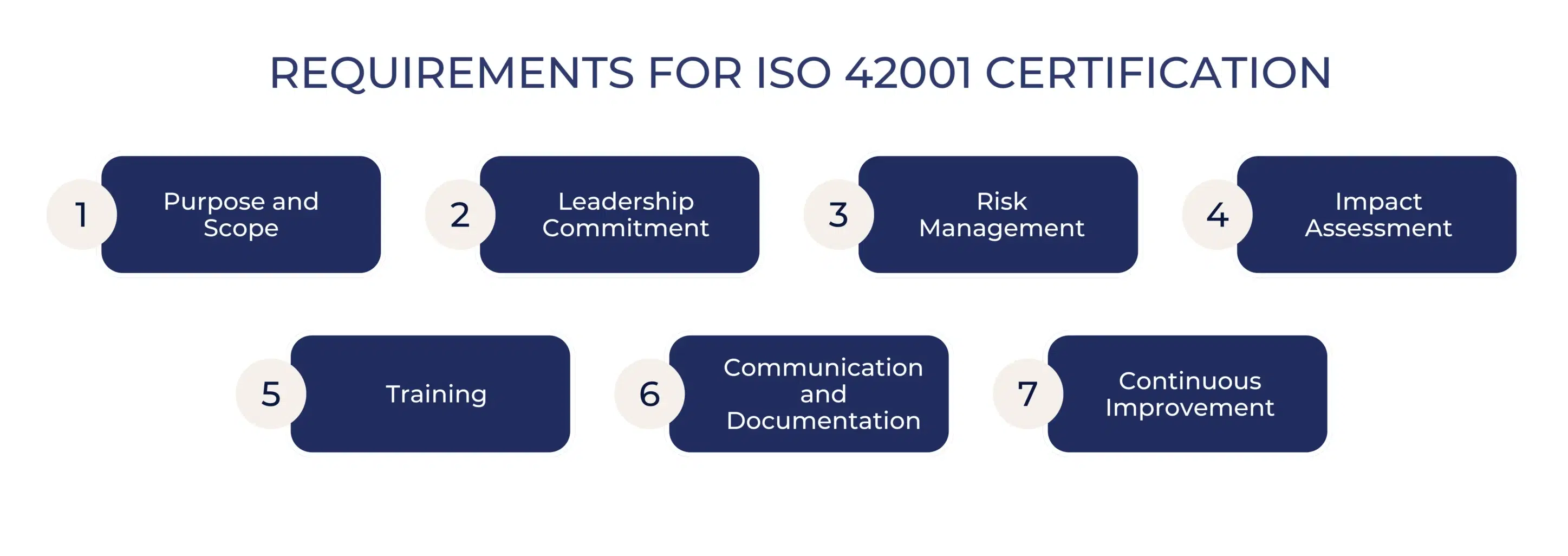
ISO 42001 Certification requires organizations to demonstrate conformance with ISO/IEC 42001:2023 across all applicable clauses and Annex A control domains. The evaluation conducted during the ISO 42001 audit assesses both the design adequacy of documented controls and the operating effectiveness of those controls as demonstrated by objective evidence. Organizations must maintain a documented AIMS that addresses the standard’s requirements for organizational context, leadership commitment, AI risk management, operational AI governance, performance evaluation, and continual improvement.
The ISO 42001 audit evaluates a defined set of mandatory documentation. Organizations must maintain an AI policy that establishes their commitment to responsible AI management and defines the scope of the AIMS. An AI risk assessment methodology must document the criteria and process used to identify, analyze, and evaluate AI risks. A risk treatment plan must document selected controls and the rationale for control selection relative to identified risks. A Statement of Applicability must reference all Annex A controls, indicate which controls are implemented, and provide documented justification for any controls excluded from scope. Management review records, internal audit records, and AI system operational documentation are also subject to review during the ISO 42001 examination.
- ✓AI Policy — documenting organizational commitment to responsible AI management and AIMS scope
- ✓AI Risk Assessment Records — methodology, criteria, and outputs of AI risk identification and evaluation
- ✓Risk Treatment Plan — selected controls, treatment decisions, and residual risk documentation
- ✓Statement of Applicability — Annex A control mapping with justifications for inclusion or exclusion
- ✓AI System Inventory — documented register of AI systems within the certification scope
- ✓Management Review Records — evidence of leadership oversight and continual improvement activity
- ✓Internal Audit Records — evidence of periodic AIMS self-assessment and nonconformity tracking
- ✓Operational Control Records — evidence demonstrating implementation and ongoing operation of AIMS controls
ISO/IEC 42001:2023 Annex A defines controls organized across domains addressing AI policy, internal organization, resources for AI systems, assessing AI system impacts, AI system lifecycle, data management, AI system information for interested parties, AI use, third-party and customer relationships, and monitoring and evaluation. During the ISO 42001 audit, auditors evaluate whether the organization’s implemented controls address each applicable domain. Evidence reviewed includes AI system design records, training data governance documentation, bias assessment records, human oversight procedures, incident logs, AI supplier contracts, and monitoring dashboards. Control coverage must reflect the organization’s actual AI risk profile — not a generic control template.
For Madrid-based organizations operating AI systems in regulated environments, Annex A controls addressing transparency, accountability, and human oversight receive particular auditor attention — with a focus on documented evidence of implementation rather than policy declarations alone. Transparency controls require organizations to maintain records of AI system capabilities, limitations, and intended use cases accessible to relevant stakeholders. Accountability controls require documented assignment of responsibility for AI governance decisions across the organization’s leadership and operational teams. Human oversight controls require documented procedures ensuring that AI system outputs subject to consequential decisions — such as credit determinations, insurance underwriting, or fraud alerts — are subject to defined human review processes. The ISO 42001 examination confirms that these controls exist in implemented form, not merely as written policy.
The certification scope defines the boundary of the AIMS subject to audit and certification. The scope must accurately reflect the AI systems, organizational units, processes, and geographic locations covered by the AIMS. Misrepresentation of scope or failure to maintain AIMS conformance within the certified scope may result in suspension or withdrawal of certification. Suspension occurs when an organization fails to address identified nonconformities within defined correction timelines, or when surveillance audit findings indicate a material breakdown in AIMS conformance. Withdrawal occurs when sustained nonconformance is confirmed or when the organization requests withdrawal. Both suspension and withdrawal are documented decisions by the certification committee and result in removal of the organization’s active ISO 42001 attestation status.
- ✓AIMS Documentation Requirements
- ✓Annex A Control Domains and Technical Requirements
- ✓Certification Scope, Suspension, and Withdrawal
Benefits of ISO 42001 Certification for Madrid-Based Organizations
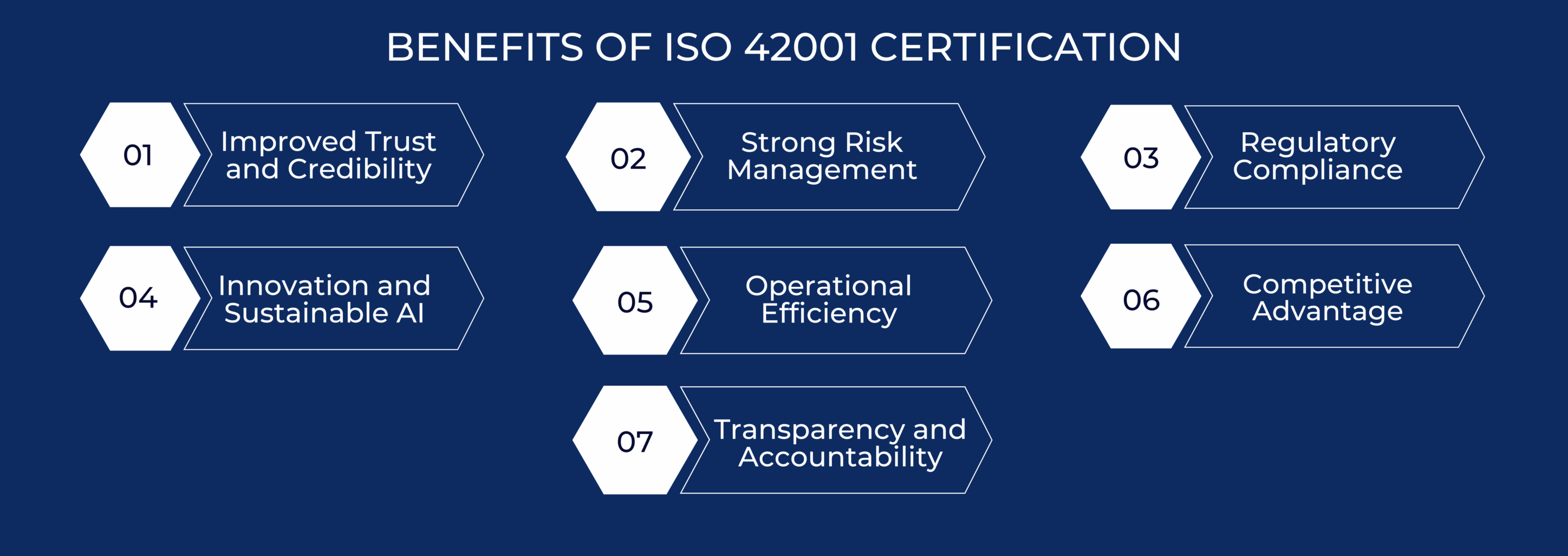
ISO 42001 Certification in Madrid delivers documented, independently verified benefits for organizations managing AI systems across financial services, technology, telecommunications, and enterprise IT sectors. The certification provides a structured basis for demonstrating AI governance maturity to regulators, enterprise clients, institutional investors, and other stakeholders requiring evidence of responsible AI management. The benefits listed below reflect the documented outcomes of ISO 42001 Certification as an independent audit credential — not outcomes of advisory or implementation services.
- ✓Independent verification of AI management system controls by a Licensed CPA Firm and certified body
- ✓ISO 42001 attestation recognized in enterprise vendor due diligence, financial sector procurement, and international contract processes
- ✓Documented conformance with ISO/IEC 42001:2023 supporting EU AI Act compliance positioning
- ✓Structured audit methodology assessing control design and operating effectiveness across the full AIMS scope
- ✓Ongoing surveillance audit oversight verifying sustained conformance throughout the three-year certification cycle
- ✓Alignment with complementary management system standards including ISO 27001 and ISO 31000 for integrated governance
- ✓Internationally recognized credential supporting cross-border business development across EU, UK, and North American markets
- ✓Evidence-based AI governance documentation supporting regulatory engagement with Spanish and EU supervisory authorities
ISO 42001 Certification in Madrid provides organizations with a recognized basis for engagement with regulatory bodies requiring evidence of AI governance frameworks. For financial institutions subject to oversight by the Bank of Spain and the European Central Bank, the certification documents a structured AIMS addressing risk management, accountability, and transparency requirements consistent with supervisory guidance on AI use in financial services. For technology companies subject to EU AI Act obligations, ISO 42001 compliance verified through independent audit provides documented evidence of systematic AI risk management that regulators can reference in supervisory assessments. The ISO 42001 attestation functions as a portable governance credential applicable across multiple regulatory and procurement contexts simultaneously.
Enterprise procurement processes across Madrid’s target markets — including financial services firms in London and New York, technology companies across the EU, and government agencies in Spain — increasingly embed AI governance requirements in vendor qualification frameworks. ISO 42001 Certification for Madrid companies provides a single, independently verified credential that satisfies multiple client due diligence requirements without requiring bespoke assessments for each client relationship. This efficiency benefit is particularly relevant for SaaS companies and AI platform developers serving multiple regulated-sector clients simultaneously. Responding to individual AI governance questionnaires from each client creates significant administrative overhead; ISO 42001 examination results documented in the attestation provide a standardized, auditor-verified response to the most common enterprise AI governance assessment questions.
ISO 42001 shares the ISO High-Level Structure with ISO 27001, enabling Madrid-based organizations that already hold ISO 27001 certification to integrate AIMS controls with existing information security management system structures. Policies, roles, risk assessment processes, management review activities, and internal audit programs established under ISO 27001 can be extended or adapted to address ISO 42001 requirements — reducing duplication of governance infrastructure. Organizations pursuing ISO 42001 Certification in Madrid alongside existing ISO 27001 certification benefit from auditor evaluation of integrated control environments. Auditors examine how AI-specific risks are managed within the broader information security and risk management framework, and assess whether AI-specific controls are appropriately distinct from information security controls.
- ✓Regulatory and Procurement Recognition
- ✓Integration with Information Security and Risk Management Frameworks
AI Management System Controls Evaluated in ISO 42001 Audit Madrid
The ISO 42001 audit in Madrid evaluates a defined set of management system controls addressing the AI lifecycle, organizational governance, data management, transparency, and stakeholder accountability. Control evaluation during the ISO 42001 examination is evidence-based — auditors assess whether controls exist as documented procedures and whether those procedures are consistently executed in operational practice. Control evaluation is not limited to documentation review; auditors test operating effectiveness through records sampling, personnel interviews, and observation of operational processes where applicable.
AI Risk Assessment and Treatment Controls
AI risk assessment controls evaluated during the ISO 42001 audit encompass the organization’s methodology for identifying and evaluating risks associated with AI systems across their operational lifecycle. Auditors review risk assessment records to determine whether the methodology identifies risks related to AI system accuracy, bias, data quality, model drift, adversarial inputs, supply chain dependencies, and unintended social impacts. Risk treatment records must demonstrate that identified risks are addressed through selected Annex A controls, with residual risk documentation confirming that treatment decisions are made at an appropriate level of organizational authority. For Madrid-based organizations operating AI systems in regulated financial or healthcare contexts, risk assessment records must reflect the heightened risk profile associated with consequential AI decision-making.
AI impact assessment controls are also evaluated during the ISO 42001 examination. ISO/IEC 42001:2023 requires organizations to assess the potential impacts of AI systems on individuals, groups, and society — consistent with EU AI Act impact assessment obligations for high-risk AI systems. Impact assessment records reviewed during the audit must document the methodology used, the AI systems assessed, the identified impacts, and the controls implemented to mitigate adverse impacts. For Madrid-based organizations deploying AI in customer-facing financial services, employment-related decisions, or public-service delivery contexts, impact assessment documentation is a critical component of AIMS conformance and receives focused auditor attention during the ISO 42001 audit.
Data Governance and AI Lifecycle Controls
Data governance controls evaluated during the ISO 42001 audit address the quality, integrity, and management of data used to develop, train, validate, and operate AI systems. Auditors review documentation of data sourcing procedures, data quality assessment records, training data governance policies, and data lifecycle management practices. For AI systems operating in Madrid’s financial services sector — where training data may include customer transaction histories, credit records, or behavioral data — data governance controls must also address personal data processing obligations under GDPR. The AIMS data governance framework should be documented with clear integration points to the organization’s privacy management program. Control effectiveness is assessed through records review and personnel interviews with data management and AI development teams.
AI system lifecycle controls encompass the governance structures applied at each stage of AI system development and deployment — from system design and model selection through training, validation, deployment, monitoring, and decommissioning. The ISO 42001 audit evaluates whether lifecycle controls are documented for each AI system within scope, whether accountability for lifecycle decisions is clearly assigned, and whether monitoring procedures generate records demonstrating ongoing system performance within defined parameters. Organizations operating multiple AI systems across different product lines or business units — a common profile among Madrid-based financial services and technology firms — must demonstrate that lifecycle controls are applied consistently across the full AIMS scope, not selectively to individual AI systems.
ISO 42001 Certification for Fintech and AI-Native Companies in Madrid
Madrid’s fintech sector has expanded significantly over the past decade, with a concentration of companies operating in payment technology, digital lending, regulatory technology, insurance technology, and open banking. These organizations are AI-native in the sense that AI systems are core to their product and service delivery — not peripheral applications. ISO 42001 Certification in Madrid that fintech organizations pursue reflects the recognition that AI governance is a foundational operational requirement, not a compliance checkbox. CertPro conducts ISO 42001 audits for fintech organizations operating in Madrid, evaluating AIMS controls across the full AI product lifecycle from model development through production deployment and ongoing monitoring.
Fintech AI Governance Audit Considerations
Fintech organizations in Madrid typically operate AI systems subject to multiple overlapping regulatory frameworks — the EU AI Act for AI system governance, GDPR for personal data processing, PSD2 for payment service operations, and sector-specific supervisory guidance from the CNMV and Bank of Spain. The ISO 42001 audit conducted by CertPro evaluates whether the organization’s AIMS addresses AI risks specific to fintech operations. These include model bias in credit scoring and lending decisions, data quality risks in transaction monitoring systems, explainability requirements for AI-driven customer-facing decisions, and supplier AI management for third-party model providers. ISO 42001 compliance that Madrid fintech organizations demonstrate through certification provides regulators and enterprise clients with independently verified evidence of structured AI governance across these intersecting compliance dimensions.
Fintech companies in Madrid seeking ISO 42001 Certification frequently operate in a vendor-client context where their AI systems are embedded in the products and services delivered to financial institution clients. In this context, ISO 42001 attestation serves a dual function: it documents the fintech company’s own AIMS conformance and provides financial institution clients with independent assurance of the AI governance controls applied to the AI systems they rely on for regulated business processes. Enterprise client procurement teams and third-party risk management functions at Madrid-based banks and insurance firms increasingly request ISO 42001 attestation from fintech vendors as a condition of contract renewal or expansion — a demand driver that positions ISO 42001 Certification in Madrid as a commercial enabler for fintech organizations pursuing institutional client relationships.
AI-Native Platform Developers and Model Providers
Madrid hosts an emerging ecosystem of AI platform developers and foundation model providers serving enterprise clients across Spain and international markets. These organizations face a distinct ISO 42001 audit profile: their AI systems are not only deployed internally but are delivered to downstream organizations that rely on the upstream provider’s AI governance for their own compliance positioning. The ISO 42001 examination for AI platform developers evaluates whether the AIMS addresses supplier responsibilities for downstream AI use. This includes documentation of AI system capabilities and limitations provided to clients, contractual AI governance obligations in client agreements, and monitoring processes for identifying misuse or unintended application of platform AI capabilities. ISO 42001 attestation issued for AI platform developers in Madrid supports downstream clients’ own ISO 42001 compliance positioning by documenting the upstream governance framework.
Independent Certification Body Positioning — CertPro ISO 42001 Audit Madrid
CertPro operates as a Licensed CPA Firm and independent ISO 42001 certified body in Madrid, conducting certification audits exclusively within an audit and certification scope. The ISO 42001 audit process conducted by CertPro is structured to maintain strict independence between audit execution and certification decision-making. Auditors engaged in Stage 1 and Stage 2 activities are separate from the certification committee that issues the ISO 42001 attestation. This structural independence is a fundamental requirement of credible ISO management system certification. It distinguishes CertPro’s certification activities from advisory or consulting engagements that combine implementation support with certification assessment.
Evidence-Based Audit Methodology
CertPro’s ISO 42001 audit methodology is evidence-based. Auditors collect and evaluate objective evidence — documents, records, system outputs, and personnel interview responses — to assess conformance with ISO/IEC 42001:2023 requirements. Audit conclusions are drawn from evaluated evidence, not from the organization’s self-assessment or declared conformance. For Madrid-based organizations, this means the audit scope encompasses the actual operational AI environment — including production AI systems, live data governance practices, and real accountability structures — not a curated presentation prepared for audit purposes. The ISO 42001 examination conducted by CertPro is designed to provide an accurate, independent picture of the organization’s AIMS conformance status at the time of audit, which forms the basis for the ISO 42001 attestation issued to the organization.
The audit program for each Madrid-based organization is determined based on the organization’s profile, AI system inventory, operational context, and risk characteristics. Organizations with large, complex AI deployments across multiple business units and regulated product lines receive more extensive audit programs than organizations with limited, lower-risk AI applications. The audit program determination is documented and communicated to the organization prior to Stage 1 activities. This transparency in audit program design allows organizations to understand the scope of auditor evaluation and prepare operational records and personnel availability accordingly — without requiring advisory engagement to structure the audit response.
Certification Committee and Attestation Issuance
The certification committee review is the final stage of the ISO 42001 Certification process prior to attestation issuance. The committee reviews the complete audit record — including Stage 1 and Stage 2 findings, nonconformity documentation, and corrective action evidence — and makes an independent determination of whether to issue, withhold, suspend, or withdraw ISO 42001 Certification. Committee members are independent of the audit team that conducted the evaluation, ensuring the certification decision reflects objective review of the audit record rather than the judgment of the auditors who collected the evidence. The ISO 42001 attestation issued by CertPro documents the certification scope, the standard against which conformance was evaluated, the audit dates, and the certification validity period — providing organizations with a formal record suitable for submission in regulatory, procurement, and vendor due diligence contexts.
FAQ
▶
What is ISO 42001 Certification and why is it relevant for Madrid-based organizations?
▶
Which types of organizations in Madrid pursue ISO 42001 Certification?
▶
What does the ISO 42001 audit process involve for a Madrid-based organization?
▶
What documentation is required for ISO 42001 Certification in Madrid?
▶
How long is an ISO 42001 certificate valid and what are the ongoing requirements?
▶
How does ISO 42001 compliance relate to EU AI Act requirements for Madrid organizations?
▶
What is the difference between the Stage 1 and Stage 2 ISO 42001 audit?
▶
Does CertPro provide implementation or advisory services alongside ISO 42001 Certification?
ISO 42001 CERTIFIED: WHY AI GOVERNANCE CERTIFICATION IS BECOMING A BOARD-LEVEL REQUIREMENT
ISO 42001 Certified: Board-Level AI Governance Guide | CertPro CPA LLC HERO ══════════════════════════════ –> src=”https://certpro.com/wp-content/uplo…

Get In Touch
have a question? let us get back to you.