
ISO 42001 Certification in Lisbon
ISO 42001 Certification in Lisbon is issued by CertPro, a Licensed CPA Firm operating as an independent certification body. Certification is conducted through a structured, evidence-based audit of an organization’s Artificial Intelligence Management System (AIMS) against the requirements of ISO/IEC 42001:2023. The certification decision is made by an independent certification committee that maintains no advisory, consulting, or implementation relationship with the auditee — ensuring objectivity throughout the process.
OUR CLIENTS





ISO 42001 Certification for Lisbon-Based Technology and AI-Driven Organizations
ISO 42001 Certification in Lisbon is issued by CertPro, a Licensed CPA Firm operating as an independent certification body. Certification is conducted through a structured, evidence-based audit of an organization’s Artificial Intelligence Management System (AIMS) against the requirements of ISO/IEC 42001:2023. The certification decision is made by an independent certification committee that maintains no advisory, consulting, or implementation relationship with the auditee — ensuring objectivity throughout the process.
Lisbon has emerged as one of Southern Europe’s most active technology and AI deployment ecosystems. The city hosts a concentrated base of SaaS providers, fintech firms, telecommunications companies, cloud-native startups, and scale-ups serving international client bases that increasingly require structured AI governance verification. Anchored by Web Summit, a dense cluster of remote-tech talent, and accelerating foreign direct investment in AI infrastructure, Lisbon’s technology sector now operates under procurement conditions where ISO 42001 Certification in Lisbon functions as a baseline vendor qualification criterion. Enterprise buyers across financial services, regulated industries, and public procurement frameworks in the EU and internationally require ISO 42001 compliance documentation as part of their third-party risk management processes.
ISO/IEC 42001:2023 is the first international management system standard specifically designed to govern AI systems. It establishes requirements for organizations to define an AIMS scope, assign accountability for AI-related risks, implement controls for ethical AI deployment, and demonstrate continual improvement through documented review cycles. The standard applies to organizations that develop AI products, integrate AI into service delivery, or procure AI systems for internal operations. ISO 42001 Certification signals to customers, institutional partners, and regulators that an organization’s AI governance framework has been independently audited and confirmed to meet the requirements of an internationally recognized benchmark.
CertPro’s ISO 42001 audit in Lisbon follows a structured, stage-based examination methodology. The process involves documentary review, evidence collection, on-site or remote evaluation of AIMS controls, and a formal nonconformity review prior to the certification committee decision. CertPro’s role is strictly confined to audit and certification activities. The firm does not provide readiness assessments, policy development, control design, implementation services, or any form of management system consulting to organizations it certifies. This independence is foundational to the validity and credibility of the ISO 42001 attestation issued upon successful completion of the audit program.
For Lisbon-based organizations operating across fintech, SaaS, cloud infrastructure, telecommunications, and AI product development, ISO 42001 Certification in Lisbon provides a documented, auditable record of AI governance maturity. As the EU AI Act establishes binding risk-based requirements for AI systems deployed in European markets, ISO 42001 certification positions organizations to demonstrate structural alignment with those regulatory expectations through an independently verified management framework — rather than self-assessment alone. CertPro’s ISO 42001 examination methodology is designed to evaluate this alignment against the standard’s requirements in a rigorous and accreditation-consistent manner.

What Is ISO 42001 Certification?
Definition and Scope of ISO/IEC 42001:2023
ISO/IEC 42001:2023 is an international standard published by the International Organization for Standardization. It specifies requirements for establishing, implementing, maintaining, and continually improving an Artificial Intelligence Management System. The standard applies to any organization — regardless of size, sector, or jurisdiction — that develops, provides, or uses AI-based products or services. It defines structural requirements for governing AI systems across their full lifecycle, from design and training through deployment and decommissioning.
ISO 42001 Certification confirms that an organization’s AIMS satisfies the standard’s documented requirements as assessed by an independent, qualified certification body. The standard is built on the ISO High-Level Structure (HLS), enabling integration with ISO 27001 for information security and ISO 31000 for enterprise risk management. This allows organizations to reuse existing governance frameworks, roles, and review processes where applicable — reducing duplication and improving overall management system efficiency.
Core Requirements of the Standard
ISO 42001 requires organizations to define the scope of their AIMS, identify internal and external stakeholders with interests in AI governance, and establish a formal AI policy authorized at the leadership level. The standard mandates a structured risk assessment process specific to AI systems, covering risks such as biased algorithmic outputs, lack of explainability, data integrity failures, unintended automation consequences, and accountability gaps.
Organizations must produce a risk treatment plan and demonstrate that controls selected to address identified AI risks are implemented, monitored, and periodically reviewed. Annex A of the standard provides a reference set of controls covering AI system impact assessment, data governance, transparency obligations, human oversight mechanisms, and accountability frameworks. An ISO 42001 audit evaluates whether the organization has operationalized these requirements through documented evidence — not through declarations of intent alone.
Who Requires ISO 42001 Certification
ISO 42001 compliance is relevant to any organization that builds AI systems, integrates AI into service delivery pipelines, or procures AI tools that influence consequential decisions. In Lisbon’s technology sector, this includes SaaS platforms using machine learning for predictive analytics, fintech firms employing AI-driven credit scoring or fraud detection, telecommunications operators using AI for network management, and cloud providers hosting AI workloads for regulated clients.
Organizations supplying AI products or services to enterprise buyers in the EU, North America, or regulated international markets face growing vendor qualification requirements that reference ISO 42001 Certification in Lisbon. Independent ISO 42001 attestation issued by a Licensed CPA Firm provides the evidence base that procurement teams, institutional investors, and regulatory reviewers require to assess an organization’s AI governance posture objectively.
ISO 42001 Certification Audit Process in Lisbon
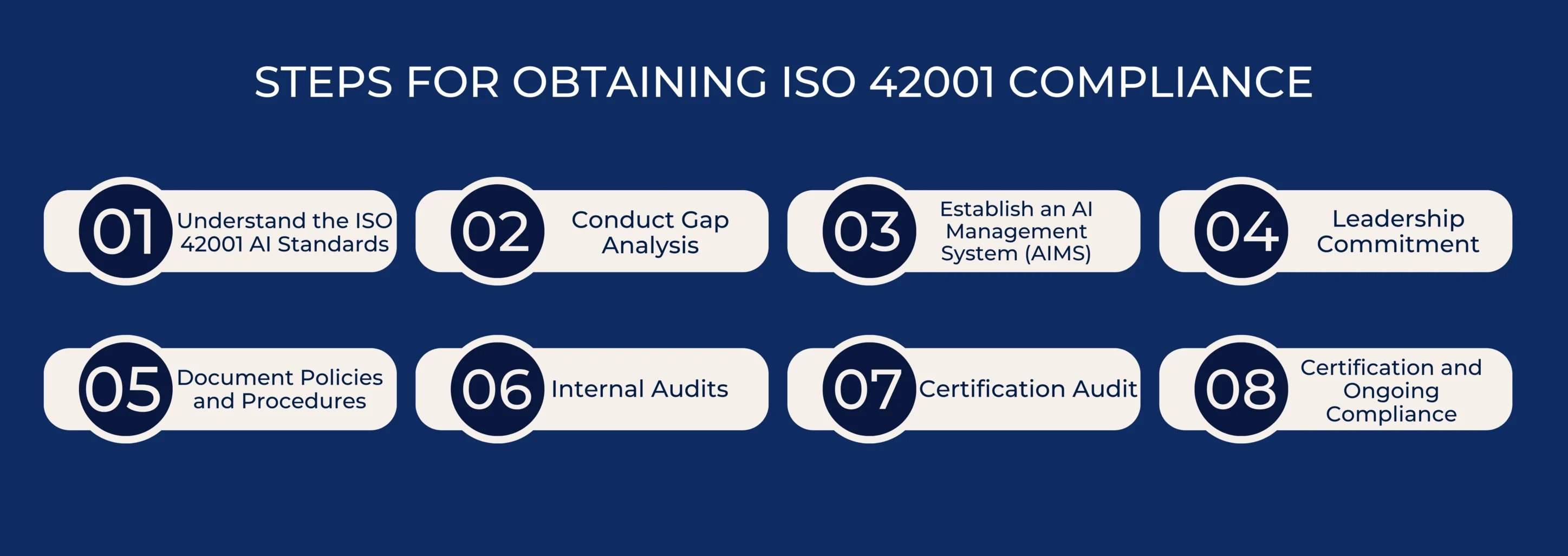
The ISO 42001 audit process in Lisbon begins with a Stage 1 audit — a structured review of the organization’s AIMS documentation against the requirements of ISO/IEC 42001:2023. During Stage 1, the audit team examines the AIMS scope definition, AI policy documentation, risk assessment records, risk treatment plan, control selection rationale, and internal audit and management review records.
The Stage 1 audit identifies whether the documented management system is sufficiently developed to proceed to Stage 2 evidence-based testing. It also confirms the audit scope, evaluates whether the organization understands its obligations under the standard, and highlights any areas requiring clarification before field-level evaluation begins. The Stage 1 output directly informs the audit program for Stage 2 and is documented in a formal audit finding record reviewed by the lead auditor and audit program manager.
The Stage 2 audit constitutes the substantive ISO 42001 examination phase. During Stage 2, auditors evaluate the design and operating effectiveness of AIMS controls through evidence collection, personnel interviews, process walkthroughs, and review of operational records. Control domains evaluated include AI system impact assessment processes, data governance and data quality procedures, transparency and disclosure practices, human oversight mechanisms, incident response protocols for AI-related failures, and accountability assignment across the AI lifecycle.
Auditors assess whether the organization’s documented controls are implemented as described and whether they function consistently over the period under review. Nonconformities identified during Stage 2 are classified and formally documented. The organization must respond with documented corrective action evidence before the certification committee convenes to issue a final certification decision.
| Audit Stage | Key Activities | Output |
|---|---|---|
| Application Review | Scope confirmation, conflict-of-interest check, audit program determination | Audit plan and program document |
| Stage 1 Audit | AIMS documentation review, scope validation, readiness assessment against ISO/IEC 42001:2023 | Stage 1 findings report |
| Stage 2 Audit | Control design and operating effectiveness evaluation, evidence collection, personnel interviews | Nonconformity report and audit findings |
| Nonconformity Review | Corrective action evidence review, closure verification by lead auditor | Verified nonconformity closure records |
| Certification Decision | Independent committee review of full ISO 42001 audit record | ISO 42001 certificate issuance or deferral |
Following the completion of Stage 2 and the resolution of identified nonconformities, the complete audit record is submitted to CertPro’s independent certification committee for review. The committee evaluates the audit findings, corrective action documentation, and the auditor’s recommendation to determine whether the organization’s AIMS satisfies the requirements of ISO/IEC 42001:2023. The certification decision is made independently of the audit team that conducted the examination, preserving the separation between audit evaluation and certification determination.
Where the committee determines that requirements are met, an ISO 42001 certificate is issued specifying the scope of the certified AIMS, the standard version applied, the certification date, and the validity period. The ISO 42001 attestation issued by CertPro as a Licensed CPA Firm constitutes an independent third-party confirmation of conformance — suitable for presentation in vendor qualification processes, regulatory submissions, and enterprise procurement evaluations.
- ✓Stage 1 Audit: Documentation and Readiness Review
- ✓Stage 2 Audit: Evidence-Based Control Evaluation
- ✓Certification Committee Decision and Certificate Issuance
Surveillance Audits and Certificate Maintenance
Annual Surveillance Audit Requirements
ISO 42001 Certification is issued with a defined validity period — typically three years — subject to satisfactory completion of annual surveillance audits. Surveillance audits evaluate whether the certified AIMS continues to conform to the requirements of ISO/IEC 42001:2023 and whether the organization has maintained the controls, processes, and documentation confirmed during the initial certification audit.
Surveillance audits are narrower in scope than initial certification audits but remain evidence-based. They examine areas including internal audit completion, management review records, changes to AI systems within the certified scope, corrective action records, and continual improvement activities. For Lisbon-based organizations deploying AI systems in dynamic technology environments, the surveillance audit cycle ensures the AIMS stays current and responsive to changes in AI system configurations, data pipelines, and risk profiles. Surveillance audit findings are reviewed by the certification committee, which retains authority to suspend or withdraw certification where material nonconformities are identified and not resolved within specified timeframes.
Recertification Audit and Certificate Renewal
Prior to the expiry of the three-year certification cycle, organizations must complete a recertification audit to maintain ISO 42001 Certification in continuous standing. The recertification audit constitutes a full-scope evaluation of the AIMS comparable in depth to the initial certification audit. It reassesses the continued adequacy of the AIMS scope, the effectiveness of controls across all applicable Annex A domains, and the organization’s capacity for continual improvement as required by the standard’s Clause 10 requirements.
Recertification audits also review any significant changes to the organization’s AI systems, operating context, or risk environment that may affect the certified scope. For ISO 42001 Certification in Lisbon holders operating in fast-moving technology sectors, the recertification process confirms that AI governance practices have evolved in line with changes to the AI system landscape, regulatory developments — including EU AI Act implementation milestones — and updated organizational risk assessments.
ISO 42001 Certification Requirements for Lisbon Organizations
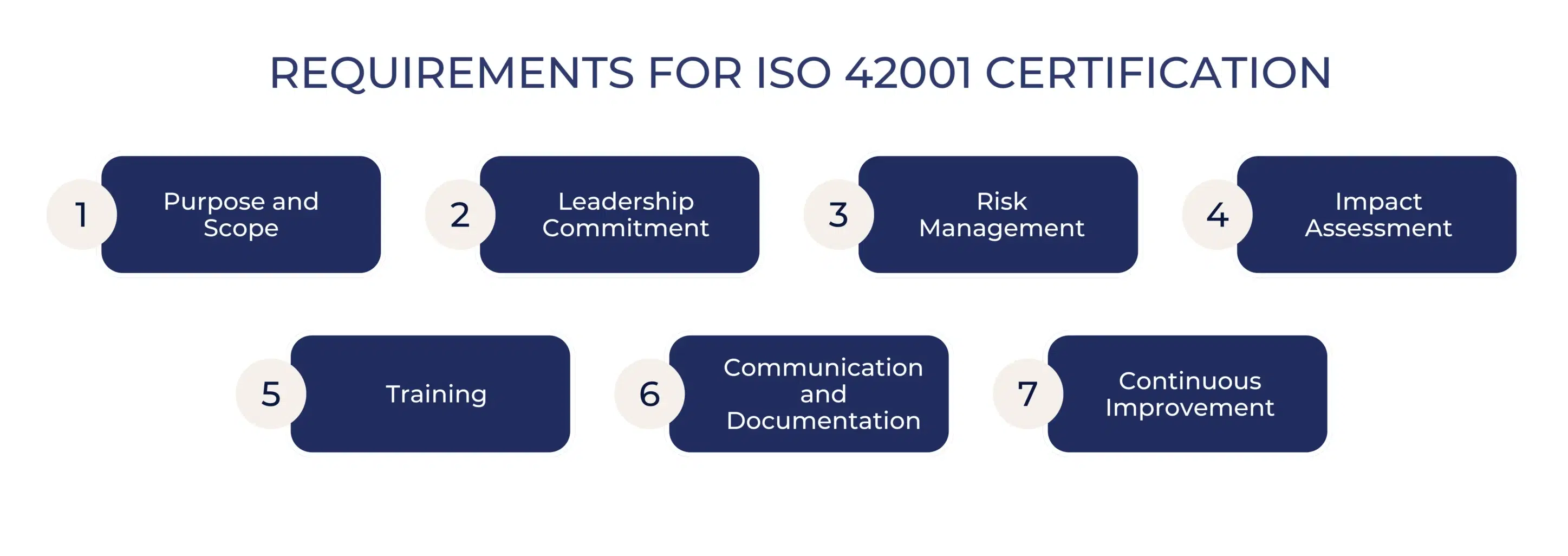
Organizations pursuing ISO 42001 Certification in Lisbon must establish and maintain a defined set of documented artifacts that demonstrate the structure and operation of their AIMS. Required documentation includes the AIMS scope statement, which defines the boundaries of the certified system; an AI policy authorized by top management; a risk assessment record documenting identified AI-related risks and their evaluation; and a risk treatment plan specifying selected controls and their owners.
Organizations must also produce records demonstrating that internal audits and management reviews have been conducted as required by ISO/IEC 42001:2023 Clauses 9.2 and 9.3. Additional documented information is required for each Annex A control selected in the Statement of Applicability, demonstrating how each control is implemented and maintained. The completeness and quality of this documentation is evaluated during the Stage 1 ISO 42001 audit and forms the evidentiary foundation for Stage 2 control testing.
The AI risk assessment required under ISO 42001 must address risks specific to the organization’s AI systems and their deployment context. For Lisbon-based fintech organizations using AI in credit decisioning, this includes risks of biased model outputs, regulatory non-compliance with EU financial services directives, and accountability failures in automated decision-making. For SaaS providers and cloud companies, risks may include data quality failures affecting model training, lack of transparency in AI output generation, and inadequate human oversight of automated processes.
The control environment must be tailored to address identified risks through documented, operating controls — not generic policy statements. Auditors evaluate whether controls selected in the Statement of Applicability are proportionate to the risk profile of the organization’s AI systems and whether operating evidence demonstrates consistent application. ISO 42001 compliance requires that this risk-control linkage is actively maintained and reviewed on a documented schedule.
ISO/IEC 42001:2023 Annex A establishes specific control requirements for human oversight of AI systems, transparency in AI decision-making, and clear accountability assignment across the AI lifecycle. Organizations must demonstrate that AI systems operating within the certified scope are subject to defined oversight mechanisms — including thresholds for human review of AI-generated outputs, escalation procedures for anomalous AI behavior, and documented roles responsible for AI system monitoring.
Transparency controls require that the organization can articulate how AI systems reach conclusions to relevant stakeholders, including customers and regulators where applicable. Accountability controls require documented assignment of responsibility for AI system outcomes to named roles or functions within the organization. These requirements are evaluated during the ISO 42001 examination through review of role descriptions, process documentation, training records, and system configuration evidence. Organizations in Lisbon’s technology sector operating AI systems that influence consequential decisions must evidence these controls as a precondition to certification.
- ✓AIMS Documentation and Governance Requirements
- ✓AI Risk Assessment and Control Environment
- ✓Human Oversight, Transparency, and Accountability Controls
Why Lisbon Organizations Pursue ISO 42001 Certification
Enterprise Procurement and Vendor Qualification Requirements
Lisbon-based technology organizations supplying AI-enabled products and services to enterprise buyers face structured vendor qualification processes that increasingly include AI governance verification as a mandatory criterion. Procurement teams at financial institutions, insurance groups, regulated utilities, and multinational corporations assess AI vendors against documented governance frameworks as part of third-party risk management programs.
ISO 42001 Certification in Lisbon provides the independently verified evidence that these procurement processes require — a certificate issued by a Licensed CPA Firm confirming that the organization’s AIMS has been audited against ISO/IEC 42001:2023. Unlike self-assessment questionnaires or policy documentation alone, an ISO 42001 attestation reflects external examination of control design and operating effectiveness. In vendor review scenarios where multiple competing AI suppliers are evaluated, ISO 42001 certification provides a documented differentiation factor that self-reported compliance cannot replicate.
EU AI Act Alignment and Regulatory Positioning
The EU AI Act, which entered into force in August 2024 and is being phased into application through 2026 and 2027, establishes binding risk-based requirements for AI systems deployed in European markets. Organizations in Lisbon operating AI systems classified as high-risk under the EU AI Act are subject to mandatory conformity assessment requirements, technical documentation obligations, and requirements for human oversight and transparency that closely map to the control domains of ISO/IEC 42001:2023.
While ISO 42001 certification does not constitute EU AI Act conformity assessment certification in itself, an independently audited AIMS aligned to the standard provides a structured foundation for demonstrating operationalized governance. For Lisbon technology companies subject to both the EU AI Act and sector-specific regulations — including PSD2 and EBA guidelines in fintech — ISO 42001 compliance in Lisbon provides a consolidated AI governance framework that addresses multiple regulatory expectations through a single management system structure.
International Market Access and Cross-Border AI Governance
Lisbon’s technology sector is significantly export-oriented, with SaaS providers, cloud platforms, and AI product companies serving clients across North America, the UK, continental Europe, and emerging markets. International buyers — particularly in regulated industries such as financial services, healthcare, and the public sector — require AI vendors to demonstrate governance maturity that goes beyond jurisdiction-specific compliance.
ISO 42001 Certification in Lisbon is recognized as an internationally valid benchmark, enabling organizations to present a single, audited governance credential to buyers across multiple markets. For companies targeting institutional clients in the United States — where vendor risk management frameworks increasingly reference AI governance controls — ISO 42001 attestation provides the independently verified documentation that U.S.-based procurement teams and third-party risk management functions require. The international recognizability of ISO/IEC 42001:2023 as a published international standard supports this cross-border use case in a way that local or self-developed governance frameworks simply cannot.
Benefits of ISO 42001 Certification for Lisbon-Based Organizations
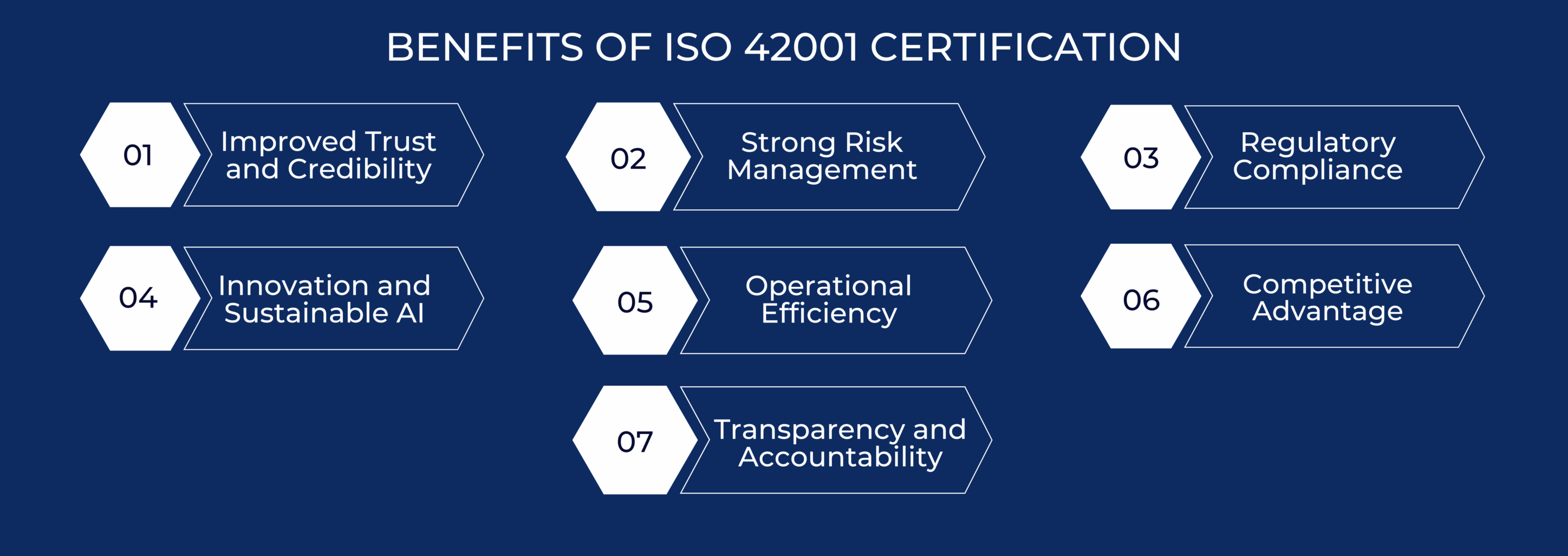
ISO 42001 Certification for Lisbon companies delivers structured, verifiable benefits across governance, commercial positioning, and regulatory alignment. The following represent the principal organizational outcomes associated with completing an independent ISO 42001 audit and receiving certification from a Licensed CPA Firm.
- ✓Independent third-party verification of the organization’s AIMS against ISO/IEC 42001:2023 requirements, issued through a formal certification decision by an independent committee
- ✓Documented evidence of AI governance maturity suitable for presentation in enterprise vendor qualification processes, regulatory submissions, and institutional partner reviews
- ✓Structured ISO 42001 audit methodology that evaluates control design and operating effectiveness, producing a verified record of AI risk management practices
- ✓Recognition in procurement processes where ISO 42001 attestation is required as a vendor qualification baseline by financial institutions, regulated buyers, and multinational enterprises
- ✓Alignment framework that supports demonstrating structural conformance with EU AI Act governance requirements through an independently audited management system
- ✓Surveillance audit cycle that maintains certification currency and confirms the AIMS continues to function effectively as AI systems and organizational context evolve
- ✓ISO 42001 compliance credential in Lisbon that supports market access across EU, North American, and international client bases requiring AI governance verification
- ✓Accountability and transparency documentation evaluated through the ISO 42001 examination by independent auditors, providing a verified record suitable for regulatory inquiries and stakeholder disclosures
Industry Sectors in Lisbon Seeking ISO 42001 Certification
Fintech and Financial Services Organizations
Lisbon has developed a significant fintech concentration, hosting payment technology companies, insurtech platforms, digital banking operations, and AI-driven financial analytics providers. Organizations in this sector deploy AI systems for credit risk assessment, transaction fraud detection, customer behavior analysis, and automated regulatory reporting. ISO 42001 Certification in Lisbon for fintech organizations demonstrates to banking partners, institutional investors, and regulatory bodies — including the Banco de Portugal and the European Central Bank — that AI systems influencing financial decisions are governed through a structured, independently audited management framework.
The ISO 42001 audit for fintech organizations evaluates controls across data governance, model transparency, human oversight of automated decisions, and accountability for AI system outputs. These control areas directly address the operational and regulatory risks specific to AI in financial services. Certification also supports vendor qualification requirements from international financial institutions procuring fintech services from Lisbon-based providers.
SaaS Providers, Cloud Companies, and Technology Startups
ISO 42001 Certification for Lisbon technology companies — particularly SaaS platforms, cloud service providers, and AI-native startups — addresses the vendor assurance requirements of enterprise buyers who embed third-party AI products into their own operational workflows. A SaaS company in Lisbon offering AI-powered HR automation, content generation, or customer service tooling to enterprise clients in regulated industries must demonstrate that its AI systems are governed, transparent, and auditable. ISO 42001 Certification in Lisbon provides exactly this demonstration through an independently issued certificate backed by documented audit evidence.
Cloud providers hosting AI workloads for financial institutions, public sector organizations, or healthcare operators face heightened vendor scrutiny that ISO 42001 attestation directly addresses. For early-stage AI startups scaling toward enterprise sales cycles, ISO 42001 Certification in Lisbon provides a governance credential that accelerates procurement approval processes and reduces the time required for vendor security and AI governance reviews.
Telecommunications and Managed Service Providers
Telecommunications companies operating in Lisbon deploy AI systems across network management, predictive maintenance, customer experience optimization, and fraud detection functions. These organizations serve both consumer and enterprise markets and are subject to sector-specific regulatory oversight from ANACOM, Portugal’s national communications regulator. Managed service providers (MSPs) in Lisbon increasingly incorporate AI-driven automation into IT service delivery, security operations, and infrastructure management for clients in banking, retail, and public administration.
For both telecommunications operators and MSPs, the ISO 42001 audit in Lisbon evaluates whether AI systems embedded in service delivery are governed through documented risk management processes, transparent operational protocols, and defined accountability structures. The ISO 42001 examination for these organizations covers AI system impact assessments, data handling practices, and human oversight mechanisms as applied to AI functions integrated into critical communications and managed IT infrastructure.
ISO 42001 Certification and AI Management System Integration
Integration with ISO 27001 and Existing Management Systems
ISO/IEC 42001:2023 shares the ISO High-Level Structure with ISO 27001 for information security management and ISO 9001 for quality management. This structural alignment means that organizations in Lisbon already certified under ISO 27001 can integrate ISO 42001 requirements into their existing management system framework. Documented processes for internal audit, management review, corrective action, and continual improvement can be reused — reducing duplication and lowering implementation effort.
Risk assessment methodologies, governance structures, and document control practices established for ISO 27001 compliance in Lisbon can be extended to address AI-specific requirements without building a completely separate system. The ISO 42001 audit evaluates whether the integrated management system adequately addresses both information security and AI governance requirements within the defined scope. Organizations pursuing integrated certification must demonstrate that AI-specific controls — including impact assessments, data quality procedures, and transparency mechanisms — are documented and operating independently of but coherently alongside information security controls.
AI System Impact Assessment Requirements
ISO/IEC 42001:2023 Annex A includes requirements for AI system impact assessments as a formal control domain. Organizations must conduct structured assessments of the potential impacts of their AI systems on individuals, groups, and society — both prior to deployment and when material changes to AI systems occur. For Lisbon-based organizations deploying AI in HR processes, credit decisioning, predictive analytics, or public service delivery, impact assessments must evaluate risks including discriminatory outcomes, privacy implications, and vulnerability of affected populations.
The ISO 42001 examination evaluates whether impact assessments have been conducted, documented, and reviewed by appropriate personnel, and whether identified impacts have informed control selection and risk treatment decisions. In the context of ISO 42001 compliance, AI system impact assessments are not optional governance activities — they are evidence-based control requirements that auditors evaluate through review of assessment records, approval documentation, and evidence that assessment outcomes have been incorporated into system design and operational controls.
FAQ
▶
What is ISO 42001 certification?
▶
Who needs ISO 42001 certification?
▶
How long does ISO 42001 certification take?
▶
What are the benefits of ISO 42001 certification?
▶
What is the cost of ISO 42001 certification?
▶
How do I prepare for ISO 42001 certification?
▶
What happens after ISO 42001 certification?
▶
How long does the ISO 42001 certification process take?
ISO 42001 CERTIFIED: WHY AI GOVERNANCE CERTIFICATION IS BECOMING A BOARD-LEVEL REQUIREMENT
ISO 42001 Certified: Board-Level AI Governance Guide | CertPro CPA LLC HERO ══════════════════════════════ –> src=”https://certpro.com/wp-content/uplo…
Get In Touch
have a question? let us get back to you.