
ISO 42001 Certification in Birmingham
The ISO 42001 audit process in Birmingham follows a structured, stage-based examination methodology conducted by CertPro as an independent Licensed CPA Firm. Each stage of the ISO 42001 audit is designed to produce objective, evidence-based findings that inform the independent certification committee’s conformance determination. The process is strictly evaluative — CertPro does not provide implementation support, advisory services, or pre-audit preparation assistance at any stage. The following stages govern all ISO 42001 certification engagements for Birmingham organizations.
OUR CLIENTS






ISO 42001 Certification for Birmingham’s Financial, Technology, and AI-Driven Organizations
ISO 42001 Certification in Birmingham is issued by CertPro, a Licensed CPA Firm operating as an independent certification body. Certification is conducted exclusively through structured audit and examination activities against the requirements of ISO/IEC 42001:2023 — the international standard for Artificial Intelligence Management Systems. CertPro does not provide consulting, advisory, implementation, or readiness services. The certification outcome is an objective, evidence-based determination issued by CertPro’s independent certification committee. This committee assesses whether an organization’s AI Management System (AIMS) conforms to ISO/IEC 42001:2023 and whether associated controls are both designed and operating effectively.
Birmingham stands as one of the United Kingdom’s most significant economic centers. The city hosts a dense concentration of financial services institutions, professional services firms, fintech operators, advanced manufacturing enterprises, healthcare technology organizations, and logistics and supply chain technology providers. A rapidly expanding ecosystem of SaaS companies, cloud service providers, and organizations actively developing or deploying AI systems adds further depth to this landscape. Birmingham’s financial district — anchored by major banks, insurance underwriters, asset managers, and a growing fintech corridor — represents one of the most AI-active commercial environments outside London. Engineering and advanced manufacturing firms in the greater Birmingham region increasingly integrate machine learning and predictive analytics into production, quality control, and asset management workflows. This activity generates structured demand for third-party AI governance verification across the region.
ISO 42001 Certification in Birmingham is pursued by organizations that develop, operate, procure, or integrate AI systems and require structured, third-party verification of their AI governance framework. Birmingham-based SaaS providers serving regulated financial institutions, managed service providers (MSPs) deploying AI-assisted monitoring tools, healthcare informatics firms applying algorithmic decision support, and cloud platform operators processing sensitive data on behalf of enterprise clients represent the core segments engaging ISO 42001 certification. Enterprise procurement teams, third-party risk management functions, and regulated clients increasingly require ISO 42001 attestation as a condition of vendor onboarding, contract renewal, or ongoing supply chain due diligence.
ISO/IEC 42001:2023 is the first globally recognized management system standard specifically designed for artificial intelligence. It establishes requirements for establishing, implementing, maintaining, and continually improving an AI Management System within an organization. The standard applies to any organization — regardless of size, industry, or geographic location — that provides or uses AI-based products and services. ISO 42001 compliance requires organizations to define AI objectives, assess AI-related risks, implement appropriate controls, assign accountability for AI governance, and operate a structured review and improvement cycle. ISO 42001 certification, as issued by CertPro, independently verifies that an organization’s AIMS meets these requirements through a rigorous, stage-based audit methodology. Birmingham organizations that complete this process demonstrate to enterprise buyers, regulators, and third-party risk teams that their AI systems are governed by a formally verified, internationally recognized management framework.

What Is ISO 42001 Certification?
ISO 42001 certification is the formal, third-party verification that an organization’s Artificial Intelligence Management System conforms to the requirements of ISO/IEC 42001:2023. The standard, published by the International Organization for Standardization in 2023, establishes a structured framework for governing the development, deployment, monitoring, and continual improvement of AI systems. ISO 42001 certification is issued following a structured ISO 42001 audit conducted by an independent certification body. In Birmingham, this function is performed by CertPro as a Licensed CPA Firm. Certification is not a self-declaration. It requires independent examination of documented policies, risk assessments, control implementations, governance structures, and operating records to determine conformance with the standard.
ISO/IEC 42001:2023 Standard Structure and Scope
ISO/IEC 42001:2023 follows the High-Level Structure (HLS) common to modern ISO management system standards, encompassing Clauses 4 through 10 for the core management system requirements. Clause 4 addresses organizational context and the identification of interested parties. Clause 5 establishes leadership and AI governance commitments. Clause 6 covers planning, including AI risk assessment and opportunity identification. Clauses 7 through 10 govern support, operation, performance evaluation, and continual improvement respectively. Annex A provides a reference control set specifically designed for AI systems. These controls cover AI system impact assessment, data governance, transparency, human oversight, and AI system lifecycle management. The standard is directly applicable to Birmingham organizations of any size and sector that develop or use AI as a component of their products, services, or internal operations.
ISO 42001 shares structural DNA with ISO 27001 (information security) and ISO 9001 (quality management). This means organizations already certified under those standards can reuse existing policy frameworks, governance roles, and management review processes when building their AIMS. ISO 42001 compliance requires an organization to define the scope of its AIMS — specifying which AI systems, processes, and organizational units are included — and to demonstrate that risk management, control implementation, and performance monitoring are systematically applied within that defined scope. Annex A also provides AI-specific control categories addressing algorithmic transparency, bias mitigation, explainability, and AI system security. During the ISO 42001 examination, an independent auditor evaluates whether these controls are both appropriately designed and operating effectively within the audit period.
Who Requires ISO 42001 Certification in Birmingham
ISO 42001 certification in Birmingham applies to any organization that develops AI systems, deploys AI within its operational processes, integrates third-party AI into its service delivery, or procures AI-enabled tools that affect clients or stakeholders. Birmingham-based financial services firms using AI-driven credit scoring, fraud detection, or investment analytics are primary candidates. SaaS companies and cloud providers embedding AI functionality into enterprise software products require ISO 42001 attestation to satisfy client vendor assurance expectations. Healthcare technology firms using algorithmic decision support for diagnostic or care pathway recommendations face structured AI governance requirements under both the standard and applicable regulatory frameworks. Advanced manufacturing and engineering companies deploying machine learning in quality control, predictive maintenance, or process automation similarly require formal AIMS governance as enterprise customer procurement expectations continue to evolve.
ISO 42001 compliance is also required by organizations that act as AI system providers supplying AI-enabled products or services to other businesses. In Birmingham’s supply chain and logistics technology sector — where route optimization, demand forecasting, and warehouse automation tools frequently incorporate AI — provider organizations face increasing third-party risk scrutiny from enterprise clients and regulated buyers. ISO 42001 attestation provides a structured, independently verified response to these demands. It demonstrates that AI governance controls are formally documented, operationally implemented, and subject to periodic independent examination. The standard explicitly recognizes that organizations may occupy multiple roles simultaneously — both developing and deploying AI — and the AIMS scope definition during the certification process reflects this complexity. CertPro’s ISO 42001 audit in Birmingham evaluates the AIMS as defined and scoped by the organization, assessing conformance against applicable clauses and Annex A controls.
ISO 42001 Certification Audit Process in Birmingham
The ISO 42001 audit process in Birmingham follows a structured, stage-based examination methodology conducted by CertPro as an independent Licensed CPA Firm. Each stage of the ISO 42001 audit is designed to produce objective, evidence-based findings that inform the independent certification committee’s conformance determination. The process is strictly evaluative — CertPro does not provide implementation support, advisory services, or pre-audit preparation assistance at any stage. The following stages govern all ISO 42001 certification engagements for Birmingham organizations.
| Audit Stage | Key Activities | Output |
|---|---|---|
| Application Review | Scope definition, AIMS boundary confirmation, conflict of interest check | Audit program determination |
| Stage 1 Audit | Documentation review, AIMS readiness assessment, clause-by-clause examination of policies and risk records | Stage 1 findings report |
| Stage 2 Audit | On-site or remote control testing, evidence collection, operational effectiveness evaluation | Nonconformity and observation report |
| Certification Committee Review | Independent review of audit findings, nonconformity resolution verification | Certification decision and ISO 42001 attestation |
| Surveillance Audit | Periodic ongoing assessment of continued AIMS conformance within the certification cycle | Surveillance confirmation or nonconformity notice |
The Stage 1 audit constitutes the initial formal examination of an organization’s documented AIMS. CertPro auditors review the organization’s AI governance policies, AIMS scope statement, AI risk assessment methodology, risk treatment plan, and Annex A control selection documentation. The Stage 1 ISO 42001 audit in Birmingham evaluates whether the organization has established a documented management system that addresses the applicable requirements of ISO/IEC 42001:2023. Auditors also assess whether the defined AIMS scope accurately reflects the AI systems, processes, and organizational units subject to certification. Additionally, they examine whether documented controls are logically designed to address identified AI risks and whether governance structures — including roles, responsibilities, and accountability assignments — are formally defined and communicated. The Stage 1 output is a written findings report identifying areas that must be resolved before Stage 2 commences.
Stage 1 documentation examined during the ISO 42001 audit in Birmingham typically includes the AI governance policy, AIMS scope statement, organizational context analysis, stakeholder register, AI risk assessment records, risk treatment plan, Annex A control applicability justifications, and management review records. For Birmingham financial services and fintech organizations, auditors additionally examine how AI-related risks intersect with applicable regulatory obligations — including Financial Conduct Authority (FCA) expectations for algorithmic fairness and explainability — and whether the AIMS documentation reflects these obligations within the risk treatment framework. Stage 1 findings do not constitute a certification determination. They identify whether the documented AIMS provides a sufficient basis for proceeding to Stage 2 operational testing. Any significant documentation gaps identified at Stage 1 must be resolved before Stage 2 is scheduled.
The Stage 2 audit assesses the operational effectiveness of the AIMS controls documented and defined during Stage 1. CertPro auditors collect and examine evidence demonstrating that controls are not only appropriately designed but are actively implemented and functioning as intended within the audit period. For Birmingham organizations, Stage 2 ISO 42001 audit activities typically include interviews with AI system owners and governance personnel, review of AI incident records and monitoring logs, examination of AI model performance documentation, assessment of human oversight mechanisms, and evaluation of internal audit results and management review outputs. Auditors test whether risk treatment controls — including Annex A controls selected by the organization — are operating in practice, producing the outcomes described in the AIMS documentation, and generating verifiable evidence of their operation.
Stage 2 control testing during the ISO 42001 examination also evaluates AI-specific governance mechanisms. These include transparency and disclosure practices, bias assessment records, AI system change management procedures, supplier and third-party AI governance controls, and AI incident response protocols. For Birmingham healthcare technology organizations, Stage 2 examination includes review of clinical AI governance records, algorithmic decision oversight documentation, and human-in-the-loop verification mechanisms. For logistics and manufacturing organizations, Stage 2 testing addresses AI system performance monitoring, drift detection records, and change management procedures for production AI deployments. Nonconformities identified during Stage 2 are formally documented and must be resolved through verified corrective action before the certification committee proceeds to the certification decision. Minor nonconformities may be resolved through documented evidence submission; major nonconformities require re-audit of the affected areas.
Following resolution of identified nonconformities, CertPro’s independent certification committee reviews the complete audit record — including Stage 1 findings, Stage 2 evidence, nonconformity reports, and corrective action verification — and issues a conformance determination. The certification committee operates independently from the audit team, ensuring the certification decision is not made by the individuals who conducted the examination. Where the committee determines that the AIMS conforms to ISO/IEC 42001:2023 requirements and associated controls are designed and operating effectively, ISO 42001 attestation is issued. The ISO 42001 certificate is valid for a three-year certification cycle, subject to satisfactory completion of annual surveillance audits and a recertification audit at the end of the cycle.
Surveillance audits are conducted on an annual basis throughout the three-year certification period. These audits assess whether the organization’s AIMS continues to conform to ISO/IEC 42001:2023 requirements and whether controls remain operationally effective. Surveillance scope is determined by CertPro based on the organization’s risk profile, any changes to the AIMS scope, significant organizational changes, and findings from the previous audit cycle. For Birmingham organizations that deploy AI systems in rapidly evolving technology environments — such as SaaS providers continuously releasing model updates or financial institutions adjusting AI-driven decisioning parameters — surveillance audits specifically evaluate whether change management controls have been applied consistently and whether the AIMS has been updated to reflect material changes in AI system scope or risk exposure. Recertification audits are conducted prior to certificate expiry and constitute a full re-examination of the AIMS against ISO/IEC 42001:2023 requirements.
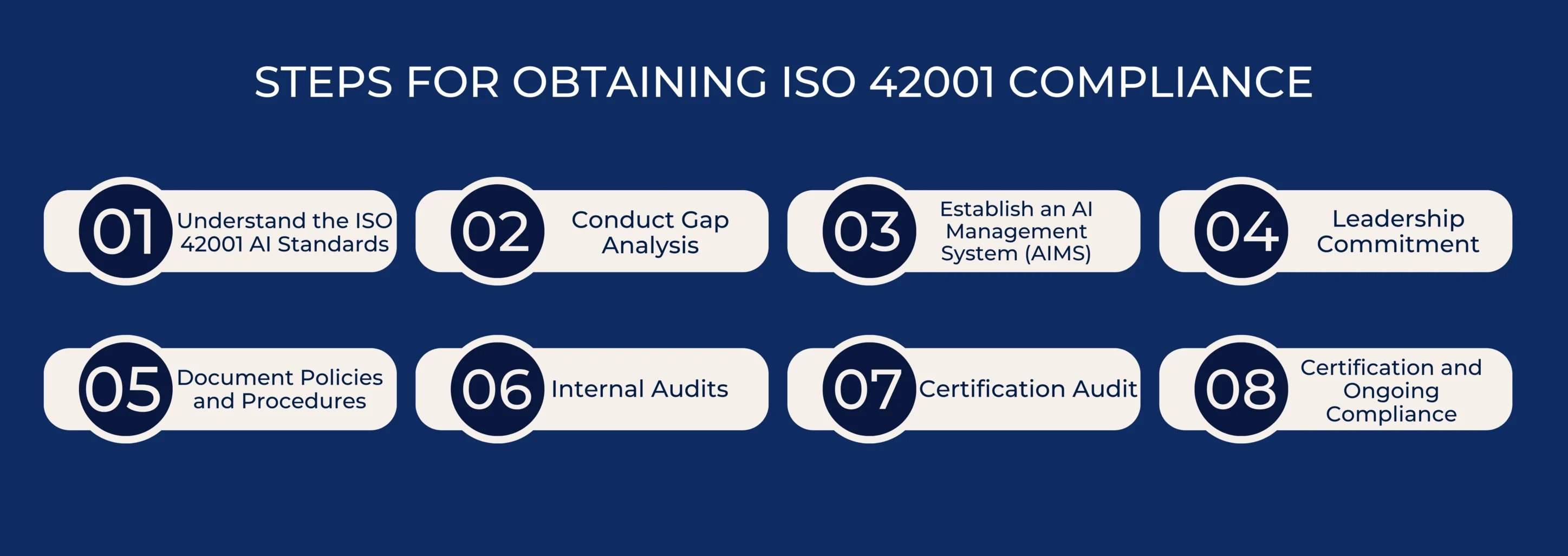
- ✓Stage 1 Audit: Documentation and Readiness Examination
- ✓Stage 2 Audit: Operational Effectiveness and Control Testing
- ✓Certification Decision, Attestation Issuance, and Surveillance
ISO 42001 Certification Requirements for Birmingham Organizations
ISO 42001 certification requirements encompass both management system obligations under Clauses 4 through 10 of ISO/IEC 42001:2023 and AI-specific control requirements defined in Annex A. Birmingham organizations seeking ISO 42001 certification must demonstrate conformance across all applicable mandatory clauses and must justify any Annex A control exclusions with documented rationale. The following sections summarize the core AIMS documentation and governance requirements evaluated during the ISO 42001 audit process.
- ✓AI Governance Policy: A formally approved, documented policy establishing the organization’s commitments to responsible AI development and deployment, including ethical principles, accountability structures, and compliance obligations.
- ✓AIMS Scope Statement: A documented definition of the organizational units, AI systems, processes, and geographic locations included within the AIMS boundary.
- ✓Organizational Context and Stakeholder Analysis: Documentation of internal and external factors affecting AI governance, including regulatory requirements, customer obligations, and technology constraints.
- ✓AI Risk Assessment Records: Formal documentation of the methodology used to identify, analyze, and evaluate AI-related risks, including records of risk assessment outputs for each AI system in scope.
- ✓Risk Treatment Plan: A documented plan specifying the controls selected to address identified AI risks, mapped to Annex A control categories where applicable.
- ✓Statement of Applicability: Documentation of all Annex A controls considered, their applicability determination, and justification for any exclusions.
- ✓Internal Audit Records: Evidence of systematic internal AIMS audits conducted at planned intervals, including audit findings and corrective action records.
- ✓Management Review Records: Documented outputs of periodic senior leadership reviews of AIMS performance, including decisions on continual improvement actions.
ISO/IEC 42001:2023 Annex A defines a structured set of AI-specific controls organized across categories addressing policies, internal organization, human resources for AI, infrastructure, AI system lifecycle, data management, third-party relationships, and incident management. These controls address the unique governance challenges of AI systems not fully covered by existing information security or quality management frameworks. Key control areas examined during the ISO 42001 audit in Birmingham include AI system impact assessment procedures, transparency and explainability mechanisms, bias and fairness monitoring practices, human oversight and intervention controls, AI system change management procedures, and data quality governance. Organizations must not only select and document these controls but must demonstrate through operational evidence that controls are actively implemented and producing measurable governance outcomes within the defined AIMS scope.
For Birmingham financial services organizations, Annex A controls governing AI transparency and explainability carry particular regulatory significance. FCA expectations for explainable algorithmic decisions in credit, insurance, and investment contexts make ISO 42001 compliance in this sector a strategic priority. Certification requires documented evidence that AI models used in regulated decisions are subject to explainability assessments, that model outputs can be explained to affected individuals upon request, and that human oversight mechanisms are formally defined and operationally active. For healthcare technology organizations in Birmingham, controls governing AI system validation, clinical oversight, and patient safety risk assessment are evaluated against documented clinical governance frameworks. Importantly, the ISO 42001 examination assesses whether Annex A controls are proportionate to the AI risks identified in the organization’s risk assessment — the standard is outcome-oriented, not prescriptive in its approach to control implementation.
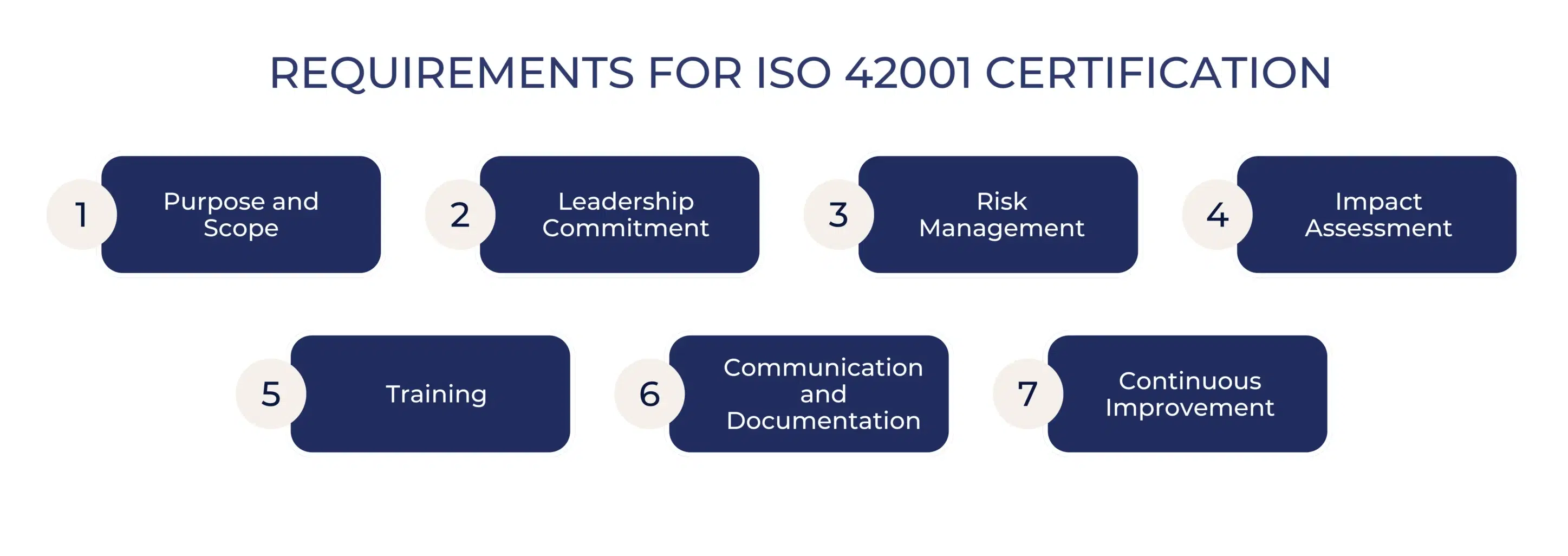
- ✓AIMS Documentation Requirements
- ✓Annex A Control Categories and AI-Specific Requirements
Why Birmingham Organizations Pursue ISO 42001 Certification
The demand for ISO 42001 certification among Birmingham organizations reflects a convergence of enterprise procurement requirements, regulatory expectations, client contractual obligations, and reputational considerations specific to AI-deploying and AI-developing organizations. Birmingham’s position as a regional hub for financial services, professional services, and technology-intensive industries creates concentrated demand for structured AI governance verification. This verification satisfies enterprise buyer due diligence, third-party risk management reviews, and supply chain assurance requirements across multiple sectors simultaneously.
Enterprise Vendor Due Diligence and Procurement Requirements
Birmingham-based SaaS providers and cloud platform operators supplying AI-enabled services to large enterprise clients — particularly those in financial services, insurance, healthcare, or central government — encounter structured AI governance verification requirements during vendor onboarding. Enterprise procurement teams and third-party risk management functions increasingly include AI governance assessment as a discrete category within vendor assurance frameworks. Suppliers must demonstrate that their AI systems are governed by a formally documented and independently verified management system. ISO 42001 attestation issued by CertPro, as a Licensed CPA Firm, provides a structured, auditor-verified response to these procurement requirements. It eliminates the need for individual customers to conduct bespoke AI governance assessments of each vendor — a significant efficiency gain for Birmingham organizations operating in multi-customer SaaS environments where individual client assurance reviews are operationally impractical.
A representative procurement scenario in Birmingham’s financial sector involves a regional bank or insurance firm onboarding a new SaaS provider that uses machine learning for document processing, fraud detection, or customer risk scoring. The regulated institution’s third-party risk team requires evidence of AI governance controls as part of its vendor due diligence process. Without ISO 42001 attestation, the SaaS provider must respond to bespoke questionnaires, provide ad-hoc policy documentation, and undergo potentially duplicative assessments from multiple clients. ISO 42001 certification in Birmingham resolves this friction. It provides a standardized, independently verified statement of AIMS conformance that satisfies multiple client assurance requirements simultaneously — reducing the vendor’s compliance burden and accelerating commercial relationships with regulated buyers.
Regulatory Alignment and EU AI Act Readiness
ISO 42001 compliance aligns closely with emerging AI regulatory frameworks, most notably the EU AI Act — the European Union’s comprehensive risk-based regulatory framework for artificial intelligence. The Act applies to organizations that place AI systems on the EU market or use AI systems affecting EU individuals, regardless of where the provider organization is headquartered. Birmingham organizations that export AI-enabled products or services to EU markets, or that use AI systems affecting EU data subjects, face structured compliance obligations under the EU AI Act. An operational AIMS conforming to ISO/IEC 42001:2023 substantially addresses these obligations. The standard’s requirements for AI risk classification, human oversight, transparency, and incident management map directly to EU AI Act requirements for high-risk AI system providers and deployers. ISO 42001 certification provides documented, independently verified evidence of these governance mechanisms, supporting regulatory compliance narratives without constituting formal legal compliance confirmation.
ISO 42001 compliance in Birmingham also intersects with UK-specific AI governance expectations. The UK’s AI Regulation white paper and sector-specific guidance from regulators including the FCA, Prudential Regulation Authority (PRA), and Information Commissioner’s Office (ICO) increasingly reference AI governance frameworks and transparency requirements that align with ISO 42001 control categories. Birmingham fintech organizations subject to FCA oversight, healthcare technology firms operating under NHS Digital governance frameworks, and engineering enterprises participating in government procurement programmes each face AI governance requirements that a formally certified AIMS directly addresses. ISO 42001 certification does not substitute for regulatory compliance determinations made by applicable regulators, but it provides a structured, independently verified governance framework that supports regulatory engagement and due diligence responses across these sectors.
Benefits of ISO 42001 Certification for Birmingham-Based Organizations
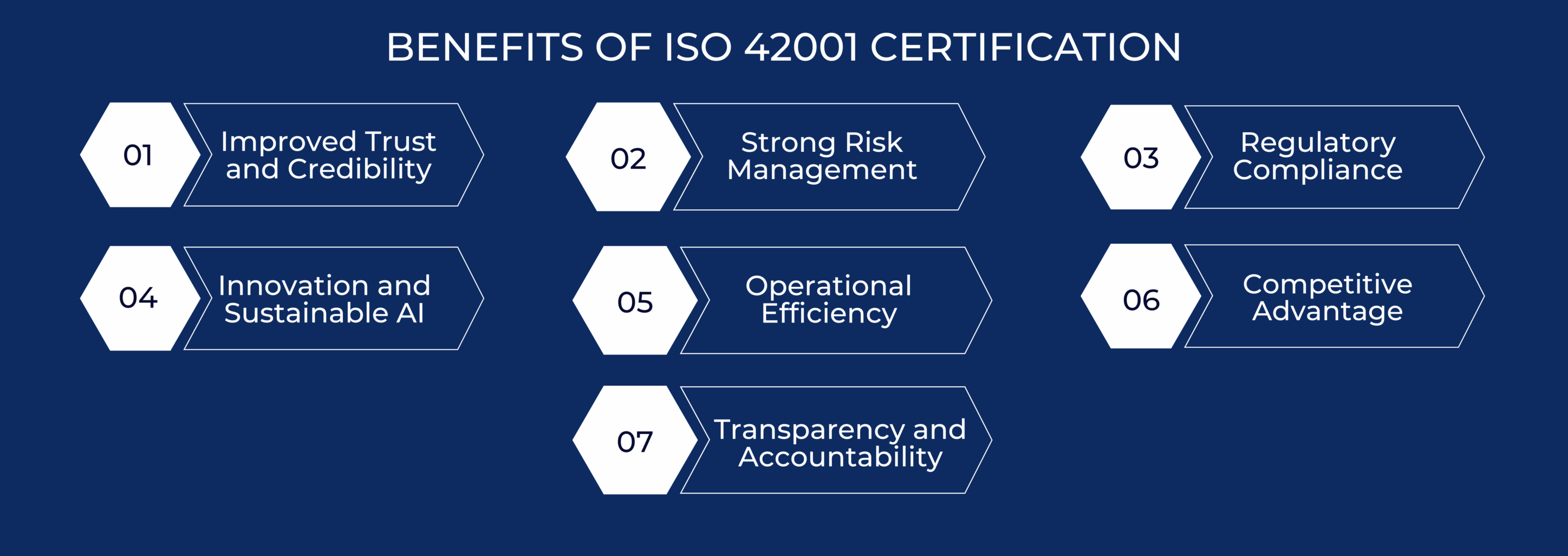
ISO 42001 certification delivers structured, independently verified benefits to Birmingham organizations operating in AI-intensive sectors. The following benefits reflect the practical outcomes of achieving and maintaining ISO 42001 certification in Birmingham across financial services, technology, healthcare, manufacturing, and professional services contexts.
- ✓Independent Verification of AI Governance Controls: ISO 42001 attestation provides a formally audited, third-party-verified statement that the organization’s AIMS conforms to ISO/IEC 42001:2023, satisfying enterprise procurement, regulatory, and client assurance requirements without reliance on self-declaration.
- ✓Structured AI Risk Management Framework: Certification requires implementation of a documented, systematic AI risk assessment and treatment process, creating organizational discipline around AI risk identification, evaluation, and control that persists beyond individual projects.
- ✓Competitive Differentiation in Enterprise Markets: ISO 42001 certification distinguishes Birmingham organizations in competitive enterprise sales processes where AI governance credentials are evaluated as part of vendor selection criteria by regulated buyers and large corporate clients.
- ✓Alignment with International AI Governance Standards: ISO/IEC 42001:2023 certification aligns the organization’s AI governance practices with international expectations, supporting market entry into regulated EU, US, and APAC markets where AI governance verification is increasingly required.
- ✓Operational Accountability and Governance Discipline: The standard’s requirements for defined roles, documented procedures, and management review create formal accountability structures for AI governance that reduce organizational risk from unmanaged AI deployments.
- ✓Ongoing Surveillance and Continuous Improvement: The annual surveillance audit cycle associated with ISO 42001 certification provides structured, periodic external review of AIMS effectiveness, creating a systematic mechanism for identifying and addressing governance gaps before they generate compliance or reputational exposure.
- ✓Supply Chain and Third-Party AI Risk Management: ISO 42001 certification requires organizations to address third-party and supplier AI risks within their AIMS, producing documented controls for AI vendor selection, performance monitoring, and incident response that satisfy supply chain assurance requirements.
- ✓Support for Cross-Border AI Governance Narratives: For Birmingham organizations with international operations or clients, ISO 42001 attestation provides a recognized, internationally credible governance statement that supports regulatory engagement and cross-border client assurance requirements simultaneously.
Industry Sectors in Birmingham Seeking ISO 42001 Certification
ISO 42001 certification in Birmingham spans multiple industry verticals where AI system deployment is accelerating and structured governance verification is demanded by clients, regulators, or commercial counterparties. The following sectors represent the principal sources of ISO 42001 certification demand among Birmingham organizations, each presenting distinct AI governance requirements that the ISO 42001 audit process is designed to assess.
Financial Services, Fintech, and ISO 42001 Compliance Birmingham
Birmingham’s financial services sector — encompassing retail and commercial banking, insurance underwriting and claims processing, asset and wealth management, mortgage lending, and a rapidly growing fintech ecosystem — represents one of the most AI-intensive commercial environments in the UK outside London. ISO 42001 Certification in Birmingham for financial services organizations provides verified assurance over AI governance controls applied to credit scoring models, fraud detection systems, anti-money laundering (AML) analytics, algorithmic trading parameters, insurance risk assessment tools, and customer-facing AI advisory applications. The FCA’s expectations for algorithmic accountability, model explainability, and bias assessment align directly with ISO 42001 Annex A control requirements. As a result, ISO 42001 compliance is increasingly a standard component of regulatory engagement strategies for AI-deploying financial institutions operating in the Birmingham market.
The ISO 42001 audit for Birmingham financial services organizations specifically evaluates whether AI risk assessment processes identify model risk, bias risk, explainability limitations, and data quality risks as distinct AI governance concerns — not merely as subsets of general information security risk. Auditors examine whether models used in regulated decisions are subject to documented validation, ongoing performance monitoring, and defined human oversight escalation procedures. Birmingham fintech organizations pursuing ISO 42001 certification must also demonstrate that third-party AI model providers — including data vendors, model-as-a-service providers, and embedded AI component suppliers — are assessed within the AIMS supplier management controls, with defined governance requirements applied to AI-specific supply chain relationships.
SaaS, Cloud Providers, and Healthcare Technology Organizations
Birmingham’s technology sector includes a substantial concentration of SaaS companies, cloud service providers, managed service providers, and healthcare informatics organizations for whom ISO 42001 certification represents a critical trust signal in enterprise sales processes. SaaS providers embedding AI-driven automation, recommendation engines, natural language processing, or predictive analytics into their products are routinely required by enterprise clients to demonstrate structured AI governance through independent third-party certification. AI management system certification in Birmingham for SaaS providers involves examination of product-level AI governance controls — including model development lifecycle documentation, testing and validation procedures, bias assessment records, and transparency disclosures — alongside organizational-level AIMS governance structures covering policy, risk assessment, and management review.
Healthcare technology organizations in Birmingham — including clinical decision support software providers, diagnostic imaging AI companies, patient pathway optimization platforms, and NHS-serving informatics firms — face particularly stringent AI governance requirements. These arise from clinical safety obligations, Medicines and Healthcare products Regulatory Agency (MHRA) software-as-a-medical-device guidance, and NHS Digital governance frameworks. ISO 42001 certification provides a structured governance framework that complements these sector-specific requirements, demonstrating that AI systems used in clinical contexts are subject to systematic risk assessment, performance monitoring, and human oversight controls verified by an independent ISO 42001 audit. The examination for healthcare technology organizations evaluates clinical AI governance records, human-in-the-loop verification procedures, and AI incident management protocols alongside standard AIMS clause requirements.
Advanced Manufacturing, Engineering, and Logistics Technology
Birmingham’s advanced manufacturing and engineering sector — spanning automotive components, aerospace engineering, precision manufacturing, and industrial automation — increasingly integrates AI-driven quality inspection, predictive maintenance, process optimization, and supply chain analytics. Manufacturing organizations deploying AI in production environments face structured AI governance requirements from tier-one customers, export-regulated supply chains, and government procurement programmes. ISO 42001 certification for Birmingham’s manufacturing and engineering firms evaluates AIMS controls governing AI system validation in production environments, performance drift monitoring, change management for AI model updates, and safety-critical AI oversight mechanisms. Logistics and supply chain technology providers in the West Midlands — serving major distribution networks and retail supply chains — similarly pursue ISO 42001 attestation to satisfy third-party risk requirements from large enterprise clients conducting annual vendor assurance reviews.
ISO 42001 Certification Scope and Independent Decision Framework
The scope of ISO 42001 certification is determined during the application review stage and formally documented in the AIMS scope statement. Scope definition is a critical governance decision that determines which AI systems, organizational units, processes, and geographic locations are subject to the ISO 42001 audit and included within the certification boundary. CertPro’s independent certification committee evaluates whether the defined scope is appropriate, complete, and not structured to exclude material AI systems or governance risks that would be expected to fall within a reasonable AIMS definition for the organization’s type and operating context.
Scope Definition and Boundary Setting
AIMS scope definition for Birmingham organizations must specify the AI systems included, the organizational functions responsible for those systems, and the processes through which those systems are developed, deployed, monitored, and retired. Organizations may scope their AIMS to cover the entire organization or to specific business units, product lines, or AI system categories — provided the defined scope does not create artificial exclusions that undermine the representativeness of the certification. For a Birmingham financial services firm with AI systems operating across retail banking, insurance, and investment management divisions, a scope limited to one division must be justified with documented rationale and must not imply organizational-wide AIMS conformance. CertPro auditors assess scope appropriateness as part of the Stage 1 examination, flagging any scope definitions that appear to exclude material AI systems without documented justification.
For multi-site Birmingham organizations — or those with AI development functions distributed across geographies, including organizations with offshore development teams contributing to AI systems deployed in Birmingham — scope definition must address how AIMS governance obligations apply to distributed functions. The ISO 42001 audit examines whether governance controls extend to all organizational units materially contributing to the AI systems within scope, including development, data management, operations, and supplier management functions regardless of geographic location. Birmingham organizations with AI systems hosted on third-party cloud infrastructure must also address the delineation of AIMS scope relative to shared responsibility arrangements with cloud providers. The certification boundary must clearly reflect organizational versus provider responsibility for AIMS control implementation and oversight.
Independent Certification Committee and Nonconformity Resolution
CertPro’s certification decision is made by an independent certification committee whose members are separate from the audit team that conducted the Stage 1 and Stage 2 examinations. This structural separation ensures that the certification determination is not influenced by the auditors who developed familiarity with the organization during the audit process. The committee reviews the complete audit record — including all evidence collected, nonconformity reports, corrective action submissions, and auditor assessments — and makes a determination based solely on whether the documented and tested AIMS conforms to ISO/IEC 42001:2023 requirements. The committee may request additional evidence or clarification before issuing a determination but does not conduct additional audit activities. The committee’s determination constitutes the official ISO 42001 attestation or, where nonconformities remain unresolved, a deferred certification decision pending satisfactory corrective action.
Nonconformities identified during the ISO 42001 audit are classified based on their severity and impact on AIMS conformance. All nonconformities must be resolved through documented corrective action before ISO 42001 attestation is issued. The organization is responsible for identifying and implementing corrective actions; CertPro’s role is limited to verifying that submitted evidence demonstrates adequate resolution of the identified nonconformity. CertPro does not prescribe corrective actions, design controls, or provide implementation guidance — the corrective action determination is exclusively the organization’s responsibility. Where corrective action evidence is insufficient, the nonconformity remains open and the certification determination is deferred until adequate resolution is demonstrated. ISO 42001 certificate suspension or withdrawal may occur where surveillance audit findings indicate material degradation of AIMS conformance or where organizations fail to maintain surveillance audit schedules within the three-year certification cycle.
ISO 42001 Certification and Its Relationship to Other Standards
ISO 42001 certification does not exist in isolation. Birmingham organizations that have already achieved certification under ISO 27001 (information security), ISO 9001 (quality management), or other ISO High-Level Structure management system standards can leverage existing governance infrastructure — including policies, risk frameworks, management review processes, and internal audit programmes — to support AIMS implementation. The integration of ISO 42001 compliance within an existing integrated management system (IMS) framework reduces duplication of governance effort and enables consistent risk management practices across security, quality, and AI governance domains.
ISO 27001 and ISO 42001 Integration for Birmingham Organizations
ISO 27001 certification and ISO 42001 certification are complementary but address distinct governance domains. ISO 27001 governs information security management, focusing on confidentiality, integrity, and availability of information assets. ISO 42001 governs AI management, addressing AI-specific risks including algorithmic bias, explainability limitations, model drift, transparency obligations, and AI-related ethical considerations that information security management alone does not cover. Birmingham organizations that are ISO 27001 certified and seeking ISO 42001 certification can reuse existing management system infrastructure — including policy frameworks, risk assessment methodologies, internal audit programs, and management review processes — adapting them to address AI-specific requirements. The ISO 42001 audit evaluates the AIMS on its own merits, however, and ISO 27001 certification does not substitute for ISO 42001 examination against the specific requirements of ISO/IEC 42001:2023.
For Birmingham financial services organizations managing both information security and AI governance certification simultaneously, integrating ISO 27001 and ISO 42001 within a unified management system enables shared governance structures. These include a single risk committee overseeing both information security and AI risks, a unified internal audit programme covering both ISMS and AIMS, and integrated management review processes addressing both standards. This integration is recognized by ISO/IEC 42001:2023, which explicitly references the ability to integrate AI management system requirements with other management system standards. CertPro conducts ISO 42001 audit activities independently from any ISO 27001 certification activities. Integrated audit scheduling — where ISO 27001 and ISO 42001 audits are conducted concurrently for efficiency — does not affect the independence or objectivity of either certification determination.
ISO 42001 Compliance and the EU AI Act Framework
The EU AI Act, which entered into force in August 2024 and applies progressively through 2027, establishes risk-based obligations for AI system providers and deployers operating in the EU market. High-risk AI systems — defined by the Act’s Annex III categories, including AI used in credit scoring, recruitment, biometric identification, and safety-critical applications — face the most stringent requirements. These include mandatory risk management systems, data governance procedures, transparency documentation, human oversight mechanisms, and conformity assessment obligations. ISO/IEC 42001:2023 AIMS requirements map substantially to these EU AI Act obligations. ISO 42001 certification therefore provides documented, independently verified evidence that an organization has implemented the governance structures required by the Act. Birmingham organizations exporting AI-enabled products to EU markets or deploying AI systems affecting EU individuals are subject to the EU AI Act regardless of UK regulatory positioning post-Brexit, making ISO 42001 compliance a strategically important investment for internationally active organizations.
FAQ
▶
What is ISO 42001 certification and who issues it in Birmingham?
▶
Which Birmingham organizations need ISO 42001 certification?
▶
How does the ISO 42001 audit process work for Birmingham organizations?
▶
How long is an ISO 42001 certificate valid in Birmingham?
▶
What documentation is required for ISO 42001 certification in Birmingham?
▶
Does ISO 42001 certification in Birmingham cover EU AI Act compliance?
▶
Can Birmingham organizations integrate ISO 42001 with ISO 27001 certification?
▶
What is the difference between ISO 42001 attestation and ISO 42001 compliance self-declaration?
ISO 42001 CERTIFIED: WHY AI GOVERNANCE CERTIFICATION IS BECOMING A BOARD-LEVEL REQUIREMENT
ISO 42001 Certified: Board-Level AI Governance Guide | CertPro CPA LLC HERO ══════════════════════════════ –> src=”https://certpro.com/wp-content/uplo…
Get In Touch
have a question? let us get back to you.