
ISO 42001 Certification in Budapest
Organizations pursuing ISO 42001 Certification in Budapest must satisfy a defined set of documentation, governance, and operational requirements before the certification audit can be completed successfully. These requirements are derived directly from ISO/IEC 42001:2023 and are assessed by CertPro auditors through structured evidence review.The following overview identifies the principal requirement categories evaluated during the ISO 42001 examination — covering documentation, leadership obligations, and AI risk assessment processes.
OUR CLIENTS










ISO 42001 Certification for Budapest-Based AI and Technology Organizations
ISO 42001 Certification in Budapest is issued by CertPro, a Licensed CPA Firm operating as an independent certification body. CertPro conducts certification exclusively against ISO/IEC 42001:2023, the international standard for Artificial Intelligence Management Systems (AIMS). The certification process evaluates whether an organization has established, implemented, and maintained an AIMS that satisfies the standard’s requirements for AI risk governance, transparency, accountability, and control effectiveness.
CertPro does not provide consulting, implementation, or readiness services. The certification decision is made independently by a certification committee based solely on audit evidence collected during Stage 1 and Stage 2 activities.
Budapest occupies a distinctive position in the Central and Eastern European technology landscape. The city functions as a regional hub for shared services, business process outsourcing, financial services, software development, IT services, and automotive engineering. A growing ecosystem of SaaS providers, cloud companies, technology startups, and enterprises developing or deploying AI systems has positioned Budapest at the center of regional AI governance demand.
Organizations headquartered or operating in Budapest are increasingly subject to enterprise vendor due diligence requirements, EU AI Act compliance expectations, and international procurement standards that reference independent AI management system certification as a condition of engagement. ISO 42001 Certification in Budapest provides organizations with a structured, independently verified attestation of their AI governance framework — one that satisfies audit committee expectations, regulatory inquiries, and enterprise procurement reviews across financial services, technology, and business services sectors.
The ISO/IEC 42001:2023 standard establishes requirements for an Artificial Intelligence Management System, addressing the unique governance challenges that arise when organizations develop, deploy, or procure AI-enabled systems. These challenges include AI risk identification and classification, human oversight mechanisms, transparency obligations, data quality governance, and accountability frameworks for AI-assisted decision-making.
Unlike sector-specific AI guidelines, ISO 42001 provides a universally applicable, auditable framework that integrates with existing management systems such as ISO 27001 and ISO 9001. For Budapest-based organizations operating across multiple jurisdictions — including Germany, Austria, the Netherlands, the United Kingdom, and the United States — ISO 42001 Certification in Budapest serves as a recognized, portable attestation of AI management maturity. It can be presented to clients, regulators, and enterprise procurement teams without requiring jurisdiction-specific adaptation. CertPro’s certification scope encompasses the full AIMS lifecycle, from policy and risk treatment through operational controls and continual improvement.
Budapest’s technology and financial services sector has experienced significant growth driven by the establishment of regional centers for major multinational corporations, the expansion of domestic fintech and insurtech firms, and the concentration of AI-enabled software development activity. Organizations in these sectors are increasingly required to demonstrate structured AI governance as a condition of maintaining client relationships with regulated financial institutions, healthcare organizations, and government entities.
ISO 42001 compliance provides the documented, independently audited evidence that procurement teams, audit committees, and regulatory bodies require when evaluating AI vendors and service providers. The certification also supports alignment with the EU AI Act’s requirements for high-risk AI system operators, as the standard’s governance framework addresses many of the transparency, human oversight, and risk management obligations that the regulation imposes. CertPro’s role is strictly that of an independent certification body — evaluating evidence, identifying nonconformities, and issuing certification decisions through a structured, impartial ISO 42001 audit process.

What Is ISO 42001 Certification?
ISO 42001 certification is the formal third-party attestation that an organization’s Artificial Intelligence Management System conforms to the requirements of ISO/IEC 42001:2023. Published by the International Organization for Standardization and the International Electrotechnical Commission in 2023, this standard represents the first internationally recognized framework specifically designed for AI governance at the management system level.
ISO 42001 certification is distinct from AI ethics assessments, algorithmic audits, or regulatory compliance reports. It evaluates whether an organization has implemented a structured, documented, and operationally effective management system that governs how AI is developed, deployed, monitored, and controlled within its operations.
Scope and Structure of ISO/IEC 42001:2023
ISO/IEC 42001:2023 follows the High-Level Structure (HLS) common to all modern ISO management system standards, covering Clauses 4 through 10. These clauses address:
Organizational context and interested parties (Clause 4), leadership and AI policy (Clause 5), planning and AI risk assessment (Clause 6), support and resource management (Clause 7), operational controls for AI systems (Clause 8), performance evaluation and internal audit (Clause 9), and continual improvement (Clause 10).
The standard also includes normative Annex A, which provides a reference control set organized into AI system impact categories, and informative annexes addressing AI concepts, risk management guidance, and data governance considerations. The ISO 42001 examination assesses conformance across all applicable clauses and selected Annex A controls based on the organization’s defined scope.
The certification scope under ISO 42001 must be clearly defined by the organization and reviewed by the certification body prior to audit commencement. The scope identifies which AI systems, business functions, organizational units, and geographic locations fall within the AIMS boundary.
For Budapest-based organizations with operations across Central and Eastern Europe, scope determination is a critical element of the ISO 42001 audit — it defines what the certificate covers and what claims the organization may make regarding its certified AI governance posture. CertPro reviews the proposed scope for adequacy and alignment with the organization’s actual AI operations before confirming the audit program. Scope exclusions must be documented and justified in accordance with the standard’s requirements.
AI Management System Requirements Under ISO 42001
An Artificial Intelligence Management System under ISO/IEC 42001:2023 requires organizations to establish documented policies governing AI use, conduct structured AI risk assessments, implement risk treatment plans, define accountability for AI-related decisions, and maintain operational controls that address transparency, human oversight, and data integrity.
The AIMS must include an AI policy approved by top management, an AI risk assessment process tailored to the organization’s AI portfolio, a statement of applicability identifying which Annex A controls are applicable and implemented, and documented evidence of continual improvement activities. ISO 42001 compliance requires not only the existence of these elements but also their operational effectiveness — demonstrated through records, metrics, audit logs, and evidence of corrective action where nonconformities are identified.
The Annex A control set in ISO/IEC 42001:2023 addresses AI-specific governance domains including AI system impact assessment, data governance for AI training and validation data, AI system lifecycle management, human oversight mechanisms, transparency and explainability controls, and supplier and third-party AI governance.
For organizations in Budapest’s financial services and fintech sectors, controls addressing AI-assisted credit decisioning, fraud detection, and customer interaction systems are particularly relevant. For software development and SaaS organizations, controls related to AI system design, testing, and deployment governance apply directly. The ISO 42001 audit evaluates both the design adequacy and operating effectiveness of implemented controls relative to the identified AI risks and the organization’s defined scope.
ISO 42001 Certification Audit Process in Budapest
The ISO 42001 audit process for Budapest-based organizations follows a structured, stage-based examination methodology conducted by CertPro as an independent Licensed CPA Firm. The process is designed to evaluate conformance with ISO/IEC 42001:2023 through systematic evidence collection, documentation review, and operational assessment — without providing advisory input, implementation direction, or readiness preparation.
Each stage of the ISO 42001 audit produces structured outputs that form the basis for the certification committee’s independent decision. Organizations benefit from a transparent, methodical process that clearly separates audit activities from the final certification determination.
| Audit Stage | Key Activities | Output |
|---|---|---|
| Application Review | Scope confirmation, audit program determination, conflict-of-interest check | Confirmed audit scope and engagement letter |
| Stage 1 Audit | AIMS documentation review, readiness assessment, identification of areas requiring attention | Stage 1 audit report, Stage 2 readiness determination |
| Stage 2 Audit | Operational effectiveness testing, evidence collection, control evaluation, nonconformity identification | Stage 2 audit report with findings and nonconformity log |
| Certification Committee Review | Independent review of audit evidence and nonconformity responses | Certification decision (grant, defer, or decline) |
| Surveillance Audit | Annual review of continued AIMS conformance and operational effectiveness | Surveillance report, certificate continuation determination |
The Stage 1 ISO 42001 audit is a documentation-focused review conducted by CertPro auditors to assess whether the organization’s AIMS documentation is sufficiently developed to proceed to operational testing. During Stage 1, auditors review the AI policy, AI risk assessment records, risk treatment plan, statement of applicability, AIMS scope documentation, and evidence of top management commitment.
The Stage 1 ISO 42001 audit for Budapest engagements also evaluates whether the organization has conducted internal audits and management reviews as required by Clauses 9.2 and 9.3 of the standard. Findings from Stage 1 identify areas where documentation is incomplete or where the AIMS design does not yet satisfy the standard’s requirements. These findings are communicated in a Stage 1 audit report, which informs the planning and timing of the Stage 2 audit.
For Budapest-based organizations undergoing the ISO 42001 examination for the first time, the Stage 1 audit confirms whether AIMS documentation reflects the actual AI systems and operations within the defined scope. Auditors assess whether risk assessments have been conducted for all in-scope AI systems, whether Annex A control selections are justified in the statement of applicability, and whether the organization has established the monitoring and measurement processes required by Clause 9.1.
Stage 1 findings do not by themselves prevent certification but must be addressed before Stage 2 can proceed. CertPro communicates Stage 1 findings in writing and confirms the Stage 2 audit schedule based on the organization’s remediation activities.
The Stage 2 ISO 42001 audit evaluates the operational effectiveness of the organization’s implemented AIMS controls through direct evidence collection, interviews with responsible personnel, observation of operational processes, and review of system records. CertPro auditors assess whether the controls documented in the statement of applicability are functioning as designed and whether the AIMS is producing the outcomes required by ISO/IEC 42001:2023.
Evidence reviewed during Stage 2 includes AI incident logs, human oversight records, data quality monitoring outputs, AI system change management records, internal audit findings, management review minutes, and corrective action documentation. The Stage 2 audit for ISO 42001 Certification in Budapest may be conducted on-site at the organization’s Budapest facilities, at remote operational locations within scope, or through a combination of on-site and remote audit techniques.
Nonconformities identified during the Stage 2 ISO 42001 audit are classified and documented in the audit report. The organization is required to submit a corrective action response addressing root cause analysis and remediation activities within a defined timeframe. CertPro reviews the corrective action responses for adequacy before submitting the complete audit file to the certification committee.
The certification committee conducts an independent review of all audit evidence, audit reports, and corrective action records — and issues the certification decision without input from the audit team. This separation of the audit and certification decision functions is a fundamental element of CertPro’s independence framework as a Licensed CPA Firm operating as a certification body.
Upon a positive certification committee decision, CertPro issues the ISO 42001 certificate covering the confirmed scope of the organization’s AIMS. The certificate has a validity period of three years, subject to satisfactory annual surveillance audits. Surveillance audits are conducted at intervals defined in the audit program — typically annually — and assess whether the organization continues to maintain its AIMS in conformance with ISO/IEC 42001:2023.
Surveillance audits review changes to the AI system portfolio, updates to the risk assessment and treatment plan, internal audit outcomes, management review records, and the organization’s response to any AI incidents or nonconformities that have occurred since the previous audit. The ISO 42001 attestation issued by CertPro remains valid only as long as surveillance requirements are met.
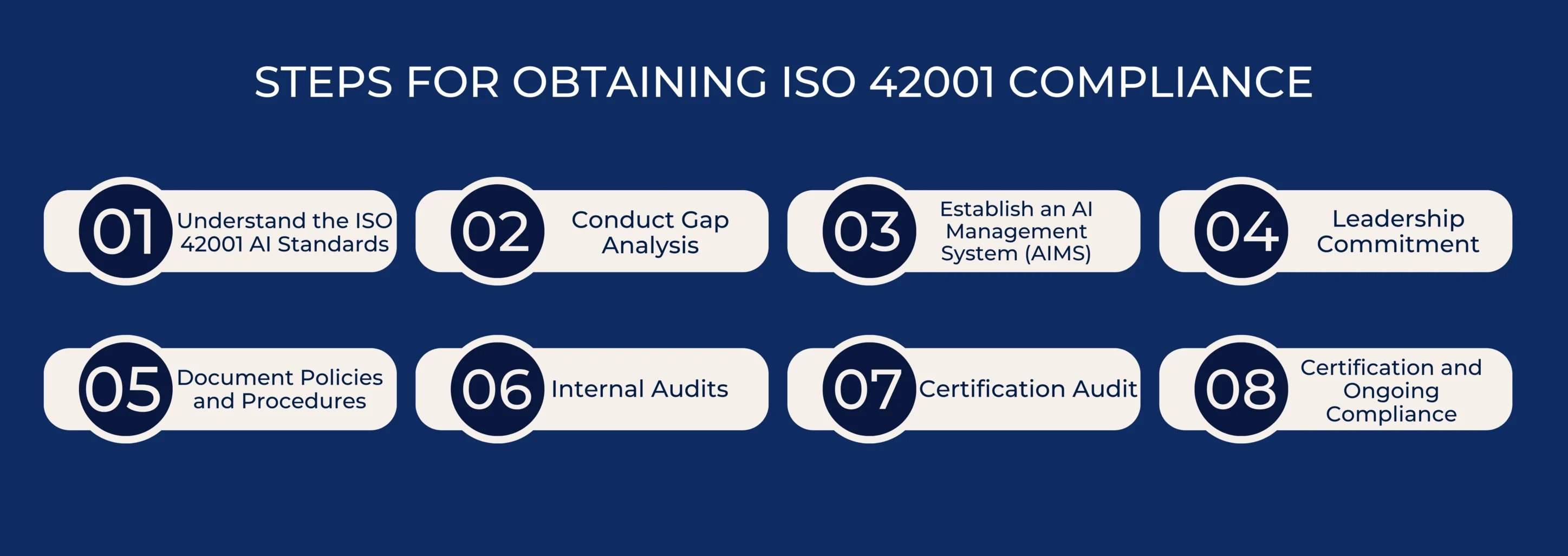
- ✓Stage 1 Audit: Documentation and Readiness Review
- ✓Stage 2 Audit: Operational Effectiveness and Evidence Collection
- ✓Certificate Issuance, Surveillance, and Recertification
ISO 42001 Certification Requirements for Budapest Organizations
Organizations pursuing ISO 42001 Certification in Budapest must satisfy a defined set of documentation, governance, and operational requirements before the certification audit can be completed successfully. These requirements are derived directly from ISO/IEC 42001:2023 and are assessed by CertPro auditors through structured evidence review.
The following overview identifies the principal requirement categories evaluated during the ISO 42001 examination — covering documentation, leadership obligations, and AI risk assessment processes.
ISO 42001 compliance requires organizations to maintain a structured set of documented information as evidence of AIMS implementation. Core documentation includes the AI policy endorsed by top management, an AI risk assessment covering all in-scope AI systems, a risk treatment plan documenting selected controls and their justification, a statement of applicability identifying applicable and implemented Annex A controls, and records of internal audits and management reviews.
Additionally, organizations must maintain operational records demonstrating that AI lifecycle management processes, human oversight mechanisms, and data governance controls are functioning as documented. For Budapest-based organizations with multiple AI applications across business units, documentation must clearly map each in-scope AI system to the applicable risk assessment and control framework.
Documentation reviewed during the ISO 42001 audit must be version-controlled, accessible to responsible personnel, and reflective of the organization’s current AI operations. Outdated or incomplete documentation represents a potential nonconformity under Clause 7.5 of the standard. CertPro auditors assess not only whether required documents exist but also whether they are maintained in a manner consistent with the standard’s requirements for documented information management.
Organizations operating shared service centers or BPO operations in Budapest that use AI for process automation must ensure their documentation reflects the AI systems deployed within those operations — not just AI systems developed internally by the organization.
ISO/IEC 42001:2023 imposes specific obligations on top management regarding AI governance. Clause 5 requires that senior leadership demonstrate commitment to the AIMS by establishing and communicating an AI policy, assigning roles and responsibilities for AI governance, ensuring adequate resources for AIMS operation, and integrating AI management objectives into the organization’s strategic planning processes.
CertPro auditors assess top management commitment through interviews, review of governance records, and examination of the AI policy’s communication and endorsement evidence. For organizations in Budapest’s financial services sector — where AI is used in credit risk, fraud detection, and customer service — demonstrating that executive leadership actively oversees the AI governance framework is a substantive audit requirement, not a procedural formality.
- ✓AI policy established and approved by top management
- ✓AI risk assessment conducted for all in-scope AI systems
- ✓Risk treatment plan with documented control selections
- ✓Statement of applicability covering Annex A controls
- ✓Internal audit program and completed audit records
- ✓Management review records demonstrating AIMS oversight
- ✓Human oversight mechanisms documented and operational
- ✓Corrective action process established and evidenced
The AI risk assessment process under ISO 42001 requires organizations to identify AI systems within scope, assess the potential impacts of those systems on individuals, groups, and the organization itself, evaluate the likelihood and severity of identified risks, and select and implement controls to treat risks to acceptable levels. The Annex A control set provides a reference framework, but organizations may also implement additional controls tailored to their specific AI risk profile.
CertPro’s ISO 42001 examination assesses whether the risk assessment methodology is systematic, documented, and consistently applied across all in-scope AI systems. For Budapest organizations deploying AI in regulated contexts — such as financial services, healthcare technology, or automotive systems — the risk assessment must address sector-specific impact scenarios with appropriate specificity and detail.
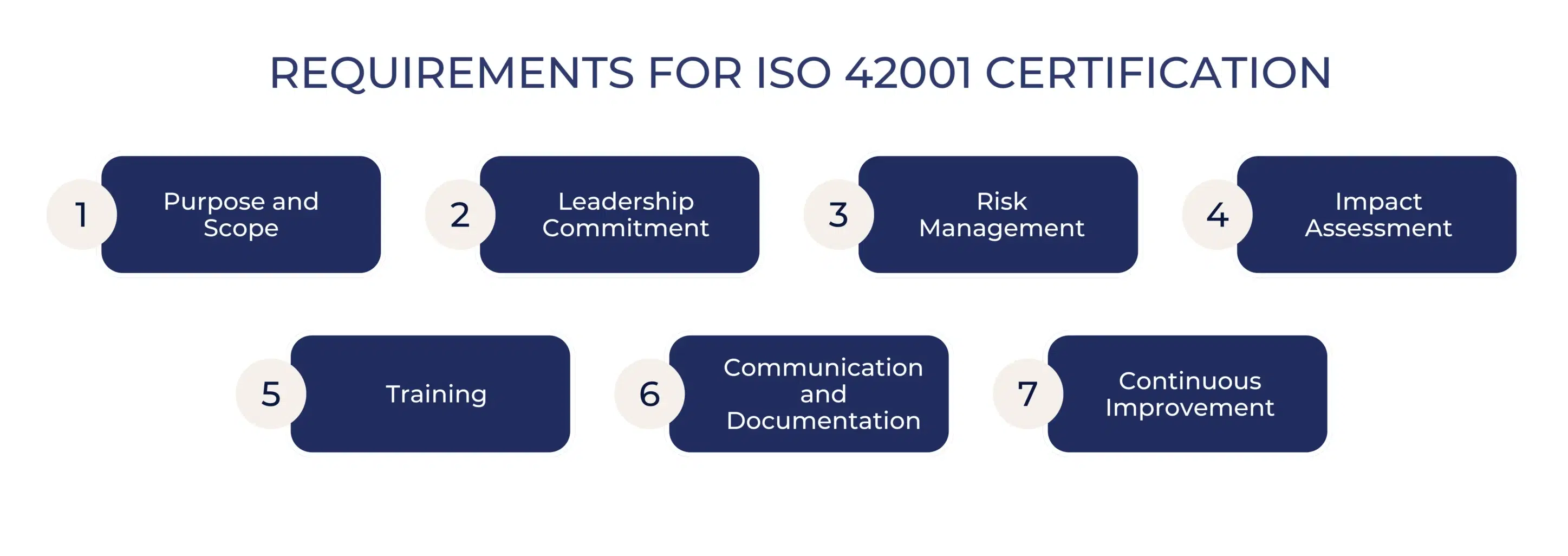
- ✓Documentation Requirements
- ✓Governance and Leadership Requirements
- ✓AI Risk Assessment and Control Evaluation
Why Budapest Organizations Pursue ISO 42001 Certification
Demand for ISO 42001 Certification in Budapest is driven by a convergence of enterprise procurement requirements, regulatory developments, and competitive positioning needs specific to the city’s technology and financial services ecosystem. Budapest-based organizations — particularly those providing AI-enabled services to clients in Western Europe, the United Kingdom, and North America — face increasing pressure to demonstrate structured, independently verified AI governance as a precondition of contract award and ongoing vendor qualification.
ISO 42001 compliance and the corresponding attestation give these organizations a credible, standardized credential that replaces fragmented, client-specific AI governance questionnaires with a single, recognized certification.
Enterprise Vendor Due Diligence and Procurement Requirements
Enterprise procurement processes at regulated financial institutions, healthcare organizations, and government entities increasingly require AI vendors and service providers to demonstrate independent certification of their AI governance frameworks. ISO 42001 certification for Budapest companies operating as vendors to these organizations provides a structured, auditable attestation that satisfies due diligence questionnaires, vendor risk assessments, and procurement qualification requirements.
Rather than responding to multiple client-specific AI governance questionnaires with self-assessments, certified organizations can present their ISO 42001 certificate and surveillance audit records as documented evidence of AIMS conformance. This reduces the administrative burden of vendor qualification processes while providing clients with a standardized basis for AI governance evaluation.
Budapest’s role as a shared services and BPO hub for multinational corporations creates a specific vendor assurance dynamic. Parent companies and clients conducting third-party risk management reviews of their Budapest-based service centers increasingly include AI governance assessments alongside information security and data protection reviews.
ISO 42001 compliance provides the documented framework that satisfies these reviews — particularly where the service center operates AI-assisted processes for financial reporting, customer interaction, HR administration, or supply chain management. ISO 42001 Certification in Budapest is especially relevant for financial services providers, as their clients in regulated industries apply stringent vendor governance standards to AI-assisted service delivery.
EU AI Act Alignment and Regulatory Positioning
The EU Artificial Intelligence Act, which entered into force in August 2024 and is being phased in through 2026, establishes binding requirements for providers and deployers of high-risk AI systems operating within the European Union. Budapest-based organizations developing or deploying AI systems that qualify as high-risk under the EU AI Act — including AI systems used in credit scoring, employment decisions, critical infrastructure management, and biometric identification — must demonstrate conformance with risk management, data governance, human oversight, transparency, and accuracy requirements.
These obligations closely parallel the AIMS requirements of ISO/IEC 42001:2023. ISO 42001 certification provides organizations with a documented, independently audited governance framework that supports EU AI Act compliance positioning, though it does not constitute legal compliance certification under the regulation itself.
Fintech and Financial Services AI Governance
ISO 42001 certification for Budapest fintech organizations is driven by the sector’s extensive use of AI in credit risk modeling, fraud detection, anti-money laundering, algorithmic trading, and robo-advisory services. Financial regulators and supervisory authorities — including the Magyar Nemzeti Bank (MNB) and European supervisory authorities — are increasing their scrutiny of AI governance practices at regulated financial institutions and their technology vendors.
ISO 42001 certification provides fintech and financial services organizations with a structured, independently verified AI governance framework that can be presented to regulators, board audit committees, and institutional clients as evidence of disciplined AI management. The certification also supports the alignment of AI governance with existing information security management systems certified under ISO 27001, creating an integrated governance posture across information security and AI management domains.
Sectors in Budapest Seeking ISO 42001 Certification
ISO 42001 Certification in Budapest spans a broad range of industry sectors, reflecting the city’s diverse technology and services economy. The following sectors represent the primary organizational profiles engaging with CertPro for ISO 42001 certification audit services in Budapest and the surrounding region. Each sector presents distinct AI governance challenges that the ISO 42001 examination is specifically designed to address.
Technology, SaaS, and Cloud Service Providers
Budapest hosts a significant concentration of SaaS companies, cloud service providers, and software development organizations serving enterprise clients across Europe and North America. These organizations frequently develop or integrate AI capabilities into their products — including natural language processing, predictive analytics, recommendation engines, and automated decision support tools.
ISO 42001 certification provides SaaS and cloud providers with a third-party attestation of their AI governance framework that can be included in security questionnaire responses, vendor qualification submissions, and marketing materials directed at enterprise prospects. For Budapest-based software development companies serving regulated industries, the ISO 42001 examination results in a certificate that supports client due diligence reviews and demonstrates AI governance maturity consistent with international standards.
Cloud service providers operating AI-powered infrastructure or platform services from Budapest data centers face vendor assurance requirements from their enterprise clients that specifically address AI system governance. ISO 42001 compliance provides the documented evidence that cloud providers need to satisfy these requirements — covering AI system lifecycle management, data governance for AI training and inference data, supplier AI governance, and incident response for AI system failures.
The certification is particularly relevant for multi-tenant cloud platforms where AI capabilities are offered as shared services, as the AIMS must address governance of AI systems that impact multiple client organizations simultaneously. CertPro’s ISO 42001 audit evaluates these multi-tenant governance arrangements within the defined certification scope.
Shared Services, BPO, and Financial Services Organizations
Budapest’s established position as a shared services and business process outsourcing center for multinational corporations creates significant demand for AI management system certification among organizations operating regional service delivery centers. These organizations increasingly deploy AI for process automation, document processing, customer interaction management, financial reconciliation, and HR administration — all of which require structured AI governance to satisfy parent company oversight requirements and client contractual obligations.
ISO 42001 Certification in Budapest for financial services centers provides the independent attestation that parent company audit teams and external auditors require when reviewing AI governance at regional service delivery operations. The certification supports third-party risk management programs at parent organizations by providing structured, auditable evidence of AI governance at the service center level.
| Sector | Primary AI Applications | ISO 42001 Relevance |
|---|---|---|
| Fintech and Financial Services | Credit scoring, fraud detection, AML, robo-advisory | Regulatory scrutiny, MNB oversight, client due diligence |
| SaaS and Cloud Providers | Predictive analytics, NLP, recommendation engines | Enterprise vendor qualification, procurement requirements |
| Shared Services and BPO | Process automation, document processing, HR AI tools | Parent company risk management, client contractual requirements |
| Software Development and IT Services | AI-assisted development tools, testing automation | Client due diligence, international expansion requirements |
| Automotive Engineering | AI-assisted design, quality control, autonomous systems | Industry supplier qualification, safety governance requirements |
Benefits of ISO 42001 Certification for Budapest-Based Organizations
ISO 42001 Certification in Budapest delivers a structured set of verifiable outcomes for organizations that complete the certification process. These outcomes are directly tied to the audit evidence collected and the independent certification decision issued by CertPro’s certification committee — not to advisory inputs or implementation activities.
The following benefits reflect the substantive outcomes of ISO 42001 attestation for organizations operating in Budapest’s technology and financial services sectors, addressing both operational governance and market positioning advantages.
ISO 42001 attestation provides organizations with independently verified evidence that their AI governance controls are designed adequately and operating effectively. This verification is conducted by CertPro’s auditors without advisory involvement — the audit team assesses evidence, identifies conformance or nonconformity, and reports findings to the certification committee. The resulting certificate represents an objective, third-party determination of AIMS conformance that carries significantly more weight in enterprise procurement and regulatory contexts than self-assessed AI governance statements.
For Budapest-based organizations competing for contracts with regulated financial institutions or government entities, this independent verification is frequently a differentiating factor in vendor qualification processes.
The ongoing surveillance audit cycle — conducted annually by CertPro — ensures that the ISO 42001 attestation remains current and reflects the organization’s actual AI governance posture rather than a point-in-time snapshot. This continuous verification model provides clients, regulators, and audit committees with confidence that the organization’s AIMS is maintained and improved over time, not simply established for certification purposes and subsequently neglected.
Organizations that demonstrate consistent performance across multiple surveillance cycles build a track record of AI governance maturity that strengthens their position in competitive procurement processes and regulatory interactions.
The ISO 42001 certification process requires organizations to implement and evidence a structured AI risk management framework — a requirement that produces tangible operational benefits beyond the certificate itself. Organizations that complete the ISO 42001 examination have, by definition, conducted systematic risk assessments of their AI systems, implemented documented controls, assigned accountability for AI governance, and established monitoring mechanisms.
These structural elements reduce the likelihood of undetected AI system failures, support faster incident response, and provide the governance documentation needed to satisfy regulatory inquiries. For Budapest organizations operating in fast-moving AI development environments, the structured AIMS framework provides a disciplined governance foundation that scales with the organization’s expanding AI capabilities.
- ✓Independent third-party attestation of AIMS conformance for client and regulatory use
- ✓Structured AI risk assessment covering all in-scope AI systems
- ✓Documented accountability framework for AI-assisted decision-making
- ✓Recognized certification supporting EU AI Act governance alignment
- ✓Annual surveillance audit confirming ongoing AIMS effectiveness
- ✓Competitive differentiation in enterprise vendor qualification processes
- ✓Portable, internationally recognized certificate for cross-border client engagements
- ✓Integration pathway with ISO 27001 and other management system certifications
ISO 42001 certification is recognized internationally as evidence of AI management system conformance, providing Budapest-based organizations with a portable credential that supports cross-border business development. Organizations pursuing contracts with clients in Germany, Austria, the Netherlands, the United Kingdom, or the United States can present their ISO 42001 certificate as documented evidence of AI governance maturity without adapting to client-specific assessment frameworks.
This recognition is particularly valuable for organizations expanding beyond the Central and Eastern European market, where international clients increasingly require independent AI governance certification as a condition of procurement. ISO 42001 Certification in Budapest positions financial services technology providers competitively against vendors from markets where AI governance certification is more established — making it a strategic asset for international growth.
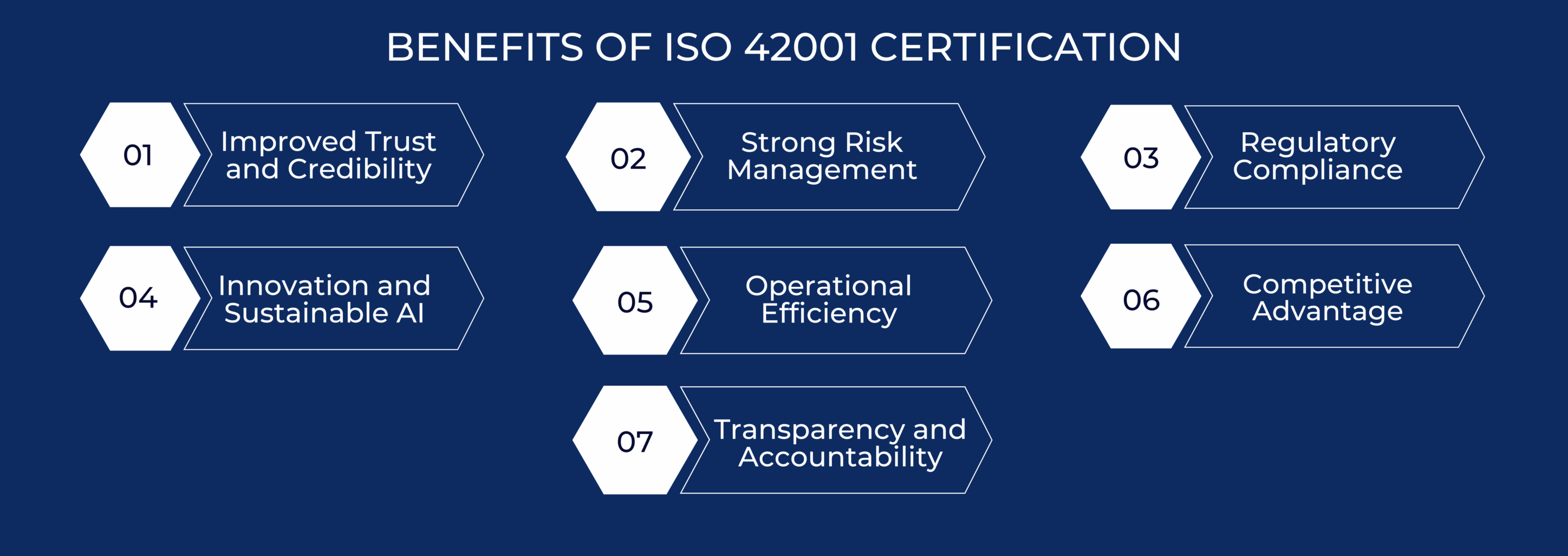
- ✓Independent Verification of AI Governance Controls
- ✓Structured AI Risk Management and Accountability Framework
- ✓Recognition in International Procurement and Cross-Border Engagements
ISO 42001 Compliance and the EU AI Act: Budapest Context
ISO 42001 compliance in Budapest operates within a rapidly evolving regulatory environment shaped by the EU Artificial Intelligence Act, the EU General Data Protection Regulation, and sector-specific AI governance expectations from financial and operational regulators. Understanding how ISO 42001 certification relates to these regulatory obligations is essential for Budapest-based organizations evaluating their AI governance strategy and long-term compliance roadmap.
ISO 42001 and EU AI Act Governance Alignment
The EU AI Act establishes a risk-based regulatory framework for AI systems, with the most stringent requirements applying to high-risk AI applications across defined sectors including financial services, employment, education, critical infrastructure, and law enforcement. Organizations in Budapest that develop or deploy high-risk AI systems must satisfy EU AI Act requirements for risk management systems, data governance, technical documentation, human oversight, accuracy and robustness, and transparency to users.
ISO/IEC 42001:2023 addresses many of these same governance dimensions through its AIMS requirements — creating a significant degree of structural alignment between ISO 42001 compliance and EU AI Act conformance obligations. While ISO 42001 certification does not constitute EU AI Act compliance certification, it provides documented evidence of a structured AI governance framework that regulators and conformity assessment bodies can reference in their evaluations.
For Budapest-based organizations required to register high-risk AI systems in the EU AI Act database, maintain technical documentation, conduct conformity assessments, or appoint an EU representative, ISO 42001 certification provides a governance foundation that supports these obligations. The AIMS documentation requirements — including the AI risk assessment, risk treatment plan, and operational records — align with the technical documentation and risk management records required by the EU AI Act for high-risk AI systems.
CertPro’s ISO 42001 audit evaluates these documentation elements against the standard’s requirements, and the resulting audit evidence supports the organization’s broader regulatory compliance documentation. This alignment does not replace sector-specific regulatory requirements but provides a structured, auditable framework that complements them effectively.
GDPR Integration and Data Governance for AI Systems
AI systems in Budapest’s technology and financial services sectors frequently process personal data in the context of model training, inference, and decision-making — creating direct intersections between ISO 42001 compliance and GDPR obligations. The ISO/IEC 42001:2023 standard’s data governance requirements address data quality, data provenance, and data lifecycle management for AI systems, covering elements that also bear on GDPR Article 5 data minimization, accuracy, and storage limitation principles.
For organizations conducting Data Protection Impact Assessments (DPIAs) under GDPR Article 35 for AI-assisted processing activities, the ISO 42001 risk assessment records and Annex A control documentation provide a structured evidence base that supports and complements the DPIA process. CertPro’s ISO 42001 audit does not assess GDPR compliance directly but evaluates the data governance controls within the AIMS scope as required by the standard.
CertPro’s Role as an Independent ISO 42001 Certification Body in Budapest
CertPro operates exclusively as an independent certification body for ISO 42001 Certification in Budapest. As a Licensed CPA Firm, CertPro’s certification activities are governed by professional independence standards that prohibit the firm from providing consulting, implementation, readiness preparation, or advisory services to organizations it certifies.
This structural independence is the foundation of the certification body’s authority to issue ISO 42001 attestation. The certificate derives its value from the auditor’s independence from the certified organization — not from any involvement in the organization’s AIMS design or implementation process.
Certification Body Independence and Conflict of Interest Management
CertPro’s independence framework requires that audit team members have no prior consulting, advisory, or employment relationship with the organizations they audit. Prior to each engagement, CertPro conducts a conflict-of-interest assessment to confirm that the assigned audit team meets independence requirements. This assessment covers direct financial interests, prior consulting engagements, personal relationships with key personnel, and any other circumstances that could impair the objectivity of the ISO 42001 audit.
For Budapest-based organizations that have previously engaged consultants or advisors for AIMS implementation, CertPro’s independence protocols ensure that the certification audit is conducted by personnel with no connection to those advisory engagements. This separation is critical to the credibility of the ISO 42001 attestation issued upon successful certification.
The certification committee that issues the final ISO 42001 certification decision operates independently from the audit team that conducted the Stage 1 and Stage 2 audits. Committee members review the complete audit file — including all audit reports, evidence summaries, nonconformity records, and corrective action responses — and make the certification decision based solely on the audit evidence presented.
This committee-based decision structure ensures that the certification decision is not influenced by commercial considerations, client relationship management, or audit team perspectives. CertPro’s ISO 42001 audit engagements in Budapest follow this same committee decision structure regardless of the size, complexity, or commercial significance of the organization under review.
Audit Methodology and Evidence Standards
CertPro’s ISO 42001 examination methodology is designed to produce audit evidence that is sufficient, appropriate, and reproducible — meeting the evidentiary standards required for certification body operations. Audit evidence is collected through document review, structured interviews with responsible personnel, observation of operational processes, and technical review of AI system documentation and monitoring records.
Auditors apply sampling techniques calibrated to the scope and complexity of the organization’s AI system portfolio, ensuring that the audit evidence base is representative of the AIMS’s operational effectiveness across the full scope. For Budapest organizations with large or complex AI portfolios — such as financial services firms with multiple AI models or technology companies with diverse AI product lines — the audit program is structured to provide adequate coverage without unnecessary duplication.
FAQ
▶
What is ISO 42001 certification and who issues it in Budapest?
▶
Which Budapest organizations need ISO 42001 certification?
▶
What is the difference between Stage 1 and Stage 2 of the ISO 42001 audit?
▶
How long is an ISO 42001 certificate valid?
▶
Does ISO 42001 certification satisfy EU AI Act compliance requirements?
▶
What documentation is required before the ISO 42001 audit can begin?
▶
Can ISO 42001 certification be integrated with ISO 27001 certification?
▶
What happens if nonconformities are identified during the ISO 42001 audit?
ISO 42001 CERTIFIED: WHY AI GOVERNANCE CERTIFICATION IS BECOMING A BOARD-LEVEL REQUIREMENT
ISO 42001 Certified: Board-Level AI Governance Guide | CertPro CPA LLC HERO ══════════════════════════════ –> src=”https://certpro.com/wp-content/uplo…

Get In Touch
have a question? let us get back to you.