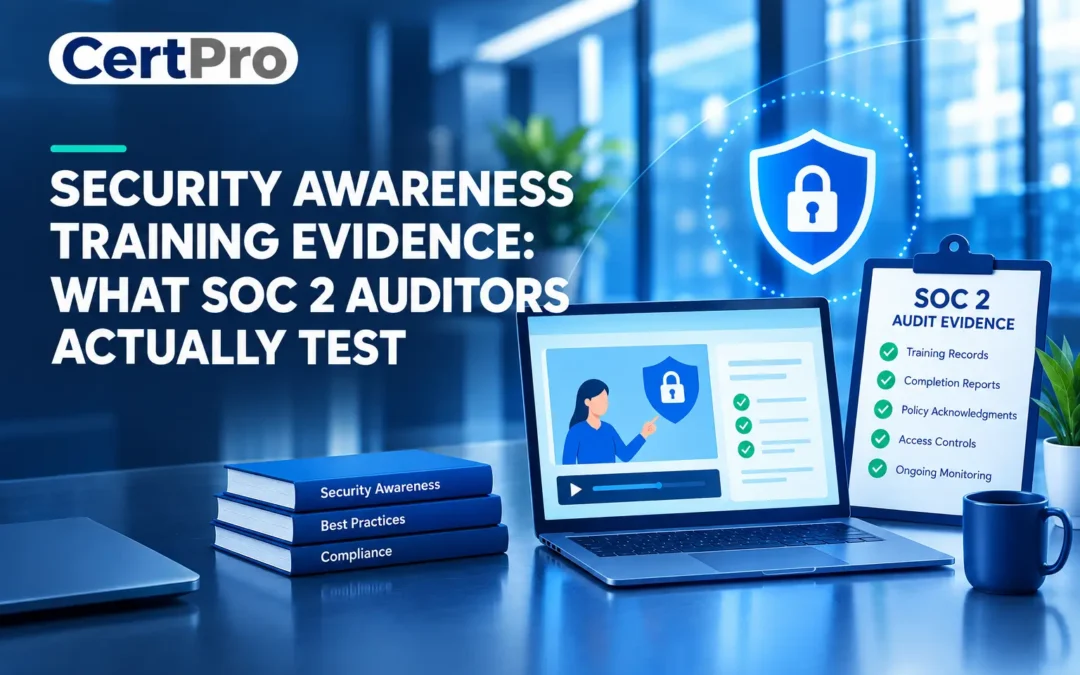

Security awareness training communicates security responsibilities and develops personnel competence. During a SOC 2 examination, auditors may evaluate the control against CC1.4 and CC2.2 of the AICPA Trust Services Criteria. They inspect management's policies and training content, then test relevant records against the defined population. Evidence may include personnel rosters, assignment dates, completion records, course versions, and follow-up records. Type 1 and Type 2 examinations apply different testing periods and objectives.
Most SOC 2 audit findings related to security awareness training are not caused by poor training content. They arise when training records fail to support management's stated control requirements. An organization can run a thoughtful, role-appropriate security awareness training program and still receive a qualified opinion if its evidence does not establish that the control operated as described during the examination period.
Security awareness training in the SOC 2 context is the formal control mechanism by which an organization communicates security objectives and employee responsibilities, and then proves that communication reached every person in scope. The AICPA's Trust Services Criteria, specifically Common Criteria 2.2, creates an affirmative obligation: management must actively push security expectations to personnel, not assume those expectations are self-evident.
This article identifies exactly which evidence categories are requested, how population scope is evaluated, what changes between a Type 1 and a Type 2 examination, and what behavioral proof now means to an independent CPA firm conducting a SOC 2 engagement.

Concern
Organizations with a functioning security awareness training program still receive audit findings. It happens not because their content is weak, but because their evidence is incomplete, their population scope is undefined, or their records do not survive the sampling methodology an independent auditor applies across a full observation window.
Overview
SOC 2 Type 2, which stands for an examination of controls over a defined period, requires evidence that security awareness training operated consistently, not merely that it exists. Auditors test population definitions, completion timestamps, assessment scores, and behavioral indicators such as phishing simulation results.
Solution
Understand precisely the evidence an independent auditor evaluates, including records that demonstrate training completion, coverage of every in-scope individual, and continuity across the examination period, including employees, contractors, and third parties with logical access.
What Is Security Awareness Training Under the SOC 2 Trust Services Criteria?
Awareness and Training as Two Evidence Types
Security awareness training communicates expected security behavior, reporting responsibilities, and applicable policies. Training also develops the competence personnel need to perform their assigned duties.
Auditors distinguish evidence of communication from evidence of participation. A policy acknowledgment may demonstrate that an individual acknowledged a policy. A dated course record may demonstrate participation in a training activity. Neither record automatically proves the other activity.
The examiner evaluates the evidence against management's control description and the applicable criteria. The required evidence depends on the control's stated objective and operation.
Criteria Mapping: CC1.4 and CC2.2
Auditors may reference CC1.4 (commitment to competence) when evaluating whether the program aligns with the organization's commitment to competent personnel.
CC2.2 addresses internal communication of information to support internal control responsibilities, but it does not independently prescribe a specific security awareness training program. The criterion may be relevant when evaluating how information reaches personnel and supports their internal control responsibilities.
The relevance of role-specific training depends on the organization's control design and risk assessment. For example, finance staff and developers may face different threats, requiring different training content. Generic off-the-shelf modules that do not address the organization's actual data-handling practices may therefore draw scrutiny.
The key auditor question is whether the population reflects the control's scope. Auditor tests selected individuals against management's documented requirements. The evidence should support the relevant assignment, completion, and follow-up activities.
Why the Examiner Tests Management's Own Policy
The AICPA Trust Services Criteria do not prescribe one universal training interval, course format, or curriculum for every service organization. Management defines the control procedures that address its circumstances and security responsibilities.
For example, management may require training during onboarding, annual refreshers, policy acknowledgments, or role-specific courses. The organization's written policy therefore provides important context. The auditor compares actual records with the requirements management established.
How Auditors Test the Training Control
Type 1 vs. Type 2: How the Evidence Burden Shifts
SOC 2 Type 2 stands for an independent examination of whether controls were designed appropriately and operated effectively over a defined observation window — commonly twelve months. This distinction matters enormously for security awareness training evidence.
In a Type 1 engagement, the auditor assesses whether the security awareness training program is suitably designed as of a single point in time. Evidence requirements are relatively contained: a written policy, a defined curriculum, a population scope statement, and a sample of enrollment or completion records demonstrating the program exists and is configured to operate as described.
A Type 2 engagement tests operational continuity across the full period. Auditors sample completion records and cross-reference them against hire dates and termination dates. An employee hired in March who has no training record by July may create a gap. A contractor granted production access in September who never appears in training logs may create a finding. Auditors also look for lapses: if the organization runs annual refreshers but evidence shows a seven-month gap in assignment activity, that gap must be explained.
Platform transitions, or switching security awareness training providers mid-period, are a specific Type 2 risk. Auditors expect a continuous evidence chain. Organizations that migrated platforms must retain exportable records from the prior provider covering the pre-transition months, or the observation window will show unexplained silence.
Type 1 vs. Type 2 Evidence Requirements for Security Awareness Training
-
Policy and control description
Type 1: Evidence supporting design and implementation at the specified date
Type 2: Evidence supporting design and operation during the examination period
-
Population records
Type 1: Evidence supporting the population and control scope
Type 2: Records supporting the population and relevant changes throughout the period
-
Completion records
Type 1: Evidence relevant to implementation at the specified date
Type 2: Dated records supporting operating-effectiveness testing
-
Assessments and acknowledgments
Type 1: When relevant to the control
Type 2: When relevant to the control and the testing procedures
-
Platform transition records
Type 1: When relevant to the specified date
Type 2: When relevant to continuity and the examination period
Operating Effectiveness: Sampling From the Relevant Population
The auditor selects samples from an appropriate population based on the control and examination procedures. An HR roster may support population selection, while contractor records, identity systems, or other sources may provide additional evidence.
The sample may include new hires, contractors, and personnel with late completion records when those cases fall within the population and support the auditor's testing approach.
Completeness and Accuracy of Training Records
The examiner evaluates the reliability of records and their relationship to the underlying activity. For example, the auditor may reconcile personnel records with LMS exports, compare assignment and completion dates, and inspect course identifiers.
A record that lists a person's name without a reliable date or course reference may provide limited support for the test.
Evidence the Examiner Requests
Auditors inspect the dated, versioned security awareness training policy to verify that it applied at the start of the examination period. They examine the curriculum, including the actual training content, and assess its alignment with the organization's risk assessment.
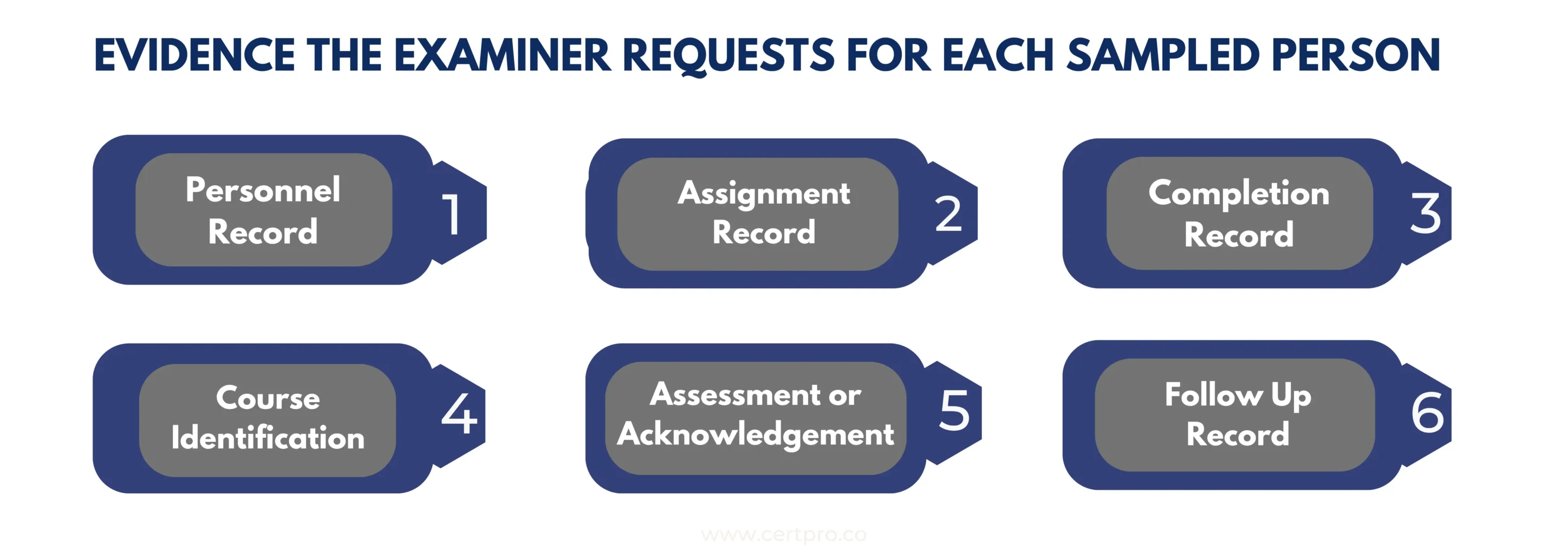
For each sampled person, the examiner may request records, depending on the control design. These may include:
- Personnel record: HR roster entry or equivalent record showing relevant employment dates.
- Assignment record: Evidence showing when management assigned the required training.
- Completion record: A dated record showing completion or another outcome required by the control.
- Course identification: Course name, version, or other information that identifies the assigned material.
- Assessment or acknowledgment: Results or acknowledgments when management's control requires them.
- Follow-up record: Evidence of action for late, missing, or incomplete training when the control requires follow-up.
These records help the auditor connect the individual, assigned requirement, and observed result. The exact evidence varies with the control and examination procedures.
What Management Should Understand About Exceptions and Records
A deviation may arise when a sampled individual lacks a required completion record, misses a stated deadline, fails a documented control requirement, or due to population discrepancies. The examiner evaluates the nature and extent of the deviation, the control's purpose, and the relevant examination evidence. An exception does not automatically determine the opinion. The training alone cannot establish the effectiveness of the organization's wider security controls.
Management may complete overdue training or correct a tracking problem after identifying a gap. The auditor considers relevant evidence about that response, including its timing and relationship to the original deviation.
However, a later completion record does not establish that the individual met an earlier deadline. For a Type 2 examination, the auditor evaluates control operation during the specified period. Management's subsequent action does not rewrite the historical test result.
Management should retain records that support the control throughout the relevant examination period, as well as any relevant historical records when personnel leave or the organization changes training platforms.
Conclusion
Security awareness training is one of the most evidence-intensive controls in a SOC 2 examination precisely because it touches every person in scope and must operate continuously across the full observation window. The auditor's question may always be whether the organization can reconstruct, for any individual with access, a complete and timestamped record of training assignment, completion, and assessed understanding.
A SOC 2 Type 2 examination evaluates security awareness training with the same rigor as access control reviews or change management. When a licensed CPA firm such as CertPro conducts SOC 2 examinations, evidence must be specific, testable, and consistent across the examination period.
Preparing for a SOC 2 Examination?
CertPro is a licensed, independent CPA firm. Schedule a meeting with our auditors to confirm the system scope, evidence requirements, and examination period for your SOC 2 engagement.