
ISO 27001 Certification in Australia
ISO 27001 certification delivers concrete, measurable benefits to Australian organisations across commercial, regulatory, operational, and reputational dimensions. Certification demonstrates that an organisation has implemented a systematically managed, independently verified ISMS — a credential that carries significant weight in government procurement, enterprise contract negotiations, and international business development. The following benefits are specific and substantive, grounded in the operational outcomes that ISO 27001 certification produces for Australian businesses operating in the current regulatory and commercial environment.
OUR CLIENTS










What Is ISO 27001 Certification
ISO/IEC 27001 is an internationally recognised standard that specifies requirements for establishing, implementing, maintaining, and continually improving an Information Security Management System (ISMS). Published jointly by the International Organization for Standardization (ISO) and the International Electrotechnical Commission (IEC), the standard defines a systematic approach to managing sensitive company and customer information so that it remains secure. ISO 27001 certification is issued only after completion of a formal third-party audit conducted by an accredited certification body, confirming that an organisation’s ISMS conforms to all mandatory clauses of the standard.
ISO/IEC 27001:2022 — The Current Operative Version
ISO/IEC 27001:2022 is the current operative version of the standard, superseding ISO/IEC 27001:2013. The 2022 revision introduced significant structural changes, most notably reducing the number of Annex A controls from 114 to 93 and reorganising them across four thematic categories: Organisational Controls, People Controls, Physical Controls, and Technological Controls. Organisations certified under the 2013 version were required to transition to ISO/IEC 27001:2022 by the transition deadline of 31 October 2025, as mandated by accredited certification bodies globally. Any new certification issued after this date must conform to the 2022 version of the standard.
The 2022 revision also introduced 11 new controls addressing emerging security domains, including threat intelligence, information security for cloud services, ICT readiness for business continuity, physical security monitoring, configuration management, web filtering, data masking, data leakage prevention, monitoring activities, secure coding, and deletion of information. These additions reflect the evolving threat landscape and the increasing reliance on cloud infrastructure, remote work environments, and digital supply chains. Organisations seeking ISO 27001 certification in Australia must demonstrate conformance to the 2022 version in all current audit engagements.
Certification Versus ISMS Implementation
ISO 27001 certification is distinct from ISMS implementation. ISMS implementation is an internal organisational activity involving the design, deployment, and operation of information security controls, policies, and processes aligned to the standard’s requirements. ISO 27001 certification, by contrast, is an external, audit-based attestation issued by an accredited certification body following a structured two-stage audit that independently verifies conformance. An organisation cannot self-declare ISO 27001 certification — the designation is only valid when conferred by an accredited third-party body following a documented audit process.
The scope of certification is organisation-defined and subject to audit verification. An organisation may certify its entire enterprise or a defined subset of its operations, systems, or locations. The defined scope must be explicitly documented in the ISMS scope statement and verified during Stage 1 and Stage 2 audits. Certification scope boundaries, including organisational units, physical locations, information assets, and technology systems within scope, are recorded in the certificate of conformance issued upon successful audit completion. Organisations must ensure that their defined scope accurately reflects the boundaries within which the ISMS operates and that all interfaces and dependencies with out-of-scope areas are clearly identified.
The ISMS Lifecycle Under ISO 27001
The ISO 27001 standard is structured around the Plan-Do-Check-Act (PDCA) lifecycle, which governs the continual improvement of the ISMS. In the Plan phase, an organisation establishes the ISMS by defining its scope, conducting a risk assessment, identifying applicable controls, and documenting an information security policy. In the Do phase, the organisation implements and operates the ISMS, including deploying selected controls from Annex A as documented in the Statement of Applicability. In the Check phase, the organisation monitors and reviews ISMS performance through internal audits, management reviews, and key performance indicators. In the Act phase, corrective and preventive actions are taken based on findings to drive continual improvement. This lifecycle ensures that ISO 27001 certification reflects an ongoing, embedded security management discipline rather than a one-time compliance exercise.
The mandatory clauses of ISO/IEC 27001:2022 — Clauses 4 through 10 — govern every element of the ISMS lifecycle. Clause 4 addresses organisational context and stakeholder requirements. Clause 5 specifies leadership and commitment obligations. Clause 6 covers planning, including risk assessment and treatment. Clause 7 defines support requirements such as resources, competence, awareness, and communication. Clause 8 covers operational planning and control. Clause 9 addresses performance evaluation, including internal audit and management review. Clause 10 requires continual improvement and corrective action. All mandatory clauses must be fully addressed and evidenced for certification to be granted — no clause may be excluded from scope.

ISO 27001 Certification in Australia — Industry Context
Australia occupies a prominent position as an Asia-Pacific hub for information technology, financial services, cloud infrastructure, and data centre operations. The country hosts a significant concentration of multinational technology companies, domestic fintech enterprises, government digital services platforms, and healthcare information systems — all of which process large volumes of sensitive personal, financial, and operational data. ISO 27001 certification in Australia has become a foundational requirement for organisations operating in these sectors, with demand for ISMS certification growing in direct proportion to the escalating frequency and sophistication of cyber threats targeting Australian institutions.
Key Sectors Driving ISO 27001 Certification Demand in Australia
Financial services organisations in Australia — including banks, insurance providers, superannuation funds, and fintech companies — represent one of the highest-demand sectors for ISO 27001 certification. These entities are subject to both voluntary international standards and mandatory regulatory requirements, making ISO 27001 a critical tool for demonstrating information security governance. The Australian Prudential Regulation Authority (APRA) Prudential Standard CPS 234 mandates that APRA-regulated entities maintain information security capabilities commensurate with the size and extent of threats to their information assets. ISO 27001 certification provides a structured framework that directly supports CPS 234 alignment, enabling regulated entities to map ISO controls — such as access control, incident management, and asset classification — to mandatory APRA requirements without duplication of effort.
Healthcare organisations and My Health Record system participants in Australia handle sensitive patient data governed by strict confidentiality and data protection obligations. Hospitals, pathology providers, medical imaging centres, telehealth platforms, and electronic health record vendors increasingly pursue ISO 27001 certification to demonstrate that their information security controls meet the standards required by both the Australian Digital Health Agency and healthcare regulators. SaaS companies and cloud service providers operating in Australia also represent a major certification segment, particularly as government procurement frameworks increasingly specify ISO 27001 certification as a baseline security credential for technology vendors.
Australian Regulatory Compliance Landscape
The Australian regulatory environment for information security is shaped by several interconnected legislative and regulatory instruments. The Privacy Act 1988 (Cth) establishes the foundational legal framework for the handling of personal information in Australia, supported by the Australian Privacy Principles (APPs), which impose specific obligations on organisations regarding the collection, use, storage, and disclosure of personal data. The Notifiable Data Breaches (NDB) scheme, established under Part IIIC of the Privacy Act, requires organisations to notify the Office of the Australian Information Commissioner (OAIC) and affected individuals when an eligible data breach is likely to result in serious harm. ISO 27001 certification supports compliance with the NDB scheme by establishing documented incident detection, response, and notification procedures as part of the ISMS.
The Australian Cyber Security Centre (ACSC) publishes the Essential Eight — a prioritised set of mitigation strategies designed to protect organisations against the most common cyber threats. While the Essential Eight and ISO 27001 are distinct frameworks, they are complementary. ISO 27001 certification provides the governance structure, risk management discipline, and documented control evidence that reinforces Essential Eight implementation. Critical infrastructure operators designated under the Security of Critical Infrastructure Act 2018 (SOCI Act) face additional obligations, and ISO 27001 certification is increasingly referenced as an appropriate standard for demonstrating security maturity under SOCI Act reporting requirements. Government entities subject to the Protective Security Policy Framework (PSPF) and the Information Security Manual (ISM) similarly benefit from ISO 27001 certification as a mechanism for evidencing security baseline conformance.
ISO 27001 and Cross-Border Data Compliance in Australia
Australian organisations engaged in cross-border data transfers — particularly those transferring personal information to overseas service providers or operating internationally — face obligations under Australian Privacy Principle 8, which requires that organisations take reasonable steps to ensure that overseas recipients handle personal information in accordance with the APPs. ISO 27001 certification provides a recognised international standard that can serve as evidence of adequate information security controls in cross-border data transfer arrangements, supporting compliance documentation for APP 8 obligations. Multinational organisations headquartered outside Australia that hold ISO 27001 certification can demonstrate to Australian regulators and clients that their global ISMS meets internationally recognised security standards, facilitating data sharing arrangements and commercial relationships with Australian entities.
| Australian Regulatory Framework | Relevance to ISO 27001 Certification |
|---|---|
| Privacy Act 1988 & Australian Privacy Principles (APPs) | ISO 27001 ISMS controls support personal data protection obligations under the APPs |
| Notifiable Data Breaches (NDB) Scheme | ISO 27001 incident management controls support breach detection, response, and notification processes |
| APRA CPS 234 | ISO 27001 controls map directly to CPS 234 information security capability requirements for regulated entities |
| ACSC Essential Eight | ISO 27001 governance framework supports Essential Eight implementation and maturity reporting |
| SOCI Act 2018 (Critical Infrastructure) | ISO 27001 certification provides structured security evidence for SOCI Act security obligation reporting |
ISO 27001 Audit in Australia
ISO 27001 certification in Australia requires the completion of a structured audit programme conducted by an accredited certification body. CertPro, as a Licensed CPA Firm, performs ISO 27001 audits in accordance with ISO/IEC 17021-1 (Requirements for bodies providing audit and certification of management systems) and ISO/IEC 27006-1 (Requirements for bodies providing audit and certification of information security management systems). The ISO 27001 audit cycle comprises an initial certification audit (Stage 1 and Stage 2), annual surveillance audits, and a recertification audit at the end of the three-year certification period.
Stage 1 Audit — Documentation and Readiness Review
The Stage 1 audit is a formal document review conducted by CertPro to assess the organisation’s readiness for the Stage 2 certification audit. During Stage 1, the auditor reviews the ISMS scope statement, information security policy, risk assessment methodology and results, risk treatment plan, Statement of Applicability, and key ISMS procedures. The auditor evaluates whether the ISMS documentation is sufficiently developed and complete to proceed to Stage 2, identifies areas of concern or potential nonconformities that must be addressed, and confirms that the audit programme for Stage 2 is appropriate given the defined scope. Stage 1 findings are documented in a formal audit report and communicated to the organisation with clear identification of issues requiring resolution prior to Stage 2.
Stage 1 audits may be conducted on-site at the organisation’s premises or remotely via secure document sharing and video conference facilities, depending on the nature of the scope and the organisation’s operational context. For organisations with complex physical security controls or multi-site operations, on-site Stage 1 visits provide additional context for scoping the Stage 2 audit programme. CertPro determines the most appropriate Stage 1 methodology based on the specific characteristics of each certification engagement. The minimum recommended interval between Stage 1 completion and Stage 2 commencement is four weeks, allowing sufficient time for the organisation to address any issues identified during Stage 1.
Stage 2 Audit — Certification Audit
The Stage 2 certification audit is a comprehensive, evidence-based evaluation of the organisation’s ISMS implementation and effectiveness. During Stage 2, CertPro auditors assess conformance with all mandatory clauses of ISO/IEC 27001:2022, evaluate the implementation and effectiveness of applicable Annex A controls, review documented evidence of ISMS operation including records of internal audits, management reviews, corrective actions, and risk assessment activities, conduct interviews with key personnel to verify awareness and competence, and inspect physical and technical controls within scope. Stage 2 findings are classified as major nonconformities, minor nonconformities, or observations, each with defined response and resolution requirements.
A major nonconformity is a failure to satisfy a mandatory requirement of ISO/IEC 27001:2022 or a systematic failure that raises serious doubt about the ISMS’s ability to achieve its intended outcomes. Major nonconformities must be resolved, with documented corrective actions and objective evidence of implementation, before the certification decision is made. A minor nonconformity represents a single isolated failure that does not indicate a systematic problem. Minor nonconformities require a corrective action plan to be submitted and accepted by CertPro within a defined timeframe, typically 90 days following the audit. Where no major nonconformities are identified and minor nonconformities are addressed satisfactorily, CertPro proceeds to the certification decision.
Surveillance Audits and Recertification
ISO 27001 certification is valid for three years from the date of certification decision. During the three-year certification cycle, CertPro conducts annual surveillance audits — at least once in each 12-month period following initial certification — to verify that the certified ISMS continues to conform to ISO/IEC 27001:2022 requirements and that the organisation is maintaining and improving its ISMS in accordance with the standard. Surveillance audits are less comprehensive than the initial Stage 2 audit but must cover the mandatory clauses, significant changes to the ISMS or the organisation, corrective actions from previous audits, and a rotating sample of Annex A controls. Failure to maintain the ISMS to the required standard or refusal to undergo scheduled surveillance audits may result in suspension or withdrawal of certification.
Recertification audits are conducted at the end of the three-year certification period, prior to certificate expiry. The recertification audit evaluates overall ISMS performance across the certification cycle, the effectiveness of the ISMS in achieving its intended outcomes, any changes to the organisational context or ISMS scope, and continued conformance with all mandatory clauses. A successful recertification audit results in the issuance of a new three-year certificate. Organisations must initiate the recertification process sufficiently in advance of certificate expiry — typically at least six months — to ensure continuity of certification status. Allowing certification to lapse requires a full initial certification audit to reinstate the certificate.

Benefits of ISO 27001 Certification for Australian Businesses
ISO 27001 certification delivers concrete, measurable benefits to Australian organisations across commercial, regulatory, operational, and reputational dimensions. Certification demonstrates that an organisation has implemented a systematically managed, independently verified ISMS — a credential that carries significant weight in government procurement, enterprise contract negotiations, and international business development. The following benefits are specific and substantive, grounded in the operational outcomes that ISO 27001 certification produces for Australian businesses operating in the current regulatory and commercial environment.
ISO 27001 certification provides Australian organisations with a structured framework for addressing multiple regulatory and contractual information security obligations simultaneously. By implementing ISO 27001 controls and maintaining a certified ISMS, organisations generate documented evidence of security controls that can be mapped to requirements under the Privacy Act 1988, APRA CPS 234, the NDB scheme, and the ACSC Essential Eight. This integrated approach reduces compliance duplication, lowers the cost of responding to regulatory inquiries and audits, and provides a consolidated body of evidence that can be presented to multiple stakeholders — regulators, clients, partners, and auditors — from a single source of truth.
For APRA-regulated entities — banks, insurance companies, and superannuation funds subject to CPS 234 — ISO 27001 certification provides a particularly strong compliance alignment mechanism. The CPS 234 requirement to maintain information security capabilities commensurate with the size and extent of information security threats maps directly to the ISO 27001 risk-based approach to ISMS design and operation. Existing ISO 27001 controls, including access control, incident management, asset classification, and cryptography, can be mapped to CPS 234 requirements without creating parallel compliance programmes, enabling regulated entities to maintain a single integrated ISMS that satisfies both ISO 27001 certification requirements and mandatory APRA obligations.
ISO 27001 certification is increasingly specified as a mandatory or preferred requirement in Australian government and enterprise procurement processes. Australian federal and state government agencies routinely require technology vendors, cloud service providers, and managed service providers to hold current ISO 27001 certification as a condition of contract eligibility. The Digital Transformation Agency (DTA) and various state-level government ICT procurement frameworks reference ISO 27001 as a recognised security baseline. For organisations tendering for government contracts, certification provides a formal, independently verified security credential that eliminates the need for extensive ad hoc security questionnaires and enables faster procurement decisions.
In enterprise procurement contexts, particularly in financial services, healthcare, and critical infrastructure, ISO 27001 certification reduces the due diligence burden imposed on prospective vendors by demonstrating a structured, audited security programme. Large enterprise buyers increasingly request copies of suppliers’ ISO 27001 certificates as part of vendor onboarding and annual supplier assurance reviews. Certified organisations can provide their certificate of conformance and audit reports as objective evidence of security control effectiveness, reducing the time and cost associated with responding to security questionnaires and enabling faster onboarding into enterprise supplier networks.
ISO 27001 certification requires organisations to implement a comprehensive, risk-based set of information security controls that directly reduce exposure to cyber threats. The mandatory risk assessment process ensures that the ISMS is designed specifically to address the threats and vulnerabilities most relevant to the organisation’s information assets and operating environment. Controls addressing access management, malware protection, network security, vulnerability management, cryptography, and incident response — all required under applicable Annex A controls — collectively reduce the likelihood of successful cyber attacks, data breaches, and ransomware incidents. Australian organisations that maintain a certified ISMS demonstrate a measurably higher level of security maturity than those relying on ad hoc security measures.
ISO 27001 certification provides Australian businesses with a universally recognised security credential that builds demonstrable trust with clients, partners, and stakeholders. Customers entrusting an organisation with their personal or commercially sensitive data can verify, through the certificate of conformance and the certification body’s public register, that the organisation’s information security controls have been independently audited and certified to an internationally recognised standard. This verification capability is particularly valuable in B2B relationships where clients conduct formal vendor risk assessments, and in consumer-facing contexts where data privacy has become a significant purchasing consideration.
- ✓Demonstrated regulatory alignment with Privacy Act 1988, APRA CPS 234, NDB scheme, and ACSC Essential Eight
- ✓Access to Australian government procurement opportunities requiring ISO 27001 certification as a baseline security credential
- ✓Reduced vendor due diligence burden and accelerated enterprise procurement onboarding
- ✓Independently verified cyber risk reduction through systematic, risk-based security controls
- ✓Cross-border data transfer compliance support under Australian Privacy Principle 8
- ✓Enhanced incident detection and response capability through mandatory incident management controls
- ✓Reputational assurance demonstrating institutional commitment to information security
- ✓Continual improvement discipline embedded in the ISMS lifecycle
- ✓Staff security awareness and competence development as a mandatory ISMS requirement
- ✓Reduced cyber insurance premiums in recognition of certified security programme maturity
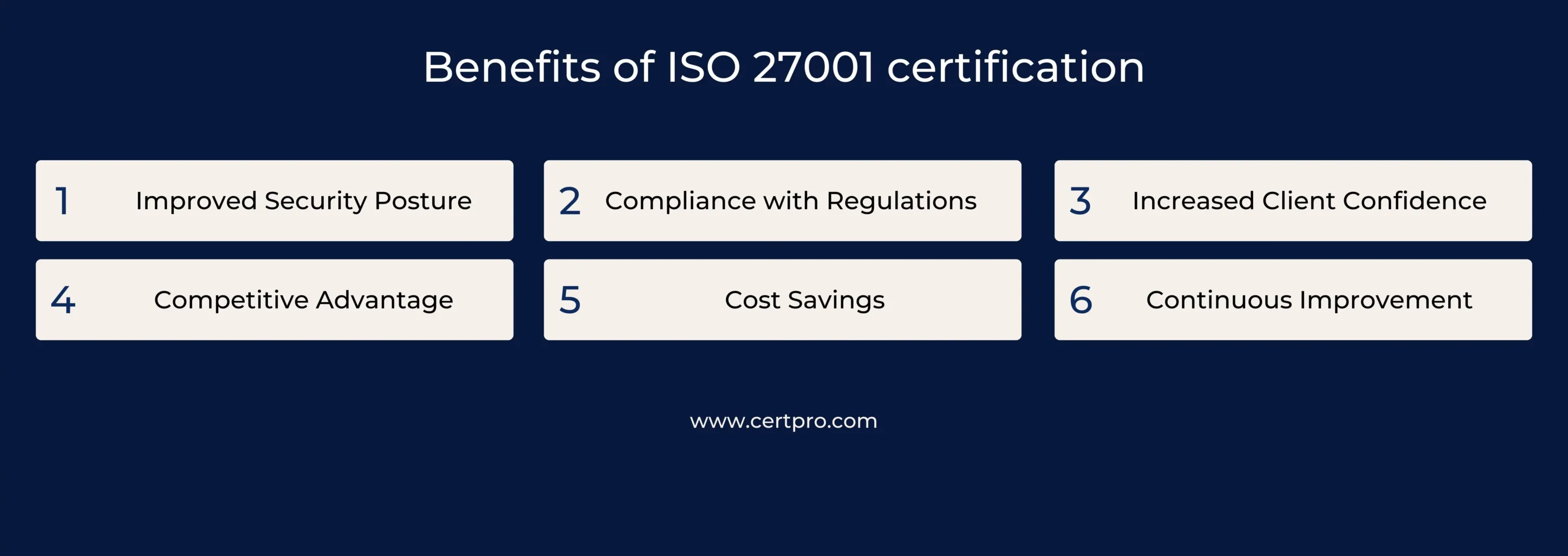
- ✓Regulatory Alignment and Compliance Efficiency
- ✓Competitive Advantage in Government and Enterprise Procurement
- ✓Cyber Risk Reduction and Incident Response Maturity
- ✓Client Trust and Cross-Border Data Transfer Compliance
Why CertPro for ISO 27001 Certification in Australia
CertPro is a Licensed CPA Firm delivering ISO 27001 certification audits in Australia. CertPro’s engagement model is strictly audit-based — all activities are structured as formal certification audit evaluations conducted in accordance with ISO/IEC 17021-1 and ISO/IEC 27006-1 requirements. CertPro does not provide consulting, advisory, or implementation services — the firm’s mandate is exclusively the independent assessment and certification of management systems, ensuring that audit independence and objectivity are maintained throughout every engagement. This specialisation positions CertPro as a certification body, not a compliance partner, providing organisations with an independently verified certification outcome that meets the most rigorous commercial and regulatory expectations.
Licensed CPA Firm — Certification Authority and Audit Independence
CertPro’s status as a Licensed CPA Firm ensures that ISO 27001 certification audits are conducted with the professional rigour, independence standards, and accountability mechanisms required of formally accredited certification bodies. Certification issued by CertPro carries the weight of a professional attestation backed by the firm’s licensed status, providing certificate holders with credentials that are recognised by Australian government agencies, enterprise procurement teams, and international counterparts. CertPro auditors are qualified information security professionals with sector-specific expertise across financial services, healthcare, government, cloud infrastructure, and critical infrastructure — enabling technically credible, context-appropriate audit evaluations for Australian organisations across all sectors.
The audit independence maintained by CertPro as a certification body is a defining characteristic that distinguishes certification from self-assessment or compliance consulting. When CertPro issues an ISO 27001 certificate of conformance, the certificate represents an independent, third-party determination that the organisation’s ISMS has been evaluated against all mandatory requirements of ISO/IEC 27001:2022 and found to be conformant. This independent attestation is what gives the certificate its commercial and regulatory value — it is not a self-declaration by the organisation, but a formal finding by a qualified, independent body accountable for the accuracy and integrity of its certification decisions.
Fixed Pricing and Transparent Engagement Model
CertPro’s fixed pricing model for ISO 27001 certification audits in Australia provides organisations with complete cost certainty from the outset of the engagement. Unlike certification bodies that quote variable audit fees subject to adjustment based on time and materials consumed, CertPro’s pricing is determined at engagement commencement based on scope, organisation size, and audit complexity — and is not subject to revision during the certification process. This model enables Australian organisations to plan and budget for ISO 27001 certification with confidence, eliminating the financial risk of cost overruns that can occur with variable-rate certification engagements. Fixed pricing applies across all stages of the initial certification cycle — Stage 1, Stage 2, and the first-year surveillance audit — and to recertification engagements at the end of the three-year cycle.
Australia-Specific Audit Delivery Capability
CertPro delivers ISO 27001 certification audits across Australia, with audit delivery capability spanning all major metropolitan and regional centres. On-site audit delivery is available in Sydney, Melbourne, Brisbane, Perth, Adelaide, Canberra, and surrounding regions. Remote audit delivery is available for organisations where on-site attendance is operationally impractical or where the ISMS scope is primarily cloud-hosted and does not require physical premises inspection. CertPro’s Australia-based audit programme ensures that scheduling, time-zone alignment, and regulatory context — including familiarity with Australian privacy law, APRA requirements, and government procurement standards — are embedded in the audit engagement from the outset.
CertPro’s sector expertise in Australian financial services, healthcare, government technology, and critical infrastructure ensures that ISO 27001 audits are conducted by professionals with direct knowledge of the regulatory and commercial environment in which Australian organisations operate. Audit teams assigned to financial services organisations are familiar with APRA CPS 234 requirements and can assess the alignment of ISO 27001 controls with mandatory prudential obligations. Audit teams serving healthcare and health information sector clients understand the specific data handling requirements of the My Health Record system, the Australian Digital Health Agency frameworks, and state health privacy legislation, ensuring that audit coverage is relevant and contextually appropriate for each sector.
FAQ
▶
What is ISO 27001 certification and why is it important for Australian businesses?
▶
How long does ISO 27001 certification take in Australia?
▶
What is the difference between ISO 27001 compliance and ISO 27001 certification?
▶
How much does ISO 27001 certification cost in Australia?
▶
How long is an ISO 27001 certificate valid in Australia?
▶
Which organisations need ISO 27001 certification in Australia?
▶
What is the current version of ISO 27001 and when was the transition deadline?
▶
What are the Stage 1 and Stage 2 audits in ISO 27001 certification?
HOW COMPLIANCE AUDIT SOFTWARE IMPROVES AUDIT READINESS
Today, most companies deal with a growing number of compliance regulations. From data privacy standards to security frameworks like SOC 2 and ISO 2700…

THE ROLE OF GRC IN ISO 27001, SOC 2, AND OTHER FRAMEWORKS
The term GRC stands for Governance Risk and Compliance. It’s a system of integrated and centralized approaches used by organizations. This system comb…
HOW TO PREPARE FOR A MULTI-STANDARD AUDIT (SOC 2, ISO 27001, HIPAA) WITHOUT OVERLAPPING EFFORTS
The current regulatory landscape is no less than a proving ground for global businesses. Organizations are struggling to comply with the complex regul…
Get In Touch
have a question? let us get back to you.