
Soc2 Certification in Australia
CertPro CPA LLC – Licensed CPA Firm conducts independent Soc2 certification audits for organizations operating across Australia. Soc2 certification evaluates the design and operating effectiveness of an organization’s controls against Soc2 requirements and regulatory standards.
OUR CLIENTS










What SOC 2 Certification Means for Australian Organisations
SOC 2 certification Australia represents one of the most significant forms of third-party security assurance available to technology service providers, SaaS companies, and data processors operating in the Australian market. Unlike a self-declared compliance statement, SOC 2 attestation Australia is issued by a Licensed CPA Firm following a formal examination of an organisation’s controls against the AICPA Trust Services Criteria. The result is an independently verified attestation report — not a certificate from a governing body — confirming that the examined controls were suitably designed and, in the case of a Type 2 report, operated effectively over a defined period.
This distinction matters significantly in Australian enterprise procurement. Vendor due diligence teams require auditor-confirmed evidence rather than policy documents alone, making SOC 2 attestation Australia the recognised standard for demonstrating credible, independent security assurance.
The governing standard for SOC 2 examinations is SSAE No. 18, section 320, issued by the American Institute of Certified Public Accountants (AICPA). The operative criteria framework is the 2017 Trust Services Criteria (2017 TSC), which the AICPA’s Assurance Services Executive Committee revised with updated Points of Focus in September 2022. These revisions did not alter the five core criteria themselves — Security, Availability, Processing Integrity, Confidentiality, and Privacy — which remain unchanged since 2017.
Security is the only mandatory criterion. The remaining four are optional but increasingly expected by clients in regulated Australian sectors including financial services, healthcare, and government contracting. The 2024 SOC benchmark study found that Availability now appears in 75.3% of SOC 2 reports and Confidentiality in 64.4%, up from 34% in 2023 — reflecting growing client expectations across the board.
For organisations pursuing SOC 2 certification Australia, the process begins with scoping decisions about which Trust Services Criteria apply to the services delivered and which systems fall within the audit boundary. A SOC 2 Type 1 certification Australia confirms that controls were suitably designed at a specific point in time. A SOC 2 Type 2 audit Australia examines whether those controls operated effectively across an observation period, typically between six and twelve months.
Type 2 reports are the standard demanded by Australian enterprise clients and APRA-regulated entities when assessing third-party vendors. Consistent control operation over time is demonstrably more meaningful than a point-in-time design assessment, which is why the SOC 2 Type 2 audit Australia has become the benchmark for serious vendor security evaluations.
The Australian regulatory environment creates specific commercial and legal reasons for organisations to obtain a SOC 2 report Australia. The Privacy Act 1988 (Cth), including the Notifiable Data Breaches (NDB) scheme, requires organisations to take reasonable steps to protect personal information. APP 11 under the Australian Privacy Principles specifically addresses security obligations that align directly with the SOC 2 Security and Confidentiality criteria.
APRA CPS 234, which governs information security for APRA-regulated entities, requires those institutions to formally assess the security capabilities of their third-party service providers — an obligation that a SOC 2 Type 2 report from a Licensed CPA Firm directly satisfies. Australian Privacy Act SOC 2 alignment has therefore become a practical compliance consideration for any technology vendor seeking to contract with banks, insurers, superannuation funds, or other regulated institutions.
SOC 2 compliance Australia is not mandated by any specific Australian statute. No provision of the Privacy Act 1988, APRA CPS 234, or any other Australian data protection regulation explicitly requires a SOC 2 report. However, the evidentiary weight of a SOC 2 attestation report issued by a Licensed CPA Firm has established it as the de facto standard for third-party security assurance Australia across enterprise technology procurement.
ASX-listed companies, government agencies, and multinational organisations operating through Australian data centre regions routinely include SOC 2 report requirements in vendor contracts. For Australian SaaS companies, managed service providers, and cloud platforms, SOC 2 certification Australia is increasingly a commercial prerequisite rather than a voluntary credential.

What Is SOC 2 Certification?
SOC 2 — System and Organisation Controls 2 — is an attestation framework developed by the AICPA to evaluate how service organisations manage customer data in relation to five Trust Services Criteria. SOC reports were formally introduced in 2011 under the Statement on Standards for Attestation Engagements (SSAE) framework, with the current governing standard being SSAE No. 18, section 320.
The framework defines two report types: Type 1, which evaluates control design at a point in time, and Type 2, which evaluates control operation over a defined period — typically six to twelve months. A SOC 2 examination is conducted exclusively by a Licensed CPA Firm or authorised public accounting organisation. No other entity may issue a valid SOC 2 attestation report, which is why SOC 2 certification Australia carries genuine evidentiary weight in procurement and regulatory contexts.
The Five Trust Services Criteria
The SOC 2 trust service criteria Australia are structured around five categories aligned to the COSO Internal Control–Integrated Framework, with cross-references to ISO 27001, NIST CSF, COBIT, and GDPR. Each criterion addresses a distinct dimension of service organisation control:
Security (CC1–CC9) is the sole mandatory criterion and covers governance, risk management, logical access, change management, operations, monitoring, and incident response. Availability addresses system uptime and performance commitments. Processing Integrity evaluates whether systems process data completely, accurately, and on time. Confidentiality governs the protection of information designated as confidential under contractual or regulatory obligations. Privacy addresses the collection, use, retention, and disposal of personal information — an area of direct relevance to Australian Privacy Principles compliance.
Organisations choose which criteria to include based on contractual commitments and client expectations. Understanding the SOC 2 trust service criteria Australia is therefore the essential first step in scoping any SOC 2 compliance Australia engagement.
A SOC 2 Type 2 examination can involve 60 to 150 or more control points, depending on the criteria selected and the complexity of the service environment. The 2024 SOC benchmark study reported that reports containing more than 150 security controls rose from 16% to 23% year-on-year, reflecting increasing control depth expectations among enterprise clients.
The AICPA also permits SOC 2 Plus examinations, which allow the auditor to include mappings to additional frameworks or regulations within the same engagement. This enables organisations to demonstrate alignment with APRA CPS 234, the Australian Privacy Principles, or other applicable standards within a single audit report — making the SOC 2 framework particularly well-suited to the diverse compliance requirements facing technology vendors across the Australian market.
Type 1 vs Type 2: Key Differences
| Characteristic | SOC 2 Type 1 | SOC 2 Type 2 |
|---|---|---|
| Evaluation Scope | Control design at a point in time | Control design and operating effectiveness over a period |
| Observation Period | Single date | Typically 6–12 months |
| Auditor Opinion | Suitably designed | Suitably designed and operating effectively |
| Enterprise Demand | Acceptable as initial credential for Australian organisations | Standard requirement for enterprise and APRA-regulated clients |
| Control Points Tested | Design review only | 60–150+ controls tested across the full observation period |
SOC 2 vs ISO 27001 in the Australian Context
SOC 2 vs ISO 27001 Australia is a common evaluation decision for organisations building out their security credentialing. ISO 27001 is an internationally recognised certification issued by accredited certification bodies, confirming that an organisation’s Information Security Management System (ISMS) meets the ISO/IEC 27001 standard. SOC 2 produces an attestation report — not a certificate — from a Licensed CPA Firm, confirming that specific controls meet the AICPA Trust Services Criteria.
The key structural difference is that ISO 27001 certifies a management system, while SOC 2 attests to specific control effectiveness. SOC 2 compliance for Australian SaaS companies is generally prioritised when the primary client base includes US-headquartered enterprises or when procurement requirements explicitly name a SOC 2 report. Organisations serving international markets frequently pursue both frameworks to address the full range of client expectations across regions.
Why SOC 2 Reports Are Requested in Australia
The demand for SOC 2 certification Australia has accelerated significantly as Australian organisations integrate cloud-based services, offshore platforms, and third-party data processors into their operations. Enterprise vendor due diligence processes now routinely specify a SOC 2 Type 2 report as a baseline security credential during supplier onboarding.
Procurement teams at ASX-listed companies, large financial institutions, and government agencies use the SOC 2 attestation report to confirm that a vendor’s controls have been independently tested — not simply documented in a self-assessment questionnaire. This shift reflects broader recognition that self-declared compliance statements do not provide the evidentiary standard required in regulated commercial relationships, driving growing reliance on third-party security assurance Australia delivered through formal CPA-led examinations.
APRA CPS 234 and Third-Party Vendor Assessment
SOC 2 APRA CPS 234 compliance represents a direct intersection point between Australian prudential regulation and international attestation standards. CPS 234 requires APRA-regulated entities — including banks, insurers, superannuation funds, and authorised deposit-taking institutions — to assess and maintain oversight of the information security capabilities of all third parties that manage or access their information assets.
A SOC 2 Type 2 attestation report from a Licensed CPA Firm provides a formally structured, auditor-verified assessment that satisfies this third-party evaluation obligation. For technology vendors seeking to contract with APRA-regulated clients in Sydney, Melbourne, or other Australian financial centres, holding a current SOC 2 Type 2 report materially reduces the due diligence burden on the regulated institution — and can be a decisive factor in vendor selection.
Beyond CPS 234, APRA’s broader expectations around operational risk management create ongoing pressure for regulated entities to obtain documented security assurances from their supply chains. SOC 2 for Australian fintech companies has become particularly prominent in this context. Fintech platforms frequently operate as third-party service providers to banks, credit unions, and payment processors that are themselves APRA-regulated.
A SOC 2 report Australia produced through a formal CPA-led examination gives the regulated institution documented evidence that its fintech vendor has been independently assessed — evidence that can be produced to APRA supervisors during prudential reviews. Australian Privacy Act SOC 2 alignment further strengthens this evidentiary value, as the report addresses control objectives that correspond directly to APP 11 obligations.
Cross-Border Data Compliance and Cloud Security
Cross-border data compliance Australia SOC 2 considerations arise when Australian organisations transfer personal information to offshore processors, or when foreign-headquartered vendors process data within Australian data centre regions. The Privacy Act 1988 places accountability on the disclosing organisation for privacy breaches by overseas recipients, making vendor attestation critically important.
SOC 2 cloud security Australia examinations address the controls governing data storage, access, encryption, and incident response within cloud environments — precisely the control domains relevant to cross-border data transfer risk. When a cloud vendor holds a current SOC 2 Type 2 report Australia covering the relevant system, the Australian disclosing organisation has documented, auditor-verified evidence of the vendor’s control posture. This supports the reasonable steps defence under the Privacy Act and strengthens compliance documentation for the OAIC.
The Consumer Data Right (CDR), which governs data sharing in the banking, energy, and telecommunications sectors, creates additional security assurance requirements for accredited data recipients and data holders. While CDR accreditation has its own specific requirements set by the ACCC and OAIC, SOC 2 cloud security Australia examinations address overlapping control domains — including access control, data encryption, audit logging, and incident management — that CDR-accredited entities are also required to maintain.
Organisations operating within the CDR regime that also hold a SOC 2 attestation report can leverage that report as supporting evidence of the technical and organisational controls underpinning their CDR compliance posture.
IRAP vs SOC 2 for Australian Government Vendors
IRAP vs SOC 2 Australia is a frequent question for technology vendors targeting Australian government contracts. The Information Security Registered Assessors Program (IRAP) is the Australian Signals Directorate’s framework for assessing cloud services and systems against the Australian Government Information Security Manual (ISM). IRAP assessments are required for vendors seeking to host government data classified at PROTECTED or above.
SOC 2 for Australian government vendors addresses a different and complementary need. It provides AICPA-standard attestation of operational security controls that satisfies US-headquartered agency requirements and enterprise procurement frameworks — but it is not a substitute for IRAP in federal government data hosting contexts. Vendors frequently hold both: IRAP for direct government contracts and SOC 2 certification Australia for commercial enterprise clients and international government agencies that require AICPA-standard attestation. Understanding IRAP vs SOC 2 Australia is therefore essential for any vendor with a mixed public and private sector client base.
SOC 2 Certification Requirements in Australia
SOC 2 requirements Australia are defined by the AICPA’s Trust Services Criteria framework rather than by Australian regulation. There is no Australian government body that mandates or registers SOC 2 certifications. The requirements flow from the 2017 Trust Services Criteria, the chosen criteria scope, and the SSAE No. 18 attestation standard under which the examination is conducted.
For Australian organisations preparing for a SOC 2 audit Australia, the foundational requirement is demonstrating that the controls in scope are both suitably designed to meet the relevant Trust Services Criteria and — for Type 2 reports — operating effectively over the observation period. Meeting this standard is what gives SOC 2 compliance Australia its commercial and regulatory credibility.
Documentation requirements for SOC 2 certification Australia centre on the System Description — a written document prepared by management that describes the services in scope, the system components (infrastructure, software, people, processes, and data), and the controls in place to meet the applicable Trust Services Criteria. The System Description must be accurate, complete, and consistent with the actual control environment examined by the auditor.
Additional documentation requirements include written policies and procedures for each control domain in scope, evidence of control operation (logs, access reviews, change records, incident reports), vendor management documentation, and risk assessment records. For organisations pursuing Australian Privacy Act SOC 2 alignment, privacy policy documentation and records of personal information handling practices are also required to support the Privacy criterion where it is included in scope.
The quality of documentation directly influences the scope and duration of a SOC 2 audit Australia. Auditors test controls against documented policies and procedures — where documentation is absent or inconsistent with observed practice, exceptions are identified and reported. For a SOC 2 Type 2 audit Australia, documentation must also demonstrate continuity of control operation across the entire observation period, not merely at a single point in time.
Audit evidence collected during a Type 2 examination includes samples drawn from across the review period. This means control failures at any point during the period can result in qualified opinions or noted exceptions in the final attestation report — reinforcing why continuous documentation discipline is essential throughout the observation window.
Technical requirements for SOC 2 certification Australia under the Security criterion — the mandatory category — include controls across logical access management, network security, encryption, vulnerability management, change management, and incident response. Specific control expectations include multi-factor authentication for privileged access, encryption of data at rest and in transit, formal access provisioning and de-provisioning processes, periodic access reviews, patch management cadence, and documented incident response procedures with evidence of testing.
For Australian SaaS companies operating multi-tenant environments, tenant isolation controls and data segregation mechanisms are also subject to examination. The auditor selects control samples across the observation period to verify that these controls operated consistently — not merely that they were configured at the start of the review window. This operational focus is what distinguishes a SOC 2 Type 2 audit Australia from a simple design review.
- ✓Logical access controls with multi-factor authentication for privileged and remote access
- ✓Encryption of customer data at rest and in transit using current cryptographic standards
- ✓Formal vulnerability management program with documented remediation timelines
- ✓Change management controls with approval workflows and post-implementation review
- ✓Incident response plan with documented procedures, roles, and evidence of testing
- ✓Vendor risk management process covering sub-service organisations and data processors
- ✓Periodic user access reviews with documented outcomes and remediation actions
- ✓Audit logging and monitoring with defined retention periods and alerting thresholds
Most Australian technology organisations rely on third-party infrastructure providers — hyperscale cloud platforms, co-location data centres, or payment processors — whose controls are relevant to the SOC 2 examination. The AICPA framework provides two methods for addressing sub-service organisations in a SOC 2 report: the Carve-Out Method, which excludes the sub-service organisation’s controls from the report and references them separately, and the Inclusive Method, which incorporates those controls within the examination scope.
For SOC 2 compliance Australia, the carve-out approach is most common. The principal organisation’s report references the sub-service organisation’s own SOC 2 report as complementary evidence. Clients and their auditors can then review both reports together to obtain a complete picture of the control environment supporting the service — an important consideration for enterprises evaluating third-party security assurance Australia across complex supply chains.
- ✓Documentation Requirements
- ✓Technical and Operational Requirements
- ✓Sub-Service Organisation Considerations
SOC 2 Certification Audit Process in Australia
The SOC 2 audit Australia is conducted exclusively by a Licensed CPA Firm under SSAE No. 18. The examination follows a defined sequence of stages — from initial scope determination through to issuance of the attestation report. Understanding each stage allows Australian organisations to allocate internal resources appropriately and ensure that audit evidence is available when required by the examination team.
The SOC 2 certification timeline Australia for a Type 2 report — from scope agreement to final report issuance — typically spans eight to fourteen months, accounting for the observation period plus audit fieldwork and reporting time. Planning ahead for this timeline is essential for organisations that need a current SOC 2 report Australia to satisfy enterprise or regulatory requirements by a specific date.
| Stage | Activity | Output |
|---|---|---|
| 1. Scope Definition | Auditor and management agree on system boundaries, criteria, and observation period | Signed engagement letter defining the SOC 2 audit scope |
| 2. Audit Program Determination | Auditor designs testing procedures for each control in scope | Documented audit program aligned to Trust Services Criteria |
| 3. Type 1 or Type 2 Assessment | Report type confirmed based on client requirements and organisation readiness | Confirmed report type and observation period start date |
| 4. Control Testing | Auditor collects and evaluates evidence across 60–150+ control points | Documented test results with any exceptions noted |
| 5. Nonconformity Review | Management responds to identified exceptions; auditor evaluates responses | Exception log with management responses and remediation evidence |
| 6. Attestation Report Issuance | Licensed CPA Firm issues signed SOC 2 attestation report with auditor opinion | Final SOC 2 report distributed under NDA to authorised recipients |
A SOC 2 readiness assessment Australia is a preliminary evaluation conducted before the formal examination to identify whether an organisation’s control environment is sufficiently mature to withstand the audit. This assessment is distinct from the SOC 2 examination itself and may be conducted by the organisation’s management team or internal audit function.
The readiness assessment evaluates whether required policies exist, whether controls are documented and operating, whether evidence is being generated and retained in a form accessible to auditors, and whether the system description accurately reflects the actual control environment. Completing this evaluation before engaging a Licensed CPA Firm reduces the risk of unexpected exceptions during fieldwork and allows the observation period to begin from a position of established control maturity — a significant advantage when planning a SOC 2 audit Australia on a defined timeline.
The SOC 2 certification timeline Australia for organisations that complete a thorough internal readiness review before the formal audit is typically shorter than for those entering the process without prior self-assessment. For a SOC 2 Type 1 certification Australia, the formal examination can typically be completed within six to ten weeks of the observation date once the auditor has received the System Description and supporting evidence.
For a SOC 2 Type 2 audit Australia, the observation period itself is the primary time driver. Most organisations select a six-month minimum observation window, with audit fieldwork and reporting adding a further two to three months after the period closes. Organisations in Sydney and Melbourne with established control environments frequently commence observation periods immediately upon engagement with their Licensed CPA Firm, making early readiness preparation especially valuable.
SOC 2 compliance Australia requires ongoing attention beyond the initial attestation. Unlike ISO 27001, which operates on a three-year certification cycle with annual surveillance audits, SOC 2 does not have a fixed recertification schedule imposed by a governing body. However, enterprise clients and APRA-regulated institutions typically require a current SOC 2 report — meaning a report whose observation period ended within the preceding twelve months.
Organisations must therefore complete annual SOC 2 Type 2 audit Australia cycles to maintain report currency. Each annual cycle begins a new observation period, with fieldwork and reporting following the close of that period. Continuous control operation between audit cycles is essential: exceptions identified during one cycle that are not remediated before the next observation period begins will recur in the subsequent report, potentially affecting the organisation’s standing with enterprise and regulated clients.
- ✓Stage-by-Stage Examination Sequence
- ✓SOC 2 Readiness Assessment Australia
- ✓Surveillance and Recertification
Benefits of SOC 2 Certification for Australia-Based Organizations
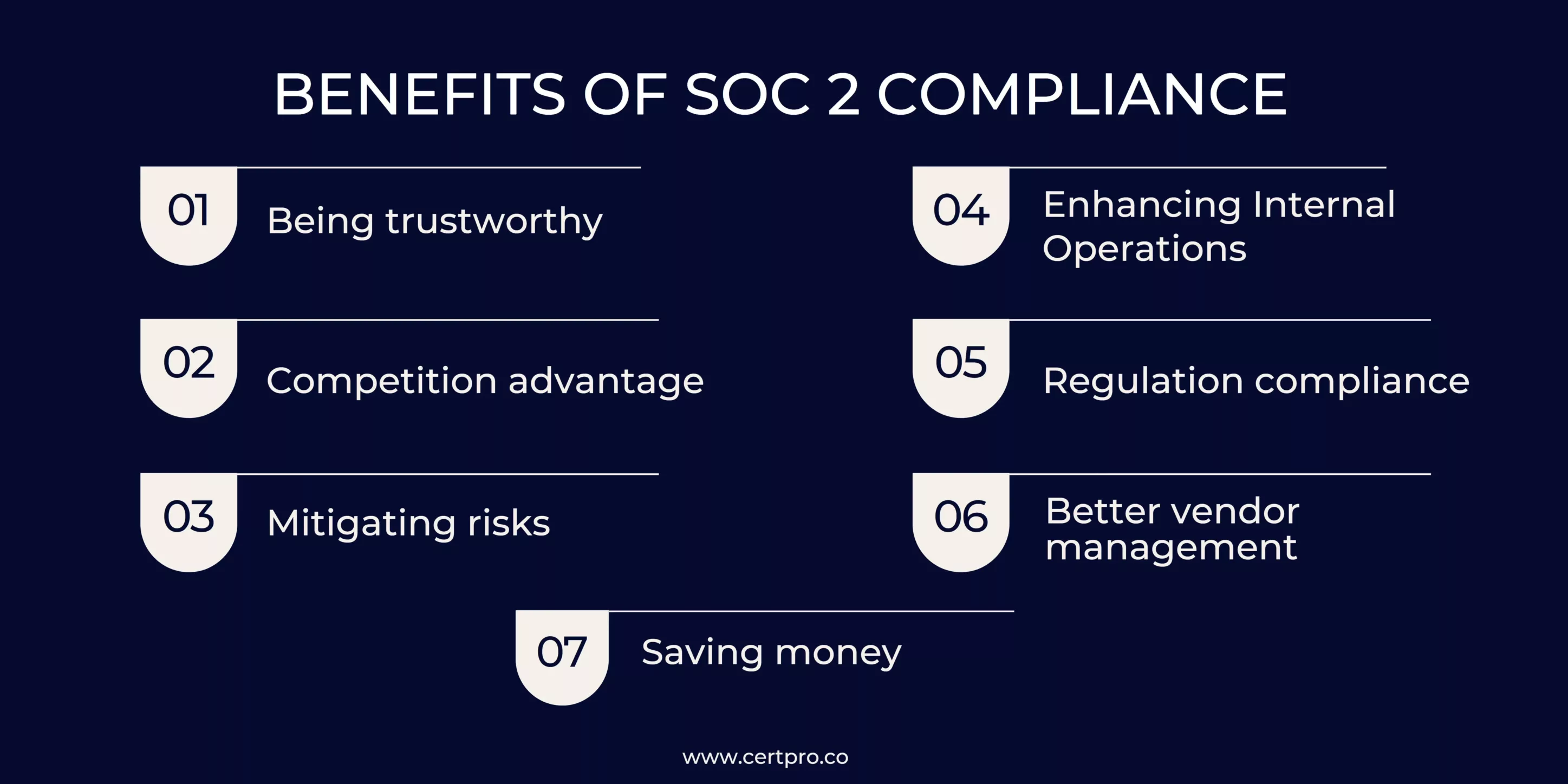
SOC 2 certified companies Australia gain a measurable commercial advantage in enterprise procurement processes where security assurance is a precondition for contract award. The benefits of SOC 2 certification Australia extend across commercial, regulatory, and operational dimensions, producing value that persists well beyond the initial attestation cycle.
For Australian organisations operating in competitive technology markets, holding a current SOC 2 Type 2 report from a Licensed CPA Firm positions the organisation as a verified, auditor-confirmed provider rather than a self-assessed one. This distinction carries increasing weight in procurement decisions at ASX-listed companies, financial institutions, and multinational enterprises with Australian operations — making SOC 2 certification Australia a strategic asset as much as a compliance credential.
SOC 2 certification for Australian companies accelerates the vendor onboarding process with enterprise clients by providing a pre-existing, auditor-verified response to the security questions that dominate procurement due diligence. Without a SOC 2 report, vendor security questionnaires can extend sales cycles by weeks or months as procurement teams seek to evaluate security posture through manual processes.
SOC 2 certified companies Australia can reference their attestation report in response to security questionnaire sections covering access control, encryption, incident response, and vulnerability management — replacing lengthy manual responses with documented, third-party-verified evidence. This reduction in procurement friction is particularly significant for SOC 2 for Australian MSPs, where winning enterprise contracts frequently depends on demonstrating a security posture that satisfies the managed service buyer’s own audit and vendor management obligations.
- ✓Accelerates enterprise vendor onboarding by providing auditor-verified responses to security due diligence requirements
- ✓Satisfies APRA CPS 234 third-party assessment obligations for vendors supplying APRA-regulated institutions
- ✓Supports Australian Privacy Act SOC 2 alignment by providing auditor-confirmed evidence of APP 11 control compliance
- ✓Enables cross-border data compliance Australia SOC 2 documentation for offshore data processing relationships
- ✓Differentiates the organisation from competitors offering only self-assessed security statements
- ✓Reduces client audit fatigue by providing a single report addressing multiple security questionnaire domains
- ✓Strengthens the organisation’s internal control environment through the discipline of annual audit cycles
- ✓Supports international market entry where US-headquartered clients require AICPA-standard SOC 2 attestation Australia
The regulatory value of SOC 2 certification Australia is most directly evident in the financial services sector, where SOC 2 APRA CPS 234 compliance intersects with commercial contracting requirements. An APRA-regulated institution that engages a vendor holding a current SOC 2 Type 2 report can use that report as a material input into its third-party risk assessment process. This reduces the internal assessment work required and provides documented evidence for its own prudential supervisory obligations.
For the vendor, the SOC 2 attestation report demonstrates that its security controls have been independently examined — not merely described. This is the standard of evidence APRA expects regulated entities to obtain from their material service providers, making SOC 2 certification Sydney and SOC 2 certification Melbourne particularly important for technology vendors serving the concentrated financial services ecosystems in those cities.
Beyond financial services regulation, SOC 2 compliance Australia provides value in relation to the Notifiable Data Breaches (NDB) scheme under the Privacy Act 1988. When a notifiable data breach occurs, the OAIC’s assessment of whether an organisation took reasonable steps to protect personal information is informed by the security measures in place at the time of the breach.
An organisation holding a current SOC 2 Type 2 report can demonstrate that its controls were independently assessed and found to be operating effectively — constituting substantive evidence of reasonable steps. This strengthens the organisation’s regulatory position in the event of an OAIC investigation and benefits clients who relied on the SOC 2 report as part of their own vendor assessment processes.
- ✓Commercial and Procurement Benefits
- ✓Regulatory and Compliance Value
SOC 2 Certification Cost in Australia
The factors that determine SOC 2 certification cost Australia are consistent with the variables that influence audit scope and complexity. These include the number of Trust Services Criteria selected, the complexity of the system environment, the number of sub-service organisations, the size of the control population, and whether the organisation is pursuing a Type 1 or Type 2 report.
SOC 2 compliance Australia engagements for organisations with simple, well-documented environments and a single criterion in scope involve fewer control points and shorter testing timelines. By contrast, organisations with complex multi-cloud architectures, multiple criteria, and extensive sub-service organisation relationships will face broader scope and greater audit effort — factors that directly affect both cost and the SOC 2 certification timeline Australia.
Factors Influencing Audit Scope and Effort
The primary drivers of audit effort in a SOC 2 audit Australia are the breadth of criteria selected and the complexity of the technical environment. Each additional Trust Services Criterion adds a distinct set of control requirements — selecting all five criteria substantially increases the control population compared to a Security-only engagement.
System complexity further multiplies effort. A SaaS organisation operating exclusively on a single hyperscale cloud platform with a carve-out for the cloud provider’s controls requires less audit testing than an organisation running across multiple data centre regions with custom networking, multiple databases, and integrated third-party services. SOC 2 certification timeline Australia is similarly affected — more complex environments require more extensive evidence collection and auditor review time, which should be factored into project planning from the outset.
Organisations seeking to manage audit scope should focus on system boundary definition early in the engagement process. Scoping decisions about which systems, services, and criteria are included in the SOC 2 examination directly determine the volume of controls tested and the evidence required.
For SOC 2 compliance for Australian SaaS companies entering their first audit cycle, a targeted initial scope — Security criterion only, covering the production SaaS environment — is a common starting point. This approach delivers a credible attestation report while maintaining manageable audit effort. Subsequent annual cycles can expand scope to include additional criteria as the organisation’s control environment matures and client expectations evolve.
Selecting SOC 2 Audit Firms Australia
SOC 2 audit firms Australia must be Licensed CPA Firms or public accounting organisations authorised to perform attestation engagements under SSAE No. 18. Not all accounting firms have the technical expertise required to conduct SOC 2 examinations across complex cloud environments. Relevant experience in information technology general controls, cloud architecture, and the AICPA Trust Services Criteria is essential.
When evaluating SOC 2 audit firms Australia, organisations should confirm that the firm holds appropriate peer review credentials, has demonstrable experience with SOC 2 examinations in comparable industries, and can provide references from SOC 2 certified companies Australia with similar system environments. The quality of the SOC 2 report Australia is directly affected by the auditor’s technical depth and their ability to design testing procedures that accurately evaluate control effectiveness — making firm selection one of the most consequential decisions in the entire SOC 2 compliance Australia process.
SOC 2 for Specific Australian Industry Sectors
SOC 2 certification Australia applies across multiple industry sectors, but its relevance and specific control expectations vary by vertical. Financial services, healthcare, SaaS, managed services, and government supply chain represent the primary sectors in which SOC 2 certification for Australian companies is both commercially and regulatorily significant.
Each sector presents distinct client expectations, regulatory intersections, and control priorities that shape the scope and content of the SOC 2 examination. Understanding sector-specific drivers helps organisations determine the right criteria, scope, and report type to maximise the commercial and compliance value of their SOC 2 compliance Australia investment.
Financial Services and Fintech
SOC 2 for Australian fintech companies is driven primarily by the requirement to contract with APRA-regulated institutions that are obligated under CPS 234 to assess vendor security capabilities. Fintech platforms operating in payments, lending, wealth management, and insurance technology frequently serve banks, credit unions, and insurers as their primary clients — and those clients require documented, third-party-verified security assurance as a condition of engagement.
The SOC 2 attestation report provides this assurance in a format that APRA-regulated institutions can use directly in their vendor risk frameworks. SOC 2 certification Sydney and SOC 2 certification Melbourne are particularly relevant for fintech companies given the concentration of financial services clients in those cities. For fintechs operating within the Consumer Data Right ecosystem, the Security and Confidentiality criteria are especially important, directly addressing the data handling obligations that CDR accreditation imposes.
SOC 2 compliance for Australian SaaS companies serving the financial sector must address the specific control expectations of regulated financial institution clients. These clients often require that vendor SOC 2 reports include the Availability and Confidentiality criteria in addition to the mandatory Security criterion, reflecting the operational dependencies and data sensitivity inherent in financial services relationships.
Some APRA-regulated clients also request that vendors provide SOC 2 reports with supplemental information addressing specific CPS 234 control categories — a capability that the AICPA’s SOC 2 Plus framework directly enables. Australian Privacy Act SOC 2 alignment within the Privacy criterion further addresses the personal information handling obligations that arise in financial services contexts under both the Privacy Act and the Consumer Data Right rules.
SOC 2 for Australian MSPs and Cloud Providers
SOC 2 for Australian MSPs addresses the specific security assurance requirements of organisations that manage IT infrastructure, cloud environments, or cybersecurity services on behalf of their clients. Managed service providers occupy a position of elevated trust in their clients’ security architectures — they typically hold privileged access to client systems, handle sensitive operational data, and are responsible for maintaining the availability of critical services.
For Australian MSPs serving enterprise or government clients, SOC 2 certification Australia is increasingly a baseline requirement rather than a differentiator. Enterprise procurement teams at organisations in Sydney, Melbourne, and Canberra routinely include SOC 2 report requirements in MSP contract terms. Government agencies engaging managed services increasingly align vendor security expectations to recognised attestation standards, further reinforcing the need for formal third-party security assurance Australia.
SOC 2 cloud security Australia examinations for managed service and cloud providers typically include the Availability criterion alongside Security, reflecting the service level commitments and uptime obligations that MSP contracts impose. The Processing Integrity criterion is relevant where MSPs operate managed database, analytics, or data processing services.
Control domains of particular focus in MSP examinations include privileged access management across client environments, logical separation between client tenants, incident detection and response procedures, and change management controls that prevent unauthorised modifications to client systems. Third-party security assurance Australia delivered through a SOC 2 Type 2 report gives MSP clients auditor-confirmed evidence that these controls operated consistently across the observation period — evidence that no marketing material or self-assessment can substitute.
How to Get SOC 2 Certification in Australia
Obtaining SOC 2 certification Australia follows a structured sequence that begins with internal scoping decisions and concludes with the issuance of the attestation report by a Licensed CPA Firm. The process is the same whether the organisation is headquartered in Sydney, Melbourne, or elsewhere in Australia, and whether it operates a cloud-native SaaS product, a managed service platform, or a data processing infrastructure.
What varies is the specific control population examined, the criteria selected, and the observation period length — all of which are determined during the scoping phase in consultation with the auditor. Understanding these variables from the outset is the most effective way to ensure the SOC 2 audit Australia proceeds efficiently and produces a report that meets client and regulatory expectations.
Steps to Initiate a SOC 2 Examination
- Define the system in scope: identify the services, infrastructure components, and data flows that will be covered by the SOC 2 examination
- Select applicable Trust Services Criteria: determine which of the five criteria apply based on service commitments, client contracts, and regulatory obligations
- Choose the report type: confirm whether a Type 1 point-in-time assessment or a Type 2 operational effectiveness examination is required by the client base
- Engage a Licensed CPA Firm: select a SOC 2 audit firm with demonstrated experience in the relevant technical environment and industry sector
- Confirm the observation period: for Type 2 reports, agree the start and end dates of the monitoring period with the auditor
- Prepare the System Description: management drafts the written description of the service and control environment for auditor review
- Collect and organise audit evidence: assemble policies, procedures, logs, access reviews, and incident records covering the observation period
- Complete audit fieldwork and respond to auditor queries: management provides documented evidence of control operation in response to any exceptions raised
Maintaining SOC 2 Compliance Over Time
SOC 2 compliance Australia requires treating the attestation as a continuous operational standard rather than a one-time audit event. Because enterprise clients and APRA-regulated institutions require current reports — typically those whose observation period ended within the preceding twelve months — Australian organisations must plan and execute annual SOC 2 Type 2 audit Australia cycles.
This means the observation period for the subsequent audit should begin immediately upon the close of the prior period, with fieldwork and reporting scheduled to ensure the new report is available before the prior report ages out. Internal control monitoring, evidence retention practices, and vendor management processes must be maintained consistently between audit cycles to ensure the next examination confirms the same level of control maturity that the prior SOC 2 report Australia demonstrated.
Significant changes to the system environment during the observation period — such as migration to a new cloud platform, material changes to access control architecture, or the addition of new sub-service organisations — must be documented and communicated to the auditor. These changes affect the control testing scope and potentially the auditor’s opinion.
Organisations undergoing major infrastructure changes during an active observation period should discuss with their Licensed CPA Firm whether a scope amendment or a revised observation period start date is appropriate. Proactive communication with the audit firm throughout the year — rather than only at fieldwork commencement — supports more accurate scoping and reduces the risk of audit exceptions arising from undisclosed system changes, helping to maintain the integrity of the ongoing SOC 2 compliance Australia programme.
SOC 2 Examinations by CertPro in Australia
CertPro is a Licensed CPA Firm conducting SOC 2 examinations for Australian organisations under SSAE No. 18 and the AICPA Trust Services Criteria. CertPro’s SOC 2 audit Australia engagements cover all five Trust Services Criteria and both Type 1 and Type 2 report formats. Examination teams include technically qualified professionals experienced in cloud architecture, information security controls, and Australian regulatory requirements.
SOC 2 certified companies Australia that have completed examinations with CertPro include SaaS providers, managed service organisations, financial technology platforms, and data centre operators across SOC 2 certification Sydney, SOC 2 certification Melbourne, and other major Australian cities — giving CertPro demonstrable experience across the full range of environments in which SOC 2 compliance Australia is required.
CertPro’s Examination Scope and Methodology
CertPro conducts SOC 2 examinations using audit programs designed specifically for each engagement, based on the client’s system environment, selected criteria, and applicable industry requirements. For each Trust Services Criterion in scope, CertPro’s examination teams design and execute testing procedures that evaluate both the design and operating effectiveness of the relevant controls.
Evidence collection covers the full observation period for Type 2 engagements, with samples selected to provide coverage across the time period. Where the SOC 2 Plus framework is applicable — for example, when a client requires mapping to APRA CPS 234 control categories or Australian Privacy Principles — CertPro includes supplemental information within the attestation report at the client’s request. The final SOC 2 report Australia is issued under CertPro’s CPA firm signature and distributed to authorised recipients under non-disclosure terms.
CertPro’s approach to SOC 2 attestation Australia is grounded in the AICPA’s attestation standards, without advisory, consulting, or implementation activities that would compromise auditor independence. CertPro does not provide control design services, policy writing, or remediation activities — functions that must be performed by management to maintain the integrity of the independent examination.
The examination relationship is strictly that of an independent Licensed CPA Firm evaluating management’s assertions about the design and operation of controls. This is consistent with the evidentiary standard that Australian enterprise clients and APRA-regulated institutions require when they request a SOC 2 report from their vendors — and it is the foundation of the commercial and regulatory value that SOC 2 certification Australia delivers.
FAQ
▶
What is SOC 2 certification?
▶
What is the difference between SOC 2 certified and SOC 2 compliant?
▶
Is SOC 2 certification mandatory for Australian companies?
▶
How long does the SOC 2 Type 2 audit process take in Australia?
▶
What is the difference between IRAP and SOC 2 in Australia?
▶
How does SOC 2 align with the Australian Privacy Act?
▶
Can Australian SMEs and startups obtain SOC 2 certification?
▶
What is a SOC 2 Plus examination and how does it apply in Australia?
Get In Touch
have a question? let us get back to you.