
ISO 27001 Certification in California
Achieving ISO 27001 certification requires organizations to demonstrate conformance with all mandatory clauses of ISO/IEC 27001:2022 and to select and implement applicable controls from Annex A based on a formal risk assessment. The ISO 27001 standard is structured around clauses 4 through 10, each imposing specific requirements that auditors evaluate during the ISO 27001 certification audit. Understanding these requirements upfront helps California organizations prepare more efficiently and avoid common nonconformities.
OUR CLIENTS










What Is ISO 27001 Certification and Why Does It Matter for California Organizations
ISO 27001 Certification in California is issued by CertPro, a Licensed CPA Firm operating as an independent third-party certification body. CertPro evaluates Information Security Management Systems (ISMS) against the requirements of ISO/IEC 27001:2022 — the internationally recognized standard for establishing, implementing, maintaining, and continually improving a structured approach to managing information security risks.
Certification is granted following a rigorous, evidence-based ISO 27001 certification audit conducted by qualified assessors. These assessors evaluate documented controls, risk treatment decisions, and management system performance across the organization’s defined scope — ensuring that every certification decision reflects genuine conformance rather than a procedural checklist.
The ISO 27001 Standard: Scope and Purpose
The ISO 27001 standard establishes a systematic framework for identifying information assets, assessing threats and vulnerabilities, and implementing controls that reduce risk to an acceptable level. ISO/IEC 27001:2022 — the current version of the standard — replaced the 2013 edition and reduced the number of Annex A controls from 114 to 93. These controls are reorganized across four themes: Organizational, People, Physical, and Technological.
Organizations certified under the 2013 version must transition to the 2022 standard by October 31, 2025, as mandated by accreditation bodies. The ISO 27001 standard applies to any organization — regardless of sector or size — that handles sensitive information and requires an independently verified management framework to govern information security systematically rather than reactively.
Why ISO 27001 Certification Matters in California’s Business Environment
California is home to the largest concentration of technology companies, SaaS providers, AI startups, fintech businesses, healthcare organizations, biotechnology firms, cloud service providers, and cybersecurity companies in the United States. Across San Francisco, San Jose, Silicon Valley, Los Angeles, San Diego, Sacramento, and Orange County, organizations routinely handle sensitive customer data, proprietary intellectual property, financial records, and protected health information.
ISO 27001 Certification in California provides these organizations with independently verified evidence that their information security controls are proportionate, documented, and operating effectively. Certification is increasingly required by enterprise customers, government contractors, and regulated counterparties as a condition of doing business — making it a market access requirement as much as a security milestone.
ISO 27001 and California’s Regulatory Context
California organizations operate under some of the most demanding privacy and data protection requirements in the United States, including the California Consumer Privacy Act (CCPA) and the California Privacy Rights Act (CPRA). ISO 27001 compliance supports an organization’s broader information governance posture by establishing documented risk treatment, access controls, incident response procedures, and audit trails — all of which are directly relevant to demonstrating security safeguards under California law.
It is important to note that ISO 27001 certification does not automatically establish compliance with the CCPA, CPRA, HIPAA, or any other California, federal, or industry-specific legal requirement. Certification confirms conformance with the ISO 27001 standard as evaluated by an independent auditor. Organizations should assess their specific legal obligations separately and use certification as a complement to — not a substitute for — formal legal compliance programs.

ENQUIRE NOW
Related Resources
Related Services in California
ISO 27001 Standard Requirements for California Organizations
Achieving ISO 27001 certification requires organizations to demonstrate conformance with all mandatory clauses of ISO/IEC 27001:2022 and to select and implement applicable controls from Annex A based on a formal risk assessment. The ISO 27001 standard is structured around clauses 4 through 10, each imposing specific requirements that auditors evaluate during the ISO 27001 certification audit. Understanding these requirements upfront helps California organizations prepare more efficiently and avoid common nonconformities.
The ISO 27001 standard organizes its requirements across seven mandatory clauses, each of which is non-negotiable during the ISO 27001 certification audit:
Clause 4 requires organizations to define the internal and external context of the ISMS, identify interested parties, and establish the scope. Clause 5 mandates leadership commitment, including a defined information security policy and assigned roles and responsibilities. Clause 6 covers planning — specifically risk assessment methodology, risk treatment plans, and the Statement of Applicability (SoA). Clause 7 addresses resource allocation, competence, awareness, and communication.
Clause 8 governs operational planning and control, including documented risk assessment results. Clause 9 requires performance evaluation through internal audits and management reviews. Clause 10 mandates continual improvement, including corrective action for identified nonconformities. All clauses are mandatory — organizations cannot exclude any clause to limit scope.
ISO/IEC 27001:2022 Annex A contains 93 controls organized across four domains: 37 Organizational controls, 8 People controls, 14 Physical controls, and 34 Technological controls. Organizations must evaluate which controls apply to their risk environment and document their decisions in a Statement of Applicability (SoA).
The SoA records each Annex A control, states whether it is included or excluded, and provides justification for each decision. Excluded controls must be supported by evidence that the associated risks do not apply or are addressed through alternative measures. During the ISO 27001 certification audit, auditors review the SoA to confirm that control selection is traceable to risk assessment outcomes and that all included controls are effectively implemented and maintained throughout the audit period.
| Annex A Domain | Number of Controls | Example Controls |
|---|---|---|
| Organizational | 37 | Information security policies, roles and responsibilities, supplier relationships, incident management |
| People | 8 | Personnel screening, terms of employment, security awareness training, confidentiality agreements |
| Physical | 14 | Physical security perimeters, equipment security, clear desk and screen policies |
| Technological | 34 | Access control, cryptography, security logging, secure development practices, data masking |
ISO 27001 compliance requires organizations to establish and apply a documented risk assessment process that identifies information security risks, evaluates their likelihood and potential impact, and determines appropriate risk treatment options. Treatment options include modifying the risk through control implementation, accepting the risk, avoiding the risk by removing the activity, or transferring it to a third party.
The selected risk treatment plan must link directly to Annex A controls and define ownership, timelines, and residual risk acceptance criteria. Risk assessment results and treatment decisions must be retained as documented evidence and reviewed at planned intervals or when significant changes occur. California organizations operating in cloud, healthcare, and fintech environments typically face complex risk landscapes that require multi-domain control selection across both organizational and technological Annex A categories — making thorough risk assessment a cornerstone of successful ISO 27001 certification in California.
- ✓Mandatory Clauses and ISMS Framework
- ✓Annex A Controls and the Statement of Applicability
- ✓Risk Assessment and Risk Treatment Requirements
ISO 27001 Certification Process
The ISO 27001 certification process follows a defined sequence of stages — from initial scope definition through audit execution, certification decision, and ongoing surveillance. Each stage produces documented evidence that auditors review and retain as part of the certification record. Organizations pursuing ISO 27001 Certification in California should understand each stage thoroughly before engaging a certification body, as preparation quality directly affects audit outcomes and timeline.
The first step in the ISO 27001 certification process is defining the ISMS scope — the boundaries within which the management system operates. Scope definition must account for the organization’s context, the nature of information assets within scope, applicable interfaces with external parties, and physical or logical boundaries.
Once scope is established, the organization must develop and maintain the full body of ISMS documentation required by ISO/IEC 27001:2022. This includes the information security policy, risk assessment methodology, risk treatment plan, Statement of Applicability, and records of internal audits and management reviews. Documentation must be version-controlled, accessible for audit review, and retained according to defined retention periods. Inadequate documentation remains one of the most common sources of nonconformities identified during Stage 1 of the ISO 27001 certification audit.
The ISO 27001 certification audit is conducted in two distinct stages. The Stage 1 audit — also called the documentation review or readiness assessment — evaluates the organization’s ISMS documentation against the requirements of ISO/IEC 27001:2022. Auditors confirm that the scope is clearly defined, the risk assessment methodology is documented, the SoA is complete, and required records exist. Stage 1 findings identify gaps before the on-site evaluation begins, giving organizations an opportunity to remediate issues proactively.
The Stage 2 audit — the main ISO 27001 certification audit — evaluates whether the implemented ISMS conforms to the standard in practice. Auditors conduct personnel interviews, observe processes, test controls, and review evidence of operating effectiveness across the full certification scope. Both audits are conducted by qualified auditors from the certification body and result in formally documented findings.
Following the Stage 2 audit, the certification body conducts a technical review of all audit findings and issues a formal certification decision. When the organization demonstrates conformance with all mandatory clauses and applicable controls, an ISO 27001 certificate is issued. The certificate is valid for three years from the date of issuance, subject to satisfactory annual surveillance audits.
Surveillance audits are conducted at least once per year during the certification period. They evaluate whether the ISMS continues to conform to the standard, whether corrective actions for prior nonconformities have been effectively implemented, and whether the organization’s risk environment has been appropriately reassessed. At the end of the three-year cycle, a full recertification audit is required to renew the certificate. For ISO 27001 Certification in California, CertPro conducts both initial certification and ongoing surveillance as part of its integrated certification program.
- ✓Scope Definition and Documentation Preparation
- ✓Stage 1 and Stage 2 Certification Audits
- ✓Certification Decision, Validity, and Surveillance
ISO 27001 Audit Process in California
The ISO 27001 audit process in California follows a structured methodology applied consistently by CertPro auditors across all engagements. Each phase of the ISO 27001 audit is designed to produce objective, evidence-based findings that support an independent certification decision. The stages below define the complete ISO 27001 audit framework as applied by CertPro for California organizations.
- Scope Definition: The auditor and organization agree on the ISMS boundaries, information assets within scope, and applicable legal and contractual requirements that inform the audit program.
- Audit Program Determination: The lead auditor develops the audit plan, identifying which clauses, controls, processes, and locations will be evaluated, and communicating the plan to the organization in advance.
- Stage 1 Audit: Auditors review ISMS documentation — including the information security policy, risk assessment records, SoA, and management review minutes — to confirm that the documented system meets ISO/IEC 27001:2022 requirements.
- Stage 2 Audit: On-site or remote evaluation of ISMS implementation, including personnel interviews, process observation, control testing, and evidence sampling across the full certification scope.
- Nonconformity Review: Auditors document major and minor nonconformities identified during Stage 2. The organization must submit a corrective action plan with root cause analysis for major nonconformities before certification can be issued.
- Certification Decision: The certification body’s technical reviewer evaluates audit reports and corrective action evidence, then issues a formal certification decision — granting, withholding, or deferring the certificate.
- Issuance of Certificate: Upon a favorable decision, CertPro issues the ISO 27001 certificate specifying the certified scope, standard version, and certificate validity period.
- Surveillance Audits: Annual surveillance audits verify ongoing conformance, evaluate corrective action closure, and assess changes to the organization’s risk environment or ISMS scope.
During Stage 2 of the ISO 27001 audit, auditors evaluate objective evidence of control implementation and operating effectiveness. Evidence sources include policy documents, procedure records, system configuration reports, access control logs, vulnerability scan results, training completion records, incident logs, and supplier agreement registers.
Auditors apply sampling methodologies to select representative evidence across the audit period, which typically covers the preceding 12 months of ISMS operation. Control testing focuses on whether implemented controls match those documented in the SoA and whether they operate consistently and effectively throughout the audit period. For ISO 27001 audit engagements in California, CertPro auditors are experienced with the technology-forward and cloud-native control environments common among California SaaS providers, AI companies, and cloud service organizations.
ISO 27001 audit findings are classified as major nonconformities, minor nonconformities, or observations. A major nonconformity indicates the absence of a required control or the complete failure of a mandatory ISMS process — certification cannot be issued until major nonconformities are closed with verified corrective action. A minor nonconformity identifies a partial or inconsistent implementation of a requirement that does not constitute a system-level failure. Organizations must address minor nonconformities within an agreed timeframe, typically before the next surveillance audit.
Observations are informational findings that do not constitute nonconformities but highlight areas for improvement. The corrective action process requires the organization to identify root cause, implement corrective measures, and provide objective evidence of resolution to the auditor for verification — ensuring that the ISO 27001 compliance program genuinely improves over time.
- ✓Evidence Evaluation and Control Testing
- ✓Nonconformities and Corrective Action Requirements
Benefits of ISO 27001 Certification for California-Based Organizations
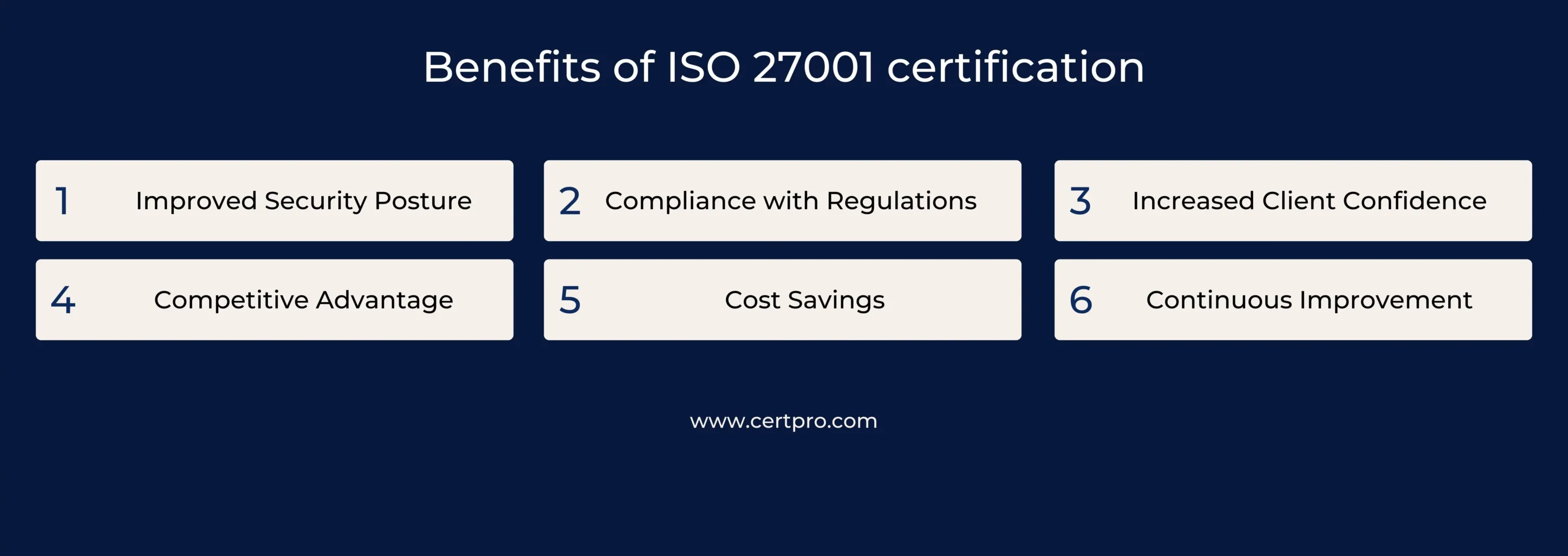
ISO 27001 Certification in California delivers independently verified outcomes that extend well beyond security posture improvement. For California organizations competing in technology, healthcare, financial services, and cloud markets, certification addresses market access requirements, reduces third-party risk exposure, and demonstrates the governance maturity that enterprise customers, investors, and regulators expect from trusted vendors and partners.
ISO 27001 certification is increasingly required as a contractual condition by enterprise buyers, government agencies, financial institutions, and healthcare organizations evaluating vendor security posture before supplier onboarding. For California SaaS providers, cloud platforms, and AI businesses seeking to serve regulated industries, ISO 27001 compliance signals that information security is managed under an independently audited framework — not merely self-assessed.
Procurement teams and vendor risk management programs across Silicon Valley, Los Angeles, and San Diego are increasingly using ISO 27001 certification as a minimum security qualification criterion. This makes certification a direct enabler of enterprise sales, government contracting, and vendor approval processes — transforming ISO 27001 Certification in California into a tangible competitive advantage.
Implementing the ISO 27001 standard requires organizations to systematically identify information assets, assess threats, evaluate vulnerabilities, and implement proportionate controls across organizational, people, physical, and technological domains. This structured approach reduces the likelihood of security incidents by ensuring controls are selected based on risk evidence rather than assumption.
Organizations that maintain ISO 27001 compliance in California demonstrate measurable reductions in uncontrolled access, undocumented data handling, and unmanaged supplier risk — three of the most common sources of data breaches in California’s technology sector. The continual improvement requirement embedded in Clause 10 ensures the ISMS adapts to evolving threats, organizational changes, and newly identified vulnerabilities over time.
ISO 27001 certification provides documented evidence of information security governance that is relevant to regulatory due diligence under California and federal frameworks. The ISMS framework — including access controls, incident response, supplier management, and audit trails — aligns structurally with security safeguard expectations under the CCPA, CPRA, and sector-specific requirements such as HIPAA for healthcare organizations.
While ISO 27001 certification does not constitute legal compliance with any of these regulations, it provides auditable evidence of a systematic approach to security that regulators, auditors, and legal counsel recognize as indicative of due care. For California fintech companies, financial services organizations, and healthcare providers, this evidentiary value is a material and practical benefit of maintaining ISO 27001 certification in California.
- ✓Market Access and Contractual Requirements
- ✓Improved Security Posture and Risk Reduction
- ✓Regulatory Alignment and Due Diligence Evidence
Who Needs ISO 27001 Certification in California?
ISO 27001 certification applies across a broad spectrum of California sectors and organizational sizes. Any organization that handles sensitive information — customer data, financial records, health information, intellectual property, or government data — and needs to demonstrate security governance to external stakeholders should evaluate whether ISO 27001 Certification in California is appropriate for its operating context. The standard is sector-agnostic, making it relevant to both established enterprises and fast-growing startups.
Technology, SaaS, and Cloud Organizations
Technology companies pursuing ISO 27001 Certification in California — including SaaS providers, cloud infrastructure platforms, AI and machine learning businesses, and cybersecurity firms — represent the largest segment of organizations seeking certification in the state. These organizations frequently process sensitive customer data at scale, operate multi-tenant cloud environments, and serve enterprise and regulated-industry clients who require independently verified security assurance.
California fintech organizations benefit similarly from ISO 27001 certification, as financial regulators and banking partners increasingly require demonstrable ISMS maturity before approving data-sharing or payment processing relationships. Cloud service providers operating from California data centers use ISO 27001 certification as a foundational component of their trust and transparency frameworks, complementing SOC 2 attestations with internationally recognized management system certification.
Healthcare, Life Sciences, and Biotechnology Organizations
Healthcare organizations pursuing ISO 27001 Certification in California — including hospitals, health systems, digital health platforms, telehealth providers, and healthcare IT vendors — use the ISMS framework to demonstrate structured governance of electronic protected health information (ePHI), clinical data, and patient records. The ISO 27001 standard provides a systematic, auditable approach to managing these sensitive information assets.
Biotechnology and life sciences companies in the San Diego, San Francisco Bay Area, and Los Angeles regions handle proprietary research data, clinical trial records, and regulated manufacturing information that require systematic security controls. ISO 27001 certification provides these organizations with an internationally recognized framework for managing information security risks, supporting both operational security and third-party assurance requirements common in clinical research and pharmaceutical supply chain environments.
Financial Services, E-Commerce, and Telecommunications
Financial services organizations pursuing ISO 27001 Certification in California — including investment firms, insurance companies, payment processors, and banking technology providers — use certification to demonstrate ISMS maturity to regulators, auditors, and institutional counterparties. Certification provides the independently verified security documentation that enterprise financial partners increasingly demand.
E-commerce businesses operating in California’s large consumer market handle payment card data, customer account information, and transaction records that require documented security controls and third-party assurance. Telecommunications companies and managed service providers serving California enterprises use ISO 27001 as a baseline security framework, demonstrating that customer data transmitted or stored on their networks is protected under a structured, independently audited management system. Across all these sectors, ISO 27001 certification in California represents a critical trust signal in competitive procurement environments.
California Regulatory Alignment with ISO 27001
California’s privacy and information security regulatory environment is among the most demanding in the United States. Alignment between the ISO 27001 standard and California’s regulatory requirements is a relevant consideration for organizations evaluating how an ISMS supports their broader compliance posture. It is important to recognize, however, that ISO 27001 certification addresses security management governance — not legal compliance per se — and should be evaluated within that context.
CCPA, CPRA, and Information Security Governance
The California Consumer Privacy Act (CCPA) and its successor, the California Privacy Rights Act (CPRA), impose requirements on businesses handling personal information of California residents — including obligations related to data security, access rights, deletion, and breach notification. ISO 27001 compliance supports the security dimension of these obligations by providing a documented framework for access control, data classification, incident detection, and supplier due diligence.
The CPRA also established the California Privacy Protection Agency (CPPA), which has authority to enforce data protection requirements and conduct audits. Organizations with an operational ISO 27001-certified ISMS are better positioned to respond to regulatory inquiries and demonstrate that security safeguards are systematically managed rather than ad hoc. This is a meaningful practical benefit of pursuing ISO 27001 Certification in California for any business handling California resident data at scale.
Federal Requirements and Cross-Jurisdictional Considerations
California organizations that also operate under federal frameworks — such as HIPAA for healthcare, GLBA for financial services, FedRAMP for federal cloud services, or CMMC for defense contractors — can use the ISO 27001 standard as a structured foundation for mapping applicable controls across multiple compliance frameworks. The ISO 27001 standard’s risk-based control selection process aligns with the control mapping approach used in NIST SP 800-53, NIST CSF, and other federal security frameworks, enabling organizations to identify control overlaps and avoid duplicating compliance effort.
California organizations subject to both state and federal requirements benefit from the ISMS framework’s structured documentation and audit trail requirements. These support responses to regulatory inquiries, legal discovery, and third-party due diligence reviews across jurisdictions — making ISO 27001 compliance a strategically valuable investment for multi-framework organizations.
ISO 27001 Certification for California Technology Sectors
California’s technology ecosystem spans hardware, software, cloud infrastructure, artificial intelligence, semiconductor design, and enterprise technology services. The requirements of the ISO 27001 standard are applied consistently across all sectors, but the specific controls most relevant to each organization vary based on the nature of information assets, applicable risk scenarios, and third-party relationships within scope. Understanding these sector-specific nuances helps California technology organizations scope and prepare for ISO 27001 certification more effectively.
AI, Machine Learning, and Data-Intensive Businesses
Artificial intelligence and machine learning companies operating in San Francisco, San Jose, and the broader Silicon Valley region handle large volumes of training data, model outputs, and inference requests that may include sensitive personal, financial, or health-related information. ISO 27001 certification for these organizations requires documented controls over data classification, data access governance, model training data provenance, and secure development practices — all addressed within the Annex A Organizational and Technological control domains.
As AI governance expectations evolve and enterprise customers impose increasingly stringent vendor security requirements, ISO 27001 Certification in California provides AI businesses with a recognized, independently audited security framework. This demonstrates structured information security management across data pipelines and model deployment environments — a differentiator that is becoming essential for enterprise AI vendor qualification.
Cloud Service Providers and Managed Service Organizations
Cloud service providers (CSPs) and managed service organizations operating from California use ISO 27001 certification to demonstrate that their shared-responsibility security model includes a formally audited ISMS. This ISMS covers management controls, infrastructure security practices, and supplier oversight processes that customers rely on when trusting a CSP with sensitive data.
ISO 27001 audit evaluations for California cloud organizations typically include assessment of logical access controls, network security, vulnerability management, change management, and cryptographic key management — controls that directly address the security risks inherent in multi-tenant cloud environments. Many California CSPs pursue ISO 27001 certification alongside SOC 2 attestations to provide customers with complementary assurance: ISO 27001 addressing management system certification and SOC 2 addressing operational control effectiveness over a defined service period.
ISMS Certification Framework and Key Components
An Information Security Management System (ISMS) certified under ISO/IEC 27001:2022 is a structured management framework — not a standalone security tool or product. Understanding the key components of the ISMS is essential for California organizations evaluating what ISO 27001 certification requires and what auditors will assess during the ISO 27001 certification audit. The three areas below are among the most frequently evaluated during both initial certification and surveillance audits.
Internal Audit and Management Review Requirements
ISO/IEC 27001:2022 Clause 9 requires organizations to conduct internal audits at planned intervals. These audits provide information on whether the ISMS conforms to the organization’s own requirements and the ISO 27001 standard, and whether it is effectively implemented and maintained. Internal audit programs must define audit criteria, scope, frequency, and method — and auditors must be independent of the activities they evaluate.
Management review — a separate requirement under Clause 9.3 — mandates that top management periodically evaluate ISMS performance using defined inputs, including audit results, risk treatment status, nonconformity records, and performance metrics. Management review outputs must include decisions on continual improvement opportunities and any required changes to the ISMS. Both internal audits and management reviews must be documented and retained as evidence for the external ISO 27001 certification audit.
Supplier Management and Third-Party Security Controls
ISO/IEC 27001:2022 Annex A includes specific controls addressing supplier relationships and the information security risks associated with third-party access to organizational information assets. Organizations must establish and maintain policies for supplier onboarding, incorporate security requirements into supplier agreements, and periodically evaluate supplier security performance.
For California organizations with complex supply chains — including SaaS vendors, cloud infrastructure providers, offshore development partners, and data processors — supplier security management is typically one of the most evidence-intensive areas evaluated during Stage 2 of the ISO 27001 certification audit. Auditors review supplier registers, contractual security clauses, supplier assessment records, and evidence of ongoing monitoring to confirm that third-party risks within the ISMS scope are systematically managed rather than left to informal arrangements.
Continual Improvement and Corrective Action
Clause 10 of ISO/IEC 27001:2022 requires organizations to continually improve the suitability, adequacy, and effectiveness of the ISMS. Continual improvement is not limited to responding to incidents or nonconformities — it encompasses proactive identification of enhancement opportunities through internal audits, management reviews, risk reassessments, and ongoing performance monitoring.
Corrective action requirements under Clause 10.1 mandate that when a nonconformity occurs, the organization must determine its root cause, evaluate whether similar issues exist elsewhere, and implement actions that address that root cause — not merely the surface symptom. Evidence of the corrective action process, including root cause analysis records and effectiveness verification, is reviewed during annual surveillance audits and recertification audits to confirm that the ISMS operates as a genuinely improving system — a core expectation of ISO 27001 compliance.
Why Choose CertPro for ISO 27001 Certification in California?
CertPro is a Licensed CPA Firm operating as an independent third-party certification body for ISO 27001 Certification in California. CertPro conducts ISO 27001 certification audits — Stage 1, Stage 2, surveillance, and recertification — exclusively as an independent evaluator, without performing consulting, implementation, or policy development activities for organizations under audit. This independence is fundamental to the credibility of certification outcomes and satisfies the objectivity requirements expected by enterprise customers and regulatory stakeholders across California’s technology, healthcare, and financial services markets.
Independent Audit Authority and CPA Firm Positioning
CertPro’s structure as a Licensed CPA Firm distinguishes its ISO 27001 certification audits from those conducted by non-CPA certification bodies. The CPA firm framework brings the standards of professional independence, evidence evaluation, and attestation rigor embedded in auditing standards directly to the ISO 27001 certification process.
For California organizations that also require SOC 2 attestations, financial audits, or regulatory compliance documentation, CertPro’s ability to operate within a unified CPA audit framework provides consistency in evidence standards, audit methodology, and reporting formats across multiple assurance engagements. CertPro auditors evaluate ISMS conformance based on objective evidence — not representations or self-assessments — and issue ISO 27001 certification decisions that reflect independent professional judgment.
California-Specific Audit Experience and Sector Coverage
CertPro’s auditors have extensive experience conducting ISO 27001 certification audits across California’s technology, healthcare, financial services, and cloud sectors — from early-stage AI startups in San Francisco to established enterprise technology providers in Silicon Valley, Los Angeles, and San Diego. This sector experience directly informs the audit program design, control sampling approach, and evidence evaluation methodology applied to each engagement.
ISO 27001 audit engagements conducted by CertPro in California are scoped, planned, and executed according to ISO/IEC 27001:2022 and applicable audit program requirements. This ensures that certification outcomes reflect genuine conformance rather than checklist completion. Organizations seeking ISO 27001 Certification in California benefit from an audit process calibrated to their actual operating environment, risk landscape, and the specific control challenges common in California’s technology-driven market.
ISO 27001 Certification in California: Key Facts
The following table summarizes key facts about ISO 27001 Certification in California as conducted by CertPro. Use this structured reference when evaluating the certification process, timeline, scope requirements, and ongoing obligations associated with maintaining ISO 27001 certification in California.
| Parameter | Detail |
|---|---|
| Standard | ISO/IEC 27001:2022 (current version; transition deadline October 31, 2025) |
| Certification Body | CertPro — Licensed CPA Firm, independent third-party certification body |
| Audit Stages | Stage 1 (documentation review) and Stage 2 (implementation audit) |
| Certificate Validity | 3 years, subject to satisfactory annual surveillance audits |
| Annex A Controls | 93 controls across 4 domains: Organizational, People, Physical, Technological |
Common Questions About ISO 27001 Certification in California
What is ISO 27001 certification?
ISO 27001 certification is formal, third-party verification that an organization’s Information Security Management System (ISMS) conforms to the requirements of ISO/IEC 27001:2022. Certification is issued by an accredited or licensed certification body — such as CertPro — following a two-stage ISO 27001 certification audit that evaluates both the documentation and the operational implementation of the ISMS.
The certificate confirms that information security risks within the defined scope are systematically identified, assessed, treated, and monitored under a structured management framework. For organizations pursuing ISO 27001 Certification in California, this independent verification is increasingly valued by enterprise buyers, regulatory bodies, and institutional partners as a credible signal of security maturity.
How long does the ISO 27001 certification process take in California?
The ISO 27001 certification timeline in California depends on the organization’s size, scope complexity, and the maturity of its existing ISMS documentation and controls. Typically, the audit process — from Stage 1 through to the certification decision — takes between 4 and 12 weeks for organizations with a well-developed ISMS.
Organizations that identify significant documentation gaps or major nonconformities during Stage 1 will require additional time to implement corrective actions before Stage 2 can proceed. Engaging CertPro early in the planning process helps California organizations understand their readiness level and set realistic timelines. Surveillance audits are then conducted annually throughout the three-year certificate validity period.
What is the difference between Stage 1 and Stage 2 in the ISO 27001 audit?
The Stage 1 ISO 27001 audit is a documentation review that evaluates whether the organization’s ISMS documentation — including the risk assessment, Statement of Applicability, policies, and management review records — meets the requirements of ISO/IEC 27001:2022. It is essentially a readiness check that identifies gaps before the on-site evaluation.
The Stage 2 audit is an on-site or remote implementation audit that evaluates whether the ISMS is actually implemented and operating as documented. Stage 2 involves personnel interviews, process observation, and evidence sampling across the full certification scope. Both stages are required for initial ISO 27001 certification, and together they form the complete ISO 27001 certification audit process.
Is ISO 27001 certification required by California law?
ISO 27001 certification is not mandated by California state law. However, it is increasingly required by enterprise customers, government contracting programs, and regulated-industry partners as a contractual or procurement condition. The CCPA and CPRA require businesses to implement reasonable security measures for personal information, and an ISO 27001-certified ISMS provides documented, independently audited evidence of a systematic security program.
It is important to note that ISO 27001 certification does not constitute automatic legal compliance with either statute. Organizations should assess their specific legal obligations under California law separately. That said, ISO 27001 Certification in California is one of the strongest forms of security governance evidence available to businesses operating in the state’s regulated markets.
How many Annex A controls does ISO/IEC 27001:2022 include?
What is a Statement of Applicability in ISO 27001?
The Statement of Applicability (SoA) is a mandatory ISO 27001 document that lists all Annex A controls, states whether each control is applicable or excluded, and provides justification for each decision. The SoA must be directly traceable to the risk assessment and risk treatment plan — controls must be included because risk assessment evidence supports their relevance, not arbitrarily.
Auditors review the SoA during both Stage 1 and Stage 2 of the ISO 27001 certification audit as a central reference document for the audit program. A well-constructed SoA demonstrates that ISO 27001 compliance is grounded in a genuine, risk-driven decision-making process rather than a generic template approach.
Does ISO 27001 certification cover cloud environments?
Yes. ISO 27001 certification can be scoped to include cloud-hosted systems, cloud-native applications, and hybrid IT environments. The ISO/IEC 27001:2022 standard includes Annex A controls that directly address cloud service security — including cloud service use policies, data protection in cloud environments, and configuration management for cloud infrastructure.
For California SaaS providers and cloud service organizations, the ISMS scope typically encompasses cloud infrastructure, development and deployment pipelines, and the organizational processes that govern cloud security management. ISO 27001 Certification in California for cloud-native businesses is a well-established pathway that CertPro auditors are experienced in evaluating across multiple cloud platforms and architectures.
What are the surveillance audit requirements for ISO 27001 certification?
ISO 27001 certificates are valid for three years, but certification is contingent on satisfactory annual surveillance audits during this period. Surveillance audits evaluate whether the ISMS continues to conform to ISO/IEC 27001:2022, whether corrective actions for previously identified nonconformities have been effectively closed, and whether changes to the organization’s risk environment or ISMS scope have been appropriately addressed.
Failure to complete a satisfactory surveillance audit can result in suspension or withdrawal of the ISO 27001 certificate — a serious consequence for organizations that rely on certification for contractual or regulatory purposes. A full recertification audit is required at the end of the three-year certificate cycle to renew the certification.
What is the transition deadline from ISO 27001:2013 to ISO 27001:2022?
The transition deadline from ISO/IEC 27001:2013 to ISO/IEC 27001:2022 is October 31, 2025, as established by international accreditation bodies. After this date, certificates issued under the 2013 version of the ISO 27001 standard will no longer be valid. Organizations certified under the 2013 standard must complete a transition audit demonstrating conformance with the 2022 version before the deadline.
New certifications issued by CertPro are conducted exclusively against ISO/IEC 27001:2022. California organizations currently holding 2013-version certificates should initiate transition planning promptly to avoid certification lapses that could affect contractual, procurement, or regulatory obligations. CertPro supports organizations through the transition audit process as part of its ISO 27001 Certification in California program.
FAQ
▶
What is ISO 42001 is the international standard for Artificial Intelligence Mana…
▶
What is ISO 27001 certification?
▶
How long does the ISO 27001 certification process take in California?
▶
What is the difference between Stage 1 and Stage 2 in the ISO 27001 audit?
▶
Is ISO 27001 certification required by California law?
▶
How many Annex A controls does ISO/IEC 27001:2022 include?
▶
What is a Statement of Applicability in ISO 27001?
▶
Does ISO 27001 certification cover cloud environments?
Get In Touch
have a question? let us get back to you.