
ISO 27018 Certification in California
Executive Summary: CertPro is a Licensed CPA Firm conducting formal ISO 27018 audits for cloud service providers, SaaS companies, and data processors operating in California. Certification scope covers PII protection controls within public cloud environments, evaluated against internationally recognized Trust Services Criteria and ISO/IEC 27018:2019 requirements.
OUR CLIENTS










What Is ISO 27018 Certification
ISO 27018 certification is the formal recognition that an organization has implemented and maintains controls aligned with ISO/IEC 27018:2019, the international code of practice for protection of personally identifiable information (PII) in public cloud computing environments. The standard was first published in 2014 and updated in 2019, establishing a globally recognized benchmark for cloud processors that handle personal data on behalf of their customers. ISO 27018 certification in California is increasingly pursued by technology companies, SaaS vendors, healthcare IT platforms, and fintech providers that process personal data for enterprise and government clients across multiple jurisdictions.
Definition: ISO 27018 and Its Scope
ISO 27018 is defined as an extension of ISO/IEC 27001 and ISO/IEC 27002, scoped specifically to cloud processors that act as public cloud service providers handling PII. The standard establishes controls, implementation guidance, and audit criteria for organizations that process personally identifiable information under contractual obligations to their customers — referred to as PII principals. ISO 27018 extends ISO 27001 by introducing cloud-specific privacy controls not addressed in the base information security management system (ISMS) framework, including consent management, data subject rights, purpose limitation, and breach notification obligations specific to cloud processing contexts.
The standard applies exclusively to public cloud environments — defined as shared, multi-tenant infrastructure operated by a cloud service provider (CSP) and accessed via the internet. Private cloud deployments and on-premises processing environments fall outside the direct scope of ISO 27018, though organizations may apply its principles as supplementary controls. For California-based organizations operating SaaS platforms, cloud data pipelines, or infrastructure-as-a-service (IaaS) offerings, ISO 27018 certification establishes a documented and audited assurance framework for PII protection that satisfies contractual and regulatory due diligence requirements.
Controller vs. Processor Accountability Under ISO 27018
ISO 27018 establishes a clear distinction between the roles of data controller and data processor in public cloud environments. The data controller — typically the cloud customer — determines the purposes and means of processing PII. The data processor — the cloud service provider or SaaS vendor — processes PII strictly on behalf of and under the instructions of the controller. ISO 27018 certification addresses the processor’s accountability obligations, establishing that cloud providers must not process PII for any purpose independent of documented customer instructions. This processor-centric framing is a defining characteristic of ISO 27018 and differentiates it from broader information security standards.
For California organizations, this controller-processor distinction carries direct legal significance under the California Consumer Privacy Act (CCPA) and its 2020 amendment, the California Privacy Rights Act (CPRA). The CPRA introduced formal definitions of ‘businesses’ and ‘service providers’ that closely parallel the GDPR controller-processor model. ISO 27018 certification does not constitute CCPA or CPRA compliance — these are distinct legal obligations — but ISO 27018 certified cloud processors demonstrate documented controls for PII handling, transparency, and data subject rights that directly support their clients’ CCPA service provider obligations. Certification confirms processor-level accountability through formal audit evidence.
ISO 27018 and Its Relationship to ISO 27001
ISO 27018 is designed to be implemented alongside ISO 27001, not as a standalone standard. ISO 27001 establishes the information security management system (ISMS) framework — including risk assessment, control selection, internal audit, and continual improvement cycles. ISO 27018 extends this framework by providing a catalogue of cloud-specific PII protection controls that supplement the ISO 27001 Annex A control set. Organizations that are already ISO 27001 certified can pursue ISO 27018 certification as an extension audit, leveraging their existing ISMS documentation and control evidence while demonstrating additional cloud privacy-specific controls. Organizations without ISO 27001 certification may also pursue ISO 27018, but must establish a compliant ISMS as a prerequisite foundation.
| Standard | Scope | Primary Focus | Cloud-Specific |
|---|---|---|---|
| ISO 27001 | All organizations | Information Security Management System (ISMS) | No |
| ISO 27002 | All organizations | Information security control implementation guidance | No |
| ISO 27018 | Public cloud processors handling PII | PII protection in public cloud environments | Yes |
| ISO 27017 | Cloud service providers and customers | Cloud-specific information security controls | Yes |
| SOC 2 | Service organizations | Trust Services Criteria: Security, Availability, Confidentiality, Privacy | Partially |
Who Needs ISO 27018 Certification in California
ISO 27018 certification in California is applicable to any organization that operates as a public cloud service provider or cloud-based data processor handling PII on behalf of third-party customers. This includes SaaS companies whose platforms collect, store, or process end-user personal data; IaaS and PaaS providers hosting customer workloads that include personal information; cloud-native healthcare IT platforms processing electronic protected health information (ePHI) in multi-tenant environments; fintech and payment processing platforms operating cloud-based services for financial institutions; and enterprise software vendors delivering cloud-hosted HR, CRM, or ERP solutions that contain employee or customer PII.
California’s technology ecosystem — anchored by Silicon Valley, the San Francisco Bay Area, Los Angeles, and San Diego’s emerging tech clusters — concentrates a disproportionate share of the world’s cloud infrastructure providers, SaaS companies, and digital health platforms. Organizations in these sectors face increasing contractual demands from enterprise customers requiring ISO 27018 certification as a vendor qualification criterion. Public sector contracts, healthcare data processing agreements, and cross-border data transfer arrangements with European and Asia-Pacific counterparties frequently specify ISO 27018 certification as a mandatory supplier requirement. ISO 27018 audit California engagements are conducted by CertPro to evaluate and certify these organizations against the full standard.

ISO 27018 Requirements and Controls
ISO 27018 certification requires organizations to implement a structured set of PII protection controls organized around twelve control categories. These controls address the full lifecycle of personal data processed in public cloud environments, from collection and purpose limitation through deletion and breach notification. Each control category within ISO 27018 corresponds to specific audit evaluation criteria that CertPro auditors apply during the certification assessment. The following sections detail the primary control categories and their application to California-based cloud providers.
ISO 27018 requires that public cloud processors obtain and document clear consent from PII principals before processing personal data, except where processing is expressly authorized by the data controller under a written agreement. Purpose limitation controls mandate that PII must only be processed for the purposes explicitly stated in the service agreement with the cloud customer — the controller. Cloud providers must not use customer PII for marketing, profiling, or secondary purposes without explicit controller authorization. CertPro auditors evaluate the organization’s consent management framework, data processing agreements, and evidence of purpose limitation enforcement across all cloud service components.
For California SaaS companies, purpose limitation controls align directly with CCPA Section 1798.140(v)(1), which prohibits service providers from processing personal information for any purpose other than performing services under the business contract. ISO 27018 certification provides documented, audited evidence of purpose limitation compliance that California cloud processors can present to enterprise customers during vendor due diligence evaluations. The audit confirms that technical and organizational controls enforce purpose boundaries — for example, that customer data is logically segregated and inaccessible to internal marketing or analytics functions without explicit authorization.
Transparency requirements under ISO 27018 mandate that cloud service providers publicly disclose the geographic locations where PII may be processed or stored, any subprocessors engaged to handle PII, and the mechanisms available for data subjects to exercise their rights. The standard requires that this information be made available to data controllers — and through them to data subjects — in a clear, accessible format. CertPro auditors review the organization’s public privacy disclosures, data processing addenda, subprocessor notification procedures, and evidence that transparency commitments are operationally enforced rather than merely documented in policy.
Data subject rights controls require that cloud processors maintain documented procedures for handling requests from PII principals — including the right of access, correction, erasure, and restriction of processing — as directed by the data controller. ISO 27018 certification confirms that the organization can technically and procedurally execute these requests within documented timeframes. For California organizations, these controls directly support CPRA data subject rights obligations, which require businesses and their service providers to honor consumer rights requests including deletion, correction, and opt-out of sharing. The audit evaluates response time metrics, evidence of completed requests, and escalation procedures for complex or disputed requests.
ISO 27018 imposes specific controls on cross-border transfers of PII, requiring that cloud processors disclose all countries where personal data may be processed and obtain controller authorization before routing PII through jurisdictions with differing privacy protections. This control is particularly relevant for California-headquartered cloud providers with global infrastructure footprints spanning AWS, Google Cloud, or Azure regions across North America, Europe, and Asia-Pacific. CertPro auditors examine data flow maps, subprocessor agreements, transfer impact assessments, and evidence of controller-authorized transfer mechanisms as part of the ISO 27018 audit scope.
Breach notification controls under ISO 27018 require that cloud processors notify the data controller without undue delay upon discovery of a PII security incident, providing sufficient detail for the controller to fulfill its own breach notification obligations to regulators and affected individuals. The standard does not specify a fixed notification timeline — unlike GDPR’s 72-hour requirement — but mandates that notification be prompt and contain the categories of PII affected, the probable scope of impact, and the remediation actions taken. Data retention controls require that PII is deleted or returned to the controller upon contract termination, with documented evidence of secure deletion across all cloud infrastructure components. CertPro auditors verify both breach response procedures and data lifecycle management controls through evidence review and system testing.
- Consent Management: Controls ensuring PII is processed only with documented controller authorization or PII principal consent
- Purpose Limitation: Technical and organizational controls preventing secondary use of PII beyond stated processing purposes
- Transparency Disclosures: Public and contractual disclosures of processing locations, subprocessors, and data handling practices
- Data Subject Rights Procedures: Documented mechanisms for access, correction, erasure, and restriction requests
- Cross-Border Transfer Controls: Authorization and documentation requirements for international PII routing
- Breach Notification Procedures: Incident detection, classification, and controller notification protocols
- Data Retention and Deletion: Lifecycle management controls including secure deletion upon contract termination
- Subprocessor Management: Vetting, contracting, and monitoring of third-party processors with access to PII
- Accountability and Audit Records: Logging of PII access, processing activities, and administrative actions
- Physical and Technical Safeguards: Encryption, access controls, and infrastructure security specific to PII environments
- Employee Training and Confidentiality: PII-specific training requirements and confidentiality commitments for cloud personnel
- Regulatory Compliance Monitoring: Ongoing review of applicable privacy law obligations across all jurisdictions of operation

- ✓Consent and Purpose Limitation Controls
- ✓Transparency and Data Subject Rights Controls
- ✓Data Transfers, Breach Notification, and Retention Controls
- ✓Full ISO 27018 Control Categories
ISO 27018 Certification Process in California
The ISO 27018 certification process in California follows a structured, sequential audit methodology conducted by CertPro as a Licensed CPA Firm. The certification process evaluates an organization’s implementation of ISO 27018 controls across all in-scope cloud services, infrastructure components, and operational procedures. The audit progresses through five defined stages, from initial documentation review through certification issuance and ongoing surveillance. Each stage produces formal audit deliverables that constitute the evidentiary basis for the certification decision. The following describes the ISO 27018 certification process as delivered by CertPro for California-based organizations.
Stage 1 of the ISO 27018 audit begins with formal scope definition — identifying the specific cloud services, data processing functions, infrastructure environments, and organizational units subject to certification. CertPro auditors evaluate the organization’s documentation framework, including its Information Security Management System (ISMS) policies, data processing agreements, privacy notices, subprocessor registers, and system architecture documentation. The Stage 1 audit establishes whether the organization’s documented controls are sufficient in design to meet ISO 27018 requirements before proceeding to operational effectiveness testing. Stage 1 produces a documented audit plan, a confirmed certification scope statement, and a preliminary assessment of documentation completeness.
For California cloud providers, Stage 1 documentation review typically examines data flow diagrams covering PII ingestion, processing, storage, and transmission across cloud regions; privacy impact assessments for high-risk processing activities; data processing addenda executed with enterprise customers; subprocessor agreements and associated due diligence records; and internal audit reports demonstrating ongoing ISMS monitoring. CertPro auditors assess whether the documentation reflects the actual operational environment — a critical distinction that separates ISO 27018 audit from self-certification programs. Organizations that have not previously documented their cloud PII processing flows in sufficient detail will receive formal Stage 1 findings identifying documentation gaps that must be addressed prior to Stage 2.
Stage 2 constitutes the primary ISO 27018 audit, during which CertPro auditors conduct detailed examination of the organization’s implemented controls across all in-scope systems, processes, and personnel functions. The Stage 2 audit includes technical evidence collection — examining system configurations, access control logs, encryption key management records, and automated breach detection capabilities — alongside interviews with personnel responsible for PII processing, incident response, and subprocessor management. CertPro auditors evaluate control effectiveness against each applicable ISO 27018 control requirement, assessing both the design adequacy and operational implementation of each control.
Stage 2 audits for California-based organizations may be conducted on-site at the organization’s primary operations facility, remotely through secure evidence submission platforms, or in a hybrid format depending on audit scope and infrastructure complexity. CertPro auditors apply consistent audit procedures regardless of delivery format, ensuring that remote audits maintain the same evidentiary rigor as on-site assessments. Technical testing during Stage 2 includes review of cloud infrastructure configurations (AWS, Google Cloud Platform, Microsoft Azure, or equivalent), database access controls, API security controls, and data residency enforcement mechanisms. Stage 2 produces a formal audit report detailing findings against each ISO 27018 control category.
Following Stage 2, CertPro auditors issue a formal nonconformity report categorizing all identified audit findings as major nonconformities, minor nonconformities, or observations. Major nonconformities represent systemic failures or complete absence of required controls that must be resolved before certification can be issued. Minor nonconformities identify partial implementation or isolated control gaps that must be addressed within a defined corrective action timeframe. Observations note areas for improvement that do not constitute nonconformities but are recorded for ongoing monitoring purposes. The nonconformity classification follows internationally recognized ISO audit terminology and is applied consistently across all CertPro ISO 27018 audit engagements.
Organizations subject to major nonconformities must submit documented corrective action plans and provide objective evidence of remediation before the Stage 3 review is closed. CertPro auditors evaluate the adequacy of corrective actions through evidence review — not through advisory participation in the remediation process. The Stage 3 review confirms that identified nonconformities have been addressed with controls that meet ISO 27018 requirements, and that the corrective actions are sustainable within the organization’s operational environment. Only upon successful closure of all major nonconformities does the audit progress to the certification decision stage. Minor nonconformity resolution is verified during the subsequent surveillance audit cycle.
The certification decision is made by CertPro’s independent certification review function upon confirmation that all Stage 2 and Stage 3 audit requirements have been satisfied. The certification decision is based exclusively on audit evidence — the documented findings of CertPro auditors — and is not influenced by commercial or advisory considerations. Certification is issued upon determination that the organization’s PII protection controls meet all applicable ISO 27018 requirements within the defined certification scope. The ISO 27018 certificate specifies the certified organization’s name, the scope of certification (cloud services covered), the applicable standard version (ISO/IEC 27018:2019), and the certificate validity period.
ISO 27018 certificates issued by CertPro are valid for three years, consistent with standard ISO certification cycles. The certificate confirms that the organization’s public cloud PII processing controls have been independently evaluated and found to be compliant with ISO/IEC 27018:2019 requirements as of the audit date. California organizations receiving ISO 27018 certification may reference the certificate in customer contracts, vendor qualification responses, and public trust disclosures. The certificate scope statement defines precisely which cloud services and processing activities are covered, enabling enterprise customers to verify that their specific use case falls within the certified scope.
ISO 27018 certification requires annual surveillance audits during the three-year certification cycle to confirm that controls remain effective and that material changes to the cloud environment, processing activities, or organizational structure have been assessed and incorporated. CertPro conducts surveillance audits in Year 1 and Year 2 following initial certification, evaluating a defined subset of controls and any areas identified in previous audit cycles. Surveillance audits examine evidence of continual improvement, internal audit activity, management review records, and any changes to the certified scope that may affect control adequacy. Significant scope changes — such as the introduction of new cloud services, migration to new infrastructure providers, or acquisition of processing activities — must be reported to CertPro and may require an interim audit assessment.
Recertification audits are conducted at the end of the three-year cycle, constituting a full reassessment of the organization’s ISO 27018 controls comparable in scope to the initial certification audit. Successful completion of the recertification audit results in issuance of a renewed certificate for a further three-year period. Organizations that fail to maintain surveillance audit schedules, or that experience material control failures identified through surveillance findings, may have their certification suspended or withdrawn. CertPro’s surveillance and recertification program is designed to ensure that ISO 27018 certification reflects the current state of the organization’s PII protection controls — not a historical point-in-time assessment.
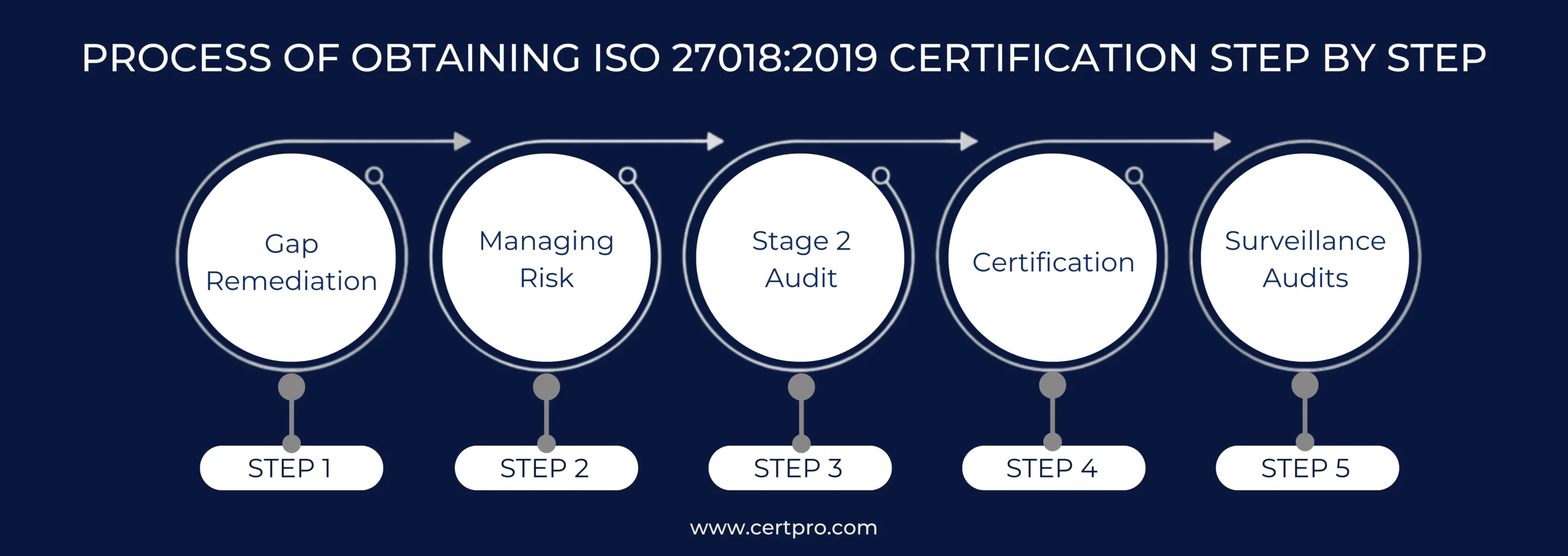
- ✓Stage 1: Scope Definition and Documentation Review
- ✓Stage 2: On-Site and Remote Audit — Evidence Collection and Control Testing
- ✓Stage 3: Nonconformity Review and Corrective Actions
- ✓Stage 4: Certification Decision and Issuance
- ✓Stage 5: Surveillance Audits and Recertification
Benefits of ISO 27018 Certification for California Organizations
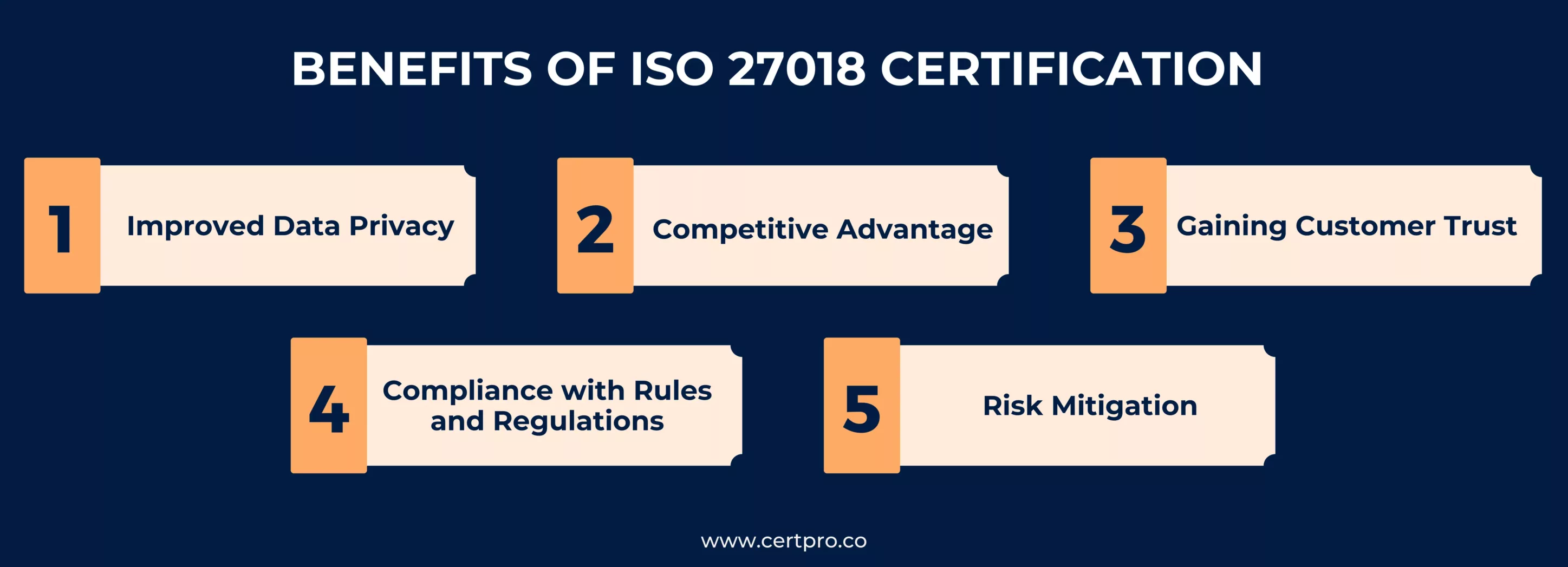
ISO 27018 certification delivers measurable, documented outcomes for California cloud service providers, SaaS companies, and data processors operating in competitive, compliance-intensive markets. The following benefits represent the concrete results of achieving and maintaining ISO 27018 certification, framed as audit outcomes rather than aspirational objectives. California organizations pursuing ISO 27018 certification through CertPro gain a verifiable, internationally recognized assurance credential that directly supports commercial, regulatory, and reputational objectives.
- ✓Client Trust and Confidence: ISO 27018 certification provides enterprise customers with independently verified evidence that the cloud provider’s PII handling controls have been formally audited — replacing self-attestation with third-party certification.
- ✓Vendor Qualification: ISO 27018 certified status satisfies vendor assessment requirements from enterprise, government, and healthcare customers that mandate cloud privacy certification as a procurement criterion.
- ✓Regulatory Alignment: Certification demonstrates documented controls that support compliance with CCPA/CPRA service provider obligations, HIPAA business associate requirements, and GDPR Article 28 processor safeguards.
- ✓Competitive Differentiation: ISO 27018 certification distinguishes certified California cloud providers in procurement evaluations where multiple vendors compete for contracts requiring cloud privacy assurance.
- ✓Contractual Compliance: Certification fulfills contractual clauses in Master Services Agreements, Data Processing Addenda, and Business Associate Agreements that require cloud providers to maintain recognized privacy management standards.
- ✓Breach Liability Reduction: Documented and audited PII controls reduce the likelihood of data breaches attributable to control failures and provide evidence of due diligence in the event of regulatory investigation.
- ✓Cross-Border Market Access: ISO 27018 certification supports data transfer arrangements with European Union, United Kingdom, and Asia-Pacific counterparties that require evidence of adequate PII protection in cloud environments.
- ✓Internal Control Maturity: The certification process drives systematic improvement in PII processing documentation, access controls, breach response procedures, and subprocessor management across the organization.
- ✓Audit Efficiency: ISO 27018 certified organizations experience reduced burden in responding to customer security questionnaires and vendor audits by presenting a recognized third-party certification in lieu of individualized assessments.
- ✓Investor and Board Confidence: Certification provides board-level assurance that data privacy risks in cloud operations are subject to independent audit oversight, supporting enterprise risk management and investor disclosure requirements.
ISO 27018 certification and CCPA/CPRA compliance are distinct obligations that address overlapping but separately defined requirements. CCPA and CPRA are California state laws creating enforceable legal duties for businesses collecting or processing California residents’ personal information. ISO 27018 is a voluntary international standard establishing audit-based certification of cloud PII controls. ISO 27018 certification does not constitute legal compliance with CCPA or CPRA — organizations remain independently responsible for satisfying statutory obligations under California privacy law. However, ISO 27018 certification provides documented, audited evidence of control implementation that directly supports CCPA service provider contract requirements and CPRA contractor provisions, reducing the evidentiary burden in regulatory inquiries and customer due diligence processes.
The California Privacy Protection Agency (CPPA), established by CPRA in 2020, has enforcement authority over CCPA violations and is actively developing audit and risk assessment regulations under CPRA Section 1798.185. California cloud service providers that demonstrate ISO 27018 certification are better positioned to satisfy the emerging CPRA audit requirements, as the ISO 27018 control framework addresses purpose limitation, data minimization, security safeguards, and data subject rights — all areas of CPPA regulatory focus. ISO 27018 certification serves as a recognized industry benchmark that California organizations can reference in regulatory filings, enforcement responses, and contractual representations regarding cloud PII protection.
- ✓ISO 27018 Certification and CCPA/CPRA Alignment
ISO 27018 Compliance for California Industries
ISO 27018 compliance in California is driven by sector-specific regulatory pressures, enterprise customer requirements, and competitive dynamics across California’s major technology industries. The following sections detail how ISO 27018 certification applies to the primary sectors driving public cloud PII certification demand in California’s technology ecosystem.
SaaS and Cloud Technology Companies
California’s SaaS sector — concentrated in Silicon Valley, San Francisco, and Los Angeles — represents the primary market for ISO 27018 cloud privacy certification. SaaS companies processing customer personal data in multi-tenant cloud environments face contractual pressure from enterprise customers requiring documented PII protection controls as a condition of vendor onboarding. ISO 27018 certification for California SaaS companies establishes a recognized, audited assurance credential that satisfies enterprise security questionnaire requirements and accelerates vendor qualification processes. Certification scope for SaaS providers typically covers the specific application services, cloud infrastructure components, and data processing functions included in customer contracts.
CertPro conducts ISO 27018 audits for California SaaS companies across the full stack of cloud-delivered services, including HR management platforms, customer relationship management (CRM) systems, marketing automation tools, collaboration and communication platforms, and data analytics services that process personal information on behalf of enterprise customers. The audit scope is defined to reflect the actual data flows and processing activities of each organization — not a generic template — ensuring that the resulting certification accurately represents the controls in place for customer PII across all certified service components.
Fintech and Financial Services Cloud Providers
California’s fintech sector — including payment processing platforms, digital banking infrastructure providers, lending technology companies, and financial data aggregators — operates under a complex compliance environment combining CCPA/CPRA obligations, Gramm-Leach-Bliley Act (GLBA) requirements, and evolving federal financial privacy regulations. ISO 27018 certification for California fintech companies provides a documented cloud PII control framework that complements financial sector-specific compliance obligations and satisfies the privacy assurance requirements of financial institution partners and enterprise clients. Fintech cloud providers frequently process sensitive financial personal data — including account information, transaction records, and credit data — that requires the highest levels of access control, purpose limitation, and breach notification capability.
CertPro ISO 27018 audits for California fintech organizations evaluate the technical and organizational controls protecting financial personal data in cloud environments, including encryption at rest and in transit, role-based access controls for financial data systems, subprocessor arrangements with data providers and payment networks, and incident response procedures calibrated to financial sector breach notification timelines. ISO 27018 SaaS compliance California fintech engagements are scoped to address the specific cloud processing activities of each organization, with particular attention to data residency requirements and cross-border transfer restrictions relevant to international financial services operations.
Healthcare IT and Digital Health Platforms
California’s digital health sector — encompassing telehealth platforms, electronic health record (EHR) cloud services, health data analytics companies, and medical device connectivity platforms — processes sensitive personal health information in cloud environments subject to HIPAA, CCPA/CPRA, and California Confidentiality of Medical Information Act (CMIA) requirements. ISO 27018 certification provides healthcare IT organizations with a documented, audited cloud privacy framework that complements HIPAA Security Rule compliance and satisfies the privacy assurance expectations of healthcare system customers, health plan partners, and employer wellness program operators.
ISO 27018 PII protection California healthcare IT audits conducted by CertPro evaluate controls for health data segregation in multi-tenant cloud environments, consent management for patient data processing beyond treatment purposes, breach detection and notification procedures aligned with HIPAA’s 60-day breach notification requirement, and subprocessor arrangements with cloud infrastructure providers hosting protected health information. The ISO 27018 control framework’s emphasis on purpose limitation and data subject rights is particularly relevant for healthcare platforms processing patient-generated health data under emerging CPRA provisions addressing the disclosure and use of sensitive personal information categories that include health and medical data.
Enterprise Software and B2B Cloud Infrastructure Providers
California-headquartered enterprise software companies and B2B cloud infrastructure providers serve global enterprise customers whose own compliance programs — including GDPR for European operations, PDPA for Asia-Pacific deployments, and sector-specific privacy regulations — impose requirements on cloud vendors’ PII protection practices. ISO 27018 certification provides California enterprise software providers with a globally recognized privacy assurance credential that satisfies customer due diligence requirements across multiple jurisdictions simultaneously. Public cloud PII certification California engagements for enterprise software companies typically span complex, multi-cloud environments integrating proprietary platform services with AWS, Google Cloud, or Azure infrastructure.
CertPro ISO 27018 audits for California enterprise software organizations address the full scope of cloud processing activities represented in customer contracts, including data hosting, processing, integration, and analytics functions. The audit evaluates controls across the complete subprocessor chain — from the certified organization’s own platform to third-party cloud infrastructure, communication tools, and data services — ensuring that the certification scope accurately represents the actual processing environment experienced by enterprise customers. This comprehensive scope definition is critical for California organizations whose enterprise customers require that subprocessor controls be explicitly included within the certified scope, not simply referenced in contractual representations.
ISO 27018 certification cost in California is determined by several factors specific to each organization’s cloud environment, operational scope, and certification context. CertPro applies a transparent, scope-based pricing model that reflects the actual audit effort required for each engagement rather than a fixed-fee structure that may not align with the complexity of the organization’s cloud PII processing activities. Understanding the cost drivers for ISO 27018 certification enables California organizations to budget accurately and prioritize the certification scope that delivers the greatest commercial and compliance value.
Primary Cost Factors for ISO 27018 Certification
- ✓Organization Size and Personnel Scope: The number of employees involved in PII processing, system administration, and cloud operations affects the audit sample size and interview requirements.
- ✓Cloud Environment Complexity: Organizations operating across multiple cloud platforms (AWS, GCP, Azure), multiple geographic regions, or hybrid cloud configurations require expanded audit procedures to cover all in-scope infrastructure.
- ✓Certification Scope Breadth: The number of cloud services, application components, and processing activities included within the certification scope directly determines audit program depth.
- ✓ISO 27001 Pre-Certification Status: Organizations with existing ISO 27001 certification have documented ISMS foundations that reduce Stage 1 documentation review requirements and total audit effort.
- ✓Number of Subprocessors: Complex subprocessor chains involving multiple third-party data processors require additional audit procedures to evaluate subprocessor management controls.
- ✓Annual Surveillance Audit Frequency: The three-year certification cycle includes two annual surveillance audits, the costs of which are factored into the total certification investment.
- ✓Audit Delivery Format: On-site audit delivery in California involves travel and logistics costs; remote audit delivery may reduce total engagement costs without compromising audit rigor.
- ✓Remediation Cycle Duration: Organizations with significant Stage 1 or Stage 2 findings requiring extended corrective action periods may incur additional audit review costs for nonconformity verification.
CertPro provides detailed pricing information tailored to each organization’s specific scope and requirements through a formal engagement scoping process. California organizations seeking ISO 27018 certification cost estimates should contact CertPro directly to initiate scope definition, which forms the basis for a transparent, itemized audit fee proposal. CertPro’s pricing model covers all stages of the certification process — from Stage 1 documentation review through certificate issuance — with surveillance audit fees defined at the outset of the certification engagement. Organizations are encouraged to contact CertPro’s California audit practice to receive a precise cost assessment aligned with their cloud environment and certification objectives.
| Organization Profile | Estimated Scope | Typical Cost Range (USD) | Certification Timeline |
|---|---|---|---|
| Early-stage SaaS startup (10-50 employees) | Single cloud application, limited subprocessors | $8,000 – $15,000 | 3–5 months |
| Mid-size cloud provider (50-250 employees) | Multiple services, 3–5 cloud regions | $15,000 – $30,000 | 4–7 months |
| Enterprise cloud platform (250+ employees) | Complex multi-cloud, global operations | $30,000 – $60,000+ | 6–12 months |
| ISO 27001 pre-certified organization | Reduced scope (ISO 27018 extension) | $6,000 – $18,000 | 2–4 months |
FAQ
▶
What does ISO 27018 certification certify?
▶
Who needs ISO 27018 certification in California?
▶
How long does ISO 27018 certification take in California?
▶
How does ISO 27018 differ from ISO 27001?
▶
Does ISO 27018 certification cover CCPA compliance?
▶
What is the audit timeline for ISO 27018 surveillance audits?
▶
Can California organizations with existing ISO 27001 pursue ISO 27018 as an extension?
▶
How does ISO 27018 address subprocessor management for California cloud providers?


More articles about ISO 27018 are coming soon. Check back for updates!
More articles about ISO 27018 are coming soon. Check back for updates!
Get In Touch
have a question? let us get back to you.