
SOC 2 Certification in California
The AICPA Trust Services Criteria encompass five categories against which controls are evaluated: Security (Common Criteria), Availability, Processing Integrity, Confidentiality, and Privacy. Every SOC 2 examination must address the Security category. Organizations may extend the scope of their SOC 2 examination to include one or more of the remaining four categories based on the nature of their services, contractual obligations, and the types of data they process, store, or transmit on behalf of customers and clients.
OUR CLIENTS










What Is SOC 2 Certification?
SOC 2 Certification in California is a formal attestation issued exclusively by a Licensed CPA Firm following an independent examination conducted under the American Institute of Certified Public Accountants (AICPA) AT-C Section 205 attestation standards. The certification confirms that an organization’s security and operational controls have been examined, tested, and found to operate in conformance with the AICPA Trust Services Criteria (TSC). SOC 2 Certification is not a self-declaration, vendor questionnaire response, or internal compliance statement — it is an independent third-party audit conclusion documented in a formal attestation report signed by a licensed practitioner.
The AICPA Trust Services Criteria encompass five categories against which controls are evaluated: Security (Common Criteria), Availability, Processing Integrity, Confidentiality, and Privacy. Every SOC 2 examination must address the Security category. Organizations may extend the scope of their SOC 2 examination to include one or more of the remaining four categories based on the nature of their services, contractual obligations, and the types of data they process, store, or transmit on behalf of customers and clients.
SOC 2 Certification in California is delivered in two distinct report types. A SOC 2 Type 1 report evaluates whether controls are suitably designed and implemented as of a specific point in time. A SOC 2 Type 2 report evaluates both the suitability of design and the operating effectiveness of controls over a defined observation period — typically six to twelve months. The Type 2 report carries greater evidentiary weight because it demonstrates sustained control performance rather than a single-point assessment. This makes it the preferred standard for enterprise vendor assurance programs, regulated industries, and sophisticated customer due diligence processes.
California organizations pursuing SOC 2 Certification operate within one of the most demanding information security and data privacy environments in the United States. The state’s technology economy — spanning SaaS providers, cloud infrastructure companies, AI platforms, fintech firms, healthcare technology organizations, and enterprise software businesses — generates substantial demand for independent security attestations. Customers, enterprise buyers, and regulated-sector clients across San Francisco, San Jose, Silicon Valley, Los Angeles, San Diego, Sacramento, and Orange County routinely require SOC 2 attestation reports before contracting with technology service providers. As a result, SOC 2 Certification has become a baseline vendor assurance requirement across California’s most active commercial sectors.
The SOC 2 examination is governed by AICPA attestation standards and the Trust Services Criteria, which are updated periodically to reflect evolving security threats, technology architectures, and control environments. The Licensed CPA Firm conducting the examination must hold appropriate credentials, maintain independence from the subject organization, and apply professional standards throughout the engagement. The resulting attestation report — whether Type 1 or Type 2 — represents a professionally binding conclusion on the state of an organization’s control environment. It provides stakeholders with independently verified assurance that cannot be replicated through self-assessment or internal audit activities alone.

ENQUIRE NOW
Related Resources
Related Services in California
Why SOC 2 Certification in California Is Strategically Important
California’s commercial and regulatory environment creates specific conditions that elevate the strategic importance of SOC 2 Certification beyond standard vendor assurance. The state is home to a disproportionate concentration of technology companies, financial institutions, healthcare organizations, biotechnology firms, and consumer-facing digital platforms. Each of these sectors operates under heightened scrutiny from customers, regulators, and institutional partners regarding data protection and security control effectiveness. Obtaining SOC 2 Certification in California signals to the market that an organization’s controls have been independently examined and formally attested by a Licensed CPA Firm.
California’s Regulatory and Privacy Context
California operates under some of the most rigorous consumer privacy laws in the United States, including the California Consumer Privacy Act (CCPA) and its successor, the California Privacy Rights Act (CPRA). While SOC 2 attestation does not automatically establish compliance with CCPA, CPRA, HIPAA, or other applicable laws, the controls evaluated during a SOC 2 examination — particularly those related to data security, access management, incident response, and confidentiality — address many of the same control domains that underpin broader privacy and regulatory obligations. California organizations frequently reference SOC 2 attestation reports as evidence of a structured, independently tested control environment during regulatory inquiries, procurement evaluations, and customer due diligence reviews.
Enterprise customers and government contractors operating in California increasingly embed SOC 2 attestation requirements directly into vendor contracts and procurement specifications. Healthcare technology providers subject to HIPAA, fintech companies operating under federal financial services regulations, and defense contractors subject to federal cybersecurity frameworks commonly treat SOC 2 compliance as a foundational element of their third-party risk management programs. For California SaaS companies and cloud service providers targeting regulated-sector clients, SOC 2 Certification is frequently a prerequisite for contract execution — not an optional differentiator.
Market Demand Across California’s Technology Ecosystem
Silicon Valley and the broader San Francisco Bay Area constitute the largest concentration of technology companies in the world, with organizations spanning AI development, cloud infrastructure, enterprise SaaS, cybersecurity, semiconductor design, and digital health. San Diego supports a significant biotechnology and defense technology cluster. Los Angeles has emerged as a major center for fintech, media technology, and e-commerce. In each of these ecosystems, SOC 2 Certification in California functions as a market access credential. Organizations without a current SOC 2 attestation report are routinely excluded from enterprise procurement processes — regardless of their internal security capabilities.
Telecommunications providers, managed service providers, and cybersecurity firms operating across California face customer bases that conduct structured third-party risk assessments requiring documented evidence of independent security attestation. SOC 2 audit engagements in California are particularly concentrated among SaaS companies, data analytics platforms, cloud storage providers, and health information technology organizations — sectors where data sensitivity and operational continuity are primary customer concerns. In these sectors, possession of a current SOC 2 Type 2 attestation report has become a standard commercial expectation rather than a voluntary commitment.
Scope of the SOC 2 Engagement in California
Defining the scope of a SOC 2 examination is the foundational step that determines which systems, services, infrastructure components, personnel functions, and Trust Services Criteria categories are subject to audit. Scope definition directly affects the depth of testing, the volume of evidence collected, the length of the observation period for Type 2 reports, and the specificity of the resulting attestation report. A well-defined scope produces an attestation report that is meaningful to stakeholders. An overly broad or imprecise scope, by contrast, may result in exceptions, qualifications, or report limitations that reduce the report’s overall utility.
System Description and Service Boundary
The SOC 2 examination scope centers on a defined system — the infrastructure, software, personnel, procedures, and data that the service organization uses to deliver its services to customers. Management is responsible for preparing a system description that accurately characterizes the service organization’s environment, the nature of the services provided, and the boundaries of the system under examination. This system description becomes part of the final attestation report and must be accurate as of the report date. For California technology companies with complex, multi-cloud or hybrid infrastructure environments, accurate system boundary definition requires careful coordination between technical, legal, and operational stakeholders.
Subservice organizations — third-party vendors whose services are part of the system under examination — must be addressed within the scope definition. The examination may apply either an inclusive method, which includes the subservice organization’s controls within the scope, or a carve-out method, which excludes subservice organization controls and addresses them through complementary user entity controls. Cloud infrastructure providers such as Amazon Web Services, Microsoft Azure, and Google Cloud are commonly addressed as subservice organizations in SOC 2 examinations conducted for California-based technology companies.
Trust Services Criteria Category Selection
The selection of Trust Services Criteria categories for inclusion in the SOC 2 examination scope is driven by the nature of the services provided and the commitments made to customers. The Security category — also referred to as Common Criteria — is mandatory in all SOC 2 examinations. Organizations that provide services with specific availability commitments should consider including the Availability criteria. Those that process financial transactions, healthcare records, or other data requiring accuracy guarantees may extend scope to include Processing Integrity. Organizations handling confidential business information or personally identifiable information should evaluate whether the Confidentiality and Privacy criteria are appropriate additions based on their specific data handling obligations.
| Trust Services Criteria | Primary Focus | Typical California Applicants |
|---|---|---|
| Security (Common Criteria) | Logical and physical access controls, risk management, change management, and system monitoring | All service organizations seeking SOC 2 Certification in California |
| Availability | System uptime, performance commitments, and business continuity planning | SaaS providers, cloud infrastructure companies, and data center operators |
| Processing Integrity | Complete, accurate, timely, and authorized data processing | Fintech firms, payment processors, and data analytics platforms |
| Confidentiality | Protection of confidential information throughout its lifecycle | Legal technology firms, enterprise SaaS providers, and AI data platforms |
| Privacy | Collection, use, retention, and disposal of personal information | Healthcare technology companies, consumer applications, and HR technology platforms |
SOC 2 Certification Requirements in California
SOC 2 examination requirements center on demonstrating that controls exist, are suitably designed, and — for Type 2 examinations — have operated effectively throughout the observation period. These requirements are not defined by California-specific statute; they are established by AICPA attestation standards and the Trust Services Criteria. However, the specific controls an organization implements and the evidence produced during examination reflect the organization’s particular technology environment, operational processes, and service commitments. For California-based organizations, this often involves complex, multi-tenant cloud architectures and high-volume data processing environments.
The control environment encompasses the organizational structures, policies, procedures, and management oversight mechanisms that form the foundation of the SOC 2 examination. Organizations must demonstrate that management has established a defined control framework, assigned accountability for control ownership, and implemented mechanisms for monitoring control performance. Common Criteria within the Security category address risk assessment processes, logical access management, change management controls, system monitoring, incident response, and vendor management — each of which requires documented procedures and evidence of consistent execution.
Evidence of control operation is central to SOC 2 compliance for California technology organizations. The Licensed CPA Firm conducting the examination will select samples of control performance evidence — access logs, change tickets, configuration settings, training records, vendor assessments, incident reports, and monitoring outputs — and test those samples against the applicable Trust Services Criteria. Controls that cannot be evidenced through documented records, system-generated logs, or observable processes cannot be considered operational for purposes of the SOC 2 examination, regardless of whether they appear in policy documentation.
Management of the subject organization is required to provide a written assertion accompanying the SOC 2 attestation report. This assertion states that the system description is fairly presented, that controls were suitably designed to meet the applicable Trust Services Criteria as of the specified date (Type 1), and — for Type 2 reports — that controls operated effectively throughout the observation period. The management assertion is a formal representation to the Licensed CPA Firm and to report recipients, carrying both professional and legal significance. California organizations should ensure that management assertions are reviewed by legal counsel and senior leadership before finalization.
- ✓Documented information security policies covering access control, incident response, change management, and risk assessment
- ✓Accurate and complete system description prepared by management, covering infrastructure, software, personnel, and processes
- ✓Written management assertion addressing suitability of control design and, for Type 2 reports, operating effectiveness throughout the observation period
- ✓Evidence artifacts demonstrating control operation: access logs, configuration records, monitoring outputs, training completions, and incident reports
- ✓Defined observation period for Type 2 examinations, typically six to twelve months of documented control operation
- ✓Identification and documentation of subservice organizations and applicable user entity controls
- ✓Risk assessment process documentation demonstrating how risks to meeting Trust Services Criteria are identified and addressed
- ✓Control Environment Requirements
- ✓Management Assertion and Documentation Requirements
The SOC 2 Audit Process: Step-by-Step
The SOC 2 audit process in California follows a defined sequence of stages established under AICPA attestation standards. Each stage produces specific outputs that inform the subsequent stage and contribute to the final attestation report. The Licensed CPA Firm conducting the SOC 2 examination maintains independence throughout every stage, applying professional judgment to evaluate evidence, assess control design, and form conclusions about control effectiveness.
The SOC 2 examination begins with engagement acceptance procedures conducted by the Licensed CPA Firm, including independence confirmation, conflict-of-interest assessment, and evaluation of the firm’s competency to perform the engagement. Following acceptance, the scope of the examination is formally defined — identifying the system under examination, the applicable Trust Services Criteria categories, the report type (Type 1 or Type 2), and the observation period for Type 2 engagements. The audit program is then developed, specifying the procedures to be performed, the evidence to be collected, and the testing methodology to be applied across each applicable Trust Services Criteria domain.
During fieldwork, the Licensed CPA Firm’s practitioners perform the procedures specified in the audit program. For SOC 2 Type 1 examinations, fieldwork focuses on evaluating whether controls are suitably designed and implemented as of the report date. Practitioners review system descriptions, policy documentation, configuration settings, and organizational structures, and conduct inquiries with personnel responsible for control operation. For SOC 2 Type 2 examinations, fieldwork extends across the full observation period and includes testing of control operation through attribute sampling — selecting samples of control evidence and evaluating each against defined criteria to determine whether the control operated as designed throughout the period.
Control testing procedures employed during a SOC 2 audit in California may include inspection of documentation, observation of control performance, re-performance of control procedures, and inquiry of relevant personnel. Where controls involve automated system functions — such as access provisioning workflows, monitoring alerts, or encryption enforcement — practitioners examine system configurations, audit logs, and technical evidence to confirm that automated controls functioned as designed throughout the observation period. The Licensed CPA Firm documents all testing procedures, evidence examined, and findings in working papers maintained in accordance with professional standards.
When testing identifies instances where a control did not operate as designed, the Licensed CPA Firm evaluates the nature, cause, and potential impact of the deviation. Exceptions are documented in the attestation report along with management’s response. The presence of exceptions does not automatically result in an adverse or qualified opinion. The practitioner applies professional judgment to determine whether the exceptions — individually or in aggregate — represent a material deviation from the applicable Trust Services Criteria. Following completion of fieldwork and exception evaluation, the Licensed CPA Firm forms its attestation opinion and issues the final SOC 2 report.
- Engagement acceptance: Independence confirmation, conflict assessment, and scope agreement between the Licensed CPA Firm and the subject organization
- Audit program development: Definition of testing procedures, evidence requirements, sampling methodology, and evaluation criteria for each applicable Trust Services Criteria domain
- System description review: Evaluation of management’s system description for accuracy, completeness, and fair presentation of the service organization’s environment
- Control design evaluation: Assessment of whether controls are suitably designed to meet the applicable Trust Services Criteria (required for both Type 1 and Type 2)
- Operating effectiveness testing: Attribute sampling and testing of control evidence across the observation period (Type 2 only)
- Exception evaluation: Documentation and professional assessment of control deviations identified during testing
- Management representation: Formal written representations from management regarding the system description and control assertions
- Report issuance: Issuance of the signed SOC 2 attestation report including the practitioner’s opinion, system description, and testing results
- ✓Engagement Initiation and Scope Definition
- ✓Fieldwork: Evidence Collection and Control Testing
- ✓Exception Evaluation and Report Issuance
SOC 2 Attestation Report: Structure and Contents
The SOC 2 attestation report produced at the conclusion of the examination is a structured professional document that communicates the Licensed CPA Firm’s findings and opinion to the intended users. Understanding the structure of the SOC 2 attestation report enables California organizations to present it effectively to customers, procurement teams, and regulatory contacts who rely on it for vendor assurance and third-party risk management purposes.
Components of the SOC 2 Report
A complete SOC 2 attestation report consists of several distinct sections. The Independent Service Auditor’s Report contains the practitioner’s opinion — unqualified, qualified, adverse, or disclaimer of opinion — on whether controls were suitably designed (Type 1) and, for Type 2 reports, whether they operated effectively throughout the observation period. Management’s assertion follows, providing the service organization’s formal representations regarding the system and controls. The system description, prepared by management, details the services provided, the system components, and the relevant control environment. For Type 2 reports, a description of tests of controls and results section documents each control tested, the testing procedures applied, and the results — including any identified exceptions and their disposition.
SOC 2 attestation reports issued for California organizations are confidential documents distributed only to specified parties — typically the subject organization and its customers or prospective customers who have executed appropriate confidentiality agreements or non-disclosure arrangements. This contrasts with SOC 3 reports, which are publicly available summaries designed for general distribution and marketing purposes but contain no detailed testing results. California organizations should establish internal protocols for managing SOC 2 report distribution, ensuring that reports are shared only with parties who have a legitimate business need and have acknowledged the document’s confidential nature.
Type 1 vs. Type 2 Report Distinctions
| Attribute | SOC 2 Type 1 | SOC 2 Type 2 |
|---|---|---|
| Assessment Focus | Suitability of control design as of a specific point in time | Suitability of design and operating effectiveness over a defined period |
| Observation Period | None — single date assessment | Typically six to twelve months |
| Testing Depth | Design evaluation and implementation confirmation | Attribute sampling of control evidence across the full observation period |
| Market Acceptance | Accepted as an initial attestation; some customers require Type 2 | Preferred standard for enterprise and regulated-sector clients |
| Report Validity | Reflects controls as of the report date only | Reflects sustained control performance over the stated observation period |
SOC 2 Compliance for California Technology Sectors
SOC 2 compliance requirements in California vary in practical application across the state’s diverse technology sectors. While the AICPA Trust Services Criteria provide a consistent framework, the specific controls implemented, the evidence generated, and the emphasis placed on particular criteria categories differ meaningfully based on the nature of services provided and the regulatory environment in which each organization operates. California’s technology economy spans sectors with markedly different risk profiles, data types, and customer assurance expectations — all of which shape how a SOC 2 audit is structured and executed.
SaaS, Cloud, and AI Organizations
SaaS companies, cloud infrastructure providers, and AI platform organizations represent the most active category of SOC 2 examination engagements in California. These organizations typically process large volumes of customer data across multi-tenant environments and are subject to enterprise customer procurement requirements that mandate a current SOC 2 Type 2 attestation report. The Security and Availability criteria are most commonly selected by SaaS and cloud providers, with Confidentiality criteria frequently added when customer data includes proprietary business information. AI organizations processing personal data or sensitive training datasets increasingly include the Privacy criteria to address customer concerns about data handling practices. SOC 2 Certification in California directly affects commercial viability and enterprise sales cycles for companies in these sectors.
The SOC 2 examination that California SaaS and AI organizations undergo must address control environments that frequently rely on infrastructure-as-a-service platforms, containerized application architectures, automated deployment pipelines, and continuous integration and delivery systems. Practitioners evaluate whether change management controls address automated deployment risks, whether access management extends to service accounts and API keys, and whether monitoring controls detect anomalies in high-velocity transaction environments. Each SOC 2 audit must address the specific technical architecture of the organization rather than applying a generic control framework.
Fintech, Healthcare Technology, and Regulated Industries
Fintech organizations and financial technology companies in California face customer bases that include banks, investment managers, insurance companies, and payment networks — all of which conduct structured third-party risk assessments requiring SOC 2 attestation. Fintech organizations frequently extend SOC 2 scope to include Processing Integrity criteria, addressing the accuracy, completeness, and authorization of financial data processing. California’s concentration of fintech activity in San Francisco, Los Angeles, and San Diego creates a high-density market for SOC 2 certification services within the financial technology sector.
Healthcare technology organizations in California — including electronic health records platforms, telehealth providers, clinical data analytics companies, and health information exchange networks — operate under HIPAA and California-specific health data regulations. SOC 2 examination in healthcare technology contexts typically includes the Security and Availability criteria, with Privacy criteria added where the organization processes protected health information or consumer health data under California law. Biotechnology companies and life sciences organizations with digital laboratory information systems, clinical trial data management platforms, and regulatory submission technology similarly benefit from SOC 2 attestation as evidence of security control maturity to their clinical, pharmaceutical, and regulatory partners.
Benefits of SOC 2 Certification for California Organizations
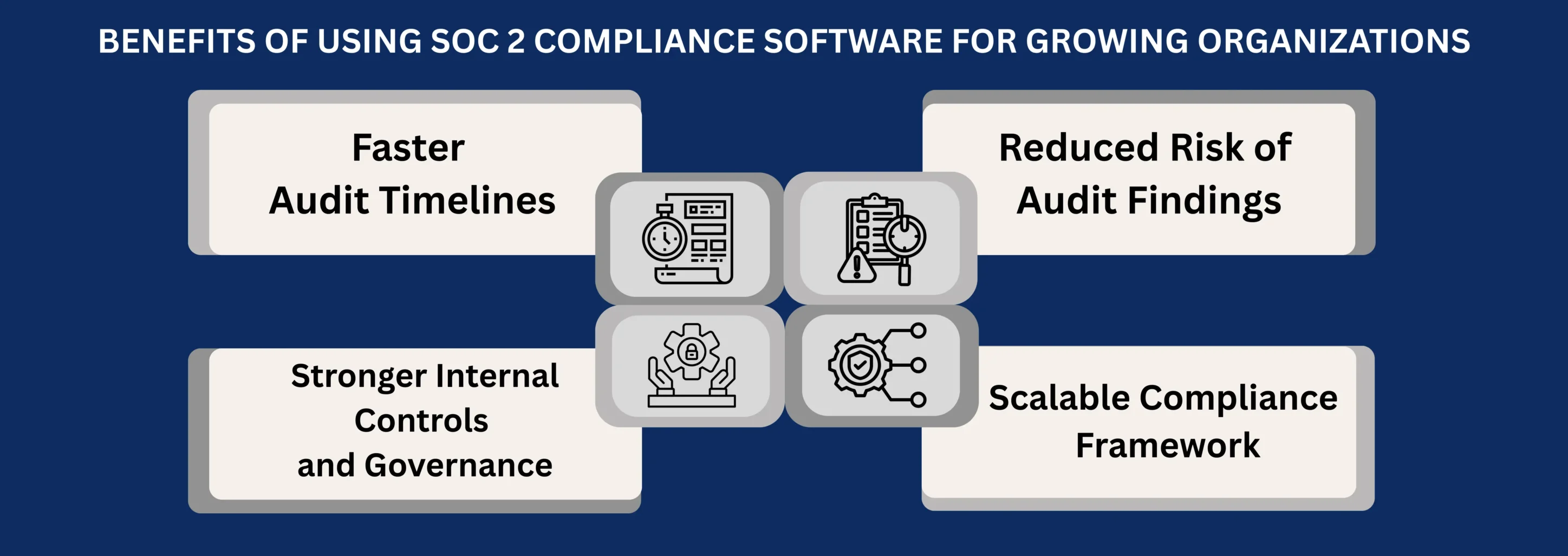
SOC 2 Certification in California delivers a defined set of organizational outcomes directly tied to the attestation process itself. These outcomes result from the independent nature of the examination, the formal attestation by a Licensed CPA Firm, and the structured format of the resulting report. The benefits of SOC 2 attestation extend across commercial, operational, and risk management dimensions of the certified organization.
A current SOC 2 Type 2 attestation report functions as a market access credential in California’s enterprise technology market. Organizations without SOC 2 attestation are routinely eliminated from enterprise vendor selection processes at the security questionnaire stage — before technical or commercial evaluation even begins. Possession of a current SOC 2 attestation report eliminates this friction point and allows enterprise sales cycles to advance based on business value rather than security assurance deficits. For California technology companies competing for Fortune 500 clients, financial institutions, healthcare systems, and federal government contracts, SOC 2 Certification is a practical prerequisite for market participation.
SOC 2 attestation also reduces the volume and complexity of customer security questionnaires an organization must respond to. Customers who receive a current SOC 2 Type 2 report — particularly one issued by a recognized Licensed CPA Firm — typically reduce or eliminate detailed security questionnaire requirements, trusting the independent attestation over self-reported responses. This reduction in questionnaire burden is a measurable operational efficiency for California technology companies managing high volumes of concurrent enterprise procurement processes.
The SOC 2 examination process itself produces internal benefits independent of the resulting attestation report. The structured evaluation of controls against the AICPA Trust Services Criteria identifies gaps in control design, inconsistencies in control execution, and documentation deficiencies that may not be visible through routine internal monitoring. Organizations that complete SOC 2 examinations regularly — particularly annual Type 2 cycles — develop more disciplined control environments, clearer accountability for control ownership, and stronger evidence management practices over time. This maturation reflects genuine operational improvement rather than a documentation exercise.
- ✓Market access: Satisfies enterprise vendor assurance requirements that exclude organizations without current SOC 2 attestation from procurement consideration
- ✓Competitive differentiation: Demonstrates independently verified security control effectiveness to prospects, customers, and partners in California’s competitive technology market
- ✓Questionnaire reduction: Accepted by enterprise customers in lieu of detailed vendor security questionnaires, reducing sales cycle friction
- ✓Regulatory alignment: Control environment evaluated against Trust Services Criteria addresses domains relevant to CCPA, CPRA, HIPAA, and other applicable California and federal requirements
- ✓Third-party risk management: Enables customers to satisfy their own vendor risk management program requirements through formal SOC 2 attestation documentation
- ✓Internal control maturity: Structured annual SOC 2 examination cycles improve control consistency, accountability, and evidence management practices
- ✓Investor and board confidence: Independent attestation provides boards, investors, and senior leadership with objective evidence of security control effectiveness
- ✓Commercial and Market Access Benefits
- ✓Internal Control and Risk Management Benefits
CertPro’s SOC 2 Attestation Services in California
CertPro operates as a Licensed CPA Firm providing independent SOC 2 examination and attestation services to organizations across California. CertPro’s practitioners conduct SOC 2 audits under AICPA AT-C Section 205 attestation standards, applying the Trust Services Criteria to evaluate the design and operating effectiveness of controls within the defined scope of each engagement. CertPro’s SOC 2 examination engagements in California address Type 1 and Type 2 reports across all five Trust Services Criteria categories — Security, Availability, Processing Integrity, Confidentiality, and Privacy.
Licensed CPA Firm Independence and Practitioner Qualifications
SOC 2 examinations can only be conducted by licensed CPA firms holding appropriate credentials and maintaining independence from the subject organization. CertPro’s practitioners hold CPA licensure and bring direct experience in AICPA attestation standards, Trust Services Criteria application, and technology-sector control environments across California’s primary industries. Independence is confirmed at engagement initiation and maintained throughout the examination. CertPro does not provide control design, policy development, or implementation activities to organizations undergoing SOC 2 examination — a structural separation that preserves the independence required for attestation under professional standards.
CertPro’s SOC 2 attestation engagements in California serve organizations across San Francisco, San Jose, Silicon Valley, Los Angeles, San Diego, Sacramento, and Orange County, as well as remote-first and distributed California-based technology companies. The firm’s examination methodology is structured to address the specific control environments of SaaS companies, cloud infrastructure providers, fintech organizations, healthcare technology platforms, AI businesses, and enterprise software companies operating within California’s technology economy. Each SOC 2 examination produces a formal attestation report that meets AICPA professional standards and satisfies enterprise customer and regulated-sector assurance requirements.
Annual Examination Cycles and Report Continuity
SOC 2 attestation reports reflect the control environment as of the report date (Type 1) or over the stated observation period (Type 2). Reports do not carry indefinite validity — enterprise customers and regulated-sector clients typically require reports dated within the prior twelve months to satisfy current vendor assurance requirements. Organizations must complete annual SOC 2 audit cycles to maintain current certified status and meet customer expectations. CertPro structures its SOC 2 examination engagements to support annual Type 2 report cycles, with observation periods aligned to the organization’s commercial calendar and customer contract renewal schedules where applicable.
SOC 2 Audit Cost Considerations in California
The scope, complexity, and report type of a SOC 2 examination are the primary factors that determine the overall engagement requirements and investment. California organizations evaluating SOC 2 audit options should consider these variables carefully when comparing examination offerings from different Licensed CPA Firms. Key scope variables include the number of Trust Services Criteria categories selected, the complexity of the system under examination, the number of in-scope systems and subservice organizations, the volume of control evidence to be tested, and the length of the observation period for Type 2 engagements.
Factors Influencing SOC 2 Examination Scope
Organizations with simple, single-system environments, a limited number of in-scope personnel functions, and a single Trust Services Criteria category will have examination scopes that are considerably narrower than organizations with complex multi-cloud architectures, multiple product lines, numerous subservice organization relationships, and multiple TSC categories in scope. Type 1 examinations have narrower scopes than Type 2 examinations, since operating effectiveness testing over the observation period is not required. California technology companies with highly automated control environments may also have different evidence collection dynamics than organizations with primarily manual control processes.
CertPro’s SOC 2 examination engagements are scoped based on the organization’s actual system description and control environment — not a standardized package. Organizations beginning with a SOC 2 Type 1 examination may subsequently transition to Type 2 examinations as their control environments mature and customer requirements evolve. This sequencing — Type 1 followed by Type 2 — is a recognized approach for organizations new to formal SOC 2 attestation. The Type 1 report provides immediate attestation value while the organization accumulates the observation period evidence required for a Type 2 engagement.
Getting Started with SOC 2 Certification in California
Initiating a SOC 2 examination engagement with CertPro begins with an engagement scoping discussion in which the organization’s system description, applicable Trust Services Criteria categories, report type, and target report date are established. CertPro’s practitioners confirm independence, execute engagement documentation, and develop the audit program prior to commencing fieldwork. The organization’s management team is responsible for preparing the system description, assembling evidence artifacts, and making personnel available for practitioner inquiries throughout the fieldwork phase.
Organizational Readiness and Evidence Management
Organizations pursuing SOC 2 Certification in California for the first time should confirm that control documentation, policy records, and evidence artifacts are accessible and organized before fieldwork commences. The SOC 2 examination requires evidence that controls existed and operated throughout the applicable period — evidence that must be produced by the organization, not created by the practitioner. Common evidence categories include access provisioning and de-provisioning records, change management approvals, vulnerability scan and penetration test reports, security awareness training completion records, incident response logs, and business continuity test results.
Management should designate a primary point of contact — typically a security officer, compliance manager, or operations lead — to coordinate evidence collection and facilitate practitioner communications during fieldwork. This coordination role is critical for maintaining examination timelines and ensuring that evidence is provided promptly and completely. California technology organizations with distributed teams, remote workforces, or multiple office locations across San Francisco, Los Angeles, San Diego, and other cities should ensure that evidence collection processes account for all in-scope personnel and system components regardless of location.
SOC 2 Examination Timeline and Scheduling
The timeline for a SOC 2 Type 1 examination typically spans four to eight weeks from engagement initiation to report issuance, depending on scope complexity and the organization’s responsiveness during evidence collection. SOC 2 Type 2 examinations involve a longer overall timeline because the observation period — typically six to twelve months — must elapse before fieldwork can be completed and the report issued. For first-time Type 2 engagements, the total timeline from initiation to report issuance is approximately eight to fourteen months. Organizations should plan their SOC 2 examination schedule with customer contract timelines, procurement deadlines, and annual renewal dates in mind to ensure that a current attestation report is available when needed.
FAQ
▶
What is SOC 2 compliance means an organization has implemented controls aligned?
▶
What does SOC 2 Certification mean for a California company?
▶
What is the difference between SOC 2 certified and SOC 2 compliant?
▶
How long does a SOC 2 audit take in California?
▶
Which Trust Services Criteria should a California SaaS company include?
▶
Does SOC 2 attestation satisfy CCPA or CPRA requirements in California?
▶
How long is a SOC 2 attestation report valid?
▶
Can startups and small businesses obtain SOC 2 Certification in California?
SOC 1 VS SOC 2: WHICH REPORT YOUR CUSTOMERS ACTUALLY ASK FOR
If you sell SaaS or provide outsourced services, you have likely been asked for a SOC report. However, the follow-up question is rarely easy to answer…

AICPA Issues New Guidance for Peer Reviewers Evaluating SOC 2 Engagements
AICPA SOC 2 guidance has been issued to help peer reviewers identify quality risks associated with SOC 2 engagements as the use of compliance automati…
SOC 2 Certified: What Does It Mean for Your Business
For companies that handle sensitive data or run cloud-based services, the question “Can you provide your SOC 2 report?” carries enormous weight. Yet, …
Get In Touch
have a question? let us get back to you.