
ISO 27001 Certification in Canada
The ISO 27001 certification audit process in Canada follows a structured sequence of evaluation activities conducted by an independent certification body. CertPro, operating as a Licensed CPA Firm, performs ISO 27001 certification audits through a defined methodology covering scope confirmation, document review, control testing, and conformity assessment. The process is designed to produce an objective determination of whether an organization’s ISMS conforms to ISO/IEC 27001:2022 requirements and whether controls operate effectively across the defined scope and audit period.
OUR CLIENTS










What Is ISO 27001 Certification and Why Does It Matter for Canadian Organizations?
ISO 27001 Certification in Canada is issued under the ISO/IEC 27001:2022 standard — the internationally recognized framework for Information Security Management Systems (ISMS). Certification confirms that an organization’s ISMS has been independently audited and found to conform to the standard’s requirements for establishing, implementing, maintaining, and continually improving information security controls. CertPro, a Licensed CPA Firm, conducts independent ISO 27001 certification audits for organizations operating across Canada. Each ISMS certification audit evaluates documented policies, risk treatment decisions, Annex A controls, and operational evidence across the defined audit scope.
For Canadian organizations handling sensitive personal, financial, healthcare, or operational data, ISO 27001 Certification in Canada provides independently verified assurance to customers, regulators, and trading partners. Canada’s technology ecosystem spans SaaS providers, fintech companies, financial institutions, healthcare organizations, cloud service providers, AI companies, cybersecurity firms, data center operators, e-commerce businesses, and telecommunications providers — operating across Toronto, Vancouver, Montreal, Ottawa, Calgary, Edmonton, and beyond. These organizations routinely face procurement requirements, contractual obligations, and customer due diligence processes that reference ISO 27001 compliance as a baseline expectation for information security governance.
ISO/IEC 27001:2022 introduced significant structural updates from its 2013 predecessor. The standard reduced Annex A controls from 114 to 93, reorganized them across four domains, and introduced 11 new controls addressing areas such as threat intelligence, cloud security, data masking, and physical security monitoring. Organizations previously certified under ISO/IEC 27001:2013 were required to transition to the 2022 version by October 31, 2025, as established by accreditation bodies. All new certifications are now issued exclusively against the 2022 standard. Understanding the updated control structure is essential for any organization entering the ISO 27001 certification audit process in Canada under the current version of the standard.
ISO 27001 compliance in Canada is increasingly relevant in the context of Canadian privacy legislation, including the Personal Information Protection and Electronic Documents Act (PIPEDA) and Quebec’s Law 25 (Act Respecting the Protection of Personal Information in the Private Sector). While ISO 27001 certification does not automatically establish compliance with Canadian or provincial privacy laws, certified organizations demonstrate that information security risks affecting personal data are systematically identified, assessed, treated, and monitored through a documented ISMS. This structured approach to risk management is valuable for organizations subject to Canadian privacy obligations and for those serving customers across the United States and international markets where security certification is a vendor assurance requirement.
The certification process culminates in an independent ISMS certification audit conducted by a qualified certification body. CertPro evaluates whether an organization’s information security controls operate as documented, address identified risks, and conform to all applicable clauses of ISO/IEC 27001:2022. The ISO 27001 audit covers the full ISMS scope — including the risk assessment methodology, Statement of Applicability, risk treatment plan, control implementation, management review records, internal audit program, and continual improvement activities. Organizations that achieve certification receive a formal certificate valid for three years, subject to annual surveillance audits that verify ongoing conformance throughout the certification cycle.
ISO/IEC 27001:2022 Standard Structure and Scope
ISO/IEC 27001:2022 is structured around ten mandatory clauses (Clauses 4 through 10) and Annex A, which contains 93 information security controls organized across four domains: Organizational Controls (37 controls), People Controls (8 controls), Physical Controls (14 controls), and Technological Controls (34 controls). Clauses 4 through 10 define the normative requirements that every certified organization must satisfy. These cover context of the organization, leadership and commitment, planning, support, operation, performance evaluation, and improvement. Annex A controls are not all mandatory — organizations select applicable controls based on risk assessment results and document inclusion or exclusion rationale in the Statement of Applicability.
The scope of ISO 27001 Certification is defined by the organization and documented within the ISMS. Scope may encompass an entire organization, a specific business unit, a defined service line, a geographic location, or a set of information assets and processing activities. Canadian organizations frequently define ISMS scope around specific services — such as cloud-hosted platforms, customer data processing environments, or financial transaction systems. A clearly defined and justified scope is a prerequisite for the ISMS certification audit, as it establishes the boundaries within which the ISMS operates and against which conformance is assessed.
Who Pursues ISO 27001 Certification in Canada?
ISO 27001 Certification in Canada is pursued by organizations across sectors where information security governance is a procurement prerequisite, regulatory expectation, or competitive differentiator. Technology companies and SaaS providers use certification to demonstrate security governance to enterprise customers during vendor assessment processes. Financial institutions and fintech companies in Toronto and Vancouver pursue ISO 27001 certification to address third-party risk management requirements from regulators and institutional clients. Healthcare organizations across Canada certify to demonstrate controls over electronic health information. Cloud service providers, AI businesses, cybersecurity firms, data center operators, e-commerce businesses, and telecommunications providers all pursue ISO 27001 Certification to establish independently verified information security posture for domestic and international customers.

ENQUIRE NOW
Related Resources
Related Services in Canada
ISO 27001 Certification Audit Process in Canada
The ISO 27001 certification audit process in Canada follows a structured sequence of evaluation activities conducted by an independent certification body. CertPro, operating as a Licensed CPA Firm, performs ISO 27001 certification audits through a defined methodology covering scope confirmation, document review, control testing, and conformity assessment. The process is designed to produce an objective determination of whether an organization’s ISMS conforms to ISO/IEC 27001:2022 requirements and whether controls operate effectively across the defined scope and audit period.
The Stage 1 audit — also referred to as the documentation review or preliminary assessment — evaluates whether the organization has established an ISMS that meets the structural requirements of ISO/IEC 27001:2022. During Stage 1, the auditor reviews the ISMS scope statement, information security policy, risk assessment methodology, risk treatment plan, Statement of Applicability, and all mandatory documented information required by the standard. The auditor confirms that the ISMS design is sufficient to proceed to Stage 2 and identifies any areas requiring clarification or additional documentation before the main ISO 27001 certification audit commences. Stage 1 findings are communicated to the organization in a written report that directly informs Stage 2 audit planning.
The Stage 1 audit also establishes the audit program for Stage 2, including the sampling approach, audit schedule, and areas of focus based on the organization’s risk profile, ISMS scope, and control implementation. For Canadian organizations operating across multiple provinces or managing complex cloud-based information environments, Stage 1 planning addresses how the ISO 27001 audit will cover relevant locations, systems, and organizational units within scope. The interval between Stage 1 and Stage 2 is typically four to eight weeks, giving the organization time to address any documentation gaps identified during the preliminary review.
The Stage 2 audit is the main ISMS certification audit, during which the auditor evaluates whether the organization’s information security controls are implemented, operational, and effective across the defined ISMS scope. The ISO 27001 certification audit at Stage 2 involves interviewing personnel, observing operational processes, reviewing system configurations, testing control operation through evidence sampling, and assessing records of management review, internal audit, and corrective action. The auditor evaluates conformance with all applicable clauses of ISO/IEC 27001:2022 and the controls selected in the Statement of Applicability.
Nonconformities identified during the Stage 2 ISO 27001 audit are classified as major or minor. A major nonconformity represents a failure to satisfy a requirement of the standard or a systemic breakdown in control operation. A minor nonconformity identifies a deviation that does not invalidate the ISMS but requires corrective action within a defined timeframe. Observations and opportunities for improvement may also be recorded. ISO 27001 Certification is granted once all major nonconformities have been resolved and verified, and the certification body has completed its review and approval of the audit file and findings.
ISO 27001 certification is valid for three years from the date of issue. Annual surveillance audits are conducted during Year 1 and Year 2 of the certification cycle to verify that the ISMS continues to conform to ISO/IEC 27001:2022 requirements and that controls remain operational and effective. Surveillance audits are narrower in scope than the initial ISO 27001 certification audit but must cover management review, internal audit results, corrective actions, continual improvement activities, and any significant changes to the organization’s information environment. A recertification audit conducted in Year 3 re-evaluates the full ISMS scope before a new three-year certificate is issued.
- ✓Stage 1 Audit: Documentation and Readiness Review
- ✓Stage 2 Audit: ISMS Certification Audit and Control Testing
- ✓Surveillance Audits and Recertification
ISO 27001 Requirements: What Canadian Organizations Must Demonstrate
ISO 27001 compliance requires organizations to satisfy all normative requirements defined in Clauses 4 through 10 of ISO/IEC 27001:2022 and to implement applicable controls from Annex A as determined by the risk assessment and treatment process. The following requirements are evaluated during the ISO 27001 certification audit and must be demonstrably met for certification to be granted.
ISO/IEC 27001:2022 mandates a defined set of documented information that must be maintained and retained throughout the ISMS lifecycle. Mandatory documented information includes the ISMS scope, information security policy, risk assessment process, risk treatment process, risk treatment plan, Statement of Applicability, information security objectives, competence records, evidence of monitoring and measurement results, internal audit program and results, management review records, and records of nonconformities and corrective actions. Each document must be controlled, version-managed, and accessible to relevant personnel. During the ISO 27001 certification audit, the auditor reviews these documents to confirm their completeness, currency, and alignment with actual ISMS operation.
The Statement of Applicability (SoA) is one of the most critical documents evaluated during the ISMS certification audit. The SoA lists all 93 Annex A controls, indicates whether each control is applicable or excluded, provides justification for exclusions, and references the implementation status of applicable controls. The SoA must be internally consistent with the risk treatment plan and must accurately reflect the actual control environment at the time of the audit. Auditors cross-reference the SoA against risk assessment outputs, risk treatment decisions, and control evidence to verify that the document accurately represents the organization’s information security control landscape.
ISO/IEC 27001:2022 requires organizations to establish and apply a defined information security risk assessment process that produces consistent, valid, and comparable results. The risk assessment must identify information security risks associated with the loss of confidentiality, integrity, and availability of information within the ISMS scope, analyze the likelihood and impact of each identified risk, and evaluate risks against defined risk acceptance criteria. Risk owners must be assigned, and risk assessment results must be documented and retained as evidence for the ISO 27001 audit review. The risk assessment must be repeated at planned intervals and whenever significant changes occur.
The risk treatment process requires organizations to select appropriate treatment options — typically acceptance, avoidance, transfer, or mitigation — and to select controls from Annex A or other sources to address risks identified for treatment. The risk treatment plan documents treatment decisions, selected controls, implementation responsibilities, and target completion dates. Organizations must obtain risk owner approval of the risk treatment plan and acceptance of residual information security risks before certification can proceed. These records form a core component of the audit evidence package reviewed during the ISO 27001 certification audit in Canada.
| Control Domain | Number of Controls | Example Controls |
|---|---|---|
| Organizational Controls | 37 | Information security policies, threat intelligence, supplier relationships, incident management |
| People Controls | 8 | Screening, terms of employment, information security awareness, disciplinary process |
| Physical Controls | 14 | Physical security perimeters, equipment maintenance, secure disposal, physical security monitoring |
| Technological Controls | 34 | Access control, cryptography, secure development, data masking, vulnerability management, cloud security |
- ✓ISMS Documentation Requirements
- ✓Risk Assessment and Risk Treatment Requirements
- ✓Annex A Controls: The 2022 Control Domains
Steps to Obtain ISO 27001 Certification in Canada
Obtaining ISO 27001 Certification in Canada involves a structured sequence of organizational activities followed by an independent ISO 27001 certification audit conducted by a qualified certification body. The steps below describe the full process — from ISMS establishment through certificate issuance — structured for clarity and practical applicability.
- Define the ISMS scope: Identify the organizational units, locations, information assets, services, and processes to be included within the ISMS boundary.
- Conduct a risk assessment: Apply a documented methodology to identify, analyze, and evaluate information security risks affecting the confidentiality, integrity, and availability of information within scope.
- Develop the risk treatment plan: Select controls from Annex A and other sources to address identified risks, assign risk owners, and document treatment decisions.
- Prepare the Statement of Applicability: Document all 93 Annex A controls, indicate applicability, justify exclusions, and reference implementation status.
- Implement and operate controls: Deploy selected controls, establish operational procedures, train relevant personnel, and generate records of control operation.
- Conduct internal audits: Perform internal ISMS audits at planned intervals to evaluate conformance with ISO/IEC 27001:2022 requirements and identify nonconformities.
- Conduct management review: Senior management reviews ISMS performance, audit results, risk treatment status, and continual improvement activities at defined intervals.
- Engage a certification body: Submit the ISMS documentation package to a certification body and schedule the Stage 1 and Stage 2 ISO 27001 certification audit.
- Complete Stage 1 and Stage 2 audits: Undergo the documentation review and main certification audit, address any nonconformities, and receive the certification decision.
ISO/IEC 27001:2022 Clause 5 requires demonstrable leadership commitment to the ISMS from top management. This includes establishing and communicating an information security policy, ensuring that ISMS objectives align with the organization’s strategic direction, assigning roles and responsibilities for information security, and integrating ISMS requirements into operational processes. During the ISMS certification audit, auditors interview senior management to assess the depth of leadership engagement, review management review records for evidence of active oversight, and confirm that adequate resources have been allocated to support the ISMS across the audit period.
For Canadian organizations undergoing ISO 27001 certification for the first time, establishing genuine management commitment is often the most consequential factor in ISMS maturity. The standard does not accept nominal policy endorsement as evidence of leadership. Auditors look for active participation in risk decisions, resource allocation decisions documented in management review minutes, and measurable information security objectives that have been tracked and reported to senior leadership. Organizations in which information security governance is delegated entirely below the executive level frequently encounter findings in this area during the Stage 2 ISO 27001 certification audit.
- ✓Management Commitment and Leadership Requirements
Benefits of ISO 27001 Certification for Canada-Based Organizations
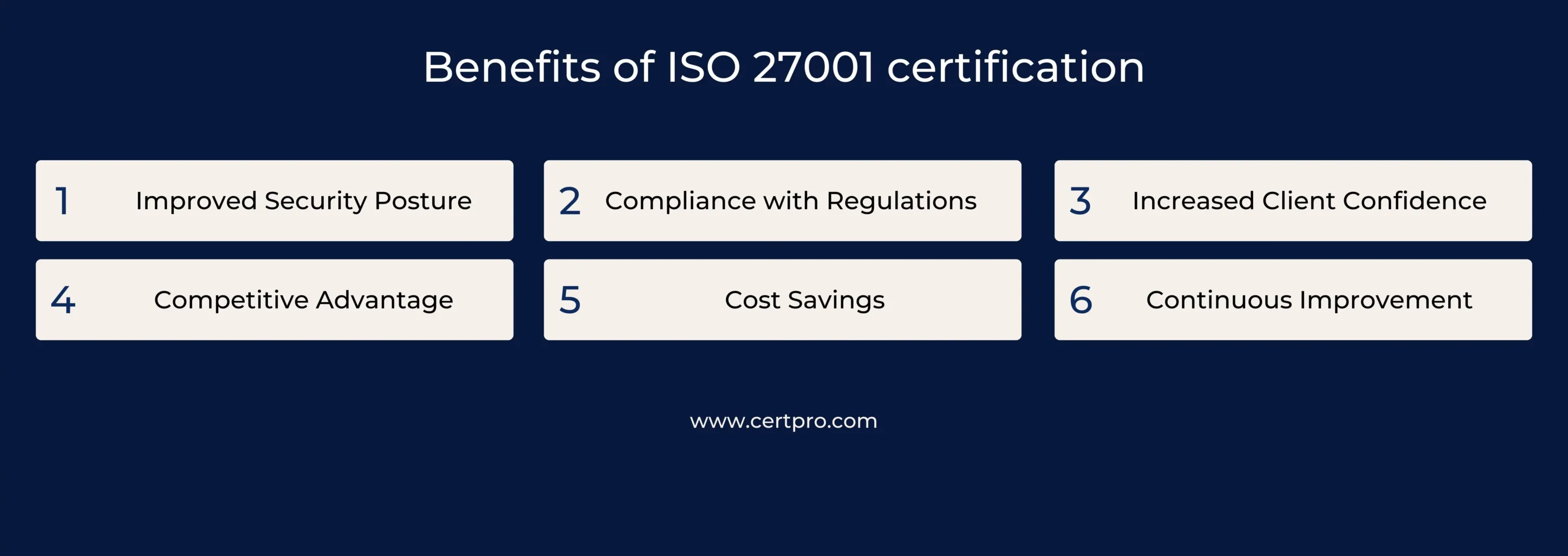
ISO 27001 Certification in Canada delivers measurable organizational benefits across commercial, operational, and regulatory dimensions. The benefits below are specific to the Canadian business environment and reflect the outcomes of conformance with ISO/IEC 27001:2022 as evaluated through independent ISO 27001 audit.
- ✓Independently verified information security posture: Certification provides third-party confirmation that the ISMS meets the requirements of ISO/IEC 27001:2022, enabling organizations to respond to customer security questionnaires and vendor assessment processes with audit-backed evidence.
- ✓Competitive differentiation in Canadian and international markets: ISO 27001 certification is recognized by enterprise customers, government procurement bodies, and international trading partners as a credible information security credential.
- ✓Alignment with Canadian privacy legislation context: A structured ISMS supports documentation of controls relevant to personal information protection obligations under PIPEDA and Quebec’s Law 25, though ISO 27001 certification does not establish legal compliance.
- ✓Reduced information security incident probability: Systematic risk assessment and treatment reduce the likelihood of data breaches, unauthorized access, and operational disruptions affecting information assets.
- ✓Improved supplier and third-party risk management: ISO 27001 compliance supports structured evaluation of supplier information security practices and contractual security requirements.
- ✓Stronger internal security culture: Mandatory awareness training, defined roles and responsibilities, and documented procedures improve information security awareness across the organization.
- ✓Structured foundation for continual improvement: The ISMS framework requires periodic internal audit, management review, and corrective action, creating a governance cycle that drives ongoing security improvement.
- ✓Regulatory and contractual credibility: Organizations subject to sector-specific requirements from financial regulators, healthcare authorities, or government procurement bodies can reference ISO 27001 certification as evidence of information security governance maturity.
Canadian technology companies and SaaS providers operating in Toronto’s MaRS Discovery District, Vancouver’s technology sector, Montreal’s AI ecosystem, and Ottawa’s government technology market face consistent enterprise customer requirements for ISO 27001 Certification in Canada as a condition of procurement. Enterprise customers in financial services, healthcare, government, and critical infrastructure routinely require vendors handling their data to hold a current ISO 27001 certificate issued by an independent certification body. The ISO 27001 certification audit provides objective evidence that security controls protecting customer data are implemented, operational, and subject to ongoing independent verification.
For SaaS companies pursuing enterprise contracts with US-based or international customers, ISO 27001 Certification in Canada is frequently cited alongside SOC 2 Type II reports as a preferred security assurance credential. The two frameworks address overlapping but distinct areas: ISO 27001 is a management system standard assessed through a certification audit, while SOC 2 is an attestation report on service organization controls. Canadian SaaS companies increasingly pursue both certifications to satisfy the full range of customer security assurance requirements across North American and European markets.
Financial institutions and fintech companies across Toronto, Calgary, and Vancouver pursue ISO 27001 Certification to address information security governance expectations from the Office of the Superintendent of Financial Institutions (OSFI), institutional clients, and international payment networks. OSFI’s B-10 guideline on technology and cyber risk management references expectations for sound information security management that align conceptually with the risk-based ISMS framework required by ISO 27001. While ISO 27001 certification does not constitute regulatory compliance with OSFI guidelines, the ISO 27001 certification audit provides structured evidence of information security risk management maturity relevant to regulatory examinations and institutional due diligence reviews.
- ✓ISO 27001 Certification for Canadian Technology and SaaS Companies
- ✓ISO 27001 Certification for Financial Institutions and Fintech Companies
ISO 27001 Certification Cost in Canada: Factors and Considerations
The investment required to achieve ISO 27001 Certification in Canada is determined by several organizational variables that affect the scope, duration, and complexity of the certification audit. Understanding these factors enables organizations to plan the ISO 27001 certification process effectively and allocate appropriate internal resources before engaging a certification body. Note that specific fee amounts are not quoted here — organizations should contact CertPro directly for scope-specific information relevant to their certification engagement.
Key Factors Affecting ISO 27001 Certification Investment
| Factor | Impact on Audit Scope | Typical Consideration |
|---|---|---|
| Organization size | Larger organizations require more audit days to cover personnel, systems, and locations | Employee count and number of ISMS-relevant roles |
| ISMS scope complexity | Broader scope covering multiple services or locations increases ISO 27001 audit duration | Number of in-scope systems, data flows, and sites |
| Number of Annex A controls applied | More applicable controls require more evidence sampling and testing time during the certification audit | Controls selected in the Statement of Applicability |
| Existing ISMS maturity | A mature ISMS with complete documentation and operational records streamlines audit execution | Internal audit history, management review cadence |
| Certification cycle stage | Initial certification audits are more extensive than annual surveillance audits | Stage 1, Stage 2, surveillance, or recertification |
Beyond the certification body’s audit activities, organizations should account for internal resource investment in ISMS documentation, risk assessment execution, control implementation, internal audit program operation, and management review activities. For Canadian organizations new to ISO 27001, the internal effort required to establish a conformant ISMS is typically more significant than the certification audit itself. Organizations that have previously operated under frameworks such as SOC 2, NIST CSF, or CIS Controls may find that existing documentation and control evidence reduces the incremental effort required to meet ISO/IEC 27001:2022 requirements.
Selecting an ISO 27001 Certification Body in Canada
Selecting a qualified ISO 27001 certification body in Canada requires organizations to evaluate the certification body’s independence, auditor qualifications, audit methodology, and recognition by relevant accreditation bodies. CertPro operates as a Licensed CPA Firm conducting independent ISO 27001 certification audits under structured, impartial audit practices. The ISO 27001 audit firm Canada engages follows evidence-based assessment procedures aligned with ISO/IEC 17021-1 — the standard governing competence requirements for bodies providing audit and certification of management systems. Organizations should confirm that the certification body’s auditors hold relevant information security qualifications and sector-specific experience aligned with the organization’s ISMS scope.
ISO 27001 Compliance in Canada: Regulatory and Contractual Context
ISO 27001 compliance in Canada represents a strategic approach to information security governance that intersects with several Canadian regulatory frameworks and contractual requirements. While ISO 27001 certification is a voluntary international standard rather than a mandatory Canadian regulation, the structured ISMS it requires aligns closely with expectations embedded in multiple Canadian legal and regulatory contexts.
PIPEDA, Quebec’s Law 25, and Information Security Governance
Canada’s Personal Information Protection and Electronic Documents Act (PIPEDA) requires organizations to protect personal information through appropriate security safeguards. Quebec’s Act Respecting the Protection of Personal Information in the Private Sector (Law 25) imposes additional requirements, including privacy impact assessments, data breach notification obligations, and documented governance of personal information handling. An ISO 27001 ISMS provides a structured framework for identifying and treating risks to personal information, documenting security safeguards, and maintaining records of security governance activities. However, ISO 27001 certification does not establish legal compliance with PIPEDA or Law 25 — organizations must separately assess their obligations under applicable Canadian and provincial privacy legislation.
For Canadian organizations transferring personal data to or from the European Union, the General Data Protection Regulation (GDPR) is also relevant. GDPR Article 32 requires that controllers and processors implement appropriate technical and organizational measures to ensure a level of security appropriate to the risk. An ISO 27001 ISMS provides a recognized framework for demonstrating that such measures are in place. ISO 27001 certification is frequently cited in GDPR compliance documentation as evidence of systematic security governance. Canadian exporters of personal data to EU-based recipients benefit from referencing ISO 27001 certification during data protection impact assessments and contractual security due diligence processes.
Government and Public Sector Procurement in Canada
Federal and provincial government procurement processes in Canada increasingly reference information security certification requirements for vendors handling sensitive government data. Public Services and Procurement Canada (PSPC) and provincial counterparts evaluate vendor security posture as part of contract award processes for technology services, cloud platforms, and managed services. ISO 27001 Certification in Canada provides independently audited evidence of information security controls that can be referenced in government procurement responses, vendor registration submissions, and security assessment packages. Organizations supplying services to the Government of Canada should review specific security requirements within applicable procurement vehicles, as ISO 27001 certification requirements may vary by contract type and data classification level.
ISO 27001 Audit Canada: CertPro’s Independent Audit Methodology
CertPro is a Licensed CPA Firm that performs independent ISO 27001 audits for organizations across Canada. The ISO 27001 audit Canada process is conducted under structured, impartial audit practices focused on evidence review, control testing, and conformity assessment against ISO/IEC 27001:2022. CertPro’s audit methodology evaluates whether documented policies, processes, and controls operate consistently across the defined audit scope and produce outcomes consistent with the standard’s requirements.
Audit Evidence Collection and Control Testing
During the ISO 27001 certification audit, CertPro auditors collect evidence through multiple methods: document review, personnel interviews, system configuration inspection, log review, process observation, and record sampling. Evidence collection is structured to evaluate both the design and operational effectiveness of information security controls. For technological controls such as access management, cryptography, vulnerability management, and secure configuration, auditors review system-generated records, configuration outputs, and operational procedures. For organizational and people controls, auditors review training records, awareness program documentation, supplier agreement terms, and incident response records to assess operational consistency.
CertPro’s approach to the ISMS certification audit emphasizes evidence traceability — meaning that each audit finding references specific evidence items that support the auditor’s determination. This evidence-based approach gives organizations clear visibility into the basis for conformance findings and nonconformity determinations, enabling targeted and effective corrective action where required. The audit report produced at the conclusion of the Stage 2 ISO 27001 certification audit documents all findings, the evidence basis for each determination, and the auditor’s overall conformity assessment recommendation to the certification decision function.
Nonconformity Management and Certification Decision
When nonconformities are identified during the ISO 27001 certification audit, organizations are required to conduct root cause analysis, implement corrective actions, and provide objective evidence of correction to the certification body within an agreed timeframe. For major nonconformities, this process must be completed before the certification decision can be made. The certification decision is made by a function within CertPro that is independent of the audit team, ensuring that the decision to grant or withhold ISO 27001 certification is based on an impartial review of the complete audit file. Once the certification decision confirms conformance, the ISO 27001 certificate is issued with a three-year validity period commencing from the date of Stage 2 audit conclusion.
ISO 27001 Certification for Canadian Healthcare and Cloud Service Providers
Two sectors with particularly strong demand for ISO 27001 Certification in Canada are healthcare organizations and cloud service providers. Both sectors handle sensitive information at scale, face stringent third-party security requirements, and operate in environments where information security failures carry significant operational and reputational consequences.
Healthcare Organizations and Electronic Health Information
Canadian healthcare organizations — including hospitals, health authorities, digital health companies, and electronic medical record (EMR) providers — handle electronic health information subject to provincial health information legislation such as Ontario’s Personal Health Information Protection Act (PHIPA), Alberta’s Health Information Act (HIA), and British Columbia’s E-Health (Personal Health Information Access and Protection of Privacy) Act. These legislative frameworks require that custodians implement safeguards appropriate to the sensitivity of health information. ISO 27001 Certification provides a structured ISMS framework for documenting and operating information security controls over health information systems. The ISO 27001 certification audit produces independently verified evidence of control operation that can be referenced in privacy impact assessments and custodian accountability documentation.
Digital health companies and health technology vendors supplying services to Canadian health authorities are frequently required to demonstrate ISO 27001 compliance as a condition of vendor onboarding. Health authorities across Ontario, British Columbia, Alberta, and Quebec have adopted information security vendor assessment processes that reference ISO 27001 certification as a preferred or required credential for vendors accessing health information systems. The ISO 27001 certification audit provides objective third-party assurance that vendor information security controls meet internationally recognized standards, reducing the due diligence burden on health authority information security teams during procurement and contract renewal processes.
Cloud Service Providers and Multi-Tenant Security Assurance
Canadian cloud service providers (CSPs) and data center operators hosting customer data across facilities in Toronto, Montreal, Calgary, and Vancouver pursue ISO 27001 Certification to provide multi-tenant customers with independent assurance that shared infrastructure and platform security controls meet recognized international standards. The ISO/IEC 27001:2022 standard includes controls directly relevant to cloud environments, addressing cloud service agreements, shared responsibilities, multi-tenancy security, and cloud-specific access controls. The 2022 update’s new technological control on cloud security (Annex A 5.23) specifically addresses information security requirements for cloud services, making the updated standard more directly applicable to CSPs and to organizations consuming cloud services.
FAQ
▶
What is ISO 27001 certification and what does it confirm?
▶
How long does the ISO 27001 certification process take in Canada?
▶
How long is ISO 27001 certification valid?
▶
What is the difference between Stage 1 and Stage 2 of the ISO 27001 audit?
▶
Does ISO 27001 certification establish compliance with PIPEDA or Quebec’s Law 25?
▶
What is the Statement of Applicability in ISO 27001?
▶
What is the transition deadline for ISO/IEC 27001:2022?
▶
What sectors in Canada most commonly pursue ISO 27001 certification?
Get In Touch
have a question? let us get back to you.