
ISO 42001 Certification in Amsterdam
CertPro is a Licensed CPA Firm delivering ISO 42001 certification audit and assessment services to organizations in Amsterdam. Operating under internationally recognized accreditation frameworks, CertPro evaluates Artificial Intelligence Management Systems (AIMS) against the requirements of ISO/IEC 42001:2023, issuing certification upon demonstrated conformance. Services are strictly limited to certification audits and assessments — no consulting or advisory services are provided.
OUR CLIENTS









What Is ISO 42001 Certification
ISO 42001 is an international standard published by the International Organization for Standardization (ISO) that specifies requirements for establishing, implementing, maintaining, and continually improving an Artificial Intelligence Management System (AIMS). Published in December 2023 as ISO/IEC 42001:2023, it is the world’s first internationally recognized management system standard specifically designed for organizations that develop, provide, or use AI systems. ISO 42001 certification formally confirms that an organization’s AIMS satisfies these internationally defined requirements across AI governance, risk accountability, transparency, and responsible AI use.
Defining AIMS: Artificial Intelligence Management System
An Artificial Intelligence Management System (AIMS) is a structured organizational framework that governs the development, deployment, monitoring, and oversight of AI systems. The AIMS establishes the policies, procedures, roles, responsibilities, and controls through which an organization manages AI-related risks and ensures that AI operations remain aligned with ethical, legal, and operational standards. Under ISO 42001, the AIMS is not a software platform — it is a documented management system that integrates AI governance into existing organizational structures, processes, and decision-making hierarchies.
The structural relationship within ISO 42001 flows as follows: ISO 42001 defines the international standard → the AIMS is the management system built to satisfy that standard → the organizational AI governance framework comprises the policies, controls, and operational procedures that constitute the AIMS in practice. This three-tier relationship means that ISO 42001 certification is not achieved by implementing a single control or policy. It requires demonstrating that the entire AIMS meets the standard’s requirements in a documented, verifiable, and auditable manner. Every element of the AIMS — from risk assessment processes to accountability structures — must be traceable to ISO 42001 clause requirements during a certification audit.
Scope of ISO 42001: Governance, Risk, and Accountability
The scope of ISO 42001 encompasses four primary domains: AI governance, AI risk management, accountability structures, and responsible AI use. AI governance under the standard requires organizations to define the authority, oversight, and decision-making structures that apply to AI systems throughout their lifecycle. AI risk management requires systematic identification, analysis, evaluation, and treatment of risks associated with AI systems — including risks of bias, opacity, security vulnerabilities, and unintended societal impact. Accountability structures under ISO 42001 require that roles and responsibilities for AI oversight are formally assigned, documented, and maintained within the organization’s management hierarchy.
Responsible AI use, as defined within the ISO 42001 framework, requires organizations to address ethical considerations in AI system design and deployment — including fairness, transparency, privacy, and non-discrimination. ISO 42001 compliance is therefore both a technical and organizational commitment. It requires not only that AI systems are built and operated responsibly, but that the organization has embedded governance structures to verify, monitor, and improve responsible AI practices over time. ISO AIMS certification issued under this standard serves as formal, third-party evidence that these governance structures exist, function effectively, and have been independently evaluated against internationally accepted criteria.
ISO 42001 and Its Relationship to Other Management System Standards
ISO 42001 follows the ISO High Level Structure (HLS), also known as Annex SL — the same harmonized framework used by ISO 27001 (Information Security Management), ISO 9001 (Quality Management), and ISO 31000 (Risk Management). This structural alignment means that organizations already certified to ISO 27001 can integrate ISO 42001 requirements into their existing management system without building entirely new frameworks. Shared elements include context of the organization, leadership commitment, planning, support, operations, performance evaluation, and improvement cycles — all of which appear across multiple ISO management system standards.
For Amsterdam-based organizations operating under GDPR obligations, integrating ISO 42001 with ISO 27001 is particularly significant. AI systems that process personal data sit at the intersection of information security requirements and AI governance requirements. ISO 42001 certification addresses AI-specific risks — such as automated decision-making, profiling, and algorithmic bias — that ISO 27001 alone does not cover. Together, these certifications demonstrate a comprehensive, multi-layered governance posture to regulators, clients, and stakeholders in Amsterdam’s highly regulated digital economy.

ISO 42001 Certification in Amsterdam
Amsterdam occupies a strategically important position in the European technology landscape. As home to one of Europe’s largest concentrations of multinational corporations, AI-native startups, fintech firms, and global cloud infrastructure providers, Amsterdam operates within a regulatory and competitive environment where AI governance has become a central institutional priority. ISO 42001 Certification in Amsterdam responds directly to this environment — providing organizations with a formally audited, internationally recognized attestation of their AI management practices at a time when regulators, investors, and clients increasingly demand documented evidence of responsible AI governance.
Regulatory Drivers for ISO 42001 Certification in Amsterdam
Amsterdam-based organizations operate under multiple overlapping regulatory frameworks that directly implicate AI governance. The General Data Protection Regulation (GDPR) — enforced in the Netherlands by the Autoriteit Persoonsgegevens (AP), the Dutch Data Protection Authority — establishes binding requirements for the lawful, fair, and transparent processing of personal data. Where AI systems are used to process personal data, make automated decisions, or conduct profiling, GDPR obligations apply directly. The AP has demonstrated active enforcement capability, with penalties for serious violations reaching up to €20 million or four percent of annual global turnover. ISO 42001 compliance supports an organization’s ability to document and demonstrate GDPR-aligned AI governance practices, reducing regulatory exposure under AP scrutiny.
The EU AI Act, which entered into force in August 2024 with phased implementation timelines through 2026 and 2027, establishes risk-based obligations for AI system providers and deployers operating within the European Union. Amsterdam organizations deploying high-risk AI systems — as defined in Annex III of the EU AI Act — face mandatory requirements for risk management systems, data governance, transparency, human oversight, and conformity assessments. ISO 42001 assessment and certification provides a structured, internationally recognized pathway for meeting many of these obligations. While ISO 42001 is not itself mandated by the EU AI Act, the AIMS framework it requires aligns closely with the Act’s technical and governance expectations — positioning certified organizations favorably during regulatory conformity evaluations.
Industry Sectors in Amsterdam Benefiting from ISO 42001 Certification
Amsterdam’s technology ecosystem spans multiple sectors where AI deployment is intensive and governance requirements are high. The fintech sector — anchored by major payment processors, digital banking platforms, and algorithmic trading firms — relies on AI systems for fraud detection, credit scoring, anti-money laundering monitoring, and customer service automation. ISO 42001 Certification in Amsterdam is directly applicable to fintech: financial regulators and institutional clients require evidence of AI governance maturity, and certification provides auditable proof of structured AIMS implementation. ISO 42001 certification for Amsterdam fintech companies also strengthens relationships with European Banking Authority (EBA) supervised entities that are increasingly scrutinizing AI governance across their supply chains.
Beyond fintech, Amsterdam’s cloud infrastructure sector — home to major hyperscaler data centers and colocation providers — faces AI governance obligations as AI workloads increasingly run on their platforms. Healthcare organizations deploying AI diagnostic tools, clinical decision support systems, and patient data analytics face both GDPR obligations and emerging EU AI Act high-risk classifications. AI management system certification in Amsterdam is equally relevant for multinational corporations that deploy AI systems across global operations and require a centralized governance framework satisfying both local Dutch regulatory expectations and international standards simultaneously.
Amsterdam’s Digital Infrastructure and AI Governance Maturity
Amsterdam is home to the Amsterdam Internet Exchange (AMS-IX), one of the world’s largest internet exchange points, and hosts significant data center infrastructure operated by global providers. This digital infrastructure density means that AI systems deployed by Amsterdam-based organizations often interact with large-scale data pipelines, cross-border data flows, and cloud-native architectures. The AIMS framework required by ISO 42001 must account for this operational complexity — addressing AI system inventories, data provenance, algorithmic accountability, and system monitoring across distributed environments. ISO 42001 audit engagements conducted by CertPro in Amsterdam evaluate AIMS effectiveness within these specific operational contexts, ensuring that certification reflects the organization’s actual governance posture rather than a theoretical framework disconnected from operational reality.
ISO 42001 AIMS Framework and Requirements
The ISO 42001 standard is organized into ten clauses, following the ISO High Level Structure. Clauses 1 through 3 cover scope, normative references, and terms and definitions. Clauses 4 through 10 contain the operational requirements against which an organization’s AIMS is evaluated during an ISO 42001 assessment. Understanding these clauses is essential for Amsterdam organizations preparing for certification, as each clause translates directly into documented evidence requirements that the certification audit will examine.
| Clause | Title | Key Requirement |
|---|---|---|
| 4 | Context of the Organization | Define internal/external factors, interested parties, and AIMS scope |
| 5 | Leadership | Top management commitment, AI policy, and assigned roles and responsibilities |
| 6 | Planning | AI risk and opportunity assessment, AI objectives, and treatment plans |
| 7 | Support | Resources, competence, awareness, communication, and documented information |
| 8 | Operation | AI risk assessment execution, AI system impact assessment, and operational controls |
| Clause | Title | Key Requirement |
|---|---|---|
| 9 | Performance Evaluation | Monitoring, measurement, internal audit, and management review |
| 10 | Improvement | Nonconformity management, corrective action, and continual improvement |
ISO 42001 requires organizations to maintain a defined body of documented information as evidence of AIMS implementation and operation. Mandatory documented information includes the AI policy, AIMS scope statement, AI risk assessment and treatment processes and results, AI system impact assessments, AI objectives and plans to achieve them, evidence of competence for personnel performing AI governance roles, and results of internal audits and management reviews. Documented information must be controlled — approved, versioned, stored securely, and accessible to authorized personnel while protected against unintended modification or deletion.
For Amsterdam-based organizations subject to GDPR, the documentation requirements of ISO 42001 complement the GDPR requirement to maintain records of processing activities under Article 30. Where AI systems process personal data, AIMS documentation can serve as a detailed supplement to Article 30 records — providing both ISO certification auditors and Autoriteit Persoonsgegevens investigators with a structured account of how AI-related data processing risks are identified, assessed, and controlled. This dual utility makes ISO 42001 documentation a high-value compliance asset for organizations navigating AI governance and data protection obligations simultaneously.
AI risk management is the operational core of the AIMS framework. ISO 42001 requires organizations to establish and execute a systematic AI risk assessment process that identifies risks associated with each in-scope AI system — including risks of harm to individuals, discriminatory outcomes, security compromise, and operational failure. Risk treatment plans must be developed and implemented to address identified risks at or below acceptable tolerance levels defined by organizational leadership. The effectiveness of risk treatments must be monitored and reported through the performance evaluation processes required under Clause 9.
ISO 42001 also introduces the concept of an AI system impact assessment — a structured evaluation of the potential societal, ethical, and operational impacts of an AI system before deployment and at defined points during its operational life. This requirement distinguishes ISO 42001 from general risk management standards and reflects the standard’s recognition that AI systems can generate harms — including discriminatory outcomes, privacy violations, and loss of human agency — that require proactive assessment rather than reactive response. For Amsterdam organizations deploying AI in regulated contexts such as financial services, healthcare, and public administration, impact assessments conducted under the AIMS framework provide formal, documented evidence of responsible AI governance that regulators and clients can examine.
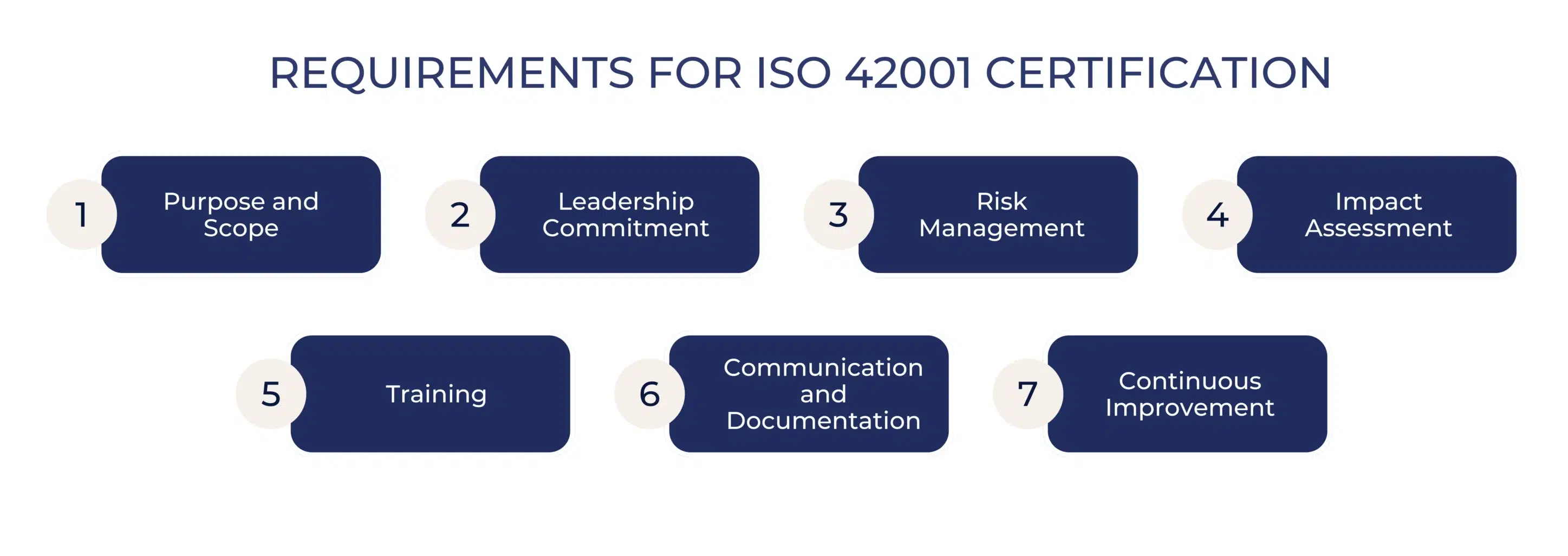
- ✓Core Clauses of ISO 42001
- ✓AIMS Documentation Requirements
- ✓AI Risk Management Within the AIMS Framework
ISO 42001 Certification Process
The ISO 42001 Certification in Amsterdam process follows a structured, multi-stage sequence that moves from initial AIMS evaluation through documented implementation, internal verification, and formal third-party audit to certificate issuance. Each stage produces documented outputs that feed into subsequent stages and form the evidentiary basis for the certification decision. CertPro, operating as a Licensed CPA Firm, conducts certification audits at Stages 1 and 2 and issues certification upon demonstrated conformance — it does not perform implementation, consulting, or preparatory services at any stage.
- Step 1 — Initial AIMS Assessment: The organization defines the scope of its AIMS, identifying AI systems in operation, relevant stakeholders, applicable regulatory requirements, and the organizational boundaries within which the AIMS will function. An initial assessment of existing AI governance practices against ISO 42001 clause requirements establishes the baseline conformance posture.
- Step 2 — Documentation and Policy Development: The organization develops the documented information required by ISO 42001, including the AI policy, AI risk assessment methodology, AI system impact assessment procedures, AI objectives, and role and responsibility assignments. All documents must be formally approved, controlled, and accessible.
- Step 3 — Implementation of AI Controls: The organization implements the operational controls, processes, and monitoring mechanisms required to manage AI risks at acceptable levels. Controls must be traceable to identified risks and documented within the AIMS framework.
- Step 4 — Internal Audit: The organization conducts an internal audit of its AIMS against all applicable ISO 42001 clause requirements. Internal auditors must be competent and independent from the activities being audited. Internal audit results, including identified nonconformities, must be documented and reported to top management.
- Step 5 — Management Review: Top management reviews AIMS performance, including internal audit findings, risk treatment effectiveness, AI objective achievement, and external context changes. Management review outputs include decisions on AIMS improvements and resource allocations.
- Step 6 — Stage 1 Certification Audit (CertPro): CertPro conducts the Stage 1 audit, reviewing AIMS documentation for completeness, scope adequacy, and clause coverage. The Stage 1 audit determines whether the organization is ready to proceed to Stage 2 and identifies any areas requiring clarification before the on-site assessment.
- Step 7 — Stage 2 Certification Audit (CertPro): CertPro conducts the Stage 2 audit, evaluating the implementation and effectiveness of the AIMS against all ISO 42001 requirements. The Stage 2 audit involves examination of documented evidence, interviews with personnel, and observation of operational processes. Findings, including any nonconformities, are documented in the audit report.
- Step 8 — Nonconformity Review and Corrective Action: Nonconformities identified during Stage 2 must be addressed through documented corrective actions. CertPro reviews the adequacy of corrective actions before proceeding to the certification decision.
- Step 9 — Certification Decision and Issuance: Upon satisfactory completion of Stage 2 and resolution of any nonconformities, CertPro issues the ISO 42001 certificate. The certificate specifies the certified organization, AIMS scope, certification standard, issue date, and expiry date.
- Step 10 — Surveillance and Recertification Audits: ISO 42001 certification is valid for three years, subject to annual surveillance audits that verify continued AIMS conformance. A full recertification audit is conducted at the end of the three-year cycle to renew certification.
CertPro’s role in the ISO 42001 certification process is strictly that of a certifying body and Licensed CPA Firm. CertPro does not implement AIMS frameworks, draft AI policies, or configure AI controls on behalf of client organizations. CertPro evaluates the AIMS that the organization has independently built and operated, assesses it against ISO 42001 requirements, and issues certification where conformance is demonstrated. This structural separation between the certifying body and the certified organization is a fundamental requirement of accredited certification practice — essential for maintaining the independence and credibility of the ISO 42001 certificate.
For Amsterdam organizations, CertPro’s audit methodology accounts for the specific operational and regulatory context in which the AIMS functions. ISO 42001 audit engagements in Amsterdam examine whether the AIMS addresses locally relevant risks — including those arising from GDPR obligations, AP enforcement priorities, EU AI Act compliance timelines, and sector-specific AI governance requirements in fintech, healthcare, and cloud infrastructure. This context-aware audit approach ensures that the ISO 42001 certificate issued by CertPro reflects genuine governance maturity rather than abstract conformance to a standard applied without regard to the organization’s actual operating environment.
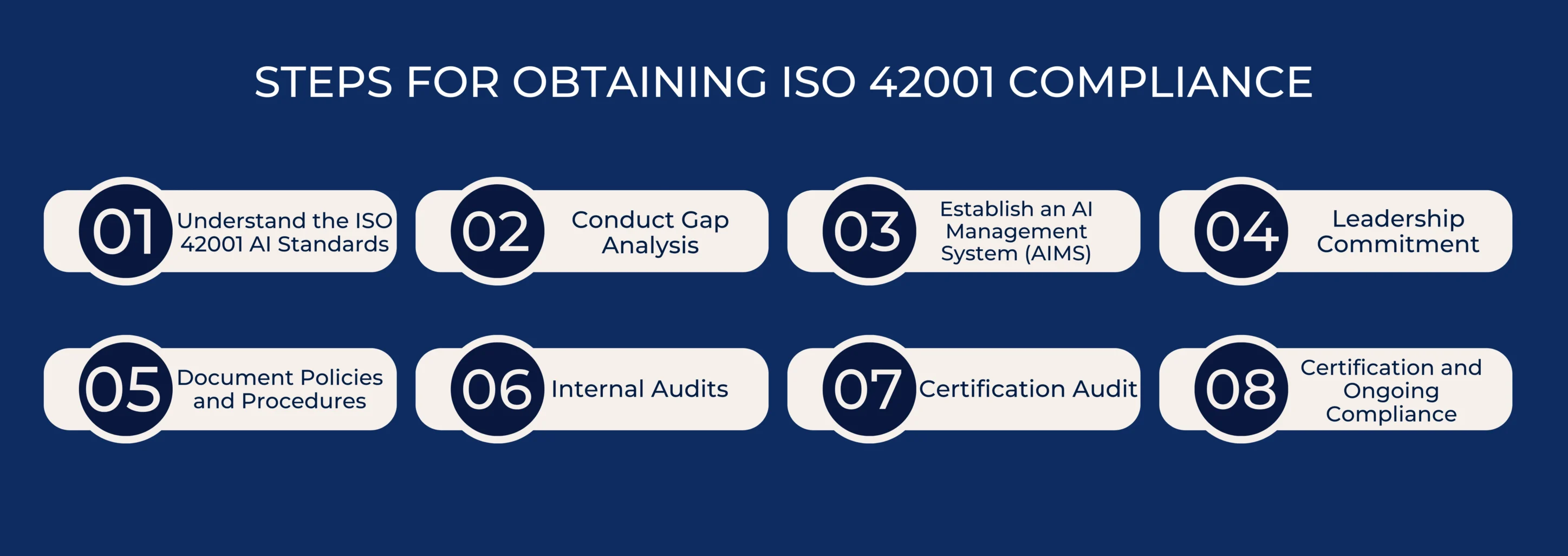
- ✓Step-by-Step ISO 42001 Certification Process
- ✓CertPro’s Role in the ISO 42001 Certification Process
ISO 42001 Audit in Amsterdam
ISO 42001 audit engagements in Amsterdam conducted by CertPro encompass four distinct audit types across the certification lifecycle. Each audit type serves a defined purpose within the AIMS oversight structure and produces documented findings communicated to the organization’s management. These findings support the certification decision or ongoing certification status. Understanding the scope and methodology of each audit type is essential for Amsterdam organizations planning their ISO 42001 certification timelines and resource allocations.
Types of ISO 42001 Audits
The ISO 42001 assessment audit — conducted prior to or as part of Stage 1 — evaluates the organization’s AIMS documentation and design against ISO 42001 clause requirements. The assessment determines the extent to which the documented AIMS addresses all mandatory requirements and identifies areas where documentation is absent, incomplete, or insufficiently detailed. The assessment audit does not evaluate operational effectiveness — it evaluates the design adequacy of the AIMS as documented. For organizations pursuing ISO 42001 Certification in Amsterdam for the first time, the assessment audit provides a structured, evidence-based view of the AIMS design’s readiness for Stage 2 evaluation.
The certification audit — conducted at Stage 2 — evaluates both the implementation and operational effectiveness of the AIMS. This audit involves examination of documented evidence (policies, risk assessments, impact assessments, training records, internal audit reports), interviews with personnel responsible for AI governance functions, and review of management review outputs. The certification audit determines whether the AIMS, as implemented and operated, meets ISO 42001 requirements in a manner that is consistent, repeatable, and effective. Major nonconformities identified during the certification audit must be resolved before certification is issued; minor nonconformities may be addressed through agreed corrective action plans with defined timeframes.
Surveillance and Recertification Audit Scope
Surveillance audits are conducted annually — typically at 12-month and 24-month intervals after initial certification — to verify that the AIMS continues to conform to ISO 42001 requirements and that the organization maintains operational effectiveness across all AIMS functions. Surveillance audits are not full-scope audits. They focus on key AIMS processes, corrective action effectiveness, internal audit activity, management review completion, and any significant changes to the AI systems or organizational context since the previous audit. Where the AIMS has deteriorated below certification requirements, CertPro has the authority to suspend or withdraw the ISO 42001 certificate.
The recertification audit — conducted at the end of the three-year certification cycle — is a full-scope evaluation equivalent in rigor to the original certification audit. It examines the AIMS in its current state, assessing whether it has been maintained, improved, and adapted to reflect changes in the organization’s AI systems, risk environment, and applicable regulatory requirements. For Amsterdam organizations, the recertification audit is an opportunity to demonstrate AI governance maturity gains achieved since initial certification — particularly relevant given the rapid evolution of the EU AI Act implementation timeline and the AP’s increasing focus on AI-related data protection issues.
What the ISO 42001 Audit Evaluates
- ✓AIMS scope definition and alignment with organizational AI system inventory
- ✓AI policy content, approval, and communication to relevant personnel
- ✓AI risk assessment process design, execution, and documentation
- ✓AI system impact assessment coverage and outputs
- ✓Risk treatment plan implementation and effectiveness evidence
- ✓AI objectives and measurable evidence of progress toward achievement
- ✓Personnel competence records for AI governance roles
- ✓Internal audit program and execution evidence
- ✓Management review records and decision outputs
- ✓Nonconformity and corrective action records
- ✓Continual improvement evidence and trend analysis
- ✓Alignment with applicable regulatory requirements including GDPR and EU AI Act obligations
Requirements for ISO 42001 Certification in Amsterdam
To achieve ISO 42001 Certification in Amsterdam, organizations must satisfy a comprehensive set of documented and operational requirements spanning all applicable clauses of ISO/IEC 42001:2023. These requirements are not advisory targets — they are mandatory conditions for certification. The ISO 42001 assessment conducted by CertPro evaluates each requirement against objective evidence provided by the organization. Requirements that are not addressed, insufficiently documented, or demonstrably ineffective in operation will result in nonconformities that must be resolved before or after certification issuance, depending on their classification as major or minor.
ISO 42001 requires demonstrable top management commitment to the AIMS. Top management must establish, approve, and communicate an AI policy that articulates the organization’s AI governance objectives, ethical commitments, and accountability structures. Management must assign specific roles and responsibilities for AIMS operation, ensure that AIMS functions are adequately resourced, and actively participate in management reviews. Evidence of top management involvement is evaluated during the certification audit through examination of policy approval records, meeting minutes, resource allocation decisions, and management review outputs. For Amsterdam-based organizations, this top management commitment to ISO 42001 compliance is particularly significant given the direct accountability that company executives face under GDPR and the emerging EU AI Act liability framework.
- ✓Defined and documented AIMS scope statement specifying included AI systems, organizational units, and geographic locations
- ✓Documented AI policy approved by top management and communicated throughout the organization
- ✓AI risk assessment process covering identification, analysis, evaluation, and treatment of AI-related risks
- ✓AI system impact assessments conducted for each in-scope AI system addressing societal, ethical, and operational impact dimensions
- ✓Risk treatment plans with defined controls, owners, timelines, and evidence of implementation
- ✓Documented AI objectives that are measurable, assigned to responsible parties, and tracked through defined performance metrics
- ✓Competence verification records for all personnel performing AI governance functions
- ✓Awareness program evidence demonstrating that relevant personnel understand the AI policy and their AIMS responsibilities
- ✓Internal audit program with documented procedures, qualified internal auditors, and audit reports for all AIMS clauses
- ✓Management review records documenting inputs reviewed, decisions made, and improvement actions assigned
- ✓Corrective action process with documented nonconformity records, root cause analyses, and action verification evidence
- ✓Evidence of continual improvement activities and their measured outcomes
- ✓Leadership and Governance Requirements
- ✓Operational and Technical Requirements
Benefits of ISO 42001 Certification for Amsterdam Organizations
ISO 42001 Certification in Amsterdam delivers substantive, measurable benefits across regulatory, commercial, operational, and reputational dimensions. These benefits are direct consequences of the structured AI governance that certification requires — not incidental side effects. Organizations that achieve ISO AIMS certification in Amsterdam demonstrate a governance maturity that differentiates them in a competitive, regulation-dense technology market and positions them favorably across multiple stakeholder relationships simultaneously.
ISO 42001 certification provides Amsterdam organizations with documented evidence of AI governance practices that align with GDPR obligations, Autoriteit Persoonsgegevens enforcement expectations, and EU AI Act governance requirements. Where AI systems process personal data or make decisions affecting individuals, certified organizations can demonstrate to regulators that systematic risk assessment, impact evaluation, and accountability structures are in place and have been independently verified. This demonstrated compliance posture reduces regulatory risk materially — regulators in enforcement proceedings typically assess the quality and maturity of an organization’s governance framework, and independently audited ISO 42001 certification is substantively stronger evidence than self-declared compliance.
Beyond direct regulatory risk, ISO 42001 compliance reduces the operational risks associated with AI system deployment. Organizations with certified AIMS frameworks identify AI system vulnerabilities, bias risks, and impact concerns before they manifest as operational failures, regulatory violations, or reputational incidents. The systematic risk assessment and treatment processes required by the standard function as an organizational early-warning system for AI-related risks — generating documented evidence of proactive governance that can be presented to regulators, insurers, and institutional clients as evidence of responsible AI operations.
Amsterdam’s technology and fintech ecosystem is characterized by intense competition for enterprise clients, institutional partnerships, and EU public sector contracts. ISO 42001 certification functions as a procurement differentiator in this environment. Enterprise clients and public sector buyers across the Netherlands and the EU increasingly require or prefer suppliers holding independently audited AI governance certifications. Fintech firms in Amsterdam that hold ISO 42001 certification can credibly demonstrate to financial institution clients that their AI systems are governed under internationally recognized standards — a requirement becoming standard in vendor due diligence questionnaires and financial services procurement frameworks.
ISO AIMS certification in Amsterdam also strengthens investor relations for organizations seeking venture capital, growth equity, or institutional investment. Investors with ESG (Environmental, Social, and Governance) mandates and those subject to Sustainable Finance Disclosure Regulation (SFDR) obligations are increasingly scrutinizing portfolio company AI governance practices. A certified AIMS provides investors with independently verified evidence that the organization has embedded responsible AI governance at the management system level — a material consideration in ESG assessments and due diligence processes for technology-intensive investments.
ISO AIMS certification communicates to customers, partners, employees, and regulators that the organization’s AI governance is subject to independent, third-party evaluation. This third-party verification element is critical — self-declared AI ethics frameworks and internal AI governance policies lack the independent scrutiny that accredited certification provides. For Amsterdam organizations whose AI systems interact directly with consumers — including AI-driven customer service, recommendation engines, insurance pricing models, and healthcare diagnostics — ISO 42001 certification gives external stakeholders confidence that the organization’s AI practices have been evaluated against objective, internationally accepted criteria by a qualified, independent certifying body.
- ✓Documented, independently audited evidence of AI governance maturity for regulatory bodies including the Autoriteit Persoonsgegevens
- ✓Competitive differentiation in procurement processes requiring AI governance certification
- ✓Strengthened investor confidence through independently verified ESG-aligned AI governance
- ✓Reduced regulatory exposure to GDPR and EU AI Act enforcement actions
- ✓Clear accountability structures that reduce organizational liability in AI-related incidents
- ✓Enhanced customer and partner trust through transparent, certified AI governance
- ✓Alignment with EU AI Act technical and governance requirements for high-risk AI systems
- ✓Continual improvement framework that keeps AI governance current as AI systems and regulatory requirements evolve
- ✓Integration pathway with ISO 27001 and ISO 9001 for organizations pursuing comprehensive management system certification
- ✓Auditable evidence trail for management review, board reporting, and external disclosure obligations
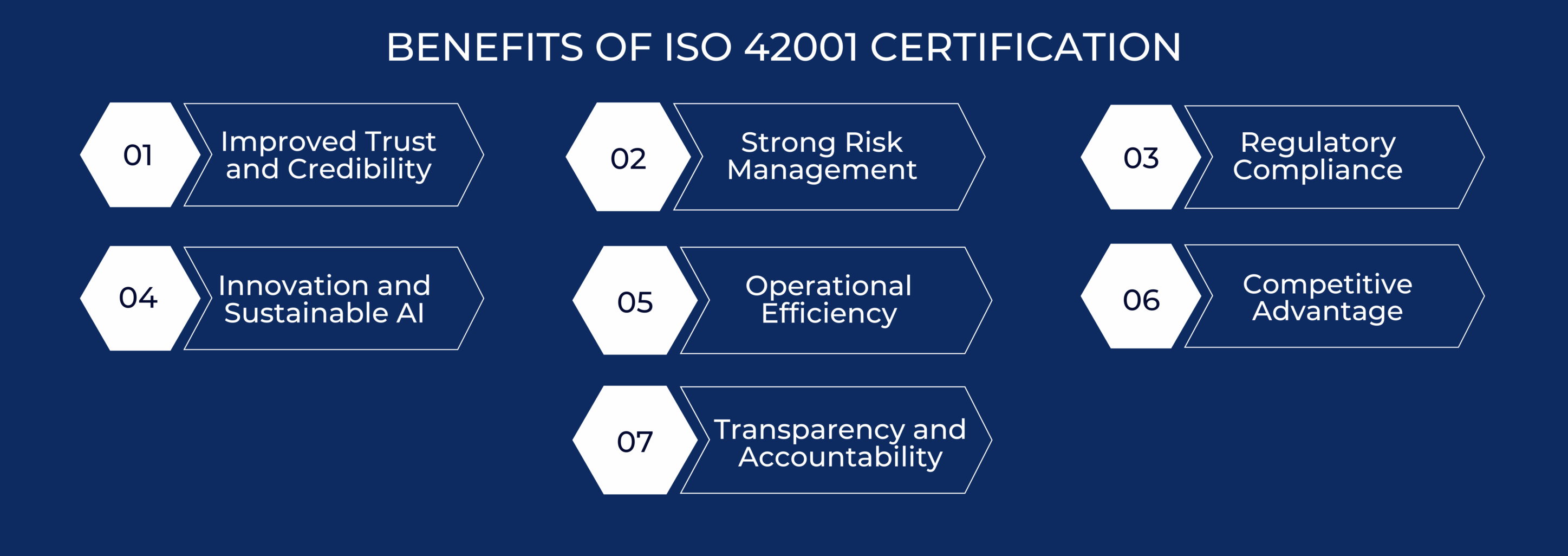
- ✓Regulatory Alignment and Risk Reduction
- ✓Competitive Advantage in Amsterdam’s Technology Market
- ✓Stakeholder Trust and Organizational Accountability
ISO 42001 Compliance in Amsterdam
ISO 42001 compliance in Amsterdam refers to the state in which an organization’s AIMS satisfies all applicable requirements of ISO/IEC 42001:2023 in a documented, operational, and verifiable manner. ISO 42001 compliance is distinct from ISO 42001 certification — compliance describes the internal state of the management system, while certification is the external attestation by an accredited body that compliance has been independently verified. Organizations can achieve internal ISO 42001 compliance without pursuing formal certification; however, certification provides the independent verification that regulators, clients, and investors increasingly require as evidence of genuine governance maturity rather than self-assessed conformance.
ISO 42001 Compliance and EU Regulatory Obligations
ISO 42001 compliance aligns directly with several EU regulatory obligations relevant to Amsterdam-based organizations. Under GDPR Article 22, organizations must implement safeguards for automated decision-making — including meaningful information about the logic involved, the significance, and the envisaged consequences. The AIMS framework required by ISO 42001 addresses these obligations through its AI system impact assessment and transparency requirements. Under GDPR Article 35 (Data Protection Impact Assessments), processing operations using new technologies that are likely to result in high risk must be subject to formal impact assessment. ISO 42001’s AI system impact assessment process, when properly integrated with DPIA procedures, satisfies both obligations through a unified assessment framework.
The EU AI Act’s requirements for high-risk AI systems — including Article 9 (Risk Management Systems), Article 10 (Data Governance), Article 13 (Transparency), Article 14 (Human Oversight), and Article 17 (Quality Management Systems) — map substantially onto ISO 42001 AIMS requirements. Organizations that achieve ISO 42001 compliance have, by definition, implemented risk management systems, data governance controls, transparency mechanisms, and quality management processes that satisfy many of the EU AI Act’s substantive requirements. This regulatory alignment means that ISO 42001 compliance in Amsterdam is not merely a certification exercise — it is a structured pathway to demonstrable EU AI Act readiness for organizations operating in high-risk AI sectors.
Demonstrating Compliance Posture to Regulators and Clients
ISO 42001 certification serves as a formal compliance posture declaration to regulators, institutional clients, and business partners. When the Autoriteit Persoonsgegevens investigates an organization’s AI-related data processing practices, the existence of a certified AIMS provides documented, independently verified evidence of a systematic compliance effort. While certification does not provide immunity from regulatory enforcement, it demonstrates good faith, organizational commitment to compliance, and the existence of governance structures designed to prevent and detect violations — factors that regulators typically consider when determining enforcement approach and penalty severity.
For client-facing compliance demonstration, ISO 42001 certification provides a universally recognized, standard-specific credential that clients can verify and rely upon without conducting their own detailed AI governance audits. This is particularly valuable for Amsterdam organizations providing AI-enabled services to multiple enterprise or public sector clients — each of which would otherwise require individual due diligence reviews of the organization’s AI governance practices. A single ISO 42001 certificate, issued by an accredited certifying body such as CertPro, satisfies the AI governance due diligence requirement across multiple client relationships simultaneously.
CertPro ISO 42001 Certification Services in Amsterdam
CertPro, a Licensed CPA Firm, provides ISO 42001 certification audit and assessment services to organizations in Amsterdam across all industry sectors. CertPro’s services are strictly limited to certification and audit activities — no implementation support, AI policy drafting, control configuration, or operational consulting services are provided. This structural separation ensures the independence required for accredited certification practice and maintains the credibility of CertPro-issued ISO 42001 certificates. Organizations pursuing ISO 42001 Certification in Amsterdam through CertPro receive an independent, audit-framed evaluation of their AIMS against all applicable ISO 42001 requirements.
CertPro Service Scope for ISO 42001
| Service | Description | Applicable Stage |
|---|---|---|
| AIMS Assessment Audit | Evaluation of AIMS documentation design against ISO 42001 clause requirements | Pre-certification / Stage 1 |
| Stage 1 Certification Audit | Review of AIMS scope, documentation completeness, and readiness for Stage 2 | Certification Process |
| Stage 2 Certification Audit | Full evaluation of AIMS implementation and operational effectiveness | Certification Process |
| Surveillance Audit | Annual verification of continued AIMS conformance and effectiveness | Post-Certification (Year 1 & 2) |
| Recertification Audit | Full-scope re-evaluation at end of three-year certification cycle | Post-Certification (Year 3) |
Licensed CPA Firm Positioning and Audit Independence
CertPro’s status as a Licensed CPA Firm distinguishes its ISO 42001 certification services from non-CPA certification bodies. As a Licensed CPA Firm, CertPro operates under professional standards that require independence, objectivity, and professional skepticism in all audit and certification activities. These professional obligations reinforce the structural independence requirements of accredited certification practice, providing Amsterdam organizations and their stakeholders with additional assurance that the ISO 42001 certification issued by CertPro reflects a rigorous, independent evaluation rather than a commercially motivated endorsement.
CertPro’s audit methodology for ISO 42001 audit engagements in Amsterdam is evidence-based and clause-driven. Audit teams evaluate each ISO 42001 clause requirement against specific, documented evidence provided by the organization. Audit findings are categorized as conformances, minor nonconformities, or major nonconformities, with clear criteria for each classification defined in CertPro’s audit procedures. All audit findings are communicated in a formal audit report delivered to the organization’s management. The certification decision is made independently by a CertPro certification committee that is separate from the audit team — ensuring that the decision to issue, suspend, or withdraw certification is made by personnel who were not directly involved in the audit execution.
Transparent, Fixed Pricing for ISO 42001 Certification
CertPro operates on a transparent, fixed pricing model for ISO 42001 certification services. Pricing is determined at the outset based on defined factors — including organizational size, number of AI systems in scope, AIMS complexity, and audit duration requirements — not on a variable or open-ended basis. This fixed pricing structure allows Amsterdam organizations to plan ISO 42001 certification expenditures with certainty, incorporating certification costs accurately into project budgets and organizational planning processes. CertPro’s pricing model covers the full certification audit cycle — Stage 1, Stage 2, and certificate issuance — with surveillance and recertification audit pricing provided separately at defined rates.
ISO 42001 Certification Cost in Amsterdam
The cost of ISO 42001 Certification in Amsterdam is determined by several objective factors that vary by organization. These factors include the number and complexity of AI systems within the AIMS scope, the size of the organization measured by headcount and number of locations, the maturity of existing management system infrastructure (particularly where ISO 27001 or ISO 9001 frameworks are already in place), and the number of audit days required to evaluate the AIMS against all ISO 42001 clause requirements. Smaller Amsterdam organizations with a limited number of AI systems and a well-documented existing management system can generally achieve certification at lower cost than large multinationals with complex, multi-system AI portfolios.
CertPro’s fixed pricing model means that the certification cost agreed at engagement commencement is the cost paid — with no variable fees, hourly overruns, or scope-creep charges applied during the certification process. This pricing transparency is important for Amsterdam organizations managing certification as part of broader compliance investment programs, where cost predictability is a governance requirement. Organizations integrating ISO 42001 certification with existing ISO 27001 or ISO 9001 programs may benefit from integrated audit efficiencies — where overlapping AIMS and ISMS requirements are evaluated in a single, combined audit engagement — reducing total audit duration and certification cost compared to two separate audit programs.
Secure Your ISO 42001 Certification in Amsterdam with CertPro
ISO 42001 Certification in Amsterdam is a formal, audited demonstration that your organization’s Artificial Intelligence Management System meets internationally recognized requirements for AI governance, risk accountability, transparency, and responsible AI use. In Amsterdam’s technology-intensive, regulation-dense operating environment — characterized by active GDPR enforcement by the Autoriteit Persoonsgegevens, advancing EU AI Act implementation timelines, and competitive pressure from AI-native companies and global technology multinationals — ISO 42001 certification positions organizations as accountable, governance-mature participants in the digital economy.
CertPro, a Licensed CPA Firm, delivers ISO 42001 certification audit and assessment services to Amsterdam organizations across all sectors. ISO 42001 audit engagements in Amsterdam are conducted under accredited, independent audit methodology — evaluating AIMS conformance against all applicable ISO/IEC 42001:2023 requirements and issuing certification where conformance is fully demonstrated. CertPro’s fixed pricing model, institutional positioning, and strict audit independence distinguish its certification services from non-accredited certification bodies and ensure that the ISO 42001 certificate issued reflects genuine governance maturity verified by qualified, independent auditors operating under professional standards applicable to Licensed CPA Firms. Contact CertPro to initiate an ISO 42001 assessment engagement in Amsterdam and establish a defined, structured pathway to ISO 42001 certification for your organization.
FAQ
▶
Who needs ISO 42001 certification in Amsterdam?
▶
What is the difference between ISO 42001 assessment and ISO 42001 certification?
▶
How long does the ISO 42001 certification process take?
▶
What is an AIMS and why is it required for ISO 42001 certification?
▶
How does ISO 42001 relate to GDPR and the EU AI Act?
▶
What industries in Amsterdam benefit most from ISO 42001 certification?
▶
How does the ISO 42001 audit differ from an internal audit?
▶
What happens if nonconformities are found during the ISO 42001 certification audit?
ISO 42001 CERTIFIED: WHY AI GOVERNANCE CERTIFICATION IS BECOMING A BOARD-LEVEL REQUIREMENT
AI is now an inevitable component of major business activities in the current corporate world. To elaborate, it is now part of product design, custome…

MindSec Launches AI Compliance for Law 25 & ISO 42001
Excerpt from Barchart Article, Published on December 3, 2025 Today, Canadian organizations face increasing pressure to comply with stringent privacy a…

UNDERSTANDING ISO 42001: A GUIDE FOR RESPONSIBLE AI MANAGEMENT SYSTEMS
The invention of artificial intelligence (AI) has changed the operational processes of many industries. However, the rapid growth of technology increa…
Get In Touch
have a question? let us get back to you.