
ISO 42001 Certification in Arlington
ISO 42001 Certification in Arlington is conducted by CertPro, a Licensed CPA Firm operating exclusively as an independent third-party certification body. CertPro evaluates documented evidence, AI governance controls, AI risk management practices, AI impact assessment processes, and Annex A control implementation against the requirements of ISO/IEC 42001:2023. ISO 42001 certification is awarded only upon a documented, evidence-based determination of conformity — not upon completion of a consulting engagement or implementation program.
OUR CLIENTS




ISO 42001 Certification for Arlington-Based Technology and AI Organizations
ISO 42001 Certification in Arlington is conducted by CertPro, a Licensed CPA Firm operating exclusively as an independent third-party certification body. CertPro evaluates documented evidence, AI governance controls, AI risk management practices, AI impact assessment processes, and Annex A control implementation against the requirements of ISO/IEC 42001:2023. ISO 42001 certification is awarded only upon a documented, evidence-based determination of conformity — not upon completion of a consulting engagement or implementation program.
Arlington’s AI and Technology Ecosystem
Arlington, Virginia, occupies a distinctive position within the Northern Virginia and Washington, D.C. technology corridor — one of the most concentrated technology and AI ecosystems in the United States. The city is home to a broad range of organizations operating at the intersection of federal government, defense, cybersecurity, commercial technology, and regulated-sector markets. These include AI companies, SaaS providers, cloud service providers, defense technology contractors, healthcare technology firms, financial services organizations, telecommunications companies, and government technology vendors.
Each of these sectors faces structured AI governance and vendor assurance expectations from enterprise buyers, federal procurement authorities, and regulated-sector clients. Arlington’s proximity to major federal agencies — including the Department of Defense, the Department of Homeland Security, and numerous intelligence and civilian agencies — means that many organizations in this region develop or deploy AI systems in contexts where independent third-party verification of AI governance conformity carries particular weight in procurement and vendor due diligence processes.
The Northern Virginia region, anchored by Arlington, also hosts one of the world’s largest concentrations of data center and cloud computing infrastructure. Organizations providing cloud-based AI services, AI-enabled SaaS platforms, or AI-integrated software products to enterprise and government customers face increasing expectations around documented AI governance frameworks, independently verified AI risk management practices, and transparent AI impact assessment processes.
ISO 42001 Certification in Arlington provides these organizations with an independently verified statement of conformity to the internationally recognized ISO/IEC 42001:2023 standard — the first international standard specifying requirements for an Artificial Intelligence Management System (AIMS). For Arlington-based organizations serving federal agencies, defense contractors, healthcare institutions, and financial services firms, ISO 42001 certification audit outcomes deliver objective, third-party evidence of AI governance maturity that supports vendor qualification, enterprise procurement review, and regulatory alignment processes.
ISO/IEC 42001:2023 and the AIMS Framework
ISO/IEC 42001:2023 is the international standard specifying requirements for establishing, implementing, maintaining, and continually improving an Artificial Intelligence Management System within an organization. The ISO 42001 standard follows the High-Level Structure (HLS) common to ISO management system standards, covering organizational context (Clause 4), leadership (Clause 5), planning (Clause 6), support (Clause 7), operation (Clause 8), performance evaluation (Clause 9), and improvement (Clause 10).
Annex A specifies AI-specific controls addressing areas such as AI policy, internal AI roles and responsibilities, AI system impact assessment, AI risk management, data governance, AI system lifecycle management, transparency and explainability, human oversight of AI systems, and supplier relationships involving AI. An organization seeking ISO 42001 certification is responsible for establishing and operating its own AIMS in conformity with these requirements. CertPro’s role is solely to evaluate that conformity through an independent ISO 42001 certification audit — not to design, implement, or advise on the organization’s AIMS.
The ISO 42001 standard applies to any organization — regardless of type, size, or sector — that develops, provides, or uses AI systems. This broad applicability makes ISO AIMS certification relevant to a wide cross-section of Arlington’s technology and business community. Whether an organization is a defense technology contractor integrating AI into intelligence systems, a healthcare technology firm deploying AI-driven clinical decision support tools, a financial services company using AI for fraud detection or credit risk modeling, or a SaaS provider embedding AI capabilities into enterprise software products, the requirements of ISO/IEC 42001:2023 provide a structured, internationally recognized framework for AI governance.
The independently issued ISO 42001 certification certificate communicates to customers, procurement authorities, regulators, and business partners that the organization’s AIMS has been evaluated against these requirements by an independent third-party certification body and found to conform.
CertPro as an Independent Certification Body
CertPro operates exclusively as an independent third-party certification body — a Licensed CPA Firm conducting ISO 42001 certification audits without providing consulting, implementation, or advisory services to auditee organizations. This independence is foundational to the integrity of the certification outcome. When CertPro issues an ISO 42001 certification certificate to an Arlington-based organization, that certificate represents an objective, evidence-based determination that the organization’s AIMS conforms to the requirements of ISO/IEC 42001:2023 as evaluated at the time of the audit.
CertPro does not participate in the design or implementation of the AIMS being evaluated, does not provide remediation recommendations as a service, and does not offer AI governance consulting or certification preparation services. This strict separation of certification and advisory activities ensures that ISO 42001 Certification in Arlington issued by CertPro carries the credibility and independence that enterprise buyers, federal procurement authorities, and regulated-sector clients expect from a third-party conformity assessment.

What Is ISO 42001 Certification?
ISO 42001 certification is an independent third-party conformity assessment that determines whether an organization’s Artificial Intelligence Management System (AIMS) meets the requirements of ISO/IEC 42001:2023. The certification is issued by an accredited or independent certification body following a structured audit process that evaluates documented information, operational evidence, AI governance controls, AI risk management practices, and Annex A control implementation.
ISO 42001 certification differs from self-attestation or self-assessment in that it requires an external, independent evaluation of objective evidence by qualified auditors — not a declaration by the organization itself. For Arlington-based organizations, ISO 42001 certification provides a credible, internationally recognized mechanism for demonstrating AI governance conformity to customers, procurement authorities, and regulators.
The ISO/IEC 42001:2023 Standard Defined
ISO/IEC 42001:2023 is the first international standard published by the International Organization for Standardization (ISO) and the International Electrotechnical Commission (IEC) that specifies requirements for an Artificial Intelligence Management System. Published in December 2023, the standard was developed by ISO/IEC JTC 1/SC 42, the subcommittee responsible for AI standardization. The ISO 42001 standard establishes a structured framework for organizations to identify, assess, and address risks and impacts associated with AI systems across their full lifecycle — from design and development through deployment, monitoring, and decommissioning.
The standard’s requirements are organized across ten clauses following the common High-Level Structure used by ISO 9001, ISO 27001, and other management system standards, enabling integration with existing management system frameworks where applicable.
The ISO 42001 standard requires organizations to document the context of their AIMS, identify interested parties and their requirements, define the scope of the AIMS, establish leadership accountability for AI governance, and plan for AI-related risks and opportunities. Organizations must also implement operational controls covering the AI system lifecycle, conduct performance evaluation through internal audits and management review, and pursue continual improvement.
Annex A of the standard provides a reference set of AI-specific controls — covering AI policy, internal AI roles, AI system impact assessment, AI risk treatment, data governance, AI system lifecycle controls, transparency, human oversight, and AI-related supplier management — against which the organization’s Statement of Applicability must be documented. These requirements form the evaluation framework used during an ISO 42001 certification audit.
What an Artificial Intelligence Management System Covers
An Artificial Intelligence Management System (AIMS), as defined by ISO/IEC 42001:2023, is the set of policies, processes, procedures, documented information, organizational structures, and controls that an organization uses to govern the development, deployment, and use of AI systems in a responsible, ethical, and risk-managed manner. The AIMS addresses the full lifecycle of AI systems within scope — including requirements definition, data acquisition and management, model development and validation, system deployment, operational monitoring, and retirement.
It also addresses the organization’s responsibilities toward affected stakeholders, including those who interact with AI systems or whose outcomes may be influenced by AI-generated outputs. For organizations in Arlington developing AI products or deploying AI in regulated contexts, the AIMS provides the documented governance structure that an independent ISO 42001 audit evaluates for conformity.
Who Requires ISO 42001 Certification in Arlington
ISO 42001 certification is relevant to any Arlington-based organization that develops, provides, or uses AI systems and has stakeholders — customers, procurement authorities, regulators, or business partners — who require independent verification of AI governance conformity. In practice, the organizations most frequently pursuing ISO 42001 Certification in Arlington include:
AI product companies and AI platform providers, SaaS organizations with AI-integrated product offerings, cloud service providers hosting AI workloads, defense and aerospace contractors using AI in intelligence or operational systems, healthcare technology organizations deploying clinical AI, financial services firms using AI in risk or compliance functions, government technology vendors providing AI-enabled services to federal agencies, and cybersecurity organizations using AI for threat detection or response. The ISO 42001 standard applies equally to organizations developing AI systems and those procuring or deploying AI from third parties, making ISO 42001 compliance relevant across the full spectrum of Arlington’s technology sector.
ISO 42001 Requirements and Annex A Controls
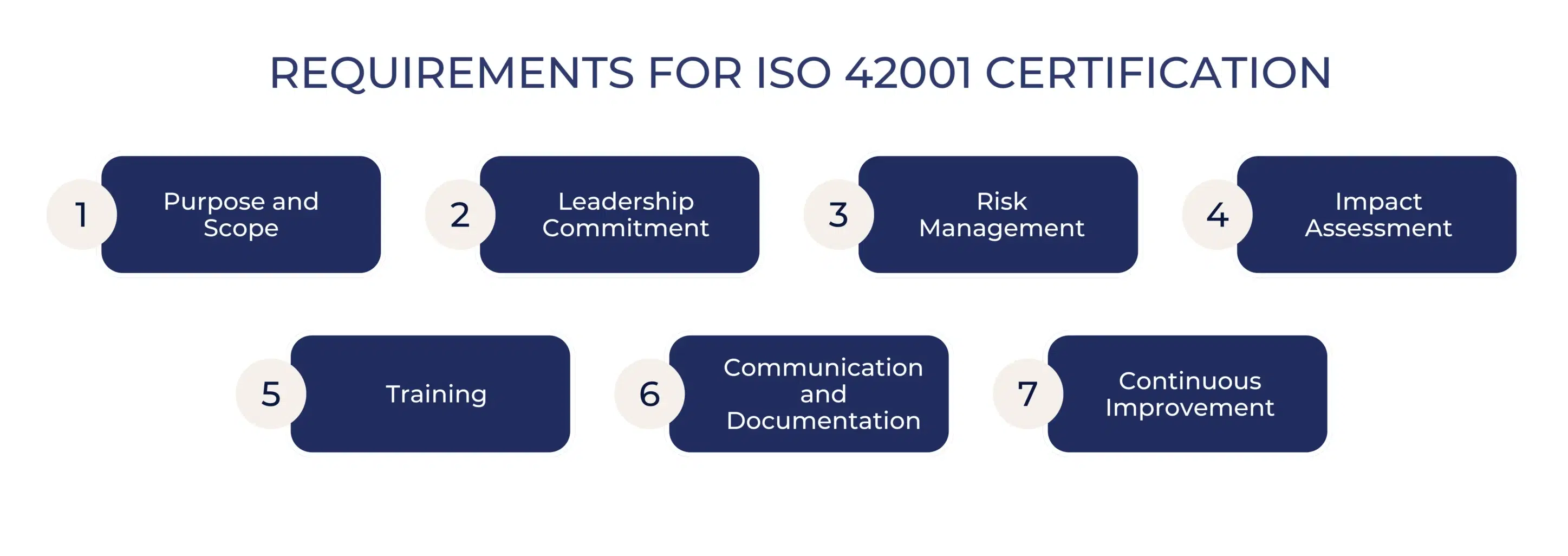
ISO 42001 compliance requires organizations to satisfy requirements across the ten clauses of ISO/IEC 42001:2023 and to document their approach to Annex A controls through a Statement of Applicability. During an ISO 42001 certification audit, CertPro evaluates documented information and operational evidence against each applicable clause and control to determine whether the organization’s AIMS conforms to these requirements. Understanding the structure of these requirements is essential for organizations preparing the documented information that auditors will evaluate.
The management system requirements of ISO/IEC 42001:2023 are organized across Clauses 4 through 10. Clause 4 requires the organization to determine its internal and external context, identify interested parties and their requirements, and define the scope of the AIMS. Clause 5 requires leadership to demonstrate commitment to the AIMS, establish an AI policy, and assign AI-related roles and responsibilities. Clause 6 requires the organization to address AI-related risks and opportunities, set AI governance objectives, and plan for AI system impact assessments.
Clause 7 covers support requirements including resources, competence, awareness, communication, and documented information. Clause 8 addresses operational planning and control, including AI system impact assessment and AI risk treatment. Clause 9 requires performance evaluation through monitoring, internal audit, and management review. Clause 10 requires the organization to address nonconformities and pursue continual improvement of the AIMS. Each of these clauses is evaluated with objective evidence during the ISO 42001 certification audit process.
Annex A of ISO/IEC 42001:2023 provides a structured reference set of AI-specific controls that organizations must consider when implementing their AIMS. These controls are organized into domains covering AI policy and governance, internal AI roles and responsibilities, AI system impact assessment, AI risk management processes, data management for AI, AI system lifecycle controls (including design, development, testing, deployment, and monitoring), transparency and explainability of AI systems, human oversight mechanisms, and management of AI-related supplier and third-party relationships.
Organizations are required to document a Statement of Applicability that identifies which Annex A controls are applicable to their AIMS scope, which have been implemented, and the justification for any controls determined to be not applicable. This Statement of Applicability is a primary document reviewed during the ISO 42001 audit and provides auditors with the structured baseline against which control implementation evidence is assessed.
Key Annex A control areas evaluated during an ISO 42001 certification audit include the organization’s AI system impact assessment process — which requires the identification and evaluation of potential adverse impacts of AI systems on individuals, groups, and society — and its AI risk management process, which covers the identification, analysis, evaluation, and treatment of AI-specific risks. Data governance controls address the quality, provenance, and management of data used in AI system development and operation.
Lifecycle controls evaluate whether the organization has documented processes for AI system design, development, validation, deployment, monitoring, and decommissioning. Transparency and explainability controls assess whether the organization has mechanisms to communicate relevant information about AI system behavior to appropriate stakeholders. Human oversight controls evaluate whether the organization has defined processes for human review, intervention, and accountability in AI system operations. Each of these control domains is evaluated against documented evidence and operational practice during the ISO 42001 certification audit.
ISO/IEC 42001:2023 specifies documented information requirements that organizations must maintain and retain as evidence of AIMS conformity. Core documented information required by the ISO 42001 standard includes the AIMS scope document, the AI policy, AI risk assessment records, AI risk treatment plan, AI system impact assessment records, the Statement of Applicability, AI governance objectives and associated monitoring records, internal audit program and internal audit reports, management review records, and records of nonconformities and corrective actions.
These documents form the primary evidence base reviewed during Stage 1 and Stage 2 of the ISO 42001 certification audit. Organizations in Arlington pursuing ISO 42001 compliance must ensure that documented information is current, controlled, and accessible to auditors, and that it accurately reflects the organization’s operational AIMS practices rather than serving solely as theoretical documentation.
| ISO 42001 Clause / Annex | Key Requirement Area | Primary Evidence Evaluated |
|---|---|---|
| Clause 4 – Context | AIMS scope, interested parties, and context determination | AIMS scope document, context analysis records |
| Clause 6 – Planning | AI risk management, AI system impact assessment, and governance objectives | Risk assessment records, impact assessment records, objectives documentation |
| Clause 8 – Operation | AI lifecycle controls and operational AI risk treatment | Operational procedures, AI system lifecycle records, risk treatment plans |
| Clause 9 – Performance Evaluation | Internal audit, management review, and ongoing monitoring | Internal audit reports, management review minutes, KPI records |
| Annex A – AI Controls | AI policy, data governance, transparency, human oversight, and supplier management | Statement of Applicability, control evidence, AI system documentation |
- ✓Core Management System Requirements (Clauses 4–10)
- ✓Annex A Controls and the Statement of Applicability
- ✓Documented Information Requirements
ISO 42001 Certification Audit Process in Arlington
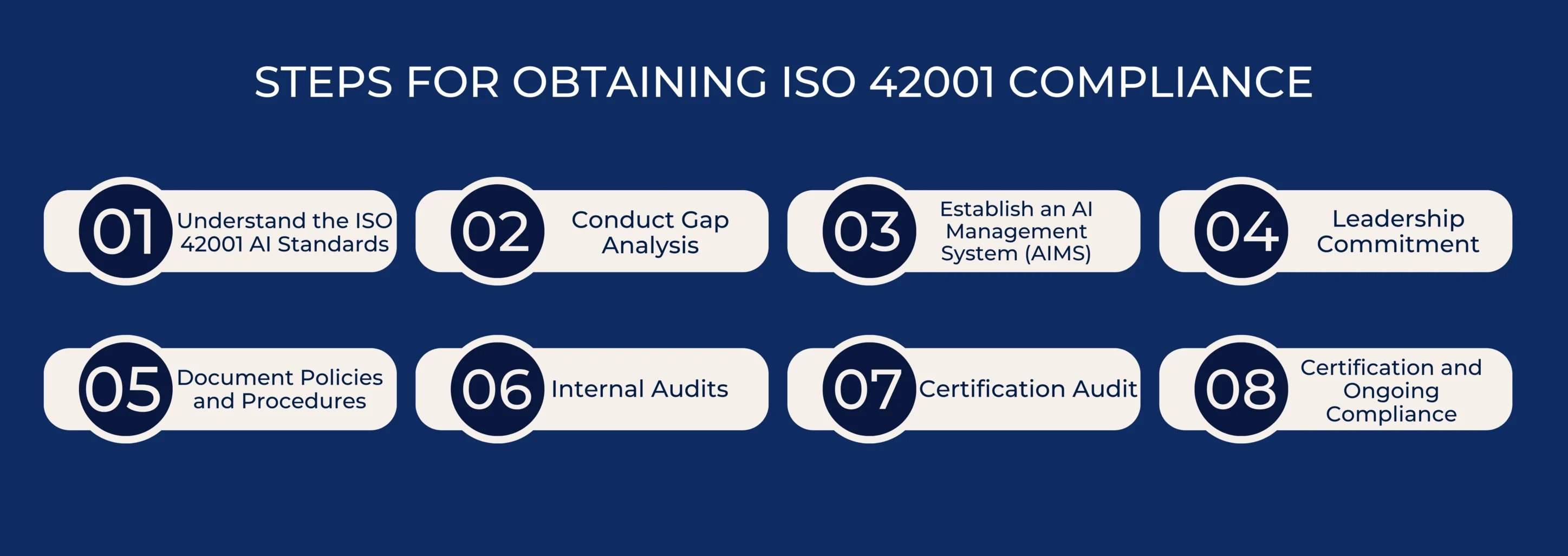
The ISO 42001 certification audit process conducted by CertPro follows a structured, multi-stage methodology consistent with internationally recognized conformity assessment practices. Each stage of the ISO 42001 audit is designed to evaluate objective evidence against specific requirements of ISO/IEC 42001:2023. The process is strictly evaluative — CertPro’s auditors assess documented information and operational evidence for conformity; they do not provide implementation guidance, advisory recommendations, or corrective action support during or following the audit. The certification decision is made independently by CertPro’s certification committee based on audit findings and documented evidence.
The Stage 1 audit is a structured review of the organization’s documented AIMS information against the requirements of ISO/IEC 42001:2023. During Stage 1, CertPro auditors review the AIMS scope document, AI policy, AI risk assessment and risk treatment documentation, AI system impact assessment records, the Statement of Applicability, AI governance objectives documentation, internal audit program and reports, and management review records.
The purpose of Stage 1 is to evaluate whether the organization has established documented information that satisfies the requirements of the ISO 42001 standard and to identify any areas where documentation is incomplete or unclear before Stage 2 field evaluation. Stage 1 findings inform the audit program for Stage 2, including the identification of processes, AI systems, and control areas to be prioritized for operational evidence evaluation. Stage 1 is typically conducted remotely for Arlington-based organizations, with audit records and documented information submitted electronically for review.
The Stage 2 audit evaluates the operational effectiveness of the organization’s AIMS by examining evidence that documented controls and processes are operating as described and in conformity with ISO/IEC 42001:2023 requirements. During Stage 2 of the ISO 42001 audit, CertPro auditors interview relevant personnel, review operational records, examine AI system documentation, assess evidence of AI risk management activities, evaluate AI system impact assessment outputs, review data governance practices, examine AI lifecycle management records, and assess evidence of human oversight mechanisms and transparency controls.
Auditors evaluate whether Annex A controls identified as applicable in the Statement of Applicability have been implemented and are operating effectively. Nonconformities identified during Stage 2 are documented in audit findings and must be addressed by the organization before a certification decision can be made. Stage 2 may be conducted on-site at the organization’s Arlington facilities or remotely, depending on audit scope and the nature of AI systems within scope.
Following Stage 2 completion, CertPro auditors compile an audit report documenting findings, evidence reviewed, nonconformities identified, and an assessment of AIMS conformity against ISO/IEC 42001:2023 requirements. This audit report is submitted to CertPro’s certification committee for independent review. The certification committee — operating independently of the audit team — reviews the audit report and makes the final certification decision.
If the committee determines that the AIMS conforms to the requirements of the ISO 42001 standard and that all identified nonconformities have been adequately addressed, the ISO 42001 certification certificate is issued. The certificate specifies the certified organization, the scope of the AIMS evaluated, the applicable standard (ISO/IEC 42001:2023), the certification date, and the validity period.
ISO 42001 certification issued by CertPro is valid for a defined certification cycle — typically three years — subject to successful completion of annual surveillance audits. Surveillance audits are periodic evaluations conducted to verify that the certified organization’s AIMS continues to conform to ISO/IEC 42001:2023 requirements between initial certification and recertification. Surveillance audits evaluate changes to the AIMS scope, significant changes to AI systems within scope, internal audit and management review activities, corrective action effectiveness, and continued implementation of Annex A controls.
Organizations that fail surveillance audit requirements risk suspension or withdrawal of their ISO 42001 certification. At the end of the certification cycle, a full recertification audit is conducted to re-evaluate AIMS conformity against the current version of the standard. For Arlington-based organizations, maintaining certification currency through surveillance audits is essential for sustaining the credibility of ISO 42001 compliance claims in procurement and vendor assurance contexts.
| Audit Stage | Key Activities | Output |
|---|---|---|
| Application Review | Scope confirmation, audit program determination, and resource planning | Audit program and schedule |
| Stage 1 Audit | Review of AIMS documentation, scope, AI policy, risk records, and Statement of Applicability | Stage 1 findings report; Stage 2 audit plan |
| Stage 2 Audit | Operational evidence evaluation, control testing, personnel interviews, and AI system record review | ISO 42001 audit report with findings and nonconformities |
| Certification Committee Review | Independent review of audit report, nonconformity closure verification, and certification decision | ISO 42001 certification certificate (if conformity confirmed) |
| Surveillance Audit | Periodic evaluation of continued AIMS conformity, changes review, and corrective action follow-up | Surveillance audit report; certification maintenance or suspension decision |
| Recertification Audit | Full re-evaluation of AIMS conformity at end of certification cycle | Renewed ISO 42001 certification certificate |
- ✓Stage 1 Audit: Documentation and Readiness Review
- ✓Stage 2 Audit: Operational Evidence and Control Evaluation
- ✓Surveillance Audits and Recertification
Why Organizations in Arlington Pursue ISO 42001 Certification
Arlington-based organizations across technology, defense, healthcare, financial services, and government contracting sectors pursue ISO 42001 Certification in Arlington in response to demand signals from enterprise customers, federal procurement processes, and regulated-sector clients who require evidence of structured AI governance. The specific drivers vary by sector and organizational context, but share a common foundation: the need for independently verified, third-party evidence that the organization’s AI systems are governed by a documented, risk-managed AIMS that conforms to an internationally recognized standard.
Federal Procurement and Government Technology Vendor Requirements
Arlington’s proximity to major federal agencies — including the Department of Defense, the Department of Homeland Security, the General Services Administration, and numerous civilian and intelligence agencies — creates a significant concentration of government technology vendors for whom AI governance verification is increasingly relevant in procurement. Federal agencies adopting AI systems are subject to executive orders, Office of Management and Budget guidance, and agency-specific AI governance policies that establish expectations for responsible AI use, risk management, and accountability.
Technology vendors providing AI-enabled systems or services to these agencies face vendor assurance and due diligence requirements from contracting officers and program management offices. ISO 42001 Certification in Arlington provides government technology contractors with independently verified evidence of AIMS conformity that can be referenced in contract proposals, vendor qualification submissions, and ongoing vendor performance reviews.
Defense technology contractors in Arlington operating under Department of Defense acquisition frameworks face particular scrutiny around the governance of AI systems used in intelligence, operational planning, logistics, and mission-critical functions. The DoD’s AI adoption strategy and associated responsible AI frameworks create structured expectations for AI risk management, testing and evaluation, and human oversight — expectations that align closely with the requirements of ISO/IEC 42001:2023.
ISO AIMS certification provides defense contractors in Arlington with a mechanism to demonstrate conformity to these AI governance expectations through an independent audit, rather than solely through internal self-assessment or prime contractor oversight processes.
Enterprise Vendor Due Diligence and SaaS Procurement
Enterprise buyers in financial services, healthcare, insurance, and other regulated sectors operating in the Northern Virginia market increasingly include AI governance requirements in vendor due diligence processes for SaaS and cloud-based technology providers. When an Arlington-based SaaS provider integrates AI capabilities into its product offering — whether for data analytics, automated decision-making, natural language processing, or predictive modeling — enterprise buyers may require evidence that the provider has a documented, independently verified AIMS governing how those AI capabilities are developed, deployed, and monitored.
An ISO 42001 certification audit outcome provides SaaS providers in Arlington with the independently verified certification document that supports these procurement reviews — without requiring the buyer to conduct a proprietary AI governance assessment of each vendor. This streamlines due diligence timelines and strengthens vendor qualification outcomes.
Healthcare, Financial Services, and Regulated Sector AI Governance
Healthcare technology organizations in Arlington deploying AI in clinical decision support, diagnostic imaging, patient risk stratification, or administrative automation face regulatory expectations from the FDA, HHS, and state health agencies around AI system safety, performance monitoring, and accountability. Financial services organizations using AI in credit decisioning, fraud detection, anti-money laundering monitoring, or algorithmic trading face scrutiny from federal and state financial regulators around model risk management, explainability, and fair lending compliance.
For both sectors, ISO 42001 compliance provides a structured, internationally recognized framework for AI governance that can be referenced in regulatory interactions, audit responses, and customer due diligence disclosures. ISO 42001 certification audit outcomes issued by an independent certification body carry greater evidentiary weight in these contexts than internal self-assessments or vendor-generated attestations.
ISO 42001 Certification Scope and Evidence Framework
The scope of an ISO 42001 certification audit defines the boundaries of the AIMS evaluated and the AI systems, organizational units, processes, and locations included within the certification boundary. Establishing an appropriate certification scope is the organization’s responsibility; CertPro evaluates the defined scope for clarity and completeness as part of the ISO 42001 audit process. The scope must accurately reflect the organization’s AI-related activities and must not be defined in a manner that artificially excludes significant AI systems or governance functions to create a misleadingly narrow certification boundary.
Defining the AIMS Certification Scope
Organizations in Arlington seeking ISO 42001 Certification must document a clear AIMS scope that identifies the AI systems and associated processes, functions, and organizational units included within the management system boundary. The scope may encompass the organization’s entire AI-related operations or may be defined around specific AI systems, product lines, business units, or geographic locations where AI governance is established and operational.
For Arlington-based organizations with multiple AI product lines or AI systems serving different customer segments — such as a cloud service provider offering both commercial and government AI services — the scope definition determines which AI systems and associated governance processes are evaluated during the ISO 42001 certification audit. Auditors assess whether the documented scope is consistent with the organization’s actual AI-related activities and whether the exclusion of any AI systems from scope is appropriately justified.
Evidence-Based Assessment and Objective Evidence Standards
ISO 42001 certification is awarded based exclusively on objective evidence — documented information, records, observations, and interview responses that demonstrate AIMS conformity against the requirements of ISO/IEC 42001:2023. CertPro auditors apply an evidence-based assessment methodology in which each audit finding is supported by specific documented or observable evidence rather than auditor judgment alone.
Evidence standards applied during the ISO 42001 audit include the existence and content of required documented information, records demonstrating that processes have been executed as documented, evidence that controls are operating consistently over time, records of internal audits and management reviews demonstrating active AIMS governance, and records of corrective actions addressing identified nonconformities. Organizations that maintain comprehensive, controlled documented information throughout their AIMS operations — rather than creating records specifically for the audit — are better positioned to provide the continuous operational evidence that auditors require to confirm AIMS conformity.
Nonconformity Classification and Certification Decision
Nonconformities identified during the ISO 42001 certification audit are documented in the audit report and communicated to the organization for response. Nonconformities represent findings where objective evidence demonstrates that a requirement of ISO/IEC 42001:2023 has not been met within the defined AIMS scope. The organization is required to address identified nonconformities through documented root cause analysis and corrective action before the certification committee makes a positive certification determination.
The certification committee reviews the audit report, the organization’s corrective action responses, and closure evidence independently of the audit team. This separation between audit execution and certification decision is a structural control that reinforces the independence of the ISO 42001 certification process. Certification is awarded only when the committee’s independent review confirms that AIMS conformity has been demonstrated through objective evidence and that identified nonconformities have been adequately resolved.
AI Governance, Risk Management, and Impact Assessment Under ISO 42001
AI governance, AI risk management, and AI system impact assessment are three interconnected areas that ISO/IEC 42001:2023 addresses through specific requirements and Annex A controls. These areas are evaluated during the ISO 42001 certification audit in Arlington as core components of the AIMS, and organizations must provide documented evidence that each area is addressed through established, operational processes rather than theoretical frameworks.
For Arlington’s technology sector — where AI systems are frequently deployed in high-stakes environments including defense, healthcare, financial services, and government operations — the robustness of these three areas is typically the most scrutinized aspect of the ISO 42001 audit.
AI Governance Structures and Leadership Accountability
ISO/IEC 42001:2023 requires organizations to establish clear AI governance structures with defined roles, responsibilities, and accountability for AIMS performance. Clause 5 of the standard requires top management to demonstrate leadership and commitment to the AIMS, establish and communicate an AI policy, assign AI governance roles, and ensure that resources necessary for AIMS operation are available. Annex A controls extend these requirements to include specific roles responsible for AI system oversight, AI risk management, and AI impact assessment processes.
During the ISO 42001 audit, auditors evaluate whether AI governance roles are clearly defined, whether accountability for AI-related decisions is documented and assigned to identified individuals or functions, whether the AI policy is current and communicated to relevant personnel, and whether leadership engagement with AIMS performance is evidenced through management review records and documented governance decisions. Effective AI governance is demonstrated through consistent, documented evidence of governance processes operating in practice — not solely through the existence of policy documents.
AI Risk Management Process Requirements
ISO/IEC 42001:2023 requires organizations to establish and operate a documented AI risk management process that identifies, analyzes, evaluates, and treats AI-specific risks associated with AI systems within scope. AI risks evaluated under this process may include risks related to data quality and bias, model performance degradation, unintended AI system behaviors, misuse or misapplication of AI outputs, privacy and security risks associated with AI system operation, and risks arising from dependencies on AI suppliers or third-party AI components.
The AI risk assessment must produce documented records that identify specific risks, their assessed likelihood and impact, and the risk treatment decisions made. Risk treatment options under ISO/IEC 42001:2023 include risk avoidance, risk reduction through control implementation, risk transfer, and risk acceptance — with documented justification for each treatment decision. During the ISO 42001 certification audit, auditors review AI risk assessment records for completeness, currency, and consistency with the organization’s actual AI system portfolio and operating environment.
AI System Impact Assessment
AI system impact assessment is a specific requirement of ISO/IEC 42001:2023, addressed in Clause 8 and supported by Annex A controls. An AI system impact assessment evaluates the potential adverse impacts of an AI system on individuals, groups, communities, and broader society — including impacts related to bias and discrimination, privacy violations, safety risks, erosion of human autonomy, and economic or social harm. The assessment must be conducted for AI systems within AIMS scope and must produce documented records that can be reviewed during the ISO 42001 audit.
For Arlington-based organizations deploying AI in high-stakes contexts — such as AI systems informing healthcare decisions, financial determinations, employment or benefits eligibility, or national security assessments — the AI system impact assessment process is a particularly significant area of audit scrutiny. Auditors evaluate whether impact assessments have been conducted for applicable AI systems, whether they are documented with sufficient detail to demonstrate meaningful analysis, and whether identified impacts have been addressed through appropriate controls or risk treatment measures.
Benefits of ISO 42001 Certification for Arlington-Based Organizations
ISO 42001 Certification for Arlington companies provides independently verified evidence of AI governance conformity that serves multiple strategic and operational purposes. The following represent the principal benefits that organizations in Arlington’s technology, defense, healthcare, financial services, and government contracting sectors obtain through ISO AIMS certification — expressed in objective terms consistent with the certification body’s independent evaluation role.
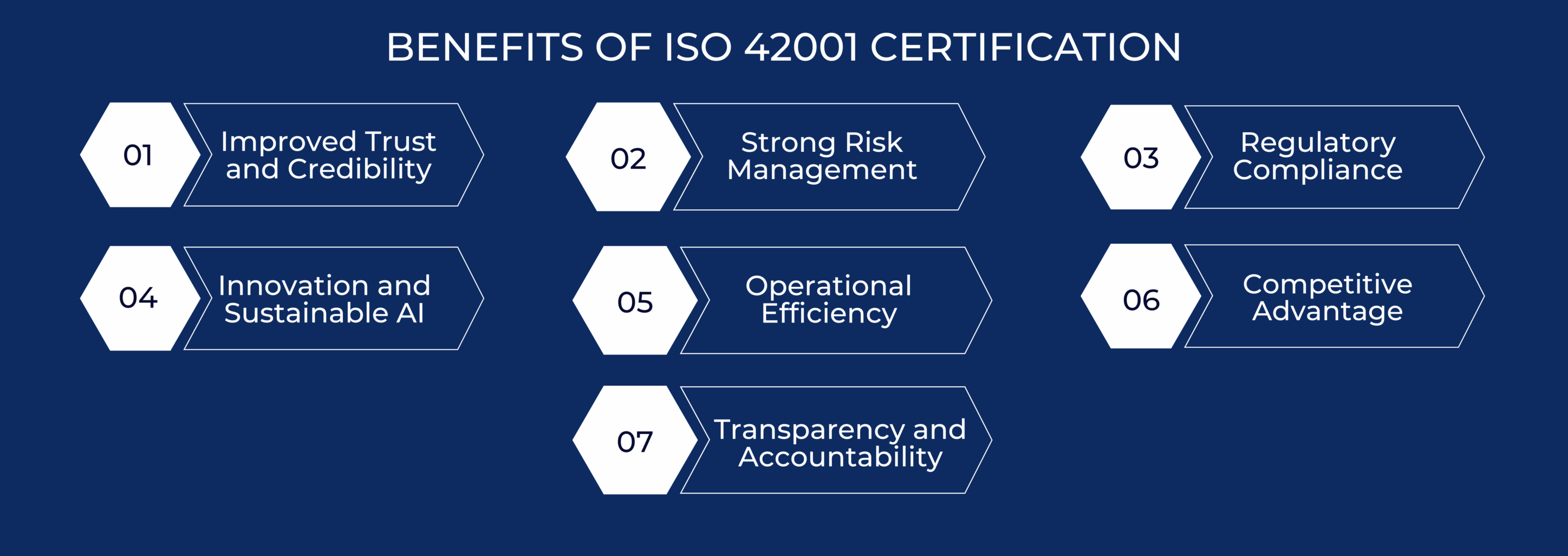
- ✓Independent third-party verification of AIMS conformity to ISO/IEC 42001:2023, providing objective evidence distinguishable from self-attestation in procurement and vendor assurance reviews
- ✓Recognized credential in federal and enterprise procurement processes where AI governance verification is required as a condition of vendor qualification or contract award
- ✓Structured framework for AI risk management, AI system impact assessment, and data governance that supports consistent, documented AI governance practices across the organization
- ✓Demonstration of AI governance maturity to regulated-sector customers in healthcare, financial services, and government contracting who face regulatory scrutiny around AI-related risks
- ✓Evidence base for responding to regulatory inquiries, audit requests, and due diligence questionnaires related to AI governance and responsible AI practices
- ✓International recognition of the ISO 42001 standard supporting AI governance credibility in cross-border commercial engagements with customers and partners outside the United States
- ✓Ongoing surveillance audit cycle that maintains currency of ISO 42001 certification and provides periodic independent verification of continued AIMS conformity
- ✓Differentiated market positioning as an AI developer or deployer with independently verified AI governance — relevant in competitive procurement environments where multiple vendors offer comparable AI capabilities
For Arlington-based organizations competing for federal contracts involving AI systems, ISO 42001 Certification in Arlington provides a credential that supports both initial vendor qualification and ongoing performance evaluation. Federal procurement authorities increasingly include AI governance requirements in solicitations and contract performance standards. An independently issued ISO 42001 certification certificate — as distinct from a vendor-prepared self-assessment — provides contracting officers and program managers with a structured, audited basis for evaluating AI governance conformity.
In competitive bid environments where multiple vendors offer technically comparable AI capabilities, ISO 42001 certification audit documentation provides a differentiating element that supports procurement confidence. The certification also supports ongoing vendor performance reviews by providing a documented baseline of AI governance standards against which changes in the vendor’s AIMS can be evaluated during surveillance audit cycles.
As AI capabilities become embedded in an increasing proportion of Arlington’s technology sector’s product and service offerings, the ability to demonstrate independent verification of AI governance to customers, partners, and end users becomes a meaningful differentiator. ISO AIMS certification in Arlington provides organizations with a third-party verified statement that their AI systems are governed by a documented, risk-managed, and independently audited AIMS — not simply by internal policies that have not been externally evaluated.
For AI companies, SaaS providers, and cloud service providers in Arlington seeking to expand into regulated industries or large enterprise markets, ISO 42001 certification addresses the AI governance credibility gap that can otherwise hinder sales cycles, slow contract negotiations, or prevent qualification on vendor panels. The certification’s foundation in the internationally recognized ISO 42001 standard also ensures that the credential’s requirements are publicly documented and verifiable by any party seeking to understand what the certification represents.
- ✓Credibility in Federal and Defense Procurement
- ✓Trust and Accountability in AI-Driven Products and Services
Sectors in Arlington Pursuing ISO 42001 Certification
ISO 42001 compliance is relevant across Arlington’s diverse technology and business ecosystem. The following sectors represent the primary organizational contexts in which ISO 42001 certification for Arlington companies is pursued, reflecting the specific AI governance demands, regulatory environments, and customer expectations characteristic of each sector within the Northern Virginia market.
Defense, Aerospace, and Intelligence Technology
Defense and aerospace organizations in Arlington develop and deploy AI systems across a wide range of applications including intelligence analysis, autonomous systems, logistics optimization, predictive maintenance, cybersecurity threat detection, and mission planning. These organizations operate under stringent government acquisition and oversight frameworks that impose specific requirements for AI testing, evaluation, monitoring, and governance.
ISO 42001 standard conformity — independently verified through certification — provides defense contractors with a documented AI governance framework that aligns with responsible AI principles emphasized in DoD AI strategy documents and acquisition policy. For prime contractors and subcontractors within the defense supply chain, ISO 42001 certification audit outcomes also support supply chain risk management requirements imposed by prime contractors on AI-related subcomponents and services.
Cybersecurity, Cloud Computing, and SaaS Providers
Arlington hosts a significant concentration of cybersecurity firms, cloud service providers, and SaaS organizations — many of which have integrated AI capabilities into their core product offerings. Cybersecurity firms using AI for threat intelligence, anomaly detection, endpoint protection, or security operations face customer expectations around the governance and reliability of AI-driven detection and response capabilities. Cloud service providers operating AI inference and training workloads for enterprise and government customers face procurement requirements around AI system documentation, data governance, and operational oversight.
SaaS providers embedding AI features — such as AI-driven analytics, automated recommendations, or AI-powered workflow tools — into enterprise software products face due diligence requirements from enterprise buyers concerned about AI-related operational and reputational risks. ISO 42001 Certification in Arlington addresses these requirements by providing an independently verified ISO AIMS certification credential applicable across these technology sectors.
Healthcare Technology, Financial Services, and Telecommunications
Healthcare technology organizations in the Arlington area developing AI-enabled clinical tools, health information systems, or administrative AI applications face both regulatory scrutiny and procurement requirements around AI governance. ISO 42001 compliance provides a structured AIMS framework that addresses AI system impact assessment, data governance, and human oversight requirements relevant to clinical AI contexts. Financial services organizations — including banks, insurance companies, investment managers, and fintech firms — operating in the Northern Virginia market use AI extensively in risk modeling, fraud detection, customer service automation, and regulatory reporting.
ISO 42001 certification audit documentation supports model risk management and AI governance disclosures required by financial regulators. Telecommunications organizations deploying AI in network management, customer service, and infrastructure optimization similarly benefit from ISO AIMS certification as evidence of structured AI governance in procurement and regulatory contexts.
ISO 42001 Certification vs. Related Standards and Frameworks
Organizations in Arlington evaluating ISO 42001 certification frequently encounter related standards and frameworks that address adjacent aspects of information security, data protection, privacy, or AI governance. Understanding how ISO/IEC 42001:2023 relates to these frameworks is relevant for organizations determining the appropriate scope and focus of their certification program and for those considering integration of multiple management system certifications.
ISO 42001 and ISO 27001: Relationship and Integration
ISO/IEC 27001 is the internationally recognized standard for Information Security Management Systems (ISMS), widely adopted by technology organizations in Arlington for information security certification. ISO/IEC 42001:2023 and ISO/IEC 27001 share the High-Level Structure common to ISO management system standards, which facilitates integration of the two management systems within a single governance framework. However, the two standards address distinct requirements: ISO 27001 focuses on the confidentiality, integrity, and availability of information assets, while the ISO 42001 standard focuses specifically on the governance, risk management, and responsible operation of AI systems.
An organization may hold certifications to both standards, with the AIMS and ISMS either integrated or operating as separate management systems depending on organizational structure. The ISO 42001 certification audit evaluates conformity to the AI-specific requirements of ISO/IEC 42001:2023 independently of any ISO 27001 certification the organization may hold.
ISO 42001 and U.S. AI Governance Frameworks
The U.S. AI governance landscape includes several frameworks relevant to Arlington-based organizations, including the NIST AI Risk Management Framework (AI RMF), Executive Order 14110 on Safe, Secure, and Trustworthy AI, the OMB Memorandum M-24-10 on Advancing Governance, Innovation, and Risk Management for Agency Use of AI, and sector-specific guidance from agencies including HHS, the FDA, and financial regulators. ISO/IEC 42001:2023 is an internationally recognized standard whose requirements align substantively with the principles and practices articulated in these U.S. AI governance frameworks — including risk-based AI governance, AI impact assessment, data governance, transparency, and human oversight.
ISO 42001 standard conformity, independently verified through an ISO 42001 certification audit, provides Arlington-based organizations with documented evidence of AI governance maturity relevant to both U.S. regulatory contexts and international procurement requirements. The international recognition of ISO/IEC 42001:2023 also supports AI governance credibility in cross-border engagements with the European Union — where the EU AI Act establishes binding requirements for high-risk AI systems — and other jurisdictions with structured AI governance expectations.
FAQ
▶
What is ISO 42001 certification and what does it certify?
▶
Which organizations in Arlington should pursue ISO 42001 certification?
▶
What is the difference between Stage 1 and Stage 2 of the ISO 42001 audit?
▶
What documented information does ISO 42001 require?
▶
How long is ISO 42001 certification valid, and what are surveillance audits?
▶
What is the Statement of Applicability in ISO 42001?
▶
How does ISO 42001 differ from ISO 27001 for Arlington organizations?
▶
What is an AI system impact assessment under ISO 42001?
ISO 42001 CERTIFIED: WHY AI GOVERNANCE CERTIFICATION IS BECOMING A BOARD-LEVEL REQUIREMENT
ISO 42001 Certified: Board-Level AI Governance Guide | CertPro CPA LLC HERO ══════════════════════════════ –> src=”https://certpro.com/wp-content/uplo…
Get In Touch
have a question? let us get back to you.