
ISO 42001 Certification in Brussels
ISO 42001 Certification in Brussels is issued by CertPro, a Licensed CPA Firm operating as an independent certification body. Certification is conducted through a structured, stage-based examination of an organization’s Artificial Intelligence Management System (AIMS) against the requirements of ISO/IEC 42001:2023 — the first internationally recognized standard governing the establishment, implementation, maintenance, and continual improvement of AI governance frameworks. Organizations seeking ISO 42001 certification gain a credible, independently verified record of their AI management practices.
OUR CLIENTS










ISO 42001 Certification for Brussels-Based Financial and Technology Organizations
ISO 42001 Certification in Brussels is issued by CertPro, a Licensed CPA Firm operating as an independent certification body. Certification is conducted through a structured, stage-based examination of an organization’s Artificial Intelligence Management System (AIMS) against the requirements of ISO/IEC 42001:2023 — the first internationally recognized standard governing the establishment, implementation, maintenance, and continual improvement of AI governance frameworks. Organizations seeking ISO 42001 certification gain a credible, independently verified record of their AI management practices.
Brussels occupies a singular position in the European regulatory landscape. As the administrative capital of the European Union and home to the principal institutions of EU governance — including the European Commission, the European Parliament, and the Council of the EU — Brussels concentrates a density of regulated enterprises, institutional technology vendors, financial services organizations, and AI-deploying entities unmatched by any other city on the continent.
Organizations operating in this environment face stringent procurement requirements, institutional due diligence expectations, and evolving regulatory obligations under frameworks including the EU AI Act and GDPR. ISO 42001 Certification in Brussels provides the independent, third-party verification that enterprise buyers, regulated counterparties, and EU institutional clients require as evidence of a structured and accountable AI governance program.
The Brussels technology and financial services ecosystem encompasses major banking groups, insurance and asset management firms, international law firms, professional services organizations, telecommunications carriers, cloud infrastructure providers, government technology vendors, and a rapidly expanding population of SaaS companies and AI-native startups. Each of these sectors operates under distinct procurement and regulatory pressures.
Financial institutions engaged with the National Bank of Belgium or the Financial Services and Markets Authority (FSMA) face technology governance expectations that increasingly extend to AI decision systems. Government technology vendors seeking contracts with EU institutions are evaluated against standards for transparency, accountability, and risk management that align directly with ISO/IEC 42001:2023 requirements. For organizations in these categories, ISO 42001 attestation delivers an objective, evidence-based record of AIMS design and operating effectiveness.
CertPro conducts ISO 42001 Certification in Brussels as an independent certification body. The certification process does not include consulting, implementation, policy development, or remediation services. The Licensed CPA Firm evaluates existing controls, documentation, and operational evidence against the standard’s requirements, issues findings through a structured nonconformity review, and renders an independent certification decision through a certification committee.
Organizations that satisfy the requirements of ISO/IEC 42001:2023 receive a certificate valid for three years, subject to annual surveillance audits. This independent examination methodology positions ISO 42001 certification as a credible and auditable record of AI governance maturity — one directly referenced by procurement officers, enterprise vendor assessment teams, and regulatory reviewers across the Brussels and wider Belgian business environment.
ISO 42001 compliance in Brussels is increasingly relevant to organizations navigating both EU regulatory developments and U.S. attestation expectations. Brussels-based organizations serving U.S. financial institutions, U.S. government contractors, or multinational enterprise buyers are evaluated against American vendor assurance frameworks — including SOC-equivalent reviews and third-party risk management assessments — that require demonstrable AI governance controls.
ISO 42001 attestation, issued by a Licensed CPA Firm, functions as a recognized evidence artifact within these multi-jurisdictional vendor review processes. This recognition reduces duplicative audit obligations and strengthens an organization’s position in cross-border procurement evaluations.

What Is ISO 42001 Certification?
ISO 42001 certification is the formal, third-party verification that an organization’s Artificial Intelligence Management System conforms to the requirements of ISO/IEC 42001:2023. Published in December 2023, the standard serves as the first global benchmark for managing AI systems. It provides a structured framework for organizations that develop, deploy, or procure AI-based products and services.
ISO 42001 certification is awarded following an independent ISO 42001 examination conducted by a Licensed CPA Firm or accredited certification body. The examination confirms that the AIMS meets specified criteria for governance, risk management, transparency, and continual improvement — making ISO 42001 compliance a recognized indicator of AI governance maturity across regulated and enterprise markets.
Scope and Structure of ISO/IEC 42001:2023
ISO/IEC 42001:2023 is structured around the high-level structure (HLS) common to all ISO management system standards, covering Clauses 4 through 10: organizational context, leadership, planning, support, operation, performance evaluation, and improvement. This architecture allows organizations already certified to ISO 27001 or ISO 9001 to integrate AIMS requirements with existing management system frameworks — reusing documented policies, risk assessment methodologies, and internal audit processes.
The standard also includes normative annexes that define AI-specific control objectives and controls, addressing areas such as data governance, algorithmic transparency, human oversight, and AI system lifecycle management. This integrated approach makes ISO 42001 compliance achievable without building a standalone governance program from the ground up.
The ISO 42001 examination evaluates whether an organization has established the foundational elements required by the standard: a defined AI policy endorsed by senior leadership, a structured AI risk assessment process, a risk treatment plan aligned to identified AI impacts, and a Statement of Applicability documenting which controls have been implemented along with the rationale for any exclusions.
The examination also assesses operational controls governing AI system development and deployment, performance monitoring mechanisms, and internal audit and management review processes. Each element is assessed for both design adequacy and operating effectiveness through evidence-based review of documentation, records, and system configurations.
ISO 42001 and the EU AI Act: Regulatory Alignment
ISO 42001 compliance aligns directly with obligations established under the EU AI Act, which entered into force in August 2024 and applies to AI system providers, deployers, and importers operating within the EU market. The EU AI Act imposes requirements for risk classification, conformity assessment, transparency, and post-market monitoring across AI systems — requirements that mirror the control domains addressed by ISO/IEC 42001:2023.
For Brussels-based organizations subject to both frameworks, ISO 42001 Certification in Brussels provides documented evidence of an operational governance structure that maps to EU AI Act conformity expectations. This alignment reduces duplicative compliance workload and strengthens the evidentiary record available during regulatory review.
ISO 42001 also shares structural alignment with ISO 27001 for information security and ISO 31000 for enterprise risk management. In practice, organizations with existing ISO 27001 certification can integrate AIMS controls into their existing Information Security Management System infrastructure — sharing policies, internal audit functions, and management review cycles — rather than establishing a separate governance program.
This integration pathway is particularly relevant for Brussels-based financial institutions and technology vendors that maintain mature ISO 27001 programs and are seeking to extend their certification scope to cover AI-specific risks without significant additional compliance overhead.
Who Requires ISO 42001 Certification
ISO 42001 certification is relevant to any organization that develops AI-based products, deploys AI systems in operational decision-making processes, or procures AI services from third-party vendors. In Brussels, this includes:
- Financial institutions using AI for credit scoring, fraud detection, or regulatory reporting
- Government technology vendors supplying AI-enabled platforms to EU institutions
- SaaS companies embedding AI functionality into enterprise software
- Telecommunications providers using AI for network management and customer service
- Professional services firms deploying AI tools in legal, consulting, or audit workflows
ISO 42001 Certification in Brussels provides each of these categories with an independently verified record of AI governance maturity, supporting procurement qualification, regulatory interaction, and enterprise client due diligence requirements.
ISO 42001 Certification Audit Process in Brussels
The ISO 42001 audit process in Brussels follows a structured, stage-based examination methodology conducted by a Licensed CPA Firm. Each audit stage produces documented outputs that are reviewed by an independent certification committee before a certification decision is rendered. The ISO 42001 audit process is consistent with ISO/IEC 17021-1 requirements for management system certification bodies and is applied uniformly across all organizations regardless of sector or size.
| Audit Stage | Key Activities | Output |
|---|---|---|
| Application Review | Scope definition, organizational context assessment, audit program determination | Confirmed audit scope and program |
| Stage 1 Audit | Documentation review, AIMS design evaluation, readiness assessment against ISO/IEC 42001:2023 clauses | Stage 1 findings report |
| Stage 2 Audit | Evidence-based testing of operating effectiveness, control sampling, personnel interviews, system configuration review | Stage 2 audit report with nonconformities |
| Nonconformity Review | Evaluation of corrective action evidence submitted by the organization | Nonconformity closure status |
| Certification Decision | Independent certification committee review of audit evidence and findings | Certificate issuance or deferral decision |
The Stage 1 audit is a structured review of the organization’s AIMS documentation and system design against the requirements of ISO/IEC 42001:2023. The Licensed CPA Firm examines the AI policy, AI risk assessment documentation, risk treatment plan, and Statement of Applicability to determine whether the management system is designed in conformance with the standard.
The Stage 1 audit also evaluates the organization’s scope definition — confirming that the defined AIMS boundary encompasses the AI systems, processes, and organizational units to which the standard’s requirements apply. Findings from the Stage 1 audit are documented and communicated to the organization before the Stage 2 audit commences, ensuring transparency throughout the ISO 42001 examination process.
For Brussels-based organizations operating across multiple jurisdictions or serving EU institutional clients, the Stage 1 audit scope determination is particularly important. The AIMS scope must clearly define which AI systems are in scope for certification, the organizational boundaries of the management system, and any interfaces with third-party AI providers or cloud-based AI services.
Where an organization uses AI components procured from external vendors — as is common among Brussels financial services firms integrating AI risk scoring or compliance monitoring platforms — the Stage 1 audit assesses how the organization’s AIMS addresses third-party AI risk within its control environment. Clear scope documentation at this stage supports a more efficient Stage 2 ISO 42001 audit.
The Stage 2 audit is the principal evidence-gathering phase of the ISO 42001 examination. The Licensed CPA Firm evaluates the operating effectiveness of AIMS controls through a combination of documentation review, personnel interviews, process walkthroughs, and technical configuration inspections.
Controls assessed during the Stage 2 audit include AI risk identification and classification procedures, data governance controls governing training data quality and provenance, human oversight mechanisms for high-risk AI decisions, incident management processes, internal audit execution records, and management review documentation. Each control is assessed against the requirements of the applicable ISO/IEC 42001:2023 clause and the organization’s own AIMS policies and procedures.
The ISO 42001 audit process for Brussels organizations results in a structured audit report identifying any nonconformities — instances where the AIMS fails to meet a specified requirement of the standard. Nonconformities are categorized and reported to the organization, which must submit evidence of corrective action within a defined timeframe.
The Licensed CPA Firm evaluates the adequacy of corrective actions before the certification committee reviews the complete audit record. This structured nonconformity process ensures that ISO 42001 certification decisions are based on objective, evidence-based assessments rather than representations made by the organization itself.
ISO 42001 certification is valid for a period of three years from the date of issuance. During this period, the organization is subject to annual surveillance audits conducted by the Licensed CPA Firm. Surveillance audits are narrower in scope than the initial certification audit but assess whether the AIMS continues to operate effectively and whether any significant changes to the organization’s AI systems, processes, or organizational structure have been reflected in the management system.
Surveillance audit findings are documented and reviewed by the certification committee, which may suspend or withdraw certification if the AIMS is found to be operating outside the requirements of ISO/IEC 42001:2023. This ongoing oversight cycle is a defining feature of credible ISO 42001 compliance.
At the end of the three-year certification cycle, the organization undergoes a recertification audit covering the full scope of the AIMS. The recertification audit follows the same structured examination methodology as the initial ISO 42001 audit and results in an independent certification decision.
For Brussels-based organizations maintaining ISO 42001 compliance as a condition of ongoing vendor approval or institutional contract eligibility, the recertification process provides continuity of certified status that procurement officers and regulatory reviewers rely upon as evidence of sustained AI governance maturity.
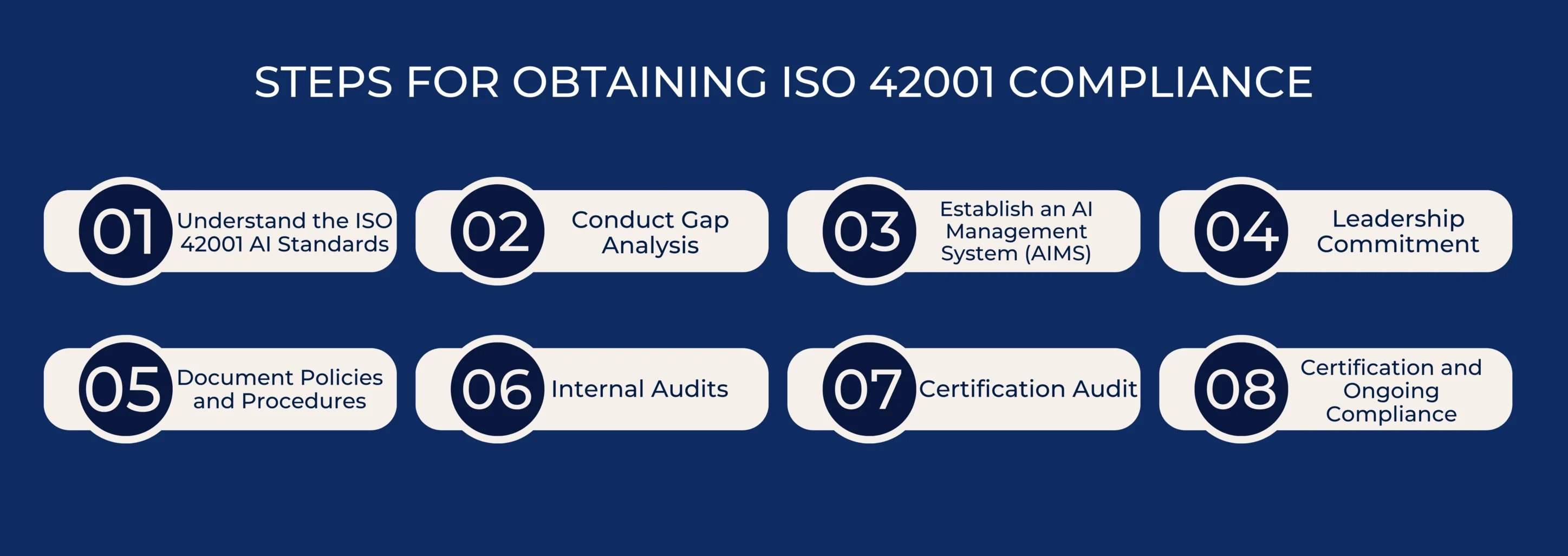
- ✓Stage 1 Audit: Documentation and Design Review
- ✓Stage 2 Audit: Operating Effectiveness Examination
- ✓Surveillance Audits and Certificate Validity
ISO 42001 Certification Requirements and AIMS Control Environment
ISO 42001 compliance requires organizations to establish and maintain a documented Artificial Intelligence Management System that addresses each of the standard’s normative clauses. The control environment evaluated during the ISO 42001 examination encompasses both management system-level requirements and AI-specific operational controls. The following requirements represent the core elements assessed during the certification audit process.
The foundational documentation requirements for ISO/IEC 42001:2023 certification include a formally approved AI policy that articulates the organization’s commitments to responsible AI development and deployment, a structured AI risk assessment process that identifies AI-related impacts and evaluates their likelihood and severity, and a risk treatment plan that maps identified risks to specific controls drawn from the standard’s normative annexes.
The Statement of Applicability (SoA) is a required document that identifies each applicable control, confirms whether the control has been implemented, and provides a reasoned justification for any exclusions. These four core documents — AI policy, risk assessment, risk treatment plan, and SoA — are examined during both Stage 1 and Stage 2 of the ISO 42001 audit process.
Beyond the core documentation set, the ISO 42001 examination evaluates records that demonstrate the operational functioning of the AIMS. These include internal audit reports, management review minutes, nonconformity and corrective action records, training completion records for personnel with AI governance responsibilities, and documented outcomes from AI system monitoring and performance evaluation activities.
For Brussels-based organizations operating AI systems in regulated contexts — such as AI-driven credit assessment tools subject to FSMA oversight, or AI-enabled reporting systems used by EU institutional clients — the audit record must also demonstrate that the AIMS addresses jurisdiction-specific regulatory requirements within the scope of the management system.
The normative annexes of ISO/IEC 42001:2023 define AI-specific control objectives and controls across domains including AI system lifecycle management, data governance, transparency and explainability, human oversight, accountability structures, and incident management. Each control domain is evaluated during the ISO 42001 examination to determine whether the organization has implemented controls proportionate to the AI risks identified in its risk assessment.
For example, organizations deploying high-risk AI systems in financial decision-making are expected to demonstrate more rigorous human oversight controls and more comprehensive audit trails than organizations using AI for low-risk process automation tasks. This risk-proportionate approach is a core principle of ISO 42001 compliance.
Data governance controls are a significant focus of the ISO 42001 attestation examination for Brussels-based financial and technology organizations. The standard requires that organizations address the quality, provenance, and representativeness of data used to train and operate AI systems.
For organizations subject to GDPR — which applies across all Brussels-based entities processing personal data — AI data governance controls must also address data minimization, purpose limitation, and data subject rights management as these intersect with AI system operations. The ISO 42001 audit assesses whether the organization’s data governance framework addresses these intersecting obligations within the documented scope of the AIMS.
The scope of ISO 42001 Certification in Brussels is defined by the organization in consultation with the Licensed CPA Firm during the application and audit program determination phase. The scope must identify the AI systems covered by the AIMS, the organizational units and locations included within the management system boundary, and any interfaces with external AI service providers or AI component suppliers.
A clearly defined and appropriately bounded scope is a prerequisite for certification. Scopes that are ambiguous, overly narrow, or inconsistent with the organization’s actual AI operations may result in audit findings that delay the ISO 42001 certification decision.
The certification decision is made by an independent certification committee that reviews the complete audit record — including Stage 1 and Stage 2 reports, nonconformity documentation, and corrective action evidence. The committee operates independently of the audit team and applies objective criteria in determining whether the organization’s AIMS satisfies the requirements of ISO/IEC 42001:2023.
Certification may be granted, deferred pending additional corrective action evidence, or declined where material nonconformities remain unresolved. Conditions for suspension or withdrawal of an issued certificate include failure to maintain the AIMS in conformance with the standard, failure to undergo required surveillance audits, or material changes to AI system scope that are not reflected in the management system.
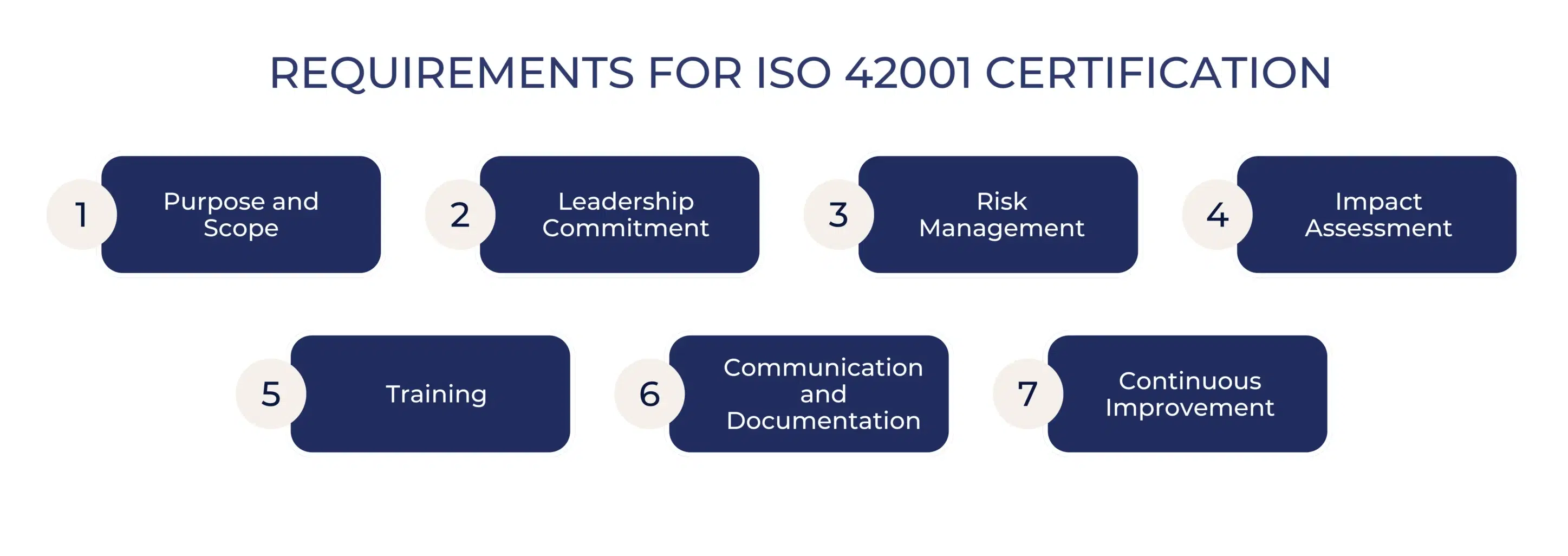
- ✓Management System Documentation Requirements
- ✓AI-Specific Control Domains
- ✓Certification Scope Definition and Independent Decision Framework
Why Organizations in Brussels Pursue ISO 42001 Certification
The demand for ISO 42001 Certification in Brussels is driven by a convergence of regulatory pressure, enterprise procurement requirements, and institutional client expectations. These reflect Brussels’s unique position as both an EU regulatory hub and a major commercial center. Organizations across multiple sectors are initiating ISO 42001 audit processes in response to specific procurement, contractual, or regulatory drivers that distinguish Brussels-based demand from that of other European cities.
EU Institutional Procurement and Vendor Due Diligence
EU institutions — including the European Commission, European Parliament, European Council, and European Central Bank — are among the largest technology procurement entities in Brussels. Vendors supplying AI-enabled platforms, data analytics services, or automated decision systems to these institutions are increasingly evaluated against AI governance standards as part of procurement qualification processes.
ISO 42001 Certification in Brussels provides technology vendors with the independently verified AI governance record that EU institutional procurement officers require. For organizations competing for EU institutional contracts, ISO 42001 attestation reduces the due diligence burden by providing a single, auditable artifact that addresses the governance, transparency, and accountability requirements specified in institutional vendor evaluation frameworks.
Consider a representative procurement scenario: a Brussels-based SaaS company supplying AI-driven regulatory reporting tools to a European Commission directorate is required to demonstrate ISO 42001 compliance as a condition of contract renewal. The organization’s existing ISO 27001 certification covers information security but does not address AI-specific governance requirements.
ISO 42001 Certification in Brussels, integrated with the existing ISO 27001 ISMS, provides the additional governance layer required to satisfy the institutional procurement condition — without requiring the establishment of a standalone governance program. This integration pathway is a practical advantage for organizations already operating mature management systems.
Financial Services Sector AI Governance Requirements
ISO 42001 certification demand from Brussels financial services organizations is shaped by supervisory expectations from the National Bank of Belgium, the FSMA, and the European Banking Authority (EBA). The EBA has issued guidelines on internal governance and the use of AI in credit risk, fraud detection, and automated decision-making. Financial institutions deploying AI systems in regulated functions are expected to demonstrate that these systems operate within a structured governance framework — a requirement directly addressed by ISO/IEC 42001:2023.
ISO 42001 compliance is also a growing requirement for Brussels fintech organizations, which face additional pressure from enterprise banking clients and payment network operators requiring third-party verified AI governance as a condition of integration and data sharing agreements.
Brussels hosts the headquarters or major operations of multiple systemically important financial institutions, including international banking groups, insurance holding companies, and asset management firms. These organizations deploy AI systems across credit underwriting, anti-money laundering monitoring, customer due diligence automation, and regulatory capital modeling — all contexts in which supervisory expectations for AI governance are explicit and documented.
The ISO 42001 audit provides these institutions with an independently evaluated governance record that can be presented to supervisory authorities as evidence of structured AI risk management. This independently verified record is increasingly referenced in supervisory examinations and regulatory interactions.
Cross-Border Vendor Assessment and U.S. Attestation Expectations
Brussels-based organizations serving U.S. financial institutions, multinational enterprise clients, or U.S. government contractors are subject to vendor assurance processes that apply American third-party risk management standards alongside EU regulatory requirements. U.S. enterprise buyers conducting vendor risk assessments frequently require documented AI governance evidence — particularly for vendors supplying AI-enabled software, data analytics services, or automated decision tools.
ISO 42001 attestation, issued by a Licensed CPA Firm operating under U.S. professional standards, is recognized within U.S. vendor assurance frameworks as credible third-party verification of AI governance controls. This cross-border recognition reduces duplicative audit obligations for Brussels-based organizations serving transatlantic client bases, making ISO 42001 compliance a practical investment for internationally active organizations.
Benefits of ISO 42001 Certification for Brussels-Based Organizations
ISO 42001 Certification in Brussels delivers measurable, documented benefits for organizations that complete the certification process. The following benefits reflect the direct outcomes of independent, third-party certification conducted by a Licensed CPA Firm — not representations of projected outcomes or advisory results. Each benefit is a direct consequence of the ISO 42001 examination and attestation process.
- ✓Independent verification of AIMS design and operating effectiveness against ISO/IEC 42001:2023 requirements, providing an auditable record for procurement and regulatory review
- ✓Recognized evidence artifact for EU institutional procurement qualification processes, reducing vendor due diligence timelines for Brussels-based technology suppliers
- ✓Documented alignment with EU AI Act conformity expectations, supporting regulatory interactions with the European Commission and national supervisory authorities
- ✓Structured surveillance audit cycle providing ongoing oversight of AIMS performance and continual improvement obligations
- ✓Cross-jurisdictional recognition within U.S. vendor assurance frameworks, reducing duplicative audit obligations for organizations serving transatlantic client bases
- ✓Certificate of conformance valid for three years, providing sustained procurement and regulatory credibility without annual full-scope re-examination
- ✓Integration pathway with existing ISO 27001 and ISO 9001 management systems, enabling shared audit infrastructure and reduced compliance overhead
- ✓Demonstration of accountability and transparency in AI system governance to institutional clients, enterprise buyers, and supervisory authorities
ISO 42001 Certification in Brussels functions as a procurement differentiator for organizations competing in markets where AI governance verification is a qualification requirement. Enterprise technology buyers — including financial institutions, telecommunications operators, and multinational corporations headquartered in Brussels — increasingly include AI governance certification in vendor prequalification criteria.
Organizations holding a valid ISO 42001 certificate issued by a Licensed CPA Firm can present this certification as objective evidence of AIMS conformance, bypassing the extended vendor questionnaire and documentation review processes that uncertified organizations must navigate. This procurement advantage is particularly valuable for smaller SaaS companies and AI startups operating in the Brussels ecosystem that seek access to large enterprise and institutional client markets.
The structured surveillance audit cycle associated with ISO 42001 attestation also provides organizations with an ongoing governance discipline that supports continual improvement of the AIMS throughout the certificate validity period. Annual surveillance audits conducted by the Licensed CPA Firm identify emerging gaps in control effectiveness, changes in the AI risk landscape, and evolving regulatory requirements that the AIMS must address.
This cycle of independent review provides Brussels-based organizations with a structured mechanism for maintaining AI governance maturity as their AI deployments evolve — without requiring the organization to self-assess the adequacy of its own controls. The result is a more resilient and credible ISO 42001 compliance posture over time.
ISO 42001 compliance provides Brussels-based organizations with a documented, independently assessed risk management framework for AI systems. In the context of the EU AI Act — which imposes obligations for risk classification, conformity assessment, and post-market monitoring on AI system providers and deployers — a certified AIMS constitutes a significant element of the organization’s regulatory defensibility record.
Supervisory authorities reviewing an organization’s AI governance posture, whether in the context of a routine examination or an incident-triggered investigation, can reference ISO 42001 examination findings and the certificate of conformance as evidence that the organization maintains a structured, independently validated approach to AI risk management. This regulatory defensibility is one of the most consequential long-term benefits of ISO 42001 Certification in Brussels.
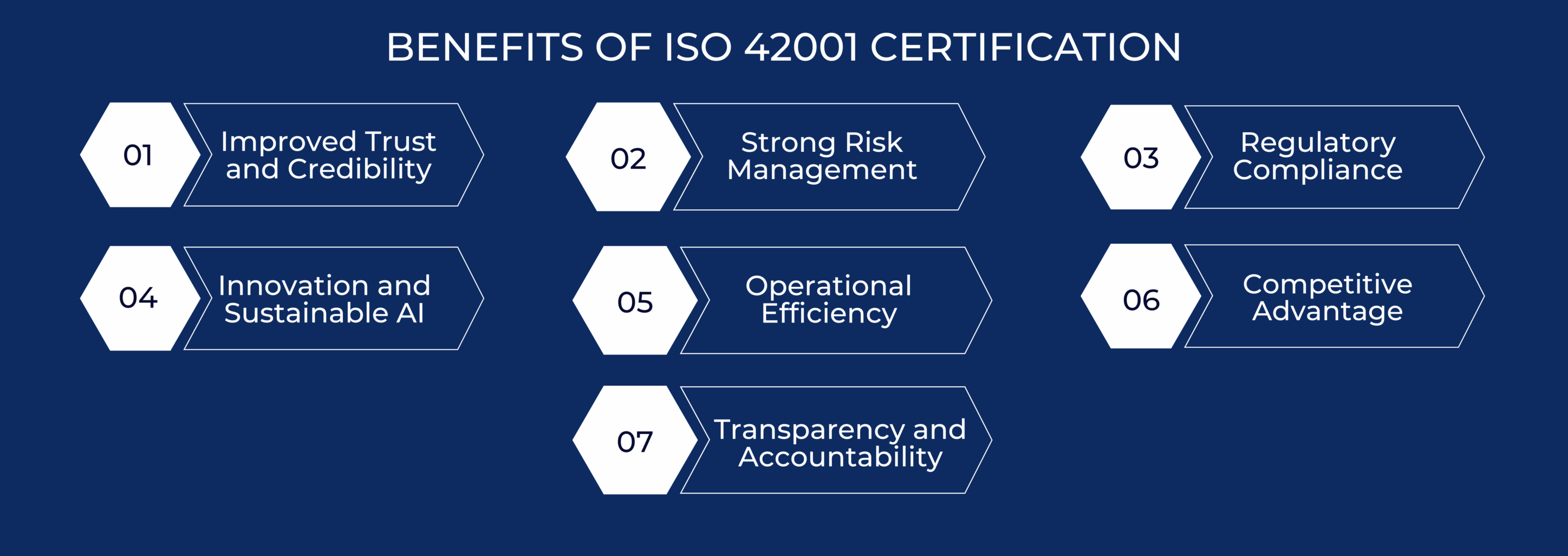
- ✓Procurement Recognition and Competitive Positioning
- ✓Risk Management and Regulatory Defensibility
Business Sectors in Brussels Seeking ISO 42001 Certification
ISO 42001 Certification for Brussels companies spans a broad range of sectors, reflecting the city’s role as both an EU regulatory center and a major commercial hub. The following sectors represent the primary organizational categories pursuing ISO 42001 audit examinations in the current market environment, each driven by distinct regulatory pressures, procurement obligations, and client due diligence requirements.
| Sector | Primary AI Governance Driver | Relevant ISO 42001 Control Domains |
|---|---|---|
| Financial Services & Banking | EBA guidelines, FSMA supervisory expectations, enterprise client due diligence | AI risk classification, human oversight, algorithmic transparency |
| Government Technology Vendors | EU institutional procurement qualification, EU AI Act conformity | Accountability structures, transparency, post-deployment monitoring |
| SaaS & Cloud Providers | Enterprise vendor security reviews, U.S. client attestation requirements | Data governance, AI lifecycle management, incident management |
| Telecommunications | Network AI management, regulatory compliance, enterprise client requirements | Operational controls, risk assessment, continual improvement |
| Professional & Legal Services | Client due diligence, cross-border engagement requirements | Human oversight, transparency, data governance |
Technology Startups and AI-Native Companies
Brussels hosts a growing population of AI-native technology companies and startups operating from innovation districts and co-working ecosystems concentrated in areas including Tour & Taxis and the Quartier Européen technology cluster. These organizations — many of which develop AI products for financial services, legal technology, healthcare, or government applications — frequently require ISO 42001 Certification in Brussels as a condition of participation in EU-funded innovation programs, as a prerequisite for pilot deployments with regulated institutional clients, or as evidence of governance maturity in international investor due diligence processes.
For early-stage organizations, the ISO 42001 examination process also serves as a structured framework for establishing AIMS disciplines that scale with the organization’s AI deployment footprint. This makes ISO 42001 compliance a foundational investment rather than a reactive compliance exercise.
Managed service providers and IT infrastructure companies operating in the Brussels market also represent a significant category of ISO 42001 audit demand. Organizations supplying managed AI operations, AI-enabled monitoring, or AI-integrated infrastructure services to regulated Belgian enterprises are evaluated by their clients against AI governance standards as part of third-party vendor risk management programs.
ISO 42001 attestation issued by a Licensed CPA Firm provides these managed service providers with a certification artifact that satisfies client vendor assurance requirements across multiple client relationships simultaneously — significantly reducing the audit burden associated with individual client-driven assessments.
ISO 42001 Certification Process: Application Through Certificate Issuance
The ISO 42001 certification process for Brussels-based organizations follows a defined sequence from initial application through certificate issuance and ongoing surveillance. Each step in the process is governed by the requirements of ISO/IEC 17021-1 and the examination methodology applied by the Licensed CPA Firm. Understanding this sequence helps organizations prepare efficiently for the ISO 42001 audit and certification decision process.
- Application submission: The organization submits an application defining the proposed AIMS scope, organizational structure, and AI systems to be covered by the certification
- Audit program determination: The Licensed CPA Firm reviews the application and determines the audit program, including the audit team composition, audit duration, and scheduling for Stage 1 and Stage 2 audits
- Stage 1 audit: Structured review of AIMS documentation — AI policy, risk assessment, risk treatment plan, and Statement of Applicability — against ISO/IEC 42001:2023 requirements
- Stage 2 audit: Evidence-based ISO 42001 examination of AIMS operating effectiveness through control testing, personnel interviews, and configuration review across all in-scope AI systems and processes
- Nonconformity review: Identified nonconformities are documented and reported; the organization submits corrective action evidence within a defined period for evaluation by the audit team
- Certification committee review: An independent certification committee reviews the complete audit record and renders a certification decision based on objective evaluation of the evidence
- Certificate issuance: Upon a positive certification decision, a certificate of conformance to ISO/IEC 42001:2023 is issued, valid for three years from the date of issuance
- Annual surveillance audits: The Licensed CPA Firm conducts annual surveillance audits to verify that the AIMS continues to operate in conformance with the standard throughout the certificate validity period
- Recertification audit: At the end of the three-year cycle, a full-scope recertification audit is conducted to renew the certificate of conformance
The ISO 42001 examination methodology applied by the Licensed CPA Firm is evidence-based throughout. Audit evidence is gathered through document inspection, records review, personnel interviews, direct observation of processes, and technical configuration verification. For AI systems, technical evidence may include model governance records, training data documentation, algorithmic impact assessments, monitoring dashboards, and change management records for AI system updates.
The audit team applies professional judgment in assessing the sufficiency and reliability of evidence presented, and documents its findings in a structured audit report that forms the basis for the certification committee’s independent review. This evidence-first approach is what distinguishes a credible ISO 42001 audit from a self-assessment or advisory engagement.
ISO 42001 audit examinations in Brussels conducted for financial services organizations or EU institutional vendors typically involve additional evidence assessment related to regulatory interface controls — specifically, how the AIMS addresses the organization’s obligations to supervisory authorities, regulatory reporting requirements for AI systems, and the governance of AI systems used in regulated functions.
The audit team evaluates whether the AIMS scope and controls adequately address these regulatory intersections within the defined certification boundary, without extending the ISO 42001 examination scope beyond the AIMS to encompass broader regulatory compliance programs. This focused approach ensures that the certification remains a precise and credible attestation of AIMS conformance.
- ✓Audit Evidence and Control Testing Methodology
FAQ
▶
What is ISO 42001 certification?
▶
Who needs ISO 42001 certification?
▶
How long does ISO 42001 certification take?
▶
What are the benefits of ISO 42001 certification?
▶
What is the cost of ISO 42001 certification?
▶
How do I prepare for ISO 42001 certification?
▶
What happens after ISO 42001 certification?
▶
How long does the ISO 42001 certification process take?
ISO 42001 CERTIFIED: WHY AI GOVERNANCE CERTIFICATION IS BECOMING A BOARD-LEVEL REQUIREMENT
ISO 42001 Certified: Board-Level AI Governance Guide | CertPro CPA LLC HERO ══════════════════════════════ –> src=”https://certpro.com/wp-content/uplo…

Get In Touch
have a question? let us get back to you.