
ISO 42001 Certification in Columbus
ISO 42001 Certification in Columbus is conducted by CertPro, a Licensed CPA Firm operating exclusively as an independent third-party certification body. CertPro evaluates conformity of an organization’s Artificial Intelligence Management System (AIMS) against the requirements of ISO/IEC 42001:2023 through a structured, evidence-based certification audit process. The resulting certification decision is based solely on audit evidence and reflects independent conformity assessment — not consulting, implementation, or readiness assistance.
OUR CLIENTS



ISO 42001 Certification for Columbus-Based Technology and Financial Organizations
ISO 42001 Certification in Columbus is conducted by CertPro, a Licensed CPA Firm operating exclusively as an independent third-party certification body. CertPro evaluates conformity of an organization’s Artificial Intelligence Management System (AIMS) against the requirements of ISO/IEC 42001:2023 through a structured, evidence-based certification audit process. The resulting certification decision is based solely on audit evidence and reflects independent conformity assessment — not consulting, implementation, or readiness assistance.
Columbus, Ohio, is one of the Midwest’s most significant business and technology centers. The city hosts a dense concentration of software companies, SaaS providers, AI developers, fintech and financial services organizations, insurance carriers, healthcare and life sciences institutions, logistics enterprises, and advanced manufacturers. The financial services corridor along High Street and Easton, the emerging Short North and Franklinton technology districts, the Columbus Innovation District, the Ohio State University research ecosystem, and the broader Central Ohio logistics and healthcare infrastructure together form an extensive landscape of organizations developing, deploying, and integrating AI systems into core business operations.
ISO/IEC 42001:2023 is the first international standard specifically establishing requirements for an Artificial Intelligence Management System. The ISO 42001 standard provides a systematic framework for organizations to govern AI responsibly — addressing AI risk management, AI impact assessment, transparency, human oversight, data governance, and AI-related controls throughout the AI system lifecycle. The standard applies to any organization providing or utilizing AI-based products and services, regardless of size, sector, or the type of AI technology deployed.
Organizations pursuing ISO 42001 Certification in Columbus operate across industries that face increasing enterprise, regulatory, and third-party AI governance expectations. Columbus-based financial services and fintech organizations face vendor assurance reviews from large enterprise clients and regulated counterparties. Healthcare and life sciences institutions manage AI systems that intersect with patient safety, clinical decision-making, and HIPAA-regulated data environments. Technology companies and SaaS providers serving national and international enterprise markets encounter procurement requirements that specify independently verified AI governance as a qualification criterion. Insurance carriers operating from Columbus apply AI-driven underwriting, claims processing, and fraud detection systems that are subject to actuarial and regulatory scrutiny.
ISO 42001 Certification in Columbus serves as independently verified evidence that an organization’s AIMS conforms to the requirements of ISO/IEC 42001:2023. The certification does not represent a guarantee of AI system performance or a warranty that AI outputs will be error-free. It documents that the organization has established, implemented, maintained, and is continually improving an AIMS that satisfies the structural, operational, and risk management requirements of the standard. This distinction is critical for enterprise buyers, regulated partners, and internal risk management functions evaluating third-party AI governance claims.
CertPro’s role in the ISO 42001 certification process is strictly evaluative. CertPro auditors assess documented information, review AI governance policies and procedures, evaluate evidence of control design and operating effectiveness, conduct interviews, and examine records — all within the scope defined at the outset of the certification engagement. CertPro does not design, implement, remediate, or advise on an organization’s AIMS. This independence preserves the integrity of the certification decision and satisfies third-party assurance requirements maintained by enterprise buyers and regulated industry participants throughout the Columbus market.

ISO 42001 Certification Audit Process for Organizations in Columbus
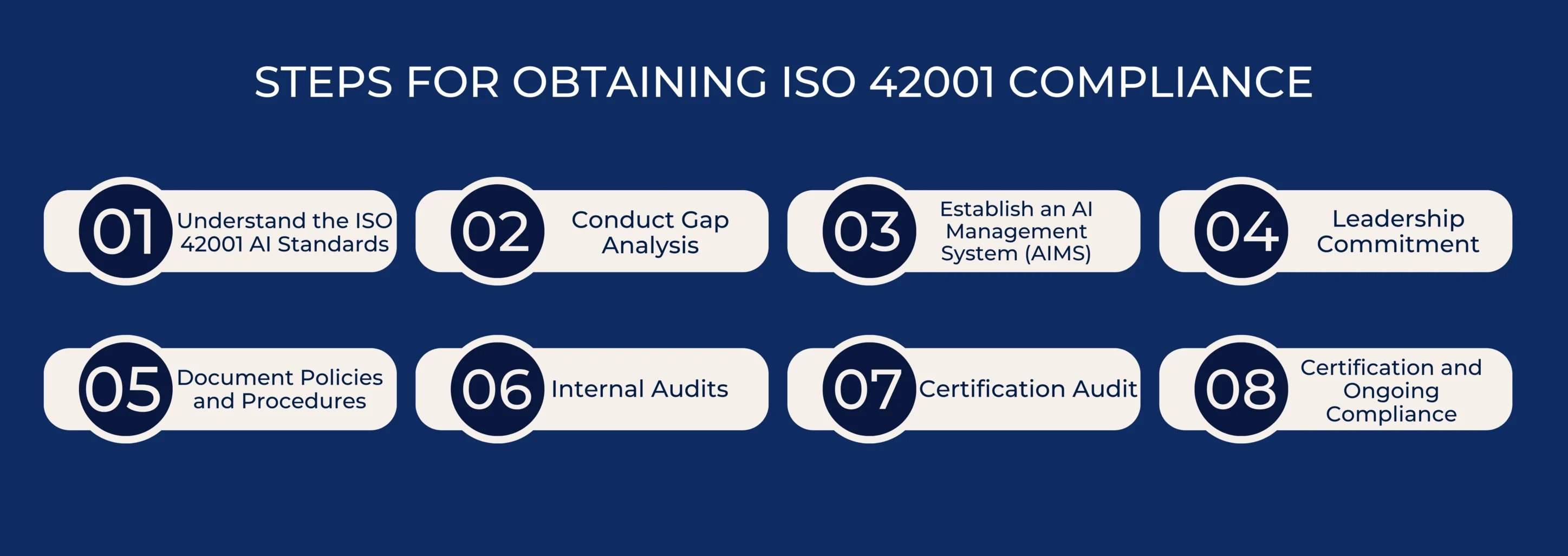
The ISO 42001 certification audit process conducted by CertPro for Columbus-based organizations follows a defined sequence of structured evaluation stages. Each stage produces documented outputs that inform subsequent stages and ultimately support the certification committee’s independent decision. The process is consistent across all sectors and organization sizes. However, the scope, audit program, and sampling methodology are determined based on the organization’s specific AIMS scope, AI system landscape, and operational context.
The Stage 1 audit is a documentation-focused evaluation. CertPro auditors review the organization’s AIMS documentation to assess whether the management system is sufficiently defined and documented to proceed to the Stage 2 field audit. Key documents reviewed during the ISO 42001 audit Stage 1 include the AI policy, AI risk assessment records, AI impact assessment documentation, AI risk treatment plan, Statement of Applicability for Annex A controls, internal audit records, and management review outputs. Stage 1 identifies documentation gaps or scope ambiguities that require resolution before field-based evidence collection begins. Findings are communicated to the organization, and the audit program for Stage 2 is determined based on Stage 1 outcomes.
For Columbus-based organizations with complex AI deployments — such as financial services firms operating algorithmic decision-making systems or healthcare organizations deploying AI-assisted diagnostics — the Stage 1 audit scope determination examines whether the documented AIMS boundaries accurately reflect the organization’s AI system landscape. The auditor evaluates whether documented AI system classifications, risk tiers, and Annex A control selections are consistent with the scope of AI activities the organization conducts. Organizations that have established their AIMS across multiple Columbus business units or technology platforms will have their scope boundaries reviewed against the documented evidence in Stage 1.
The Stage 2 audit is the primary field-based evidence evaluation. CertPro auditors conduct structured interviews, review operational records, examine AI system documentation, and test the operating effectiveness of controls across the organization’s AIMS. The ISO 42001 certification audit at Stage 2 evaluates whether the controls and processes documented in Stage 1 are implemented and functioning as described. Auditors assess AI risk management processes, AI impact assessment records, data governance controls, transparency mechanisms, human oversight procedures, and AI system lifecycle management practices against the requirements of ISO/IEC 42001:2023 and the organization’s own documented AIMS commitments.
Evidence collected during Stage 2 is evaluated against ISO/IEC 42001:2023 clauses 4 through 10, covering context of the organization, leadership, planning, support, operation, performance evaluation, and improvement. Annex A controls selected in the Statement of Applicability are also evaluated for design appropriateness and operational effectiveness. Nonconformities identified during Stage 2 are documented and communicated to the organization, which must address them before the certification committee issues a decision. Both minor and major nonconformities are captured in the Stage 2 audit report, which forms part of the certification committee’s decision file.
Following Stage 2 audit completion and nonconformity resolution, the certification committee conducts an independent review of the full audit file. The committee operates separately from the audit team to preserve independence in the certification decision. Where the audit file demonstrates AIMS conformity with ISO/IEC 42001:2023 requirements, the committee issues ISO 42001 certification. The certificate identifies the certified organization, the scope of the AIMS, the applicable standard, the certification issue date, and the validity period. ISO 42001 certification is valid for three years, subject to successful surveillance audits conducted annually during the certification cycle.
Surveillance audits are conducted at defined intervals during the three-year certification cycle to verify that the certified organization’s AIMS continues to conform to ISO/IEC 42001:2023 requirements. These audits evaluate continued compliance with selected Annex A controls, the effectiveness of corrective actions taken since the previous audit, and the ongoing operation of management review and internal audit processes. At the conclusion of the three-year cycle, a recertification audit re-evaluates full AIMS conformity. Columbus organizations whose AI system landscape or business scope has changed materially during the cycle should document scope updates as part of ongoing AIMS maintenance, ensuring the scope at recertification accurately reflects current AI operations.
| Audit Stage | Key Activities | Output |
|---|---|---|
| Stage 1 — Documentation Review | Review of AI policy, risk assessment, impact assessment, Statement of Applicability, internal audit records | Stage 1 findings report; Stage 2 audit program |
| Stage 2 — Field Evidence Evaluation | Control testing, interviews, operational record review, Annex A control effectiveness evaluation | Stage 2 audit report; nonconformity log |
| Nonconformity Resolution | Organization addresses identified nonconformities; auditor reviews evidence of closure | Resolved nonconformity file submitted to certification committee |
| Certification Committee Review | Independent review of full audit file; ISO 42001 certification decision issued | ISO 42001 certificate or deferred decision |
| Surveillance Audit | Annual review of continued AIMS conformity; corrective action follow-up | Surveillance audit report; continued certification status |
- ✓Stage 1 Audit: Documentation Review and Readiness Determination
- ✓Stage 2 Audit: On-Site Evidence Evaluation and Control Testing
- ✓Certification Decision, Surveillance Audits, and Recertification
ISO 42001 Standard Requirements Evaluated During Certification
The ISO 42001 standard establishes requirements organized across management system clauses and Annex A controls. During the ISO 42001 certification audit, CertPro auditors evaluate the organization’s AIMS against both the management system requirements of clauses 4 through 10 and the AI-specific controls selected by the organization from Annex A. Organizations are responsible for establishing, implementing, and maintaining all AIMS elements evaluated during the certification process. CertPro evaluates conformity with these requirements through objective evidence — it does not design or recommend the AIMS structure.
ISO/IEC 42001:2023 clauses 4 through 10 establish the management system framework requirements that an organization must satisfy. Clause 4 requires organizations to define the internal and external context relevant to AI, identify interested parties and their requirements, and define the AIMS scope. Clause 5 establishes leadership requirements, including top management commitment, the AI policy, and organizational roles and responsibilities for AI governance. Clause 6 addresses planning — requiring AI risk assessments, defined AI objectives, and planned AI impact assessments. Clause 7 covers support requirements including resources, competence, awareness, communication, and documented information. Clauses 8, 9, and 10 address operational controls, performance evaluation through internal audit and management review, and the improvement cycle including corrective action and continual improvement processes.
During the ISO 42001 compliance evaluation, auditors assess whether documentation produced under each clause is complete, current, and consistent with the organization’s actual AI operations. For Columbus technology companies operating AI-driven SaaS platforms, this includes evaluating whether the AI risk assessment reflects the specific risk profile of the AI systems in scope, whether AI objectives are measurable and linked to business outcomes, and whether management review records demonstrate active leadership engagement with AIMS performance data. Inconsistencies between documented processes and observed operational practices constitute nonconformities that must be resolved before certification is issued.
Annex A of ISO/IEC 42001:2023 provides a reference set of AI governance controls organized across domains relevant to responsible AI development and deployment. Organizations select applicable Annex A controls based on their AI risk assessment and AI impact assessment outcomes, documenting selections and justifications in the Statement of Applicability. Annex A control domains address AI system impact assessment, data management for AI, AI system lifecycle controls, transparency and explainability requirements, human oversight mechanisms, AI system performance monitoring, and controls for responsible use of AI. The auditor evaluates whether selected controls are appropriately designed for the identified AI risks and whether they are operating effectively in practice.
For Columbus financial services and fintech organizations deploying AI in credit decisioning, fraud detection, or customer-facing applications, Annex A controls related to human oversight, explainability, and AI impact assessment carry particular weight during the ISO 42001 certification audit. Auditors examine whether the organization has documented the AI system’s decision logic at an appropriate level of detail, whether human review mechanisms are operational for high-stakes AI outputs, and whether AI impact assessments have been conducted prior to deployment and updated when the AI system undergoes material changes. ISO 42001 compliance in these contexts requires documented evidence of control operation — not simply the existence of a written policy.
ISO/IEC 42001:2023 requires organizations to conduct AI impact assessments as part of the planning and operational requirements of the AIMS. An AI impact assessment evaluates the potential effects of an AI system on individuals, groups, and society — including safety, fairness, privacy, and economic impacts. The assessment must be documented and maintained as part of the AIMS’s recorded information. During the ISO 42001 audit, auditors review AI impact assessment records to confirm that assessments have been conducted for AI systems within scope, that identified impacts have been addressed through controls or treatment decisions, and that assessments are reviewed when AI systems change materially.
AI risk management under ISO/IEC 42001:2023 requires organizations to identify AI-related risks, evaluate their likelihood and potential consequences, determine risk treatment options, and document risk treatment decisions. The AI risk treatment plan must align with the organization’s overall risk appetite and be approved by appropriate leadership. Risk treatment options may include implementing Annex A controls, accepting residual risk, avoiding AI system deployment in certain contexts, or transferring risk through contractual arrangements with AI providers or downstream users. CertPro auditors evaluate whether the risk management process is systematic, whether risk treatment decisions are documented and authorized, and whether residual risks have been reviewed and accepted at the appropriate organizational level.
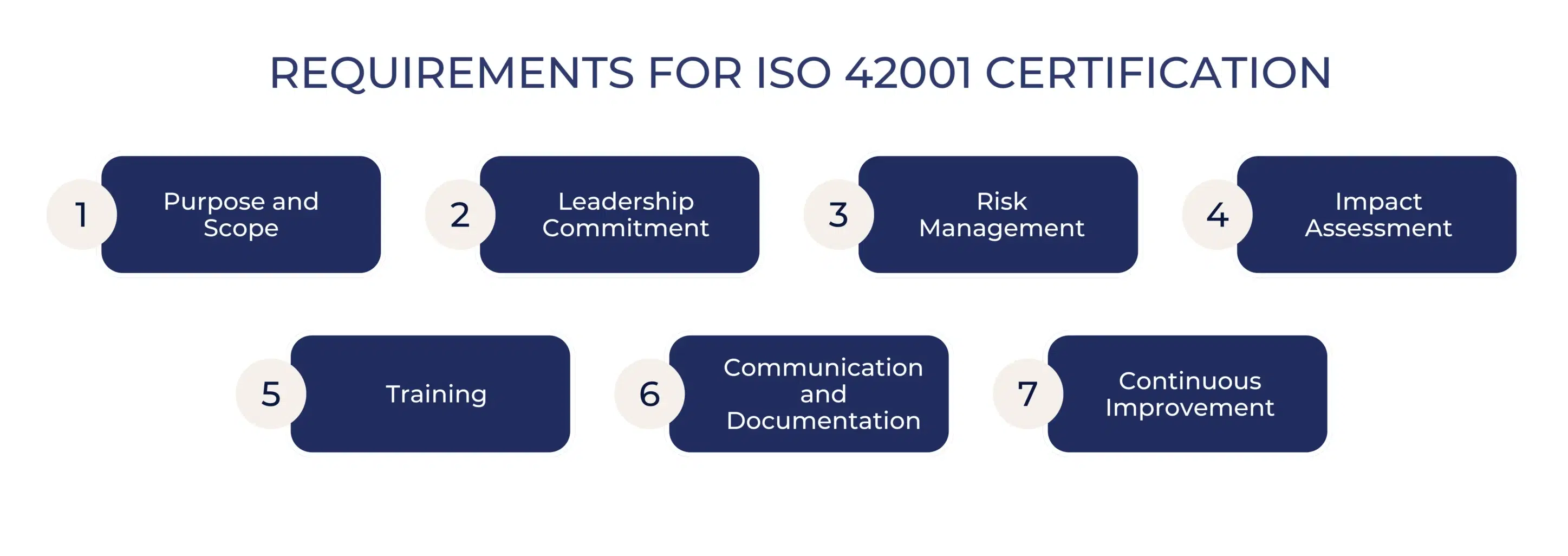
- ✓Management System Clauses: Clauses 4 Through 10
- ✓Annex A Controls for AI Governance
- ✓AI Impact Assessment and AI Risk Management Requirements
Why Columbus Organizations Pursue ISO 42001 Certification
ISO 42001 Certification in Columbus is pursued across multiple industry sectors in response to distinct but overlapping demand drivers. Enterprise vendor security and AI governance reviews, regulatory expectations in financial services and healthcare, international SaaS market expansion requirements, and internal risk management frameworks each create independent business rationale for independent ISO 42001 conformity assessment. The following drivers reflect observed patterns across the Columbus technology and financial services ecosystem.
Enterprise Procurement and Vendor AI Governance Reviews
Large enterprise organizations headquartered or operating in Columbus increasingly include AI governance requirements in vendor qualification and third-party risk management processes. A Columbus-based SaaS provider bidding for a contract with a major financial institution or healthcare system may encounter a vendor questionnaire that specifically requests ISO 42001 certification as evidence of independently verified AI governance. Without a recognized certification, vendors must complete extensive self-assessment questionnaires, submit to customer-directed audits, or provide alternative evidence of AI risk management — processes that are significantly more burdensome than presenting a valid ISO 42001 certificate issued by a qualified certification body.
Columbus’s technology ecosystem includes a substantial concentration of SaaS and cloud service providers whose customer base spans regulated industries including financial services, insurance, healthcare, and government contracting. ISO 42001 certification for Columbus technology companies operating in these markets provides a standardized, independently verified basis for demonstrating AI governance maturity. Rather than responding to each enterprise client’s unique AI governance questionnaire with custom documentation, certified organizations can reference their ISO 42001 certificate and the scope of their certified AIMS as a consistent response to vendor assurance requests across their entire customer portfolio.
Regulatory Context and U.S. AI Governance Expectations
The U.S. AI governance landscape relevant to Columbus organizations includes executive guidance from the National Institute of Standards and Technology (NIST) AI Risk Management Framework, sector-specific regulatory expectations from federal financial regulators regarding model risk management and algorithmic fairness, and state-level AI governance developments. While ISO 42001 certification is not mandated by U.S. federal law as of 2024, the standard’s requirements align substantively with existing regulatory expectations for AI risk management, documentation, human oversight, and impact assessment. ISO 42001 compliance provides Columbus financial services organizations with a documented, auditable AI governance framework that supports regulatory examination responses and board-level AI risk reporting.
Columbus-based organizations with international operations or multinational enterprise customers face AI governance expectations that extend beyond U.S. regulatory frameworks. The European Union’s AI Act establishes mandatory requirements for high-risk AI systems and transparency obligations for general-purpose AI models, creating direct compliance obligations for organizations whose AI systems are used within the EU or whose customers are EU-based entities. ISO 42001 Certification in Columbus positions financial services and technology organizations to demonstrate a recognized international AI governance framework to EU counterparties and regulators — a material advantage as international AI regulatory alignment becomes both a commercial and legal necessity.
Columbus Sector-Specific AI Governance Demand
Columbus’s insurance sector — one of the city’s historically dominant industries — operates AI systems in underwriting, claims management, fraud detection, and customer service. Insurance regulators and reinsurance partners increasingly expect documented AI governance controls for automated underwriting and claims adjudication systems. ISO 42001 certification achieved by Columbus insurance organizations provides structured, third-party-verified evidence of AI governance that can be presented to state insurance regulators, reinsurance counterparties, and enterprise commercial clients during vendor qualification processes. The Columbus Innovation District and the Ohio State University research ecosystem also generate AI-focused startups and spin-out companies that pursue ISO 42001 certification as a market credential when targeting enterprise and regulated-sector customers.
- ✓Financial services and fintech organizations responding to enterprise vendor AI governance review requirements
- ✓Insurance carriers demonstrating AI controls for underwriting and claims AI systems to regulators and reinsurers
- ✓Healthcare and life sciences organizations governing AI systems in clinical, administrative, and research contexts
- ✓SaaS providers serving regulated industry customers requiring independently verified AI governance
- ✓Logistics and transportation companies operating AI-driven routing, demand forecasting, and warehouse automation systems
- ✓Advanced manufacturers deploying AI in quality control, predictive maintenance, and production optimization
- ✓Ohio State University and Columbus Innovation District AI research spin-outs entering enterprise markets
- ✓Cybersecurity and cloud service providers whose customers require third-party AI governance verification
ISO 42001 Certification Scope and Independent Decision Framework
The scope of ISO 42001 Certification in Columbus is defined by the organization at the outset of the certification process and documented within the AIMS. The scope statement identifies the AI systems, business functions, organizational units, geographic locations, and AI-related activities covered by the AIMS. The certification body evaluates only the activities and AI systems within the defined and documented scope. CertPro’s certification decision reflects conformity within the stated scope — not a representation of the organization’s AI governance posture beyond the certified AIMS boundaries.
Scope Definition and Boundary Considerations
Organizations establishing an AIMS scope for ISO 42001 certification must consider which AI systems are material to their business operations and governance obligations. The scope must be defined with sufficient clarity to identify what is included and what is excluded from the AIMS. For a Columbus AI management system certification engagement, the scope might encompass all AI systems used in a specific product line, all AI systems operated by a defined business unit, or the full AI system portfolio of the organization. Exclusions from the scope must be documented and justified — arbitrary exclusion of AI systems that present material risk is likely to be identified during the Stage 1 audit as an area requiring scope revision.
For Columbus organizations that use third-party AI systems provided by cloud AI platforms, foundation model providers, or embedded AI vendors, the AIMS scope must address how the organization governs its use of external AI — including vendor selection, contractual AI governance obligations, and monitoring of third-party AI system performance. ISO/IEC 42001:2023 does not require organizations to certify their AI vendors’ systems. However, the organization’s processes for evaluating, selecting, and monitoring third-party AI providers are within the scope of the AIMS and are evaluated during the ISO 42001 audit Columbus organizations undergo.
Independence of the Certification Committee Decision
CertPro’s certification committee operates independently of the audit team that conducted the Stage 1 and Stage 2 audits. This structural separation ensures that the certification decision is not influenced by relationships or judgments formed during the audit process. The certification committee reviews the complete audit file — including Stage 1 findings, the Stage 2 audit report, nonconformity records, and evidence of nonconformity closure — and makes an independent determination of whether the evidence supports issuance of ISO 42001 certification. The committee may request additional evidence, defer the certification decision, or decline to certify if the audit file does not demonstrate sufficient conformity with ISO/IEC 42001:2023 requirements.
Conditions under which an issued ISO 42001 certificate may be suspended or withdrawn include: failure to maintain the AIMS in conformity with the standard’s requirements, material changes to the certified scope that have not been assessed through a scope-change audit, failure to complete required surveillance audits within the defined schedule, or discovery of misrepresentation in documentation submitted during the certification process. Columbus organizations that experience significant changes to their AI system landscape — such as deployment of new AI systems, acquisition of AI-enabled businesses, or migration to new AI platforms — should notify CertPro to determine whether a scope-change evaluation is required to maintain certification validity.
Benefits of ISO 42001 Certification for Columbus-Based Organizations
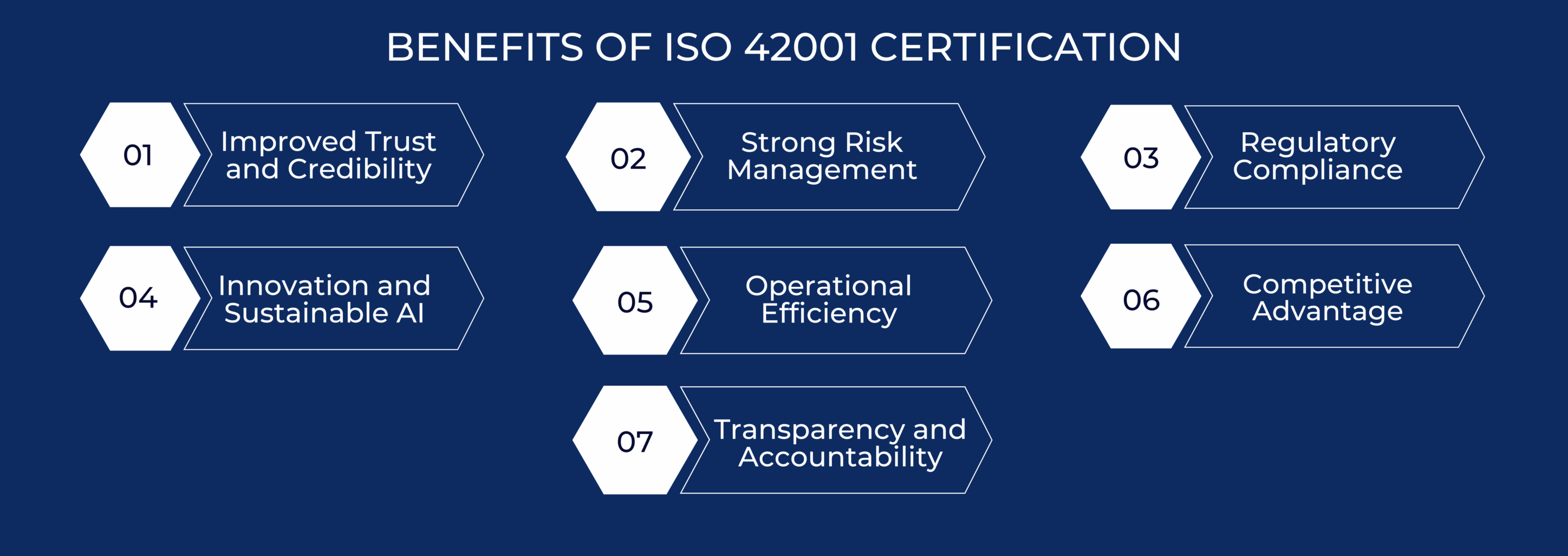
ISO 42001 Certification in Columbus produces verifiable, independently assessed evidence of AIMS conformity that organizations can present to enterprise buyers, regulated partners, boards of directors, and internal risk management functions. The following benefits reflect outcomes directly attributable to the certification and the structured audit process that produces it — not to consulting, advisory, or implementation activities.
ISO 42001 certification provides Columbus organizations with objective, third-party-verified evidence that their AIMS conforms to an internationally recognized AI governance standard. This distinguishes the certification from self-assessments, internal attestations, or vendor-provided AI governance documentation — none of which carry the independent verification weight of a certification audit conducted by a qualified third-party certification body. For organizations responding to enterprise procurement AI governance questionnaires, security reviews, or regulatory inquiries, an ISO 42001 certificate issued by CertPro represents a reliable, independently assessed statement of AI governance conformity that third parties can evaluate and rely upon.
The structured ISO 42001 certification audit process provides Columbus organizations with a systematic external review of their AI governance documentation, controls, and operational practices. Audit findings — including both nonconformities and observations — provide documented input into the organization’s continual improvement process. This differs from internal audits, which may be subject to organizational bias or limited auditor independence. The external audit perspective identifies gaps, inconsistencies, and control weaknesses that internal review processes may not surface, producing AIMS improvement opportunities grounded in objective evidence rather than internal judgment.
ISO 42001 certification obtained by Columbus fintech and technology companies is increasingly recognized in enterprise procurement processes as a qualifying credential for vendors deploying AI systems in regulated or high-stakes environments. As enterprise organizations mature their third-party AI risk management programs, vendor qualification frameworks are beginning to reference ISO 42001 as a recognized AI governance standard alongside established security certifications such as ISO 27001 and SOC 2. Columbus technology companies that achieve ISO 42001 certification position themselves to qualify for procurement opportunities where AI governance verification is a stated requirement — reducing the time and cost associated with responding to custom AI due diligence requests from individual enterprise customers.
ISO 42001 certification obtained by Columbus financial services organizations also supports internal governance objectives. Boards of directors and senior leadership teams at Columbus financial institutions and insurance carriers are increasingly required to demonstrate that AI systems operating in customer-facing and risk-relevant functions are subject to documented, independently reviewed governance frameworks. A valid ISO 42001 certificate provides board-level assurance of AIMS conformity that supplements internal audit reporting and supports AI-related disclosures in regulatory filings, annual reports, and enterprise risk management communications.
- ✓Independently verified evidence of AIMS conformity with ISO/IEC 42001:2023 for third-party reliance
- ✓Structured audit findings that provide documented input into the AIMS continual improvement process
- ✓Procurement qualification for enterprise vendor programs requiring AI governance verification
- ✓Board-level and leadership AI governance assurance documentation
- ✓Standardized AI governance credential recognized in international markets and by EU-based counterparties
- ✓Reduction in customer-directed AI due diligence burden through presentation of a valid ISO 42001 certificate
- ✓Alignment with NIST AI Risk Management Framework and international AI regulatory expectations
- ✓Ongoing surveillance audit oversight that maintains continuous AIMS conformity verification
- ✓Independently Verified AI Governance Evidence
- ✓Market Recognition and Procurement Qualification
ISO 42001 and Its Relationship to ISO 27001 and Other Management System Standards
ISO/IEC 42001:2023 follows the High-Level Structure (HLS) common to all ISO management system standards, making it structurally compatible with ISO 27001 (information security), ISO 9001 (quality management), and ISO 31000 (risk management). Columbus organizations that hold existing ISO 27001 certification will find that the management system framework elements of the ISO 42001 standard — context, leadership, planning, support, operation, performance evaluation, and improvement — map directly to the same clauses in their existing management system. This structural compatibility allows organizations to integrate AIMS documentation, policies, internal audit programs, and management review processes with existing management systems, reducing documentation duplication and administrative overhead.
Integration with ISO 27001 for Columbus Technology Organizations
For Columbus technology companies and cloud service providers that hold ISO 27001 certification, the ISO 42001 certification audit evaluation builds on — but does not replicate — the information security controls evaluated under ISO 27001. ISO 42001 specifically addresses AI system governance, including AI-specific risk assessment, AI impact assessment, AI transparency controls, and human oversight mechanisms that are outside the scope of ISO 27001’s information security focus. Data governance controls addressing AI training data quality, data provenance, and data bias assessment are evaluated under ISO 42001’s Annex A and represent AI-specific requirements beyond what ISO 27001 Annex A controls address. Organizations integrating ISO 27001 and ISO 42001 maintain separate Statements of Applicability for each standard.
The relationship between ISO 42001 and ISO 27001 is complementary rather than substitutive. ISO 27001 addresses the confidentiality, integrity, and availability of information assets — including data used by AI systems — while ISO 42001 addresses the governance, risk management, and ethical operation of AI systems themselves. A Columbus organization operating an AI-driven analytics platform may require ISO 27001 certification to satisfy customer data security requirements and ISO 42001 certification to satisfy AI governance requirements. The two certifications address distinct assurance domains and are both relevant to the risk profile of AI-dependent technology organizations serving regulated industries.
Alignment with the NIST AI RMF and EU AI Act
The NIST AI Risk Management Framework (AI RMF), published in January 2023, establishes a voluntary framework for managing AI risk organized around four functions: Govern, Map, Measure, and Manage. ISO/IEC 42001:2023 addresses each of these functional areas through its management system requirements and Annex A controls. Columbus organizations that have adopted the NIST AI RMF as an internal AI governance reference will find that ISO 42001 certification audit evidence aligns substantially with the documented practices required under the NIST framework. Importantly, ISO 42001 compliance demonstrates conformity with a formal international standard, whereas NIST AI RMF adoption remains a voluntary, self-assessed framework — a distinction that matters to enterprise buyers and regulators evaluating the credibility of AI governance claims.
The EU AI Act’s requirements for high-risk AI systems — including risk management systems, data governance, transparency, human oversight, accuracy, and post-market monitoring — align with Annex A controls and management system requirements addressed in the ISO 42001 standard. Columbus organizations whose AI systems are classified as high-risk under the EU AI Act, or whose customers are EU-regulated entities subject to AI Act obligations, may use ISO 42001 certification as a component of their EU AI Act compliance documentation. While ISO 42001 certification does not constitute direct EU AI Act conformity assessment, it provides structured, independently verified evidence of an AI governance framework that addresses requirements substantially similar to those mandated for high-risk AI systems under the Act.
Columbus Industries and Organizations Served by ISO 42001 Certification
ISO 42001 Certification in Columbus is relevant across the full spectrum of industries that develop, deploy, or depend on AI systems in their operations. Columbus’s diverse economic base — spanning financial services, technology, healthcare, insurance, logistics, advanced manufacturing, higher education, and professional services — generates AI governance demand across multiple sectors simultaneously. The following overview addresses sector-specific AI governance contexts within the Columbus market.
Financial Services, Fintech, and Insurance Organizations
Columbus has a historically significant financial services and insurance sector, with major institutions including Nationwide Insurance, Huntington Bancshares, and a substantial concentration of fintech companies operating from the Short North and downtown Columbus technology districts. These organizations deploy AI systems across credit underwriting, claims processing, fraud detection, customer service automation, investment analysis, and regulatory reporting functions. ISO 42001 certification pursued by Columbus financial services and fintech organizations demonstrates independently verified AI governance to enterprise clients, banking regulators, insurance regulators, and institutional investors who require evidence of structured AI risk management in the organizations they evaluate, partner with, or regulate.
The insurance industry’s use of AI in actuarial modeling, underwriting scoring, and claims adjudication has attracted increasing regulatory attention from state insurance departments. Columbus insurance carriers that can present ISO 42001 certification documentation demonstrate to the Ohio Department of Insurance and to reinsurance partners that their AI systems operate under a documented, independently audited governance framework. This is particularly relevant for AI systems that produce individual-level decisions affecting policyholders, where regulatory expectations around fairness, explainability, and human oversight are most acute. Columbus financial services firms also use ISO 42001 certification when responding to model risk management examination requests from banking regulators.
Healthcare, Life Sciences, and Research Organizations
The Ohio State University Wexner Medical Center, Nationwide Children’s Hospital, OhioHealth, and a growing life sciences research ecosystem centered on the Columbus Innovation District and OSU campus represent significant healthcare and research organizations deploying AI in clinical, administrative, and research settings. Healthcare AI systems — including AI-assisted diagnostics, predictive analytics for patient risk stratification, clinical decision support tools, and AI-driven revenue cycle management — operate in environments where human oversight, auditability, and documented governance are essential requirements. ISO 42001 certification provides these organizations with a structured framework for AI governance that is independently evaluated through the certification audit process.
Life sciences companies operating from Columbus that develop AI-enabled medical devices or AI-driven drug discovery platforms face additional regulatory considerations from the FDA’s AI/ML-based Software as a Medical Device (SaMD) framework. ISO 42001 certification addresses AI governance, risk management, and lifecycle management requirements that are substantively relevant to the FDA’s expectations for AI-enabled medical devices. While ISO 42001 certification does not constitute FDA regulatory clearance, it provides documented, independently assessed evidence of AI governance practices that support FDA regulatory submissions and quality management system documentation for AI-enabled medical products developed or manufactured by Columbus life sciences organizations.
Logistics, Advanced Manufacturing, and Technology Companies
Columbus is a major U.S. logistics hub, with significant operations from companies including Amazon, Walmart, and major third-party logistics providers operating distribution and fulfillment infrastructure across the Columbus metropolitan area. These organizations deploy AI in demand forecasting, route optimization, warehouse automation, and supply chain risk management. ISO 42001 certification for logistics organizations demonstrates structured AI governance to enterprise retail clients and supply chain partners who include AI governance requirements in their vendor qualification frameworks. Advanced manufacturers in the Columbus region — including automotive components suppliers and aerospace manufacturers operating in Central Ohio — deploy AI in quality control, predictive maintenance, and production optimization, creating similar AI governance assurance requirements from OEM customers and tier-one partners.
| Industry Sector | AI System Examples | Primary ISO 42001 Demand Driver |
|---|---|---|
| Financial Services & Fintech | Credit scoring, fraud detection, algorithmic trading, customer service AI | Enterprise vendor reviews, banking regulator model risk management expectations |
| Insurance | Underwriting AI, claims adjudication, fraud detection | State regulatory scrutiny, reinsurance partner governance requirements |
| Healthcare & Life Sciences | Clinical decision support, diagnostic AI, patient risk stratification | Patient safety obligations, FDA AI/ML SaMD framework alignment |
| Logistics & Supply Chain | Demand forecasting, route optimization, warehouse automation | Enterprise retail client vendor qualification frameworks |
| Technology & SaaS | AI-driven SaaS platforms, cloud AI services, AI developer tools | Enterprise procurement AI governance requirements, EU AI Act exposure |
Documented Information Requirements for ISO 42001 Certification
ISO/IEC 42001:2023 requires organizations to maintain specified documented information as evidence of AIMS establishment, implementation, and operation. Documented information serves as the primary audit evidence evaluated during the ISO 42001 certification audit. The sufficiency, accuracy, and currency of documented information directly influence the certification committee’s ability to make a positive certification decision. Incomplete or outdated documentation constitutes a nonconformity that must be resolved before certification is issued.
The core documented information required under ISO/IEC 42001:2023 includes the AI policy, AIMS scope statement, AI risk assessment records, AI impact assessment records, AI risk treatment plan, Statement of Applicability for Annex A controls, AI objectives and plans for achieving them, internal audit program and audit records, management review records, and corrective action records. Each document must be controlled — meaning it must be identifiable, version-controlled, reviewed for continued appropriateness, and retained according to defined retention periods. During the ISO 42001 audit, auditors request access to current versions of all required documented information and verify that document control processes are operating as described in the AIMS.
The Statement of Applicability is a particularly critical document in the ISO 42001 compliance audit. It records every Annex A control, the organization’s determination of whether each control is applicable, the justification for any control exclusions, and whether applicable controls are currently implemented. Auditors review the Statement of Applicability against the AI risk assessment and AI impact assessment to verify that control selections are logically justified by documented risk and impact findings. Controls that address identified risks must be selected; exclusions of controls that address documented risks require formal justification and review. The Statement of Applicability is signed by authorized organizational leadership and reviewed as part of the management review process.
ISO/IEC 42001:2023 requires organizations to conduct internal audits at planned intervals to evaluate whether the AIMS conforms to the organization’s own requirements and to the standard’s requirements. Internal audit records — including the audit program, individual audit reports, and records of corrective actions arising from internal audit findings — are reviewed by CertPro auditors during the ISO 42001 certification audit. A functioning internal audit program demonstrates that the organization is actively monitoring its own AIMS conformity rather than relying solely on external certification audits. Absence of internal audit records, or records that reflect cursory review without substantive findings, is likely to be identified as a nonconformity during the Stage 2 audit.
Management review records document the periodic leadership-level evaluation of the AIMS’s performance and continued suitability. ISO/IEC 42001:2023 specifies inputs that must be addressed in management review, including the status of AI risks and opportunities, AI system performance monitoring results, internal audit findings, corrective action status, and opportunities for AIMS improvement. Management review outputs must include decisions related to AIMS continual improvement opportunities and any resource needs identified during the review. For Columbus organizations, management review records provide auditors with evidence that organizational leadership is actively engaged with AI governance — a core requirement reflecting the standard’s emphasis on top management commitment to responsible AI.
- ✓Core AIMS Documentation
- ✓Internal Audit and Management Review Records
FAQ
▶
What is ISO 42001 Certification and what does it demonstrate?
▶
Which Columbus organizations need ISO 42001 Certification?
▶
How long does the ISO 42001 certification audit process take?
▶
What is the difference between Stage 1 and Stage 2 of the ISO 42001 audit?
▶
How is CertPro’s role in ISO 42001 certification defined?
▶
How long is an ISO 42001 certificate valid?
▶
Can an organization with ISO 27001 certification use existing documentation for ISO 42001?
▶
Does ISO 42001 certification satisfy EU AI Act requirements?
ISO 42001 CERTIFIED: WHY AI GOVERNANCE CERTIFICATION IS BECOMING A BOARD-LEVEL REQUIREMENT
ISO 42001 Certified: Board-Level AI Governance Guide | CertPro CPA LLC HERO ══════════════════════════════ –> src=”https://certpro.com/wp-content/uplo…
Get In Touch
have a question? let us get back to you.