
ISO 42001 Certification in Kyiv
CertPro’s ISO 42001 examination methodology follows a defined sequence of audit stages applicable to all Kyiv-based organizations seeking certification, regardless of sector. The process encompasses documentation review, control testing, nonconformity assessment, and an independent certification committee decision. Upon successful completion, the organization receives a formal ISO 42001 attestation valid for a defined certificate period, subject to ongoing surveillance. This structured approach positions ISO 42001 Certification in Kyiv as a rigorous, credible, and internationally recognized demonstration of AI management system conformance.
OUR CLIENTS









ISO 42001 Certification for Kyiv-Based Financial and Technology Organizations
ISO 42001 Certification in Kyiv is issued by CertPro, a Licensed CPA Firm operating as an independent third-party certification body. CertPro evaluates whether an organization’s Artificial Intelligence Management System (AIMS) conforms to the requirements of ISO/IEC 42001:2023 through a structured, evidence-based audit process. Certification decisions are made by an independent certification committee — not by the auditing team — ensuring objective separation between assessment and determination. The certificate issued upon successful evaluation constitutes formal attestation that the organization’s AIMS design and operational controls satisfy the standard’s requirements within the defined certification scope.
Kyiv occupies a distinctive position in the regional and global technology landscape. The city functions as one of Eastern Europe’s primary hubs for software development, IT outsourcing, cybersecurity research, and SaaS product delivery. Ukraine’s capital hosts a significant concentration of engineering talent, and Kyiv-based organizations frequently serve enterprise clients in the United States, the European Union, the United Kingdom, and other markets with stringent vendor assurance and third-party risk management expectations.
Many Kyiv-based technology firms, fintech companies, and cloud service providers operate within supply chains where AI-related transparency and governance documentation is a procurement requirement. ISO 42001 Certification in Kyiv addresses this demand directly — providing an independently verified record of an organization’s AI governance controls and risk management framework that enterprise buyers and institutional partners can rely upon.
ISO/IEC 42001:2023 is the international standard for AI management systems. It specifies requirements for establishing, implementing, maintaining, and continually improving an AIMS within the context of an organization that develops, provides, or uses AI systems. The standard addresses AI-specific risks including transparency, accountability, fairness, safety, and privacy in the context of AI-enabled products and services.
For Kyiv organizations deploying machine learning models, natural language processing systems, automated decision-making tools, or AI-integrated SaaS platforms, ISO 42001 compliance requires demonstrating that these risks are identified, assessed, and managed through documented controls within a governed management system.
Kyiv’s fintech sector has grown substantially in recent years, with organizations building AI-driven credit scoring, fraud detection, and automated customer service systems. Simultaneously, the city’s cybersecurity firms increasingly integrate AI into threat detection and incident response products. Software development and IT outsourcing companies operating under contracts with U.S. and EU enterprise clients face vendor security reviews that now routinely include AI governance expectations.
ISO 42001 certification for Kyiv companies provides a recognized, internationally accepted credential that satisfies these third-party assurance requirements — without relying on self-reported compliance claims. The certification is not advisory in nature. It is an objective, evidence-based determination that the AIMS meets the standard’s criteria within the audited scope.
CertPro’s ISO 42001 examination methodology follows a defined sequence of audit stages applicable to all Kyiv-based organizations seeking certification, regardless of sector. The process encompasses documentation review, control testing, nonconformity assessment, and an independent certification committee decision. Upon successful completion, the organization receives a formal ISO 42001 attestation valid for a defined certificate period, subject to ongoing surveillance. This structured approach positions ISO 42001 Certification in Kyiv as a rigorous, credible, and internationally recognized demonstration of AI management system conformance.

ISO 42001 Certification Audit Process for Organizations in Kyiv
The ISO 42001 audit process for Kyiv-based organizations follows a structured, stage-based examination methodology conducted by CertPro as an independent Licensed CPA Firm. Each stage produces documented outputs that feed the subsequent phase, ensuring a traceable, evidence-driven pathway from initial application to certificate issuance.
The ISO 42001 audit process applies uniformly across sectors — whether the applicant is a fintech firm, a cybersecurity company, a SaaS provider, or an IT outsourcing organization — with scope and risk profile determining the specific depth and breadth of examination activities.
The Stage 1 ISO 42001 audit constitutes a documentation and readiness review. CertPro auditors examine the organization’s AIMS documentation to determine whether the management system has been established in conformance with ISO/IEC 42001:2023 requirements. This stage includes review of the AI policy, AI risk assessment documentation, AI risk treatment plans, the scope statement, and records of management review.
Auditors assess whether the organization has defined its AI context, identified interested parties, and established measurable AI management objectives. The Stage 1 output is a documented finding report that identifies any areas requiring clarification or remediation before Stage 2 can proceed. For Kyiv organizations, Stage 1 may be conducted remotely or on-site, depending on scope complexity and audit program determination.
During Stage 1, auditors also confirm that the organization has completed an AI impact assessment for systems within the certification scope, documented roles and responsibilities for AI governance, and established a process for monitoring and measuring AIMS performance.
The Stage 1 audit does not constitute a certification decision — it is a prerequisite evaluation that determines whether the organization’s documented system is sufficiently developed to proceed to operational testing. Organizations that resolve Stage 1 findings proceed to Stage 2 audit scheduling. The interval between Stage 1 and Stage 2 is determined by the audit program and the nature of findings identified during the documentation review phase.
The Stage 2 ISO 42001 audit examines the operational effectiveness of the AIMS controls within the defined scope. CertPro auditors evaluate whether the controls documented in Stage 1 have been implemented and are operating as intended. This includes interviewing personnel responsible for AI governance functions, reviewing records of AI risk assessments, inspecting evidence of control operation, and testing whether the organization’s AI transparency and accountability mechanisms function as documented.
For Kyiv-based organizations with AI systems embedded in customer-facing products or backend automation, Stage 2 examination may include review of system logs, model governance records, bias monitoring outputs, and AI incident management records.
Nonconformities identified during Stage 2 are classified and communicated to the organization in a formal audit report. The organization is required to submit a corrective action response addressing root causes and remediation evidence. CertPro’s audit team reviews the corrective action response before forwarding the complete audit file to the independent certification committee.
The committee, which operates separately from the audit team, makes the final certification determination based solely on the audit evidence presented. This separation ensures that the ISO 42001 audit process for Kyiv organizations maintains objectivity and independence at the point of certification decision, consistent with international certification body standards.
Following certificate issuance, the certification cycle includes periodic surveillance audits conducted within the three-year certificate validity period. Surveillance audits verify that the AIMS continues to conform to ISO/IEC 42001:2023 requirements and that certified controls remain effective over time.
For Kyiv organizations, surveillance activities may include targeted control reviews, review of corrective actions taken since the previous audit, and assessment of any significant changes to AI systems within the certification scope. Surveillance audits are not full re-examinations — they are focused evaluations designed to confirm ongoing conformance.
Recertification audits are conducted prior to certificate expiry to evaluate whether the AIMS continues to meet standard requirements across the full certification scope. Recertification follows a process comparable to the initial ISO 42001 examination, including documentation review and operational effectiveness testing.
Organizations that maintain their AIMS and address any nonconformities identified during surveillance will be well-positioned for recertification without material disruption. The certificate issued upon recertification carries a new three-year validity period. Organizations should plan for recertification activity within the final months of the existing certificate term to avoid lapses in certification status.
| Audit Stage | Key Activities | Output |
|---|---|---|
| Application Review | Scope confirmation, conflict of interest check, audit program determination | Audit program and engagement confirmation |
| Stage 1 Audit | Documentation review, AIMS policy and risk assessment examination | Stage 1 finding report; Stage 2 readiness determination |
| Stage 2 Audit | Control effectiveness testing, personnel interviews, evidence collection | Nonconformity report and corrective action review |
| Certification Committee Review | Independent review of audit file and corrective action responses | Certification decision and ISO 42001 attestation issuance |
| Surveillance Audit | Targeted control review and ongoing conformance verification | Surveillance audit report; continued certificate validity |
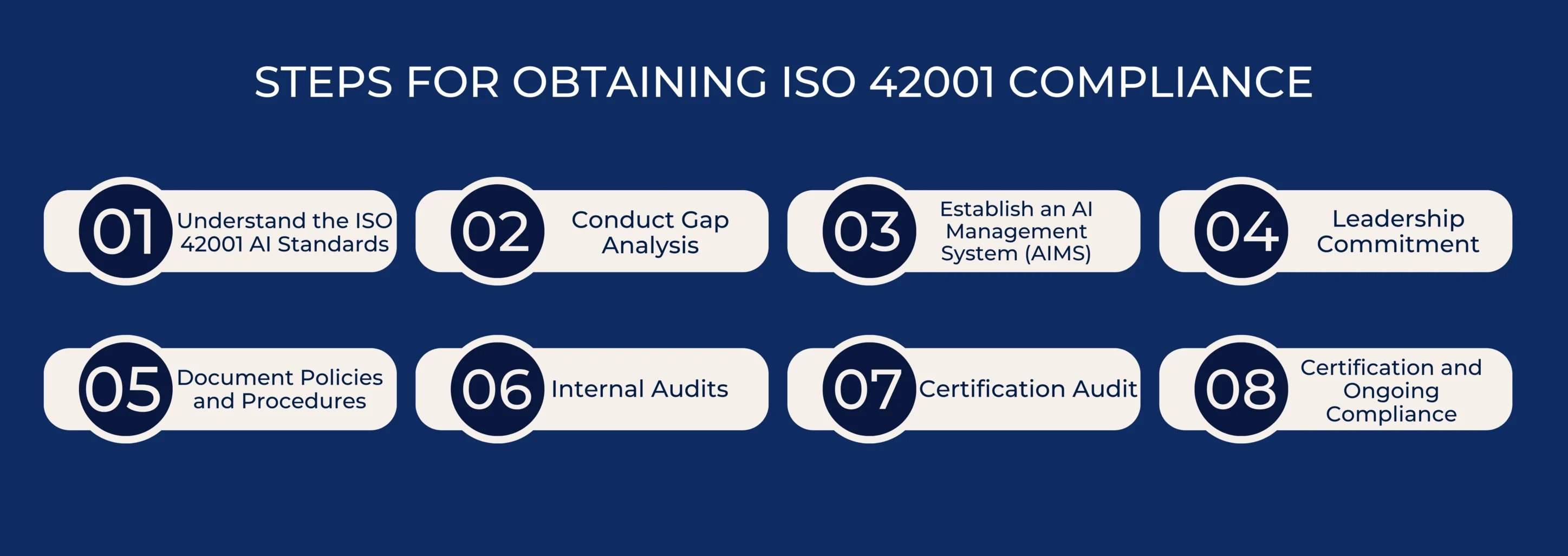
- ✓Stage 1 Audit: Documentation and Readiness Review
- ✓Stage 2 Audit: Operational Effectiveness Examination
- ✓Surveillance Audits and Recertification
Why Organizations in Kyiv Pursue ISO 42001 Certification
Demand for ISO 42001 Certification in Kyiv reflects a convergence of external procurement requirements, regulatory awareness, and competitive positioning in international markets. Kyiv-based technology companies frequently operate within U.S. and EU enterprise supply chains where third-party AI risk management has become a formal vendor assessment criterion.
ISO 42001 compliance in Kyiv provides these organizations with an independently verified credential that satisfies buyer-side due diligence requirements — without relying on self-attestation, which is increasingly insufficient for enterprise procurement processes involving AI-enabled services.
Enterprise Vendor Assurance and Third-Party Risk Requirements
U.S. financial institutions, healthcare organizations, and technology enterprises are subject to third-party risk management frameworks that require vendors deploying AI systems to demonstrate documented governance and accountability controls. For Kyiv-based software development and IT outsourcing firms serving these clients, ISO 42001 certification functions as a recognized vendor assurance credential.
When an enterprise client’s procurement or vendor risk team requests evidence of AI governance, an ISO 42001 certificate issued by an independent Licensed CPA Firm constitutes independently audited, committee-reviewed documentation. This carries materially greater evidentiary weight than a vendor-completed questionnaire or internal policy reference.
EU enterprises operating under the EU AI Act’s vendor and deployer obligations are beginning to incorporate ISO 42001 conformance into supplier evaluation processes. Kyiv companies exporting AI-integrated products or services into EU markets may face contractual requirements to demonstrate AIMS conformance. ISO 42001 attestation from an independent certification body provides a structured, auditable record that satisfies these requirements.
The certification is particularly relevant for organizations delivering AI systems classified under the EU AI Act’s high-risk or limited-risk categories, where documentation of risk management and transparency controls is a regulatory expectation for the systems’ EU-market deployers.
Kyiv Fintech and Cybersecurity Sector Drivers
ISO 42001 compliance in Kyiv’s fintech sector is driven by regulatory and institutional expectations around AI-driven financial decision-making. Kyiv-based fintech firms building AI-powered credit assessment, anti-money laundering detection, or automated investment tools face scrutiny from both domestic regulators and international partners regarding the governance of these systems.
ISO 42001 Certification in Kyiv provides a standardized framework within which these organizations document how AI systems are developed, tested, monitored, and governed — translating internal AI governance practices into an externally audited, internationally recognized credential.
Kyiv’s cybersecurity sector presents a related but distinct certification demand profile. Organizations developing AI-assisted threat detection, vulnerability assessment, or incident response platforms serve enterprise and government clients with high assurance expectations. ISO 42001 Certification for these organizations demonstrates that the AI components embedded in security products are governed through a documented management system with defined risk assessment, monitoring, and accountability controls.
This is particularly relevant for ISO 42001 certification Kyiv IT sector organizations competing for contracts with regulated financial institutions, critical infrastructure operators, or defense-adjacent technology buyers — where AI governance certification is a differentiating factor in competitive evaluations.
ISO 42001 Requirements and Certification Scope for Kyiv Organizations
ISO/IEC 42001:2023 specifies requirements across the full Plan-Do-Check-Act management system lifecycle. Organizations pursuing ISO 42001 Certification in Kyiv must demonstrate conformance with clauses 4 through 10 of the standard, covering organizational context, leadership and governance, planning, support, operation, performance evaluation, and improvement.
Additionally, the standard’s annexes provide normative and informative guidance on AI-specific controls, AI system impact assessments, and supply chain considerations applicable to organizations that develop or deploy AI within complex vendor ecosystems.
ISO 42001 compliance requires Kyiv organizations to establish and maintain a defined set of documented information as evidence of AIMS operation. Core documentation includes the AI policy, which must be approved by top management and communicate the organization’s commitment to responsible AI development and use. Organizations must also maintain AI risk assessment records documenting identified risks, their analysis, and evaluation against defined risk criteria.
AI risk treatment plans must specify selected controls, responsible parties, and implementation status. Operational records must demonstrate that the AIMS is functioning as documented — including records of AI system monitoring, audit results, management reviews, and corrective actions.
The ISO 42001 examination of documentation does not evaluate whether an organization’s AI policy is aspirationally comprehensive — it evaluates whether the documented system is operationally implemented and whether records demonstrate consistent application of the defined controls. For Kyiv organizations, this distinction is significant: certification requires evidence of operation, not merely the existence of policy documents.
During the Stage 1 and Stage 2 audits, CertPro auditors examine whether documentation is current, accessible, controlled, and supported by operational records that demonstrate the AIMS functions as intended within the defined scope.
ISO/IEC 42001:2023 requires organizations to conduct AI impact assessments for AI systems within the certification scope. An AI impact assessment evaluates the potential consequences of an AI system’s outputs on individuals, groups, or society — addressing dimensions including fairness, transparency, privacy, safety, and accountability.
For Kyiv-based organizations, AI impact assessments must be documented, reviewed at defined intervals, and updated when significant changes occur to AI systems within scope. The assessment methodology must be clearly defined, and its outputs must feed directly into the organization’s risk treatment decisions.
Risk management under ISO 42001 requires organizations to define AI-specific risk criteria, conduct structured risk assessments for AI systems in scope, and select risk treatment options aligned with the organization’s risk appetite. Unlike general information security risk management, AI risk assessment under ISO/IEC 42001:2023 addresses risks that arise specifically from the nature of AI — including model drift, training data quality, explainability limitations, and unintended bias in automated decisions.
Kyiv organizations operating AI systems across diverse use cases must ensure that risk assessment processes are tailored to the specific characteristics of each AI system within the certification scope, not applied as a generic template across all systems.
The certification scope defines the boundaries within which the AIMS is examined and the certificate applies. For Kyiv organizations, scope definition is a critical early-stage activity that determines which AI systems, organizational units, processes, and locations are included in the ISO 42001 audit.
A narrowly defined scope — covering, for example, a specific AI product line or a defined set of AI-enabled services — allows organizations to focus their documentation and operational evidence on the systems most relevant to client assurance requirements. The scope statement is reviewed during Stage 1 and must accurately reflect the organizational boundaries within which the AIMS operates.
- ✓AI policy approved and communicated by top management
- ✓Organizational context analysis identifying internal and external factors affecting the AIMS
- ✓AI risk assessment records for all AI systems within the defined scope
- ✓AI risk treatment plan with documented control selections and responsible parties
- ✓AI impact assessments for in-scope AI systems addressing fairness, transparency, and safety
- ✓Defined roles and responsibilities for AI governance functions
- ✓Records of AIMS performance monitoring, internal audits, and management reviews
- ✓Corrective action records addressing identified nonconformities
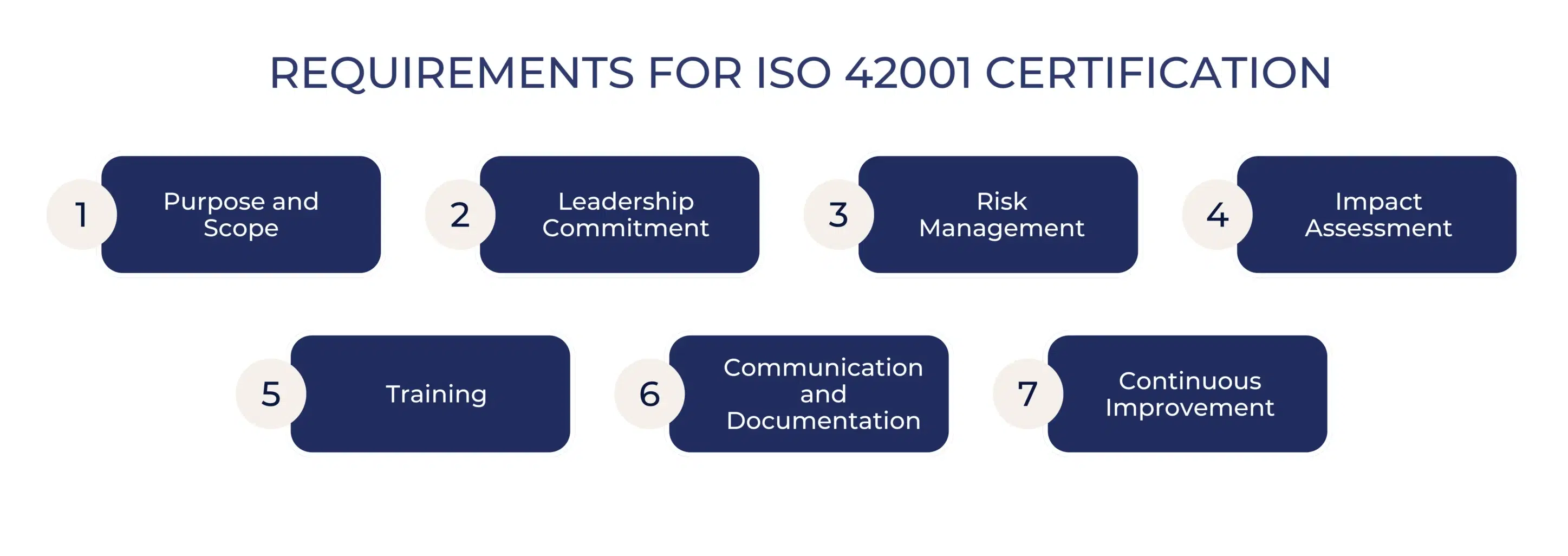
- ✓Core Documentation Requirements
- ✓AI Impact Assessment and Risk Management Requirements
- ✓Certification Scope Definition and Independent Decision Framework
Sectors in Kyiv Seeking ISO 42001 Certification
ISO 42001 Certification is pursued across multiple industry sectors in Kyiv, reflecting the city’s diverse technology economy. Organizations seeking ISO 42001 Certification in Kyiv span software development, fintech, cybersecurity, cloud infrastructure, and enterprise SaaS — each with distinct AI deployment profiles and external assurance requirements.
The common driver across sectors is the need to demonstrate independently verified AI governance to clients, partners, regulators, or institutional buyers who require more than vendor self-certification as evidence of AI risk management.
Software Development and IT Outsourcing Organizations
Kyiv’s software development and IT outsourcing sector represents the largest concentration of organizations likely to pursue ISO 42001 certification. These firms frequently develop AI-integrated applications, machine learning pipelines, and intelligent automation systems under contract for U.S. and EU enterprise clients.
When contracts include third-party AI governance requirements — increasingly common in regulated industries such as financial services, healthcare technology, and critical infrastructure — ISO 42001 certification for Kyiv companies provides a structured basis for satisfying those obligations through an independent certification process, rather than through client-specific audits or questionnaire-based assessments.
For IT outsourcing organizations building AI components within client product environments, the certification scope may be defined to cover the organization’s internal AI development processes, model governance practices, and AIMS documentation — even where the AI systems themselves are deployed within client infrastructure.
This approach allows Kyiv-based development organizations to maintain a certifiable AIMS covering their own development and delivery processes. The result is a consistent assurance credential applicable across multiple client engagements, rather than a bespoke response to each client’s vendor security review.
Cloud Service Providers and SaaS Organizations
Kyiv-based cloud service providers and SaaS organizations that integrate AI capabilities into their platforms face AI governance expectations from enterprise subscribers and regulated-industry clients. ISO 42001 audit examinations for these Kyiv organizations focus on how AI features are developed, tested, monitored, and governed within the platform’s operational environment.
For SaaS providers serving U.S. financial institutions or healthcare organizations, AI governance certification complements existing information security credentials such as SOC 2 or ISO 27001 — directly addressing the AI-specific dimension that general security standards do not fully cover.
Cloud infrastructure organizations hosting AI workloads or providing AI platform services face additional scope considerations — particularly regarding the delineation between the infrastructure provider’s responsibilities and the AI developer’s responsibilities in a shared-service model. ISO/IEC 42001:2023 addresses supply chain considerations for AI systems, and Kyiv-based cloud organizations may need to document how AI-related responsibilities are allocated across their service agreements.
The ISO 42001 examination evaluates whether these delineations are documented and whether controls are implemented consistently within the organization’s defined scope of responsibility.
| Sector | Primary AI Use Cases | Key ISO 42001 Assurance Driver |
|---|---|---|
| Software Development / IT Outsourcing | AI-integrated application development, ML pipelines | Enterprise client third-party AI governance requirements |
| Fintech | Credit scoring, fraud detection, AML systems | Regulatory expectations and institutional partner requirements |
| Cybersecurity | AI-assisted threat detection, incident response | Regulated-industry client assurance and competitive differentiation |
| SaaS Providers | AI-powered platform features and automation | Enterprise subscriber vendor security reviews |
| Cloud Service Providers | AI workload hosting and platform services | Shared-responsibility documentation and supply chain assurance |
Benefits of ISO 42001 Certification for Kyiv-Based Organizations
ISO 42001 Certification provides Kyiv organizations with a set of concrete, operationally relevant outcomes tied to the independent verification of their AI management systems. These outcomes are defined by the certification’s structural characteristics — third-party examination, independent committee decision, documented attestation, and ongoing surveillance — rather than by advisory activities.
The following outcomes represent the primary functional value of ISO 42001 Certification in Kyiv for organizations operating in the city’s technology, fintech, and outsourcing sectors.
The primary functional outcome of ISO 42001 Certification in Kyiv is an independently verified record that the organization’s AIMS conforms to ISO/IEC 42001:2023 requirements. This verification is produced through an evidence-based examination conducted by CertPro auditors and reviewed by an independent certification committee — not by the organization’s own personnel.
For organizations that have invested in building AI governance frameworks internally, ISO 42001 attestation translates that internal work into an externally credible, third-party-validated credential that carries weight in procurement evaluations, regulatory inquiries, and institutional partner assessments.
Kyiv organizations operating in competitive international markets benefit from the credibility differential that independent certification provides relative to self-attestation. When enterprise clients in the U.S. or EU evaluate vendor AI governance through third-party risk management processes, a certificate from an independent Licensed CPA Firm carries demonstrably greater evidentiary weight than a vendor-completed AI governance questionnaire.
ISO 42001 examination by an independent body provides a structured basis for buyers to rely on the organization’s AI governance claims without conducting their own on-site review — a material efficiency in complex vendor management environments.
ISO 42001 compliance requires organizations to operate a structured AI risk management process — not merely to document policies. For Kyiv technology organizations that have grown rapidly and integrated AI capabilities into products or services without a formalized governance layer, the certification process establishes a documented AIMS that defines how AI risks are identified, assessed, treated, and monitored on an ongoing basis.
The structured framework creates accountability — assigning defined roles for AI governance, establishing measurable objectives, and requiring evidence of management review — that supports both internal oversight and external assurance requirements.
The ongoing surveillance cycle embedded in the ISO 42001 certification structure provides a mechanism for maintaining governance discipline over the certificate period. Surveillance audits conducted by CertPro verify that the AIMS remains conformant as organizational changes, new AI system deployments, or evolving risk environments affect the organization.
This ongoing oversight structure differentiates ISO 42001 attestation from point-in-time self-assessments and ensures that the certificate reflects the organization’s current AI governance posture rather than a historical snapshot.
- ✓Independently verified AIMS conformance with ISO/IEC 42001:2023 requirements
- ✓Third-party attestation credential recognized in enterprise vendor assurance processes
- ✓Structured AI risk assessment and treatment documentation supporting regulatory inquiries
- ✓Defined accountability framework for AI governance roles and management review
- ✓Ongoing surveillance oversight maintaining certification relevance over the three-year certificate period
- ✓Internationally recognized credential supporting market access in the U.S., EU, and UK
- ✓Complement to existing ISO 27001 or SOC 2 certifications addressing the AI-specific governance dimension
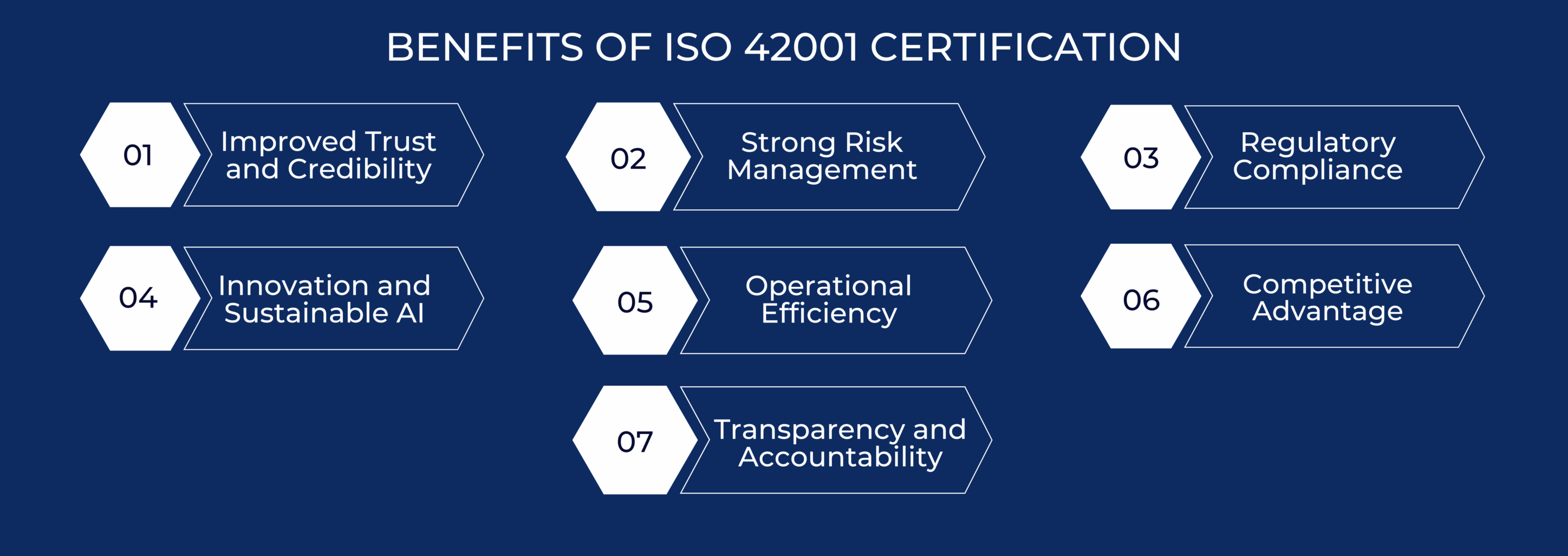
- ✓Independent Verification of AI Governance Controls
- ✓Structured AI Risk Management and Accountability Framework
ISO 42001 Certification and the EU AI Act: Relevance for Kyiv Organizations
The EU Artificial Intelligence Act, which entered into force in August 2024 with phased implementation through 2026 and 2027, establishes obligations for providers and deployers of AI systems placed on the EU market. Kyiv-based organizations that develop or export AI systems into the EU — whether as product components, embedded features, or standalone platforms — are subject to the Act’s requirements in the capacity of either providers or deployers.
ISO 42001 compliance provides a structured management system framework that aligns with several of the EU AI Act’s governance, risk management, and transparency requirements, particularly for organizations operating within high-risk or limited-risk AI system categories.
Alignment Between ISO 42001 and EU AI Act Obligations
While ISO 42001 certification does not constitute legal compliance with the EU AI Act — the two are distinct instruments — the standard’s requirements for AI impact assessment, risk management, transparency documentation, and governance accountability align substantively with the Act’s provisions for high-risk AI systems.
Kyiv organizations that have obtained ISO 42001 attestation will have a documented, independently verified governance framework that can support EU AI Act conformity assessments and technical documentation requirements. EU-market deployers contracting with Kyiv-based AI developers may reference ISO 42001 certification in their vendor due diligence as evidence that the developer’s AI governance processes have been examined by an independent third party.
For Kyiv organizations serving EU financial institutions under the Digital Operational Resilience Act (DORA) or other sector-specific EU regulatory frameworks, AI governance documentation is becoming an integrated element of ICT third-party risk management. ISO 42001 examination produces a documented audit record that satisfies the evidentiary requirements of financial institution procurement teams conducting vendor assessments under these frameworks.
The convergence of EU AI Act obligations and sector-specific regulatory expectations creates a layered demand environment where ISO 42001 Certification in Kyiv functions as a cross-cutting assurance instrument applicable across multiple regulatory contexts simultaneously.
U.S. Market Considerations for Kyiv AI Vendors
U.S. enterprise organizations across financial services, healthcare, and technology sectors are implementing AI governance frameworks in response to guidance from the NIST AI Risk Management Framework (AI RMF), Executive Order 14110 on Safe, Secure, and Trustworthy AI, and sector-specific regulatory expectations. For Kyiv-based technology firms supplying AI-integrated services to U.S. enterprise clients, ISO 42001 certification provides an internationally recognized governance credential that aligns with AI RMF categories including GOVERN, MAP, MEASURE, and MANAGE.
U.S. client procurement teams familiar with the NIST AI RMF can directly map ISO 42001 AIMS controls to NIST framework functions, supporting vendor qualification processes efficiently.
Financial institutions regulated by the Office of the Comptroller of the Currency, the Federal Reserve, or the Consumer Financial Protection Bureau are subject to guidance on model risk management and AI governance that increasingly incorporates third-party vendor expectations. Kyiv-based fintech and software organizations serving these institutions through core banking integrations, credit decision tools, or compliance automation platforms benefit from ISO 42001 attestation as a structured response to model risk management due diligence inquiries.
The certification’s independent examination basis satisfies the third-party validation expectations embedded in U.S. banking regulator guidance on model governance and AI risk management.
ISO 42001 Certification and Relationship to ISO 27001 for Kyiv Organizations
Many Kyiv technology organizations hold existing ISO 27001 certification covering their information security management systems. ISO 42001 addresses a complementary but distinct domain — AI management system governance — and is not a replacement for, or extension of, ISO 27001. Organizations holding both certifications demonstrate independently verified controls across both information security and AI governance dimensions, providing enterprise clients with a more comprehensive assurance picture than either standard provides in isolation.
CertPro conducts ISO 42001 audit and ISO 27001 audit examinations as separate, independent processes, each evaluated against the requirements of the respective standard.
Integrated Management System Considerations
ISO/IEC 42001:2023 follows the ISO High Level Structure (HLS) common to ISO 27001, ISO 9001, ISO 14001, and other management system standards. This structural alignment allows organizations that already operate an ISO 27001 ISMS to integrate ISO 42001 AIMS requirements into their existing management system framework — sharing common elements such as internal audit processes, management review procedures, corrective action frameworks, and documented information controls.
Integration does not mean the two standards are equivalent — each has unique technical requirements — but operational efficiency is achievable for organizations managing both management systems simultaneously.
For Kyiv organizations seeking both ISO 27001 and ISO 42001 certification, audit programs may be structured to allow coordinated but separate examination of the ISMS and AIMS. The certification decisions for each standard remain independent — ISO 42001 compliance in Kyiv does not follow automatically from ISO 27001 certification, and vice versa.
Each standard’s requirements are evaluated separately against the organization’s documented and operational controls within the respective certification scope. Organizations should define clear scope boundaries for each management system to avoid ambiguity in either audit process.
AI Security Controls Under ISO 27001 vs. ISO 42001
ISO 27001:2022 introduced explicit AI-adjacent security controls within its Annex A control set, including controls addressing data classification, supplier relationships, and configuration management applicable to AI system environments. However, ISO 27001 evaluates these controls as information security measures — not as AI governance or AI management system requirements.
ISO 42001 examines AI-specific dimensions that ISO 27001 does not address: AI impact assessment methodology, model transparency and explainability obligations, bias monitoring and fairness controls, and AI-specific incident response. Kyiv organizations developing AI systems require ISO 42001 certification to demonstrate governance of these AI-specific dimensions, which fall entirely outside the scope of ISO 27001 examination.
FAQ
▶
What is ISO 42001 Certification?
▶
Which organizations in Kyiv pursue ISO 42001 Certification?
▶
What does the ISO 42001 audit process involve for Kyiv organizations?
▶
How long is the ISO 42001 certificate valid?
▶
Is ISO 42001 Certification the same as ISO 27001 Certification?
▶
What is an ISO 42001 attestation?
▶
Does ISO 42001 certification satisfy EU AI Act compliance obligations?
▶
What is required to maintain ISO 42001 certification after it is issued?
ISO 42001 CERTIFIED: WHY AI GOVERNANCE CERTIFICATION IS BECOMING A BOARD-LEVEL REQUIREMENT
ISO 42001 Certified: Board-Level AI Governance Guide | CertPro CPA LLC HERO ══════════════════════════════ –> src=”https://certpro.com/wp-content/uplo…

Get In Touch
have a question? let us get back to you.