
ISO 42001 Certification in Leeds
The ISO 42001 audit process for Leeds-based organizations follows a structured, stage-based examination methodology conducted by CertPro as an independent Licensed CPA Firm. Each stage of the audit is designed to produce objective, evidence-based findings that form the basis of the certification decision. The audit process does not include advisory, readiness, or implementation activities — it is conducted exclusively as an independent evaluation function.
OUR CLIENTS







ISO 42001 Certification for Leeds-Based Financial, Technology, and AI-Driven Organizations
Leeds ranks among the United Kingdom’s most economically significant cities outside London. The city is anchored by one of Europe’s largest concentrations of financial and professional services firms, a rapidly expanding legal technology corridor, NHS-linked healthcare technology organizations, retail and e-commerce technology operators, and a growing base of SaaS providers and cloud service companies actively deploying AI systems at scale.
ISO 42001 Certification in Leeds is issued by CertPro, a Licensed CPA Firm operating as an independent certification body. Certification is conducted through a structured, stage-based examination of an organization’s AI Management System (AIMS) against the requirements of ISO/IEC 42001:2023 — the international standard for artificial intelligence management systems published by the International Organization for Standardization. ISO 42001 attestation is issued solely on the basis of objective audit evidence gathered during the examination process and is entirely independent of any consulting, implementation, or advisory engagement.
ISO/IEC 42001:2023 establishes requirements for organizations to plan, implement, maintain, and continually improve an AI Management System. The standard addresses AI-specific risk management, governance structures, transparency mechanisms, accountability frameworks, and controls designed to ensure that AI systems are developed, deployed, and operated responsibly.
For organizations in Leeds operating in regulated sectors — including financial services, legal services, healthcare, and public sector technology — ISO 42001 compliance provides an independently verified foundation for demonstrating responsible AI governance to clients, regulators, procurement authorities, and institutional counterparties.
Leeds hosts a distinctive concentration of organizations for whom ISO 42001 Certification in Leeds carries direct commercial relevance. Financial institutions operating from Leeds city centre and back offices increasingly require third-party AI governance attestation as part of vendor due diligence processes. Legal technology firms in the city’s growing LegalTech corridor face client-side requirements for documented AI accountability and transparency.
NHS-linked health technology organizations must demonstrate that AI systems used in clinical decision support, patient administration, or diagnostic processing are subject to structured governance controls. Retail and e-commerce technology companies deploying recommendation engines, dynamic pricing algorithms, and demand forecasting models face evolving consumer protection expectations around algorithmic transparency.
CertPro conducts ISO 42001 certification audits across all of these sectors in Leeds, evaluating AI Management System controls against the specific requirements of ISO/IEC 42001:2023 through an evidence-based, independent audit methodology.

What Is ISO 42001 Certification?
ISO 42001 Certification is formal, third-party attestation that an organization’s AI Management System meets the requirements of ISO/IEC 42001:2023. Published in December 2023, the standard represents the first internationally recognized framework specifically designed to govern the responsible development, deployment, and operation of AI systems.
Certification is issued by an independent certification body following a structured audit process. The ISO 42001 audit evaluates the organization’s AIMS against the standard’s clauses covering organizational context, leadership commitment, planning, support, operation, performance evaluation, and continual improvement.
The Structure of ISO/IEC 42001:2023
ISO/IEC 42001:2023 follows the High-Level Structure (HLS) common to modern ISO management system standards, making it integrable with ISO 27001 (information security), ISO 9001 (quality management), and ISO 31000 (risk management). The standard is organized across ten clauses: Clauses 1 through 3 establish scope, normative references, and terms; Clauses 4 through 10 define the management system requirements that form the basis of the ISO 42001 examination.
Clause 4 requires organizations to understand their internal and external context, including the role AI plays in their operations and the interests of affected stakeholders. Clause 6 mandates AI-specific risk assessment and treatment planning, while Clause 8 governs operational controls applied to AI systems throughout their lifecycle.
Annex A of the standard provides a reference set of AI-specific controls covering AI policy, internal organization, resources, impact assessment, AI system lifecycle, human oversight, documentation, and responsible AI use — each of which is subject to evaluation during the ISO 42001 audit.
What the ISO 42001 Standard Governs
ISO 42001 governs the systemic management of AI across an organization, rather than the technical performance of individual AI models. The standard requires organizations to establish and maintain an AI policy, define roles and responsibilities for AI governance, conduct AI-specific impact assessments, implement controls over AI system acquisition and development, and document evidence of continual improvement.
ISO 42001 compliance requires that organizations address bias, transparency, data quality, human oversight, and accountability as structural requirements of their management system — not as aspirational principles. For Leeds-based organizations, this means that existing governance structures, risk registers, and control documentation must be formally aligned to the AIMS requirements and made available for independent ISO 42001 examination.
ISO 42001 Certification in Leeds therefore involves a comprehensive review of policies, procedures, technical controls, operational records, and governance evidence across the defined scope of the organization’s AI activities.
ISO 42001 Certification Audit Process for Organizations in Leeds
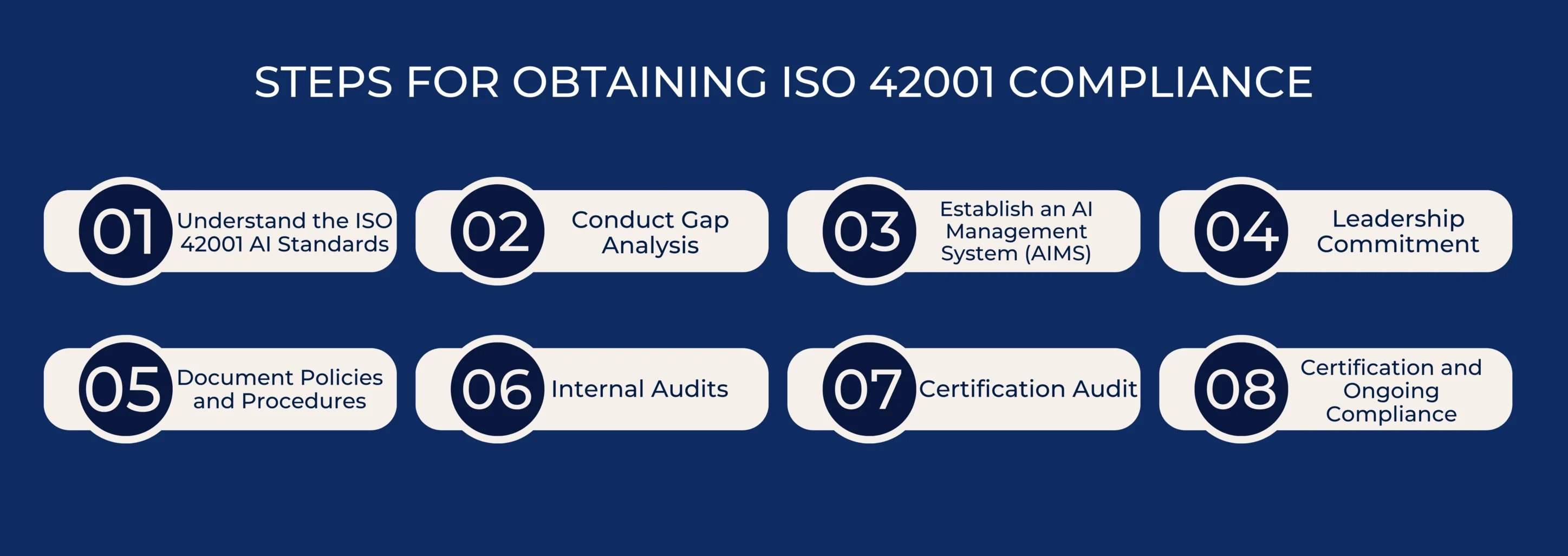
The ISO 42001 audit process for Leeds-based organizations follows a structured, stage-based examination methodology conducted by CertPro as an independent Licensed CPA Firm. Each stage of the audit is designed to produce objective, evidence-based findings that form the basis of the certification decision. The audit process does not include advisory, readiness, or implementation activities — it is conducted exclusively as an independent evaluation function.
The ISO 42001 audit process in Leeds begins with an application review. During this phase, the certification body evaluates the organization’s defined AIMS scope, the nature of AI systems within scope, the organizational context, and any applicable regulatory requirements.
Audit program determination establishes the audit plan — including the audit team composition, audit duration, and the specific ISO/IEC 42001:2023 clauses and Annex A controls that will be evaluated. For Leeds-based organizations operating across multiple business units or AI system types, scope determination is a critical step that defines the boundaries of the certification.
The audit program is designed to ensure that all material AI management activities within the defined scope are subject to examination, and that audit findings reflect the actual state of the organization’s AIMS rather than a subset of its operations.
The Stage 1 audit constitutes a structured review of the organization’s AIMS documentation against the requirements of ISO/IEC 42001:2023. The Stage 1 ISO 42001 audit evaluates whether the organization has established a documented AI policy, conducted AI risk assessments aligned to Clause 6, defined an AI risk treatment plan, produced a Statement of Applicability for Annex A controls, and documented governance roles and responsibilities for AI oversight.
The Stage 1 audit does not evaluate the operational effectiveness of controls — it determines whether the documented AIMS is sufficiently developed to proceed to the Stage 2 examination. For organizations in Leeds, Stage 1 findings are communicated formally, and any significant documentation gaps are identified before Stage 2 proceeds.
The Stage 1 audit also reviews the organization’s understanding of its AI context, including the types of AI systems in scope, data inputs and outputs, and the stakeholder groups affected by AI decisions.
The Stage 2 audit is the primary operational examination of the organization’s AI Management System. During the Stage 2 ISO 42001 audit, auditors evaluate the design and operating effectiveness of controls across all applicable Annex A domains — including AI system lifecycle controls, human oversight mechanisms, incident management procedures, bias monitoring activities, data governance controls, and transparency documentation.
Audit evidence is collected through interviews with key personnel, review of operational records and system logs, testing of documented procedures against observed practice, and examination of AI impact assessment documentation. Nonconformities identified during the Stage 2 audit are classified and formally reported. The organization is required to respond with documented corrective actions before the certification decision is finalized.
The certification committee then reviews audit findings, evaluates corrective action responses, and determines whether the AIMS meets the requirements of ISO/IEC 42001:2023 sufficient to warrant certificate issuance.
| Audit Stage | Key Activities | Output |
|---|---|---|
| Application Review | Scope definition, organizational context review, audit program determination | Confirmed audit scope and program |
| Stage 1 Audit | Documentation review, AI policy evaluation, risk assessment and Statement of Applicability examination | Stage 1 findings report |
| Stage 2 Audit | Control effectiveness testing, evidence collection, nonconformity identification | Stage 2 audit report with findings |
| Nonconformity Review | Corrective action evaluation and closure verification | Corrective action closure confirmation |
| Certification Decision | Certification committee review, certificate issuance or deferral | ISO 42001 certificate or decision notice |
ISO 42001 certification is issued for a three-year cycle, subject to annual surveillance audits that verify the continued operation and improvement of the AIMS. Surveillance audits are typically conducted at twelve and twenty-four months following initial certification. They evaluate whether the organization continues to meet ISO/IEC 42001:2023 requirements, focusing on areas of the AIMS that have changed, any new AI systems brought within scope, and the organization’s internal audit and management review activities.
At the end of the three-year certification cycle, a recertification audit re-evaluates the AIMS in its entirety using the same structured examination methodology as the initial certification audit. For Leeds-based organizations, maintaining ISO 42001 Certification in Leeds through annual surveillance demonstrates ongoing ISO 42001 compliance and provides continuous third-party verification to clients, regulators, and procurement authorities.
- ✓Application Review and Audit Program Determination
- ✓Stage 1 Audit: Documentation and Readiness Review
- ✓Stage 2 Audit: Control Effectiveness Examination
- ✓Surveillance Audits and Recertification
Why Leeds-Based Organizations Pursue ISO 42001 Certification
The demand for ISO 42001 Certification in Leeds reflects the intersection of commercial procurement requirements, regulatory expectation, and the depth of the city’s AI-active sectors. Leeds operates as the UK’s primary financial centre outside London, with significant concentrations of banking, insurance, asset management, and financial technology firms — all of which face increasing pressure from institutional counterparties and regulators to demonstrate structured AI governance.
ISO 42001 Certification in Leeds provides these organizations with independently verified attestation that their AI Management Systems are formally governed and subject to structured third-party examination.
Financial Services and Fintech Procurement Requirements
ISO 42001 certification for Leeds financial services firms is driven primarily by enterprise vendor due diligence and regulatory compliance expectations. Major financial institutions headquartered or operating in Leeds — including banks, building societies, and insurance companies — conduct structured third-party AI risk reviews as part of their vendor onboarding and periodic reassessment processes. Technology vendors providing AI-powered services to these institutions are increasingly required to demonstrate ISO 42001 compliance as a condition of contract award or renewal.
In the fintech sector, ISO 42001 Certification in Leeds is further driven by cross-border market access requirements. Fintech companies seeking to operate with EU-regulated financial institutions must demonstrate alignment with AI governance frameworks that are substantively consistent with the EU AI Act’s requirements for high-risk AI systems — for which ISO 42001 provides a recognized reference standard. The ISO 42001 attestation issued by CertPro provides the independently verified documentation that procurement and regulatory review processes require.
Healthcare Technology and Legal Services AI Governance
Leeds hosts a significant concentration of healthcare technology organizations linked to NHS trusts, including companies providing AI-assisted clinical decision support tools, diagnostic imaging analysis systems, patient pathway optimization software, and population health management platforms. These organizations operate in an environment where AI governance is subject to MHRA oversight, NHS supplier assurance frameworks, and evolving NHS Digital standards.
ISO 42001 compliance for Leeds health technology firms demonstrates that AI systems used in clinical or administrative contexts are subject to structured impact assessment, human oversight controls, and documented accountability mechanisms — all of which are evaluated during the ISO 42001 audit process.
The city’s legal services sector similarly demands documented AI governance. Law firms and legal technology companies deploying AI in contract analysis, litigation prediction, or document review face client expectations for transparency and accountability that ISO 42001 Certification directly addresses through its Annex A controls on AI transparency, human review, and explainability documentation.
SaaS Providers and Cloud Service Companies in Leeds
Leeds has developed a substantial ecosystem of SaaS providers and cloud service companies, many of which have integrated AI capabilities into their core product offerings. For these organizations, ISO 42001 compliance addresses a specific commercial challenge: enterprise buyers — particularly those in regulated sectors — require formal evidence that AI features within SaaS platforms are governed by structured management systems rather than informal development practices.
ISO 42001 Certification provides that evidence in the form of an independently issued attestation document that can be shared with prospective clients, included in RFP responses, and referenced in vendor security questionnaires. CertPro’s engagement model is strictly limited to the independent audit and certification function — evaluating the SaaS organization’s existing AIMS against ISO/IEC 42001:2023 requirements — without extension into consulting or implementation activities.
ISO 42001 Certification Requirements and Evaluation Criteria
The ISO 42001 examination conducted by CertPro evaluates organizations against the full requirements of ISO/IEC 42001:2023, spanning management system clauses and Annex A controls. The evaluation framework is evidence-based: auditors assess whether documented controls exist, whether those controls are appropriately designed to address the AI risks and impacts identified by the organization, and whether the controls operate effectively in practice.
The following categories represent the primary evaluation domains assessed during ISO 42001 audit engagements in Leeds.
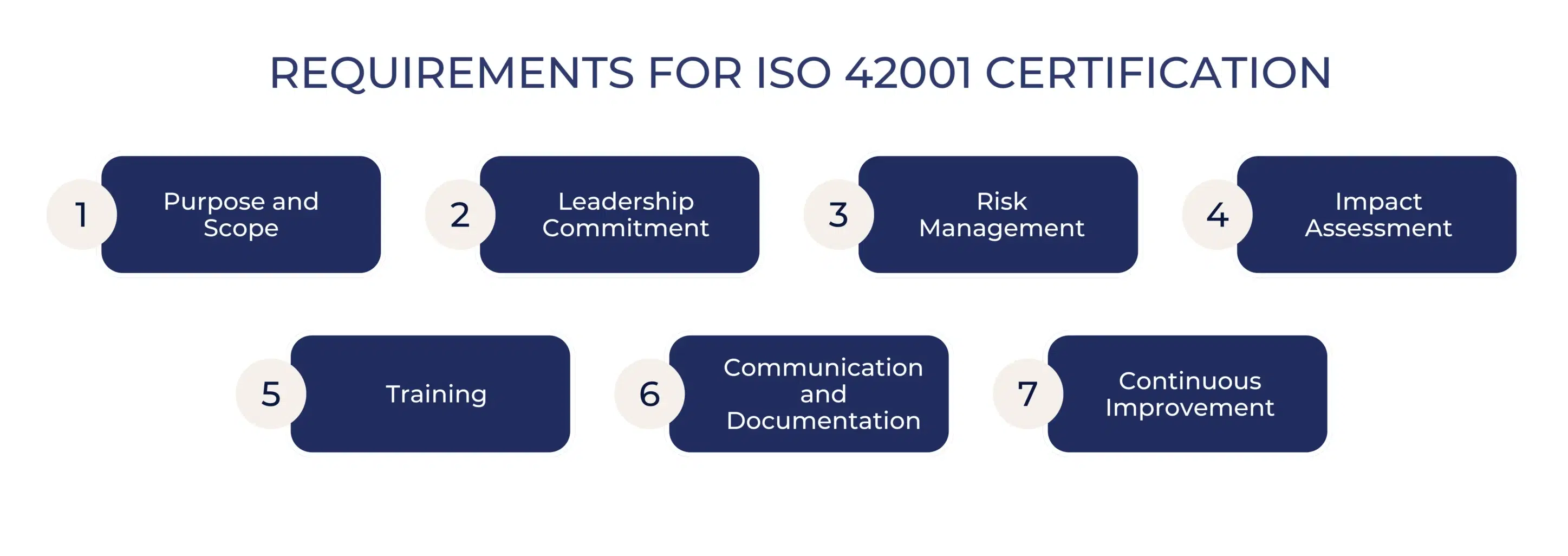
ISO 42001 compliance requires organizations to maintain a defined set of documented information that forms the evidentiary basis for audit evaluation. The core documentation requirements assessed during the ISO 42001 examination include:
An AI policy establishing the organization’s commitment to responsible AI development and use; an AI risk assessment identifying and evaluating risks arising from AI systems within scope; an AI risk treatment plan documenting selected controls and their rationale; and a Statement of Applicability identifying which Annex A controls apply and justifying any exclusions.
Organizations in Leeds must also maintain documented evidence of AI impact assessments, internal audit records, management review outputs, and records of continual improvement activities. The completeness and coherence of this documentation is evaluated during Stage 1 of the ISO 42001 audit, while operational records demonstrating effective implementation are examined during Stage 2.
Annex A of ISO/IEC 42001:2023 provides a structured reference set of AI-specific controls organized across domains that address the full lifecycle of AI system development, deployment, and operation. During the ISO 42001 audit, evaluators assess the design and operating effectiveness of controls across these domains based on the organization’s Statement of Applicability and the scope of its AIMS.
Controls related to AI system lifecycle governance require organizations to document requirements for AI system acquisition or development — including data sourcing, model selection, validation, testing, and deployment authorization. Human oversight controls require documented procedures for human review of AI outputs in contexts where AI decisions affect individuals or material business outcomes. Data quality and governance controls require evidence that data used to train, validate, and operate AI systems is managed with documented quality and provenance standards. Transparency and explainability controls require organizations to maintain documentation enabling stakeholders to understand how AI systems make decisions within the defined AIMS scope.
Findings identified during the ISO 42001 audit are documented as nonconformities and reported to the organization. Nonconformities require documented corrective actions that address the root cause of the identified gap. The certification committee reviews audit findings, the organization’s corrective action documentation, and the auditor’s assessment of corrective action adequacy before determining whether ISO 42001 certification is appropriate.
Certification is not issued where material nonconformities remain open or where corrective actions are assessed as insufficient to address identified control deficiencies. The certification decision is independent of any commercial relationship and is made exclusively on the basis of audit evidence.
Where certification is approved, the ISO 42001 certificate documents the certified scope, the applicable standard version (ISO/IEC 42001:2023), the certification body, and the certificate validity period. Conditions for suspension or withdrawal of certification are triggered where surveillance audits identify significant deterioration of AIMS effectiveness.
- ✓Core AIMS Documentation Requirements
- ✓Annex A Control Domains Under Examination
- ✓Nonconformity Classification and Certification Decision
Benefits of ISO 42001 Certification for Leeds-Based Organizations
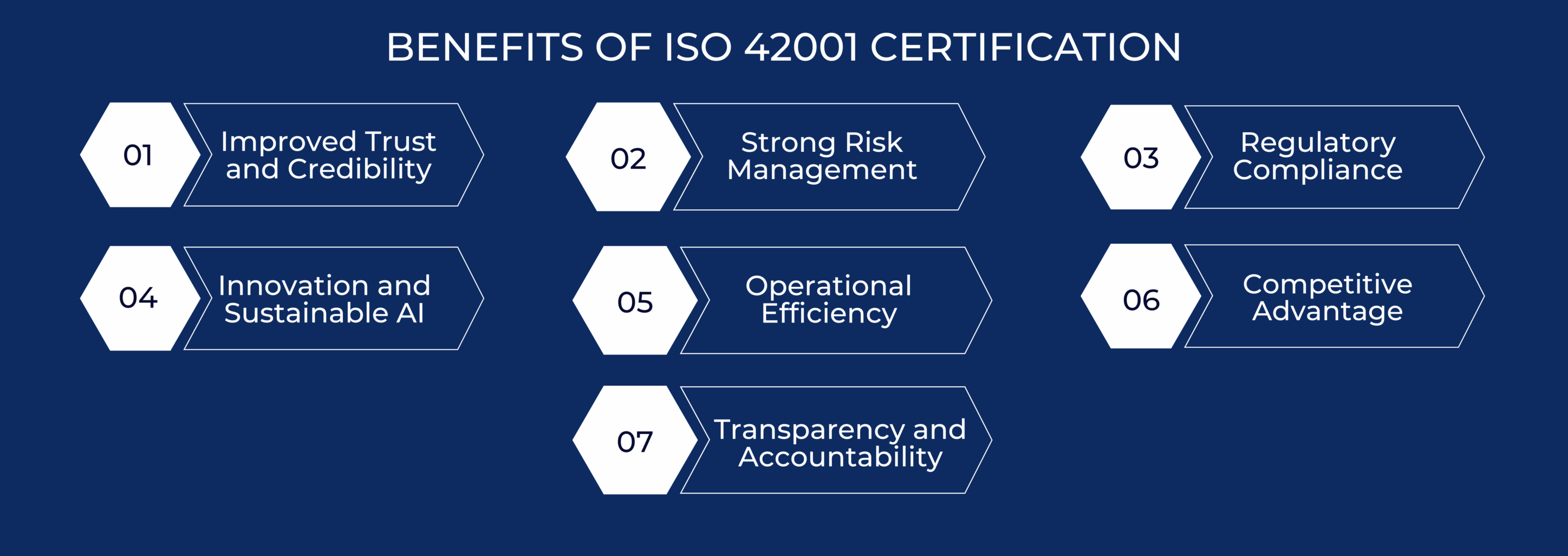
ISO 42001 Certification in Leeds delivers substantive organizational benefits that are directly tied to audit outcomes and the independently issued attestation. These benefits extend across commercial relationships, regulatory positioning, internal governance, and long-term AI risk management — and are distinct from any consulting or implementation outcome.
- ✓Independent third-party verification of AI Management System controls against ISO/IEC 42001:2023, providing documentary evidence for client and regulator review
- ✓Structured ISO 42001 audit methodology that identifies AI governance gaps through objective examination rather than self-assessment
- ✓ISO 42001 attestation document that satisfies enterprise vendor due diligence requirements in financial services, legal, healthcare, and public sector procurement processes
- ✓Recognition in international procurement processes, including those requiring EU AI Act alignment for organizations serving European markets
- ✓Ongoing surveillance audit cycle that maintains continuous third-party oversight of AIMS effectiveness and drives documented continual improvement
- ✓Defined accountability framework for AI systems that reduces regulatory exposure where AI decisions affect individuals or material business outcomes
- ✓Differentiation in competitive RFP responses and vendor security questionnaire submissions requiring evidence of formal AI governance
- ✓Certificate issuance that can be referenced in investor communications, regulatory submissions, and public reporting on AI governance commitments
For Leeds-based technology vendors serving regulated financial institutions, NHS organizations, and large enterprise clients, ISO 42001 Certification provides the specific form of evidence that structured procurement processes require. Enterprise vendor due diligence programs — whether conducted by banks assessing technology suppliers under FCA operational resilience requirements, NHS trusts evaluating clinical AI vendors, or multinational corporations reviewing SaaS providers — increasingly include AI governance as a distinct evaluation category.
ISO 42001 Certification in Leeds provides a standardized, independently verified response to this evaluation category that is recognized internationally. The ISO 42001 attestation issued by CertPro documents that the vendor’s AI Management System has been examined against an internationally recognized standard by an independent Licensed CPA Firm — satisfying the evidentiary requirements of most enterprise third-party AI risk assessment frameworks.
This recognition is particularly significant for organizations in Leeds seeking to expand their client base into markets where ISO 42001 compliance is either required or strongly preferred by institutional buyers.
ISO 42001 compliance aligns organizations with the substantive requirements of emerging AI regulatory frameworks, including the EU AI Act, the UK Government’s AI Regulation White Paper principles, and sector-specific AI governance expectations from the FCA, MHRA, and ICO. For Leeds-based organizations operating across multiple regulatory jurisdictions — particularly fintech and SaaS companies serving both UK and EU markets — ISO 42001 Certification provides a documented governance baseline recognized across these frameworks.
The standard’s requirements for AI impact assessment, human oversight, transparency, and accountability directly correspond to requirements embedded in the EU AI Act for high-risk AI systems. Organizations maintaining ISO 42001 compliance therefore have a structured foundation for demonstrating regulatory alignment. The reduction in regulatory exposure that results from structured AIMS governance is an outcome of the certification process itself — audit-identified control improvements drive the reduction in risk, not advisory or consulting activities external to the ISO 42001 audit.
- ✓Vendor Due Diligence and Procurement Recognition
- ✓Regulatory Alignment and Risk Reduction
Industry Sectors in Leeds Seeking ISO 42001 Certification
ISO 42001 Certification in Leeds is sought by organizations across a range of industry sectors that develop, deploy, or procure AI systems as part of their core operations. The city’s economic structure — characterized by depth in financial services, healthcare, legal, retail technology, and digital media — creates a distinctive pattern of ISO 42001 certification demand. This demand reflects both sector-specific regulatory requirements and commercial procurement dynamics unique to Leeds-based organizations.
| Industry Sector | AI Use Cases Requiring AIMS Governance | Primary ISO 42001 Driver |
|---|---|---|
| Financial Services & Fintech | Credit scoring, fraud detection, algorithmic trading, customer onboarding automation | FCA AI governance expectations, enterprise vendor due diligence, EU AI Act alignment |
| Healthcare Technology | Clinical decision support, diagnostic imaging AI, patient pathway optimization | NHS supplier assurance, MHRA oversight, patient safety accountability |
| Legal Services & LegalTech | Contract analysis, litigation prediction, document review automation | Client transparency requirements, professional accountability standards |
| Retail & E-Commerce Technology | Recommendation engines, dynamic pricing, demand forecasting | Consumer protection regulation, algorithmic accountability expectations |
| SaaS & Cloud Service Providers | AI-powered platform features, predictive analytics, automated workflows | Enterprise buyer procurement requirements, international market access |
Retail, E-Commerce, and Digital Media Technology
Leeds is home to a significant cluster of retail technology companies, e-commerce platform operators, and digital media firms, several of which operate at substantial scale. Organizations in this sector deploy AI systems for personalization, product recommendation, pricing optimization, inventory management, and audience targeting — all of which involve automated decision-making that affects consumer outcomes.
ISO 42001 compliance for Leeds retail technology firms is increasingly relevant as the UK Consumer Duty regulation, FCA algorithmic accountability expectations, and ICO guidance on automated decision-making collectively create a documented governance requirement for consumer-facing AI. The ISO 42001 audit evaluates whether organizations have conducted AI impact assessments for these systems, implemented human oversight mechanisms for high-stakes automated decisions, and maintained transparency documentation enabling affected consumers to understand the basis of AI-influenced outcomes.
Leeds-based digital media companies similarly benefit from ISO 42001 attestation where AI is used in content curation, advertising targeting, or audience segmentation at scale.
Managed Service Providers and AI Infrastructure Companies
Managed service providers (MSPs) and AI infrastructure companies operating in Leeds face a specific ISO 42001 certification requirement arising from their position in the AI supply chain. Organizations that provide AI infrastructure, data processing services, model hosting, or AI-enabled managed services to regulated clients are themselves subject to AI governance requirements as third-party AI providers.
Enterprise clients — particularly in financial services and healthcare — require MSPs and infrastructure providers to demonstrate that their own operations are governed by structured AI management systems. ISO 42001 audit engagements for Leeds-based MSPs evaluate the provider’s controls over AI system configuration, access management, model versioning, incident management, and the documentation provided to clients regarding AI system capabilities and limitations.
ISO 42001 Certification provides MSPs in Leeds with the independently verified attestation that their enterprise clients require as part of their own third-party AI risk management programs.
ISO 42001 Certification Scope and Independent Decision Framework
The scope of ISO 42001 Certification defines the boundaries of the AI Management System subject to audit evaluation and attestation. Scope determination is a structured process conducted during the application review phase and directly influences the audit program, audit duration, and the content of the issued certificate. For Leeds-based organizations, scope definition requires careful consideration of which AI systems, business units, processes, and organizational functions are included within the AIMS boundary.
Defining the Certification Scope for Leeds Organizations
ISO 42001 certification scope is defined by the organization based on its AI activities, the AI systems it develops or deploys, and the organizational units responsible for AI governance. For a Leeds-based fintech company, scope might include AI systems used in credit decisioning, fraud detection, and customer communication automation across UK operations. For an NHS-linked healthcare technology provider, scope might encompass AI systems used in specific clinical pathway applications within defined NHS trust partnerships. For a SaaS provider, scope typically aligns with the AI features of the platform subject to enterprise client procurement review.
The certification body evaluates the appropriateness of the defined scope — including whether any exclusions from Annex A controls are justified by the nature of the organization’s AI activities. The issued ISO 42001 certificate documents the certified scope precisely, ensuring that the ISO 42001 attestation accurately represents the boundaries of the evaluated AIMS rather than implying organization-wide certification where scope is limited.
Independence of the Certification Decision
The ISO 42001 certification decision is made by a certification committee that is structurally independent from the audit team that conducted the examination. This separation of functions ensures that the certification decision is based solely on documented audit evidence and is not influenced by commercial, advisory, or implementation relationships.
CertPro operates exclusively as an independent certification body for ISO 42001 audit engagements in Leeds — the organization does not provide consulting, implementation, or readiness services that would create a conflict of interest with its certification function. For Leeds-based organizations, this independence is a critical attribute of the certification’s value: ISO 42001 attestation issued by an independent Licensed CPA Firm carries significantly greater evidential weight in procurement, regulatory, and investor review processes than self-assessment or consultant-developed documentation.
The certification committee’s independent review of audit findings, nonconformity responses, and corrective action evidence constitutes the formal ISO 42001 examination conclusion upon which the certification decision rests.
CertPro ISO 42001 Audit Services in Leeds
CertPro conducts ISO 42001 certification audits in Leeds as an independent Licensed CPA Firm with no advisory, consulting, or implementation function. ISO 42001 audit engagements in Leeds are conducted exclusively for the purpose of independent examination and attestation — evaluating organizations’ AI Management Systems against the requirements of ISO/IEC 42001:2023 and issuing certification on the basis of objective audit evidence.
This positioning as an independent certification body, distinct from any consulting or advisory role, is fundamental to the validity and commercial utility of the ISO 42001 certification attestation for organizations operating in Leeds.
Audit Methodology and Evidence Standards
CertPro’s ISO 42001 audit methodology follows the structured examination approach required by ISO/IEC 17021-1 (requirements for certification bodies) and the specific evaluation requirements of ISO/IEC 42001:2023. Audit evidence is collected through document review, personnel interviews, observation of operational processes, and testing of documented controls against observable practice.
The audit team’s findings are documented in structured audit reports that identify specific clause references, describe the evidence reviewed, and classify any identified nonconformities. For Leeds-based organizations operating across multiple sites or remote working arrangements, the audit methodology accommodates both on-site and remote evidence collection as appropriate to the nature of the AIMS and the controls under examination.
ISO 42001 attestation is issued only where the evidence collected during both Stage 1 and Stage 2 audits — together with the organization’s corrective action responses to identified nonconformities — demonstrates that the AIMS meets the requirements of the standard in all material respects.
Certificate Issuance and Validity
ISO 42001 certificates issued by CertPro document the certified organization’s name, the defined certification scope, the standard version (ISO/IEC 42001:2023), the certification body’s identity and accreditation status, the certificate issue date, and the certificate validity period. Certificates are issued for a three-year cycle from the date of initial certification, subject to satisfactory annual surveillance audits at the twelve-month and twenty-four-month intervals.
Certificate validity is conditional on the organization’s continued ISO 42001 compliance with ISO/IEC 42001:2023 requirements, as verified through surveillance audits and any additional audit activities triggered by material changes to the AIMS scope or AI system portfolio. Certificates may be suspended or withdrawn where surveillance audits identify significant nonconformities that are not resolved within the required timeframe.
For Leeds-based organizations, the three-year certificate provides a stable basis for client assurance, regulatory documentation, and procurement submissions throughout the certification cycle, with the annual surveillance audit providing ongoing independent verification of AIMS effectiveness.
FAQ
▶
What is ISO 42001 Certification and who issues it in Leeds?
▶
Which Leeds organizations are required to obtain ISO 42001 certification?
▶
What is the difference between Stage 1 and Stage 2 of the ISO 42001 audit?
▶
How long is an ISO 42001 certificate valid in Leeds?
▶
What documentation is required for ISO 42001 certification in Leeds?
▶
Does ISO 42001 certification cover all AI systems in an organization?
▶
How does ISO 42001 certification relate to the EU AI Act for Leeds-based organizations?
▶
What is the ISO 42001 surveillance audit and when does it occur?
ISO 42001 CERTIFIED: WHY AI GOVERNANCE CERTIFICATION IS BECOMING A BOARD-LEVEL REQUIREMENT
ISO 42001 Certified: Board-Level AI Governance Guide | CertPro CPA LLC HERO ══════════════════════════════ –> src=”https://certpro.com/wp-content/uplo…
Get In Touch
have a question? let us get back to you.