
ISO 42001 Certification in Maryland
ISO 42001 Certification in Maryland is conducted by CertPro as a Licensed CPA Firm performing independent third-party conformity assessment audits under ISO/IEC 42001:2023. CertPro evaluates organizational conformity to the Artificial Intelligence Management System (AIMS) standard through structured, evidence-based audit programs. Operating exclusively as an independent certification body, CertPro does not serve as an advisor, implementer, or consultant to any organization it certifies — ensuring unbiased ISO 42001 compliance evaluation at every stage.
OUR CLIENTS





Independent ISO 42001 Certification by a Licensed CPA Firm in Maryland
ISO 42001 Certification in Maryland is conducted by CertPro as a Licensed CPA Firm performing independent third-party conformity assessment audits under ISO/IEC 42001:2023. CertPro evaluates organizational conformity to the Artificial Intelligence Management System (AIMS) standard through structured, evidence-based audit programs. Operating exclusively as an independent certification body, CertPro does not serve as an advisor, implementer, or consultant to any organization it certifies — ensuring unbiased ISO 42001 compliance evaluation at every stage.
Maryland’s AI Ecosystem and the Role of Independent Certification
Maryland occupies a strategically significant position in the United States technology landscape. The state hosts a dense concentration of federal agencies, defense contractors, research institutions, and private-sector technology organizations operating within the Washington, D.C. and Baltimore corridor. Major employers and innovators in biotechnology, life sciences, healthcare, pharmaceuticals, cybersecurity, information technology, aerospace and defense, financial services, and software development are all headquartered or maintain significant operations in Maryland.
Organizations across these sectors are increasingly developing, deploying, or integrating artificial intelligence systems into critical operations — creating direct demand for structured AI governance and independently verified conformity to internationally recognized standards. ISO 42001 Certification in Maryland addresses this need directly through a rigorous, third-party audit process aligned with ISO/IEC 42001:2023.
Maryland-based organizations operate in close proximity to federal procurement processes, defense acquisition requirements, and health data regulatory frameworks — establishing a distinct context for AI governance. Federal technology contractors, AI companies, cloud service providers, SaaS platforms, and healthcare AI developers in Maryland face procurement expectations, vendor assurance requirements, and enterprise risk management obligations that increasingly reference ISO/IEC 42001:2023 as the governing standard for Artificial Intelligence Management Systems.
ISO 42001 Certification in Maryland provides these organizations with an independently verified credential demonstrating conformity to the standard’s requirements. That conformity is evaluated through a structured ISO 42001 certification audit conducted by a Licensed CPA Firm with no advisory interest in the outcome — reinforcing the credibility and objectivity of every certificate issued.
CertPro’s Role: Independent Certification Body, Not a Consultant
CertPro’s function in the ISO 42001 certification process is strictly that of an independent third-party evaluator. The organization seeking certification is responsible for establishing, operating, monitoring, and maintaining its own Artificial Intelligence Management System in conformity with ISO/IEC 42001:2023. CertPro’s responsibility begins at the point of audit — reviewing documented information, evaluating objective evidence, assessing control design and operating effectiveness, and rendering an independent certification decision through a structured committee process.
This independence is fundamental. CertPro does not design AI governance frameworks, develop AI risk management policies, or participate in AIMS implementation for any organization it audits. The Licensed CPA Firm structure reinforces this objectivity by applying professional standards for evidence evaluation and institutional accountability to every ISO 42001 certification audit conducted in Maryland.
ISO 42001 Certification in Maryland through CertPro applies to organizations of all sizes and across all sectors that develop, deploy, or use AI systems as part of their operations. The certification scope is defined by the organization and evaluated by CertPro auditors against the specific requirements of ISO/IEC 42001:2023.
Certification decisions are made by CertPro’s independent certification committee based solely on audit evidence — not on organizational intent, market positioning, or commercial relationships. This structure ensures that ISO 42001 Certification in Maryland carries genuine third-party credibility in enterprise procurement, vendor assurance, and regulatory compliance contexts across the state’s diverse and highly regulated technology sectors.

What Is ISO 42001 Certification?
ISO 42001 Certification is the formal process by which an independent certification body — such as CertPro — evaluates an organization’s Artificial Intelligence Management System against the requirements of ISO/IEC 42001:2023 and issues a certificate of conformity upon successful completion of a structured audit program. ISO/IEC 42001:2023 is the first internationally recognized standard specifically designed to govern the responsible development, deployment, and use of artificial intelligence systems within organizations.
The ISO 42001 standard establishes requirements for an AIMS that enables organizations to manage AI-related risks, uphold ethical AI principles, maintain transparency, and demonstrate accountability across the full AI system lifecycle. Understanding what ISO 42001 Certification entails is essential for any Maryland organization considering this credential.
The ISO/IEC 42001:2023 Standard Explained
The ISO 42001 standard follows the High-Level Structure (HLS) common to ISO management system standards, organized through Clauses 4 to 10. These clauses cover organizational context, leadership, planning, support, operation, performance evaluation, and continual improvement. In addition to these core management system clauses, ISO/IEC 42001:2023 includes a normative Annex A containing AI-specific controls organized across key domains.
These domains include AI policy, internal organization, resources for AI systems, AI system impact assessment, AI system lifecycle considerations, data governance, information for interested parties, and use of AI systems. Organizations must evaluate all Annex A controls and document their selections — including justifications for any excluded controls — in a Statement of Applicability. This document is foundational to every ISO 42001 certification audit and is reviewed in detail during both Stage 1 and Stage 2 evaluations.
The ISO 42001 standard distinguishes between organizations that develop AI systems, organizations that deploy AI systems developed by others, and organizations that use AI-enabled products or services. Each role carries different obligations under the standard, and the scope of ISO 42001 Certification reflects the specific role — or combination of roles — an organization occupies.
For Maryland-based organizations — including biotechnology companies using AI for drug discovery, healthcare organizations deploying AI diagnostics, cybersecurity firms building AI-driven threat detection, and federal contractors integrating machine learning into government systems — the standard’s flexibility allows for scope definitions that accurately reflect operational reality while maintaining rigorous ISO 42001 compliance evaluation criteria.
Key Requirements Evaluated in an ISO 42001 Audit
An ISO 42001 audit evaluates conformity across the full scope of the standard’s requirements. Core areas of evaluation include the organization’s AI policy and objectives, AI risk assessment methodology and risk treatment plan, documented AI system impact assessment process, data governance controls, human oversight mechanisms, transparency and explainability practices, internal audit program, management review process, and the documented information maintained to demonstrate AIMS operation.
Auditors assess both the design adequacy of controls and their operating effectiveness — reviewing objective evidence such as records, procedures, system configurations, training documentation, and management outputs — rather than accepting management assertions alone. ISO 42001 compliance is established through this evidence-based evaluation, not through self-declaration or internal policy statements.
| ISO/IEC 42001:2023 Clause | Subject Matter | Audit Focus Area |
|---|---|---|
| Clause 4 | Organizational Context and Interested Parties | AIMS scope definition, AI policy alignment, stakeholder requirements |
| Clause 6 | Planning — Risk Assessment and Objectives | AI risk methodology, risk treatment plan, Annex A control applicability |
| Clause 8 | Operation — AI System Lifecycle | AI impact assessment, data governance controls, development lifecycle controls |
| Clause 9 | Performance Evaluation | Internal audit records, monitoring outputs, management review documentation |
| Annex A | AI-Specific Control Domains | Statement of Applicability, control design adequacy, operating effectiveness |
ISO 42001 Certification Audit Process in Maryland
The ISO 42001 certification audit process conducted by CertPro for Maryland-based organizations follows a structured, multi-stage program designed to assess conformity to ISO/IEC 42001:2023 through systematic evidence collection and independent evaluation. Each stage of the audit program serves a distinct purpose and produces documented outputs that inform the certification decision.
The process is governed by CertPro’s certification procedures and applies consistently to all organizations seeking ISO 42001 Certification in Maryland — regardless of industry sector, organizational size, or AI system complexity. This consistency ensures that every certificate issued represents the same standard of independent evaluation.
The Stage 1 audit constitutes a systematic review of the organization’s documented information to assess the design of its Artificial Intelligence Management System and confirm readiness for Stage 2 evaluation. During Stage 1, CertPro auditors review the AIMS scope documentation, AI policy, AI risk assessment records, risk treatment plan, Statement of Applicability, AI system impact assessment documentation, and key procedural documents governing AI system lifecycle operations.
The Stage 1 ISO 42001 audit also evaluates whether the organization has established the internal audit and management review processes required by ISO/IEC 42001:2023. Findings are documented and communicated to the organization, clearly identifying any areas where documentation is insufficient or where AIMS design does not meet the standard’s requirements — before Stage 2 proceeds.
The Stage 2 audit is the primary conformity assessment, during which CertPro auditors evaluate the operating effectiveness of the organization’s Artificial Intelligence Management System through direct review of objective evidence. This stage involves interviews with personnel responsible for AI governance, examination of AI system records, review of data governance outputs, assessment of AI impact assessment results, evaluation of human oversight controls, and verification that Annex A controls selected in the Statement of Applicability are implemented and functioning as designed.
The ISO 42001 certification audit at Stage 2 assesses actual operational performance — not documentation intent — by examining evidence generated through day-to-day AIMS operation. Nonconformities identified during Stage 2 are classified, documented, and reported to the organization. These nonconformities must be addressed with verified corrective actions before a positive certification recommendation can be made.
Following Stage 2, the lead auditor prepares a comprehensive audit report documenting findings, evidence reviewed, nonconformities identified, and a recommendation for or against certification. This report is submitted to CertPro’s independent certification committee — a body entirely separate from the audit team — which reviews the report and makes the final ISO 42001 compliance determination.
The committee’s independence from the audit team ensures that the certification decision reflects objective assessment of evidence rather than audit team judgment alone. Upon committee approval, CertPro issues the ISO 42001 certificate with a defined scope, certification date, and validity period — completing the formal ISO 42001 certification audit process for Maryland organizations.
ISO 42001 Certification in Maryland is maintained through a structured surveillance audit cycle. CertPro conducts surveillance audits on a defined schedule — typically annually — to verify that the certified organization continues to conform to ISO/IEC 42001:2023 requirements and that the AIMS remains operational and effective.
Surveillance audits are narrower in scope than initial certification audits but include review of internal audit outputs, management review records, corrective action effectiveness, and any changes to AI systems or AIMS structure that may affect certification scope. Recertification audits are conducted prior to certificate expiry — typically on a three-year cycle — and constitute a full re-evaluation of AIMS conformity against the ISO 42001 standard. Failure to maintain conformity demonstrated through surveillance or recertification audits may result in certificate suspension or withdrawal.
| Audit Stage | Key Activities | Output |
|---|---|---|
| Application Review | Scope definition, audit program determination, conflict of interest assessment | Confirmed audit scope and program |
| Stage 1 Audit | AIMS documentation review, AI policy and risk assessment evaluation, readiness assessment | Stage 1 findings report |
| Stage 2 Audit | Operational evidence review, control effectiveness assessment, nonconformity identification and documentation | Stage 2 audit report with certification recommendation |
| Certification Committee | Independent review of audit report and supporting evidence, final certification decision | Certificate of Conformity or rejection notice |
| Surveillance Audit | Ongoing conformity verification, corrective action review, AIMS change impact assessment | Surveillance audit report, continued certification status confirmation |
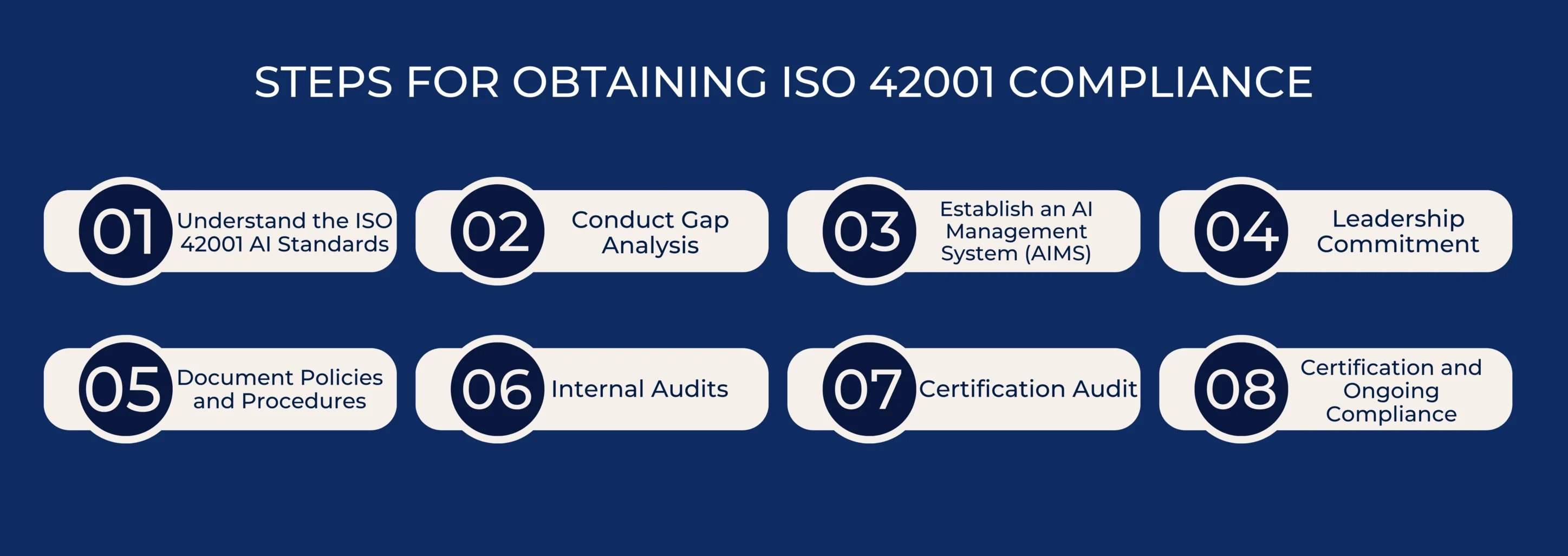
- ✓Stage 1 Audit: Documentation Review and Scope Evaluation
- ✓Stage 2 Audit: Operational Evidence and Control Effectiveness
- ✓Surveillance Audits and Recertification
ISO 42001 Requirements and AIMS Evaluation Criteria
ISO 42001 compliance requires organizations to establish, document, implement, operate, monitor, and continually improve an Artificial Intelligence Management System that addresses the specific requirements of ISO/IEC 42001:2023. CertPro’s certification audit evaluates conformity against these requirements through systematic evidence review — assessing both what the organization has documented and what it can demonstrate through operational records.
The evaluation framework encompasses management system requirements, AI-specific operational requirements, and the Annex A control framework applicable to the organization’s AI activities. Together, these elements form the basis of every ISO 42001 certification audit CertPro conducts in Maryland.
ISO/IEC 42001:2023 mandates specific documented information as evidence of AIMS establishment and operation. The foundational documents evaluated in every ISO 42001 certification audit include the AI policy, AI risk assessment and risk treatment plan, Statement of Applicability documenting selected and excluded Annex A controls with justification, AI system impact assessment records, objectives and plans to achieve them, internal audit program and results, management review records, and corrective action documentation.
These documents collectively demonstrate that the organization has systematically identified AI-related risks, determined appropriate controls, implemented those controls operationally, and established mechanisms for monitoring performance and driving improvement. Each document is evaluated for completeness, accuracy, and consistency with actual AIMS operations observed during the ISO 42001 audit — not simply for its existence in a document repository.
The AI system impact assessment is a particularly significant documented information requirement under ISO/IEC 42001:2023. Organizations must assess the potential impacts of their AI systems — including effects on individuals, groups, and society — as part of the AI system lifecycle process.
For Maryland-based healthcare AI developers, this assessment must address patient safety and clinical decision-support considerations. For defense contractors, it must address security and mission-integrity implications. For financial services AI deployments, it must address fairness, explainability, and regulatory compliance dimensions. CertPro auditors review impact assessment records during the ISO 42001 certification audit to verify that the assessment methodology is appropriate for the organization’s AI context and that documented outputs are consistent with the AI systems in scope.
Annex A of ISO/IEC 42001:2023 contains a structured set of AI-specific controls organized into key domains: AI policy and organizational responsibilities, resources for AI systems, AI system impact assessment, AI system lifecycle management, data governance for AI, transparency and information provision for interested parties, and responsible use of AI systems.
Organizations must evaluate all Annex A controls and document in the Statement of Applicability which controls are applicable to their AIMS scope, which are implemented, and — for any excluded control — the justification for exclusion. The Statement of Applicability is a central document in every ISO 42001 audit: it maps the organization’s risk treatment decisions to specific controls and provides the framework against which operating effectiveness is assessed during the ISO 42001 certification audit.
- ✓AI policy — organizational commitments to responsible AI development and use
- ✓Internal organization — defined roles, responsibilities, and accountability for AI governance
- ✓Resources for AI systems — governance of computational, human, and data resources
- ✓AI system impact assessment — structured evaluation of AI system effects on individuals and society
- ✓AI system lifecycle — controls across design, development, testing, deployment, and decommissioning phases
- ✓Data governance for AI — data quality, provenance, bias evaluation, and access control requirements
- ✓Transparency and explainability — documentation and communication of AI system capabilities and limitations
- ✓Human oversight — mechanisms for human review, intervention, and accountability in AI-driven decisions
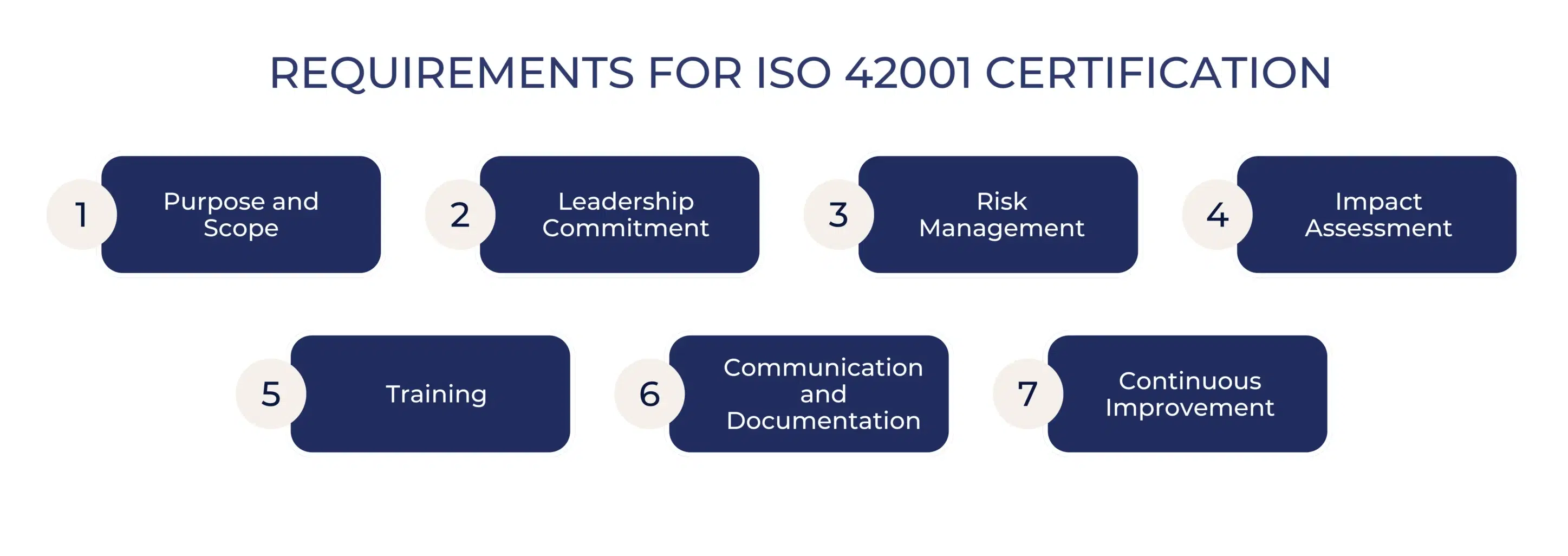
- ✓Core AIMS Documentation Requirements
- ✓Annex A Controls and the Statement of Applicability
Maryland Sectors Pursuing ISO 42001 Certification
ISO 42001 Certification in Maryland is relevant across a broad cross-section of the state’s technology and regulated industry sectors. Maryland’s unique position — bridging federal procurement markets, advanced research ecosystems, and private-sector technology development — creates concentrated demand for independently verified AI governance across multiple industries.
Organizations in each of these sectors face distinct AI governance obligations, procurement requirements, and stakeholder expectations that ISO 42001 Certification in Maryland directly addresses through independent third-party conformity assessment conducted by CertPro under the ISO 42001 standard.
Healthcare AI, Biotechnology, and Life Sciences
Maryland’s healthcare and life sciences sector — anchored by Johns Hopkins Medicine, the University of Maryland Medical System, the National Institutes of Health in Bethesda, and FDA headquarters in Silver Spring — represents one of the state’s most significant concentrations of AI development and deployment activity. Healthcare organizations deploying AI for clinical decision support, diagnostic imaging, genomic analysis, and drug discovery face rigorous expectations for AI safety, transparency, and accountability from regulators, hospital procurement offices, and institutional review processes.
ISO 42001 Certification in Maryland for healthcare AI developers provides an independently verified attestation that AI governance systems conform to internationally recognized requirements — a credential increasingly requested in hospital and healthcare network vendor qualification processes. Pursuing ISO 42001 Certification through CertPro gives these organizations a structured, audited framework for demonstrating responsible AI deployment.
Biotechnology and pharmaceutical companies in Maryland’s life sciences corridor — spanning Baltimore, Rockville, Gaithersburg, and the I-270 technology corridor — are integrating AI into research workflows, clinical trial design, regulatory submission preparation, and manufacturing quality control. For these organizations, ISO 42001 Certification provides a structured framework for managing AI-related risks that intersect with FDA regulatory expectations for software as a medical device, Good Manufacturing Practice requirements, and data integrity obligations.
The ISO 42001 certification audit evaluates whether these organizations have established AIMS controls appropriate to their specific AI use cases and regulatory environment. The audit does not assess direct FDA regulatory compliance — but it does verify that the organization’s AI management system addresses AI risks in a structured, documented, and continuously monitored manner consistent with ISO 42001 compliance requirements.
Federal Contractors, Cybersecurity, and Defense Technology
ISO 42001 Certification in Maryland is being sought in growing numbers by government contractors — reflecting the expanding role of AI in federal procurement and defense technology. Maryland hosts a substantial concentration of federal contractors and defense technology organizations, particularly in the NSA corridor around Fort Meade, defense and intelligence community operations in Bethesda and Chevy Chase, and the cybersecurity cluster spanning Annapolis Junction and Columbia.
These organizations are integrating AI into intelligence analysis, cybersecurity threat detection, autonomous systems, and mission-critical software — contexts where AI governance, accountability, and audit trail requirements are especially stringent. ISO 42001 Certification in Maryland provides these organizations with a structured, third-party-verified AIMS credential that can be referenced in federal procurement documentation, contract compliance submissions, and agency vendor qualification processes.
ISO 42001 Certification is particularly relevant for Maryland cybersecurity firms — including managed security service providers, threat intelligence platforms, and security operations centers incorporating AI-driven detection and response capabilities. As AI becomes central to cybersecurity operations — automating threat identification, anomaly detection, and incident response — the governance of these AI systems becomes a material security consideration in its own right.
Enterprise customers and federal agencies increasingly expect cybersecurity vendors to demonstrate that AI systems embedded in their platforms are governed through structured, auditable processes. ISO 42001 Certification provides that independently verified credential, assessed through CertPro’s structured ISO 42001 audit program against the full requirements of ISO/IEC 42001:2023.
Financial Services, SaaS, and Cloud AI Providers
Maryland’s financial services sector — including banking institutions, insurance companies, investment firms, and fintech organizations operating in Baltimore and the Washington metropolitan area — is deploying AI for credit underwriting, fraud detection, regulatory compliance automation, and customer experience personalization. For these organizations, AI governance intersects with existing regulatory obligations under federal banking regulations, state financial licensing requirements, and consumer protection frameworks.
ISO 42001 Certification in Maryland for financial services organizations provides an independently assessed AIMS credential that demonstrates structured AI risk management. This credential is relevant in both internal audit contexts and in responding to financial regulator expectations for documented AI governance — areas where self-assessment alone provides insufficient assurance. Achieving ISO 42001 compliance through an independent certification audit strengthens these organizations’ positions in both regulatory and enterprise due diligence settings.
Benefits of ISO 42001 Certification for Maryland-Based Organizations
ISO 42001 Certification for Maryland-based organizations delivers a range of independently verifiable outcomes that address enterprise procurement expectations, regulatory engagement contexts, and internal AI governance maturity objectives. The following benefits reflect what ISO 42001 Certification demonstrates through objective third-party audit — documented, evidence-based results of conformity assessment to ISO/IEC 42001:2023, not aspirational claims.
Each benefit listed below is tied directly to what the ISO 42001 certification audit process evaluates and verifies — providing organizations with substantiated, credible evidence of responsible AI governance.
- ✓Independent verification of AIMS conformity to ISO/IEC 42001:2023 through a structured third-party ISO 42001 certification audit
- ✓Demonstrated AI risk management methodology evaluated against internationally recognized ISO 42001 standard requirements
- ✓Credible evidence of human oversight, transparency, and accountability controls for AI system stakeholders
- ✓Structured audit documentation suitable for reference in federal procurement, vendor qualification, and enterprise due diligence processes
- ✓Independently assessed AI system impact assessment processes demonstrating responsible AI deployment practices
- ✓Ongoing surveillance audit program providing continuous third-party oversight of AIMS effectiveness and ISO 42001 compliance
- ✓Recognition in enterprise and government procurement processes where AI governance credentials are evaluated
- ✓Structured framework for demonstrating alignment with evolving U.S. and international AI governance expectations through verified ISO 42001 conformity
One of the most operationally significant outcomes of ISO 42001 Certification in Maryland is its recognition in enterprise and government procurement processes. As large organizations — including federal agencies, health systems, financial institutions, and defense contractors — establish vendor qualification requirements for AI systems and AI-enabled services, ISO 42001 Certification provides a structured, independently verified credential that addresses AI governance due diligence requirements.
A Maryland-based AI company undergoing vendor qualification with a federal health agency or a defense prime contractor can reference its ISO 42001 certificate — issued by an independent Licensed CPA Firm following a documented ISO 42001 certification audit — as objective evidence of structured AI governance, rather than relying on self-assessment or internal policy documentation alone.
The vendor qualification scenario is particularly relevant for Maryland SaaS providers and cloud service organizations supplying AI-enabled products to regulated industries. A SaaS company providing an AI-powered analytics platform to Maryland hospital networks, for example, may face procurement requirements that include demonstrating how AI systems are governed, how AI risks are assessed and managed, and what controls exist for data used in AI model training and inference.
ISO 42001 Certification in Maryland provides a structured, audited response to these requirements — with the credibility of independent third-party assessment by a Licensed CPA Firm rather than the limited assurance of a vendor-completed security questionnaire. The ISO 42001 standard’s requirements directly address the AI governance questions that procurement teams and enterprise risk managers are asking.
ISO 42001 Certification in Maryland aligns with the direction of U.S. federal AI governance policy — including the AI Executive Order framework, NIST AI Risk Management Framework (AI RMF), and sector-specific AI guidance from agencies such as the FDA, HHS, and financial regulators. While ISO 42001 Certification does not constitute regulatory compliance with any specific U.S. law or regulation, the ISO 42001 standard’s requirements for AI risk assessment, impact evaluation, transparency, human oversight, and continual improvement are structurally aligned with the principles articulated in U.S. AI governance frameworks.
For Maryland organizations navigating both federal AI policy expectations and international standards requirements — particularly those with cross-border business relationships or international customer bases — ISO 42001 Certification provides a globally recognized foundation for demonstrating responsible AI governance and verifiable ISO 42001 compliance.
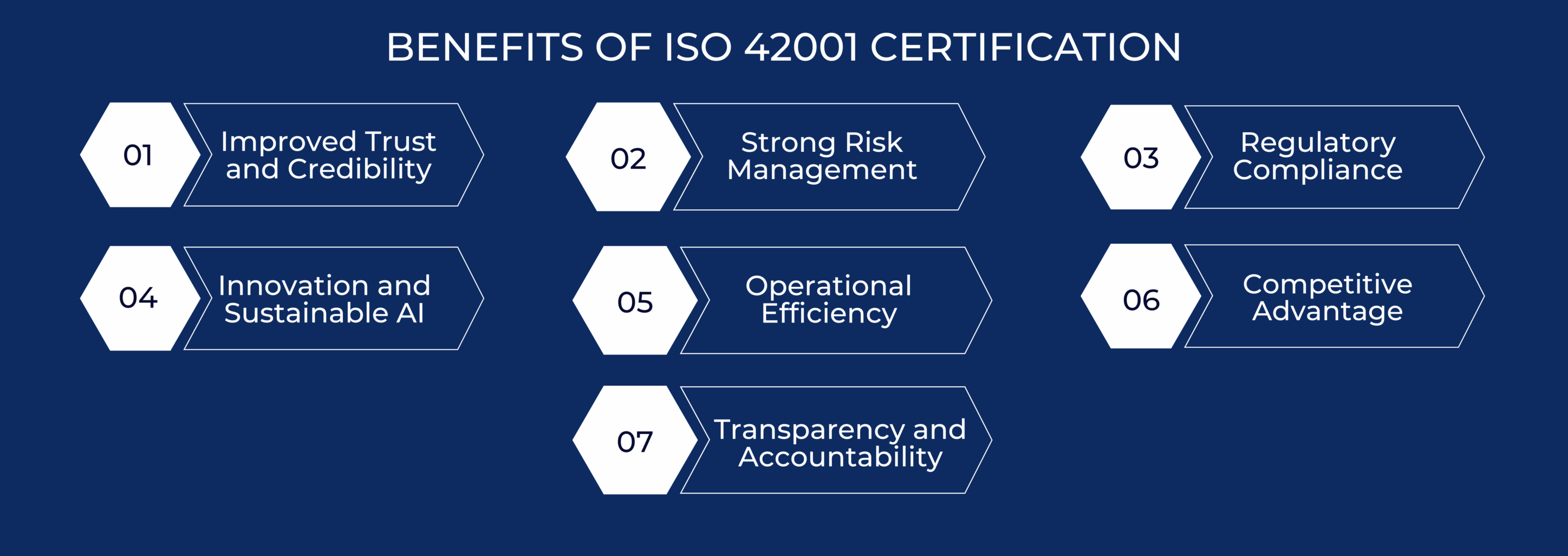
- ✓Procurement Recognition and Vendor Qualification
- ✓Alignment with U.S. AI Governance and Regulatory Expectations
ISO 42001 Audit Methodology and Evidence Evaluation
The ISO 42001 audit methodology applied by CertPro in Maryland follows established international standards for conformity assessment, combining systematic document review, personnel interviews, process observation, and records examination to generate objective evidence of AIMS conformity or nonconformity. Every audit finding is supported by documented evidence — not auditor judgment alone — ensuring that the certification decision reflects a reproducible, evidence-based evaluation of the organization’s Artificial Intelligence Management System against the specific requirements of ISO/IEC 42001:2023.
This rigorous, structured approach to the ISO 42001 audit is what distinguishes CertPro’s certification from self-assessment tools or consultant-led readiness reviews — and why the resulting certificate carries genuine third-party credibility in Maryland’s regulated technology markets.
Evidence Collection and Objective Assessment
During an ISO 42001 certification audit, CertPro auditors collect and evaluate multiple categories of objective evidence. Documentary evidence includes AI policies, risk assessment records, impact assessment outputs, Statement of Applicability, operational procedures, training records, internal audit reports, management review minutes, and corrective action logs. Testimonial evidence is gathered through structured interviews with AI governance personnel, data scientists, product managers, legal and compliance teams, and executive leadership responsible for AI oversight.
Observational evidence is gathered through review of AI system configurations, data management practices, and operational controls as they exist in the production environment. The combination of these evidence types — evaluated against the specific requirements of each applicable ISO 42001 standard clause and Annex A control — provides the basis for each audit finding and the overall certification recommendation.
The ISO 42001 audit evaluates two distinct dimensions of control performance. Control design adequacy assesses whether the controls documented in the AIMS are appropriately structured to address identified AI risks. Operating effectiveness assesses whether those controls are functioning as designed in actual operations — consistently applied and producing auditable outputs.
A control that exists in policy but is not operationally implemented will be identified as a nonconformity regardless of its design intent. This distinction between design and operation is central to the value of ISO 42001 Certification: it provides assurance not just that an organization has written AI governance policies, but that those policies are operationally embedded and generating evidence of effective AI risk management — a distinction that matters deeply in enterprise procurement and regulatory contexts.
Nonconformity Classification and Certification Decision
Nonconformities identified during the ISO 42001 certification audit are documented with specific reference to the ISO/IEC 42001:2023 clause or Annex A control that has not been satisfied, the objective evidence supporting the finding, and the auditor’s assessment of the nonconformity’s significance. The organization is required to address identified nonconformities through documented corrective actions before a positive certification recommendation is finalized.
CertPro’s certification committee reviews the audit report, the nonconformity record, and the organization’s corrective action evidence independently of the audit team — providing a structured, institutionally separated decision-making process that reinforces the integrity of ISO 42001 Certification in Maryland. Certificates are issued with a defined validity period, scope statement, and certification number for public reference and procurement use.
ISO 42001 Certification Scope for Maryland Organizations
The scope of ISO 42001 Certification defines the boundaries of the Artificial Intelligence Management System evaluated during the certification audit. Scope determination is the organization’s responsibility and is reviewed by CertPro during both the application phase and the Stage 1 ISO 42001 audit for appropriateness, completeness, and alignment with the organization’s actual AI activities.
A well-defined scope accurately identifies the AI systems covered by the AIMS, the organizational units involved, the geographic locations included, and the boundaries of AI system lifecycle activities within the certification perimeter. Scope clarity is essential: it determines what the issued certificate represents and what third parties can rely on it to attest.
Defining AIMS Scope Across Maryland’s AI Ecosystem
For Maryland organizations, AIMS scope definition must reflect the specific AI systems the organization develops or deploys, the data these systems process, the populations affected by AI outputs, and the regulatory environment in which AI systems operate. A Maryland healthcare AI company developing a clinical decision-support tool may scope its AIMS to include the AI model development process, the data governance framework for training data, the clinical validation process, and operational controls for deployed model monitoring — while excluding unrelated internal business applications.
A federal technology contractor deploying machine learning for anomaly detection may scope its AIMS to cover the specific AI pipeline, the human oversight process for AI-generated alerts, and the data handling controls — while clearly documenting scope boundaries in the AIMS documentation reviewed during the ISO 42001 certification audit. Accurate scope definition ensures that the certificate meaningfully represents the organization’s AI governance posture.
Scope limitations that exclude significant AI activities without documented justification — or that fail to account for outsourced AI processes and third-party AI system components that materially affect AIMS performance — are evaluated as potential nonconformities during the ISO 42001 certification audit. ISO/IEC 42001:2023 requires that the scope statement reflect the full context of AI activities presenting risks addressed by the AIMS, not a minimized perimeter constructed to simplify certification.
CertPro auditors assess the reasonableness of scope boundaries during Stage 1 and verify that operational evidence gathered during Stage 2 is consistent with the declared scope — ensuring that every issued certificate accurately represents the organization’s certified AI governance boundaries and that ISO 42001 compliance is meaningful rather than nominal.
Certification Validity, Suspension, and Withdrawal
ISO 42001 Certification in Maryland is issued for a defined validity period — typically three years — subject to satisfactory completion of annual surveillance audits. CertPro maintains the authority to suspend or withdraw certification where surveillance audit findings demonstrate material nonconformity with ISO/IEC 42001:2023 requirements, where the certified organization fails to maintain the AIMS within the certified scope, or where the organization does not participate in the scheduled surveillance audit program.
Certification suspension is a formal status that must be disclosed by the organization in any context where the certificate is referenced — a requirement enforced through CertPro’s certification maintenance procedures. The independence of the certification process ensures that no commercial or relationship considerations affect the suspension or withdrawal decision. Only audit evidence and conformity with the ISO 42001 standard determine certification status.
ISO 42001 Certification vs. Other AI and Information Security Standards
Maryland organizations operating in regulated industries frequently hold or pursue multiple management system certifications — including ISO 27001 for information security management, SOC 2 for service organization controls, and ISO 9001 for quality management. Understanding how ISO 42001 Certification relates to and differs from these standards is essential for organizations designing their AI governance and certification strategy.
ISO 42001 is not a subset or extension of ISO 27001, nor is it equivalent to a SOC 2 Type II report. It is a distinct, AI-specific management system standard with requirements that address AI governance dimensions — including algorithmic accountability, AI impact assessment, and transparency — not covered by information security or service organization control frameworks. Organizations pursuing ISO 42001 Certification in Maryland should understand these distinctions clearly when presenting their certification credentials to procurement teams and regulators.
ISO 42001 and ISO 27001: Complementary but Distinct
ISO 27001 certification addresses information security management — the protection of information assets against confidentiality, integrity, and availability risks. ISO 42001 certification addresses AI management — the responsible development, deployment, and use of AI systems, including AI-specific risks such as algorithmic bias, lack of explainability, inappropriate automation, and adverse societal impacts.
While both standards share the High-Level Structure and common management system clause requirements (Clauses 4 to 10), their Annex A control domains are entirely distinct. ISO 27001 Annex A covers information security controls across organizational, people, physical, and technological domains. ISO 42001 Annex A covers AI governance controls specific to AI system design, data governance, impact assessment, transparency, and human oversight. Organizations pursuing both certifications — as many Maryland cybersecurity and healthcare AI companies do — operate two distinct management systems with separate scopes, policies, risk assessments, and control frameworks, each evaluated through its own independent ISO 42001 certification audit or ISO 27001 audit program.
ISO 42001 and NIST AI RMF Alignment
The NIST AI Risk Management Framework (AI RMF 1.0), published in January 2023, provides a voluntary framework for managing AI risks across the AI system lifecycle through four core functions: Govern, Map, Measure, and Manage. The ISO 42001 standard and the NIST AI RMF share common conceptual foundations — both address AI risk identification, impact assessment, transparency, accountability, and continual improvement. However, they serve different purposes.
The NIST AI RMF is a voluntary guidance framework; ISO/IEC 42001:2023 is a certifiable management system standard with auditable requirements. Maryland organizations — particularly federal contractors and government technology providers for whom NIST framework alignment is expected — may pursue ISO 42001 Certification in Maryland as a mechanism for demonstrating structured conformity to AI risk management requirements that parallel NIST AI RMF principles. Crucially, the ISO 42001 certification audit provides an independently audited credential that the NIST framework alone cannot deliver.
FAQ
▶
What is ISO 42001 Certification and who issues it in Maryland?
▶
Which Maryland organizations need ISO 42001 Certification?
▶
What is the difference between Stage 1 and Stage 2 of the ISO 42001 audit?
▶
What documents are required for an ISO 42001 audit in Maryland?
▶
How long is an ISO 42001 certificate valid in Maryland?
▶
Does ISO 42001 Certification require conformity with all Annex A controls?
▶
How does ISO 42001 Certification differ from ISO 27001 Certification?
▶
What is CertPro’s role in the ISO 42001 certification process for Maryland organizations?
ISO 42001 CERTIFIED: WHY AI GOVERNANCE CERTIFICATION IS BECOMING A BOARD-LEVEL REQUIREMENT
ISO 42001 Certified: Board-Level AI Governance Guide | CertPro CPA LLC HERO ══════════════════════════════ –> src=”https://certpro.com/wp-content/uplo…
Get In Touch
have a question? let us get back to you.