
ISO 42001 Certification in Minneapolis
ISO 42001 Certification in Minneapolis is relevant across a broad range of industry sectors reflecting the Twin Cities’ diverse and technology-intensive economic base. Organizations in healthcare and medical technology, financial services and insurance, retail and consumer technology, manufacturing, food and agriculture technology, SaaS development, cloud computing, cybersecurity, data analytics, and AI-focused companies are actively pursuing ISO 42001 Certification as AI governance requirements intensify across enterprise procurement, regulatory expectations, and vendor assurance programs.
OUR CLIENTS




ISO 42001 Certification for Minneapolis-Based AI and Technology Organizations
ISO 42001 Certification in Minneapolis is pursued by organizations across the Twin Cities metropolitan area that develop, deploy, or rely upon artificial intelligence systems in regulated, high-stakes, or enterprise-facing environments. ISO/IEC 42001:2023 establishes the international standard for an Artificial Intelligence Management System (AIMS), defining requirements for AI governance, AI risk management, AI impact assessment, human oversight, transparency, explainability, and responsible AI practices across the full AI system lifecycle.
CertPro is a Licensed CPA Firm conducting independent ISO 42001 certification audits for Minneapolis-based organizations. Each audit evaluates conformity against ISO/IEC 42001:2023 through objective evidence review and a structured audit methodology. CertPro operates exclusively as an independent third-party certification body and does not provide consulting, implementation, or readiness services of any kind.
Minneapolis and the broader Twin Cities region is home to a concentrated and diverse ecosystem of organizations operating AI systems across multiple sectors. Major healthcare and medical technology organizations — including nationally prominent hospital systems and health IT developers — operate AI-driven clinical decision support, diagnostic imaging analysis, and patient data management platforms. Financial services and insurance firms headquartered in Minneapolis apply AI across underwriting, fraud detection, claims processing, and investment analytics.
Retail and consumer technology companies, including global retail corporations with significant Minneapolis footprints, deploy AI for demand forecasting, personalization, and supply chain optimization. Manufacturing, food and agriculture technology, cybersecurity, SaaS, and cloud service providers across the Twin Cities increasingly integrate AI systems into their products and operational infrastructure — making ISO 42001 Certification in Minneapolis relevant across virtually every growth sector in the regional economy.
The ISO 42001 standard was published in December 2023 as the first international management system standard specifically addressing AI governance across the full AI system lifecycle. It applies to organizations of all sizes that provide or use AI-based products and services. The standard requires organizations to establish, implement, maintain, and continually improve an AIMS — covering AI policy, AI risk management processes, AI impact assessment procedures, data governance controls, human oversight mechanisms, transparency documentation, and Annex A controls addressing AI-specific risk domains.
ISO 42001 compliance signals to enterprise buyers, regulated sector partners, government procurement teams, and third-party risk management programs that an organization’s AI management practices have been independently assessed and found to conform to the internationally recognized AIMS standard.
For Minneapolis organizations seeking ISO 42001 Certification, the process begins with an application and scoping determination conducted by CertPro as the independent certification body. The audit program covers two primary stages: a Stage 1 documentation and readiness review, followed by a Stage 2 conformity assessment audit that evaluates the design and operating effectiveness of AIMS controls against ISO/IEC 42001:2023 requirements.
Upon successful completion of both audit stages, resolution of any identified nonconformities, and an independent certification committee decision, the organization receives an ISO 42001 certificate valid for three years — subject to annual surveillance audits. Organizations that achieve ISO AIMS Certification demonstrate to stakeholders that an independent, qualified assessment of their AI management practices has been completed by a third-party certification body.

ISO 42001 Certification Audit Process for Minneapolis Organizations
The ISO 42001 certification audit process follows a structured, multi-stage methodology designed to evaluate whether an organization’s Artificial Intelligence Management System conforms to the requirements of ISO/IEC 42001:2023. CertPro conducts each stage as an independent third-party certification body, applying objective evidence review, documented audit procedures, and a formal certification committee decision framework.
The process is consistent for all Minneapolis-based organizations regardless of sector, AI application type, or organizational size. However, the specific scope and depth of evaluation reflect the organization’s defined AIMS scope and the complexity of its AI systems.
The ISO 42001 certification audit process begins with the submission of an application and an initial scoping determination. During this phase, CertPro reviews the organization’s defined AIMS scope, the nature and categories of AI systems covered, the organizational context, and the identified interested parties along with their AI-related requirements. The audit program is then determined based on AIMS scope, the number and types of AI systems, organizational structure, and applicable requirements of ISO/IEC 42001:2023.
The output of this phase is a formal audit program specifying the audit stages, audit team composition, and the documented information and evidence required for evaluation.
Scoping decisions directly affect which AI systems, organizational units, and processes fall within the certification boundary. Minneapolis organizations frequently scope their ISO 42001 certification audit to cover specific AI product lines, business functions utilizing AI, or the entire enterprise AIMS — depending on the breadth of AI deployment and business objectives.
The defined scope is documented and reviewed during the Stage 1 audit to confirm it accurately represents the organization’s AI management activities and does not exclude AI systems that would be material to conformity evaluation. Any discrepancies identified during scope review are addressed prior to Stage 2 audit commencement.
The Stage 1 audit is a structured review of the organization’s documented information and AIMS design against the requirements of ISO/IEC 42001:2023. CertPro’s audit team evaluates the AI policy, AI risk management documentation, AI impact assessment records, AIMS objectives, and documented procedures covering key standard requirements including Annex A controls. The Stage 1 audit also reviews the organization’s understanding of its context, stakeholder requirements, the AIMS scope, and the completeness of all documented information required by the ISO 42001 standard.
The output of the Stage 1 audit is a documented report identifying areas of conformity, areas requiring clarification, and any concerns that must be addressed prior to the Stage 2 audit.
The Stage 1 audit for Minneapolis organizations is typically conducted remotely or on-site depending on the nature of the AIMS and the documented information under review. Key documented information reviewed during Stage 1 includes the AI policy, AI risk assessment methodology and outputs, AI impact assessment procedures, Annex A control selection rationale, AIMS objectives and performance indicators, internal audit program documentation, and management review records.
Organizations are expected to have this documentation established and available for review prior to Stage 1. The resulting Stage 1 report serves as the foundation for planning the Stage 2 audit program and confirming audit team readiness to proceed with the full ISO 42001 certification audit.
The Stage 2 audit is the primary conformity assessment phase of the ISO 42001 certification audit process. CertPro’s audit team evaluates objective evidence demonstrating that the organization’s AIMS controls are designed appropriately and operating effectively in accordance with ISO/IEC 42001:2023 requirements. Evidence evaluation during Stage 2 covers AI risk management processes, AI impact assessment execution, Annex A control implementation, data governance controls, human oversight mechanisms, transparency and explainability documentation, monitoring and measurement activities, nonconformity management, internal audit execution, and management review outputs.
The Stage 2 audit produces a formal findings report identifying conformities, observations, and any nonconformities requiring resolution before certification can be recommended.
| Audit Stage | Key Activities | Output |
|---|---|---|
| Application & Scoping | AIMS scope review, audit program determination, documented information checklist | Formal audit program and confirmed certification scope |
| Stage 1 Audit | Documentation review, AI policy evaluation, AIMS design assessment, Annex A coverage review | Stage 1 audit report with findings and Stage 2 readiness determination |
| Stage 2 Audit | Objective evidence evaluation, control testing, AI risk and impact assessment review, Annex A control conformity assessment | Stage 2 conformity findings report |
| Nonconformity Review | Review of corrective action evidence submitted by the organization | Nonconformity closure determination |
| Certification Decision | Independent certification committee review and final determination | ISO 42001 certificate issuance or deferral |
Following the Stage 2 audit, any identified nonconformities are formally communicated to the organization with specific reference to the ISO/IEC 42001:2023 clauses or Annex A controls where nonconformity was determined. The organization must submit objective evidence of corrective action within a defined timeframe. CertPro’s audit team reviews submitted evidence to determine whether nonconformities have been adequately addressed before forwarding the complete audit file to the independent certification committee.
The certification committee conducts a final review of all audit documentation, findings, and corrective action evidence before issuing a certification decision. Upon a positive determination, the organization receives an ISO 42001 certificate valid for three years — confirming that the defined AIMS scope conforms to ISO/IEC 42001:2023 requirements as of the certification audit date.
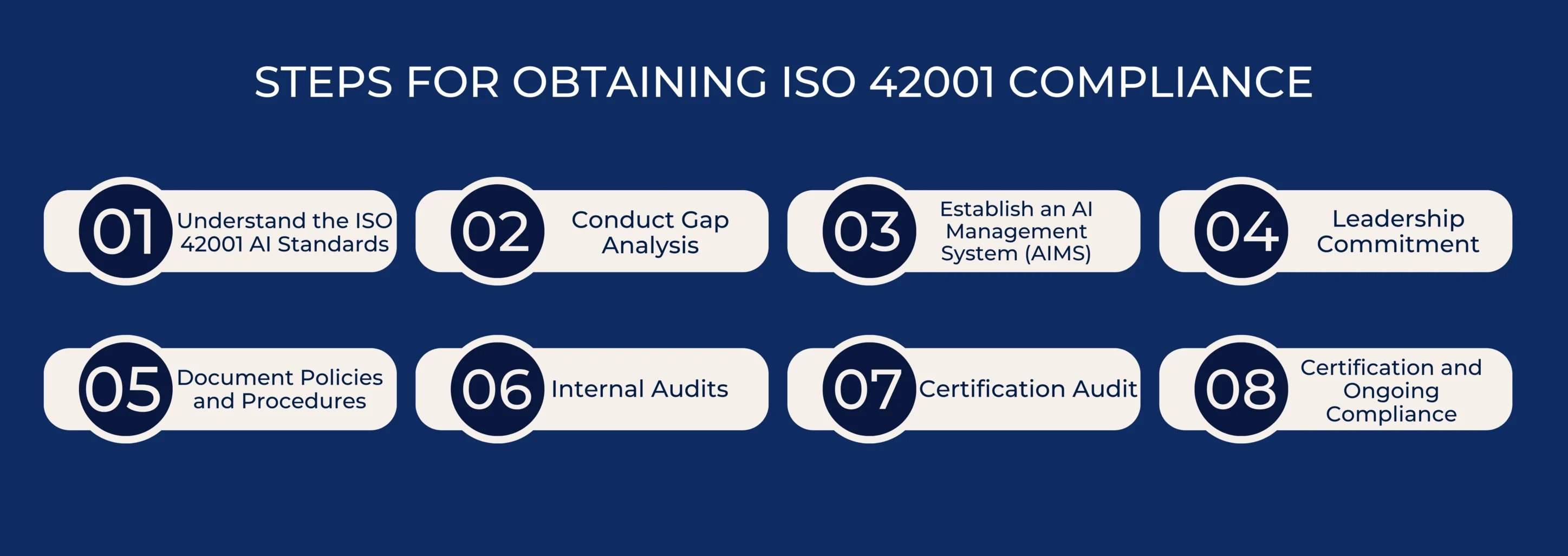
- ✓Application, Scoping, and Audit Program Determination
- ✓Stage 1 Audit: Documentation and AIMS Readiness Review
- ✓Stage 2 Audit: Conformity Assessment and Evidence Evaluation
- ✓Nonconformity Resolution, Certification Decision, and Certificate Issuance
ISO 42001 Standard Requirements Evaluated During the Certification Audit
The ISO 42001 standard is organized around a high-level structure consistent with other ISO management system standards, covering Clauses 4 through 10 for the management system framework and Annex A for AI-specific controls. During an ISO 42001 certification audit in Minneapolis, CertPro evaluates the organization’s AIMS against all applicable clauses and the Annex A controls selected based on AI risk assessment and impact assessment outcomes.
The standard requires organizations to systematically identify and address risks and opportunities associated with their AI systems, establish documented AI governance structures, and demonstrate continual improvement of the AIMS over time. ISO 42001 compliance is assessed across all of these dimensions during the certification audit.
ISO/IEC 42001:2023 Clauses 4 through 10 establish the management system requirements that form the foundation of the AIMS. Clause 4 requires organizations to determine their organizational context — including internal and external issues affecting AI governance, the needs and expectations of interested parties with respect to AI, and the defined scope of the AIMS. Clause 5 addresses leadership requirements, including top management commitment to the AI policy, defined organizational roles and responsibilities for AI governance, and integration of AIMS requirements into the organization’s business processes.
Clauses 6 and 7 cover planning — including AI risk management and AI impact assessment — and support requirements covering competence, awareness, and communication related to AI governance.
Clauses 8, 9, and 10 address operational controls, performance evaluation, and improvement requirements respectively. Clause 8 requires organizations to plan, implement, and control the processes needed to meet AIMS requirements — including AI risk treatment, AI impact assessment execution, and Annex A control operation. Clause 9 requires internal audit execution and management review at planned intervals, with documented records of findings and outputs. Clause 10 requires organizations to address nonconformities through corrective action and demonstrate continual improvement of the AIMS.
CertPro evaluates objective evidence across all applicable clauses during the ISO 42001 certification audit to determine conformity with each management system requirement.
Annex A of ISO/IEC 42001:2023 provides a reference set of AI-specific controls organized across domains addressing AI policies, internal organization governance, human resources considerations related to AI, responsible AI supply chain management, AI system lifecycle controls, and data governance for AI. Organizations determine which Annex A controls are applicable based on the results of their AI risk assessment and AI impact assessment processes. Controls not selected must be justified through documented rationale.
During the ISO 42001 certification audit, CertPro evaluates whether the organization’s selected Annex A controls are appropriately designed and operating effectively, and whether any exclusions are supported by adequate documented rationale consistent with AI risk and impact assessment outputs.
Key Annex A control domains evaluated during the ISO 42001 audit include controls related to AI system objectives and policies, AI risk management processes, AI impact assessment procedures, data quality and data governance for AI systems, AI transparency and explainability documentation, human oversight mechanisms, AI system performance monitoring, and AI supply chain and third-party AI provider management.
For Minneapolis organizations operating AI systems in healthcare, financial services, or other regulated environments, controls addressing human oversight, explainability, bias mitigation, and data governance are typically among the most substantively evaluated areas during the conformity assessment. ISO 42001 compliance evaluation covers both the design adequacy and the operational evidence for each applicable Annex A control.
ISO/IEC 42001:2023 requires organizations to establish and maintain AI risk management processes that identify, analyze, evaluate, and treat AI-related risks across the AI system lifecycle. AI risk assessments must document risk sources, potential impacts, likelihood determinations, and the controls selected to treat identified risks. The standard also requires AI impact assessments that evaluate potential impacts on individuals, groups, and society — covering areas such as privacy, fairness, safety, transparency, and accountability.
During the ISO 42001 certification audit, CertPro reviews the methodology, execution records, and outputs of both the AI risk assessment and AI impact assessment processes. This evaluation determines whether the organization’s approach conforms to the ISO 42001 standard’s requirements and whether treatment actions have been implemented and verified.
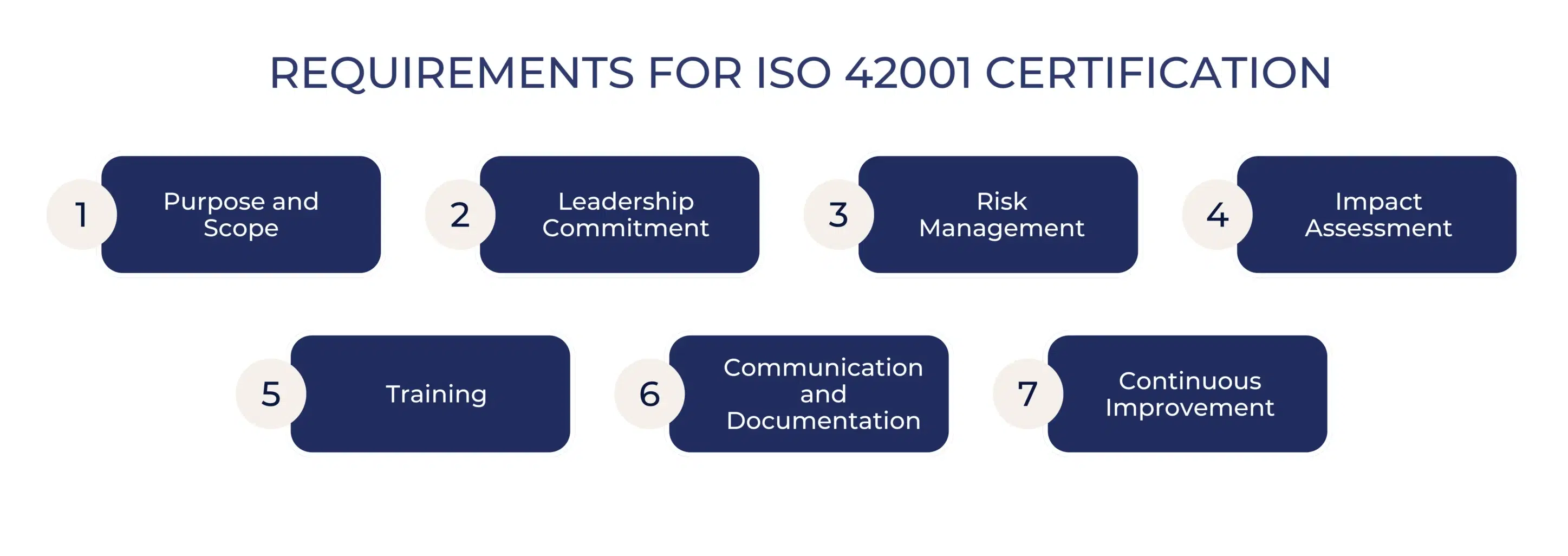
- ✓Management System Framework: Clauses 4 Through 10
- ✓Annex A Controls: AI-Specific Risk and Governance Requirements
- ✓AI Risk Management and AI Impact Assessment Requirements
Minneapolis Industry Sectors Pursuing ISO 42001 Certification
ISO 42001 Certification in Minneapolis is relevant across a broad range of industry sectors reflecting the Twin Cities’ diverse and technology-intensive economic base. Organizations in healthcare and medical technology, financial services and insurance, retail and consumer technology, manufacturing, food and agriculture technology, SaaS development, cloud computing, cybersecurity, data analytics, and AI-focused companies are actively pursuing ISO 42001 Certification as AI governance requirements intensify across enterprise procurement, regulatory expectations, and vendor assurance programs.
Healthcare, Medical Technology, and Life Sciences Organizations
Minneapolis is home to a nationally significant healthcare and medical technology ecosystem, including major hospital systems, health insurance organizations, medical device manufacturers, and health IT companies. Many of these organizations deploy AI systems in clinical decision support, diagnostic imaging, patient risk stratification, claims automation, and population health management. AI systems used in clinical or health-related contexts face heightened scrutiny regarding safety, explainability, human oversight, and bias controls.
ISO 42001 Certification in Minneapolis for healthcare and medical technology organizations provides independent validation that AI governance controls addressing these specific risk domains have been assessed against the ISO/IEC 42001:2023 standard. Health system procurement teams and regulatory bodies increasingly expect documented AI governance frameworks from technology vendors operating in clinical environments.
Medical technology companies developing AI-enabled devices or software as a medical device (SaMD) face additional regulatory expectations from the U.S. Food and Drug Administration alongside broader AI governance requirements from health system customers. ISO 42001 compliance documentation is reviewed as part of vendor qualification and third-party risk management assessments conducted by large health system procurement organizations in the Twin Cities.
Independent ISO 42001 certification by a Licensed CPA Firm provides an objective, documented assessment outcome that can be referenced in vendor qualification questionnaires, request-for-proposal responses, and regulatory submissions addressing AI management practices.
Financial Services, Insurance, and Fintech Organizations
Minneapolis ranks among the largest financial services centers in the United States, with major banking institutions, insurance companies, investment management firms, and fintech companies operating extensively across the Twin Cities. Financial services organizations apply AI across credit scoring, fraud detection, anti-money laundering, algorithmic trading, customer service automation, underwriting, and actuarial analysis. The use of AI in credit and lending decisions is subject to U.S. regulatory expectations addressing fairness, explainability, and model risk management.
ISO AIMS Certification provides financial services organizations in Minneapolis with an independently assessed framework demonstrating that AI governance controls — including bias monitoring, explainability documentation, and human oversight — have been evaluated against the ISO 42001 standard.
Fintech companies and insurance technology providers based in Minneapolis frequently encounter AI governance due diligence requirements from enterprise banking and insurance partners, venture-backed portfolio review processes, and financial regulatory expectations. An ISO 42001 certification audit conducted by an independent Licensed CPA Firm produces a documented conformity assessment outcome that directly addresses the AI governance evidence typically requested in third-party risk management programs operated by large financial institutions.
ISO 42001 compliance documentation is increasingly referenced in enterprise contract negotiations and vendor onboarding processes within the regional financial services sector.
Retail Technology, SaaS, Cloud, and AI-Native Companies
Minneapolis is home to major global retail corporations and a growing ecosystem of retail technology, SaaS, cloud service, and AI-native companies. Retail organizations deploy AI across demand forecasting, inventory optimization, personalized marketing, fraud detection, and logistics. SaaS providers and cloud service organizations serving regulated enterprise customers increasingly face AI governance requirements embedded in customer contracts and procurement frameworks.
ISO 42001 Certification in Minneapolis for retail technology and SaaS companies provides an independently assessed certification confirming that AI management processes conform to the internationally recognized AIMS standard. This supports enterprise sales cycles where AI governance documentation is a defined procurement requirement.
- ✓Healthcare and medical technology organizations deploying clinical AI systems
- ✓Health insurance and managed care organizations applying AI in claims and utilization management
- ✓Banking and financial services firms using AI in credit, fraud, and compliance functions
- ✓Insurance carriers and insurtech companies applying AI in underwriting and risk assessment
- ✓Retail and consumer technology companies using AI in demand forecasting and personalization systems
- ✓SaaS providers and cloud service organizations serving regulated enterprise customers
- ✓AI-native companies and technology startups developing AI-powered products
- ✓Manufacturing and food and agriculture technology organizations deploying industrial AI systems
Why Minneapolis Organizations Pursue ISO 42001 Certification
ISO 42001 certification for Minneapolis companies is driven by a convergence of enterprise procurement expectations, regulatory developments, customer assurance requirements, and organizational AI governance objectives. The decision to pursue ISO 42001 Certification typically reflects demand from enterprise buyers conducting vendor AI governance reviews, requirements embedded in enterprise service agreements, expectations from regulated sector partners, and organizational commitments to responsible AI practices. The ISO 42001 standard provides the internationally recognized framework against which these AI management practices are independently evaluated and certified.
Enterprise Vendor Qualification and Third-Party Risk Management
Large enterprise organizations across healthcare, financial services, retail, and manufacturing sectors in Minneapolis have established third-party risk management programs that evaluate the AI governance practices of technology vendors and service providers. These programs increasingly request evidence of ISO 42001 compliance as a component of vendor qualification, contract renewal, and ongoing vendor assurance activities.
A Minneapolis-based SaaS provider serving a major health system, for example, may receive a vendor questionnaire requiring documentation of AI risk management processes, AI impact assessment records, Annex A control implementation, and evidence of independent third-party AI governance certification. An ISO 42001 certification audit conducted by CertPro as an independent Licensed CPA Firm produces a formal certification outcome that addresses these evidence requirements directly.
Third-party risk management programs operated by major Twin Cities financial institutions and health systems typically require vendor AI governance documentation during new vendor onboarding and periodic re-evaluation cycles. ISO 42001 certification audit outcomes — including the certification scope, audit period, and certification body credentials — are referenced in vendor security questionnaire responses, request-for-information submissions, and enterprise procurement due diligence packages.
Independent certification by a Licensed CPA Firm provides documented evidence that the organization’s AIMS has been evaluated by a qualified third-party assessor rather than relying solely on self-attestation. This distinction is critical in high-stakes enterprise procurement contexts where ISO 42001 Certification in Minneapolis carries measurable credibility value.
U.S. AI Governance Expectations and Regulatory Alignment
U.S. AI governance expectations are evolving across federal and state regulatory frameworks, sector-specific guidance, and executive policy directives. The U.S. National Institute of Standards and Technology AI Risk Management Framework (NIST AI RMF), sector-specific AI guidance from the Office of the Comptroller of the Currency and the Consumer Financial Protection Bureau, and AI-related provisions in evolving state privacy laws create a regulatory landscape where documented AI governance practices are increasingly expected.
ISO/IEC 42001:2023 aligns conceptually with NIST AI RMF functions of Govern, Map, Measure, and Manage — providing a certifiable international standard framework that supports alignment with U.S. AI governance expectations. ISO 42001 compliance documentation does not substitute for regulatory compliance determinations, but it provides structured evidence that supports broader alignment efforts.
Minneapolis organizations serving global enterprise customers or participating in international technology markets may also face AI governance requirements shaped by the European Union AI Act, which establishes risk-based obligations for AI system providers and deployers operating in EU markets. ISO 42001 compliance documentation provides a structured reference for demonstrating AI management practices alignment with international AI governance requirements across multiple jurisdictions.
While ISO 42001 Certification in Minneapolis does not constitute legal compliance with the EU AI Act or any specific regulatory framework, the independently assessed conformity evidence produced through the certification process supports broader AI regulatory alignment documentation efforts.
International Market Access and Global Enterprise Sales
Minneapolis-based technology companies expanding into international markets — particularly in Europe, the United Kingdom, and Asia-Pacific — encounter AI governance requirements that reference ISO/IEC 42001:2023 as the baseline standard for AI management system evaluation. ISO AIMS Certification provides internationally recognized documentation that is accepted across procurement frameworks in multiple countries and regions.
Global enterprise buyers conducting vendor qualification for AI-enabled software, cloud services, and data analytics platforms frequently request ISO 42001 certification evidence as a component of their vendor assurance programs. For Minneapolis technology companies pursuing enterprise contracts in regulated international markets, ISO 42001 certification audit outcomes produced by an independent Licensed CPA Firm provide conformity documentation that supports global sales and partnership development activities.
Benefits of ISO 42001 Certification for Minneapolis-Based Organizations
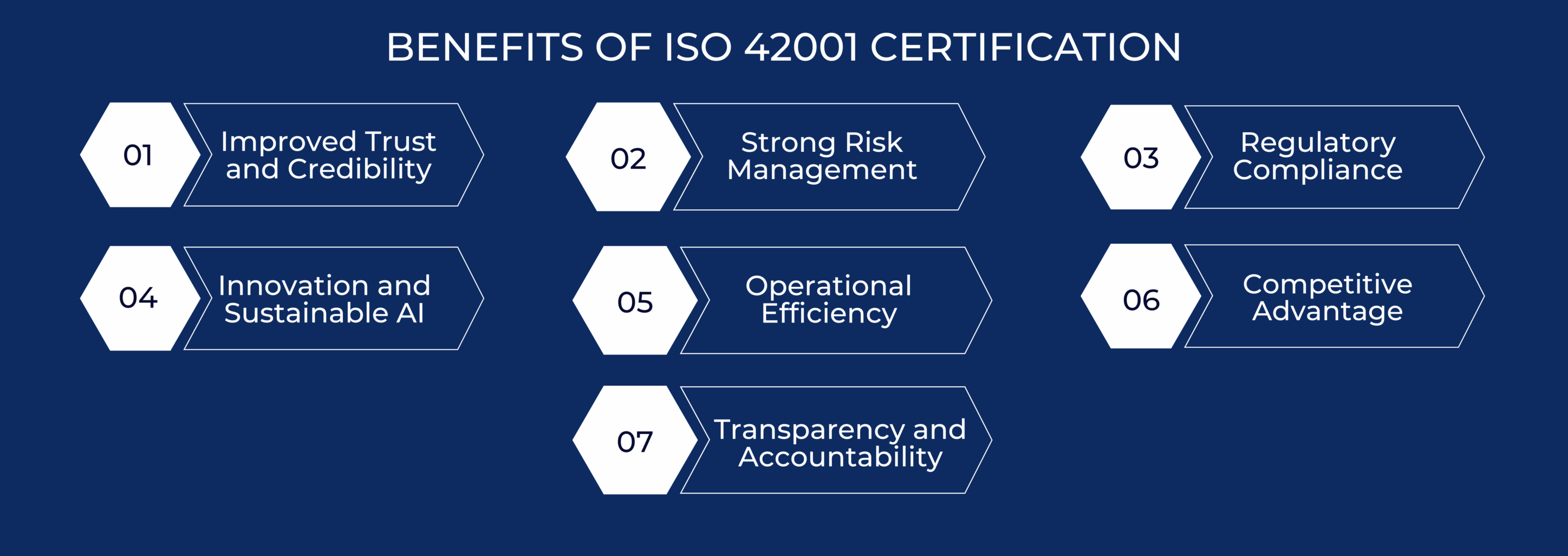
ISO 42001 Certification in Minneapolis delivers measurable organizational benefits that extend across AI governance, risk management, stakeholder assurance, and market positioning. The benefits described below reflect outcomes of achieving independent certification through a conformity assessment process — not promotional claims about expected results. Each benefit derives from specific aspects of the ISO 42001 standard and the independent certification audit methodology applied by CertPro as a Licensed CPA Firm.
ISO 42001 certification provides independent, third-party validation that an organization’s Artificial Intelligence Management System controls are designed appropriately and operating effectively in accordance with ISO/IEC 42001:2023 requirements. This independent validation is distinct from internal assessments or self-attestation, as the certification outcome reflects findings from a qualified external audit team conducting objective evidence review against defined standard requirements.
For Minneapolis organizations subject to enterprise vendor qualification requirements, the independent validation provided by ISO 42001 certification audit outcomes directly addresses procurement team requirements for third-party AI governance assurance. The certification also establishes a documented baseline of AI management control effectiveness that supports ongoing internal audit and management review activities.
Independent validation through the ISO 42001 certification audit also produces documented findings that identify areas where AI governance controls performed as designed and areas where improvement opportunities were identified. This structured audit output supports informed management decision-making regarding AI risk treatment priorities, resource allocation for AI governance improvement, and documentation of the organization’s AI management maturity trajectory.
The annual surveillance audit cycle associated with three-year ISO 42001 certification maintains ongoing independent oversight of AIMS control effectiveness — providing continuous third-party review rather than a single point-in-time assessment.
Achieving ISO 42001 certification requires organizations to demonstrate that structured AI risk management and AI impact assessment processes are established, documented, and operating as designed. This approach to AI risk management produces a documented risk and impact assessment record that can be referenced in internal governance reporting, board-level AI oversight activities, regulatory examinations, and enterprise vendor assurance processes.
Minneapolis organizations operating AI systems in healthcare, financial services, or other regulated environments benefit from the accountability documentation produced by ISO 42001 compliant AI risk management processes. Regulators and enterprise buyers increasingly expect evidence of systematic AI risk identification, assessment, and treatment — and ISO 42001 compliance provides that documented evidence trail.
- ✓Independent third-party validation of AIMS controls against ISO/IEC 42001:2023 requirements
- ✓Documented conformity assessment outcome for use in enterprise vendor qualification processes
- ✓Structured AI risk management and AI impact assessment documentation supporting regulatory alignment
- ✓Annex A control evaluation providing evidence of AI-specific governance control implementation
- ✓Annual surveillance audit cycle maintaining ongoing independent AIMS oversight
- ✓Internationally recognized ISO AIMS Certification supporting global enterprise market access
- ✓Formal nonconformity identification and corrective action documentation supporting continual improvement
- ✓Certification committee-reviewed conformity determination providing independent credibility
ISO 42001 certification for Minneapolis companies provides a differentiated position in enterprise procurement evaluations where AI governance certification is either required or weighted favorably. As large enterprise organizations across healthcare, financial services, and other sectors formalize AI vendor qualification requirements, organizations holding current ISO 42001 certification enter procurement processes with documented independent conformity evidence that self-attesting competitors cannot match.
The certification scope, audit period, and certification body credentials are reviewable by procurement teams — providing full transparency into the basis and boundaries of the conformity assessment. For Minneapolis SaaS providers, AI platform companies, and technology service organizations competing for enterprise contracts, ISO 42001 certification audit outcomes offer objective AI governance credentials that support differentiated positioning in competitive procurement contexts.
- ✓Independent Validation of AI Governance Controls
- ✓Structured AI Risk Management and Accountability Documentation
- ✓Competitive Differentiation in Enterprise AI Procurement
ISO 42001 Surveillance Audits and Certification Maintenance
ISO 42001 certification issued following a successful certification audit is valid for a three-year certification cycle, subject to annual surveillance audits and a recertification audit at the end of the three-year period. The surveillance and recertification program ensures that the certified organization’s AIMS continues to conform to ISO/IEC 42001:2023 requirements over time and that changes to AI systems, risk profiles, or operational context are reflected in updated AI governance controls and documentation.
CertPro conducts surveillance audits and recertification audits as independent assessments consistent with the same evidence-based methodology applied during the initial ISO 42001 certification audit.
Annual Surveillance Audit Program
Annual surveillance audits are conducted at approximately twelve-month and twenty-four-month intervals during the three-year certification cycle. The surveillance audit evaluates whether the certified AIMS continues to conform to ISO/IEC 42001:2023 requirements, with particular focus on internal audit execution, management review outputs, corrective action records, Annex A control operation, and any changes to the organization’s AI systems or context that affect the AIMS scope or risk profile.
Surveillance audit scope is determined based on initial certification audit findings, areas identified for monitoring, and any significant changes to the certified organization’s AI operations or management system. Identified nonconformities during surveillance audits require documented corrective action before certification status is confirmed as maintained.
Minneapolis organizations maintaining ISO 42001 certification through the surveillance audit cycle benefit from ongoing independent oversight that reinforces internal AIMS accountability and provides stakeholders with continuous evidence of maintained conformity. Enterprise customers and procurement teams that rely on ISO 42001 certification documentation in vendor qualification programs typically require current, in-scope certification rather than historical certification records.
Annual surveillance audits ensure that the certification remains current and reflects the organization’s actual AI management practices — a critical consideration for Minneapolis organizations using ISO 42001 certification in active vendor assurance and procurement contexts.
Recertification Audit and Certification Renewal
At the conclusion of the three-year certification cycle, a recertification audit is conducted to renew the ISO 42001 certificate for a subsequent three-year period. The recertification audit is a comprehensive evaluation of the AIMS, covering all applicable ISO/IEC 42001:2023 clauses and Annex A controls rather than the focused surveillance scope. Recertification audits evaluate the cumulative effectiveness of the AIMS over the certification cycle — including the outcomes of internal audits, management reviews, corrective actions, and any evolution of the organization’s AI systems or risk profile.
A successful recertification audit and certification committee decision results in issuance of a renewed ISO 42001 certificate confirming continued conformity. Organizations must initiate the recertification process sufficiently in advance of the current certificate expiry to maintain uninterrupted certification status.
CertPro: Independent ISO 42001 Certification Body for Minneapolis Organizations
CertPro is a Licensed CPA Firm providing independent, third-party ISO 42001 certification audits for Minneapolis-based organizations through conformity assessments conducted in accordance with ISO/IEC 42001:2023. CertPro operates exclusively as an independent certification body and does not provide consulting, advisory, implementation, readiness, or remediation services. This exclusive focus on independent certification audit activities ensures the objectivity and impartiality of the ISO 42001 certification audit process and the resulting certification decision.
Licensed CPA Firm Positioning and Audit Independence
CertPro’s status as a Licensed CPA Firm establishes a foundation of professional standards, independence requirements, and audit methodology rigor that differentiates its ISO 42001 certification audit services from non-CPA certification bodies. CPA professional standards impose independence requirements that prohibit providing advisory, consulting, or implementation services to audit clients — a structural protection for audit objectivity that aligns directly with the independence requirements expected of third-party certification bodies.
Minneapolis organizations engaging CertPro for ISO 42001 certification audits receive an independently conducted conformity assessment by a certification body operating under professional standards that reinforce audit independence at both the firm and engagement level.
The ISO 42001 certification audit process conducted by CertPro applies structured audit procedures, documented evidence collection, and a formal certification committee review that separates the audit team’s findings from the certification decision. This separation of audit execution and certification determination is a fundamental quality control mechanism — ensuring that the certification outcome reflects an objective review of all audit evidence rather than a single auditor’s judgment.
Minneapolis organizations that achieve ISO AIMS Certification through CertPro’s independent audit process receive a certification outcome grounded in professional audit standards, structured evidence evaluation, and independent committee review.
Scope of CertPro’s ISO 42001 Certification Services in Minneapolis
CertPro’s ISO 42001 certification services in Minneapolis encompass the complete certification audit lifecycle: initial application and scoping, Stage 1 documentation review, Stage 2 conformity assessment audit, nonconformity review, certification committee decision, certificate issuance, annual surveillance audits, and recertification audits. Each phase is conducted as an independent evaluation activity with no advisory component.
CertPro does not evaluate readiness, develop documentation, design controls, or provide guidance on how organizations should establish or operate their AIMS. The organization retains full responsibility for establishing and maintaining its AIMS. CertPro’s role is exclusively to assess conformity against ISO/IEC 42001:2023 requirements through structured independent audit procedures and produce a documented certification outcome based on objective evidence.
FAQ
▶
What is ISO 42001 certification and what does it certify?
▶
Which Minneapolis organizations need ISO 42001 certification?
▶
What is an Artificial Intelligence Management System (AIMS)?
▶
How does the ISO 42001 audit process work in Minneapolis?
▶
What documentation is reviewed during an ISO 42001 certification audit?
▶
What are the Annex A controls in ISO 42001 and how are they evaluated?
▶
How long is an ISO 42001 certificate valid?
▶
Does ISO 42001 certification cover regulatory compliance with U.S. AI laws?
ISO 42001 CERTIFIED: WHY AI GOVERNANCE CERTIFICATION IS BECOMING A BOARD-LEVEL REQUIREMENT
ISO 42001 Certified: Board-Level AI Governance Guide | CertPro CPA LLC HERO ══════════════════════════════ –> src=”https://certpro.com/wp-content/uplo…
Get In Touch
have a question? let us get back to you.