
ISO 42001 Certification in Minnesota
ISO 42001 Certification in Minnesota is conducted by CertPro as a Licensed CPA Firm performing independent third-party certification audits under ISO/IEC 42001:2023. CertPro evaluates an organization’s Artificial Intelligence Management System against the standard’s requirements and issues certification based solely on conformity evidence — not advisory relationships or implementation services. This independent approach ensures that every ISO 42001 certification audit reflects an objective, unbiased assessment of your AIMS.
OUR CLIENTS



ISO 42001 Certification for Minnesota-Based AI and Technology Organizations
ISO 42001 Certification in Minnesota is conducted by CertPro as a Licensed CPA Firm performing independent third-party certification audits under ISO/IEC 42001:2023. CertPro evaluates an organization’s Artificial Intelligence Management System against the standard’s requirements and issues certification based solely on conformity evidence — not advisory relationships or implementation services. This independent approach ensures that every ISO 42001 certification audit reflects an objective, unbiased assessment of your AIMS.
Minnesota’s technology, healthcare, financial services, insurance, manufacturing, retail, agriculture, and research sectors increasingly develop and deploy AI systems subject to enterprise vendor assurance, regulatory scrutiny, and third-party risk management expectations. ISO/IEC 42001:2023 — published by the International Organization for Standardization — defines the requirements for establishing, operating, monitoring, and continually improving an Artificial Intelligence Management System (AIMS). The ISO 42001 standard applies to any organization that provides or uses AI-based products and services, regardless of industry sector or organizational size. ISO 42001 Certification in Minnesota verifies that an organization’s AIMS conforms to those requirements through an independent, evidence-based audit process conducted by CertPro.
Minnesota occupies a distinctive position in the U.S. AI landscape. The state is home to globally recognized healthcare and medical technology organizations — including major health systems and medical device manufacturers — that integrate AI into diagnostic tools, clinical decision support, and patient management platforms. Its financial services and insurance sector, anchored in the Twin Cities metropolitan area, uses AI for underwriting, fraud detection, customer analytics, and algorithmic trading. Manufacturing enterprises across the state deploy AI for predictive maintenance, quality control, and supply chain optimization, while agricultural technology companies apply machine learning to precision farming, crop monitoring, and yield forecasting.
SaaS providers, cybersecurity firms, software developers, and AI-native companies are distributed across Minneapolis, Saint Paul, Rochester, Bloomington, and other technology centers, creating concentrated demand for independent AI governance verification. ISO 42001 Certification in Minnesota directly addresses the enterprise procurement and regulatory requirements these organizations face when demonstrating responsible AI governance to customers, regulators, and institutional stakeholders.
The ISO 42001 certification audit evaluates whether an organization’s documented AIMS, AI policies, AI risk management processes, AI impact assessments, Annex A controls, internal audit function, and management review practices conform to ISO/IEC 42001:2023 requirements. CertPro’s role is strictly that of an independent certification body — evaluating conformity against the standard, identifying nonconformities, and rendering a certification decision. The organization retains full responsibility for establishing, operating, and maintaining its AIMS.
CertPro does not provide implementation, policy development, control design, readiness assessment, or AI governance consulting services. The ISO 42001 standard shares structural alignment with ISO 9001, ISO 14001, and ISO 27001 through the High-Level Structure (HLS), enabling organizations with existing management system certifications to integrate AIMS requirements efficiently into their governance frameworks. ISO 42001 compliance that Minnesota enterprises seek reflects both internal governance maturity and external market expectations for independently verified AI accountability. CertPro issues ISO 42001 certification exclusively on the basis of audit evidence demonstrating conformity with the standard’s requirements across all applicable clauses and Annex A controls within the defined certification scope.

What Is the ISO 42001 Standard and What Does It Require?
ISO/IEC 42001:2023 is the first international standard establishing requirements for an Artificial Intelligence Management System. Published in December 2023 by ISO and IEC, the ISO 42001 standard provides organizations with a structured, certifiable framework for governing AI systems responsibly. It applies to organizations that develop, deploy, or operate AI-based products and services and establishes requirements across AI risk management, AI impact assessment, data governance, transparency, human oversight, and continual improvement. Conformity with the ISO 42001 standard is evaluated through an independent ISO 42001 certification audit conducted by an accredited or licensed third-party certification body such as CertPro.
Clause-Level Requirements of ISO/IEC 42001:2023
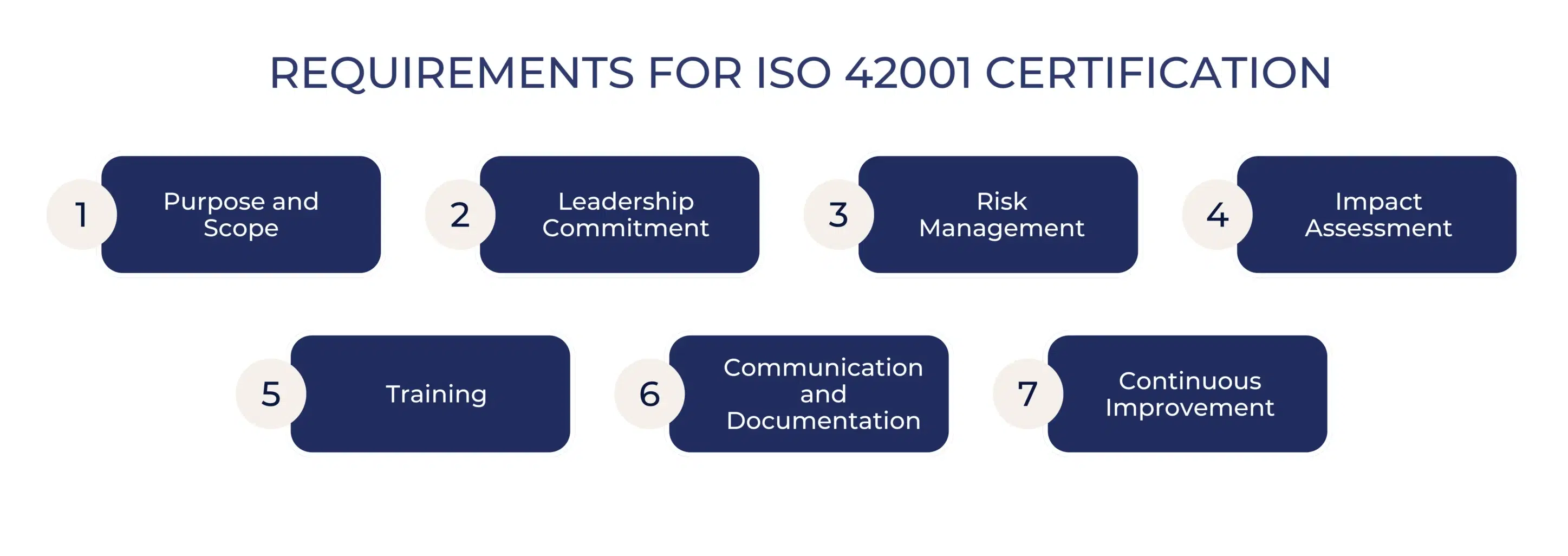
ISO/IEC 42001:2023 is structured across Clauses 4 through 10, following the High-Level Structure common to ISO management system standards. Clause 4 requires organizations to define the organizational context, identify internal and external issues relevant to AI, determine interested parties and their requirements, and establish the scope of the AIMS. Clause 5 establishes leadership requirements, including top management commitment, AI policy development, and assignment of roles and responsibilities for AI governance.
Clause 6 covers planning, requiring organizations to address AI-related risks and opportunities, establish AI objectives, and integrate those objectives into operational processes. Clause 7 addresses support requirements including resources, competence, awareness, communication, and documented information. Clauses 8 through 10 cover operational planning and control, performance evaluation through internal audit and management review, and continual improvement processes. Each clause is evaluated during the ISO 42001 certification audit for documented conformity and evidence of effective implementation.
Annex A Controls Under the ISO 42001 Standard
Annex A of ISO/IEC 42001:2023 provides a reference set of AI-specific controls that organizations select and implement based on their AI risk profile and the outcomes of their AI impact assessments. Annex A controls address areas including AI system impact assessment processes, AI system documentation, data governance for AI, AI lifecycle management, transparency and explainability of AI systems, human oversight mechanisms, AI system robustness and reliability, and responsible AI design principles.
The organization documents its control selections in a Statement of Applicability (SoA), justifying inclusions and exclusions based on risk assessment outcomes. During the ISO 42001 AIMS audit, CertPro evaluates whether the controls identified in the SoA have been designed and implemented in conformity with the ISO 42001 standard’s requirements. Controls that are excluded must be supported by documented rationale, and that rationale is subject to audit evaluation.
AI Risk Management and AI Impact Assessment Requirements
ISO/IEC 42001:2023 requires organizations to establish, implement, and maintain an AI risk management process that identifies, analyzes, evaluates, and treats risks associated with AI systems throughout their lifecycle. Risk treatment options include avoiding, mitigating, transferring, or accepting identified risks. Treatment decisions must be documented with evidence of authorization by appropriate management.
Separately, the standard requires organizations to conduct AI system impact assessments evaluating the potential effects of AI systems on individuals, groups, and society. Impact assessments must consider ethical considerations, fairness, privacy, safety, and societal impact. Both the risk management process and impact assessment methodology are evaluated during the ISO 42001 assessment to determine whether they conform to the standard’s requirements and whether outputs are used to inform AIMS decisions. Minnesota organizations operating AI systems in regulated sectors such as healthcare and financial services face heightened scrutiny in these areas due to the sensitivity of AI-driven decisions affecting patients, consumers, and financial market participants.
ISO 42001 Certification Audit Process in Minnesota
The ISO 42001 certification audit process conducted by CertPro for Minnesota organizations follows a structured, multi-stage program designed to assess conformity with ISO/IEC 42001:2023 requirements through objective evidence evaluation. The process is consistent with internationally recognized certification audit methodology and covers application review, audit program determination, Stage 1 documentation review, Stage 2 on-site or remote audit, nonconformity review, and certification committee decision.
Each stage produces documented outputs that form the basis for the certification decision. ISO 42001 audit engagements in Minnesota are scoped to the specific AI systems, business functions, and organizational units that fall within the defined AIMS certification scope.
| Audit Stage | Key Activities | Output |
|---|---|---|
| Application Review | Scope confirmation, conflict-of-interest check, audit program planning | Audit program and engagement confirmation |
| Stage 1 Audit | Review of AIMS documentation, AI policy, risk assessment, SoA, and scope definition | Stage 1 findings report and readiness determination |
| Stage 2 Audit | On-site or remote evaluation of AIMS implementation, control effectiveness, and objective evidence | Audit findings report with conformities and nonconformities identified |
| Nonconformity Review | Organization submits corrective action evidence; auditor evaluates adequacy of response | Nonconformity closure determination |
| Certification Decision | Independent certification committee reviews full audit file and renders certification decision | ISO 42001 certificate issued or withheld |
The Stage 1 audit is a structured review of the organization’s AIMS documentation conducted prior to the Stage 2 field audit. During Stage 1, CertPro auditors review the organization’s AI policy, AIMS scope statement, AI risk assessment records, AI impact assessment documentation, Statement of Applicability, AI objectives, and all documented information required by ISO/IEC 42001:2023 clauses.
The Stage 1 audit also evaluates whether the organization has identified its context, determined relevant interested parties, and established an internal audit and management review program consistent with the standard’s requirements. Stage 1 findings are documented in a report that identifies areas of conformity, potential concerns, and any issues that must be resolved before Stage 2 proceeds. This stage does not evaluate operational implementation or control effectiveness — those evaluations occur at Stage 2. Minnesota organizations undergoing an ISO 42001 audit should have their core AIMS documentation completed and internally reviewed before Stage 1 commences.
The Stage 2 audit constitutes the primary conformity assessment and evaluates whether the organization’s AIMS has been implemented and is operating in conformity with ISO/IEC 42001:2023 requirements. CertPro auditors collect and evaluate objective evidence through document review, personnel interviews, observation of processes, and examination of records.
Evidence evaluated during Stage 2 includes AI risk treatment records, AI impact assessment outputs, Annex A control implementation records, internal audit reports, management review minutes, corrective action records, and monitoring and measurement data. The ISO 42001 certification audit at Stage 2 covers all clauses from 4 through 10 and evaluates the Annex A controls documented in the SoA. Auditors identify conformities and nonconformities, with nonconformities classified based on the nature and extent of the departure from the standard’s requirements. The Stage 2 audit report documents all findings and provides the evidentiary basis for the certification committee’s decision.
ISO 42001 certification issued by CertPro is valid for a three-year certification cycle, subject to satisfactory surveillance audits conducted at defined intervals. Surveillance audits evaluate the continued conformity of the AIMS with ISO/IEC 42001:2023 requirements, including any changes to AI systems, organizational structure, or AIMS scope that occurred since the previous audit.
Surveillance audits assess whether internal audits and management reviews are being conducted as required, whether nonconformities identified in previous audits have been effectively addressed, and whether AI risk management and impact assessment processes remain active and effective. At the end of the three-year cycle, a recertification audit is conducted to renew the certificate. Failure to maintain conformity or to address identified nonconformities within required timeframes may result in suspension or withdrawal of certification. ISO 42001 certification audit engagements in Minnesota follow this structured surveillance program to maintain the integrity of the certification over time.
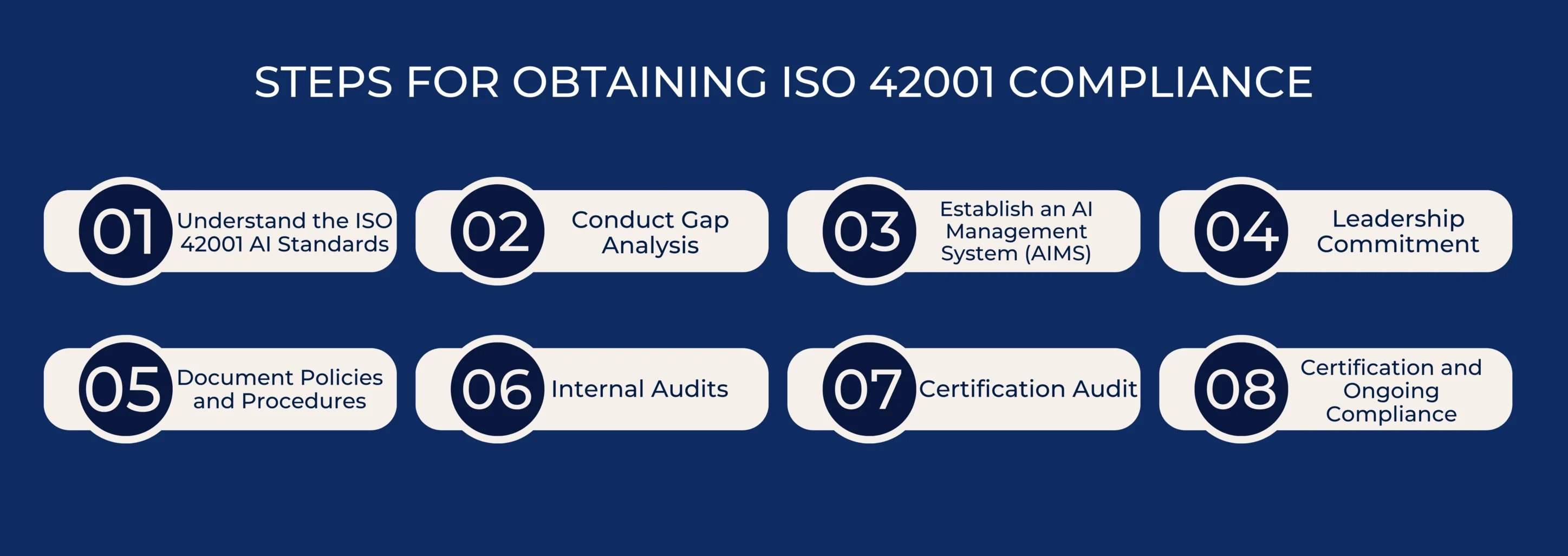
- ✓Stage 1 Audit: Documentation and Scope Review
- ✓Stage 2 Audit: Implementation and Evidence Evaluation
- ✓Surveillance Audits and Certification Validity
Minnesota Industries Pursuing ISO 42001 Certification
ISO 42001 Certification in Minnesota spans a wide range of industries and organizational types, driven by the state’s diverse technology and innovation ecosystem. Minnesota organizations pursue ISO 42001 certification to demonstrate independently verified AI governance to enterprise customers, regulated institutions, procurement bodies, and institutional investors who require evidence of responsible AI management practices. The sectors below represent the primary demand base for ISO 42001 compliance that Minnesota organizations seek to satisfy.
Healthcare, Medical Technology, and Life Sciences
Minnesota is home to major health systems, academic medical centers, and globally recognized medical technology companies that integrate AI into clinical decision support, diagnostic imaging analysis, medical device functionality, patient monitoring, and administrative automation. AI systems operating in healthcare and medical technology environments are subject to FDA regulatory oversight, HIPAA requirements, and enterprise vendor assessment programs maintained by hospital systems and health insurance organizations.
ISO 42001 Certification in Minnesota provides healthcare and medical technology organizations with independently verified evidence that their AIMS conforms to international requirements for AI risk management, AI impact assessment, data governance, and human oversight. These requirements are increasingly incorporated into vendor qualification programs maintained by major Minnesota health systems and payers. Organizations developing AI-enabled medical devices must also navigate FDA’s AI/ML-based Software as a Medical Device (SaMD) framework, making a structured AIMS aligned with the ISO 42001 standard a directly relevant governance instrument.
Financial Services, Insurance, and Fintech
The Twin Cities metropolitan area hosts a significant concentration of financial services institutions, insurance carriers, and fintech companies that deploy AI for underwriting, credit scoring, fraud detection, customer segmentation, investment analytics, and claims processing. Minnesota financial services organizations operate under federal regulatory frameworks including OCC guidance on model risk management, Federal Reserve supervisory expectations, and state-level Minnesota Department of Commerce oversight.
AI systems used in credit decisions, insurance underwriting, and financial product recommendations are subject to fairness, transparency, and explainability requirements that align directly with ISO/IEC 42001:2023 provisions. Enterprise vendor security and AI governance reviews conducted by large financial institutions increasingly require ISO 42001 compliance that Minnesota technology suppliers must demonstrate. ISO 42001 Certification in Minnesota for financial services and insurance organizations provides third-party verification that AI risk management, impact assessment, and transparency controls conform to the international standard.
Manufacturing, Retail, Agriculture, and Software Development
Minnesota’s manufacturing sector applies AI across predictive maintenance, quality inspection, robotics integration, and supply chain management platforms. Agricultural technology organizations in the state use machine learning for precision agriculture, crop disease detection, and automated harvesting equipment. Retail enterprises deploy AI recommendation engines, demand forecasting systems, and customer analytics platforms. SaaS providers and software development companies distributed across the state build AI-enabled applications for enterprise customers across regulated and unregulated industries.
Each of these contexts generates demand for ISO 42001 certification as enterprise procurement programs incorporate AI governance verification requirements into vendor qualification processes. ISO 42001 certification audit engagements conducted by CertPro evaluate the AIMS maintained by organizations in each of these sectors against the requirements of ISO/IEC 42001:2023, documenting conformity based on objective evidence collected during the audit program.
ISO 42001 Certification Requirements and Evaluation Criteria
ISO 42001 compliance is evaluated against the full requirements of ISO/IEC 42001:2023, encompassing management system clauses and Annex A controls selected in the organization’s Statement of Applicability. The ISO 42001 assessment conducted by CertPro is evidence-based — each requirement must be supported by documented information demonstrating that the requirement has been addressed and that associated processes are operational. The following areas constitute the primary evaluation criteria during an ISO 42001 certification audit.
ISO/IEC 42001:2023 requires organizations to maintain specific documented information as evidence of AIMS conformity. Core documentation evaluated during the ISO 42001 certification audit includes the AI policy, AIMS scope statement, AI risk assessment records, AI risk treatment plan, AI impact assessment documentation, Statement of Applicability, AI objectives and plans to achieve them, internal audit program and reports, management review records, and records of nonconformity and corrective action.
The AI policy must articulate the organization’s commitment to responsible AI development and deployment, be appropriate to the organization’s context, provide a framework for setting AI objectives, and be communicated to all relevant personnel. The AIMS scope statement must define the boundaries of the management system with sufficient precision to enable consistent audit evaluation. Documented information must be controlled in accordance with Clause 7.5 requirements, including version control, access controls, and retention periods appropriate to the nature of the records.
ISO/IEC 42001:2023 Clause 9.2 requires organizations to conduct internal audits at planned intervals to confirm whether the AIMS conforms to the organization’s own requirements and the standard’s requirements, and whether it is effectively implemented and maintained. Internal audit programs must define the frequency, methods, responsibilities, and reporting requirements for audits. Auditors must be selected to ensure objectivity and impartiality.
Management review, required by Clause 9.3, must evaluate AIMS performance — including internal audit results, monitoring and measurement data, AI risk management outputs, nonconformity and corrective action status, and opportunities for improvement. During the ISO 42001 AIMS audit, CertPro evaluates the internal audit program’s design, the objectivity of the audit function, the completeness of internal audit reports, and whether management review inputs and outputs conform to Clause 9.3 requirements. Deficiencies in internal audit or management review are among the most common sources of nonconformity identified during ISO 42001 certification audits.
The certification scope defines the boundaries within which ISO 42001 certification applies, specifying the AI systems, business units, locations, and processes covered by the AIMS. Scope determination is a critical step in the ISO 42001 certification process because it defines what is — and what is not — subject to audit evaluation. Organizations must document the scope with sufficient precision to avoid ambiguity and must ensure that all AI systems and processes within scope are fully addressed by the AIMS.
During the ISO 42001 assessment, CertPro evaluates whether the declared scope accurately reflects the organization’s AI activities and whether any exclusions from scope are appropriately justified. Scope limitations that appear designed to exclude high-risk AI systems from evaluation are subject to auditor scrutiny. Minnesota organizations with complex, multi-entity, or multi-site AI deployments must carefully define scope boundaries to ensure that all material AI governance activities are included within the certified AIMS perimeter.
- ✓Core AIMS Documentation Requirements
- ✓Internal Audit and Management Review Evaluation
- ✓Scope Determination and Certification Boundary Definition
Benefits of ISO 42001 Certification for Minnesota-Based Organizations
ISO 42001 Certification in Minnesota provides organizations with independently verified evidence of AI governance conformity that supports enterprise procurement qualification, regulatory engagement, and institutional stakeholder confidence. The following benefits reflect the verifiable outcomes associated with successful ISO 42001 certification audit completion.
- ✓Independent verification that the organization’s AIMS conforms to ISO/IEC 42001:2023 requirements, demonstrable to enterprise customers and procurement bodies
- ✓Structured ISO 42001 audit methodology that evaluates AI risk management, AI impact assessment, Annex A controls, internal audit function, and management review practices against the international standard
- ✓Recognition in enterprise vendor qualification programs that require independently certified AI governance from technology suppliers and AI service providers
- ✓Ongoing surveillance oversight through scheduled surveillance audits that maintain the certification’s credibility throughout the three-year certification cycle
- ✓Alignment with U.S. federal and state AI governance expectations, including NIST AI Risk Management Framework principles and emerging state-level AI accountability requirements
- ✓Facilitation of cross-sector procurement by demonstrating ISO 42001 compliance to customers in regulated industries including healthcare, financial services, and government
- ✓Integration pathway with ISO 27001 information security and ISO 9001 quality management systems through the High-Level Structure shared across ISO management system standards
- ✓Documented evidence base for AI-related regulatory inquiries, contractual obligations, and institutional investor due diligence reviews
Minnesota technology suppliers, SaaS providers, AI platform companies, and cloud service organizations increasingly encounter enterprise vendor qualification requirements that include AI governance verification as a precondition for contract award or renewal. Large healthcare systems, financial institutions, manufacturers, and government agencies operating in Minnesota have incorporated AI governance assessments into their third-party risk management programs. Vendors who deploy AI in their products or services are now routinely required to demonstrate conformity with recognized AI management standards.
ISO 42001 certification for Minnesota companies provides a standardized, independently audited instrument for satisfying these requirements — without subjecting individual vendors to multiple bespoke customer audits. The certification’s growing recognition in enterprise procurement programs reflects the institutionalization of AI governance verification as a core component of vendor risk management, paralleling the role that ISO 27001 certification has played in information security vendor qualification over the past decade.
ISO/IEC 42001:2023 aligns with the NIST AI Risk Management Framework (AI RMF 1.0), the EU AI Act’s requirements for high-risk AI systems, and emerging U.S. federal agency guidance on AI governance. Minnesota organizations subject to federal oversight — including FDA-regulated medical device manufacturers, OCC-supervised financial institutions, and federal contractors deploying AI in government service delivery — can demonstrate alignment with regulatory expectations through ISO 42001 compliance.
The standard’s requirements for AI impact assessment, transparency, human oversight, and continual improvement reflect the core principles articulated in U.S. executive orders on AI safety and the NIST AI RMF’s Govern, Map, Measure, and Manage functions. ISO 42001 certification provides a documented, externally verified record of conformity that organizations can reference in regulatory submissions, audit responses, and contractual representations regarding their AI governance practices.
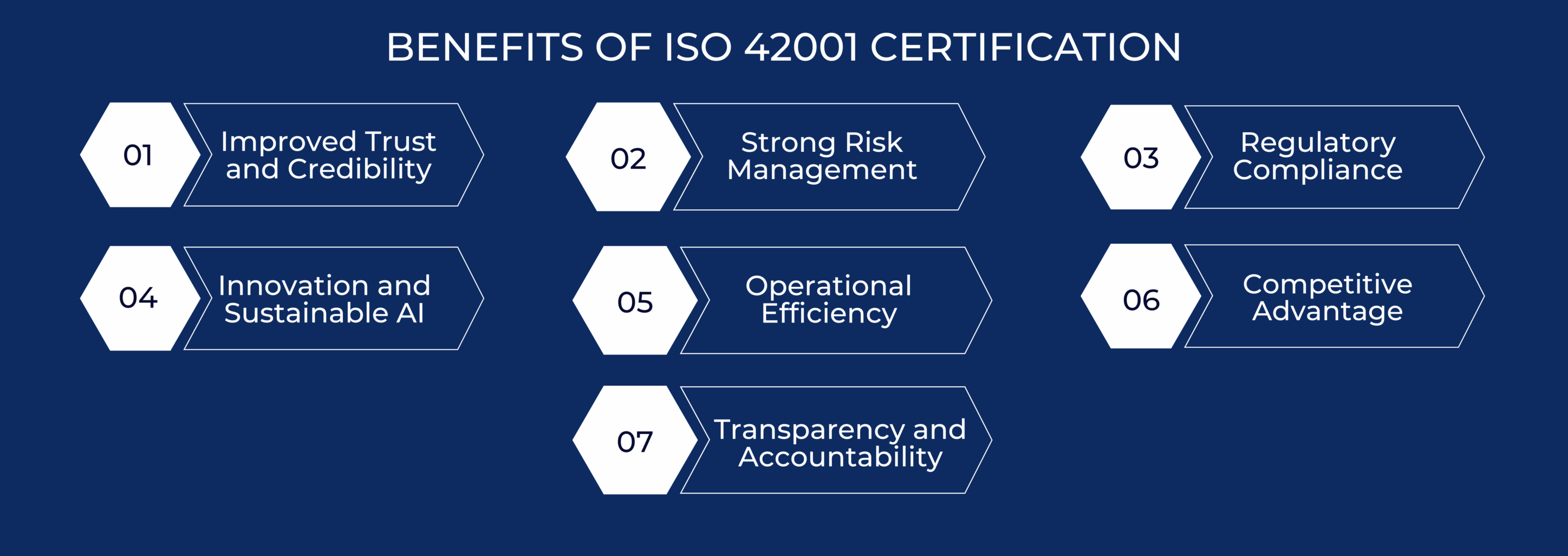
- ✓Enterprise Vendor Assurance and Procurement Recognition
- ✓Regulatory Alignment and AI Accountability Frameworks
How ISO 42001 Relates to Other Management System Standards
ISO/IEC 42001:2023 shares the High-Level Structure (HLS) adopted by all major ISO management system standards, enabling organizations with existing certifications in ISO 27001, ISO 9001, ISO 14001, or other HLS-aligned standards to integrate AIMS requirements into their existing governance framework. This structural alignment reduces duplication of documentation, governance processes, and internal audit activities when organizations pursue multiple management system certifications. The ISO 42001 standard also has specific technical relationships with ISO 27001 for information security and ISO 31000 for risk management — relationships that organizations should understand when designing their AIMS.
ISO 42001 and ISO 27001 Integration for Minnesota Organizations
ISO 27001 and ISO 42001 address complementary but distinct governance domains — information security management and AI management respectively. Many Minnesota organizations that develop or deploy AI systems already hold ISO 27001 certifications covering their information security management systems, creating a natural integration pathway for adding AIMS certification. Common elements across the two standards include context of the organization, risk assessment processes, documented information requirements, internal audit, management review, and continual improvement.
Organizations can reuse existing governance structures, committee charters, audit schedules, and document control frameworks when implementing the AIMS alongside the ISMS. However, the AI-specific requirements of ISO/IEC 42001:2023 — including AI impact assessments, AI lifecycle controls, and Annex A AI-specific controls — are distinct from ISO 27001’s Annex A information security controls and must be addressed through AIMS-specific documentation and processes. During an integrated certification audit, CertPro evaluates each standard’s requirements independently based on the evidence applicable to each management system.
ISO 42001 and the NIST AI Risk Management Framework
The NIST AI Risk Management Framework (AI RMF 1.0), published in January 2023, provides voluntary guidance for organizations managing AI risks in the United States. ISO/IEC 42001:2023, published in December 2023, provides internationally recognized, certifiable requirements for AI management systems. The two frameworks share conceptual alignment around AI risk identification, evaluation, treatment, and monitoring — but differ in their fundamental nature. The NIST AI RMF is a voluntary guidance document, while the ISO 42001 standard provides requirements subject to independent third-party certification audit.
Minnesota organizations that have adopted the NIST AI RMF as an internal governance framework will find that many of its core elements — Govern, Map, Measure, and Manage — correspond to requirements addressed by ISO/IEC 42001:2023 clauses and Annex A controls. However, NIST AI RMF alignment does not constitute ISO 42001 conformity. Achieving ISO 42001 Certification in Minnesota requires an independent audit evaluation against the standard’s full requirements conducted by a licensed certification body such as CertPro.
CertPro’s Role as an Independent ISO 42001 Certification Body in Minnesota
CertPro operates as a Licensed CPA Firm conducting independent third-party ISO 42001 certification audits for organizations in Minnesota. CertPro’s function is exclusively that of a certification body — evaluating conformity against ISO/IEC 42001:2023 requirements, documenting audit findings, and rendering an independent certification decision. CertPro does not provide advisory, implementation, consulting, training, or managed compliance services. This independence is fundamental to the integrity of every ISO 42001 certification issued and is maintained through conflict-of-interest controls, auditor competency requirements, and certification committee independence from the audit team.
Independent Certification Body Positioning and Conflict-of-Interest Controls
The independence of the ISO 42001 certification process requires that CertPro maintain strict separation between certification audit activities and any advisory or consulting services. CertPro does not establish AIMS frameworks, develop AI policies, design Annex A controls, or provide corrective action guidance for organizations it certifies. This separation ensures that every ISO 42001 audit conducted in Minnesota reflects an objective, unbiased evaluation of conformity based solely on evidence presented during the audit process.
Conflict-of-interest checks are conducted at the engagement initiation stage to confirm that CertPro has no prior advisory relationship with the organization being audited. Auditor assignments are reviewed for technical competency in AI management systems and relevant sector experience. The certification decision is made by a certification committee independent of the audit team, reviewing the complete audit file and rendering a determination based on documented evidence of conformity or nonconformity.
Auditor Competency and Sector-Specific Audit Capability
ISO 42001 certification audits require auditors with competency in AI management system requirements, AI risk management concepts, AI lifecycle processes, data governance, and the technical and organizational contexts in which AI systems operate. CertPro assigns auditors with demonstrated competency in ISO/IEC 42001:2023 requirements and relevant sector knowledge for each Minnesota engagement.
Sector-specific competency is particularly relevant for healthcare and medical technology organizations where AI systems interact with clinical processes and FDA-regulated device software, for financial services organizations where AI models are governed by model risk management requirements, and for agricultural technology organizations where AI systems operate in complex physical and biological environments. ISO 42001 AIMS audit engagements in Minnesota conducted by CertPro are scoped and staffed to reflect the technical and operational context of each organization’s AI systems — ensuring that evidence collection and evaluation are performed by auditors with the expertise required to assess complex, domain-specific AIMS implementations.
FAQ
▶
What is ISO 42001 certification and why does it matter for Minnesota organizations?
▶
Which Minnesota organizations need ISO 42001 certification?
▶
What is an Artificial Intelligence Management System (AIMS)?
▶
How long does the ISO 42001 certification audit process take in Minnesota?
▶
What is the difference between Stage 1 and Stage 2 of the ISO 42001 audit?
▶
How long is ISO 42001 certification valid?
▶
What is an ISO 42001 AIMS audit and how does it differ from an internal audit?
▶
Does ISO 42001 certification apply to AI systems provided by third parties?
ISO 42001 CERTIFIED: WHY AI GOVERNANCE CERTIFICATION IS BECOMING A BOARD-LEVEL REQUIREMENT
ISO 42001 Certified: Board-Level AI Governance Guide | CertPro CPA LLC HERO ══════════════════════════════ –> src=”https://certpro.com/wp-content/uplo…
Get In Touch
have a question? let us get back to you.