
ISO 42001 Certification in New Jersey
ISO 42001 Certification in New Jersey spans a broad range of industries and organizational types. The state’s concentration of technology, life sciences, financial services, and healthcare organizations creates diverse demand for AI management system certification — driven by customer requirements, enterprise governance mandates, regulatory expectations, and competitive differentiation.The following sectors represent primary areas of ISO 42001 certification activity across New Jersey, each with distinct AI governance drivers and AIMS implementation priorities.
OUR CLIENTS





ISO 42001 Certification in New Jersey for AI and Technology Organizations
ISO 42001 Certification in New Jersey is conducted by CertPro, a Licensed CPA Firm operating as an independent third-party certification body. CertPro evaluates organizations against ISO/IEC 42001:2023 — the international standard for Artificial Intelligence Management Systems (AIMS) — issuing formal certification to organizations that demonstrate conformance through an independent ISO 42001 certification audit and assessment process.
ISO 42001 Certification in New Jersey is available to organizations across all industries that develop, provide, integrate, or deploy AI systems. Eligible sectors include AI technology companies, SaaS providers, cloud service providers, cybersecurity firms, fintech businesses, financial institutions, pharmaceutical and life sciences organizations, healthcare technology companies, biotechnology companies, telecommunications providers, data center operators, logistics businesses, and enterprises using AI in core business operations.
ISO/IEC 42001:2023 — The International AIMS Standard
ISO/IEC 42001:2023 is the first international standard specifically addressing Artificial Intelligence Management Systems (AIMS). Published jointly by the International Organization for Standardization (ISO) and the International Electrotechnical Commission (IEC) in 2023, the ISO AIMS standard establishes requirements for organizations to design, implement, maintain, and continually improve a structured management system for AI.
The standard addresses AI risk management, AI objectives, AI policies, human oversight of AI systems, transparency, accountability, data governance, and a comprehensive set of Annex A controls applicable to AI system lifecycle management. The ISO AIMS standard recognizes that organizations deploying AI systems face distinct risks related to algorithmic decision-making, data quality, bias, privacy, security, and third-party AI dependencies — all of which require a structured governance approach.
ISO/IEC 42001:2023 delivers this structure through a Plan-Do-Check-Act management system model applied specifically to AI contexts, forming the basis of every ISO 42001 assessment conducted in New Jersey and globally.
What ISO 42001 Certification Confirms
ISO 42001 certification confirms that an organization has established, implemented, maintained, and is continually improving an Artificial Intelligence Management System that meets the requirements of ISO/IEC 42001:2023. Certification is issued only after an independent ISO 42001 certification audit conducted by a licensed third-party certification body such as CertPro.
Specifically, the ISO 42001 assessment confirms that the organization has:
- Defined an AI policy with clear organizational commitments
- Established measurable AI objectives with documented plans
- Identified and assessed AI-related risks systematically
- Implemented appropriate controls drawn from Annex A
- Maintained required AIMS documentation
- Conducted internal audits at planned intervals
- Performed management reviews at leadership level
ISO 42001 certification does not confirm automatic compliance with New Jersey law, U.S. federal AI governance requirements, or industry-specific regulations. Rather, it confirms that an independent ISO 42001 audit has verified the organization’s AIMS against the international requirements of ISO/IEC 42001:2023.
Organizations operating across Newark, Jersey City, Princeton, Hoboken, New Brunswick, Edison, Morristown, and the broader New Jersey technology ecosystem increasingly pursue this independent confirmation to demonstrate responsible AI governance to customers, partners, regulators, and stakeholders.
New Jersey’s AI and Technology Landscape
New Jersey occupies a strategically important position in the U.S. AI and technology ecosystem. The state hosts significant concentrations of pharmaceutical and life sciences companies in the Princeton, New Brunswick, and Parsippany corridors; major financial services and fintech firms in Jersey City and Newark; telecommunications and media companies across northern New Jersey; biotechnology and healthcare technology organizations throughout the state; and a growing base of AI-focused SaaS providers, cloud service operators, and cybersecurity companies.
New Jersey’s proximity to New York City and Philadelphia creates additional demand from enterprises deploying AI systems in financial services, professional services, logistics, and media. Universities and research institutions — including Rutgers University and Princeton University — contribute to the state’s AI research and commercialization environment.
Across these sectors, organizations are increasingly required by customers, enterprise procurement processes, and governance frameworks to demonstrate structured AI risk management. This makes ISO 42001 Certification in New Jersey a relevant and growing requirement in enterprise contracting and regulatory conversations across the state.

ISO 42001 Certification Audit Process in New Jersey
The ISO 42001 certification audit process in New Jersey follows a structured sequence of evaluation stages conducted by CertPro as an independent third-party certification body. The ISO 42001 audit process is designed to provide objective evidence that an organization’s AIMS conforms to the requirements of ISO/IEC 42001:2023.
The process encompasses scope definition, Stage 1 and Stage 2 audits, nonconformity review, certification decision, and ongoing surveillance. Each stage is conducted independently, without advisory or consulting input from the certification body, preserving the integrity of every ISO 42001 assessment.
The Stage 1 ISO 42001 audit evaluates the organization’s AIMS documentation and the degree to which the management system has been designed to meet the requirements of ISO/IEC 42001:2023. During Stage 1, CertPro auditors review the organization’s AI policy, AI objectives, risk assessment and risk treatment documentation, Statement of Applicability (where applicable), Annex A control selection rationale, internal audit records, and management review outputs.
Stage 1 also confirms that the organization’s defined AIMS scope is appropriate and that the organization understands the requirements of the ISO AIMS standard. The Stage 1 ISO 42001 assessment in New Jersey identifies any areas where AIMS documentation does not yet meet the standard’s requirements before the Stage 2 field audit proceeds.
Stage 1 findings are communicated formally to the organization. Transition to Stage 2 requires that any significant gaps identified during Stage 1 have been adequately addressed.
The Stage 2 ISO 42001 audit in New Jersey is the substantive conformance evaluation in which CertPro auditors assess whether the organization’s AIMS has been effectively implemented and is operating as documented. Stage 2 involves interviews with responsible personnel, review of operational evidence, testing of AIMS processes, and evaluation of Annex A control implementation across the defined scope.
Auditors examine evidence of AI risk assessments being conducted for AI systems within scope, risk treatment decisions being implemented, AI objectives being monitored, internal audits being performed, and management reviews being conducted at planned intervals.
The ISO 42001 compliance assessment at Stage 2 produces audit findings categorized as conformities, observations, minor nonconformities, or major nonconformities. Major nonconformities prevent certification until resolved and re-evaluated. Minor nonconformities are subject to corrective action verification during surveillance. The Stage 2 ISO 42001 audit produces the formal audit report that underpins the certification decision.
Following the ISO 42001 certification audit in New Jersey, CertPro’s certification decision process independently reviews the audit report and findings before issuing a certification determination. Certification is issued when the audit evidence demonstrates that the organization’s AIMS conforms to ISO/IEC 42001:2023 with no unresolved major nonconformities.
The ISO 42001 certificate is valid for three years, subject to satisfactory surveillance audits conducted at regular intervals — typically annually — during the certification cycle. Surveillance audits verify that the AIMS continues to operate effectively, that previously identified nonconformities have been addressed, and that the organization continues to maintain and improve its AIMS.
At the end of the three-year certification cycle, a recertification audit is required to renew the ISO 42001 certificate. The recertification ISO 42001 audit in New Jersey follows a scope and process similar to the initial Stage 2 audit, evaluating continued conformance and system improvement over the full certification period.
| Audit Stage | Primary Focus | Outcome |
|---|---|---|
| Stage 1 Audit | AIMS documentation review and scope confirmation | Stage 1 findings report; Stage 2 readiness determination |
| Stage 2 Audit | AIMS implementation and evidence evaluation | Formal audit report with conformity findings |
| Certification Decision | Independent review of Stage 2 audit report | ISO 42001 certificate issued or nonconformities actioned |
| Surveillance Audit | Continued AIMS operation and corrective action verification | Continued certification or corrective action required |
| Recertification Audit | Full AIMS re-evaluation at end of three-year cycle | Certificate renewed for subsequent three-year period |
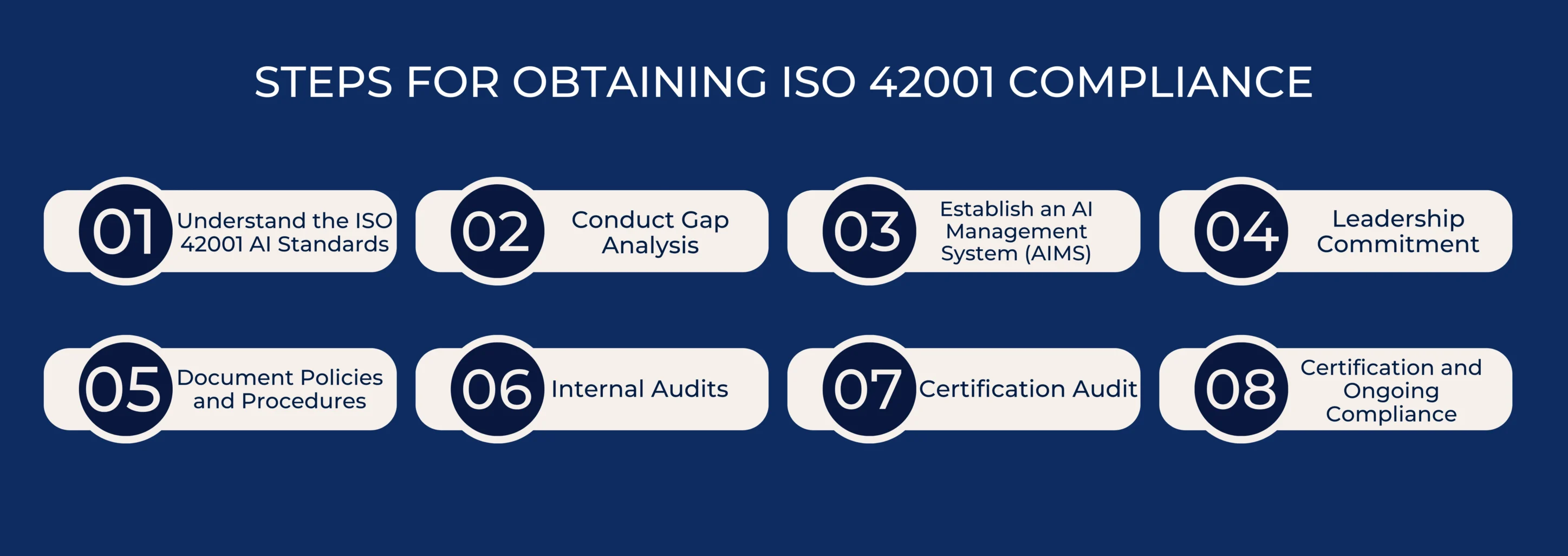
- ✓Stage 1 Audit — Documentation and Readiness Review
- ✓Stage 2 Audit — Implementation and Evidence Evaluation
- ✓Certification Decision, Issuance, and Surveillance
ISO 42001 Standard Requirements and AIMS Documentation
ISO/IEC 42001:2023 establishes specific requirements across multiple clauses covering organizational context, leadership, planning, support, operation, performance evaluation, and improvement. ISO 42001 compliance requires organizations to address each clause systematically and to maintain documented information demonstrating conformance.
The ISO AIMS standard is structured around the ISO High-Level Structure (HLS), making it compatible with other management system standards such as ISO 27001 (information security) and ISO 9001 (quality management). This compatibility enables integrated management system approaches where applicable, reducing duplication of documentation and audit effort for organizations already operating under related frameworks.
The core requirements of ISO/IEC 42001:2023 address the full lifecycle of an organization’s AI management activities. Organizations must define the scope of the AIMS, identifying which AI systems, processes, and organizational units fall within the management system boundary.
The standard requires organizations to establish an AI policy articulating commitments regarding responsible AI, human oversight, transparency, and accountability. AI objectives must be established at relevant functions and levels, with documented plans for achieving them and measurable metrics for monitoring progress.
The ISO 42001 assessment evaluates whether organizations have conducted structured AI risk assessments covering AI system design, data inputs, model behavior, outputs, deployment contexts, and third-party AI components. Risk treatment plans must select appropriate controls — drawn from Annex A or justified from other sources — and document the rationale through a Statement of Applicability or equivalent mechanism. Evidence of risk treatment implementation is a primary focus of every ISO 42001 audit conducted in New Jersey.
Annex A of ISO/IEC 42001:2023 provides a reference set of AI management controls organized across multiple domains, including AI policy, internal organization, resources for AI systems, assessing AI system impacts, AI system lifecycle management, data management for AI systems, third-party and supplier relationships, information for interested parties, and use of AI systems.
Organizations must evaluate which Annex A controls are applicable within their AIMS scope and document their control selection decisions. Controls related to AI system lifecycle management address requirements at the design, development, testing, deployment, monitoring, and decommissioning stages of AI systems.
Data management controls address data quality, data provenance, data bias assessment, and data governance practices that underpin AI system performance and risk management. Third-party and supplier controls address AI components, models, datasets, and services sourced from external providers — a consideration of particular relevance to New Jersey organizations integrating externally developed AI models and cloud-based AI services into their operations. Correct Annex A control implementation is evaluated during every ISO 42001 certification audit in New Jersey.
ISO/IEC 42001:2023 requires organizations to establish and maintain an internal audit program for the AIMS, with audits conducted at planned intervals to determine whether the management system conforms to the organization’s own requirements and to the requirements of the standard. Internal audit results must be reported to management, and the organization must take corrective actions to address any identified nonconformities.
Separately, top management must conduct management reviews of the AIMS at planned intervals — evaluating AIMS performance, AI objectives achievement, audit findings, risk assessment updates, and opportunities for improvement.
Evidence of both internal audits and management reviews is examined during the ISO 42001 certification audit in New Jersey as indicators of whether the AIMS is operating as a functioning, continually improving management system rather than as a static documentation exercise. The absence of documented internal audit or management review records is typically treated as a significant conformance concern during the ISO 42001 assessment.
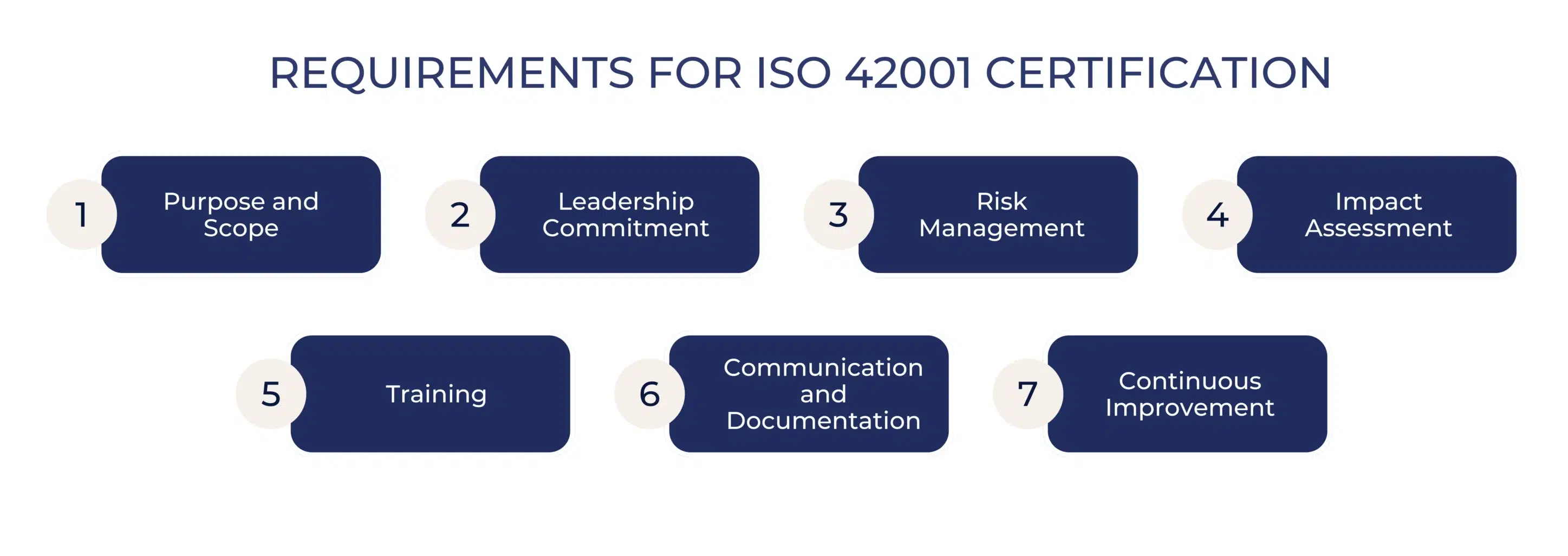
- ✓Core AIMS Requirements Under ISO/IEC 42001:2023
- ✓Annex A Controls and AI System Lifecycle Management
- ✓Internal Audits and Management Review Requirements
New Jersey Business Sectors Pursuing ISO 42001 Certification
ISO 42001 Certification in New Jersey spans a broad range of industries and organizational types. The state’s concentration of technology, life sciences, financial services, and healthcare organizations creates diverse demand for AI management system certification — driven by customer requirements, enterprise governance mandates, regulatory expectations, and competitive differentiation.
The following sectors represent primary areas of ISO 42001 certification activity across New Jersey, each with distinct AI governance drivers and AIMS implementation priorities.
Pharmaceutical, Life Sciences, and Healthcare Technology
New Jersey is home to a globally significant concentration of pharmaceutical and life sciences companies, including major enterprises headquartered in Princeton, New Brunswick, Parsippany, and Bridgewater. These organizations increasingly deploy AI systems in drug discovery, clinical trial design, pharmacovigilance, manufacturing quality control, supply chain optimization, and patient data analytics.
The use of AI in regulated pharmaceutical and healthcare contexts introduces requirements for documented AI risk management, validation of AI system behavior, data governance, and human oversight — requirements that align directly with ISO/IEC 42001:2023. Healthcare technology companies, biotechnology firms, and medical device organizations operating in New Jersey face similar AI governance demands, particularly where AI systems influence clinical decisions, patient safety monitoring, or regulated processes.
ISO 42001 compliance for these New Jersey organizations provides a structured framework for documenting and independently confirming AI governance practices in a sector subject to U.S. FDA oversight and increasing regulatory attention to AI-enabled medical products and processes.
Financial Services, Fintech, and Insurance
New Jersey’s financial services sector — concentrated in Jersey City, Newark, and Hoboken, directly adjacent to the New York City financial market — includes major banks, asset managers, insurance companies, fintech startups, and financial technology platform providers. These organizations deploy AI systems for credit decisioning, fraud detection, algorithmic trading, customer service automation, risk modeling, and regulatory reporting.
AI governance certification is increasingly referenced in enterprise risk management frameworks, vendor due diligence processes, and emerging regulatory guidance from U.S. financial regulators addressing algorithmic accountability and model risk management. Through ISO 42001 Certification in New Jersey, financial services organizations can demonstrate structured AI risk management, documented control environments, and independent third-party verification of AIMS conformance.
The ISO 42001 assessment evaluates whether financial services organizations have addressed AI system risks specific to high-stakes decisioning contexts — including fairness, explainability, data integrity, and auditability of AI model behavior.
Technology, Telecommunications, and Data Center Operators
New Jersey hosts a substantial base of technology companies, telecommunications providers, and data center operators — including major national carrier facilities, cloud infrastructure providers, and managed service organizations — that develop or integrate AI capabilities into their products and services.
SaaS providers and cloud service companies embedding AI features into enterprise software face increasing demand from business customers to demonstrate that AI systems are governed through a structured, independently audited management framework. Telecommunications companies deploying AI for network optimization, predictive maintenance, customer experience management, and security operations face similar expectations from enterprise clients and infrastructure partners.
The ISO 42001 audit for these New Jersey technology sector organizations evaluates AIMS implementation across the full scope of AI systems under management — including proprietary models, third-party AI APIs, and AI-enabled automation platforms. Data center operators and managed service providers using AI for infrastructure management and security monitoring represent an additional and growing category of New Jersey organizations engaged in the ISO 42001 certification process.
Benefits of ISO 42001 Certification for New Jersey-Based Organizations
ISO 42001 Certification in New Jersey delivers measurable organizational benefits extending across governance, risk management, commercial positioning, and stakeholder confidence. The following benefits reflect outcomes associated with achieving independent certification against the ISO AIMS standard, as observed across organizations in technology, financial services, life sciences, and enterprise AI deployment contexts.
ISO 42001 certification establishes a documented, independently verified framework for AI governance and risk management within the organization. Certification confirms that the organization has defined accountability for AI systems at the leadership level, established an AI policy with clear commitments regarding responsible AI, and implemented a structured process for identifying, assessing, and treating AI-related risks.
This governance structure provides boards, senior executives, and audit committees with documented evidence that AI risk is being managed through a systematic, audited process — a consideration of growing importance as AI governance becomes a board-level concern in financial services, life sciences, and technology organizations.
The ISO 42001 audit provides independent verification of governance claims, distinguishing organizations with substantiated AIMS implementation from those making unverified assertions. For New Jersey organizations subject to enterprise risk management requirements, regulatory expectations, or investor scrutiny regarding AI, the ISO 42001 certification audit delivers documented third-party confirmation of governance posture.
ISO 42001 Certification in New Jersey provides certified organizations with a documented, independently verified credential that can be presented in enterprise sales processes, vendor qualification reviews, request for proposal (RFP) responses, and customer due diligence questionnaires.
Enterprise customers in financial services, healthcare, pharmaceutical, and government sectors increasingly include AI governance requirements in vendor qualification criteria — requiring AI system providers to demonstrate structured AI risk management through independently verifiable means. ISO 42001 certification satisfies this requirement by providing third-party attestation of AIMS conformance against an internationally recognized standard.
New Jersey organizations certified under ISO/IEC 42001:2023 can reference their ISO 42001 compliance status in commercial negotiations and enterprise procurement processes where AI governance is evaluated. Certification also reduces the burden of responding to individual customer AI governance questionnaires by providing a standardized, independently audited framework that addresses common AI risk management inquiries systematically.
- ✓Independent third-party verification of AI risk management practices through a formal ISO 42001 certification audit
- ✓Structured AIMS documentation providing evidence of AI governance for enterprise customer due diligence
- ✓Board-level accountability framework for AI systems confirmed through the ISO AIMS standard
- ✓Reduced vendor questionnaire burden through a standardized, independently audited AI governance credential
- ✓Alignment with NIST AI RMF and international AI governance frameworks through ISO 42001 compliance
- ✓Competitive differentiation in enterprise markets requiring AI governance certification
- ✓Three-year certification with annual surveillance maintaining ongoing ISO 42001 compliance in New Jersey
- ✓Foundation for an integrated management system approach combining ISO 42001 with ISO 27001 or ISO 9001
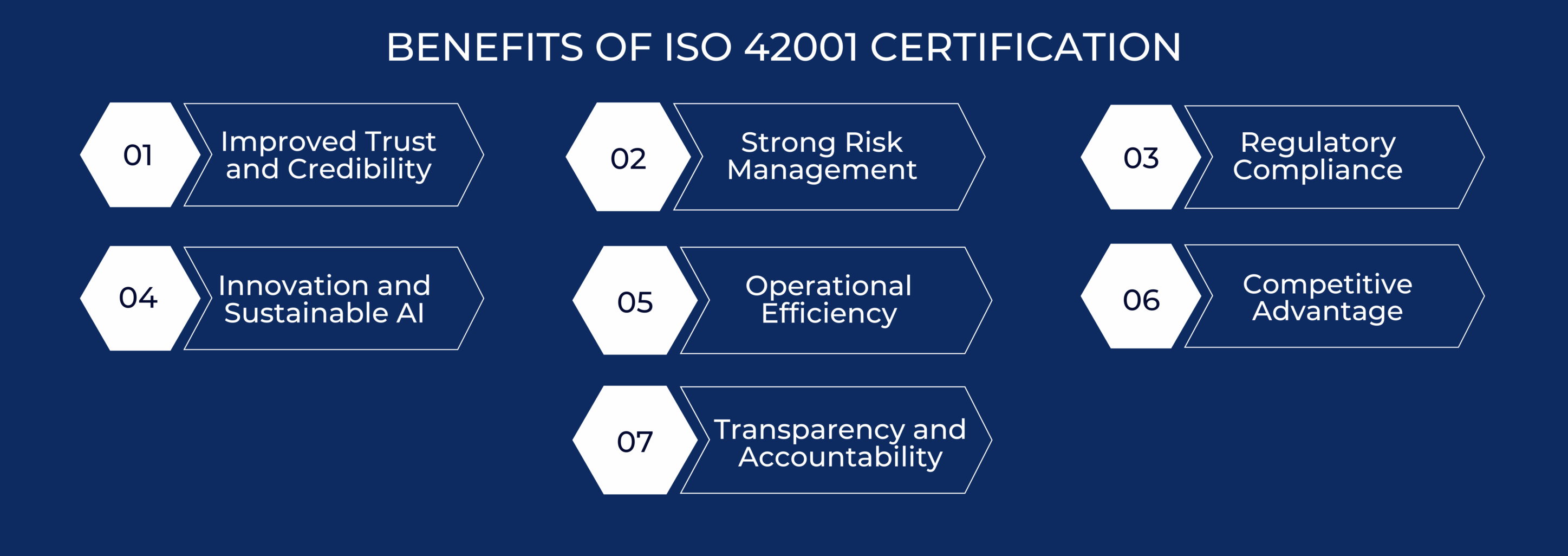
- ✓Governance, Risk Management, and Accountability
- ✓Commercial and Procurement Advantages
ISO 42001 Compliance and Integration with Other Management System Standards
ISO 42001 compliance is designed to integrate with existing management system frameworks through the ISO High-Level Structure (HLS) that underpins multiple ISO management system standards. New Jersey organizations already certified under ISO 27001, ISO 9001, or other HLS-aligned standards can integrate AIMS requirements into their existing management system infrastructure — reducing duplication of documentation, internal audit activities, and management review processes where applicable.
The ISO 42001 assessment evaluates AIMS conformance independently, regardless of whether the AIMS is implemented as a standalone system or integrated with other management frameworks. This flexibility makes ISO 42001 Certification in New Jersey accessible to organizations at varying stages of management system maturity.
ISO 42001 and ISO 27001 Integration
ISO 27001, the international standard for Information Security Management Systems (ISMS), is the most frequently integrated standard with ISO 42001 among New Jersey technology, financial services, and healthcare organizations. Both standards share an HLS structure with common elements covering organizational context, leadership, planning, support, operation, performance evaluation, and improvement.
Organizations maintaining an ISO 27001 ISMS can extend their existing management system infrastructure to address AIMS-specific requirements — including AI risk assessment processes, AI policy, Annex A AI controls, and AI-specific documented information. The information security controls under ISO 27001 Annex A address security of AI system data, AI model assets, and AI system infrastructure, which are complementary to the AI-specific controls under ISO 42001 Annex A.
CertPro conducts the ISO 42001 audit in New Jersey as an independent assessment regardless of whether the organization is simultaneously certified under ISO 27001. The certification decision is based exclusively on conformance with ISO/IEC 42001:2023 requirements, ensuring the integrity of each ISO 42001 certification audit.
Relationship to NIST AI RMF and U.S. Regulatory Frameworks
The NIST AI Risk Management Framework (AI RMF), published by the National Institute of Standards and Technology in January 2023, provides voluntary guidance for U.S. organizations managing AI risk across four core functions: Govern, Map, Measure, and Manage. ISO/IEC 42001:2023 and the NIST AI RMF address complementary aspects of AI governance and risk management, and New Jersey organizations may draw on both frameworks when developing their AIMS.
However, ISO 42001 certification is an independent third-party conformance assessment against the specific requirements of ISO/IEC 42001:2023. It does not constitute certification against the NIST AI RMF, which is a voluntary guidance framework without a formal certification scheme.
Similarly, ISO 42001 compliance does not automatically establish compliance with New Jersey data privacy requirements, U.S. federal AI governance requirements, or sector-specific regulations from the FDA, SEC, OCC, or other regulators. Organizations must evaluate applicable legal and regulatory requirements independently of their ISO 42001 certification status.
ISO 42001 and Data Privacy Considerations
ISO 42001 Annex A includes controls addressing data management for AI systems — covering data quality, data provenance, data bias, and the governance of datasets used for AI model training, validation, and operation. These data governance controls are directly relevant to New Jersey organizations subject to data privacy requirements, including obligations under applicable U.S. state privacy laws, industry-specific data handling requirements, and contractual data protection obligations.
The ISO 42001 assessment evaluates whether the organization has implemented data governance controls appropriate to the AI systems within scope, including controls addressing personal data processed by AI systems.
Organizations in New Jersey’s financial services and healthcare sectors with specific data handling obligations under GLBA, HIPAA, or sector-specific regulations should assess how ISO 42001 data governance controls interact with their existing data protection frameworks. ISO 42001 certification addresses data governance from an AI management system perspective and is not a standalone privacy compliance certification — but it provides a meaningful governance layer that supports broader data protection programs.
Why New Jersey Organizations Pursue ISO 42001 Certification
Demand for ISO 42001 Certification in New Jersey is driven by a convergence of enterprise customer requirements, regulatory developments, governance expectations, and the strategic importance of AI systems to organizational operations. New Jersey’s position as a hub for pharmaceutical, financial services, technology, and telecommunications industries — all sectors experiencing accelerating AI adoption — positions the state’s organizations at the forefront of AI governance certification demand in the United States.
Enterprise Customer and Supply Chain Requirements
Enterprise organizations in financial services, pharmaceutical, government contracting, and healthcare sectors are increasingly incorporating AI governance requirements into vendor qualification and third-party risk management programs. New Jersey technology companies, SaaS providers, and AI system vendors serving these enterprise markets face growing demand to demonstrate structured AI risk management through independently verified credentials.
ISO 42001 Certification in New Jersey provides the standardized, internationally recognized credential that satisfies enterprise AI governance requirements — without requiring individual customer audits or customized assessments. Organizations in the New York City metropolitan market, accessible to New Jersey companies across the Hudson River, similarly reflect this enterprise demand for AI governance certification.
This extends the commercial relevance of ISO 42001 certification beyond New Jersey’s state borders to the broader regional enterprise market that New Jersey technology and services companies serve, making the ISO 42001 certification audit a strategic investment for growth-focused organizations.
Regulatory Developments and AI Governance Expectations
U.S. federal and state regulatory attention to AI governance has intensified substantially since 2023, with executive orders, agency guidance, and legislative proposals addressing AI risk management, algorithmic accountability, and AI transparency across multiple sectors. While ISO 42001 certification does not constitute regulatory compliance, the structured AI risk management framework it establishes is directly relevant to demonstrating the kind of responsible AI governance that emerging regulatory frameworks reference.
New Jersey organizations in regulated sectors — including financial services regulated by the OCC, Federal Reserve, and CFPB; pharmaceutical organizations subject to FDA oversight; and healthcare organizations under HHS and CMS jurisdiction — can reference their ISO 42001 compliance as evidence of structured AI risk management in regulatory interactions.
Organizations must recognize, however, that sector-specific regulatory requirements must be evaluated and addressed through applicable compliance programs separately from ISO 42001 certification. The ISO AIMS standard provides a documented, independently audited foundation for AI governance that is increasingly recognized in regulatory and policy discussions as a meaningful indicator of organizational AI risk management maturity.
CertPro: Independent ISO 42001 Certification Body in New Jersey
CertPro is a Licensed CPA Firm operating as an independent third-party certification body providing ISO 42001 Certification in New Jersey. CertPro conducts ISO 42001 certification audits exclusively as an independent certification body — without providing consulting, implementation, advisory, or AIMS design services to certification clients.
This independence is fundamental to the integrity of the ISO 42001 certification process and is maintained strictly across all engagement types. CertPro’s certification team includes auditors with documented competence in AI management systems, AI risk management, and the requirements of ISO/IEC 42001:2023, ensuring that every ISO 42001 assessment is conducted by qualified professionals.
Scope of CertPro’s Certification Services
CertPro’s ISO 42001 certification audit services in New Jersey encompass the full certification lifecycle: Stage 1 AIMS documentation review, Stage 2 implementation and evidence audit, certification decision, certificate issuance, annual surveillance audits, and three-year recertification audits. CertPro issues ISO 42001 certificates to organizations that demonstrate conformance with ISO/IEC 42001:2023 through the formal audit process.
The certification scope is defined by each organization’s AIMS scope statement, which specifies the AI systems, organizational units, locations, and processes covered by the certification. CertPro conducts ISO 42001 audits for New Jersey organizations across all industry sectors, including pharmaceutical and life sciences, financial services and fintech, technology and SaaS, healthcare, telecommunications, logistics, and enterprise AI deployment contexts.
Certification engagements are scoped and priced based on the complexity and scale of the organization’s AIMS, the number and type of AI systems within scope, and the number of organizational locations covered.
Independence and Certification Integrity
CertPro maintains strict operational separation between its ISO 42001 certification audit activities and any other professional services, in accordance with the independence requirements applicable to third-party certification bodies. CertPro does not provide AIMS implementation services, AI policy development, AI risk assessment consulting, control design, internal audit services, or any other advisory activities to organizations seeking ISO 42001 certification from CertPro.
This independence ensures that the ISO 42001 assessment conducted by CertPro reflects an objective evaluation of the organization’s AIMS against the requirements of ISO/IEC 42001:2023, without conflict of interest.
Organizations seeking AIMS implementation guidance, AI risk management consulting, or AI governance advisory services should engage qualified independent consultants or advisors separately from the certification body. CertPro’s role is limited exclusively to independent audit, assessment, and certification activities under the ISO AIMS standard.
FAQ
▶
What is ISO 42001 Certification?
▶
What is ISO 42001 and what does certification confirm?
▶
Which New Jersey organizations need ISO 42001 certification?
▶
How long does the ISO 42001 certification process take?
▶
How long is an ISO 42001 certificate valid?
▶
Does ISO 42001 certification confirm compliance with New Jersey or U.S. federal laws?
▶
What is the difference between ISO 42001 and the NIST AI RMF?
▶
What are Annex A controls in ISO 42001?
ISO 42001 CERTIFIED: WHY AI GOVERNANCE CERTIFICATION IS BECOMING A BOARD-LEVEL REQUIREMENT
ISO 42001 Certified: Board-Level AI Governance Guide | CertPro CPA LLC HERO ══════════════════════════════ –> src=”https://certpro.com/wp-content/uplo…
Get In Touch
have a question? let us get back to you.