
ISO 42001 Certification in Oregon
The ISO 42001 certification audit process conducted by CertPro for Oregon-based organizations follows a structured, multi-stage program designed to assess conformity against the requirements of ISO/IEC 42001:2023. Each stage produces documented audit outputs, which are then evaluated through an independent certification decision process. The ISO 42001 audit is conducted exclusively as an evaluation of conformity — CertPro does not provide implementation, remediation, or advisory input at any stage of the audit program.
OUR CLIENTS



Independent ISO 42001 Certification by a Licensed CPA Firm in Oregon
ISO 42001 Certification in Oregon is conducted by CertPro as a Licensed CPA Firm performing independent third-party conformity assessment audits under ISO/IEC 42001:2023 — the international standard for Artificial Intelligence Management Systems. CertPro evaluates whether an organization’s AIMS meets the requirements of ISO/IEC 42001:2023 through structured, evidence-based audit procedures. CertPro operates exclusively as an independent certification body, distinct from any consulting, implementation, or advisory function. Organizations seeking ISO 42001 Certification in Oregon benefit from an objective, credential-based assessment process that carries institutional weight with enterprise customers, regulators, and procurement stakeholders.
Oregon’s Technology and AI Ecosystem
Oregon maintains one of the most concentrated technology ecosystems in the United States. The Portland metropolitan area and the broader Silicon Forest region host a substantial cluster of semiconductor manufacturers, electronics companies, software developers, SaaS providers, cloud computing organizations, and AI-focused enterprises. Major global technology companies maintain significant operations in Oregon, and a growing population of AI startups, data and analytics firms, cybersecurity organizations, and advanced manufacturing companies has established Oregon as a recognized center of technology innovation on the West Coast.
Healthcare systems, financial services institutions, clean technology developers, and research organizations operating in Oregon increasingly develop or deploy AI systems that intersect with regulated data environments, patient information, and consumer financial data. These conditions make structured AI governance and independent conformity assessment operationally essential — and position ISO 42001 Certification in Oregon as a critical priority for organizations across multiple sectors.
ISO 42001 Certification in Oregon directly addresses the specific challenges faced by organizations that develop, integrate, or deploy AI systems across these sectors. As AI adoption expands within Oregon’s technology industry, enterprises face increasing scrutiny from enterprise customers, regulators, and procurement teams evaluating whether AI systems are governed through structured, documented, and independently verified management systems.
The ISO 42001 standard provides that governance structure, and an independent ISO 42001 certification audit conducted by a Licensed CPA Firm delivers the objective verification that procurement reviewers, enterprise customers, and regulatory stakeholders require. CertPro’s certification audits do not extend to implementation or readiness activities — the organization bears full responsibility for establishing, operating, and maintaining its AIMS, while CertPro independently evaluates conformity against the requirements of ISO/IEC 42001:2023.
U.S. AI Governance Context and Oregon-Specific Regulatory Relevance
The United States federal AI governance landscape has evolved through executive orders, agency guidance, and sector-specific regulatory frameworks that impose clear expectations on organizations developing or deploying AI systems. Federal agencies — including the National Institute of Standards and Technology — have published AI risk management frameworks that align substantively with the structure of ISO/IEC 42001:2023.
Oregon-based organizations in healthcare, financial services, and public-sector contracting face vendor assurance requirements, third-party risk management expectations, and enterprise procurement criteria that increasingly reference structured AI governance frameworks. ISO 42001 compliance, as verified through an independent ISO 42001 certification audit, provides organizations with documented evidence of conformity that can be referenced in vendor questionnaires, regulatory disclosures, and enterprise risk management reporting. CertPro’s position as a Licensed CPA Firm conducting independent certification audits reflects the credential-based authority that enterprise procurement processes and regulated-sector customers recognize when evaluating AI governance claims.
Oregon’s cross-sector AI adoption — spanning semiconductor fabrication, cloud infrastructure, healthcare informatics, financial technology, and software-as-a-service — creates heterogeneous governance requirements. Organizations providing AI-enabled products or services to regulated industries face customer expectations that AI systems are governed, documented, monitored, and independently assessed.
ISO 42001 Certification in Oregon positions organizations to satisfy those expectations through a recognized international standard evaluated by an independent, credentialed third party. The certification scope, audit findings, and issuance of a certificate of conformity all reflect the output of CertPro’s independent evaluation — not the organization’s own assertions regarding its AI governance practices.

What Is ISO 42001 Certification?
ISO 42001 certification is the formal process by which an independent certification body evaluates whether an organization’s Artificial Intelligence Management System conforms to the requirements established in ISO/IEC 42001:2023. The ISO 42001 standard, published in December 2023 by the International Organization for Standardization, is the first international management system standard specifically designed for organizations that develop, provide, or use AI systems.
Certification confirms — through objective evidence and structured audit procedures — that the organization has established, implemented, maintained, and is continually improving an AIMS that meets the normative requirements of the standard. For Oregon-based organizations, achieving ISO 42001 Certification in Oregon signals a documented and independently verified commitment to responsible AI governance.
The ISO/IEC 42001:2023 Standard and AIMS Structure
ISO/IEC 42001:2023 follows the High-Level Structure common to ISO management system standards, organizing requirements across Clauses 4 through 10. Clause 4 addresses organizational context and interested parties. Clause 5 covers leadership and AI policy. Clause 6 addresses planning, including AI risk and opportunity management. Clause 7 covers support functions including resources, competence, and documented information. Clause 8 addresses operational planning and control, including AI impact assessment and the AI system lifecycle. Clause 9 covers performance evaluation through internal audit and management review. Clause 10 addresses continual improvement and nonconformity management.
Annex A of ISO/IEC 42001:2023 provides a reference set of AI-specific controls — analogous to Annex A in ISO/IEC 27001 — organized across domains including AI policy, internal organization, resources for AI systems, assessing AI system impact, the AI system lifecycle, data for AI systems, and information for interested parties. During an ISO 42001 certification audit, conformity is assessed against both the clause requirements and applicable Annex A controls as determined by the organization’s Statement of Applicability.
The ISO 42001 standard applies to any organization — regardless of size, sector, or geographic location — that develops, provides, or uses AI systems. This scope encompasses organizations that build AI products, integrate AI into existing services, procure AI from third-party vendors, or deploy AI within their own operations. The standard does not prescribe specific AI technologies or algorithmic methods.
Instead, it establishes management system requirements that govern how the organization identifies AI-related risks, assesses AI system impacts, documents its AI governance approach, controls its AI system lifecycle, and monitors AI system performance. ISO 42001 compliance, as verified through independent certification, demonstrates that an organization’s AI governance is structured, documented, and operating effectively — not merely claimed.
How ISO 42001 Differs from Other Management System Standards
ISO 42001 is distinct from ISO/IEC 27001 (information security management) and ISO 31000 (risk management) in its specific focus on AI systems and the unique governance challenges they present. While ISO/IEC 27001 addresses the confidentiality, integrity, and availability of information assets, the ISO 42001 standard addresses AI-specific concerns — including algorithmic transparency, bias detection and mitigation, AI system explainability, human oversight mechanisms, AI impact assessment, and the ethical dimensions of AI deployment.
Because ISO/IEC 42001:2023 shares the High-Level Structure common to other ISO management system standards, organizations already certified to ISO/IEC 27001 can integrate AIMS requirements with their existing information security management systems. This enables shared documentation, aligned risk management processes, and coordinated internal audit programs. ISO 42001 certification audit procedures evaluate conformity against AI-specific requirements that do not overlap with the information security controls evaluated under ISO/IEC 27001 certification audits.
ISO 42001 Certification Audit Process in Oregon
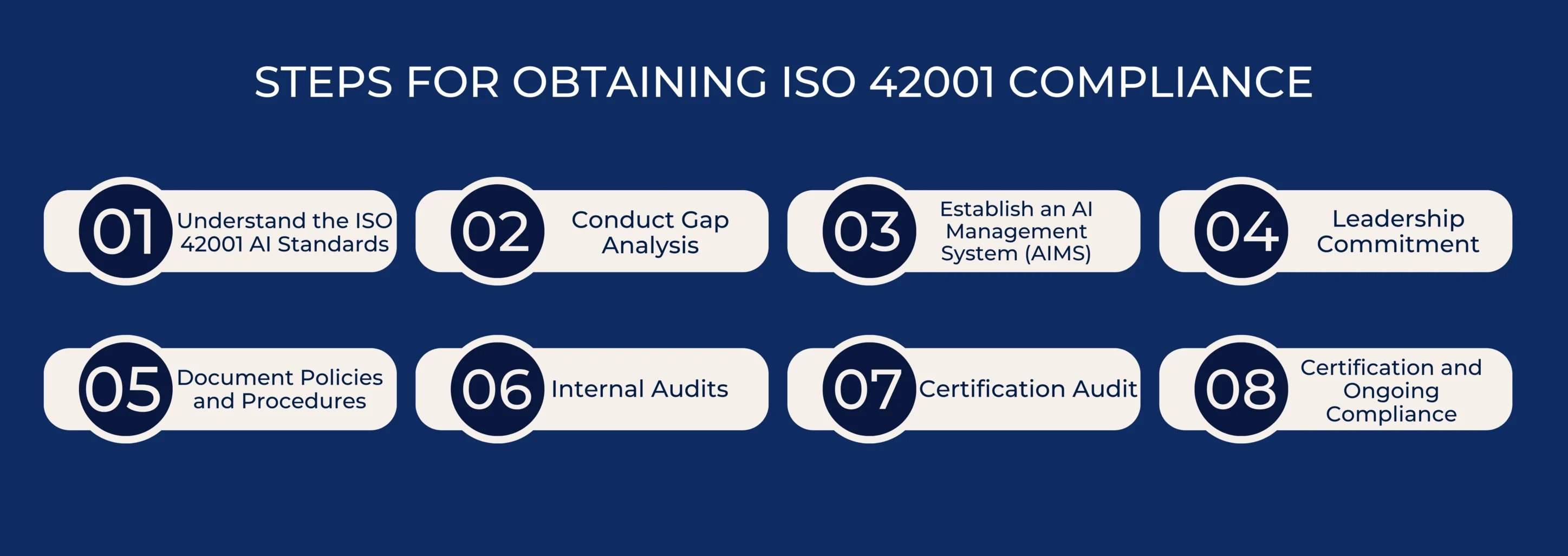
The ISO 42001 certification audit process conducted by CertPro for Oregon-based organizations follows a structured, multi-stage program designed to assess conformity against the requirements of ISO/IEC 42001:2023. Each stage produces documented audit outputs, which are then evaluated through an independent certification decision process. The ISO 42001 audit is conducted exclusively as an evaluation of conformity — CertPro does not provide implementation, remediation, or advisory input at any stage of the audit program.
| Audit Stage | Key Activities | Output |
|---|---|---|
| Application Review | Scope confirmation, AIMS boundary definition, audit program determination | Confirmed audit scope and program |
| Stage 1 Audit | Review of AIMS documentation, AI policy, risk assessment, AI impact assessment, Statement of Applicability | Stage 1 findings report |
| Stage 2 Audit | On-site or remote evidence evaluation, Annex A control testing, clause conformity assessment | Stage 2 audit report with nonconformities |
| Nonconformity Review | Review of corrective actions submitted by the organization against identified nonconformities | Accepted or escalated nonconformity resolution |
| Certification Decision | Independent committee review of audit evidence and findings | Certificate of conformity issued or withheld |
| Surveillance Audit | Periodic review of continued AIMS conformity between certification cycles | Surveillance findings and certification status confirmation |
| Recertification Audit | Full re-evaluation of AIMS conformity prior to certificate expiry | Renewed certificate of conformity |
The Stage 1 audit focuses on reviewing the organization’s AIMS documentation to assess whether the documented system is sufficiently developed to proceed to Stage 2 evaluation. During the Stage 1 audit, CertPro reviews the organization’s AI policy, AI risk assessment documentation, AI impact assessment records, Statement of Applicability, documented information required by ISO/IEC 42001:2023 Clauses 4 through 10, and any evidence of internal audit and management review activity.
The Stage 1 audit determines whether the organization has documented its AIMS scope, identified applicable Annex A controls, and produced the foundational documented information required by the ISO 42001 standard. Stage 1 findings are communicated to the organization, and any significant documentation gaps identified are addressed before the Stage 2 audit proceeds. CertPro does not prescribe how documentation gaps are resolved — that responsibility rests entirely with the organization.
The Stage 2 audit constitutes the primary conformity assessment activity within the ISO 42001 certification audit program. CertPro auditors evaluate objective evidence of AIMS implementation across Clauses 4 through 10 and all applicable Annex A controls identified in the organization’s Statement of Applicability.
Evidence evaluation includes interviews with personnel responsible for AI governance functions, review of AI system lifecycle documentation, examination of AI impact assessment records, review of data governance controls, assessment of human oversight mechanisms, and evaluation of monitoring and measurement activities. Nonconformities identified during the Stage 2 audit are documented, classified, and communicated to the organization for corrective action. CertPro reviews all corrective action evidence submitted by the organization before the audit findings are presented to the independent certification committee. The ISO 42001 audit Oregon methodology follows the same structured approach applied across all CertPro certification programs, ensuring consistent evidence evaluation and independent decision-making.
Following resolution of audit findings, the complete audit record — including Stage 1 and Stage 2 reports, nonconformity documentation, and corrective action evidence — is reviewed by CertPro’s independent certification committee. The committee evaluates whether the audit evidence supports a certification decision and whether the organization’s AIMS demonstrates conformity with ISO/IEC 42001:2023.
The certification committee operates independently of the audit team, maintaining the required separation between audit and certification decision functions. Upon a positive certification decision, CertPro issues a certificate of conformity specifying the organization’s name, AIMS scope, applicable standard (ISO/IEC 42001:2023), and certificate validity period. ISO 42001 certificates are subject to annual surveillance audits confirming continued AIMS conformity, and a full recertification audit is conducted prior to the three-year certificate expiry. CertPro may suspend or withdraw certification if surveillance activities identify material nonconformities that the organization fails to address within the specified timeframe.
- ✓Stage 1 Audit: Documentation and Readiness Review
- ✓Stage 2 Audit: Evidence Evaluation and Control Assessment
- ✓Certification Decision, Issuance, and Surveillance Cycle
ISO 42001 Requirements and AIMS Documentation
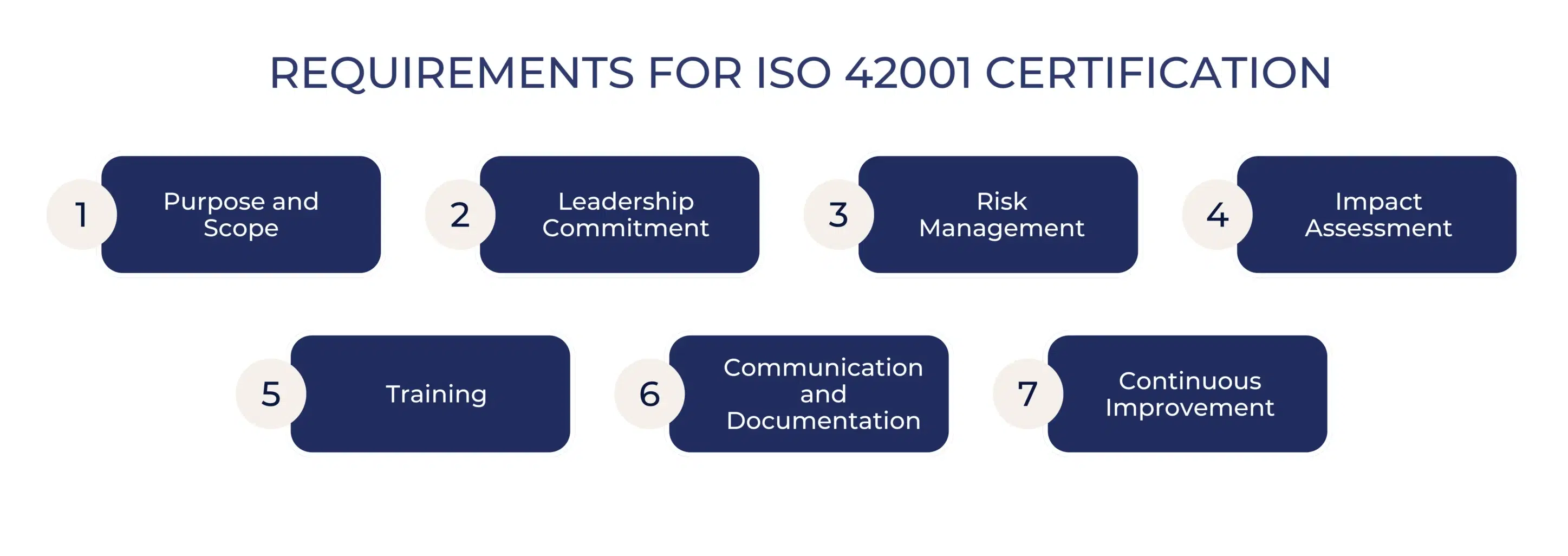
ISO/IEC 42001:2023 establishes specific documented information requirements that form the evidentiary foundation of the ISO 42001 certification audit. Oregon-based organizations pursuing ISO 42001 Certification in Oregon are evaluated against these requirements through objective evidence review. CertPro assesses whether the required documented information exists, is properly controlled, and accurately reflects actual AIMS operation.
The ISO 42001 standard requires organizations to maintain and retain documented information across several key categories. The AI policy, required under Clause 5.2, must communicate the organization’s commitments regarding responsible AI development and use, be appropriate to the organization’s context, and be available to interested parties. The AI risk assessment, required under Clause 6.1, documents the process for identifying AI-related risks, assessing their likelihood and consequence, and determining appropriate treatment options. The risk treatment plan documents how identified risks are addressed through selected Annex A controls or other measures.
The Statement of Applicability, required under Clause 6.1.3, lists all Annex A controls, specifies which controls are applicable, and provides justification for any excluded controls. Internal audit results and management review records provide evidence that the AIMS is being monitored, evaluated, and continually improved. CertPro’s ISO 42001 certification audit evaluates the completeness, accuracy, and operational relevance of each category of required documented information.
The AI impact assessment is a distinctive requirement of ISO/IEC 42001:2023, addressed under Clause 8.4. Organizations must assess the potential impacts — both positive and negative — of their AI systems on individuals, groups, and society, and document the results. The AI impact assessment informs control selection from Annex A and shapes the organization’s overall approach to risk treatment.
Annex A of ISO/IEC 42001:2023 organizes AI-specific controls across eight primary domains: policies for AI (A.2), internal organization (A.3), resources for AI systems (A.4), assessing AI system impact (A.5), AI system lifecycle (A.6), data for AI systems (A.7), information for interested parties about AI systems (A.8), and use of AI systems (A.9). During an ISO 42001 certification audit, CertPro evaluates whether the controls selected in the organization’s Statement of Applicability are effectively implemented and whether objective evidence supports conformity with each applicable control. Organizations pursuing ISO 42001 compliance in Oregon must demonstrate that Annex A controls address the specific AI systems within the defined AIMS scope.
ISO/IEC 42001:2023 Clause 9.2 requires organizations to conduct internal audits at planned intervals to evaluate whether the AIMS conforms to the standard’s requirements and is effectively implemented and maintained. Internal audit programs must be planned, conducted by competent personnel, and produce documented results communicated to relevant management.
Clause 9.3 requires management review of the AIMS at planned intervals, producing documented outputs that include decisions on AIMS improvements, resource needs, and any changes to the system. These internal evaluation activities provide evidence of the organization’s ongoing self-assessment capability and are reviewed during both Stage 1 documentation reviews and Stage 2 evidence evaluations. CertPro’s ISO 42001 audit assesses whether internal audit programs are conducted according to the documented plan, whether findings are recorded accurately, and whether management review outputs reflect genuine AIMS evaluation rather than pro forma compliance documentation.
- ✓Core AIMS Documentation Requirements
- ✓AI Impact Assessment and Annex A Control Domains
- ✓Internal Audit and Management Review Requirements
Oregon Industry Sectors Seeking ISO 42001 Certification
ISO 42001 Certification in Oregon is relevant across a broad range of industry sectors where AI systems are developed, integrated, or deployed. Oregon’s technology ecosystem creates concentrated demand for AI governance certification among organizations that serve regulated industries, enterprise customers, and government entities with structured vendor assurance requirements. Understanding which sectors benefit most from the ISO 42001 standard helps organizations evaluate whether pursuing certification aligns with their commercial and compliance priorities.
Technology, SaaS, and Cloud Providers
ISO 42001 certification for Oregon technology companies — particularly those developing SaaS platforms, cloud infrastructure, and AI-enabled software products — addresses enterprise procurement processes that evaluate AI governance as part of vendor risk management. Oregon’s Silicon Forest region hosts a significant concentration of software developers and cloud service providers that build AI functionality into products serving healthcare, financial services, and government customers.
ISO 42001 Certification in Oregon for SaaS and cloud-sector organizations provides independently verified evidence of AIMS conformity that satisfies vendor security reviews, third-party risk assessments, and enterprise procurement questionnaires. The ISO 42001 certification audit evaluates whether the organization’s AIMS governs the full AI system lifecycle — from design and data sourcing through deployment, monitoring, and decommissioning — as required by Annex A control domain A.6.
Healthcare, Financial Services, and Semiconductor Organizations
Oregon healthcare organizations that deploy AI in clinical decision support, patient data analysis, diagnostic imaging, or care coordination face regulatory expectations — including FDA software guidance and HIPAA-adjacent risk management obligations — that align directly with structured AI governance requirements. ISO 42001 compliance provides a documented framework against which healthcare AI systems can be independently evaluated during a formal ISO 42001 certification audit.
Oregon fintech and financial services organizations deploying AI in credit decisioning, fraud detection, risk modeling, or customer-facing applications face regulatory scrutiny regarding algorithmic transparency and bias control — both of which are addressed within the ISO 42001 standard’s Annex A control domains. Oregon’s semiconductor and electronics manufacturing sector, centered in Hillsboro and the broader Portland metro area, increasingly integrates AI into fabrication quality control, process optimization, and supply chain management — creating AIMS scope requirements that span operational technology environments alongside traditional IT systems.
- ✓SaaS providers and cloud service organizations developing AI-enabled products
- ✓Healthcare systems and health technology companies deploying clinical AI
- ✓Financial services firms and fintech organizations using AI in regulated decisioning
- ✓Semiconductor and electronics manufacturers integrating AI in fabrication and quality control
- ✓Advanced manufacturing companies using AI in production optimization and supply chain
- ✓Clean technology developers applying AI to energy management and grid optimization
- ✓Cybersecurity firms deploying AI-based threat detection and response systems
- ✓Data and analytics organizations providing AI-driven insights to regulated-sector customers
Benefits of ISO 42001 Certification for Oregon-Based Organizations
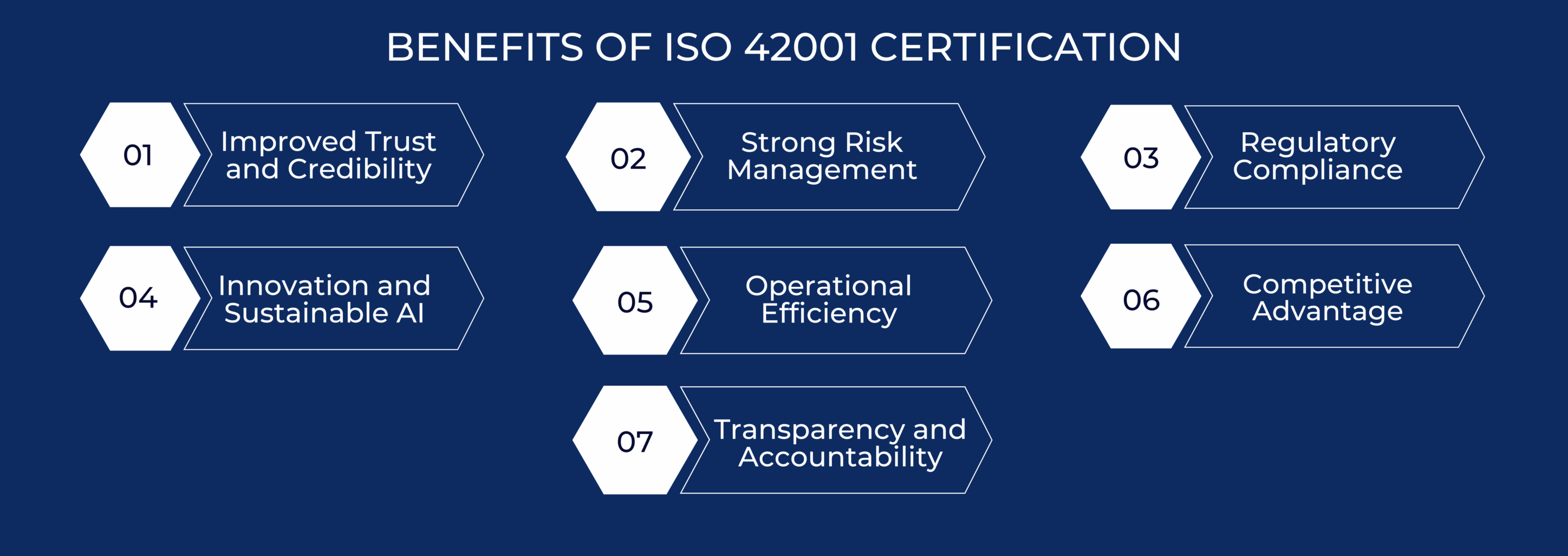
ISO 42001 Certification in Oregon provides organizations with independently verified evidence of AIMS conformity that carries institutional weight in enterprise procurement, regulatory engagement, and cross-sector AI governance contexts. The benefits of certification reflect the outcomes of a structured, independent ISO 42001 audit process — not organizational assertions about AI governance quality. For Oregon-based organizations, these benefits translate directly into competitive advantage and risk reduction across commercial and regulatory channels.
An ISO 42001 certification audit conducted by an independent Licensed CPA Firm produces a certificate of conformity that enterprise customers, procurement teams, and regulated-sector partners can reference as objective evidence of AI governance maturity. Oregon organizations that have achieved ISO 42001 Certification in Oregon can present the certificate in response to vendor questionnaires, third-party risk assessments, and supply chain due diligence requests — replacing self-attestation with independently verified conformity.
For Oregon technology companies serving financial institutions, healthcare systems, government agencies, and large enterprise customers, the certificate of conformity demonstrates that AI governance claims have been evaluated through structured audit methodology against the requirements of ISO/IEC 42001:2023 — not merely self-reported. This distinction is material in procurement processes where independent verification of vendor AI governance is a condition of contract award or ongoing vendor approval status.
ISO 42001 compliance, as demonstrated through independent certification, aligns Oregon organizations with multiple domestic and international AI governance frameworks. The NIST AI Risk Management Framework (AI RMF 1.0) shares substantive alignment with ISO/IEC 42001:2023 in its treatment of AI risk identification, impact assessment, transparency, and human oversight. Organizations that achieve ISO 42001 certification audit-confirmed conformity can reference that certification when responding to federal agency AI governance expectations, state-level technology procurement requirements, and international customer due diligence processes.
For Oregon organizations with cross-border operations — including technology exporters, multinational SaaS providers, and organizations subject to EU AI Act applicability — ISO 42001 Certification in Oregon provides a documented AI governance baseline recognized across regulatory jurisdictions. The ISO 42001 standard’s alignment with the EU AI Act’s risk-tiered approach, transparency requirements, and human oversight obligations makes certification particularly valuable for Oregon organizations serving European markets or operating under EU regulatory scope.
ISO 42001 certification establishes the AIMS as a structured management system subject to ongoing internal audit, management review, and surveillance audit cycles — creating a documented record of continual improvement that extends well beyond initial certification. Organizations that maintain ISO 42001 certification through annual surveillance audits demonstrate sustained AI governance performance, not a point-in-time assertion.
The structured AI risk management requirements of ISO/IEC 42001:2023 — including AI impact assessment, risk treatment planning, and Annex A control implementation — provide a documented basis for communicating AI risk management activities to boards of directors, audit committees, regulatory examiners, and enterprise customers. CertPro’s surveillance audits assess continued conformity, providing ongoing external validation that the AIMS remains effective between recertification cycles. Oregon organizations that integrate AIMS requirements with existing ISO/IEC 27001 information security management systems benefit from aligned risk management, shared documentation controls, and coordinated audit activities.
- ✓Independent Verification and Enterprise Procurement Recognition
- ✓Alignment with U.S. and International AI Governance Frameworks
- ✓Structured AI Risk Management and Continual Improvement
ISO 42001 Certification Scope and Independent Decision Framework
The scope of ISO 42001 certification is defined by the organization and evaluated by CertPro during the application review and Stage 1 audit. Scope definition determines which AI systems, business units, processes, and geographic locations are included within the AIMS boundary — and are therefore subject to evaluation during the ISO 42001 certification audit. A well-defined scope is essential to ensuring that the certificate of conformity accurately reflects the organization’s AI governance activities.
Defining and Evaluating the AIMS Scope
ISO/IEC 42001:2023 Clause 4.3 requires organizations to determine the scope of the AIMS by considering the external and internal context established under Clause 4.1 and the requirements of interested parties identified under Clause 4.2. The scope must identify the AI systems and associated processes included within the AIMS boundary and must be available as documented information.
During the Stage 1 audit, CertPro evaluates whether the defined scope is appropriate — neither artificially restricted to avoid evaluation of material AI systems nor inconsistently applied across the organization’s AI development and deployment activities. The scope is recorded on the issued certificate of conformity, providing external parties with a precise definition of what the ISO 42001 certification audit covered. Oregon organizations with multiple AI products, platforms, or business units may define scopes that include all or a subset of their AI systems, subject to CertPro’s assessment that the defined scope accurately reflects the AIMS boundaries in operation.
Independent Certification Committee and Nonconformity Management
CertPro’s ISO 42001 certification audit program maintains a structural separation between the audit team that conducts Stage 1 and Stage 2 audits and the certification committee that makes the final certification decision. This separation ensures that the certification decision is based on a complete review of the audit record — not influenced by the audit team’s direct engagement with the auditee organization.
Nonconformities identified during the ISO 42001 audit are classified and communicated to the organization, which is then responsible for root cause analysis and corrective action. CertPro reviews the objective evidence submitted by the organization in response to identified nonconformities before the matter is presented to the certification committee. The certification committee may grant certification, require additional corrective action evidence, or decline certification based on the audit record. Suspension or withdrawal of ISO 42001 certification may occur if surveillance activities reveal that the AIMS has materially deteriorated or that the organization has failed to address audit findings within the specified timeframe.
Why Oregon Organizations Pursue ISO 42001 Certification
Demand for ISO 42001 Certification in Oregon is driven by the state’s technology sector composition, its concentration of AI-active enterprises, and the increasing use of AI governance certification in enterprise vendor evaluation, regulated-sector procurement, and cross-border commercial requirements. ISO 42001 certification for Oregon companies reflects both proactive AI governance investment and responsive compliance positioning — and increasingly serves as a prerequisite for enterprise contract awards and regulated-sector partnerships.
Enterprise Vendor Reviews and Third-Party Risk Management
Enterprise customers — particularly in financial services, healthcare, and government contracting — conduct structured vendor risk assessments that increasingly include AI governance as an evaluated domain. An Oregon-based SaaS provider serving a major health system, for example, may receive a vendor security review questionnaire that asks whether AI systems embedded in the platform are governed by a documented management system and whether that system has been independently certified.
Without ISO 42001 certification, the organization can only self-attest to its AI governance practices — a response that carries limited evidential weight in structured procurement processes. With ISO 42001 Certification in Oregon, the organization can provide a certificate of conformity issued by a Licensed CPA Firm, demonstrating that the AIMS has been independently evaluated and found to conform with the requirements of ISO/IEC 42001:2023. This distinction directly affects vendor approval timelines, contract award decisions, and ongoing vendor qualification status in enterprise procurement programs where an ISO 42001 certification audit is a qualifying criterion.
AI Governance in Oregon’s Growing Startup and Innovation Ecosystem
AI startups and emerging technology companies pursuing ISO 42001 compliance in Oregon face a specific challenge: demonstrating AI governance maturity to enterprise customers and investors without the organizational history that established firms rely on in procurement processes. ISO 42001 certification provides a structured, internationally recognized basis for demonstrating that an early-stage organization has implemented an audited AI management system — accelerating vendor qualification and supporting enterprise sales processes.
Oregon’s startup ecosystem, concentrated in Portland and extending through the technology corridor connecting Hillsboro, Beaverton, and the broader metro area, includes AI companies developing natural language processing, computer vision, predictive analytics, and autonomous decision-making systems. These organizations benefit from ISO 42001 Certification in Oregon as an objective evidence basis when responding to enterprise customer due diligence, investor governance questions, and regulatory inquiries. The ISO 42001 standard is increasingly recognized across Oregon’s technology community as the AI governance baseline for organizations seeking to serve regulated industries or expand into international markets.
FAQ
▶
What is ISO 42001 certification and who provides it in Oregon?
▶
What is an Artificial Intelligence Management System (AIMS)?
▶
Which Oregon organizations need ISO 42001 certification?
▶
What is evaluated during an ISO 42001 certification audit in Oregon?
▶
How long does ISO 42001 certification remain valid?
▶
What are ISO 42001 Annex A controls?
▶
How does ISO 42001 compliance relate to the EU AI Act?
▶
What is the difference between Stage 1 and Stage 2 of the ISO 42001 certification audit?
ISO 42001 CERTIFIED: WHY AI GOVERNANCE CERTIFICATION IS BECOMING A BOARD-LEVEL REQUIREMENT
ISO 42001 Certified: Board-Level AI Governance Guide | CertPro CPA LLC HERO ══════════════════════════════ –> src=”https://certpro.com/wp-content/uplo…
Get In Touch
have a question? let us get back to you.