
ISO 42001 Certification in Philadelphia
CertPro is a Licensed CPA Firm providing independent, third-party ISO 42001 Certification in Philadelphia through conformity assessment audits conducted exclusively against the requirements of ISO/IEC 42001:2023. Certification decisions are made by an independent certification committee based solely on audit evidence. CertPro performs no consulting, implementation, or advisory services — ensuring complete objectivity throughout the ISO 42001 audit process.
OUR CLIENTS




ISO 42001 Certification for Philadelphia’s AI-Driven Organizations
CertPro is a Licensed CPA Firm providing independent, third-party ISO 42001 Certification in Philadelphia through conformity assessment audits conducted exclusively against the requirements of ISO/IEC 42001:2023. Certification decisions are made by an independent certification committee based solely on audit evidence. CertPro performs no consulting, implementation, or advisory services — ensuring complete objectivity throughout the ISO 42001 audit process.
Philadelphia’s economy generates substantial demand for independent ISO 42001 Certification in Philadelphia across multiple sectors. Healthcare and life sciences institutions — including major academic medical centers, hospital networks, and pharmaceutical and biotechnology firms concentrated along the I-95 corridor — are actively deploying AI systems in clinical decision support, drug discovery, and patient engagement. Financial services organizations and fintech companies operating in Center City face growing enterprise vendor security requirements that include documented AI governance frameworks.
A rapidly expanding population of SaaS providers, cloud-native technology companies, and managed service providers headquartered in Philadelphia or serving regulated clients in the region further intensifies demand for third-party ISO 42001 Certification. Higher education and research institutions affiliated with the University of Pennsylvania, Drexel University, Temple University, and Thomas Jefferson University are among those developing and deploying AI systems in academic and administrative contexts. Each of these sectors faces distinct but overlapping pressure from procurement requirements, regulatory expectations, and enterprise vendor due diligence processes that recognize ISO/IEC 42001:2023 certification as evidence of responsible AI governance.
ISO 42001 Certification in Philadelphia is conducted by CertPro as an independent certification body. The ISO 42001 audit program evaluates whether an organization’s Artificial Intelligence Management System (AIMS) satisfies the normative requirements of ISO/IEC 42001:2023. This includes clauses governing organizational context, leadership, planning, support, operation, performance evaluation, and continual improvement.
The ISO 42001 assessment also evaluates applicable controls from Annex A of the standard, which addresses organizational policies, AI-specific risk treatment, data management, system impact assessment, and transparency obligations. The certification process proceeds through defined stages — application review, Stage 1 documentation review, Stage 2 conformity assessment audit, nonconformity review, and independent certification committee decision — without any involvement in advising organizations on how to design or implement controls. Organizations in Philadelphia seeking to demonstrate AI governance accountability, satisfy enterprise vendor security reviews, or meet regulatory expectations in healthcare, financial services, and public procurement can engage CertPro as their independent ISO 42001 certification body.
The ISO/IEC 42001:2023 standard was published by the International Organization for Standardization and the International Electrotechnical Commission in 2023. It established the first internationally recognized management system standard specifically designed for organizations that develop, deploy, or use artificial intelligence. ISO 42001 compliance in Philadelphia is increasingly referenced in enterprise procurement frameworks, public sector vendor requirements, and financial sector third-party risk management programs.
CertPro conducts the ISO 42001 audit as a Licensed CPA Firm operating under an independent certification model. This ensures that every certification decision reflects objective evidence gathered during the audit and remains free from any commercial interest in the outcome.

What Is ISO 42001 Certification?
Definition and Scope of ISO/IEC 42001:2023
ISO 42001 Certification is the formal, third-party attestation that an organization’s Artificial Intelligence Management System (AIMS) conforms to the requirements of ISO/IEC 42001:2023. The standard defines the criteria for establishing, implementing, maintaining, and continually improving an AIMS within the context of an organization’s AI-related activities.
The scope of ISO 42001 Certification is determined by the boundary of AI systems and processes included in the AIMS. This can encompass the development of AI models, the deployment of AI-enabled products or services, or the use of AI tools in internal operations. ISO 42001 Certification is distinct from AI ethics assessments or regulatory compliance programs in that it is based on a structured management system framework — one that requires documented policies, defined roles and responsibilities, systematic risk assessment, control implementation, and performance monitoring. The certification applies to any organization regardless of size, sector, or geographic location, provided the organization develops, deploys, or uses AI systems within its defined scope.
AI Management System Requirements Under ISO/IEC 42001:2023
The ISO/IEC 42001:2023 standard is structured around ten clauses, with normative requirements beginning at Clause 4. Clause 4 requires organizations to define their organizational context, identify interested parties, and determine the scope of the AIMS. Clause 5 addresses leadership commitment, AI policy, and defined organizational roles for AI governance. Clause 6 covers planning, including AI risk and opportunity assessment and the treatment of risks through controls drawn from Annex A.
Clauses 7 through 10 address support resources, operational execution, performance evaluation through internal audit and management review, and continual improvement. Annex A of ISO/IEC 42001:2023 provides a reference control set covering areas such as AI policy, internal organization, resources for AI systems, assessing AI system impacts, AI system lifecycle management, data management for AI systems, and information for interested parties regarding AI use. Organizations pursuing ISO 42001 Certification in Philadelphia must demonstrate conformance with all applicable clauses and selected Annex A controls through documented evidence reviewed during the ISO 42001 AIMS audit.
How ISO 42001 Differs from Other AI Governance Frameworks
ISO 42001 Certification differs from other AI governance frameworks in several important respects. The EU AI Act establishes regulatory obligations for AI systems placed on the EU market but does not itself provide a certification mechanism or audit methodology. The NIST AI Risk Management Framework (AI RMF) offers a voluntary guidance structure without third-party certification. ISO/IEC 42001:2023, by contrast, is an auditable management system standard that defines specific requirements against which an independent certification body can assess conformance and issue a formal certificate.
ISO 42001 also differs from ISO/IEC 27001 (information security) and SOC 2 (service organization controls) in that it specifically addresses AI system risk, transparency, accountability, and the governance structures required to manage AI-related impacts. Organizations holding ISO 27001 or SOC 2 certifications may find that ISO 42001 Certification complements their existing credentials by addressing the distinct governance obligations associated with AI system development and deployment — areas not fully covered by information security management frameworks alone.
ISO 42001 Certification Audit Process for Organizations in Philadelphia
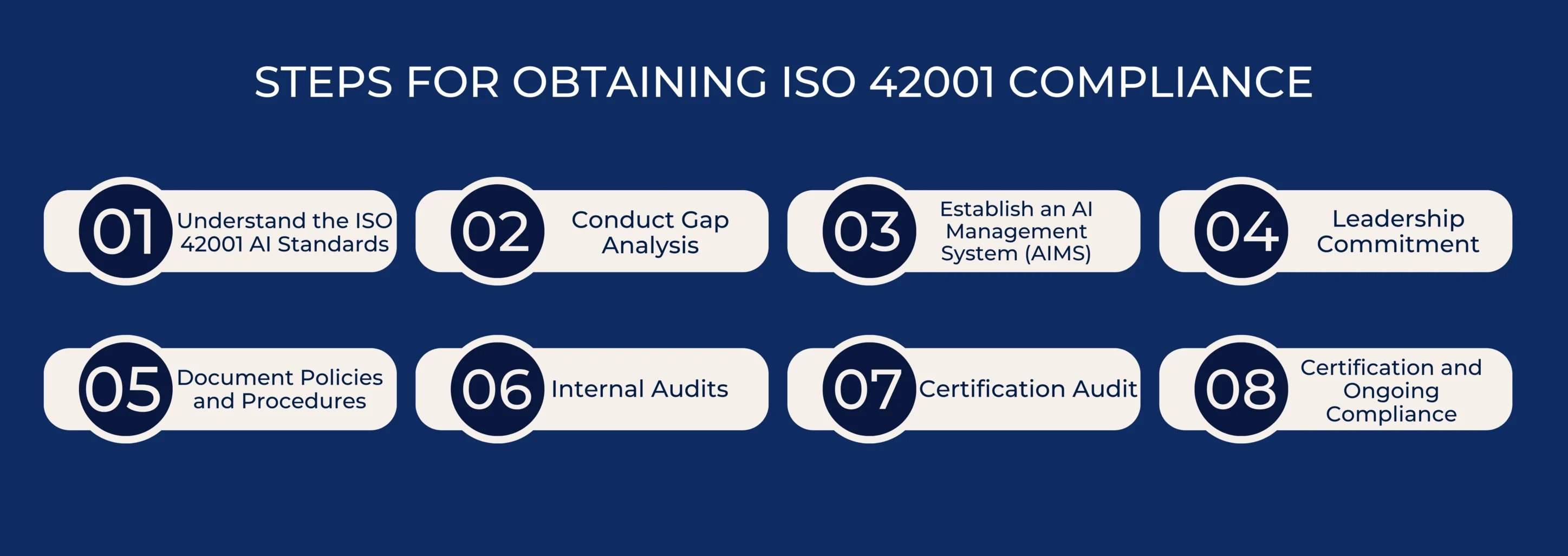
The ISO 42001 audit process conducted by CertPro for Philadelphia-based organizations follows a structured, multi-stage program designed to evaluate AIMS conformance against the requirements of ISO/IEC 42001:2023. Each stage produces defined outputs that inform the certification committee’s decision. The table below summarizes the key stages of the ISO 42001 AIMS audit conducted for organizations seeking ISO 42001 Certification in Philadelphia.
| Audit Stage | Key Activities | Output |
|---|---|---|
| Application Review | Scope determination, audit program planning, conflict-of-interest check | Confirmed audit scope and program |
| Stage 1 Audit | Documentation review, AIMS readiness evaluation, identification of areas requiring clarification | Stage 1 findings report |
| Stage 2 Audit | Conformity assessment against ISO/IEC 42001:2023 clauses and Annex A controls, evidence collection, interviews | Audit report with nonconformities |
| Nonconformity Review | Review of corrective action evidence submitted by the organization | Closure determination |
| Certification Decision | Independent committee review of audit evidence and nonconformity closure | Certificate issuance or deferral |
| Surveillance Audit | Annual assessment of continued AIMS conformance within certificate validity period | Surveillance audit report |
The Stage 1 ISO 42001 audit focuses on reviewing the organization’s AIMS documentation to determine whether the management system has been sufficiently established to proceed to the Stage 2 conformity assessment. During the Stage 1 audit, CertPro evaluates the organization’s AI policy, documented scope statement, AI risk assessment records, risk treatment plan, and Annex A control selection and justification documentation — equivalent to a Statement of Applicability in the AIMS context.
The Stage 1 audit also examines internal audit records, management review minutes, and whether the organization has identified the AI systems within scope, documented their intended purposes, and established the governance structures required by ISO/IEC 42001:2023 Clauses 4 through 7. The output of the Stage 1 ISO 42001 audit is a findings report identifying any documentation gaps or areas requiring clarification before the Stage 2 audit proceeds. Organizations in Philadelphia undergoing ISO 42001 Certification in Philadelphia should ensure all required documentation is established and available for review at this stage.
The Stage 2 ISO 42001 audit is the primary conformity assessment, during which CertPro evaluates whether the organization’s AIMS operates in accordance with ISO/IEC 42001:2023 requirements. The Stage 2 audit examines objective evidence across all in-scope AIMS processes, including AI system impact assessments, data governance practices, human oversight mechanisms, accountability structures, and the operational effectiveness of controls selected from Annex A.
Audit evidence is gathered through document review, interviews with personnel responsible for AI governance and system management, observation of processes, and examination of records demonstrating that controls have been implemented and are operating as described. Nonconformities identified during the Stage 2 ISO 42001 AIMS audit are documented in the audit report and communicated to the organization. The organization must submit evidence of corrective action for nonconformity closure before the certification committee issues its decision. For Philadelphia-based organizations, the Stage 2 audit is conducted at the organization’s operational locations or through a combination of on-site and remote audit activities, as determined during audit program planning.
The certification decision for ISO 42001 Certification in Philadelphia is made by an independent certification committee that reviews the complete audit report, nonconformity records, and evidence of corrective action closure. The certification committee operates independently of the audit team to ensure full objectivity in the certification decision. Upon satisfactory review, the committee issues an ISO 42001 certificate specifying the certified organization, the scope of the AIMS, the applicable standard (ISO/IEC 42001:2023), and the certificate validity period.
ISO 42001 certificates issued by CertPro are valid for a three-year certification cycle, subject to satisfactory completion of annual surveillance audits. The first surveillance audit is conducted approximately twelve months after the initial certification decision. A recertification audit is required before the end of the three-year cycle to maintain certification without interruption. Suspension or withdrawal of certification may occur if the organization fails to maintain AIMS conformance or does not cooperate with surveillance audit requirements.
- ✓Stage 1 Audit: Documentation Review and Readiness Evaluation
- ✓Stage 2 Audit: Conformity Assessment and Evidence Collection
- ✓Certification Committee Decision and Certificate Validity
Why Organizations in Philadelphia Pursue ISO 42001 Certification
Enterprise Vendor Security Reviews and Procurement Requirements
Philadelphia’s concentration of large healthcare systems, financial institutions, and pharmaceutical companies creates significant downstream pressure on technology vendors and AI solution providers to demonstrate third-party validated AI governance. Enterprise vendor security reviews conducted by major health system networks and regional banks increasingly include AI governance evaluation criteria. ISO 42001 Certification in Philadelphia provides SaaS vendors, cloud service providers, and AI solution developers with documented evidence of AIMS conformance that can be presented in response to vendor questionnaires and procurement due diligence processes.
Consider a Philadelphia-based AI analytics company seeking to supply clinical decision support tools to a major academic medical center. That company would typically be required to demonstrate structured AI governance controls as part of the health system’s third-party risk management program. ISO 42001 Certification provides an independently verified record of control conformance that satisfies this requirement far more efficiently than organization-authored self-assessments — streamlining vendor qualification and reducing the administrative burden of repeated questionnaire responses.
Regulatory Expectations in Healthcare, Life Sciences, and Financial Services
Philadelphia’s healthcare and life sciences sector operates under a multi-layered regulatory environment that includes HIPAA requirements for protected health information, FDA oversight of AI-enabled medical devices and software as a medical device (SaMD), and state health department requirements. AI systems deployed in clinical or administrative contexts are subject to scrutiny regarding bias, transparency, and accountability — areas directly addressed by ISO/IEC 42001:2023.
Financial services organizations in Philadelphia — including banks, investment firms, and fintech companies operating in Center City — face examination expectations from federal banking regulators and the SEC that include vendor management and model risk governance. ISO 42001 compliance in Philadelphia’s financial services sector supports these expectations by providing a documented framework for AI system oversight that aligns with principles articulated in interagency model risk management guidance. Pharmaceutical and biotechnology organizations using AI in drug discovery, clinical trial design, or regulatory submissions also face increasing FDA expectations regarding documentation, validation, and transparency of AI system decisions — all areas addressed through a structured ISO 42001 assessment.
International Market Access and Cross-Border Compliance
Philadelphia-based organizations with international operations or customers in jurisdictions where AI governance regulation is advancing — particularly the European Union, United Kingdom, and Canada — benefit from ISO 42001 Certification as a recognized international standard that supports cross-border market access. The EU AI Act, which entered into force in 2024 with phased implementation timelines, imposes mandatory requirements on high-risk AI systems and organizations placing AI systems on the EU market.
While the EU AI Act does not mandate ISO 42001 Certification specifically, conformance with ISO/IEC 42001:2023 demonstrates alignment with many of the governance, transparency, and risk management obligations the regulation requires. For Philadelphia-based SaaS providers and technology companies expanding into European markets, ISO 42001 Certification in Philadelphia provides an internationally recognized credential that supports enterprise sales processes and regulatory positioning in EU jurisdictions. This is particularly relevant for fintech companies operating across U.S. and EU payment, lending, or investment markets.
ISO 42001 Certification Requirements and Evaluation Criteria
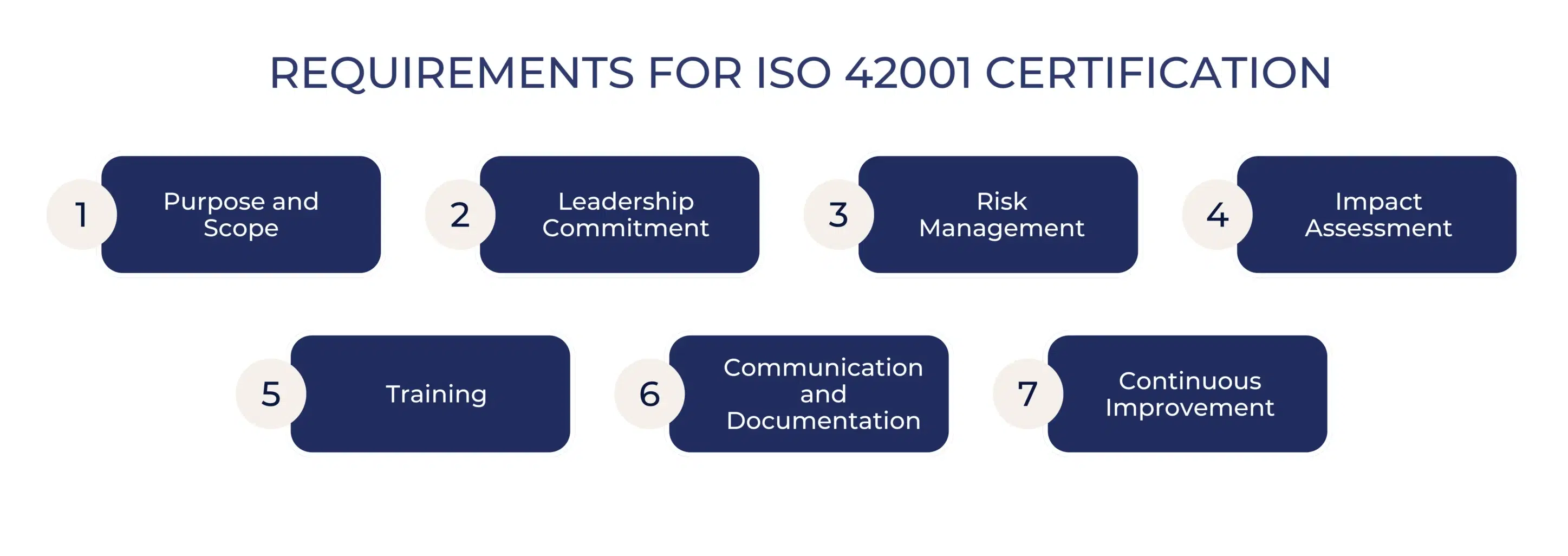
ISO 42001 Certification requires organizations to maintain documented information demonstrating the establishment and operation of the AIMS. Core documentation requirements under ISO/IEC 42001:2023 include an AI policy approved by top management, a documented AIMS scope statement, AI risk assessment records identifying and evaluating risks associated with in-scope AI systems, a risk treatment plan specifying selected controls and their justification, and records of internal AIMS audits and management reviews.
Annex A control implementation requires additional documentation, including AI system impact assessment records, data management practices, human oversight procedures, and transparency documentation for AI system outputs. The ISO 42001 assessment conducted by CertPro examines whether documented information is complete, current, and consistent with the organization’s actual AI governance practices. Documented information must be controlled in accordance with Clause 7.5, which addresses the creation, maintenance, and availability of records. Organizations in Philadelphia undergoing an ISO 42001 assessment should ensure that all documentation accurately reflects the AI systems within scope and the controls applied to manage associated risks.
Annex A of ISO/IEC 42001:2023 provides a reference set of controls organized into domains that address the specific governance requirements of AI systems. The control domains include organizational controls addressing AI policy, roles and responsibilities, and supplier relationships for AI systems; controls addressing resources required for AI system development and operation; controls governing AI system impact assessment and risk treatment; controls addressing the AI system lifecycle from design through decommissioning; data management controls specific to training data, validation data, and operational data; and controls governing information provided to interested parties about AI system capabilities and limitations.
During the ISO 42001 AIMS audit, CertPro evaluates the organization’s selection and implementation of controls from Annex A. Auditors assess whether the control selection is justified based on the results of the AI risk assessment and whether selected controls are operating as designed. Organizations are not required to implement every Annex A control, but must provide documented justification for any exclusions where applicable controls are not selected.
The ISO 42001 assessment conducted by CertPro is evidence-based, meaning that every finding in the audit report is supported by specific audit evidence gathered during the Stage 1 and Stage 2 audits. Evidence types include documents, records, interview responses, and observed processes. Where audit evidence demonstrates that a requirement of ISO/IEC 42001:2023 has not been met, a nonconformity is recorded in the audit report.
Nonconformities identified during the ISO 42001 audit in Philadelphia must be addressed through corrective action before the certification committee issues a certification decision. The audit report specifies the clause or control against which each nonconformity was raised and documents the evidence that substantiated the finding. Organizations must provide evidence that corrective actions have been implemented and are effective before closure is granted. The certification committee then reviews the complete audit file — including nonconformity records and corrective action evidence — before making an independent determination on certificate issuance.
- ✓Documentation Requirements for ISO 42001 Certification
- ✓Annex A Control Domains and AIMS Control Selection
- ✓Evidence-Based Assessment and Nonconformity Classification
Philadelphia Business Sectors Seeking ISO 42001 Certification
ISO 42001 Certification in Philadelphia is relevant across a broad range of industries and organization types. The following sectors represent the primary sources of demand for ISO 42001 Certification among Philadelphia-based organizations pursuing independent AIMS conformance verification.
Healthcare, Life Sciences, and Pharmaceutical Organizations
Philadelphia’s healthcare and life sciences ecosystem encompasses major academic medical centers, specialty hospital networks, pharmaceutical manufacturers, contract research organizations, and medical device developers. Many of these organizations deploy or develop AI systems in clinical, research, and administrative contexts. AI systems used in radiology image analysis, electronic health record management, patient risk stratification, clinical trial design, and drug discovery pipelines are subject to specific governance requirements that ISO/IEC 42001:2023 is designed to address.
Pharmaceutical companies in the Delaware Valley region using AI in manufacturing quality control or regulatory submissions face increasing documentation expectations from the FDA regarding AI system transparency and validation. ISO 42001 Certification for Philadelphia companies in this sector provides a structured, independently verified framework for demonstrating that AI systems are governed with appropriate oversight, accountability, and risk controls. Third-party ISO 42001 Certification also supports health system vendor qualification requirements for AI-enabled clinical tools, reducing friction in procurement and partnership processes.
Financial Services, Fintech, and Insurance Organizations
Philadelphia financial services organizations increasingly seek ISO 42001 Certification to address AI governance expectations from federal banking regulators, SEC examination programs, and enterprise client procurement requirements. Philadelphia-based banks, insurance companies, investment management firms, and fintech companies use AI systems in credit underwriting, fraud detection, algorithmic trading, claims processing, customer service automation, and regulatory compliance monitoring. These applications carry significant accountability implications, and ISO 42001 compliance in Philadelphia’s financial services sector supports the governance structures required to manage AI system risk at an organizational level.
ISO 42001 compliance is also beneficial for Philadelphia fintech companies — particularly those developing AI-enabled lending, payments, or wealth management platforms — when expanding distribution through partnerships with regulated financial institutions that require vendor AI governance documentation. The independent ISO 42001 audit conducted in Philadelphia provides these organizations with certification evidence that can be produced in response to bank regulatory examination requests and institutional partnership requirements.
SaaS Providers, Cloud Companies, and Technology Organizations
Philadelphia’s growing technology ecosystem includes SaaS providers, cloud-native application developers, managed service providers, and AI-focused startups serving regulated clients in healthcare, financial services, education, and government. AI management system certification in Philadelphia is particularly relevant for technology organizations whose products embed or rely on machine learning models, large language models, or automated decision systems.
Enterprise customers in regulated industries require technology vendors to demonstrate AI governance as part of third-party risk management programs. ISO 42001 Certification in Philadelphia enables SaaS and cloud companies to present independently verified evidence of AIMS conformance during vendor security reviews, procurement evaluations, and contract negotiation processes. Organizations operating AI platforms as cloud services face increasing scrutiny regarding the transparency of AI system behavior and the controls in place to manage model drift, bias, and unintended outputs — all areas addressed within the Annex A control framework of ISO/IEC 42001:2023.
Benefits of ISO 42001 Certification for Philadelphia-Based Organizations
ISO 42001 Certification in Philadelphia provides organizations with independent, third-party verification that their AIMS conforms to the requirements of ISO/IEC 42001:2023. This verification is conducted by a Licensed CPA Firm operating as an independent certification body, ensuring that the certification reflects objective audit evidence rather than the organization’s own assessment of its AI governance practices.
Third-party verification carries significantly greater weight than self-attestation in enterprise vendor qualification processes, regulatory examinations, and partnership due diligence. Organizations holding ISO 42001 Certification can present the certificate and accompanying audit scope as evidence of control conformance without requiring enterprise clients to conduct their own AI governance assessments. This reduces the administrative burden associated with responding to multiple, overlapping vendor security questionnaires and allows AI governance documentation to be centralized and consistently presented across multiple client relationships. The independent certification model also provides assurance to the organization’s own board and senior leadership that AI governance controls have been evaluated by a qualified external auditor.
ISO 42001 Certification supports the establishment of a structured AI risk management framework that documents accountability for AI system decisions and outcomes across the organization. The management system requirements of ISO/IEC 42001:2023 require organizations to define roles and responsibilities for AI governance, conduct systematic AI risk and impact assessments, implement controls to address identified risks, and monitor control effectiveness through internal audit and management review.
This structured approach to AI accountability is increasingly recognized as a governance expectation by boards of directors and executive teams in regulated industries. For Philadelphia-based organizations managing AI systems that influence clinical decisions, credit determinations, or automated regulatory filings, the accountability framework established through ISO 42001 compliance provides a documented record of governance that can be referenced in the event of an adverse outcome or regulatory inquiry. The annual surveillance audit cycle further ensures that the AIMS remains effective and continues to address evolving AI risks as the organization’s AI capabilities expand.
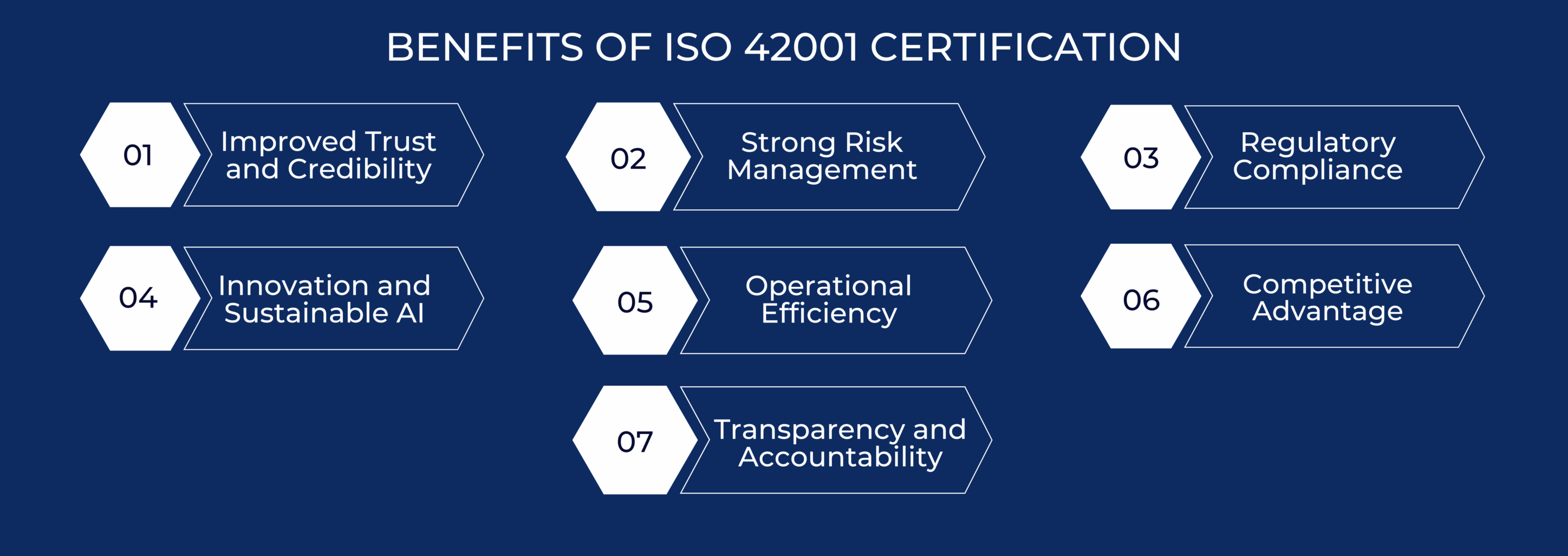
- ✓Independent third-party verification of AIMS conformance against ISO/IEC 42001:2023 requirements
- ✓Recognition in enterprise vendor security reviews and procurement qualification processes
- ✓Documented AI governance framework supporting regulatory examination and due diligence responses
- ✓Structured AI risk assessment and control accountability across all in-scope AI systems
- ✓Annual surveillance audit providing ongoing oversight of AIMS effectiveness
- ✓International recognition supporting market access in the EU and other jurisdictions with AI governance requirements
- ✓Differentiated positioning in competitive procurement processes requiring AI governance documentation
- ✓Board and executive-level assurance through independent certification committee validation
- ✓Independent Verification of AI Governance Controls
- ✓Structured AI Risk Management and Accountability Framework
- ✓Key Benefits of ISO 42001 Certification
ISO 42001 Certification Scope and Independent Decision Framework
Defining the AIMS Certification Scope
The scope of ISO 42001 Certification in Philadelphia is determined by the boundary of AI systems, processes, and organizational units included within the AIMS. Organizations must define the scope in a documented scope statement that identifies the AI systems covered, the locations and functions involved, and any exclusions with justification. The scope definition is reviewed during the application stage and the Stage 1 ISO 42001 audit to ensure it is appropriate for the organization’s AI activities and does not unreasonably exclude AI systems that pose significant risk to interested parties.
A Philadelphia-based healthcare AI company might define its certification scope to include AI systems used in clinical documentation and care coordination while excluding non-AI software products. A fintech company might scope the ISO 42001 Certification to cover AI systems used in credit risk modeling and fraud detection. The defined scope is reflected on the issued ISO 42001 certificate and determines which processes and controls are subject to audit during Stage 2 and all subsequent surveillance audits.
Independent Certification Committee and Decision Process
The certification decision process for ISO 42001 Certification in Philadelphia requires that the decision be made by personnel who are independent of the audit team. This independence is a fundamental requirement of accreditation standards governing certification bodies and ensures that the certification decision is not influenced by the audit team’s relationship with the audited organization.
The certification committee reviews the complete audit file, including the Stage 1 and Stage 2 audit reports, nonconformity records, and documentation of corrective action closure. The committee assesses whether the ISO 42001 audit was conducted in accordance with the audit program, whether all material requirements of ISO/IEC 42001:2023 were evaluated, and whether the evidence supports a conclusion of conformance. Where the committee identifies questions regarding audit evidence or nonconformity closure, it may request additional information before reaching a decision. The committee issues a certification decision resulting in either certificate issuance, deferral pending additional information, or refusal where material nonconformities remain unresolved.
Surveillance Audit Cycle and Certificate Maintenance
ISO 42001 certificates issued to Philadelphia-based organizations are maintained through a structured surveillance audit cycle over a three-year certification period. The first surveillance audit is typically scheduled approximately twelve months following the initial certification date and evaluates whether the AIMS continues to conform to ISO/IEC 42001:2023 requirements within the certified scope. The second surveillance audit is conducted in the second year of the certification cycle.
A recertification audit is conducted in the third year, prior to certificate expiry, and involves a comprehensive reassessment of AIMS conformance similar in scope to the initial Stage 2 audit. If an organization extends its AI system scope or makes material changes to its AIMS during the certification cycle, the change may require an extension audit to evaluate conformance of the new or modified scope. Organizations that fail to complete surveillance audits within the required timeframe or that demonstrate material AIMS nonconformities during surveillance may have their ISO 42001 Certification suspended or withdrawn by the certification committee.
ISO 42001 Assessment: Key Evaluation Areas
AI Risk Assessment and Treatment Evaluation
The ISO 42001 assessment conducted by CertPro specifically evaluates the adequacy and implementation of the organization’s AI risk assessment and risk treatment processes. ISO/IEC 42001:2023 requires organizations to identify risks associated with in-scope AI systems, evaluate their potential impact on individuals and society, and implement controls to treat risks to an acceptable level. The risk assessment must consider risks arising from the AI system’s intended use, foreseeable misuse, potential for discriminatory or biased outputs, privacy implications, and transparency limitations.
During the ISO 42001 audit in Philadelphia, auditors examine risk assessment records to determine whether the methodology is documented, consistently applied, and proportionate to the complexity and potential impact of the AI systems in scope. Risk treatment decisions — including control selection from Annex A and the organization’s residual risk acceptance — are evaluated for logical consistency with the risk assessment results. Organizations in Philadelphia with high-impact AI systems, such as those used in clinical decision support or automated credit decisions, are expected to demonstrate more rigorous risk assessment and treatment processes than organizations using AI in lower-risk contexts.
AI System Impact Assessment and Transparency Controls
The ISO 42001 assessment includes evaluation of the organization’s AI system impact assessment processes, which are required by Annex A of ISO/IEC 42001:2023. An AI system impact assessment documents the potential effects of an AI system on individuals, groups, and society — including effects related to fairness, privacy, safety, and transparency. The assessment must be completed before the AI system is deployed and reviewed whenever material changes are made to the system.
Auditors evaluate whether impact assessments have been completed for AI systems within the certification scope, whether the assessments address the required areas, and whether findings from the assessments have been used to inform control selection and risk treatment. Transparency controls — which address the information provided to users and affected parties about AI system capabilities, limitations, and decision logic — are also evaluated during the ISO 42001 assessment in Philadelphia. Organizations are required to document what information is provided about AI system outputs, how users are informed of AI involvement in decisions, and what mechanisms exist for individuals to query or challenge automated determinations.
FAQ
▶
What is ISO 42001 certification?
▶
Who needs ISO 42001 certification?
▶
How long does ISO 42001 certification take?
▶
What are the benefits of ISO 42001 certification?
▶
What is the cost of ISO 42001 certification?
▶
How do I prepare for ISO 42001 certification?
▶
What happens after ISO 42001 certification?
▶
How long does the ISO 42001 certification process take?
ISO 42001 CERTIFIED: WHY AI GOVERNANCE CERTIFICATION IS BECOMING A BOARD-LEVEL REQUIREMENT
ISO 42001 Certified: Board-Level AI Governance Guide | CertPro CPA LLC HERO ══════════════════════════════ –> src=”https://certpro.com/wp-content/uplo…
Get In Touch
have a question? let us get back to you.