
ISO 42001 Certification in Phoenix
ISO 42001 Certification in Phoenix is conducted by CertPro, a Licensed CPA Firm operating exclusively as an independent third-party certification body. CertPro evaluates organizational conformity against the full requirements of ISO/IEC 42001:2023 through a structured, evidence-based audit methodology. Certification decisions are issued by an independent certification committee based solely on objective audit evidence. No advisory, consulting, implementation, or readiness services are provided — ensuring complete independence throughout every ISO 42001 certification audit.
OUR CLIENTS










ISO 42001 Certification for Phoenix-Based Technology and AI Organizations
ISO 42001 Certification in Phoenix is conducted by CertPro, a Licensed CPA Firm operating exclusively as an independent third-party certification body. CertPro evaluates organizational conformity against the full requirements of ISO/IEC 42001:2023 through a structured, evidence-based audit methodology. Certification decisions are issued by an independent certification committee based solely on objective audit evidence. No advisory, consulting, implementation, or readiness services are provided — ensuring complete independence throughout every ISO 42001 certification audit.
Phoenix’s AI and Technology Ecosystem Driving ISO 42001 Demand
Phoenix hosts one of the most strategically significant technology and industrial ecosystems in the United States. Semiconductor fabrication plants operated by TSMC, Intel, and allied suppliers anchor a global-scale advanced manufacturing corridor across the Greater Phoenix area. Aerospace and defense contractors, healthcare and life sciences organizations, financial services firms, fintech companies, SaaS providers, cloud service organizations, cybersecurity companies, automotive and mobility firms, telecommunications providers, logistics enterprises, and renewable energy developers together form an ecosystem where AI systems are being developed, deployed, and procured at scale.
Organizations across each of these sectors face increasing enterprise procurement requirements, federal contracting standards, state-level AI governance expectations, and sector-specific regulatory frameworks that recognize or require independently verified AI management controls. ISO 42001 Certification in Phoenix provides organizations with independently assessed, documented evidence of AI management system conformity — the kind enterprise customers, federal procurement officials, regulated-industry counterparties, and institutional investors increasingly require when evaluating AI-capable vendors and service providers. The ISO 42001 certification audit evaluates whether an organization’s Artificial Intelligence Management System meets the structured requirements of ISO/IEC 42001:2023 across governance, risk, impact assessment, data integrity, transparency, and human oversight dimensions.
ISO/IEC 42001:2023 — The International Standard for AI Management Systems
ISO/IEC 42001:2023 is the first internationally recognized standard specifying requirements for establishing, implementing, maintaining, and continually improving an Artificial Intelligence Management System (AIMS). Published by the International Organization for Standardization (ISO) and the International Electrotechnical Commission (IEC) in 2023, the ISO 42001 standard addresses AI governance structures, AI risk management processes, AI impact assessments, data governance for AI systems, transparency and explainability controls, human oversight mechanisms, and Annex A AI-specific controls organized across organizational, people, physical, and technological categories.
The standard applies to any organization — regardless of size, sector, or geographic location — that develops, provides, or uses AI systems. For Phoenix-based organizations operating AI-enabled products, platforms, or internal processes, conformity with the ISO 42001 standard demonstrates that AI systems are governed through documented, systematically maintained, and independently verified management controls. ISO 42001 compliance that Phoenix organizations achieve through certification is recognized by enterprise procurement teams, regulatory bodies, and international business counterparties as evidence of structured AI governance maturity.
CertPro’s Independent Certification Body Positioning in Phoenix
CertPro functions exclusively as an independent certification and audit body. The organization does not provide AI governance consulting, AI risk management advisory, AI implementation services, policy development, control design, readiness support, or training of any kind. ISO 42001 Certification in Phoenix through CertPro is delivered through a structured audit program in which evidence collection, control evaluation, and nonconformity identification are conducted independently against the requirements of ISO/IEC 42001:2023.
ISO 42001 certification audit findings are documented objectively and submitted to an independent certification committee that issues the final certification decision. This structural independence distinguishes certification body activities from consulting or advisory services and ensures that CertPro’s audit conclusions are free from conflicts of interest. Phoenix-based organizations seeking ISO 42001 certification engage CertPro specifically because of this independence — recognizing that a certificate issued by a body with no implementation involvement carries greater credibility with enterprise customers, regulators, and international trade partners.

What Is ISO 42001 Certification?
ISO 42001 certification is a formal, independent third-party determination that an organization’s Artificial Intelligence Management System conforms to the requirements of ISO/IEC 42001:2023. Certification is achieved through a structured audit process in which an independent certification body reviews documented evidence, evaluates control implementation and effectiveness, and verifies that the organization’s AIMS addresses all applicable clauses and Annex A controls.
ISO 42001 certification is distinct from self-declaration or internal assessment. It requires an external, independent party to examine objective evidence and issue a certification decision based on findings — not on the organization’s own assertion of conformity. The ISO 42001 standard covers Clauses 4 through 10, which govern context of the organization, leadership, planning, support, operation, performance evaluation, and continual improvement of the AIMS. Annex A specifies AI-specific controls addressing AI system impact assessment, AI system lifecycle considerations, data for AI, documentation, and responsible AI practices.
Core Components of an Artificial Intelligence Management System
An Artificial Intelligence Management System under ISO/IEC 42001:2023 encompasses the policies, processes, organizational structures, roles, responsibilities, and documented controls that an organization uses to govern AI systems across their full lifecycle. Each component of the AIMS must satisfy specific clause requirements:
Clause 4 — Context: Addresses internal and external issues affecting AI governance objectives, including the needs of interested parties. Clause 5 — Leadership: Requires top management to establish an AI policy, assign defined responsibilities, and demonstrate active oversight. Clause 6 — Planning: Requires organizations to identify AI-related risks and opportunities and establish measurable AI objectives. Clause 7 — Support: Covers resources, competence, awareness, communication, and documented information required to operate the AIMS. Clause 8 — Operation: Addresses AI system impact assessment and AI risk treatment, including design and deployment of Annex A controls. Clause 9 — Performance Evaluation: Requires internal audit and management review activities. Clause 10 — Continual Improvement: Requires the organization to respond to nonconformities and systematically enhance AIMS performance over time.
ISO 42001 Annex A Controls and AI-Specific Requirements
Annex A of ISO/IEC 42001:2023 specifies AI-specific controls organized across categories including: policies for responsible AI, internal organization for AI governance, resources for AI systems, AI system impact assessment, AI system lifecycle controls, data governance for AI, information for interested parties (transparency and explainability), and human oversight mechanisms.
The Annex A controls are not universally mandatory in their entirety. Organizations prepare a Statement of Applicability (SoA) that documents which Annex A controls apply to their AI systems and operating context, along with justifications for any exclusions. During the ISO 42001 certification audit, auditors evaluate the organization’s SoA alongside documented controls and operational evidence to verify that applicable controls are designed and operating effectively. AI system impact assessment — which requires organizations to identify, analyze, and treat potential impacts of AI systems on individuals, groups, and society — is a central Annex A requirement evaluated during every ISO 42001 audit engagement in Phoenix.
ISO 42001 Certification Audit Process for Phoenix Organizations
The ISO 42001 certification audit process for organizations in Phoenix follows a structured, multi-stage methodology that evaluates conformity against ISO/IEC 42001:2023 — from initial application review through certificate issuance and ongoing surveillance. Each stage produces documented outputs that inform subsequent activities and culminate in an independent certification committee decision.
The process is designed to generate objective, reproducible audit evidence rather than advisory recommendations. All audit activities are conducted by qualified auditors with no involvement in the organization’s AIMS design or implementation, preserving the independence that gives ISO 42001 Certification in Phoenix its market credibility.
| Audit Stage | Key Activities | Output |
|---|---|---|
| Application Review | Scope definition, AIMS boundary confirmation, audit program determination | Confirmed audit scope and program |
| Stage 1 Audit | Documentation review, readiness assessment, AIMS policy and SoA evaluation | Stage 1 findings report, Stage 2 readiness determination |
| Stage 2 Audit | Evidence collection, control testing, Annex A evaluation, interviews and observations | Detailed audit findings, nonconformity identification |
| Nonconformity Review | Review of identified nonconformities, corrective action evidence evaluation | Closure status for each nonconformity |
| Certification Decision | Independent certification committee review, certificate issuance or denial | ISO 42001 certificate or decision notice |
The Stage 1 audit is a structured review of the organization’s AIMS documentation and readiness for the Stage 2 ISO 42001 certification audit. During Stage 1, the auditor reviews the organization’s AI policy, risk assessment documentation, AI system impact assessments, Statement of Applicability, risk treatment plan, internal audit records, and management review outputs.
The Stage 1 audit evaluates whether the documented AIMS addresses applicable requirements of ISO/IEC 42001:2023, identifies documentation gaps or structural issues that may affect Stage 2 activities, and confirms the scope of AI systems and organizational units to be covered. Stage 1 findings are documented and provided to the organization in advance of Stage 2. The Stage 1 audit does not constitute a certification decision — it is a preparatory review that ensures the Stage 2 ISO 42001 certification audit can be conducted efficiently against a defined, documented AIMS framework.
The Stage 2 audit is the substantive ISO 42001 certification audit in which the auditor collects objective evidence through document review, staff interviews, process observations, and technical control testing. Auditors evaluate whether the AIMS controls defined in the organization’s SoA are not only documented but operationally active — verifying that AI impact assessments are being conducted, AI risk treatment measures are implemented, data governance controls are functioning, transparency and explainability requirements are addressed, and human oversight mechanisms are effective.
ISO 42001 audit Stage 2 activities in Phoenix include evaluation of all applicable Annex A controls, testing of management system processes across Clauses 4 through 10, and identification of any nonconformities — defined as failure to satisfy a requirement of ISO/IEC 42001:2023. All findings are documented with specific references to standard clauses and the objective evidence reviewed. The Stage 2 audit report is then submitted to the independent certification committee for the certification decision.
Following Stage 2 audit completion and nonconformity review, the audit findings package is submitted to CertPro’s independent certification committee. The committee reviews audit evidence and findings independently of the audit team, then issues a certification decision — approval, conditional approval pending corrective action closure, or non-approval — based exclusively on objective evidence.
When certification is approved, the organization receives an ISO 42001 certificate documenting the certified scope, applicable standard (ISO/IEC 42001:2023), and certificate validity period. ISO 42001 certificates are typically valid for three years, subject to annual surveillance audits that verify ongoing AIMS conformity and continued operation of certified controls. Recertification audits are conducted at the end of the three-year cycle. The ISO 42001 compliance that Phoenix organizations maintain through this structured surveillance cycle ensures that certification reflects current operational reality — not merely a point-in-time snapshot.
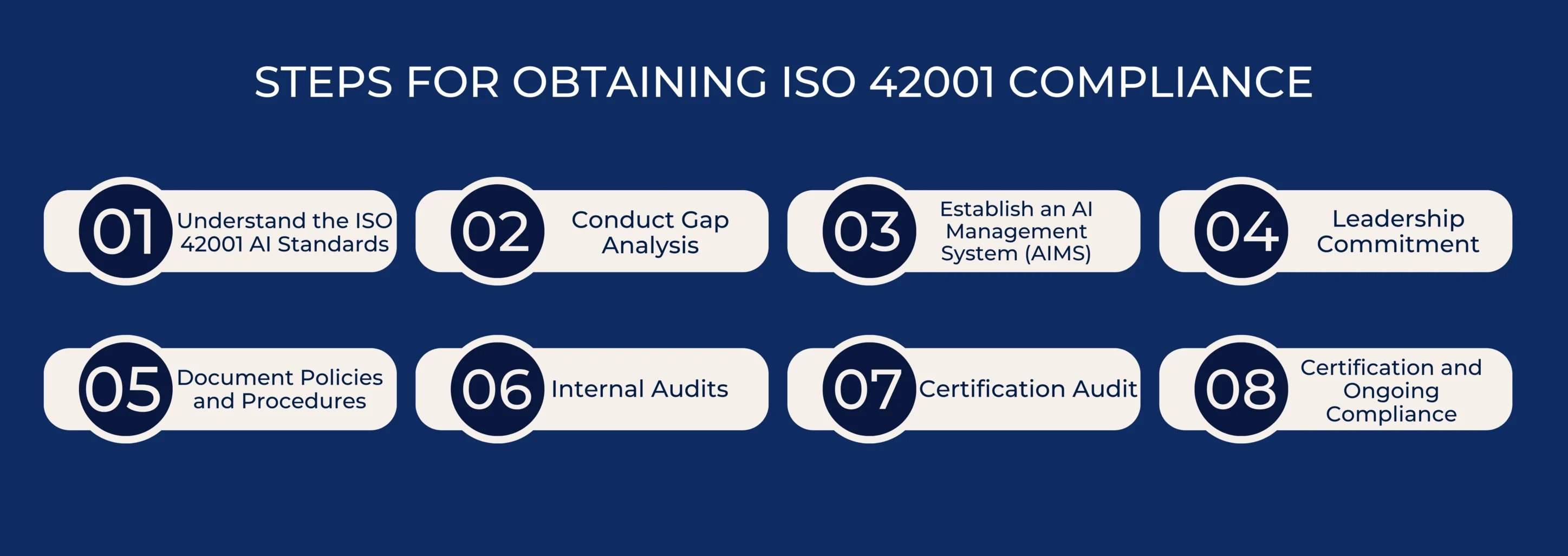
- ✓Stage 1 Audit: Documentation and Readiness Review
- ✓Stage 2 Audit: Evidence Collection and Control Evaluation
- ✓Certification Decision, Certificate Issuance, and Surveillance Cycle
ISO 42001 Requirements Evaluated During Certification Audits
The ISO 42001 certification audit evaluates conformity with the full scope of ISO/IEC 42001:2023 requirements, encompassing both management system clauses and Annex A AI-specific controls. Understanding which requirements are evaluated enables Phoenix-based organizations to structure their AIMS documentation and operational controls in a manner that produces auditable evidence across all applicable clauses. The sections below outline the primary documentation, operational, and governance requirements addressed during a structured ISO 42001 certification audit.
ISO/IEC 42001:2023 requires organizations to maintain documented information sufficient to demonstrate that the AIMS is planned, implemented, and controlled effectively. Core documentation evaluated during the ISO 42001 certification audit includes:
The AI policy (Clause 5.2), AI risk assessment and risk treatment plan (Clauses 6.1 and 8.4), Statement of Applicability documenting applicable Annex A controls (Clause 6.1.4), AI system impact assessment records (Annex A.6), internal audit program and reports (Clause 9.2), and management review records (Clause 9.3). Organizations must also maintain documented AIMS scope (Clause 4.3) and competence requirements for personnel with AIMS-related roles (Clause 7.2).
During each ISO 42001 certification audit in Phoenix, auditors review each of these documented artifacts for completeness, consistency with operational practice, and alignment with the organization’s identified AI context, objectives, and risk profile.
Beyond documentation, the ISO 42001 standard requires organizations to operationalize AI management controls that are verifiable through objective evidence during audit activities. Operational requirements evaluated during the ISO 42001 certification audit include:
AI Impact Assessments (Annex A.6): Executed and documented prior to AI system deployment. AI Risk Treatment Controls: Implemented from Annex A or the organization’s own control framework. Data Governance Controls (Annex A.8): Addressing data quality, provenance, and integrity for AI training and inference. Transparency and Explainability Measures (Annex A.9): Appropriate to the AI system’s context and risk level. Human Oversight Mechanisms (Annex A.10): Allowing authorized personnel to monitor, intervene in, or override AI system decisions.
Technical auditors evaluate these operational controls through evidence such as system logs, process records, configuration documentation, and staff competency records. ISO 42001 compliance across these operational dimensions is a core determinant of certification eligibility for Phoenix organizations.
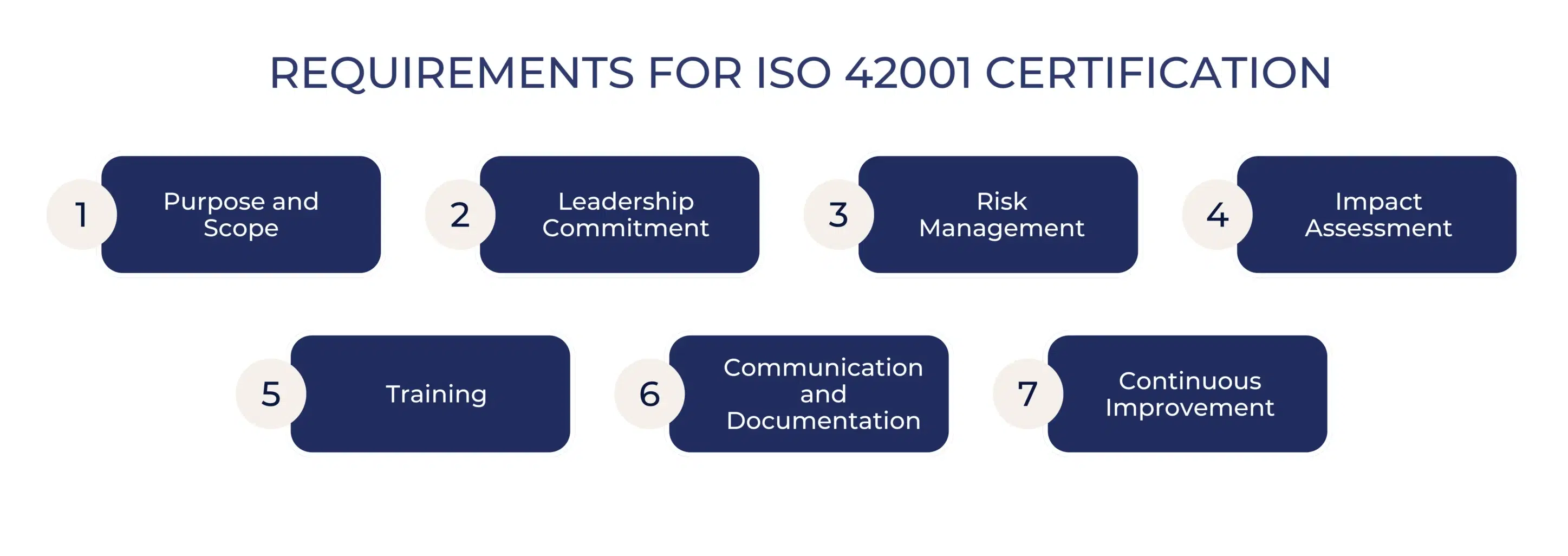
- ✓Documentation Requirements for ISO 42001 Conformity
- ✓Operational and Technical Control Requirements
Phoenix Industries and Organizations That Pursue ISO 42001 Certification
ISO 42001 certification for Phoenix companies spans a broad range of industries in which AI systems are embedded in core operations, customer-facing products, or enterprise infrastructure. Phoenix’s economic structure — anchored by advanced semiconductor manufacturing, aerospace and defense, healthcare and life sciences, financial services, technology, and logistics — creates concentrated demand for structured AI governance verification across multiple high-stakes application domains. The sector profiles below describe the specific AI governance contexts that drive ISO 42001 Certification in Phoenix across the Greater Phoenix area.
Semiconductor, Advanced Manufacturing, and Aerospace Organizations
Phoenix’s semiconductor and advanced manufacturing sector — anchored by TSMC’s Arizona facilities, Intel’s fabrication operations, and a dense supplier ecosystem — increasingly relies on AI systems for process control, quality assurance, predictive maintenance, yield optimization, and supply chain management. Aerospace and defense organizations operating in the Greater Phoenix corridor, including facilities associated with Boeing, Honeywell Aerospace, and allied defense contractors, deploy AI in engineering design, mission-critical systems, and logistics operations.
For these organizations, ISO 42001 certification audit activities evaluate whether AI systems embedded in manufacturing and defense contexts are governed with the documentation, impact assessment, and human oversight controls required by ISO/IEC 42001:2023. Federal procurement requirements and defense contracting standards increasingly recognize AI governance certifications as vendor qualification criteria — making ISO 42001 standard conformity in Phoenix directly relevant to contract eligibility and supply chain positioning.
Healthcare, Life Sciences, Financial Services, and Technology Organizations
Healthcare and life sciences organizations in Phoenix — including Banner Health, Dignity Health, Mayo Clinic’s Arizona operations, and a growing cluster of health-tech companies — deploy AI in clinical decision support, diagnostic imaging, patient monitoring, and administrative operations. These high-stakes applications make AI impact assessment and human oversight controls central to the ISO 42001 certification audit evaluation process.
Phoenix’s financial services and fintech sector, encompassing major banks, insurance companies, payment processors, and emerging fintech platforms, uses AI in credit decisioning, fraud detection, risk modeling, and customer service automation. SaaS providers, cloud service organizations, cybersecurity companies, AI development firms, and technology startups concentrated in the Scottsdale, Tempe, and downtown Phoenix technology corridors pursue ISO 42001 Certification in Phoenix to satisfy enterprise customer vendor due diligence requirements and to differentiate in competitive procurement evaluations where AI governance verification is a stated qualification criterion.
Benefits of ISO 42001 Certification for Phoenix-Based Organizations
ISO 42001 Certification in Phoenix produces independently verified outcomes recognized across enterprise procurement, regulatory review, and international business contexts. The benefits described below reflect the direct, documented consequences of achieving ISO 42001 certification through a structured, independent audit process — not projected outcomes or marketing claims.
- ✓Independently verified demonstration of conformity with ISO/IEC 42001:2023 AI management system requirements
- ✓Structured audit evidence supporting enterprise vendor security reviews and third-party risk management processes
- ✓Recognition in federal procurement evaluations and defense contracting vendor qualification processes relevant to Phoenix aerospace and defense organizations
- ✓Verified AI impact assessment and human oversight controls that satisfy regulated-industry counterparty requirements in healthcare and financial services
- ✓Documented AI governance framework supporting international market access for Phoenix-based SaaS, cloud, and AI companies
- ✓Evidence-based ISO 42001 compliance documentation that supports regulatory engagement with AI governance frameworks in the United States and internationally
- ✓Annual surveillance audit cycle that verifies ongoing AIMS conformity and identifies systemic control weaknesses before they escalate
- ✓ISO 42001 certificate recognized by enterprise procurement teams as an independently assessed AI governance benchmark
A concrete scenario illustrating the procurement value of ISO 42001 Certification in Phoenix involves a semiconductor equipment software vendor supplying AI-based process control systems to a TSMC or Intel fabrication facility. The enterprise customer’s vendor risk management program requires documented evidence of AI governance conformity before authorizing software integration into production systems.
Without an independently issued ISO 42001 certificate, the vendor must respond to lengthy questionnaires, submit to bespoke audits, and provide self-prepared documentation that enterprise security teams must independently evaluate. With ISO 42001 certification, the vendor can present an audit-based certificate referencing a defined scope, a confirmed audit date, and a specific standard version — enabling procurement teams to complete AI governance due diligence efficiently and with confidence. This scenario applies across Phoenix’s technology supply chain, where AI-capable vendors serving semiconductor, aerospace, healthcare, and financial services enterprise customers encounter AI governance verification as a standard procurement requirement.
The ISO 42001 certification audit findings and resulting certificate provide Phoenix-based organizations with structured documentation of AI governance practices that aligns with emerging U.S. federal AI governance frameworks. These include the NIST AI Risk Management Framework (AI RMF), Executive Order 14110 on AI safety and security, and sector-specific AI governance guidance from the FDA, OCC, and other federal regulatory bodies.
While ISO 42001 certification does not constitute regulatory compliance with any specific U.S. statute, the structured AI management system it certifies — covering AI impact assessment, data governance, transparency, and human oversight — directly addresses the governance dimensions that regulators evaluate when assessing AI risk management maturity. For Phoenix organizations subject to HIPAA, financial services AI guidance, or federal contracting requirements, the ISO 42001 standard provides a recognized international framework that supports regulatory engagement and demonstrates proactive, verifiable AI governance investment.
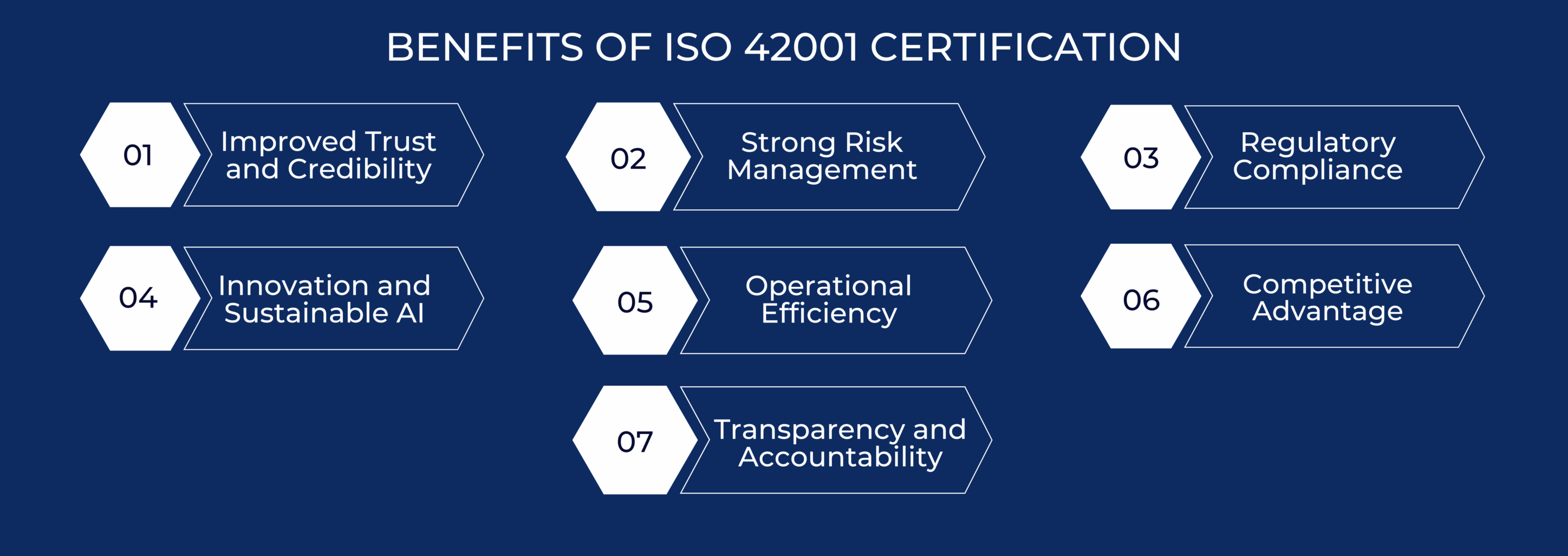
- ✓Enterprise Procurement and Vendor Qualification Value
- ✓Regulatory Alignment and AI Governance Credibility
ISO 42001 Certification Scope, Validity, and Maintenance
ISO 42001 certification scope, certificate validity, and maintenance obligations are defined during the audit program determination phase and confirmed through the certification decision process. Understanding these structural elements enables Phoenix-based organizations to accurately represent their ISO 42001 certification status to customers, regulators, and business partners throughout the certificate lifecycle.
Defining Certification Scope and AIMS Boundaries
The certification scope defines the organizational units, AI systems, processes, and locations covered by the ISO 42001 certification audit. Scope definition is a critical step because the certificate issued by CertPro is valid only for the activities, AI systems, and organizational boundaries confirmed during the audit program determination. Organizations may choose to certify a specific AI system or product line, a defined business unit, a geographic facility, or the entire organization.
Phoenix-based organizations that develop multiple AI products — a common structure among SaaS and AI platform companies in the Scottsdale and Tempe technology corridors — may define scopes covering their AI development lifecycle and deployment infrastructure rather than individual AI models. The auditor verifies during both Stage 1 and Stage 2 that the defined scope is accurate and that all material AI systems and processes within the scope boundary are addressed by the AIMS documentation and controls evaluated during the ISO 42001 certification audit.
Certificate Validity, Surveillance Audits, and Recertification
An ISO 42001 certificate issued following a successful certification audit is valid for three years from the date of the certification decision. Maintaining certificate validity requires the certified organization to undergo annual surveillance audits — typically conducted in years one and two of the certification cycle — during which auditors verify that the AIMS remains operational, Annex A controls continue to function as documented, internal audit and management review activities have been completed, and previously identified nonconformities have been addressed.
Significant AIMS changes — such as deployment of new AI systems, expansion to new organizational units, or material changes to AI governance processes — may require scope updates and additional audit activities. Recertification audits are conducted in the third year and involve a comprehensive re-evaluation of AIMS conformity comparable in scope to the initial ISO 42001 certification audit. Certificate suspension or withdrawal may occur if surveillance audit findings indicate systemic AIMS nonconformity or if the organization fails to complete required surveillance activities within the certification cycle.
How ISO 42001 Differs from Related AI Governance and Security Standards
Phoenix organizations evaluating AI governance certification options frequently encounter multiple standards and frameworks addressing overlapping but distinct aspects of information security, privacy, and AI risk management. Understanding how ISO 42001 differs from ISO 27001, SOC 2, NIST AI RMF, and other frameworks supports accurate scope definition and certification strategy development. The comparisons below address the most common distinctions raised during ISO 42001 audit program determination discussions in Phoenix.
| Standard / Framework | Primary Focus | Certification Type | AI-Specific Coverage |
|---|---|---|---|
| ISO/IEC 42001:2023 | Artificial Intelligence Management System (AIMS) | Third-party certification | Full — AI governance, risk, impact assessment, Annex A controls |
| ISO/IEC 27001:2022 | Information Security Management System (ISMS) | Third-party certification | Limited — information security controls only |
| SOC 2 (AICPA TSC) | Trust Services Criteria for service organizations | CPA attestation report | Minimal — security, availability, and confidentiality focus |
| NIST AI RMF | AI Risk Management Framework | Self-assessment / voluntary | Comprehensive AI risk coverage — no independent certification available |
ISO 42001 vs. ISO 27001 for Phoenix Technology Organizations
ISO 27001 certification addresses information security management system requirements and is widely held by Phoenix-based technology, SaaS, and cloud organizations. ISO 42001 and ISO 27001 share a common management system structure — both follow the ISO High-Level Structure used across ISO management system standards — making integration of the two standards technically feasible for organizations that already maintain an ISO 27001 ISMS.
However, the two standards address distinct risk domains. ISO 27001 governs information security risks (confidentiality, integrity, and availability of information), while the ISO 42001 standard governs AI-specific risks including AI system impact on individuals and society, AI model bias and fairness, data quality for AI, and AI system transparency and explainability. An organization certified to ISO 27001 is not automatically in conformity with ISO 42001. The AI impact assessment requirements, Annex A AI controls, and AI-specific governance requirements of ISO/IEC 42001:2023 require independent evaluation through a separate ISO 42001 certification audit.
ISO 42001 and the NIST AI Risk Management Framework
The NIST AI Risk Management Framework (AI RMF 1.0), published in January 2023, provides a voluntary framework for organizations to govern, map, measure, and manage AI risks. The NIST AI RMF does not involve independent certification — organizations self-assess conformity and voluntarily report their alignment. ISO 42001 certification provides what the NIST AI RMF does not: independent third-party verification of AI management system conformity through a structured, evidence-based ISO 42001 certification audit conducted by a qualified auditor and reviewed by an independent certification committee.
For Phoenix organizations subject to federal procurement requirements referencing NIST frameworks, ISO 42001 certification complements NIST AI RMF alignment by providing externally verified evidence of AI governance maturity that self-assessment alone cannot produce. The two frameworks are complementary rather than duplicative. The ISO 42001 compliance that Phoenix organizations achieve through certification can be mapped against NIST AI RMF functions and categories to support comprehensive federal engagement.
FAQ
▶
What is ISO 42001 certification and why do Phoenix organizations need it?
▶
Which Phoenix organizations are eligible for ISO 42001 certification?
▶
What does the ISO 42001 audit process involve for a Phoenix organization?
▶
What is the difference between Stage 1 and Stage 2 of the ISO 42001 certification audit?
▶
Does CertPro provide consulting or implementation services alongside ISO 42001 certification in Phoenix?
▶
How long is an ISO 42001 certificate valid for Phoenix organizations?
▶
What Annex A controls are evaluated during the ISO 42001 certification audit?
▶
Is ISO 42001 certification the same as ISO 27001 certification for Phoenix AI companies?
ISO 42001 CERTIFIED: WHY AI GOVERNANCE CERTIFICATION IS BECOMING A BOARD-LEVEL REQUIREMENT
ISO 42001 Certified: Board-Level AI Governance Guide | CertPro CPA LLC HERO ══════════════════════════════ –> src=”https://certpro.com/wp-content/uplo…
Get In Touch
have a question? let us get back to you.