
ISO 42001 Certification in Portland
ISO 42001 certification provides Portland-based organizations with independently verified conformity to the internationally recognized requirements of ISO/IEC 42001:2023 for Artificial Intelligence Management Systems. The benefits are substantive and directly relevant to the competitive, regulatory, and governance environments in which Portland technology and AI organizations operate. The following considerations represent independently verifiable outcomes of successful ISO 42001 certification — not marketing claims or projected outcomes.
OUR CLIENTS




ISO 42001 Certification for Portland’s AI and Technology Organizations
ISO 42001 Certification in Portland is conducted by CertPro, a Licensed CPA Firm providing independent, third-party conformity assessment audits. These audits evaluate whether an organization’s Artificial Intelligence Management System (AIMS) meets the requirements of ISO/IEC 42001:2023. Portland’s technology and innovation ecosystem — spanning software development, semiconductor and electronics, healthcare and life sciences, cloud computing, cybersecurity, AI development, advanced manufacturing, clean technology, robotics, and data analytics — creates direct and sustained demand for independent ISO 42001 certification. Organizations across the Portland metropolitan area that develop or deploy AI systems face growing enterprise vendor assurance requirements, regulatory expectations, and third-party risk management frameworks. ISO 42001 certification in Portland serves as a structured, evidence-based demonstration of AI governance conformity recognized across these contexts.
ISO/IEC 42001:2023 is the international standard specifying requirements for establishing, implementing, maintaining, and continually improving an Artificial Intelligence Management System. An AIMS is a structured set of policies, processes, controls, roles, responsibilities, and documented information through which an organization manages the risks and impacts associated with AI systems across their lifecycle. The ISO 42001 standard addresses AI governance, AI risk management, AI impact assessment, human oversight, transparency, explainability, data governance, and the responsible development and deployment of AI systems. For Portland-based organizations, independent ISO 42001 certification provides objective verification — conducted by CertPro as a Licensed CPA Firm and independent certification body — that the organization’s AIMS conforms to the internationally recognized requirements of ISO/IEC 42001:2023.
Portland’s position within the Pacific Northwest technology market intensifies the relevance of ISO 42001 compliance for local organizations. The city hosts a significant concentration of software providers, SaaS companies, AI companies, cloud service providers, semiconductor manufacturers, and healthcare technology organizations. Many of these supply AI-integrated systems to enterprise customers, regulated industries, and government procurement channels. Enterprise vendor due diligence reviews increasingly require suppliers to demonstrate conformity to recognized AI governance standards. ISO 42001 certification in Portland provides organizations with independent, third-party attestation that their AIMS has been evaluated against ISO/IEC 42001:2023 requirements through a structured certification audit conducted by CertPro. This positions certified organizations favorably in competitive procurement environments and supports broader AI governance accountability across Portland’s innovation-driven economy.
The ISO 42001 standard distinguishes clearly between the organization’s responsibility for establishing and operating its AIMS and the role of an independent certification body in evaluating conformity through the certification audit process. CertPro conducts ISO 42001 certification audits in Portland exclusively as an independent third-party certification and conformity assessment body. CertPro does not provide consulting, advisory, implementation, readiness support, policy development, control design, or AI governance consulting services. The ISO 42001 certification audit process evaluates objective evidence submitted by the organization and collected during on-site or remote audit activities, assessing whether the AIMS conforms to the applicable requirements of ISO/IEC 42001:2023. This independence is foundational to the credibility and recognition of ISO 42001 certification in Portland’s enterprise and regulated-industry procurement markets.

What Is ISO 42001 Certification?
ISO 42001 certification is a formal, independent conformity assessment that verifies an organization’s Artificial Intelligence Management System conforms to the requirements of ISO/IEC 42001:2023. The ISO 42001 standard was published by the International Organization for Standardization (ISO) and the International Electrotechnical Commission (IEC). It represents the first internationally recognized management system standard specifically addressing AI governance, risk management, and the responsible development and deployment of AI systems. Certification is issued by an independent certification body — such as CertPro, operating as a Licensed CPA Firm — following a structured audit process. That process evaluates documented evidence, implemented controls, operational practices, and management system performance against the requirements of the standard.
Structure and Scope of the ISO 42001 Standard
ISO/IEC 42001:2023 follows the High-Level Structure (HLS) common to ISO management system standards, covering Clauses 4 through 10: organizational context, leadership, planning, support, operation, performance evaluation, and improvement. This structure allows integration with other ISO management systems, including ISO 27001 for information security and ISO 9001 for quality management. In addition to the core management system clauses, ISO/IEC 42001:2023 includes Annex A, which specifies AI-specific controls organized into domains addressing AI policy, AI risk management, AI impact assessment, data governance, AI system lifecycle management, human oversight, transparency, and supplier relationships. Annex B provides supplementary implementation guidance. The scope of ISO 42001 certification is defined by the organization and must clearly identify the AI systems, organizational units, processes, and geographic locations included within the certified AIMS.
The AI-specific controls in Annex A of ISO/IEC 42001:2023 are particularly relevant to Portland-based organizations developing or deploying AI systems. These controls require organizations to establish documented AI policies, conduct AI risk assessments, perform AI impact assessments, manage data used to train and operate AI systems, maintain transparency in how AI systems function, ensure meaningful human oversight of AI decision-making, manage AI systems across their full lifecycle from design through decommissioning, and address risks associated with third-party AI components and suppliers. The ISO 42001 standard does not prescribe specific technical approaches to AI development. Instead, it establishes a management system framework through which organizations systematically identify, assess, treat, and monitor AI-related risks and impacts.
Who Needs ISO 42001 Certification?
ISO 42001 certification is applicable to any organization that develops, deploys, uses, or provides AI systems — regardless of size, sector, or the specific AI technologies involved. In Portland, this includes software development firms embedding AI capabilities into their products, semiconductor and electronics companies designing AI-accelerated hardware, healthcare and life sciences organizations using AI for diagnostics or patient data analysis, cloud computing providers offering AI-integrated services, financial services firms using AI for risk modeling or fraud detection, advanced manufacturing companies deploying AI-driven automation, cybersecurity companies using AI for threat detection, clean technology organizations using AI for energy optimization, and robotics companies developing AI-controlled systems. Any business using AI in a context where that use creates risks or impacts — to individuals, operations, regulatory standing, or third parties — has relevant grounds to pursue ISO 42001 certification.
ISO 42001 compliance is increasingly referenced in enterprise vendor qualification requirements, supply chain risk management programs, and regulatory guidance frameworks across the United States. Portland-based SaaS providers, AI companies, and cloud service providers supplying AI-integrated products or services to enterprise customers, healthcare organizations, financial institutions, or government agencies frequently encounter requirements to demonstrate conformity to recognized AI governance standards. ISO 42001 certification provides these organizations with independent, third-party verification that their AIMS conforms to ISO/IEC 42001:2023 — a credential recognized in procurement, vendor assurance, and due diligence contexts. Organizations already certified to ISO 27001 or ISO 9001 may find that the High-Level Structure of ISO 42001 supports efficient integration of the AIMS with existing management system infrastructure.
Key Annex A Control Domains in ISO/IEC 42001:2023
| Annex A Control Domain | Focus Area |
|---|---|
| AI Policies | Establishing organizational AI governance policy and objectives |
| AI Risk Management | Identifying, assessing, and treating AI-related risks |
| AI Impact Assessment | Evaluating potential impacts of AI systems on individuals and society |
| Data for AI | Governance of data used in AI system development and operation |
| AI System Lifecycle | Controls across design, development, testing, deployment, and decommissioning |
| Human Oversight | Mechanisms ensuring human review and control of AI outputs |
| Transparency and Explainability | Disclosure and interpretability requirements for AI systems |
| Supplier Relationships | Managing AI-related risks from third-party AI components and vendors |
ISO 42001 Certification Audit Process in Portland
The ISO 42001 certification audit process conducted by CertPro for Portland-based organizations follows a structured, multi-stage methodology aligned with international conformity assessment practices. The process evaluates objective evidence submitted by the organization and collected during audit activities, assessing conformity to the requirements of ISO/IEC 42001:2023. CertPro operates exclusively as an independent certification body and does not provide any form of advisory, consulting, or implementation services in connection with the ISO 42001 certification audit process. The certification decision is made independently by CertPro’s certification committee based on audit findings and documented evidence.
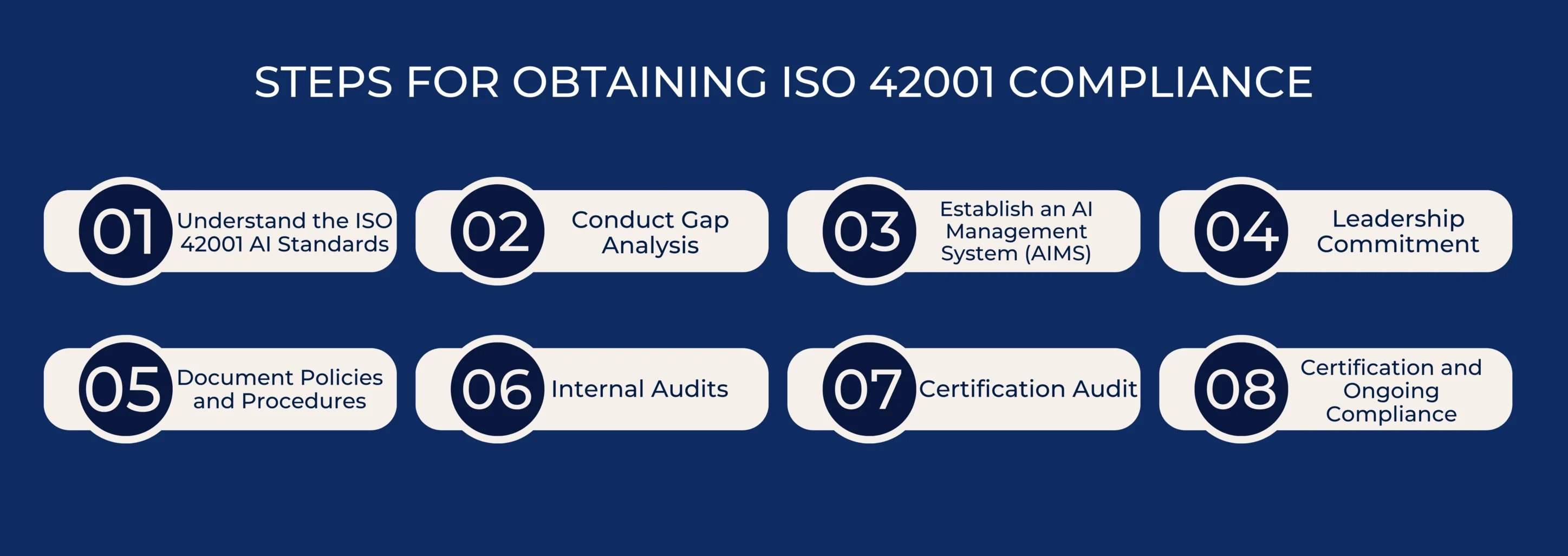
The ISO 42001 certification audit process consists of two primary stages. The Stage 1 audit is a documentation and readiness review in which CertPro’s auditors evaluate the organization’s documented AIMS against the requirements of ISO/IEC 42001:2023. Stage 1 activities include reviewing the AIMS scope definition, AI policy documentation, AI risk assessment records, AI impact assessment documentation, Annex A control selection and justification, and supporting documented information. The Stage 1 audit determines whether the organization’s documented system is sufficiently developed to proceed to Stage 2, and identifies any areas requiring attention before Stage 2 activities commence. Stage 1 findings are communicated to the organization, and the audit program is adjusted as necessary.
The Stage 2 audit is a conformity assessment evaluating whether the organization’s AIMS is effectively implemented and operating in conformity with ISO/IEC 42001:2023. Stage 2 activities include interviewing personnel in relevant roles, reviewing records and operational evidence, evaluating the implementation of Annex A controls, assessing AI risk treatment activities, reviewing AI impact assessment outputs, evaluating internal audit and management review records, and examining corrective action processes. Auditors collect objective evidence across all areas within the defined certification scope. Nonconformities identified during Stage 2 are documented and communicated to the organization through the audit findings report. The organization must address all nonconformities, and CertPro reviews the adequacy of corrective actions before the ISO 42001 certification decision is made.
Following the completion of Stage 2 audit activities and the resolution of identified nonconformities, CertPro’s certification committee conducts an independent review of all audit documentation, findings, and corrective action evidence. The certification committee makes the ISO 42001 certification decision based solely on the audit record and the evidence of conformity to ISO/IEC 42001:2023. If conformity is confirmed, CertPro issues the ISO 42001 certificate specifying the certified scope, the applicable standard, and the certificate validity period. The certificate remains valid for three years, subject to satisfactory completion of surveillance audits conducted during the certification cycle.
Surveillance audits are conducted by CertPro at defined intervals during the three-year certification cycle. These audits verify that the certified AIMS continues to conform to ISO/IEC 42001:2023 requirements and that the organization maintains effective AI governance controls. Surveillance audit activities evaluate changes to the AIMS, new or modified AI systems within the certified scope, internal audit outcomes, management review records, and the status of previously identified nonconformities. Recertification audits are conducted prior to the expiration of the three-year certificate to evaluate continued conformity and determine whether the ISO 42001 certificate may be renewed. Failure to maintain conformity may result in suspension or withdrawal of the certificate.
| Audit Stage | Key Activities | Output |
|---|---|---|
| Application Review | Scope confirmation, audit program determination, auditor assignment | Audit program and schedule |
| Stage 1 Audit | Documentation review, AIMS scope and policy evaluation, readiness assessment | Stage 1 findings report |
| Stage 2 Audit | Evidence collection, control implementation review, personnel interviews, records evaluation | Stage 2 audit report with nonconformities |
| Nonconformity Review | Organization submits corrective actions; CertPro evaluates adequacy of responses | Corrective action acceptance determination |
| Certification Decision | Independent certification committee review of full audit record | ISO 42001 certificate issuance or deferral |
| Surveillance Audit | Ongoing conformity verification at defined intervals within three-year cycle | Surveillance findings and certificate maintenance |
| Recertification Audit | Full conformity assessment prior to certificate expiry | Certificate renewal decision |
- ✓Stage 1 and Stage 2 Certification Audits
- ✓Certification Decision, Certificate Issuance, and Surveillance
ISO 42001 Requirements: What Portland Organizations Must Demonstrate
ISO 42001 compliance requires Portland-based organizations to establish, document, implement, and maintain an Artificial Intelligence Management System that satisfies all applicable requirements of ISO/IEC 42001:2023. The standard’s requirements span management system governance across Clauses 4 through 10 and AI-specific technical and operational controls specified in Annex A. During the ISO 42001 certification audit, CertPro evaluates objective evidence demonstrating that the organization has addressed each applicable requirement within the defined certification scope. The sections below identify the core documentation, operational, and governance requirements that organizations must demonstrate conformity to during the audit process.
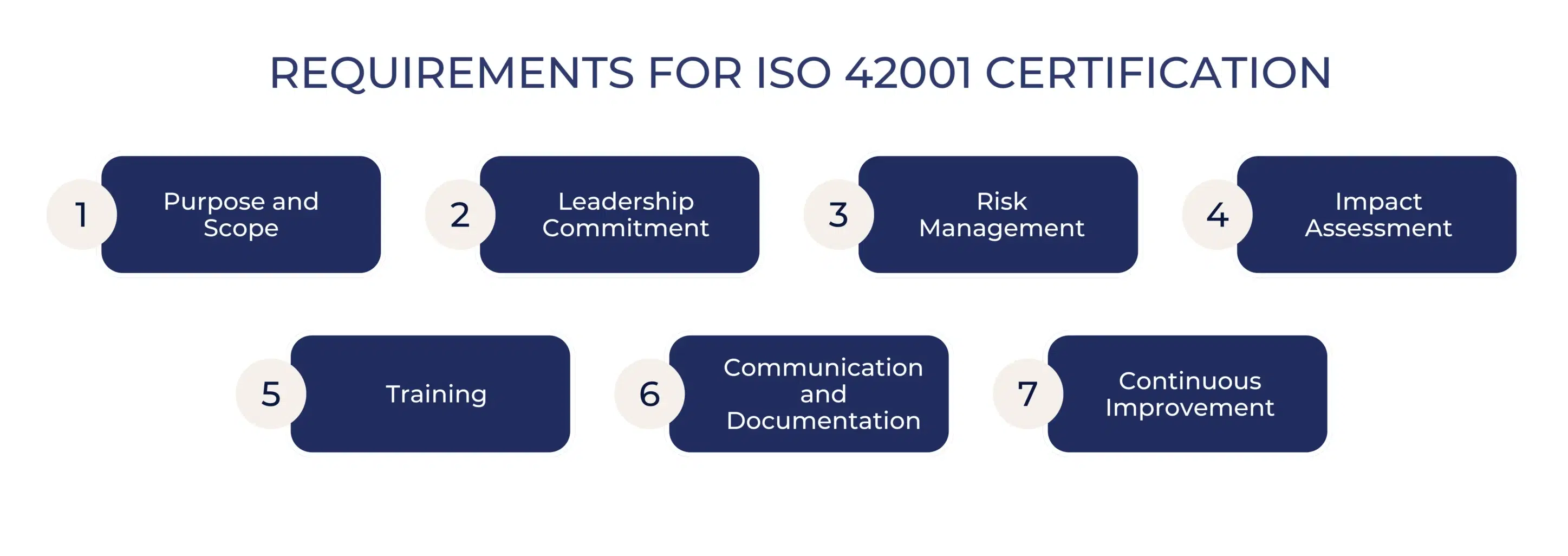
ISO/IEC 42001:2023 requires organizations to maintain a defined set of documented information as evidence of AIMS establishment and operation. Core documentation evaluated during the ISO 42001 certification audit includes the defined AIMS scope, the AI policy approved by top management, AI risk assessment records documenting identified risks and their associated likelihood and impact evaluations, AI risk treatment plans specifying selected controls and treatment decisions, AI impact assessment documentation for AI systems with potential impacts on individuals or society, and a statement of applicability referencing selected and excluded Annex A controls with justifications. Internal audit records and management review records must also be maintained as documented evidence of ongoing system evaluation and improvement. The completeness and currency of this documented information is assessed during both the Stage 1 and Stage 2 audits.
The AI policy required by ISO/IEC 42001:2023 must be authorized by top management, communicate the organization’s commitment to responsible AI development and deployment, establish AI governance objectives, and be communicated to all relevant personnel and stakeholders. The AI risk assessment process must be systematic and repeatable, producing documented outputs that identify AI-specific risks — including risks to individuals affected by AI system outputs, operational risks associated with AI system failures, and risks to third parties in the AI supply chain. AI impact assessments are required for AI systems identified as having potential adverse impacts on individuals, groups, or societal systems, and must be completed prior to deployment. These documented requirements form the evidentiary foundation evaluated during the ISO 42001 certification audit.
Beyond documentation, ISO 42001 compliance requires evidence that the organization’s AIMS is operationally implemented and that AI governance controls are functioning effectively. This includes demonstrated implementation of AI risk treatment controls aligned with risk assessment outputs, evidence of human oversight mechanisms for AI systems within the certified scope, operational data governance practices addressing the quality and provenance of data used in AI system training and operation, AI system lifecycle controls spanning design, development, validation, testing, deployment, monitoring, and decommissioning, and supplier management controls addressing AI-related risks from third-party components, pre-trained models, and AI platform vendors. During the Stage 2 ISO 42001 audit, CertPro auditors collect evidence of operational implementation through personnel interviews, observation, and review of operational records.
Top management engagement is a specific requirement of ISO/IEC 42001:2023, evaluated during the ISO 42001 certification audit through evidence of leadership commitment to the AIMS. Requirements include top management approval of the AI policy, allocation of resources necessary for AIMS implementation and maintenance, assignment of roles and responsibilities for AI governance, communication of AI governance expectations across the organization, and participation in management review activities. Internal audit is also mandatory: the organization must conduct and document internal audits of the AIMS at planned intervals, with findings reported to top management and addressed through documented corrective actions. Management reviews must evaluate AIMS performance, audit findings, AI risk status, and the continued suitability of the AIMS for the organization’s AI activities.
ISO/IEC 42001:2023 requires organizations to manage AI systems across their complete lifecycle — from initial concept and design through development, testing, deployment, operation, monitoring, and eventual decommissioning. Lifecycle controls must address how AI governance requirements are integrated into each phase, how changes to AI systems are assessed for associated risks and impacts, and how AI system performance is monitored against defined objectives after deployment. For Portland-based organizations developing AI products — including software firms, semiconductor companies with AI-integrated hardware, and healthcare technology providers — lifecycle requirements have direct application to product development processes. These controls must be integrated into development workflows rather than treated as a separate management system activity.
AI impact assessment is a specific operational requirement evaluated during the ISO 42001 certification audit for AI systems with potential consequences for individuals, groups, or societal systems. The impact assessment process must identify affected stakeholders, assess the nature and severity of potential impacts, document risk treatment decisions, and establish monitoring mechanisms to detect actual impacts during operation. For Portland healthcare organizations using AI for clinical decision support, financial services firms using AI for credit or fraud assessment, and cloud providers offering AI-as-a-service to downstream users, impact assessment requirements apply directly to both the development and ongoing operation of AI systems. The ISO 42001 audit evaluates whether impact assessments have been conducted for applicable systems and whether the outputs inform the organization’s risk treatment and monitoring activities.
- ✓Management System Documentation Requirements
- ✓Operational and Governance Requirements
- ✓AI System Lifecycle and Impact Assessment Requirements
Portland’s Technology Ecosystem and ISO 42001 Certification Demand
Portland’s technology and innovation ecosystem generates direct and sustained demand for ISO 42001 certification across multiple industry sectors. The Portland metropolitan area hosts a diverse concentration of technology organizations — from established semiconductor manufacturers and electronics firms to emerging AI companies, SaaS providers, healthcare technology organizations, and clean technology innovators — many of which develop, integrate, or deploy AI systems as a core component of their products or services. ISO 42001 certification in Portland is increasingly relevant as enterprise customers, regulated-industry clients, and procurement teams across the Pacific Northwest require independent verification of AI governance conformity from their technology suppliers.
Technology and Software Development Sector
Portland’s software development and technology sector includes a significant number of SaaS providers, platform companies, and independent software vendors that embed AI and machine learning capabilities into their products. These organizations supply AI-integrated software to enterprise customers across industries including financial services, healthcare, manufacturing, logistics, and public sector organizations. Enterprise procurement teams conducting vendor assurance reviews for AI-integrated software suppliers increasingly reference ISO 42001 compliance as a qualification criterion. ISO 42001 certification in Portland provides software and SaaS companies with independent, third-party verification that their AIMS conforms to ISO/IEC 42001:2023 — a credential directly applicable to enterprise and regulated-industry procurement contexts within the Pacific Northwest technology market.
Portland’s AI and machine learning companies — including organizations developing natural language processing systems, computer vision applications, predictive analytics platforms, and AI-powered automation tools — are among the most directly relevant candidates for ISO 42001 certification. These organizations develop AI systems deployed in contexts with material impacts on end users, customers, and operational outcomes. The ISO 42001 certification audit evaluates whether the AI systems and associated management practices within the certified scope conform to the AI governance, risk management, and impact assessment requirements of ISO/IEC 42001:2023. For Portland AI companies pursuing contracts with enterprise or regulated-industry customers, ISO 42001 certification provides a recognized and independently verified demonstration of AI governance maturity.
Semiconductor, Healthcare, and Advanced Manufacturing Sectors
Portland’s semiconductor and electronics industry — including established manufacturers and a growing ecosystem of chip design firms — is increasingly integrating AI capabilities into hardware products and embedded systems. Semiconductor companies designing AI accelerators, edge AI chips, and AI-integrated embedded systems operate within supply chains where AI governance verification is becoming relevant to both upstream component qualification and downstream product certification. ISO 42001 certification for Portland semiconductor and electronics organizations provides independent verification that AI-related governance practices for the development and qualification of AI-integrated hardware conform to the requirements of ISO/IEC 42001:2023.
Healthcare and life sciences organizations in Portland using AI for diagnostics, clinical decision support, drug discovery, patient monitoring, or medical device functionality face AI governance requirements that align directly with the ISO 42001 standard. AI systems in clinical contexts carry material risks to patient safety and data privacy, making systematic AI risk management, impact assessment, and human oversight essential governance requirements. Advanced manufacturing organizations in the Portland area deploying AI for quality control, predictive maintenance, process optimization, or robotics face analogous AI governance requirements within their operational technology environments. ISO 42001 certification provides both sectors with a recognized management system framework, independently evaluated through the structured certification audit process.
Industry Sectors Pursuing ISO 42001 Certification in Portland
| Industry Sector | AI Use Cases Driving ISO 42001 Certification Demand |
|---|---|
| Software and SaaS | AI-integrated products supplied to enterprise and regulated-industry customers |
| Semiconductor and Electronics | AI-accelerated hardware, embedded AI systems, edge AI chip design |
| Healthcare and Life Sciences | Clinical decision support, diagnostics, patient monitoring, medical AI |
| Cloud Computing | AI-as-a-service platforms, AI inference infrastructure, managed AI services |
| Financial Services | AI-driven risk modeling, fraud detection, credit assessment, algorithmic trading |
| Advanced Manufacturing | Predictive maintenance, AI quality control, robotics, process automation |
| Cybersecurity | AI-powered threat detection, anomaly detection, security automation |
| Clean Technology | AI-driven energy optimization, grid management, environmental monitoring |
Benefits of ISO 42001 Certification for Portland-Based Organizations
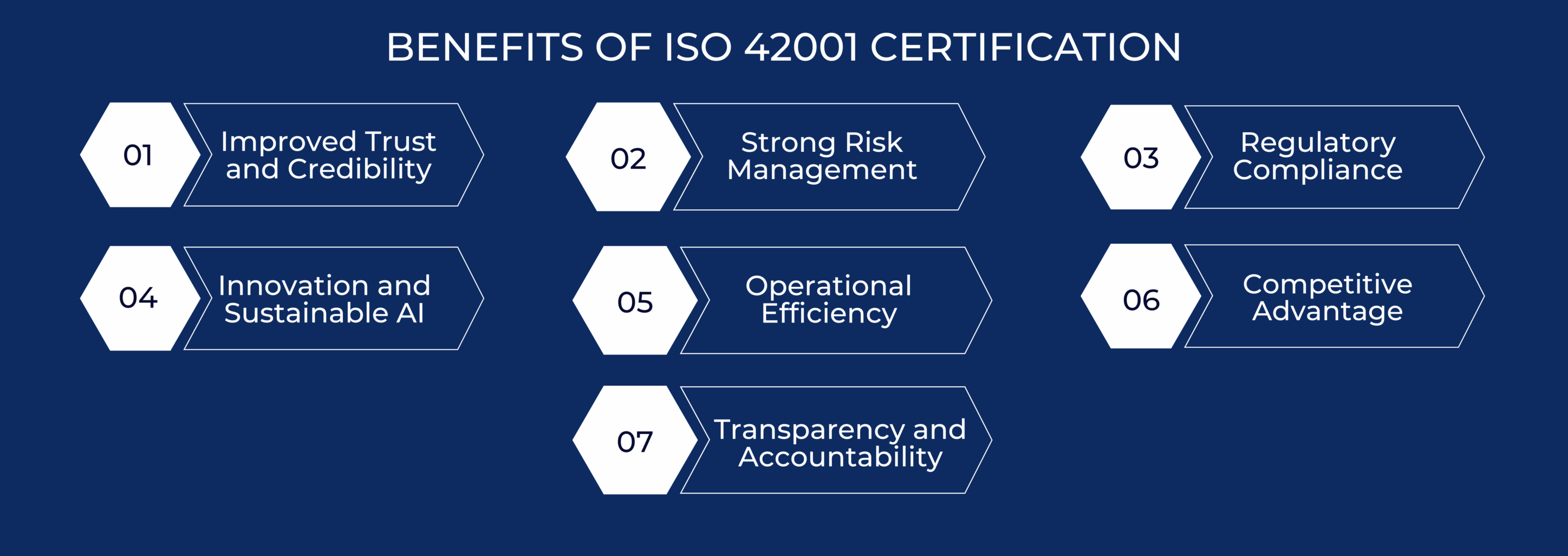
ISO 42001 certification provides Portland-based organizations with independently verified conformity to the internationally recognized requirements of ISO/IEC 42001:2023 for Artificial Intelligence Management Systems. The benefits are substantive and directly relevant to the competitive, regulatory, and governance environments in which Portland technology and AI organizations operate. The following considerations represent independently verifiable outcomes of successful ISO 42001 certification — not marketing claims or projected outcomes.
ISO 42001 certification is recognized in enterprise vendor qualification processes as independent evidence that the certified organization’s AIMS conforms to ISO/IEC 42001:2023. Portland-based technology vendors and SaaS providers supplying AI-integrated products or services to enterprise customers frequently encounter vendor assurance review requirements that assess AI governance practices. ISO 42001 certification provides these organizations with a credential that procurement teams can verify independently. This reduces the scope of individual vendor AI governance questionnaires and supports faster qualification in competitive procurement cycles. For Portland organizations bidding for contracts with regulated-industry customers — including healthcare systems, financial institutions, and government agencies — ISO 42001 certification provides relevant assurance evidence aligned with recognized AI governance expectations.
A representative procurement scenario in Portland’s technology market involves a SaaS provider supplying AI-powered analytics software to a regional health system. The health system’s vendor assessment process requires the SaaS provider to demonstrate conformity to recognized AI governance standards. ISO 42001 certification in Portland — issued by CertPro as a Licensed CPA Firm following a structured ISO 42001 certification audit — provides the health system’s procurement team with independent, third-party attestation of the SaaS provider’s AIMS conformity to ISO/IEC 42001:2023. This certification-based evidence directly supports vendor qualification without requiring the health system to conduct its own AI governance assessment of the supplier’s internal systems and practices.
ISO 42001 certification demonstrates that an organization has established and is maintaining a structured AI governance framework evaluated against the requirements of an internationally recognized standard. For Portland organizations operating in regulated sectors — healthcare, financial services, cloud computing, and cybersecurity — where U.S. regulatory frameworks increasingly address AI governance expectations, ISO 42001 certification provides a structured, evidence-based mechanism for demonstrating responsible AI practices. Federal AI governance frameworks, sector-specific AI guidance from U.S. regulatory agencies, and state-level data protection and AI accountability requirements relevant to Oregon-based organizations all create contexts in which ISO 42001 certification provides meaningful alignment with formal AI governance expectations.
ISO 42001 compliance, as demonstrated through independent certification, provides Portland organizations with a systematic basis for AI risk management and impact assessment that is both structured and documented. Organizations maintaining a certified AIMS are required to conduct AI risk assessments, complete AI impact assessments for applicable systems, implement risk treatment controls, maintain human oversight mechanisms, and monitor AI system performance — all documented activities that generate an ongoing evidence trail supporting accountability for AI governance decisions. This documented AI governance record is relevant to internal audit and enterprise risk management programs, board-level AI governance oversight, and third-party risk management reviews conducted by customers and business partners.
- ✓Independent, third-party verification of AIMS conformity to ISO/IEC 42001:2023 by a Licensed CPA Firm
- ✓Recognition in enterprise vendor qualification and procurement processes for AI-integrated products and services
- ✓Structured AI risk management framework evaluated through evidence-based ISO 42001 certification audit methodology
- ✓AI impact assessment documentation supporting accountability for AI systems affecting individuals or society
- ✓Ongoing surveillance audit cycle maintaining verified conformity throughout the three-year certificate validity period
- ✓Alignment with U.S. AI governance expectations and regulatory frameworks relevant to Portland-based organizations
- ✓Independent validation of human oversight mechanisms for AI systems within the certified scope
- ✓Differentiation in the Pacific Northwest technology market through internationally recognized AI governance certification
- ✓Enterprise Procurement Recognition and Vendor Qualification
- ✓AI Governance Accountability and Regulatory Alignment
- ✓Structured AI Risk Management and Ongoing Surveillance
ISO 42001 Certification Audit: Evidence Evaluation and Nonconformity Review
The ISO 42001 certification audit conducted by CertPro evaluates objective evidence to determine whether the organization’s AIMS conforms to the requirements of ISO/IEC 42001:2023. Evidence evaluation is the central methodology of the certification audit: auditors collect, review, and assess documentation, records, operational outputs, and personnel testimony to form audit conclusions grounded in verifiable facts rather than representations. The ISO 42001 certification audit is not an advisory engagement or a conformity preparation activity — it is a formal, independent conformity assessment conducted by CertPro as a Licensed CPA Firm and independent certification body.
Objective Evidence Collection and Audit Methodology
During the ISO 42001 certification audit, CertPro auditors collect objective evidence through document review, records inspection, personnel interviews, and — where applicable — observation of operational processes involving AI systems within the certified scope. Document review covers all required AIMS documentation, including the AI policy, risk assessment records, impact assessment documentation, statement of applicability, internal audit records, and management review minutes. Records inspection evaluates operational evidence including data governance records, AI system testing and validation records, corrective action documentation, supplier assessment records, and training records for personnel with AI governance responsibilities. Personnel interviews assess whether documented processes are understood and implemented by those responsible for AI governance activities.
The ISO 42001 audit methodology follows a risk-based sampling approach. Auditors determine the depth and breadth of evidence collection based on the complexity of the organization’s AI activities, the scope of the certified AIMS, and the risk significance of individual AI systems within the scope. For Portland organizations with large or complex AI portfolios — such as cloud providers offering multiple AI services, healthcare organizations operating multiple AI-integrated clinical systems, or manufacturing organizations with AI-driven automation across multiple facilities — the audit program is structured to provide reasonable coverage of the defined scope within available audit time. Audit sampling does not guarantee that all instances of nonconformity will be identified; the certification decision is based on the evidence collected during the structured audit process.
Nonconformity Classification and Corrective Action Requirements
Nonconformities identified during the ISO 42001 certification audit are documented and communicated to the organization through the formal audit findings report. The organization is required to submit a corrective action response addressing each identified nonconformity, including root cause analysis and documented evidence of corrective action implementation. CertPro evaluates the adequacy of corrective action responses before the certification committee makes the certification decision. That decision is deferred until all nonconformities are satisfactorily addressed and CertPro confirms that submitted evidence demonstrates effective resolution. Observations identified during the ISO 42001 audit — which are not nonconformities but indicate areas for potential improvement — are included in the audit report for the organization’s reference.
Following the issuance of the ISO 42001 certificate, CertPro conducts surveillance audits during the three-year certification cycle to verify that the organization’s AIMS continues to conform to ISO/IEC 42001:2023 and that previously identified nonconformities have not recurred. Surveillance audits may cover any area within the certified AIMS scope and evaluate whether the organization has maintained its AI governance controls, updated AI risk assessments and impact assessments in response to changes in AI system scope or functionality, completed internal audits, and conducted management reviews. Findings from surveillance audits are subject to the same nonconformity and corrective action process applicable to initial certification audits. Certificate suspension or withdrawal may result from failure to address surveillance audit findings within required timeframes.
ISO 42001 Certification vs. Related Standards for Portland Organizations
Portland organizations evaluating ISO 42001 certification frequently consider how it relates to other ISO management system standards relevant to their operations — including ISO 27001 for information security management, ISO 9001 for quality management, and ISO 31000 for risk management. Understanding the distinctions between these standards is important for defining the appropriate scope of ISO 42001 certification and for determining how existing management system infrastructure can be integrated with a new AIMS. Each standard addresses a distinct governance domain, and ISO 42001 certification does not substitute for or replace certification to other management system standards.
ISO 42001 and ISO 27001: Complementary Certification Frameworks
ISO 42001 and ISO 27001 share the High-Level Structure common to ISO management system standards, which supports integration of the AIMS with an existing Information Security Management System (ISMS). However, the two standards address distinct governance domains. ISO 27001 governs the security of information assets — confidentiality, integrity, and availability — across the organization’s information systems. ISO 42001 governs the responsible development and deployment of AI systems, addressing AI-specific risks, impacts, governance, transparency, and human oversight that are not covered by ISO 27001 Annex A controls. For Portland-based organizations already certified to ISO 27001, ISO 42001 certification extends governance to cover AI-specific risks and management system requirements — including AI impact assessment, AI lifecycle management, and AI-specific supplier controls — that go beyond information security.
Portland cloud computing providers, cybersecurity firms, and SaaS companies that hold ISO 27001 certification may find that the shared High-Level Structure of ISO 42001 enables efficient integration of AIMS documentation, internal audit, management review, and corrective action processes with existing ISMS infrastructure. The certification audit processes for ISO 27001 and ISO 42001 are conducted independently, each addressing their respective standard requirements. Portland organizations pursuing both certifications benefit from a coherent management system architecture that addresses both information security and AI governance within a shared operational framework, while each certification remains independently assessed and issued by the certification body.
ISO 42001 Standard Compared to AI Governance Frameworks
The ISO 42001 standard differs from AI governance frameworks such as the NIST AI Risk Management Framework (AI RMF) in a critical respect: ISO/IEC 42001:2023 is a certifiable management system standard with defined requirements against which organizations can be independently audited and certified. The NIST AI RMF is a voluntary guidance framework designed to support AI risk management practices, but it does not provide a certification mechanism or an independent conformity assessment process. For Portland organizations in regulated industries or competitive enterprise markets where independent certification is required — rather than voluntary self-assessment against guidance frameworks — ISO 42001 certification provides the formal, third-party credential that NIST AI RMF alignment alone cannot deliver. ISO 42001 certification is also recognized internationally, supporting Portland organizations that operate in global markets or supply AI systems to international enterprise customers.
Maintaining ISO 42001 Certification: Surveillance and Recertification
ISO 42001 certification is valid for a three-year period from the date of issuance, subject to the completion of scheduled surveillance audits and ongoing conformity with ISO/IEC 42001:2023 requirements. Maintaining the ISO 42001 certificate requires Portland-based organizations to sustain the operational effectiveness of their AIMS, conduct periodic internal audits, complete management reviews at defined intervals, address identified nonconformities through documented corrective actions, and participate in surveillance audits conducted by CertPro. Organizations that fail to meet these ongoing obligations risk suspension or withdrawal of their ISO 42001 certificate.
Surveillance Audit Scope and Frequency
CertPro conducts surveillance audits for ISO 42001 certified organizations in Portland at defined intervals within the three-year certification cycle. Surveillance audits evaluate whether the certified AIMS continues to conform to ISO/IEC 42001:2023 and whether the organization is maintaining its AI governance controls effectively. Surveillance audit scope is determined by CertPro based on changes to the organization’s AI activities, findings from previous audits, and the risk significance of AI systems within the certified scope. Changes to the organization’s AI portfolio — such as the addition of new AI systems, significant modifications to existing AI systems, or changes to organizational context affecting the AIMS — may trigger additional surveillance activities outside the standard audit cycle.
Recertification audits are conducted by CertPro prior to the expiration of the three-year ISO 42001 certificate to evaluate whether the organization’s AIMS continues to conform to ISO/IEC 42001:2023 requirements and whether the certificate may be renewed for a further three-year period. The recertification audit evaluates the full scope of the certified AIMS and includes review of internal audit and management review records from the preceding certification cycle, assessment of changes to the AIMS since initial certification, and evaluation of the organization’s ongoing AI risk management and impact assessment activities. Successful completion of the recertification audit and resolution of any identified nonconformities results in issuance of a renewed ISO 42001 certificate for the subsequent three-year period.
Certificate Suspension and Withdrawal Conditions
CertPro may suspend or withdraw an organization’s ISO 42001 certificate under specific conditions affecting the validity of the certification. Suspension may result from the organization’s failure to submit required corrective action evidence within defined timeframes following surveillance audit findings, failure to participate in scheduled surveillance audits, or identification of significant AIMS nonconformities that raise doubt about the ongoing validity of the certification. Certificate withdrawal may follow sustained suspension where the organization fails to restore conformity within the suspension period. Suspension and withdrawal decisions are made by CertPro’s certification committee based on documented evidence of AIMS conformity status and the organization’s response to identified nonconformities. Organizations with suspended or withdrawn certificates are required to disclose the status of their ISO 42001 certification to stakeholders and customers relying on the certification as evidence of AI governance conformity.
FAQ
▶
What is ISO 42001 certification and how does it apply to Portland organizations?
▶
Who conducts ISO 42001 certification audits in Portland?
▶
What is an Artificial Intelligence Management System (AIMS)?
▶
How does the ISO 42001 audit process work for Portland organizations?
▶
What documentation is required for the ISO 42001 certification audit?
▶
How long is ISO 42001 certification valid in Portland?
▶
Does ISO 42001 certification replace ISO 27001 certification for Portland technology organizations?
▶
Which Portland industries have the highest demand for ISO 42001 certification?
ISO 42001 CERTIFIED: WHY AI GOVERNANCE CERTIFICATION IS BECOMING A BOARD-LEVEL REQUIREMENT
ISO 42001 Certified: Board-Level AI Governance Guide | CertPro CPA LLC HERO ══════════════════════════════ –> src=”https://certpro.com/wp-content/uplo…
Get In Touch
have a question? let us get back to you.